
Edmonton is where I became a foodie.
Not the person who photographs a croissant from six angles before taking a bite. I mean the more primitive version: someone who suddenly realized the world contained far more interesting things to eat than he had encountered growing up.
In the early 2000s, I moved from Gold River—a tiny village on Vancouver Island—to study at the University of Alberta. Everyone calls it the U of A. My first university class had more students than my entire high school.
Edmonton was exciting, overwhelming and rough around the edges. It was also the first genuinely multicultural city I had lived in.
I tried sushi, Thai, Indian and Korean food for the first time. I jogged to Chinatown with ginger beef waiting at the end like a highly calorific fitness reward. I shopped at T&T Supermarket in West Edmonton Mall for Chinese food and ingredients I had never seen back home. I walked, ran or took transit across the city because food was a mission.
My tastebuds received a better education than my brain.
Edmonton became a second hometown. It was not where I grew up as a child or teenager, but it was where I matured as a young adult. When Audrey and I returned nearly twenty years later, I had travelled to roughly 75 countries and eaten my way through a fair portion of them.
The city had changed. So had I.
Downtown was more developed. The restaurant scene had grown deeper and more polished. Some areas felt almost unrecognizable, yet Edmonton still had the slightly scruffy, unpretentious personality I remembered.
Best of all, a few old favourites had survived.
This guide combines the seven restaurants Audrey and I personally ate at with the Edmonton foods, neighbourhood institutions and newer dining rooms I would prioritize now.
I am not going to rank a donair shop, a brunch restaurant, an Indigenous sharing-plate dining room and a sports bar from first to twenty-fifth as though they are competing in the same event. That creates a tidy list and a useless decision.
The better questions are:
What should you eat in Edmonton? Where should you eat it? And which restaurants make sense for the trip you are actually taking?
If the accommodation is not fixed yet, it is worth comparing Edmonton hotels before choosing your restaurant shortlist. A convenient base will save more time than trying to compensate for poor geography with increasingly optimistic meal plans.
How to Choose Where to Eat in Edmonton
Edmonton is spread out enough that restaurant geography matters.
You can eat extremely well downtown, particularly around Jasper Avenue and the ICE District. Whyte Avenue and Old Strathcona remain my favourite areas for combining food with independent shops, theatres, festivals and street life. The 124 Street and Wîhkwêntôwin side of the city has developed into another serious dining zone.
A complete Edmonton food trip still refuses to fit into one neat neighbourhood.
Green onion cakes, Ukrainian food, north-side donair institutions and several international specialists may require a deliberate drive or transit journey. That was true when I was a student, when crossing the city for one meal seemed perfectly reasonable. It remains true now.
Before choosing restaurants, ask yourself five questions:
- Do you want something with a genuine Edmonton connection?
- Are you looking for brunch, a quick lunch, a neighbourhood dinner or a special occasion?
- Where will you already be that day?
- Are you willing to cross the city for one meal?
- How many serious restaurant opportunities do you actually have?
The last question matters most.
A visitor with two days in Edmonton may have four or five proper meals. Handing that person 60 restaurant names without priorities is not helpful. It is surrender.
For a first visit, I would try to include three different sides of Edmonton food:
- one locally connected item, such as green onion cakes or donair;
- one long-running neighbourhood institution;
- and one restaurant showing where the city’s dining scene is now.
That could mean green onion cakes, DaDeO and a dinner built around Alberta ingredients. It could also mean donair, an independent brunch and Indigenous sharing plates.
The contrast is more important than chasing somebody else’s numerical ranking.
Edmonton Restaurant Chooser
| Restaurant | Best reason to choose it | Area | Best for | Main catch |
|---|---|---|---|---|
| DaDeO | Cajun-Creole food in a long-running Whyte Avenue institution | Old Strathcona | Casual dinner | Limited weekly opening pattern |
| Bistro Praha | Goulash, schnitzel and old-world atmosphere | Downtown | Substantial dinner | Better for an unhurried meal |
| OEB Breakfast Co. | Elaborate brunch with several Edmonton locations | Multiple areas | Big breakfast | A multi-city brand rather than a uniquely Edmonton restaurant |
| Top Donair | Personally tested central donair option | Jasper Avenue | Quick, filling meal | Not a complete citywide donair comparison |
| The Taco Shop | A proper sit-down meal during a West Edmonton Mall day | West Edmonton Mall | Mall lunch or dinner | Best when you are already at the mall |
| The Canadian Icehouse | Sports-bar convenience beside Rogers Place | ICE District | Game or concert | Occasion matters more than culinary ambition |
| Green Onion Cake Man | The food with Edmonton’s clearest festival connection | North-central Edmonton | Casual local-food stop | Requires a deliberate trip for many visitors |
| RGE RD | Contemporary cooking connected to Alberta producers | Wîhkwêntôwin area | Food-first dinner | A reservation-led splurge |
| Bernadette’s | Indigenous sharing plates in a tiny dining room | Downtown | Distinctive special dinner | Very limited seating |
| Sabor | Seafood and Iberian dining downtown | Downtown | Celebration or group dinner | A fuller commitment than a quick pre-event meal |
| Rosewood Foods | Independent downtown breakfast and lunch | Downtown | Brunch or lunch | Daytime only |
| Pip | Brunch or dinner tied naturally to Whyte Avenue | Old Strathcona | Brunch or neighbourhood dinner | Weekend brunch is walk-in |
| Tokiwa Ramen | Focused ramen lunch | 104 Avenue | Specialist lunch | Short service window and can sell out |
| Padmanadi | Long-running vegan Indonesian food | Downtown | Plant-based lunch or dinner | Opening windows vary |
| Duchess Bake Shop | One of Edmonton’s strongest pastry stops | 124 Street or Ritchie | Coffee, pastry or dessert | Not a substitute for a full meal |
Edmonton Made Me a Food Traveller
Edmonton does not have one dominant food identity in the way some cities are immediately linked to a single dish.
Its strength is accumulation.
There are neighbourhood restaurants that have survived several decades of changing tastes. Ukrainian and Eastern European food reflects the region’s cultural history. Chinese, Vietnamese, Filipino, Korean, Japanese, South Asian, Middle Eastern, African and Latin American restaurants are spread across the city. Chefs work with Alberta meat, grains and seasonal produce. Bakeries, brunch restaurants and late-night places all have their own following.
This did not suddenly appear after I left. Edmonton already had a thriving international food scene in the early 2000s.
For somebody arriving from a village of fewer than two thousand people, the city felt like a culinary atlas. I could try a cuisine I had never eaten, get on a bus the following week and find another.
The restaurants were not always polished. Neither was I.
Food became one of the ways I learned Edmonton. Chinatown meant ginger beef after a jog. West Edmonton Mall meant T&T groceries, early sushi experiments and more restaurant choices than I knew how to process. Whyte Avenue meant food before nightlife, after shopping or whenever I could justify another visit to DaDeO.
Returning with Audrey was different because Edmonton was no longer introducing us to the wider food world. We had eaten ceviche in Peru, schnitzel in Austria, goulash in Central Europe and countless variations of noodles, curries, dumplings and grilled meat across Asia and beyond.
That did not make Edmonton less interesting. It made the return more revealing.
I could understand the dishes differently, compare them against meals eaten elsewhere and recognize how far the city’s restaurant scene had developed.
Audrey also noticed something quickly: you should not judge Edmonton solely from downtown.
Downtown has considerably more interesting dining than it did during my student years, and you can eat well there without travelling far. But Whyte Avenue changed Audrey’s perception of the city because it revealed another Edmonton—more independent, lived-in and culturally expressive.
The same applies to its restaurants.
Edmonton rewards people who move around.
What to Eat in Edmonton
Green Onion Cakes: Edmonton’s Clearest Local Food Story
If you want to begin with the food most closely connected to Edmonton itself, start with a green onion cake.
Green onion cakes were not invented in Edmonton. Their history stretches much farther back. What Edmonton can claim is a particularly strong local relationship with them.
Siu To immigrated to Edmonton in the late 1970s, opened a restaurant and later began selling green onion cakes at city festivals. The savoury, pan-fried cakes became so familiar at local events that generations of Edmontonians started treating them as part of the city’s food culture.
That distinction matters.
Calling every dish served in a city “local food” is lazy. Green onion cakes have a real Edmonton story involving immigration, festivals and decades of public appetite.
Green Onion Cake Man is the obvious place to pursue that connection today. The restaurant is north of the main downtown visitor zone, so this is not necessarily something you stumble across while moving between attractions. It is a stop you plan because you want to understand a specific part of Edmonton.
I somehow missed green onion cakes during our return trip, which now feels ridiculous. After travelling around the world and coming back to the city where my palate first expanded, I skipped the food with perhaps the clearest Edmonton identity.
That omission has already written part of my next itinerary.
Edmonton Donair
Donair means more in Edmonton than an outsider might initially expect.
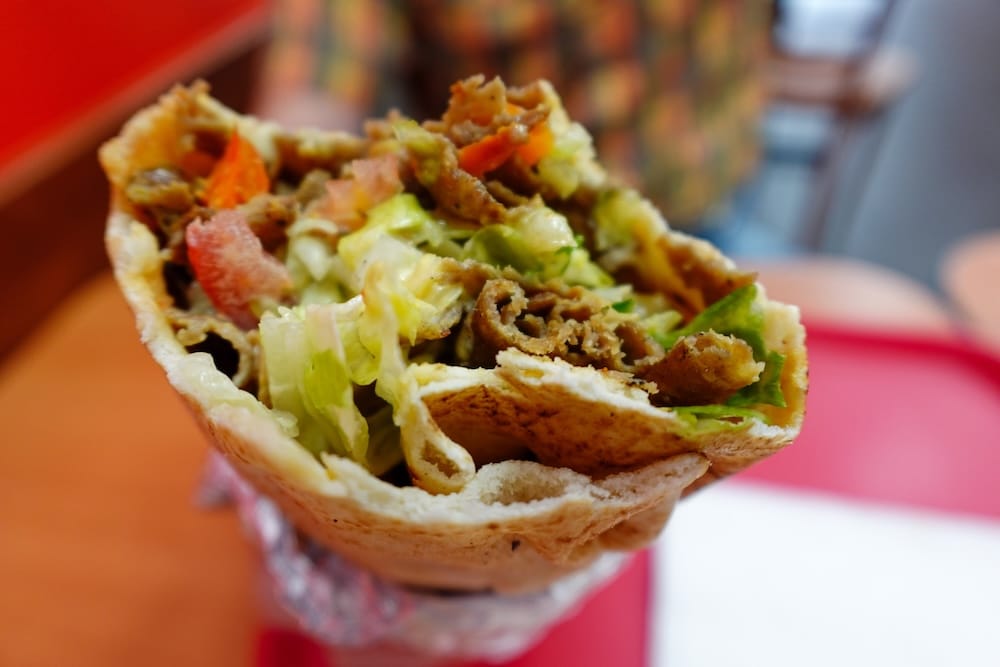
The Canadian donair is strongly associated with Halifax, but Edmonton developed its own sprawling donair culture. Local shops do not follow one rigid formula. Beef and chicken are common, as are mixed donairs. Lettuce, tomato, pickles and hot peppers may appear. Some people want sweet sauce; others prefer garlic sauce.
Many orders also become large enough to require a minor engineering qualification.
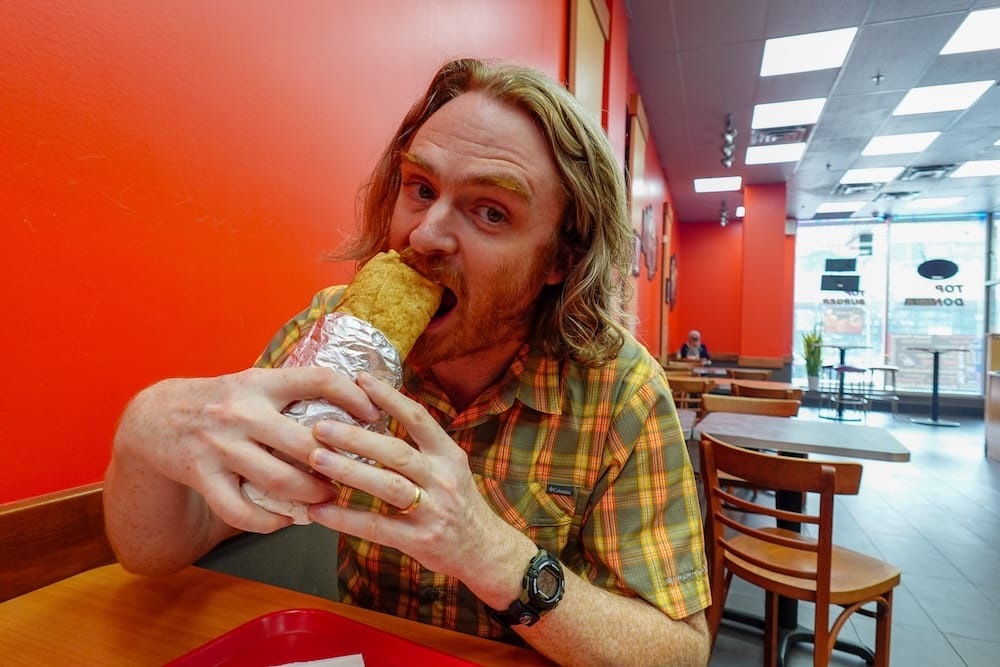
Our meal at Top Donair demonstrated that beautifully.
Donair suits Edmonton. It is filling, casual and relatively inexpensive. It works after a long day, a late evening or an overambitious walk through cold weather. This is not delicate food, and Edmonton has never required everything to be delicate.
Top Donair remains a convenient introduction for visitors staying centrally. Swiss Donair is another long-running specialist worth considering if you are prepared to head farther north.
I would not crown an absolute winner without eating through a much larger portion of Edmonton’s donair supply. That sounds like a noble research project, although probably one requiring several months and elastic waistbands.
The useful advice is simpler: try at least one independent donair shop rather than dismissing donair as generic fast food.
Ukrainian and Eastern European Food
Edmonton’s Ukrainian and wider Eastern European traditions deserve more attention than they receive in many visitor guides.
Bistro Praha gave us one of the strongest dinners of our trip, but Czech and Central European food should not be asked to represent the entire regional story.
Uncle Ed’s, connected to Mundare Sausage House, is a more direct choice for Ukrainian comfort food and deli products. Think sausage, cabbage rolls, perogies and other dishes designed to sustain people through winters that occasionally feel personal.
The main complication is timing. Some traditional restaurants keep earlier or more limited hours than newer downtown dining rooms. Ukrainian food is something to plan for lunch or an early meal, not something to remember at nine in the evening and assume will still be waiting.
First Nations Food in Edmonton
One of the clearest gaps in our original trip was Indigenous dining.
Bernadette’s is now one of the restaurants I would prioritize. Chef Scott Iserhoff, from Attawapiskat First Nation in Treaty 9, works with Svitlana Kravchuk in a tiny dining room built around Indigenous sharing plates and seasonal ingredients.
It is important not to speak about First Nations cuisine as though it were one uniform Canadian tradition. Different nations, territories, family histories and environments produce different foodways.
Bernadette’s represents the perspective of the people operating it. It does not claim to summarize everyone.
The dining room has only a handful of tables, so this is not a restaurant I would leave to a casual last-minute decision. It deserves planning, but it also offers something deeper than another interchangeable upscale dinner.
Alberta Ingredients and Contemporary Edmonton Dining
Not everything worth eating in Edmonton needs to be old or attached to a single iconic dish.
RGE RD is one of the clearest choices for experiencing Alberta through a contemporary restaurant. Its cooking emphasizes regional producers, seasonal ingredients and using more of the animal rather than reducing “local food” to a steak under dramatic lighting.
This is a food-first dinner rather than a convenient meal squeezed between attractions. It costs more than donair or brunch, demands more planning and performs a different job.
That is why it makes no sense to rank RGE RD against Green Onion Cake Man. One is a destination dinner. The other is a locally connected casual stop.
A good food trip has room for both.
International Food Is Edmonton Food Too
Destination guides often treat only historically local dishes as authentic, then push everything connected to immigration into one vague paragraph labelled “international food.”
That badly misunderstands Edmonton.
Chinese, Vietnamese, Filipino, Korean, Indian, Pakistani, Lebanese, Turkish, Ethiopian, Somali, Latin American and many other food traditions are not side notes to the city’s restaurant culture. They are a large part of it.
When I say Edmonton made me a foodie, I do not mean it taught me to appreciate one regional specialty. It gave me access to cuisines I had barely known existed while growing up in Gold River.
Sushi, Thai curries, Korean dishes and Indian food were my opening chapters. Later travel gave me a much larger reference point, but Edmonton supplied the curiosity.
A complete food visit should not consist only of green onion cakes, donair and Alberta beef. Those foods matter. They are not the whole story.
Poutine, Brunch and Beer: Good in Edmonton, Not Unique to Edmonton
We ate poutine in Edmonton. We had a memorable brunch. I drank local beer beside Rogers Place.
All three belong in this guide because they were part of our trip and because Edmonton does them well.
None needs to be falsely claimed as uniquely Edmontonian.
Poutine is broader Canadian comfort food. Brunch has become a major restaurant category across the country. Alberta craft beer deserves attention, but a local pint does not carry the same civic history as green onion cakes.
That does not diminish the pleasure.
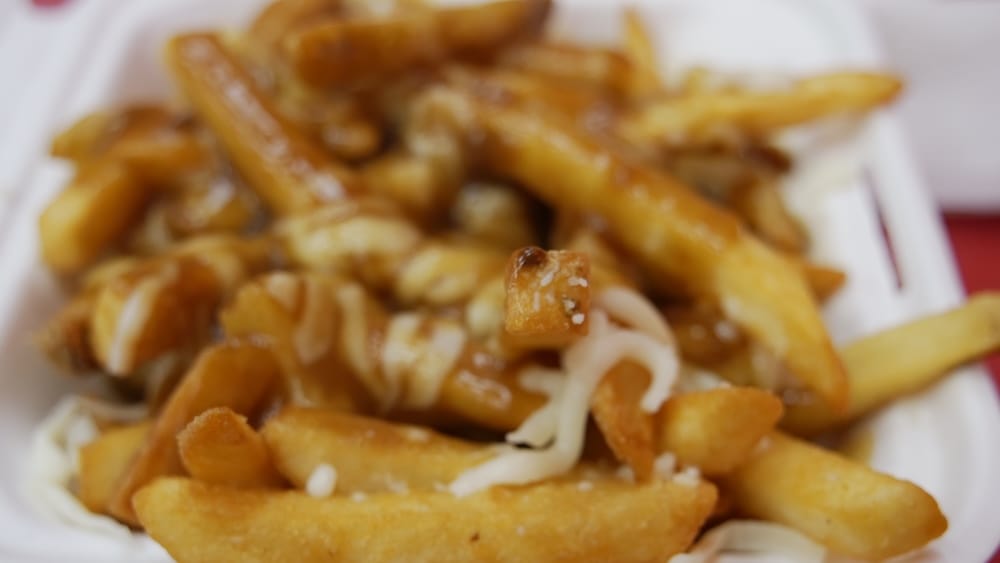
Sometimes the correct thing to eat in Edmonton is not historically significant. Sometimes it is fries, cheese curds and gravy because you have been outside in February and your body is requesting emergency construction material.
The Seven Edmonton Restaurants We Ate At
DaDeO: Returning to My Old Whyte Avenue Favourite
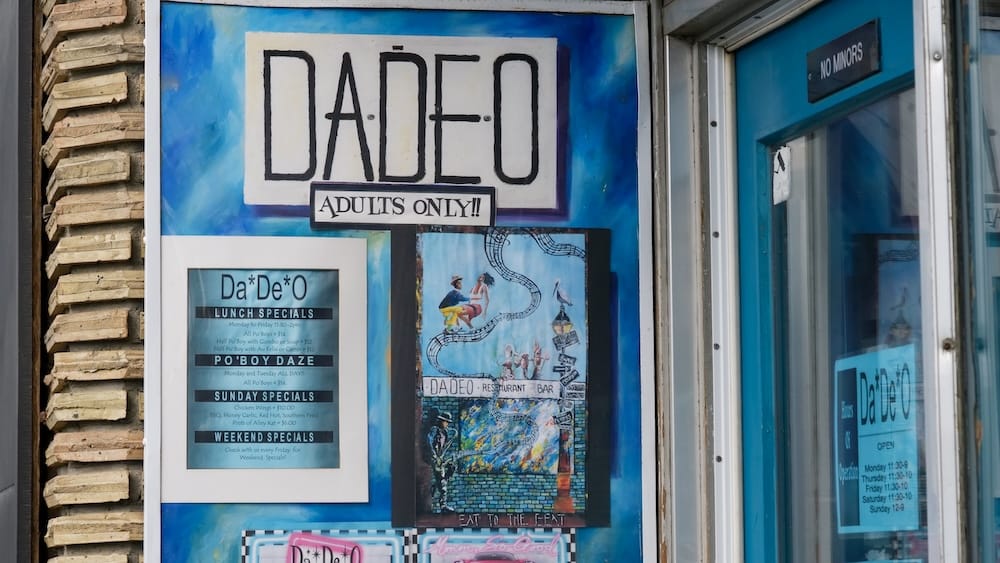
DaDeO was the restaurant I cared most about revisiting.
During my student years, I worked at the Safeway across Whyte Avenue and ate at DaDeO two or three times a month. That made it part of my Edmonton routine rather than an occasional treat.
I remembered the old diner decor, flavoured Coca-Cola, po’boy sandwiches and especially the sweet potato fries.
Returning nearly twenty years later had the potential to ruin the memory. Nostalgia is not always kind when confronted with fluorescent lighting and a current menu.
Instead, DaDeO still felt recognizable.
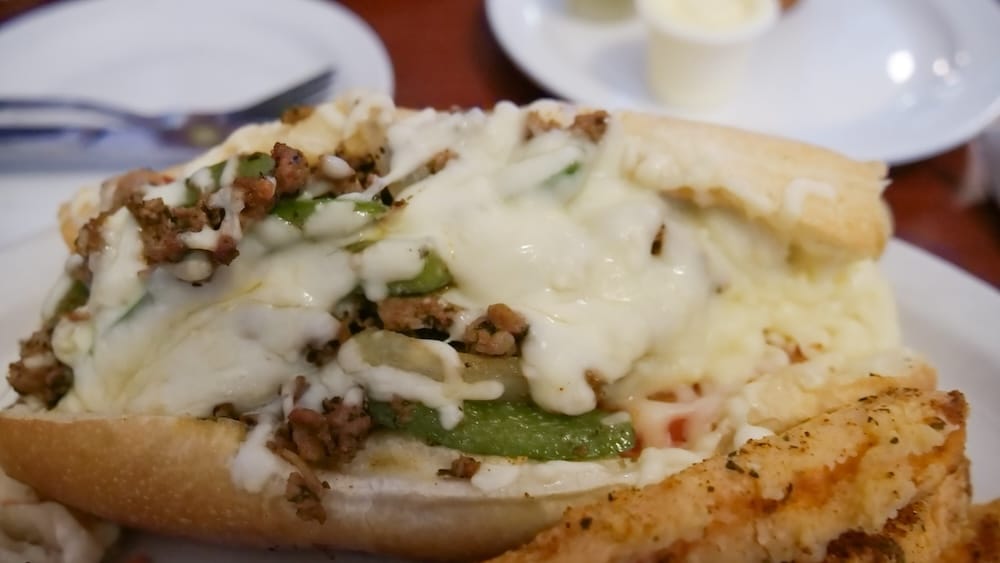
I ordered a steak-and-cheese po’boy with sweet potato fries and a flavoured Coke. Audrey chose gumbo with sausage, shrimp, chicken and rice, accompanied by warm cornbread, butter and jalapeño jam.
My meal was exactly the sort of food I associated with those student years: messy enough to require concentration, rich enough to justify a long walk afterward and completely uninterested in restraint.
The sweet potato fries remained the star.
“Legendary” is an overused restaurant adjective, but I had been saying it about these fries long before anyone had to worry about search algorithms. They were crisp, sweet and salty, but part of their power came from what they represented: a period of my life when eating at a favourite restaurant felt like a major event.
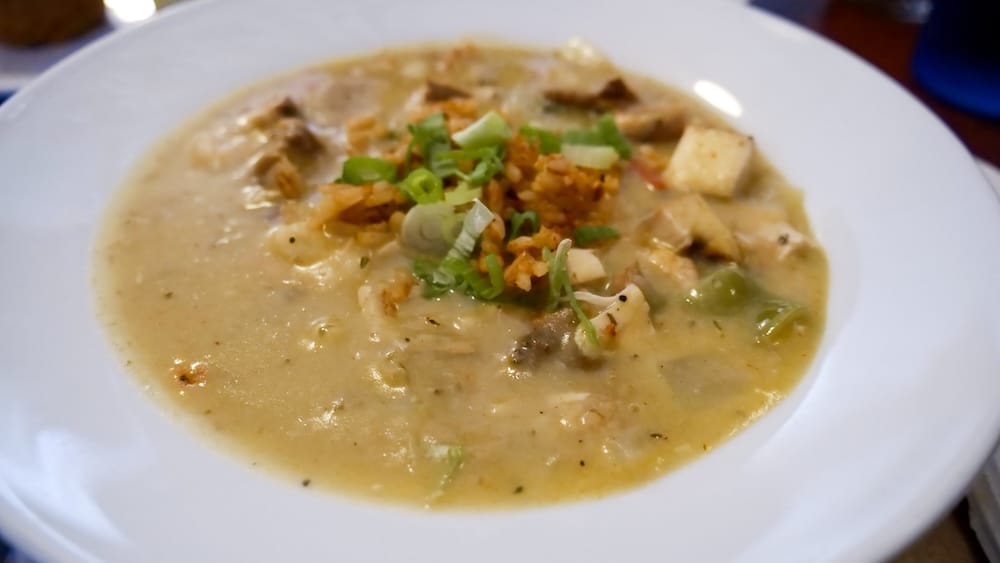
Audrey’s gumbo gave her a different experience. It was thick, filling and layered with several kinds of meat and seafood. The slightly sweet cornbread worked particularly well against the savoury bowl.
DaDeO matters here for more than nostalgia. It remains a distinctive Whyte Avenue restaurant with a personality of its own. The food is Cajun and Creole-inspired, the atmosphere deliberately retro and the portions designed for people who have arrived hungry.
It also fits naturally into an Old Strathcona day. You can browse independent shops, walk Whyte Avenue and finish with a meal that feels part of the neighbourhood.
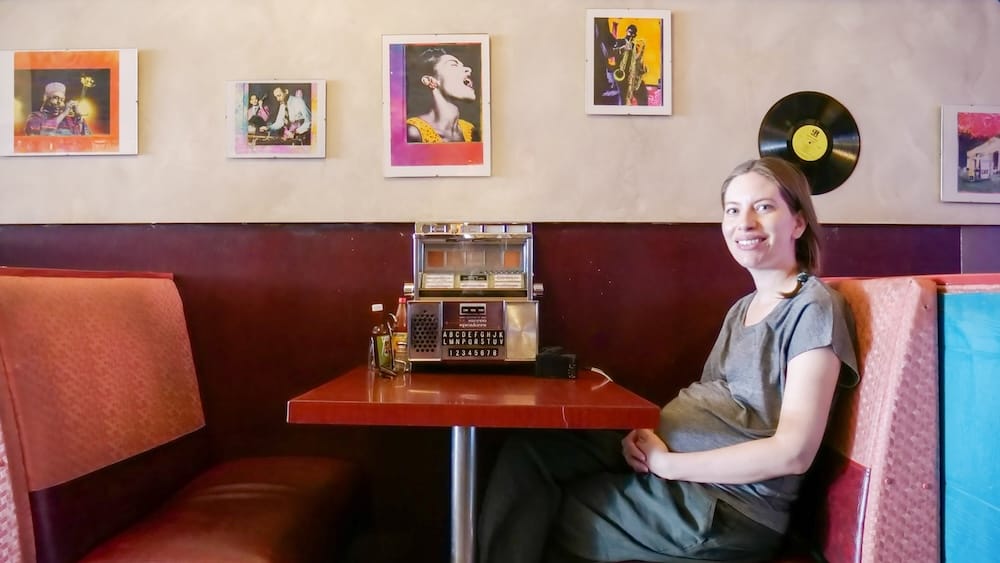
The main warning is its weekly closing pattern. Check the current opening days before building your south-side plans around it.
For me, DaDeO remains the strongest personal restaurant recommendation in Edmonton. That does not make it the formal winner of every possible category. It combines food I still enjoy with a sense of place and personal history no new dining room can reproduce.
It survived. So did my appetite.
Bistro Praha: Goulash, Schnitzel and an Old-World Dining Room
Bistro Praha gave us one of the most complete dinners of our return.
The restaurant has been part of Edmonton since the 1970s, and its atmosphere feels pleasantly detached from whatever trend happens to be dominating social media. Classical music, dark wood and Central European comfort food do most of the work.
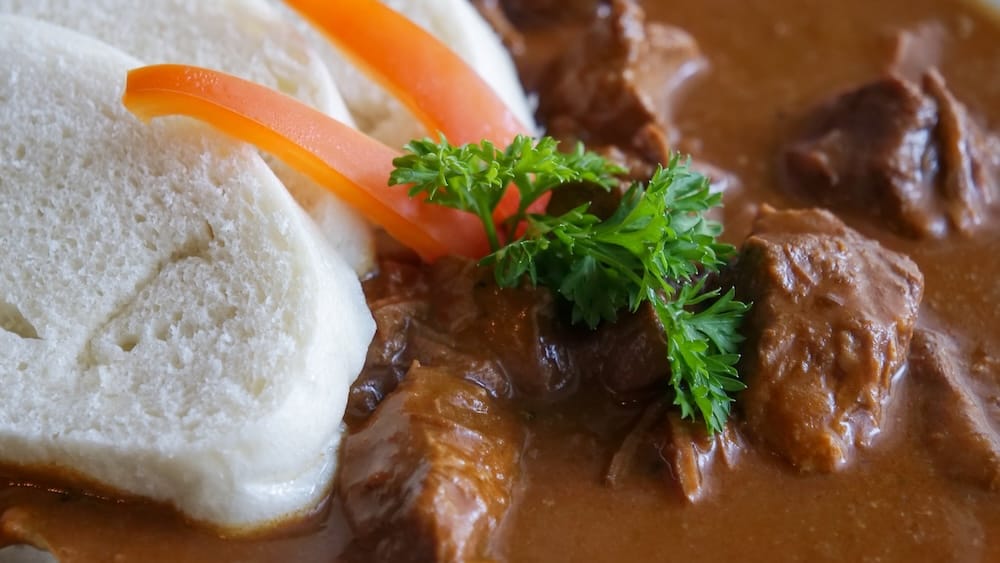
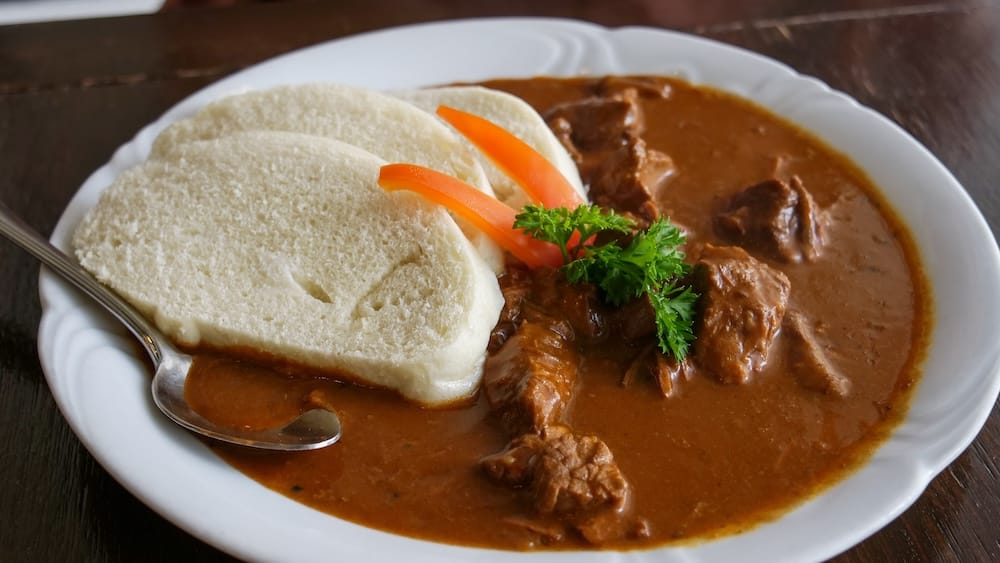
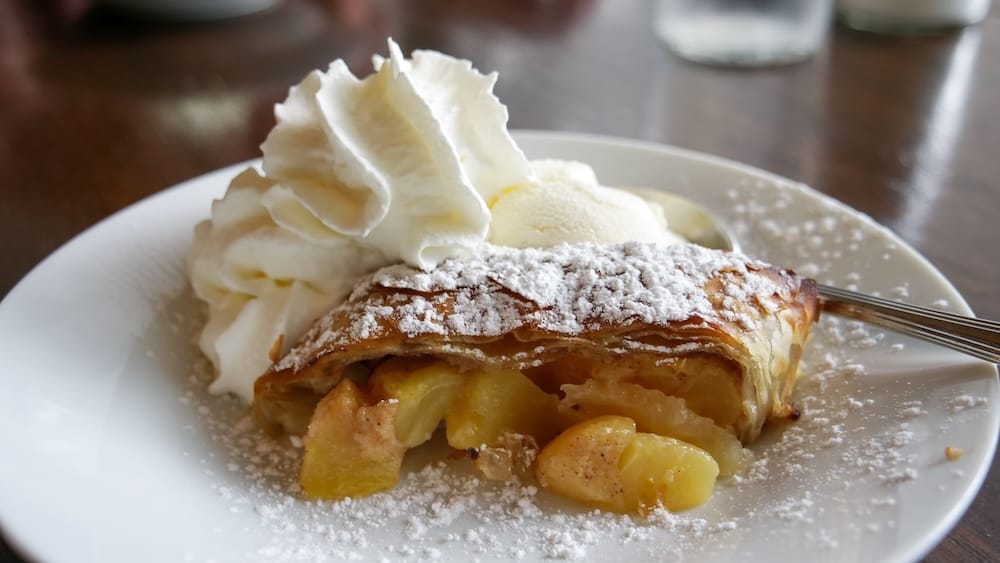
I ordered goulash with bread dumplings. Audrey chose schnitzel cordon bleu with potatoes, and we shared an apple dessert with ice cream and whipped cream.
My goulash was rich and deeply savoury, with tender meat and dumplings designed to absorb the sauce. It made me slow down and stop thinking about where we were going next.
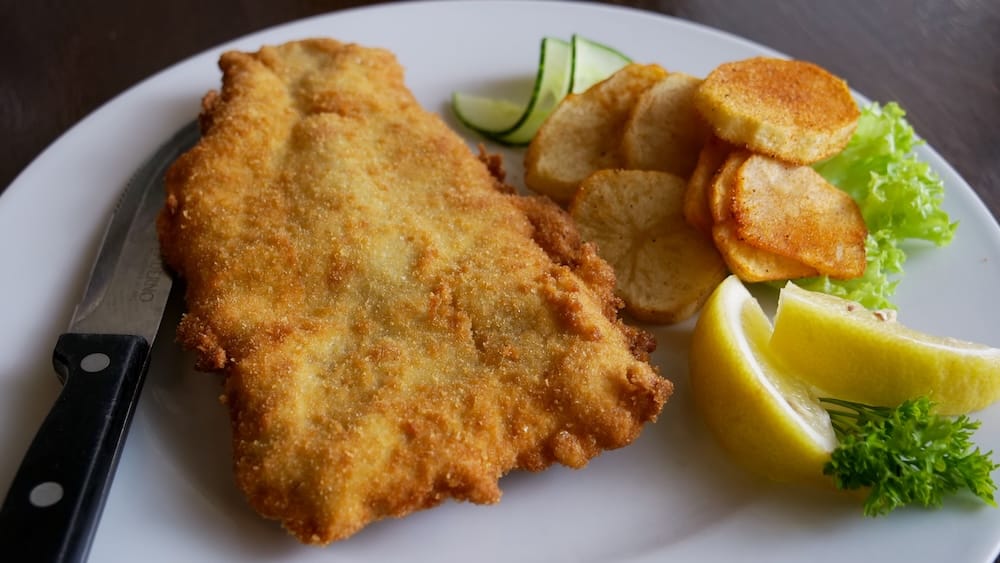
Audrey’s schnitzel had the crisp exterior she wanted, with tender meat, ham and melted cheese inside. We had eaten schnitzel in Austria and milanesas many times in Argentina, so this was not our first encounter with breaded meat. That made the comparison more useful. Bistro Praha’s version held its own.
The dessert carried us back toward Germany and Austria: warm apple, cold ice cream, whipped cream and a combination that did not require reinvention.
Bistro Praha works especially well for visitors staying downtown. Edmonton has newer restaurants with more fashionable rooms, but few can reproduce this mixture of longevity, atmosphere and culinary focus.
It is also where I would go when I want dinner to feel like an evening rather than a refuelling stop.
The menu still revolves around dishes such as goulash and schnitzel, although individual preparations and desserts can change. Check ahead if one exact dish matters to you.
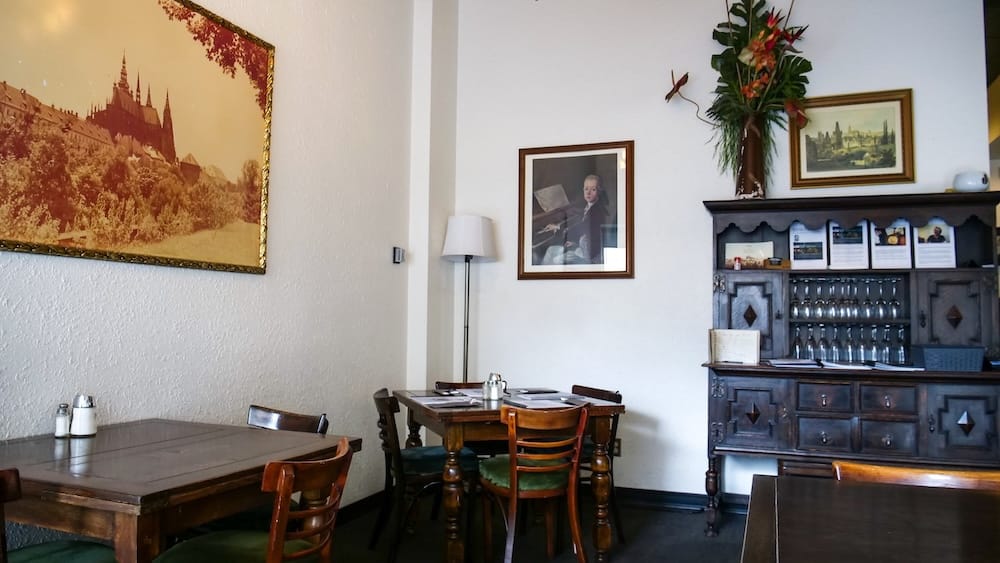
For a first trip, Bistro Praha remains one of my strongest downtown choices. It tells a different side of Edmonton from brunch, donair or contemporary Alberta dining.
New does not automatically mean better. Sometimes a restaurant survives because people would miss it terribly if it disappeared.
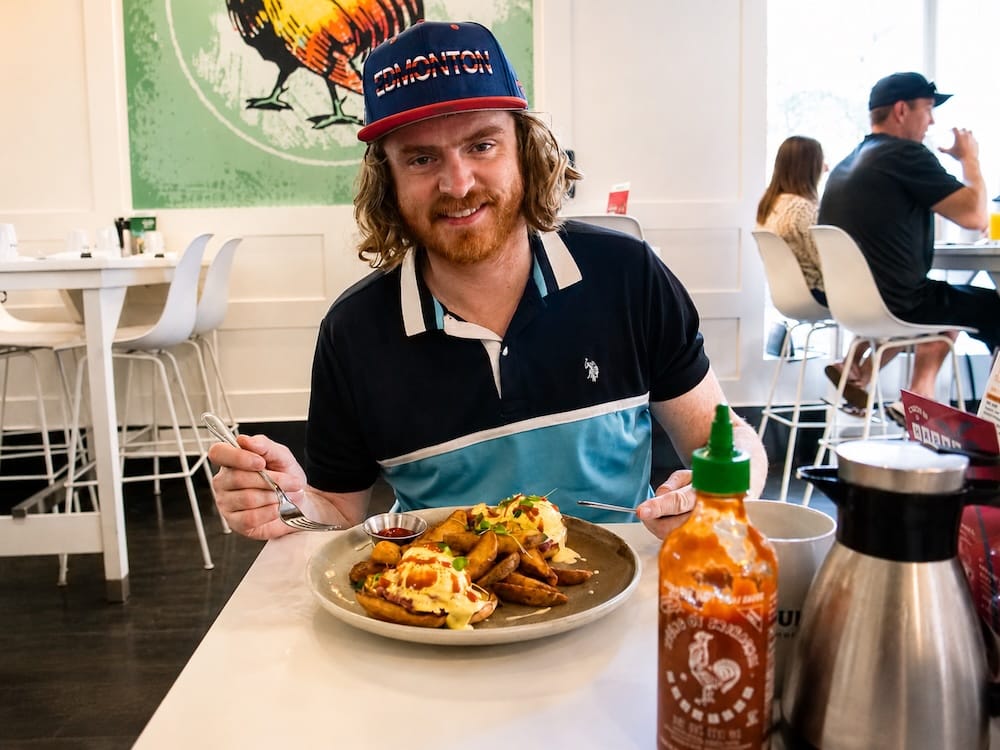
OEB Breakfast Co.: Savoury Versus Sweet
Audrey and I rarely order identical breakfasts, which allows us to conduct highly scientific research involving twice as much food.
At OEB, I chose the savoury side: eggs Benedict with Montreal-style smoked meat, brioche, seasoned potatoes and hot sauce.
Audrey surprised me with French toast.
She normally leans savoury too, but thick brioche with cinnamon, orange, berries and maple syrup pulled her in the opposite direction. It was sweet without becoming one-dimensional, and she particularly liked how the orange lifted the heavier bread and syrup.
My breakfast was the other kind of excess. Smoked meat, eggs, sauce and brioche are not ingredients that whisper. Together they created the sort of plate that quietly removes lunch from the itinerary.
The combination worked. The smoked meat gave the Benedict more substance than the usual thin slice of ham, and the potatoes absorbed whatever sauce escaped.
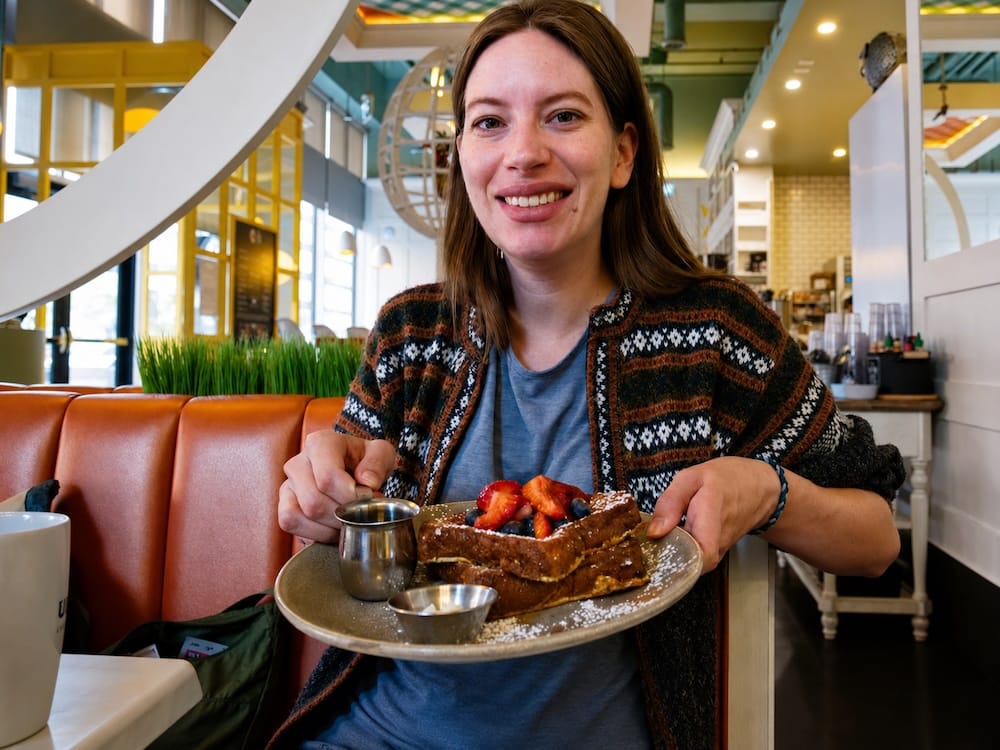
We liked OEB enough to visit another location later, which gives it more weight than a brunch we happened to enjoy once and forget.
OEB is now a multi-city brand rather than a uniquely Edmonton institution. Its advantages are a broad menu, an established concept and several Edmonton locations.
Readers seeking an independent local brunch should also consider Rosewood Foods downtown or Pip near Whyte Avenue. We did not eat at either, so I cannot invent a plate-by-plate showdown. They simply serve different practical roles: Rosewood for a downtown daytime meal and Pip for brunch tied to Old Strathcona.
OEB remains a good choice when you want an elaborate breakfast and enough variety to satisfy somebody craving smoked meat while the person across the table decides breakfast should be dessert.
Come hungry. OEB treats “the most important meal of the day” as a portioning instruction.
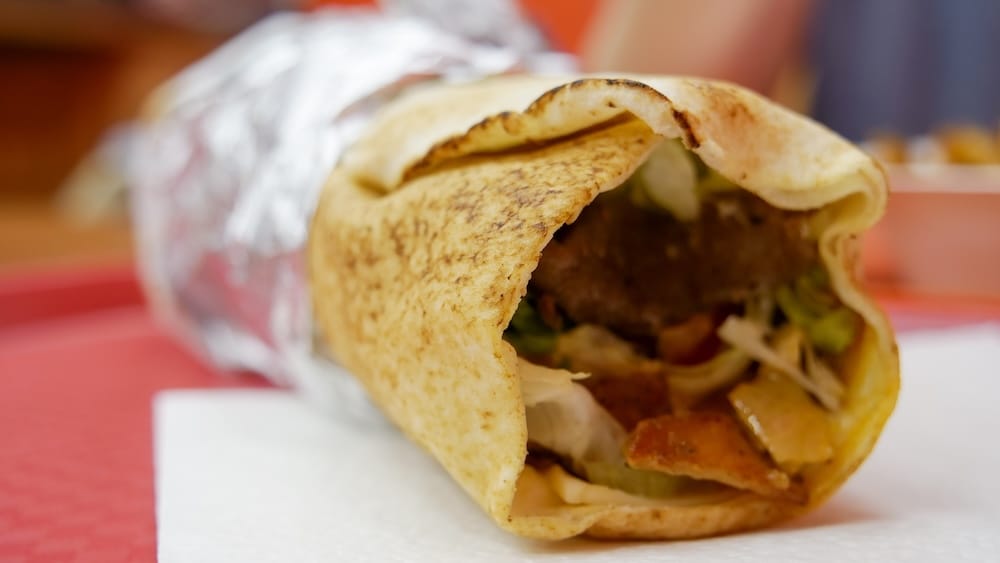
Top Donair: A Serious Portion Near Jasper Avenue
Donair looks manageable until somebody places the actual object in front of you.
At Top Donair, I ordered a medium mixed beef-and-chicken donair. Audrey saw its size and immediately chose a smaller chicken version.
Her instincts were sound.
The donairs arrived packed with meat, vegetables, sauce, pickles and hot peppers. This was not a snack disguised as lunch. It was comfort food with structural ambition.
I liked the mix of beef and chicken because it created more variation than a single-meat order. Audrey enjoyed hers but was equally pleased with her decision not to match my portion.
We also ordered poutine.
Adding fries, gravy and cheese curds to an already substantial donair meal was not guided by medical prudence. We were covering Edmonton food and apparently interpreted that as an obligation to defeat hunger for several days.
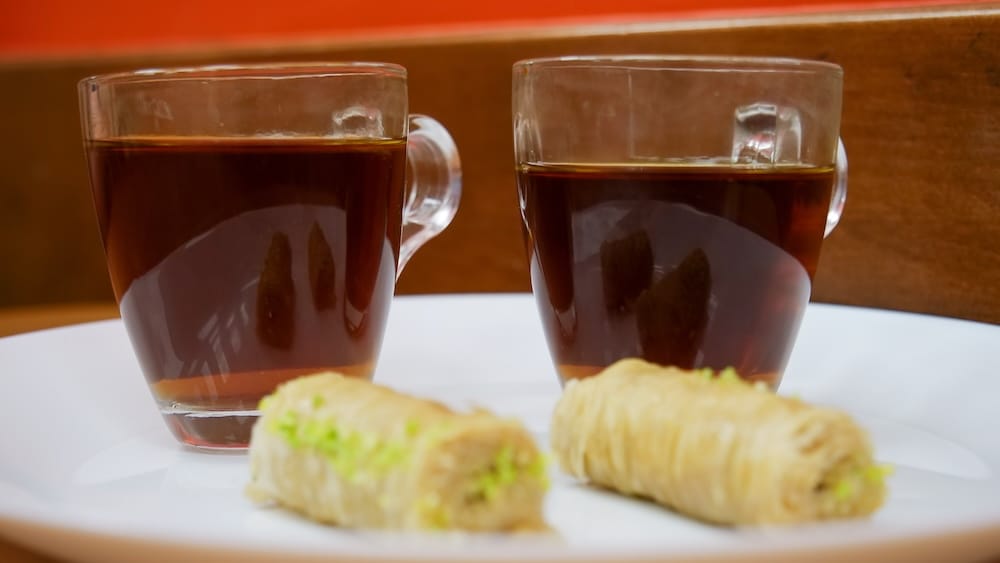
Tea and pistachio-covered baklava provided an unexpectedly warm finish. The people serving us were generous and welcoming during our visit, although the complimentary items should be understood as part of that meal rather than a permanent promise.
Top Donair remains open on Jasper Avenue, with beef, chicken and mixed donairs still central to the menu. That makes it easy to include if you are staying downtown.
Would I call it Edmonton’s undisputed donair champion? No.
I ate there and liked it. I did not complete a controlled comparison against every serious donair shop in the city. Swiss Donair farther north also deserves consideration.
Top Donair’s strength is more specific: it gave us a filling, enjoyable introduction to Edmonton donair culture without requiring a special journey beyond the central visitor zone.
If you order a medium, inspect it before committing to side dishes.
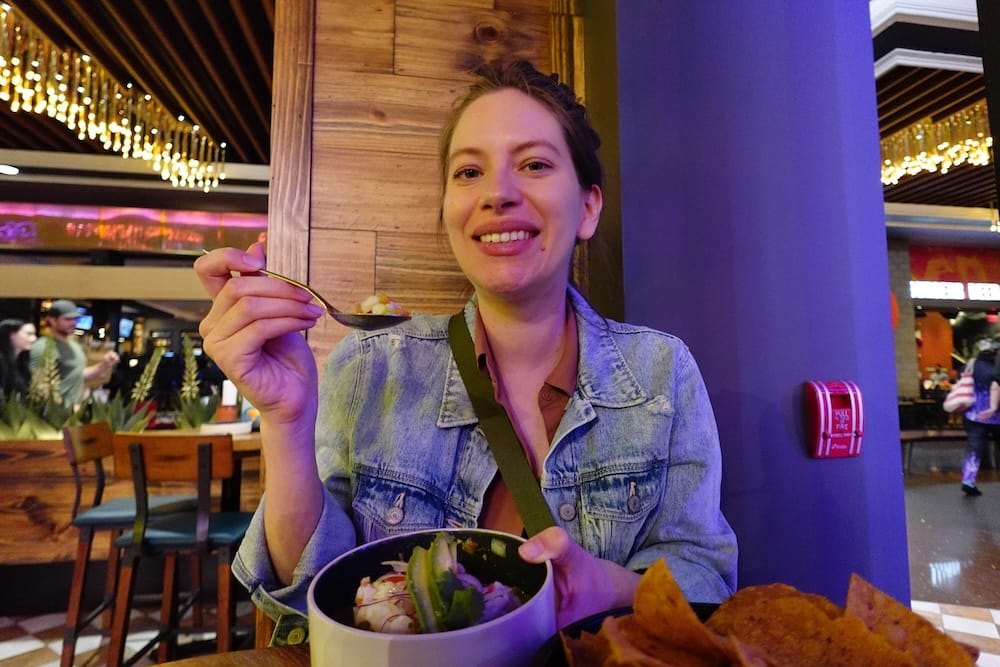
The Taco Shop: A Proper Meal at West Edmonton Mall
West Edmonton Mall creates a particular restaurant problem.
You can walk past food for an hour without deciding anything because there are too many choices, everybody becomes hungry at a slightly different moment and the mall is large enough to turn “let’s find lunch” into an expedition.
Our first mission after arriving was food. Nobody who knows us will find that surprising.
We headed to BRBN Street, the full-service restaurant corridor formerly known as Bourbon Street, and chose The Taco Shop.
The meal began with guacamole prepared at the table and fresh corn chips. Table-side preparation occasionally feels like theatre compensating for an ordinary dish. This guacamole did not need the performance. It was fresh, generous with avocado and exactly what we wanted.
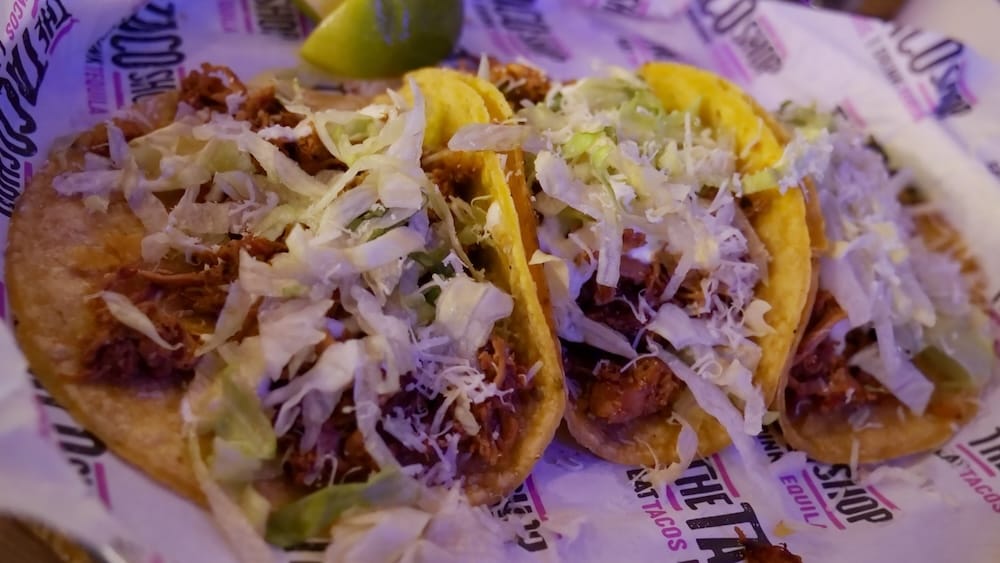
I ordered chicken tinga tacos. The shredded chicken had smokiness, mild heat and enough filling that the ingredients were escaping from the tortillas.
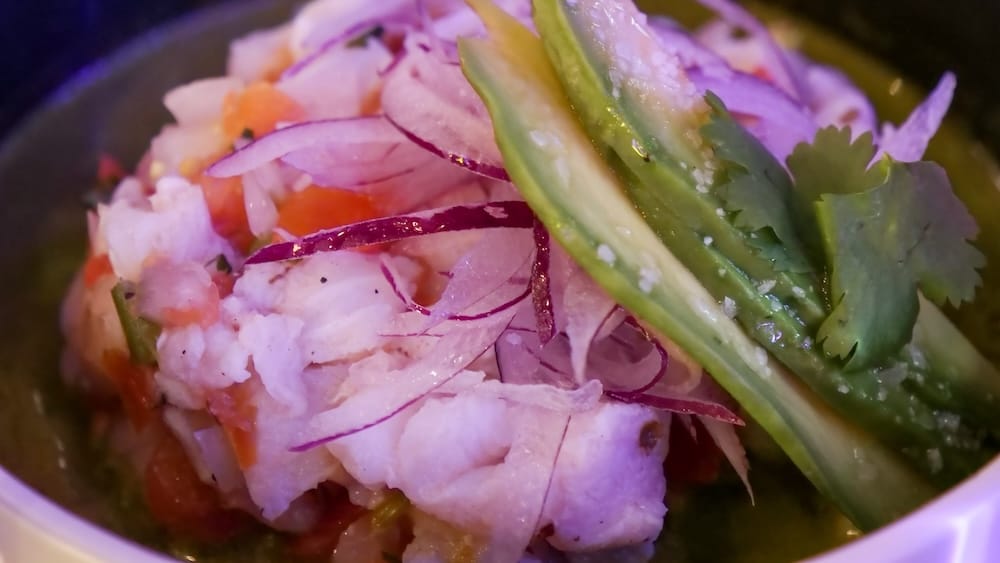
Audrey chose fish ceviche, which gave her a stronger basis for comparison. She is half Peruvian and has eaten ceviche repeatedly in Peru, where proximity to the Pacific naturally helps.
The Edmonton version was not going to replace ceviche eaten on the Peruvian coast, and she did not pretend otherwise. She still enjoyed the lime, red onion, cilantro, avocado, tomato and fish.
That is the correct level of praise. A dish can be good without requiring us to erase every superior version we have eaten elsewhere.
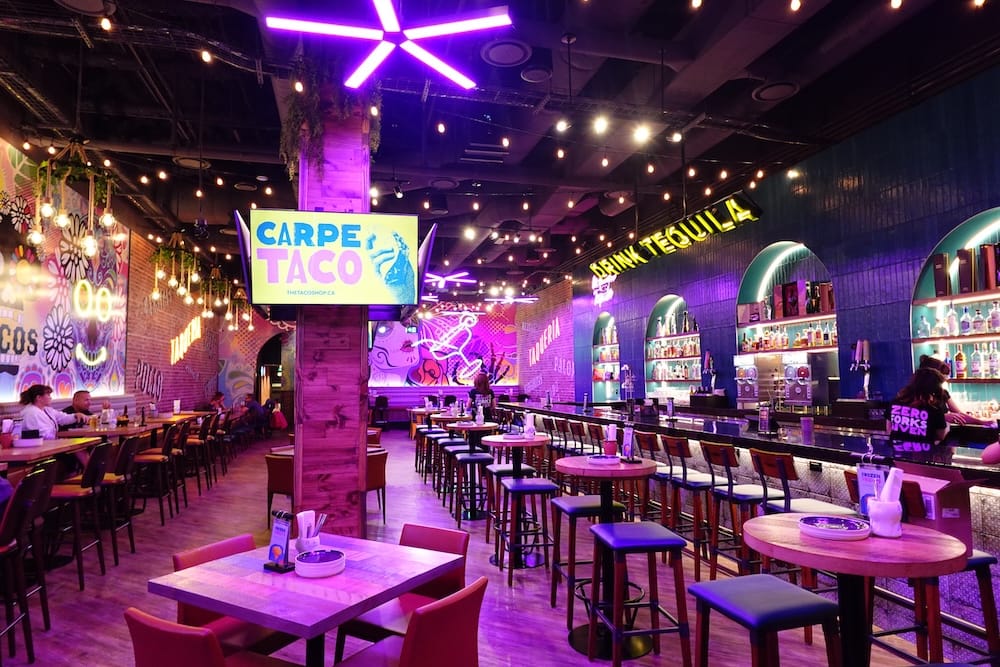
The Taco Shop still serves table-side guacamole and ceviche, making our meal useful for current visitors rather than purely nostalgic.
I recommend it to travellers already spending a substantial part of the day at West Edmonton Mall who want a proper sit-down meal rather than an emergency food-court compromise.
I would not cross the entire city solely to declare it Edmonton’s definitive Mexican restaurant. Its value is tied to the setting.
A restaurant can be the right choice for your day without defeating every similar restaurant in Edmonton.
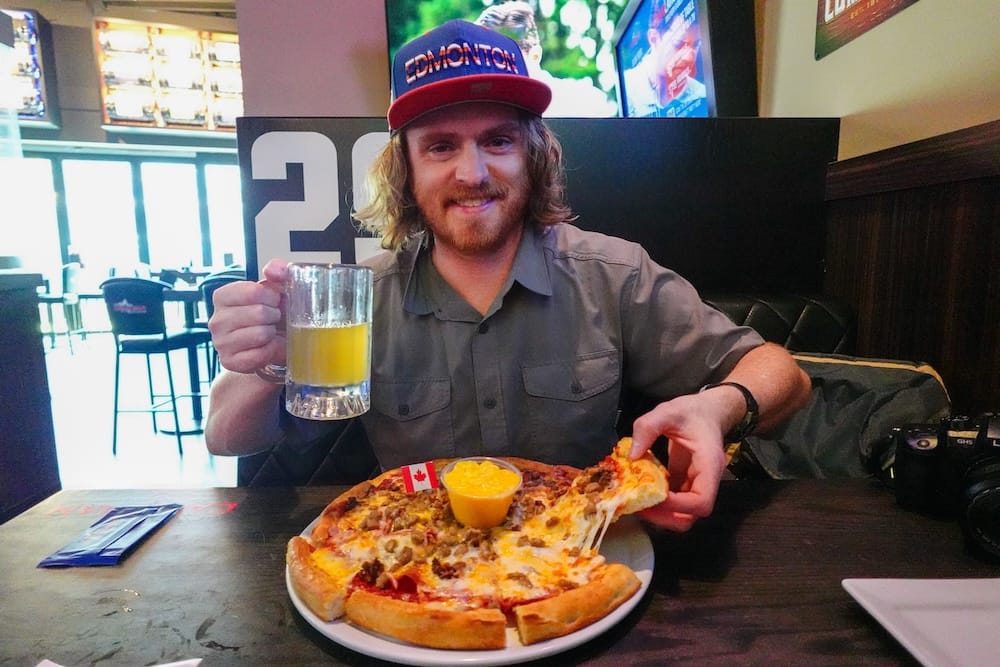
The Canadian Icehouse: Pizza and Sports-Bar Excess Near Rogers Place
Our meal at The Canadian Icehouse made sense from the moment we sat down.
Rogers Place was nearby, televisions faced every direction and the room was built for people who wanted sports with their food. We arrived early enough to choose a booth before the atmosphere had a chance to become hectic.
I ordered a local beer and we shared a heavily loaded meat pizza with pepperoni, bacon, sausage and beef, accompanied by a cheese dip.
This pizza did not suffer from a protein shortage.
Audrey ate three slices. I ate five. We were already stuffed beyond belief, which normally signals the end of a responsible meal.
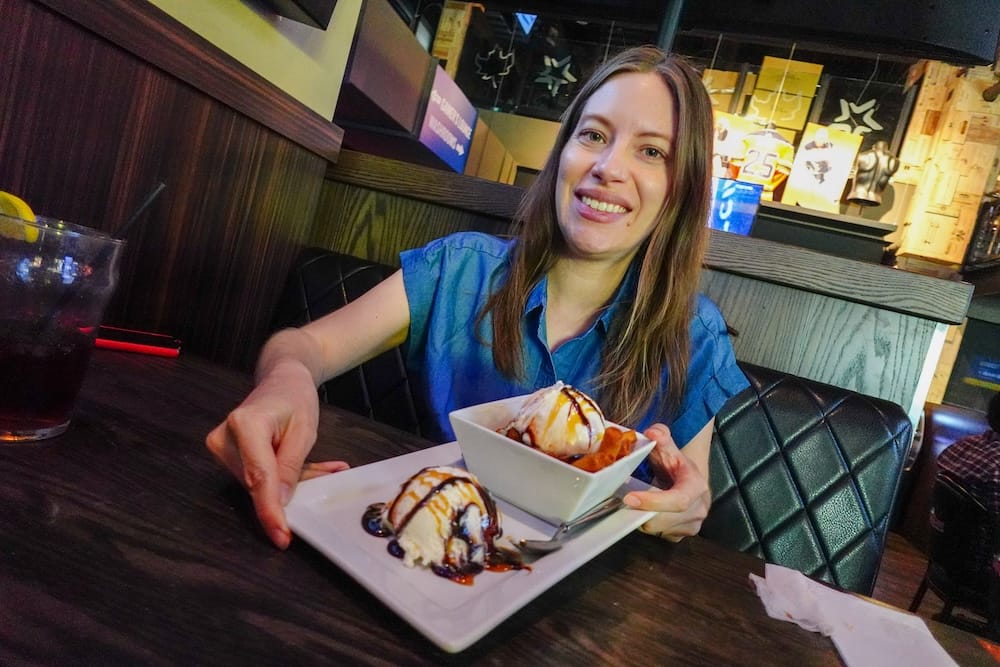
Unfortunately, dessert poutine had entered the conversation.
It had little relationship to savoury poutine beyond the name and a general disregard for restraint. Fried dough, ice cream, chocolate and caramel landed somewhere between amusement-park mini doughnuts, funnel cake and churros.
It was ridiculous. We ordered it anyway.
The contrast between hot dough and cold ice cream worked, although it moved us well beyond the point where either of us needed more food.
The Canadian Icehouse remains in the ICE District and still operates as a sports bar and entertainment venue. Dessert poutine, however, is no longer on the current menu, so do not arrive expecting to reproduce our entire meal.
Its strongest role is practical. If you are attending an Oilers game or a Rogers Place concert and want a casual restaurant immersed in the surrounding sports atmosphere, it works.
We did not visit during a live game, so our quiet early meal should not be mistaken for proof of event-night conditions. Reservations, crowds, parking and specials can all behave differently when thousands of people are approaching the arena.
Readers who care more about the food than the sports-bar setting have stronger central alternatives, including Bistro Praha, Bündok and Sabor.
The Canadian Icehouse belongs here because it answers a real question: where can you eat near Rogers Place without leaving the event atmosphere?
That is narrower than calling it one of Edmonton’s finest restaurants. It is also more useful.
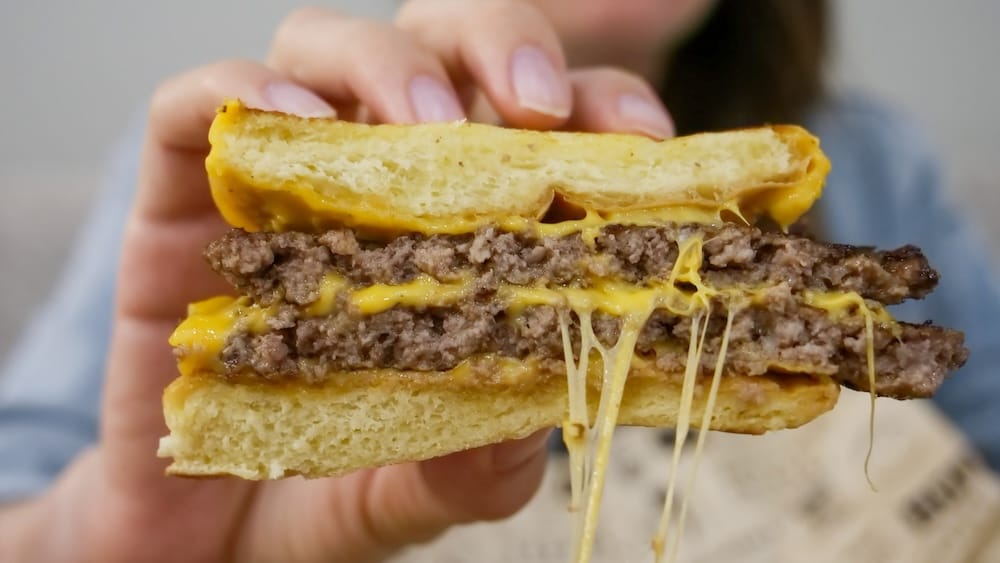
Wayback Burgers: Burgers, Loaded Fries and Fried Cheesecake
Our Wayback Burgers meal was not an exercise in moderation.
We ordered a double cheeseburger, loaded fries with cheese, bacon and green onion, a strawberry milkshake and fried cheesecake.
“Happy high cholesterol day” was the general mood.
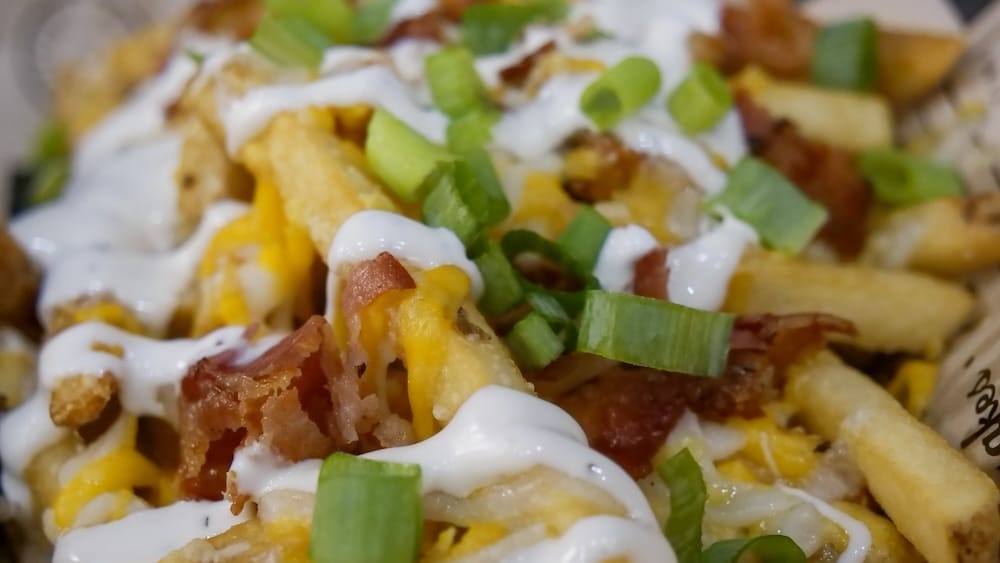
The burger and fries delivered exactly the kind of indulgent fast-food meal we had chosen. The loaded fries were less a side dish than a second main course. We shared one strawberry milkshake because even we recognized that two shakes plus fried cheesecake might represent unnecessary escalation.
The fried cheesecake was the surprise.
It arrived with a hot, crisp cinnamon-sugar shell and a cooler cheesecake centre. The temperature contrast initially felt strange, but it worked. Audrey said she would gladly eat it again.
It was essentially a cheesecake churro, a description that either sells the dish immediately or sends you looking for a salad.
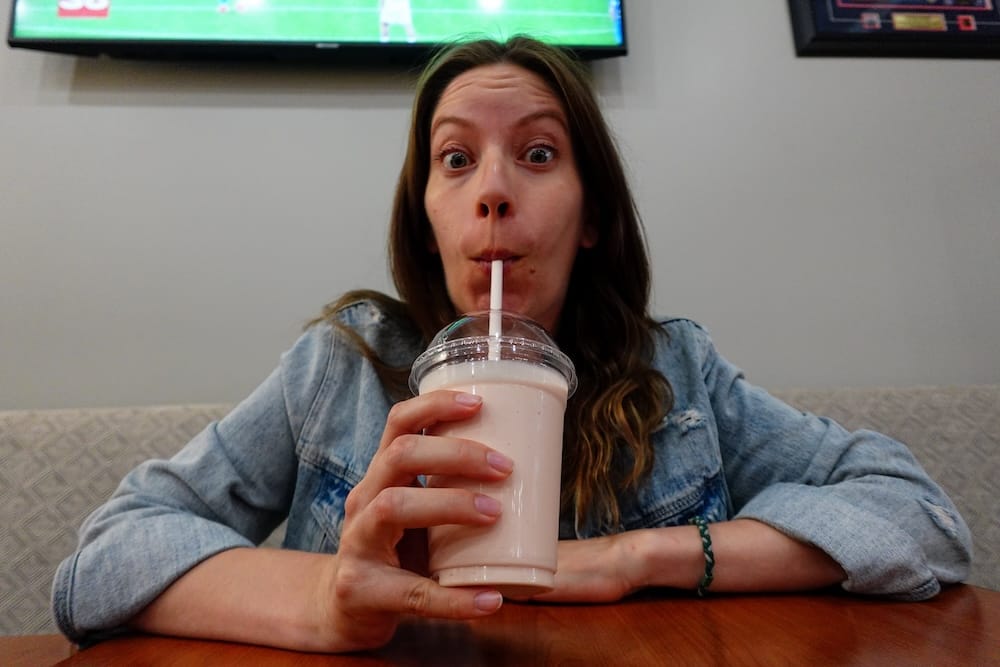
Wayback still has an Edmonton presence, but fried cheesecake is not on the current main Canadian menu. It belongs to our particular meal rather than a current order I can promise.
There is also an obvious editorial reality: Wayback is a chain, while Edmonton has independent restaurants that deserve priority when visitors have only a few meals.
That does not make our experience irrelevant. We ate there, enjoyed ourselves and found the dessert memorable enough to keep discussing.
Not every meal needs to carry the cultural weight of an entire city.
Sometimes you eat a burger.
Sometimes you fry the cheesecake too.
For a first-time visitor with limited meals, I would usually choose something more locally specific. For a casual burger-and-shake stop, Wayback performs the job it promises.
Fun, filling and honest about what it is.
The Edmonton Restaurants That Complete the Picture
Our seven meals covered a surprising amount of ground, but they did not cover Edmonton.
We missed Indigenous dining, green onion cakes, direct Ukrainian food, most of the city’s stronger contemporary restaurants and many of the international cuisines that had shaped my original relationship with the city.
The restaurants below fill those gaps. I have not eaten at them, so I am not going to invent tasting notes or pretend they are old favourites. They are current priorities because each performs a meaningful role in Edmonton’s food story.
Destination Dinners and Special Occasions
RGE RD
RGE RD is where I would go for a contemporary dinner connected to Alberta producers and ingredients.
The restaurant’s identity is built around seasonal cooking, regional sourcing and fuller use of the animal. This is not a meal to wedge between attractions. It is the evening.
RGE RD makes sense for food-first travellers who are willing to spend more and reserve ahead. It is dinner-focused and closed on Sundays, so the calendar controls the decision as much as appetite.
Bernadette’s
Bernadette’s offers one of Edmonton’s most distinctive current dinners.
The tiny room, sharing-plate format and specific perspective of chef Scott Iserhoff and Svitlana Kravchuk separate it from generic upscale dining.
With only a handful of tables, this is among the clearest places to reserve rather than hope. It is also near the top of my personal next-trip list because Indigenous dining was absent from our original visit.
Sabor
Sabor is a long-running downtown choice built around seafood, Iberian cooking, tapas and family-style meals.
Its location makes it particularly useful for visitors staying centrally or planning an evening near the ICE District. I would choose it when dinner is meant to be social and substantial rather than a rushed plate before an event.
Sabor and The Canadian Icehouse may both fit a central itinerary, but they perform completely different jobs. One makes dinner the event; the other keeps you inside event-night energy.
Olia
Olia represents a newer side of Edmonton dining.
The focus is contemporary Italian food, and its Jasper Avenue location fits naturally into a 124 Street or Wîhkwêntôwin evening.
This is a polished dinner rather than a casual snack, and it belongs in the category of restaurants I would reserve when food already controls the night.
Bündok
Bündok gives the downtown and ICE District area a chef-driven sharing-plate option.
It suits diners who want to remain central without defaulting to an arena-oriented restaurant. The meal is designed to unfold over several dishes, so it works better for a relaxed dinner than a hurried pre-concert stop.
The Marc
The Marc occupies a quieter role as a long-running French bistro.
I would consider it for a business lunch, a restrained dinner or an evening when classic bistro food matters more than novelty.
A definitive food guide does not need to call every restaurant a life-changing destination. Sometimes the correct place is the one that fits the conversation.
Casual Restaurants and Neighbourhood Favourites
Fu’s Repair Shop
Fu’s Repair Shop combines Chinese-fusion dishes, dim sum, cocktails, music and a deliberately theatrical nightlife atmosphere.
It is not a traditional Chinese restaurant, and it is currently restricted to adults. That makes it suitable for a lively dinner that continues into drinks, not a family meal or a quiet comparison with Chinatown dining.
Otto Food & Drink
Otto Food & Drink brings sausages, beer and communal neighbourhood energy to Alberta Avenue.
This is not a polished downtown destination. That is part of the appeal. Otto gives visitors a reason to experience a different part of Edmonton and works best for a relaxed evening when crossing the city is not an inconvenience.
Rosewood Foods
Rosewood Foods solves a practical downtown problem.
Many restaurants visitors save are dinner-only. Rosewood operates during the day, providing an independent breakfast or lunch without sending you across Edmonton before coffee.
It does not take reservations, which simplifies one part of the plan and introduces uncertainty elsewhere. I would rather acknowledge that than invent a guaranteed waiting time.
For travellers who like the sound of OEB but prefer an independent downtown restaurant, Rosewood is the logical alternative.
Pip
Pip fits naturally into a Whyte Avenue and Old Strathcona day.
It serves brunch and dinner, with weekday brunch reservations and a walk-in approach on weekends. That makes it more flexible than a restaurant performing only one meal.
Pip is high on my return list because it could turn breakfast into part of the south-side experience rather than a separate mission.
Chinese and Japanese Specialists
Tokiwa Ramen
Tokiwa Ramen is perfect for the right itinerary and useless for the wrong one.
It operates during a short daytime window and may finish service when the soup is gone. Do not save it for dinner or assume it will be available all afternoon.
The payoff is a focused ramen lunch rather than a restaurant attempting sushi, teriyaki, noodles and fifteen unrelated categories.
Schedule Tokiwa first. Build the rest of the day around it.
Izakaya Tomo
Izakaya Tomo offers Japanese pub dining in south Edmonton.
Shared dishes and drinks are the point, making it a relaxed alternative to a formal Japanese restaurant. Its location requires more effort for somebody staying downtown, but that becomes worthwhile when izakaya-style dining is a priority rather than a vague preference for Japanese food.
Sai Woo Garden
Sai Woo Garden gives this guide a Chinatown anchor and works best as a family-style Cantonese meal.
Go with enough people to share several dishes rather than guarding one plate while silently regretting everybody else’s order.
Chinatown restaurants sometimes have less polished online information than larger dining groups, so check current hours directly before building the evening around one place.
Shanghai 456
Shanghai 456 is a Shanghainese specialist on 118 Avenue, associated with buns and xiao long bao.
It is better treated as a deliberate food trip than a convenient central recommendation.
I used to cross Edmonton for meals without thinking twice. A visitor with two days and no car may reasonably make a different decision. The restaurant belongs here because it gives the city depth beyond the obvious dining corridors, not because it is easy for everybody to reach.
Middle Eastern and Latin American Restaurants
Sofra
Sofra gives downtown Edmonton a focused Turkish dining option.
It makes sense for a complete dinner built around grilled meats, vegetables, breads and shared dishes. I would describe it specifically as Turkish rather than hiding its identity inside a broad regional category.
The Bedouins
The Bedouins sits outside the main visitor districts and is most relevant to diners specifically seeking dishes such as lamb mandi and a fuller regional meal.
This is not a “whatever is nearby” choice. Its entire value lies in being the reason to leave the centre.
A food-first traveller with a car may prioritize it. Someone in Edmonton for one night probably will not.
Ávila Arepa
Ávila Arepa brings Venezuelan food to the Garneau and Whyte Avenue side of the city.
Arepas create a casual meal distinct from the taco-heavy way Latin American food is often presented. Its location also makes it practical to combine with a south-side day rather than requiring a separate journey.
Plant-Based Dining and Bakeries
Padmanadi
Padmanadi is a long-running, family-owned vegan Indonesian restaurant.
Its importance reaches beyond plant-based dining. It represents the international food culture that made Edmonton so formative for me in the first place.
I would recommend it to vegan diners, but I would not limit it to them. Cuisine should remain the reason to go.
An Chay
An Chay serves vegetarian Vietnamese food near Jasper Avenue and the 124 Street side of the city.
It offers a lighter counterpoint to Edmonton’s many meat-heavy meals without becoming a generic collection of fashionable vegetables.
Vegetarian does not automatically mean safe for every allergy, so direct confirmation still matters when cross-contact is medically significant.
Duchess Bake Shop
Duchess Bake Shop deserves its own category because a pastry stop should not be forced to compete against dinner.
With locations on 124 Street and in Ritchie, it can slot into different neighbourhood plans. I would use it for coffee, pastries or dessert between larger meals.
By the third day of a serious food itinerary, replacing lunch with a bakery stop may feel less like compromise and more like diplomacy.
Where to Eat in Edmonton by Neighbourhood
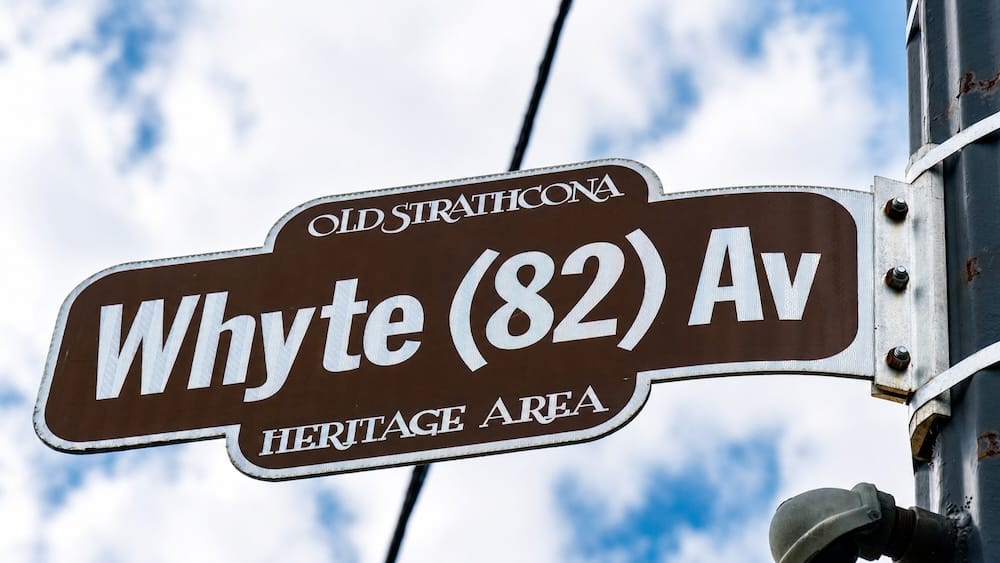
Whyte Avenue, Old Strathcona and Garneau
Whyte Avenue remains my favourite area for combining food with a wider Edmonton experience.
DaDeO is the personal anchor. Pip provides independent brunch and dinner. Ávila Arepa adds Venezuelan food nearby. The meal is surrounded by independent shops, theatres, festivals and the lived-in atmosphere of Old Strathcona.
This is where I would send visitors who want Edmonton to feel like a city rather than a sequence of indoor attractions.
Visitors who would rather sample several businesses than commit to one restaurant can check availability for the Whyte Avenue food walk through Booking.com. It combines multiple tasting stops with Old Strathcona’s history, murals and neighbourhood character.
Downtown and the ICE District
Downtown Edmonton now supports several different food trips.
Bistro Praha brings history and old-world comfort. Sabor handles seafood and celebrations. Bündok offers sharing plates. Rosewood covers daytime meals. Bernadette’s supplies one of the city’s most distinctive small dining rooms. Fu’s Repair Shop combines dinner with nightlife.
The Canadian Icehouse serves another purpose: direct sports-bar convenience beside Rogers Place.
The important decision is whether the evening is built around the food, the event or both.
Trying to do both without enough time is how people end up inhaling an expensive meal while staring at the clock.
Wîhkwêntôwin and 124 Street
The 124 Street and Wîhkwêntôwin area may be Edmonton’s strongest current zone for building a food-focused half-day.
Tokiwa can handle lunch if its narrow window fits. Duchess supplies pastries. An Chay covers vegetarian Vietnamese food. Olia provides contemporary Italian dining. RGE RD can become the evening destination.
Do not assume every restaurant is next door because it shares a broad neighbourhood label. Check the actual walking route, particularly when Edmonton’s weather has opinions.
North-Central Edmonton and Alberta Avenue
Green Onion Cake Man, Otto Food & Drink and Uncle Ed’s create an interesting locally focused lane outside the visitor core.
Add Swiss Donair farther north and the day becomes even more Edmonton-specific, though considerably less compact.
This works best with a car, ride-hailing or a deliberate transit plan. The reward is food that feels rooted in Edmonton rather than interchangeable with restaurants in any Canadian downtown.
Chinatown
Chinatown remains part of my Edmonton food memory.
I used to jog there for ginger beef, which says something about my priorities and the questionable logic of using Chinese food as a running reward.
Sai Woo Garden gives the current guide a practical restaurant anchor, but Chinatown deserves to be approached as a district rather than one isolated pin. Check live business details, walk around and allow the neighbourhood to be more than a historical footnote.
West Edmonton Mall
West Edmonton Mall offers an overwhelming number of food and drink choices, which is both helpful and paralyzing.
The Taco Shop was our successful full-service meal. It allowed us to share several dishes and sit down properly rather than accepting a rushed food-court compromise.
Do not overcomplicate a mall day. West Edmonton Mall already consumes time and energy. Leaving, crossing the city for lunch and returning later sounds more reasonable on a map than it feels in real life.
Restaurants Worth Crossing the City For
Some restaurants are not part of a convenient cluster, and that is fine.
Izakaya Tomo makes sense when Japanese pub dining matters. Shanghai 456 may justify the journey for Shanghainese dishes. The Bedouins appeals to diners pursuing a specific regional meal. Swiss Donair belongs on the list for somebody taking Edmonton donair seriously.
“Worth the detour” should not become automatic praise. A detour is worthwhile only when the food answers a priority you actually have.
Food was a mission when I lived in Edmonton.
It can still be one, but missions should have a point.
Food Tours in Edmonton: Let Someone Else Plan Lunch
I normally enjoy choosing restaurants myself. Half the fun is staring at menus, comparing neighbourhoods and gradually turning a simple lunch into an unnecessarily complicated research project.
A food tour still makes sense in Edmonton. The city’s restaurant scene is spread across several neighbourhoods, and one guided outing can introduce you to multiple businesses without using every available meal on separate reservations.
I did not take these tours during our trip, so they are researched options rather than personal recommendations. The three experiences below are currently bookable through Booking.com and perform genuinely different jobs.
Whyte Avenue Food Walk
The Whyte Avenue food walk is the most natural fit for a first-time visitor already planning to explore Old Strathcona.
The guided experience lasts roughly three hours and fifteen minutes and includes six local food stops. The route also works in neighbourhood history, street art, murals and the wider character of Whyte Avenue rather than moving people between restaurants without explaining where they are.
This is the tour I would choose when the priority is food combined with one of Edmonton’s most enjoyable urban neighbourhoods. Treat it as a substantial lunch experience rather than eating beforehand and arriving heroically full.
You can see current dates for the Edmonton Whyte Avenue food walk on Booking.com.
124 Street Food Walk
The 124 Street food walk performs a similar job in a different part of Edmonton.
This three-hour-and-fifteen-minute experience moves through seven local eateries, with chef and owner stories, behind-the-scenes elements, seasonal tastings, neighbourhood murals and a pause overlooking the North Saskatchewan River Valley.
I would choose this version when the 124 Street and Wîhkwêntôwin dining corridor is already part of the itinerary. It provides a more concentrated introduction to one of Edmonton’s strongest current food areas and reduces the temptation to schedule lunch, pastries and dinner back-to-back because they all looked nearby on a map.
Travellers can check the current 124 Street food walk schedule through Booking.com.
Edmonton Food Bike Tour
The Edmonton food bike tour is the more active and ambitious option.
The four-hour experience includes an e-bike and helmet, three substantial chef-curated food stops and riding through parts of the river valley between meals. This gives it a wider geographic reach than either walking tour and combines two sides of Edmonton that are central to this site: food and the river valley.
It is also a half-day activity rather than a casual guided lunch. Weather, comfort on a bicycle and the physical demands of being outside for several hours all matter. The e-bike reduces the effort, but it does not turn the experience into four hours of sitting at a table.
Active travellers can view current availability for the Edmonton food bike tour on Booking.com.
Which Edmonton Food Tour Should You Choose?
Choose the Whyte Avenue food walk for Old Strathcona history, street life and the neighbourhood where I have the strongest personal food connection.
Choose the 124 Street food walk for a concentrated introduction to one of Edmonton’s most developed current dining corridors.
Choose the food bike tour when you want the meal to become a wider half-day experience involving the river valley and more movement between stops.
I would not try to squeeze one of these tours between brunch and a large dinner. The whole advantage is allowing somebody else to organize several tastes into one experience. Give it room to perform that job.
Where to Stay for an Edmonton Food Trip
Where you stay will determine whether Edmonton feels pleasantly varied or like a series of long drives interrupted by meals.
Downtown for the Widest Car-Free Choice
Downtown is the safest all-purpose base for a first visit. Bistro Praha, Sabor, Bündok, Rosewood Foods, Bernadette’s, Fu’s Repair Shop and Rogers Place are all tied to the central part of the city, while LRT and bus connections make it easier to reach other areas.
Travellers who want to minimize driving can compare hotels in Downtown Edmonton and use one or two deliberate outings for Whyte Avenue, 124 Street or north-side food.
If an Oilers game or concert is controlling the trip, it may be more useful to check hotels near Rogers Place rather than choosing a cheaper room that creates a second transportation problem after the event.
Whyte Avenue for Neighbourhood Atmosphere
Whyte Avenue and Old Strathcona suit travellers who value street life, independent shops and restaurants that feel embedded in the neighbourhood.
DaDeO, Pip and Ávila Arepa fit naturally into this base, while downtown remains reachable across the river. You can browse current hotels around Whyte Avenue if the south-side experience matters more than being beside the ICE District.
West Edmonton Mall When the Mall Is the Main Event
Staying near West Edmonton Mall makes sense when the mall is consuming a full day or several parts of the trip. It reduces the temptation to spend valuable time crossing Edmonton before and after an already exhausting indoor expedition.
Readers building the visit around the mall can compare hotels near West Edmonton Mall. The trade-off is weaker access to Edmonton’s downtown, Whyte Avenue and north-side restaurant clusters.
There is no perfect base for every restaurant in this guide. Choose the area that handles most of your meals, then accept that one or two worthy restaurants may require a trip.
Choosing by Meal and Occasion
Breakfast or Brunch
Choose OEB for a large, elaborate brunch with several location options.
Choose Rosewood Foods for an independent downtown breakfast or lunch.
Choose Pip when brunch should be part of a Whyte Avenue and Old Strathcona day.
The strongest choice depends less on who has the most photogenic eggs than where you need to be afterward.
Quick Lunch
Choose Green Onion Cake Man for something with a genuine Edmonton connection.
Choose Top Donair for a personally tested central donair.
Consider Swiss Donair for a more deliberate north-side mission.
Choose Tokiwa Ramen only when its short lunch window fits.
Choose Uncle Ed’s for Ukrainian food during its earlier operating schedule.
A cheap meal stops being quick when it requires 45 minutes of travel each way.
Casual Dinner
My personal choice remains DaDeO, especially as part of a Whyte Avenue evening.
Choose Otto Food & Drink for sausages, beer and neighbourhood character.
Choose Padmanadi or An Chay for plant-based dining led by cuisine rather than compromise.
Choose Bistro Praha when casual still allows enough time for goulash, schnitzel and dessert.
Special Occasion
Choose RGE RD for contemporary Alberta-focused cooking.
Choose Bernadette’s for a small Indigenous sharing-plate experience.
Choose Sabor for seafood and an Iberian-style celebration.
Choose Olia for current Italian dining.
Choose Bündok for a food-led downtown evening built around sharing.
“Special occasion” describes the commitment, not one universal atmosphere.
Before an Oilers Game or Concert
Choose The Canadian Icehouse when convenience and sports energy are the priority.
Choose Bündok, Sabor or Bistro Praha when the meal matters more than staying inside the arena atmosphere.
Choose Fu’s Repair Shop when the evening is adults-only and likely to continue into drinks or music.
Allow more time than seems necessary. Event traffic, restaurant demand and arena entry have a talent for consuming every spare minute.
Plant-Based Food
Choose Padmanadi for vegan Indonesian food and the experience of an established Edmonton restaurant.
Choose An Chay for vegetarian Vietnamese food around Jasper Avenue and 124 Street.
Neither label guarantees an allergen-free kitchen. Contact the restaurant directly when cross-contact matters.
Pastries and Dessert
Choose Duchess Bake Shop when you want coffee and pastry substantial enough to count as an Edmonton food stop without committing to another full restaurant meal.
This becomes especially attractive once enthusiasm remains high but internal storage is approaching capacity.
Practical Edmonton Dining Logistics
Check the Day Before Falling in Love With a Restaurant
Independent restaurants do not all operate seven days a week.
DaDeO closes during part of the week. RGE RD and Sabor have their own closed days. Tokiwa serves during a short lunch period. Uncle Ed’s finishes earlier than a typical dinner restaurant. Rosewood is daytime only. Fu’s is an evening venue restricted to adults.
A restaurant can be perfect in theory and completely useless on the one day you are free.
Check the schedule first. Build the dream meal second.
Reserve the Small and Food-First Restaurants
Bernadette’s has only a handful of tables. RGE RD, Sabor and Olia are better suited to advance planning when the meal matters to the trip.
Walk-in brunch creates a different kind of uncertainty. Pip handles weekdays and weekends differently. Rosewood does not accept reservations.
Leave flexibility where the restaurant requires it rather than inventing guaranteed wait times from somebody else’s Saturday.
Rogers Place Changes Downtown
A normal downtown evening and an Oilers game night are not the same thing.
Parking demand increases, event rates may apply in designated areas and restaurants near the arena fill differently. Specials advertised during ordinary service may also have event-day restrictions.
Check the Rogers Place schedule even when you are not attending. Thousands of people arriving for a concert can alter your quiet dinner too.
West Edmonton Mall Distances Are Real
West Edmonton Mall is not one indoor hallway.
Reaching a restaurant depends on where you are in the complex, what you were doing beforehand and whether your group has become distracted by an ice rink, amusement ride, store or indoor lake.
Choose the meal before everybody reaches the stage where no decision is acceptable.
A Car Helps, but It Is Not Required
Driving makes it easier to connect north-side institutions, suburban specialists and restaurants outside the central dining zones.
It is not necessary for every strong food trip.
Downtown, Whyte Avenue and the 124 Street side can each support several meals. Transit and ride-hailing can cover selected detours.
A visitor who dislikes driving may need to accept that one trip cannot contain every famous donair shop, bakery and dining room. That is healthier than spending the entire visit trapped in a vehicle chasing food.
For a food-first itinerary built around north-side and suburban restaurants, travellers can compare Edmonton car rentals through Booking.com. Rent one because it solves a real access problem, not because every Edmonton trip automatically requires a vehicle.
Taxes and the Final Bill
Alberta does not have a provincial sales tax. Restaurant bills are subject to the federal 5% GST.
Gratuities are separate, and some restaurants may add service charges for larger groups. Check the menu or reservation terms rather than assuming every place handles this identically.
The important point for international visitors is that the menu price will not normally be the final total.
Dietary Needs and Accessibility
Menu labels such as vegan, vegetarian, gluten-free or gluten-friendly can narrow the field. They do not guarantee that a kitchen is free from cross-contact.
OEB marks several dietary attributes. Izakaya Tomo publishes a gluten-free menu. Padmanadi is vegan, and An Chay is vegetarian.
Anyone managing a severe allergy should contact the restaurant directly.
Accessibility information is also uneven. A ground-floor entrance does not automatically confirm accessible washrooms, suitable table spacing or an easy experience for every mobility need.
Contact the restaurant when access is material. The same applies to high chairs and stroller space. Our return to Edmonton was a babymoon, so I am not going to pretend we tested these dining rooms with a child.
How I Would Use a Limited Number of Meals
One Day in Edmonton
With one day, choose contrast over volume.
Start with brunch where the sightseeing begins: Rosewood downtown, Pip near Whyte Avenue or OEB when location and menu breadth are more useful.
Use lunch or a snack for something Edmonton-connected. Green onion cakes are the clearest choice. Donair works when it fits the route better.
Give dinner to one restaurant with enough personality to carry the evening:
- DaDeO for Whyte Avenue history and my strongest personal connection;
- Bistro Praha for a downtown institution;
- RGE RD for Alberta-focused contemporary dining;
- Bernadette’s for Indigenous sharing plates;
- or Sabor for seafood and a celebratory meal.
Trying to eat all five represents a misunderstanding of the assignment.
A Weekend in Edmonton
A weekend provides enough meals to experience range without turning every waking hour into digestion.
Include one brunch, one locally connected casual food, one Whyte Avenue or Old Strathcona meal, one downtown dinner and one destination restaurant or international specialist.
That might mean OEB, green onion cakes, DaDeO, Sabor and Padmanadi.
Another weekend could feature Rosewood, donair, Ávila Arepa, Bistro Praha and RGE RD.
The exact combination matters less than avoiding five restaurants that all perform the same job.
A guided food walk can also replace one lunch and several separate snack stops. The e-bike food tour is substantial enough to treat as most of a half-day rather than something to squeeze between two restaurant reservations.
A West Edmonton Mall Day
Eat inside the mall during the day.
The Taco Shop is the personally tested full-service option I can recommend. It gave us a proper sit-down meal with several dishes rather than a hurried compromise.
Save the destination restaurant for dinner only if you still have the energy to leave the mall, cross Edmonton and remain enthusiastic about another substantial meal.
West Edmonton Mall can consume an entire day. Pretending otherwise is how itineraries become punishment.
An Oilers Game or Rogers Place Concert
Decide whether convenience or food quality leads the evening.
The Canadian Icehouse keeps you beside Rogers Place and inside the sports atmosphere.
Bistro Praha, Bündok and Sabor provide more food-led experiences but require better timing.
Reserve when appropriate, account for parking or transit and finish early enough that nobody spends dessert staring at a clock.
A Food-First Trip With a Car
A car turns Edmonton’s geography into an advantage.
Build a north-side and north-central circuit around Green Onion Cake Man, Uncle Ed’s, Otto and Swiss Donair. Pursue Tokiwa for lunch, Izakaya Tomo for dinner or another specialist outside the visitor core.
End one evening with RGE RD or Bernadette’s.
Group restaurants geographically. Do not spend the entire day zigzagging because every place looked close when viewed individually.
Edmonton Without a Car
Focus on three areas:
- downtown and the ICE District;
- Whyte Avenue and Old Strathcona;
- 124 Street and Wîhkwêntôwin.
Each supports enough food to produce a varied trip.
Green Onion Cake Man, Swiss Donair, Uncle Ed’s and some specialists may require a separate journey. Choose the one that matters most instead of treating car-free travel as a challenge to complete everything.
A compact food trip can still be excellent. It simply tells a different version of Edmonton.
What I Would Eat Next Time
Returning after nearly twenty years was more emotional than I expected.
I had spent so long thinking of Edmonton as a past life: the U of A, old apartments, neighbourhood walks, student jobs and the restaurants that introduced me to a wider world.
I genuinely did not know whether I would ever return.
When I finally did, the city felt familiar without being frozen. Edmonton had matured. I had too.
DaDeO gave me the clearest bridge between those two versions of myself. Bistro Praha reminded Audrey and me of meals in Europe. OEB showed how thoroughly brunch had become an event. Top Donair, The Taco Shop, The Canadian Icehouse and Wayback filled the trip with casual food, mall dining, sports atmosphere and a fried dessert with no interest in restraint.
The return also showed how much remains.
Next time, I would begin with the thing I somehow missed: green onion cakes from Green Onion Cake Man.
I would reserve Bernadette’s because Indigenous dining was absent from our original trip. I would give one evening to RGE RD. I would compare another serious donair shop with Top Donair, most likely Swiss Donair. I would seek out Uncle Ed’s for Ukrainian food, choose an independent brunch at Rosewood or Pip and return to the Asian food traditions that first made Edmonton feel enormous to me.
Padmanadi, Tokiwa, Sai Woo Garden, Izakaya Tomo and An Chay could each take the trip in a different direction.
The conclusion is not that Edmonton has one restaurant everybody must visit.
It is that Edmonton rewards curiosity.
Try something with a genuine local connection. Eat at one institution that has survived. Give another meal to a restaurant showing where the city is now. Leave downtown at least once unless your schedule genuinely prevents it. Check the operating days before falling in love with an itinerary.
Most importantly, do not treat Edmonton food as a consolation prize between attractions.
For me, food was one of the attractions from the beginning.
Edmonton was the first city that taught me to chase a meal, try something unfamiliar and understand a place through what it eats. Nearly twenty years and roughly 75 countries later, that still feels like one of the most valuable educations I received there.
Frequently Asked Questions
What foods should you try in Edmonton?
Green onion cakes have Edmonton’s clearest local food story, while donair, Ukrainian and Eastern European cooking, Alberta ingredients and the city’s international restaurants all belong in a broader food itinerary.
Which Edmonton restaurants did I personally visit?
Audrey and I ate at DaDeO, Bistro Praha, OEB Breakfast Co., Top Donair, The Taco Shop, The Canadian Icehouse and Wayback Burgers. The other restaurants in this guide are researched priorities rather than places I personally tested.
Which Edmonton neighbourhood is best for restaurants?
Downtown offers the widest car-free choice, Whyte Avenue and Old Strathcona provide the strongest neighbourhood atmosphere, and 124 Street with Wîhkwêntôwin works well for a food-focused half-day. Edmonton rewards moving between more than one area.
Do you need a car for an Edmonton food trip?
No. Downtown, Whyte Avenue and the 124 Street side can each support several meals, with transit or ride-hailing covering selected detours. A car becomes more useful for north-side institutions, suburban specialists and restaurants outside the main dining zones.
Should you reserve Edmonton restaurants in advance?
Reserve small or food-first restaurants when the meal matters, particularly Bernadette’s, RGE RD, Sabor and Olia. Also check opening days before committing, because several independent restaurants keep limited schedules or short service windows.
Which Edmonton food tour should you choose?
Choose the Whyte Avenue food walk for Old Strathcona history and street life, the 124 Street food walk for a concentrated dining corridor, or the food bike tour for a more active half-day that includes the river valley.
How should first-time visitors plan a limited number of meals?
Aim for contrast: one locally connected food such as green onion cakes or donair, one long-running neighbourhood institution, and one restaurant showing where Edmonton dining is now. That is more useful than trying to chase a universal ranking.
This guide is also available in Spanish. [Leé la versión en castellano: Mejores restaurantes de Edmonton: qué comer y dónde comer]
This article contains affiliate links. If you book through one of these links, I may earn a commission at no extra cost to you.