
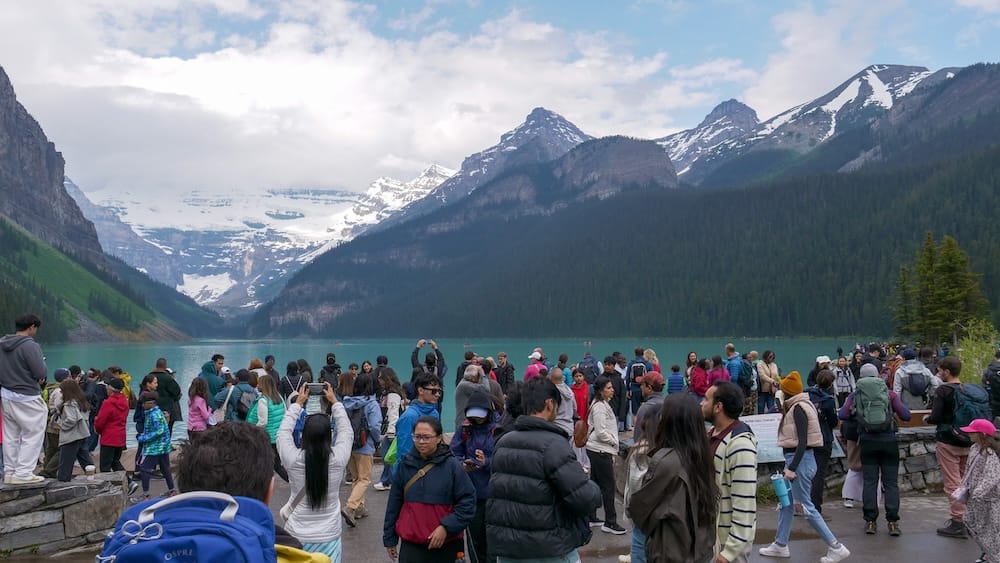
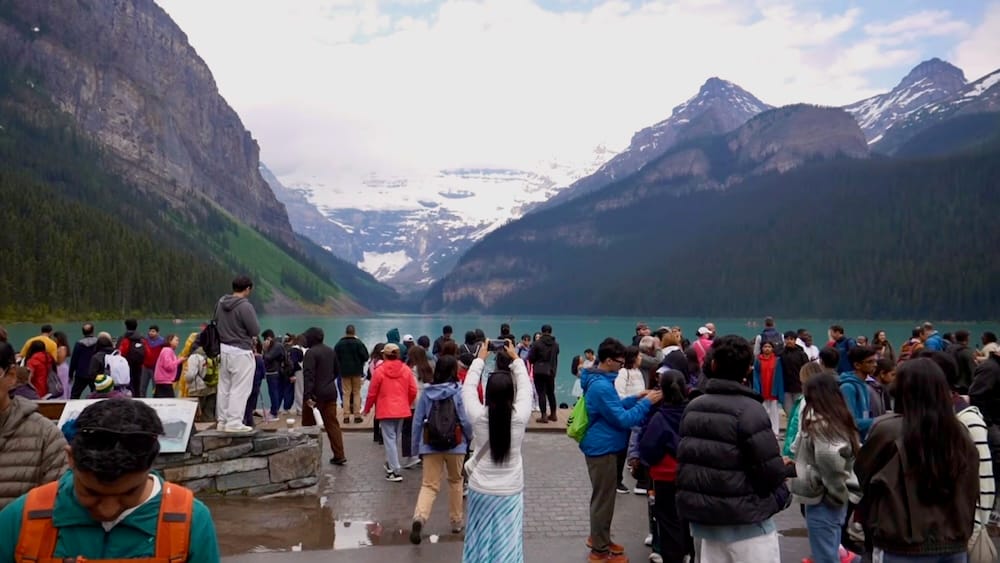
I grew up with a Canadian’s mental model of what a lake is supposed to feel like: a dock, some quiet, maybe one other family a few hundred metres down the shore. Lake Louise breaks that model completely, and it breaks it fast. On an older trip, self-driving through the Rockies, we arrived at four in the afternoon, well past any reasonable morning rush, and the shoreline was still full of people snapping photos along the rail. Years later, on a private tour, we showed up early in the morning instead, hoping to beat the crowd. It was already busy. Genuinely busy, not “a few more people than usual” busy. Two visits, years apart, at opposite ends of the day, and Lake Louise hit the same way both times.
What Actually Hits You When You Arrive
Somewhere in the middle of that second arrival, half-joking, Audrey and I tossed out a line about how it was going to be extra crowded: “five million people came to visit us, you can feel it.” It was meant as an exaggeration. It turns out we weren’t far off. Banff National Park logged 4.5 million visitors in the 2025–26 fiscal year, a new record, breaking the previous high of 4.28 million set just two years before. Our joke landed within half a million of the real number, which says less about our instincts and more about how packed this park has actually become.
Where the Crowd Actually Is (and Isn’t)
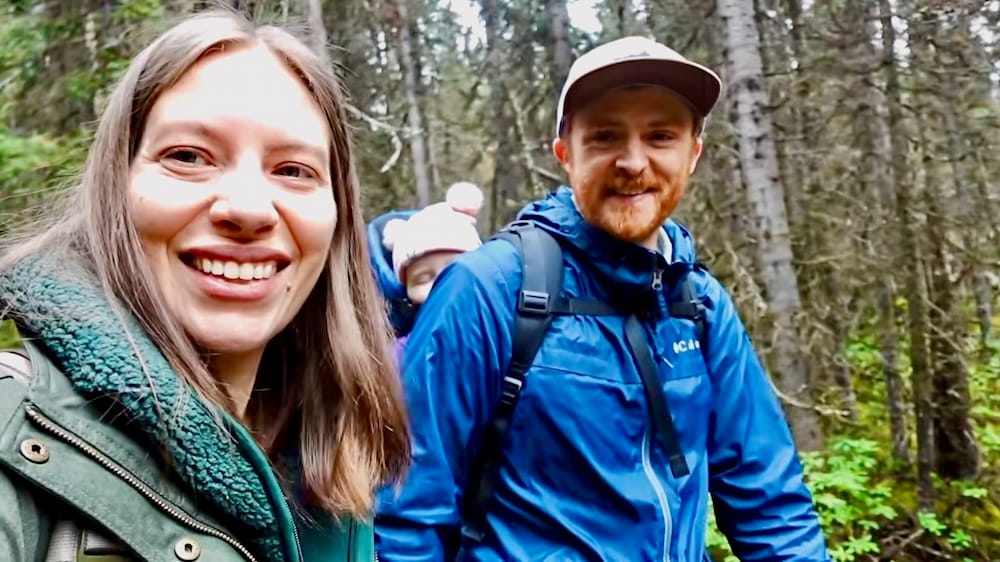
What matters more than that raw number is where the pressure actually lands. It isn’t spread evenly across Banff National Park — it’s concentrated hard at a handful of specific points, and Lake Louise is the worst of them. Parks Canada’s own field unit superintendent for the area has put it plainly, calling Lake Louise “the epicentre of the issue” for the entire park.
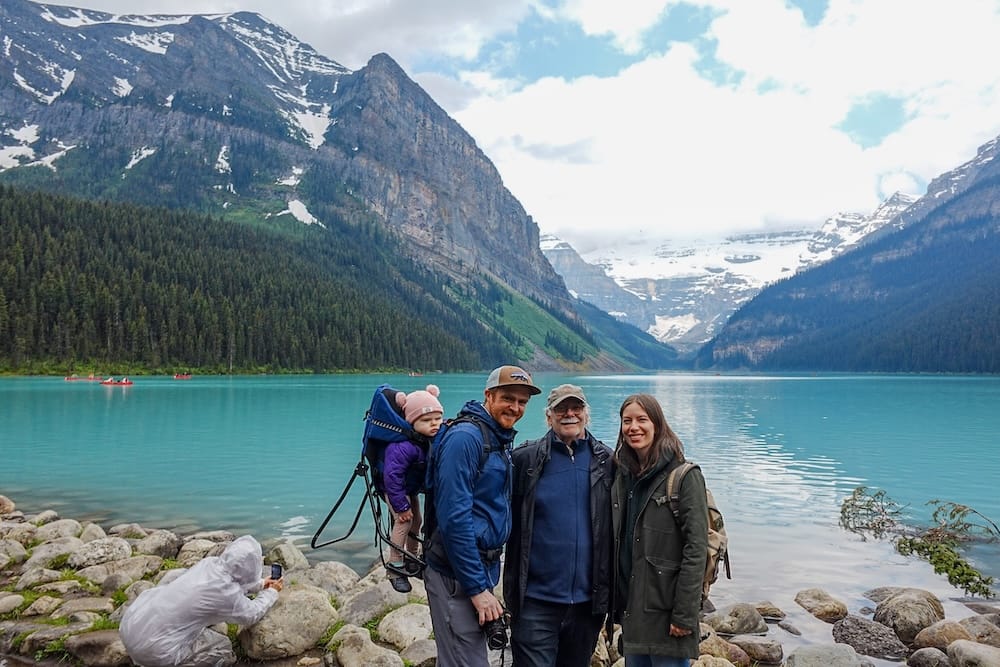
That tracks with what we saw. Lake Louise and Moraine Lake together now draw roughly 2.6 million visitors a year, about 70 percent more than in 2010, and nearly all of that pressure lands on the same narrow strip of shoreline in front of the Fairmont. We stood right in the middle of it and still managed to get our shot: Victoria Glacier framed perfectly between the peaks, the water that unreal turquoise, a scatter of red canoes out on the surface. The photo works. It just isn’t a private moment.
“Crowds descend, but it’s spectacular for a good reason, right?” “Yeah, no, it’s understood.” That exchange, traded between Audrey and me while we stood there, is really the honest version of the whole thing. We weren’t wrong. The lake earns the crowd. It just doesn’t earn it everywhere at once — the crush is real, but it’s a single, predictable bottleneck, not a condition covering the whole destination.
Why It Feels Worse Than It Used To
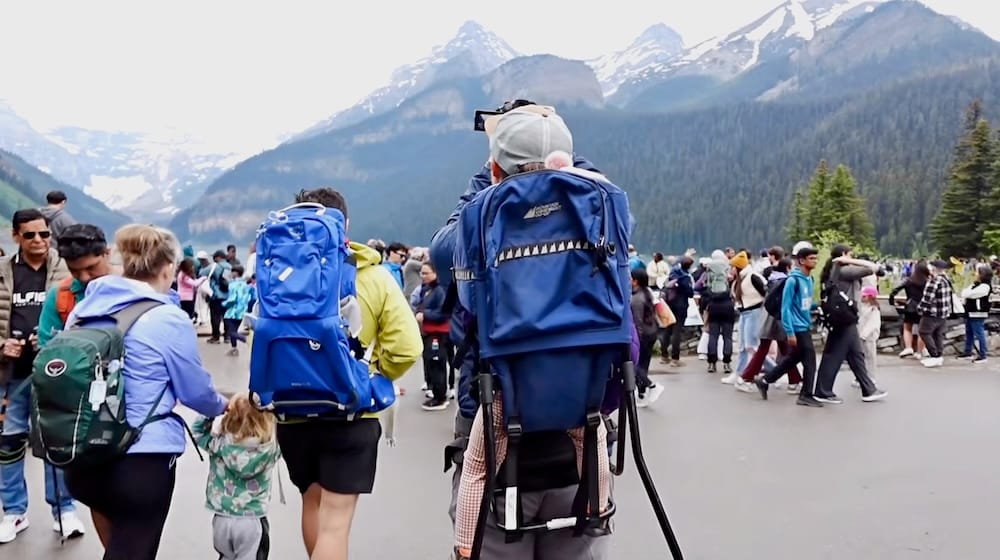
I used to think this was mostly about park fees. On camera, I said Parks Canada had removed park entry fees and that the resulting flood of visitors was “astronomical.” That was half right, and the other half deserves a proper correction.
Banff’s visitation has been climbing almost every year for over a decade, independent of any fee changes at all — that 70 percent jump at Lake Louise and Moraine since 2010 didn’t happen because of a single policy. What is true and current is the Canada Strong Pass, a federal program that waives national park admission during specific windows — this year, June 19 through September 7, plus an earlier stretch from December 12 to January 15. Paid parking still applies during those periods; only the entry fee itself goes away. So the free-admission piece is real, and it’s happening right now, but it’s compounding an already-existing surge rather than causing it from scratch. Lake Louise would still be this crowded without it. The free window just adds more people onto a base that was already climbing.
If you’re timing a visit around whether entry happens to be free, check the current Canada Strong Pass dates directly, since they shift from year to year.

Get the Shot, Then Get Out
So what do you actually do with all of this? The strategy Audrey and I landed on, without ever really discussing it out loud, was simple: get the photo everyone gets, then leave the shoreline behind.
That’s just good sequencing, not a compromise. The classic shot — glacier, mountains, turquoise water, a canoe or two — is worth having. Skipping it because of the crowd would be cutting off your nose to spite your face; you’re right there, it takes ten minutes, and you’ll want it later. But once you have it, there’s no reason to keep standing shoulder to shoulder with everyone else angling for the same angle. Walk toward any of the trails branching off from that same spot and the crowd thins out fast. I can speak to this directly for Fairview Lookout, which we hiked ourselves and which dropped us into a completely different, much quieter experience within about ten minutes of walking. The trailhead sign at that junction lists several other options heading out from the same point — Lake Agnes, Saddleback Pass, Big Beehive, Plain of Six Glaciers — and while I haven’t personally tested each of those, the pattern held up clearly enough on the one I did test that I’d bet on it holding for the others too: walk away from the photo spot in almost any direction, and the crowd stops following you.
If sorting through all of that yourself — the timing, the walking, the deciding which trail to take — isn’t how you want to spend your morning, a guided option takes the decision off your plate entirely. You can browse current Lake Louise tour options and let someone else handle the sequencing for you.
Is It Still Worth It?
Yes. The crowd at Lake Louise is real, it’s well-documented by the people who actually manage the park, and the trend line says it isn’t going away. But it’s a one-spot problem, not a whole-destination one. Show up expecting the shoreline to feel like a packed subway platform with a view, because it will. Get your photo anyway, because it’s genuinely worth having. Then walk away from it, because that’s where the lake actually starts to feel like something you get to experience rather than something you fought a crowd for. It’s crowded exactly where you’d expect, exactly as much as the numbers suggest, and it’s still worth going.
Frequently Asked Questions
How crowded is Lake Louise in summer?
Genuinely crowded, not just “busy.” We visited at two different times of day, on two separate trips, and the shoreline was packed both times. Banff National Park logged 4.5 million visitors in the 2025-26 fiscal year, a new record, and a large share of that pressure lands directly on Lake Louise.
Why has Lake Louise gotten more crowded recently?
It’s mostly a long-term trend rather than one single cause. Visitation to Lake Louise and Moraine Lake together has climbed about 70 percent since 2010. Free-admission periods under the current Canada Strong Pass add extra visitors on top of that, but they’re compounding an existing surge, not creating it.
When is admission to Banff National Park free in 2026?
The Canada Strong Pass waives park entry fees from June 19 through September 7, 2026, with an earlier window that ran from December 12, 2025 to January 15, 2026. Paid parking still applies during these periods since only the entry fee is waived. It’s worth checking the current dates directly before you plan around them, since they can change year to year.
Is the crowding the same across all of Lake Louise, or just one spot?
It’s concentrated in one specific place: the shoreline directly in front of the Fairmont Chateau, where everyone stops for the classic photo. Parks Canada’s own field unit superintendent has called Lake Louise “the epicentre of the issue” for the whole park, but that pressure isn’t spread evenly once you move away from that one strip of shoreline.
How do you avoid the crowds at Lake Louise?
Get the classic shoreline photo first, since it’s genuinely worth having, then walk toward one of the trails branching off from that same spot. We hiked Fairview Lookout ourselves and found a completely different, much quieter experience within about ten minutes of walking. Other trails branch from the same junction, including Lake Agnes, Saddleback Pass, Big Beehive, and Plain of Six Glaciers, though I’ve only personally tested the one.
Is Lake Louise still worth visiting despite the crowds?
Yes. The crowd is real and well-documented, and it isn’t going away. But it’s a one-spot problem rather than a whole-destination one, and once you’ve gotten your photo and moved past that single bottleneck, the lake starts to feel like something you actually get to experience.
This article is also available in Spanish. [Leé la versión en castellano: ¿Qué tan lleno está Lake Louise en verano? Cómo es realmente ahora mismo]
This article contains affiliate links. If you book through one of these links, I may earn a commission at no extra cost to you.