
After several trips to Banff National Park, you might imagine we have slowly worked our way through some unofficial Canadian Rockies wildlife checklist: bear, elk, moose, sheep, tick, tick, tick. Our actual record is much messier than that, which is probably why I find it more interesting.
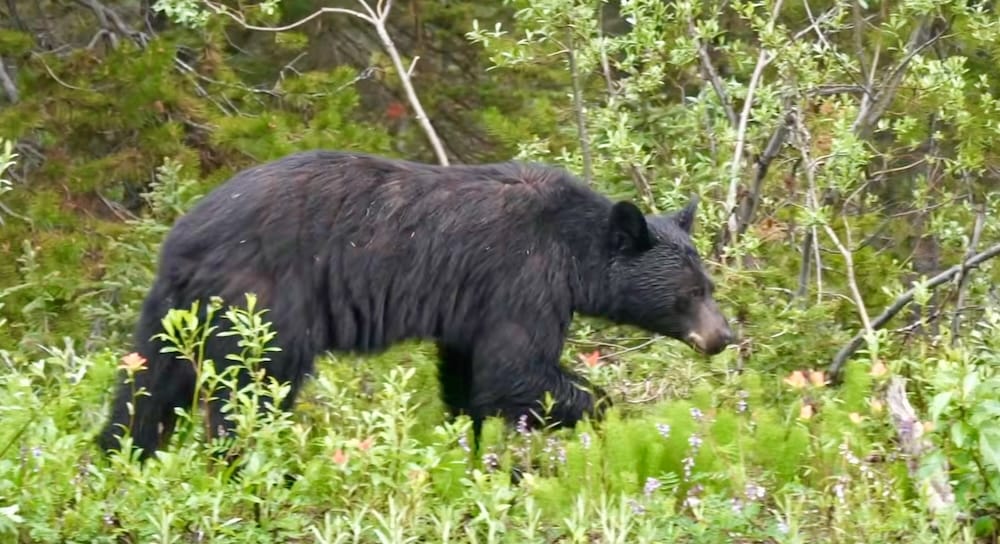
Audrey and I have seen elk and deer around Banff town. Canada geese wandered into an otherwise ordinary morning beside the Bow River. On a more recent family trip, a black bear appeared beside the road while we were travelling from Lake Louise toward Moraine Lake. During my six-day horseback trip into Banff’s backcountry, marmots and ground squirrels became part of life around the lodges. On our first Canadian Rockies road trip, a group of bighorn sheep stopped us in our tracks—literally—when we had to stop the car and let them cross.
And despite all those trips, all those kilometres and all that time outside, we have still never seen a moose in Banff.
That feels more representative of wildlife in Banff than any perfect species checklist. Most of our memorable encounters happened while we were doing something else, and none of them gives me much confidence that another traveller could repeat the experience simply by turning up at the same place. These are the animals we actually encountered, what those moments were like, and the gaps that remained even after several very different trips through the park.
The black bear we were incredibly lucky to see
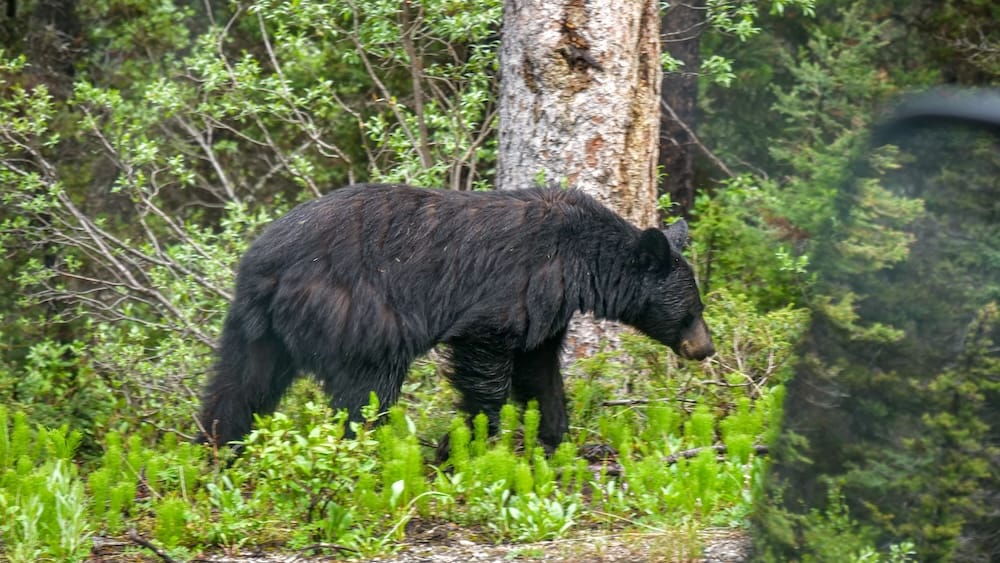
Our black bear encounter happened on one of our more recent trips to Banff National Park, when Audrey and I were travelling with our daughter Aurelia and Audrey’s dad on a private day tour.
We had already visited Lake Louise and were driving toward Moraine Lake when the bear appeared beside the road. There was no wildlife stakeout, no tip from somebody at a hotel and no patient waiting with binoculars. One minute we were travelling between two of Banff’s most famous lakes; the next minute there was a black bear.
At the time we described ourselves as having “got super lucky and spotted a black bear,” which still feels like the most accurate possible description.
The bear was moving around and feeding while we scrambled to get photographs. I remember saying, “Oh, he’s just doing his own thing,” followed shortly by the considerably less philosophical, “Wow, that’s amazing. I got it really good.” Then I checked whether Audrey had managed to get the shot too.
“Got it. Got it. Got it. Amazing.”
There you have the sophisticated wildlife commentary of two travel vloggers when an unexpected bear appears.
What I like about this encounter now is that the excitement never depended on us believing we had discovered some secret bear location. When we reached Moraine Lake later, we were still talking about seeing the bear as another surprise from an already packed day. We felt lucky because it was lucky.
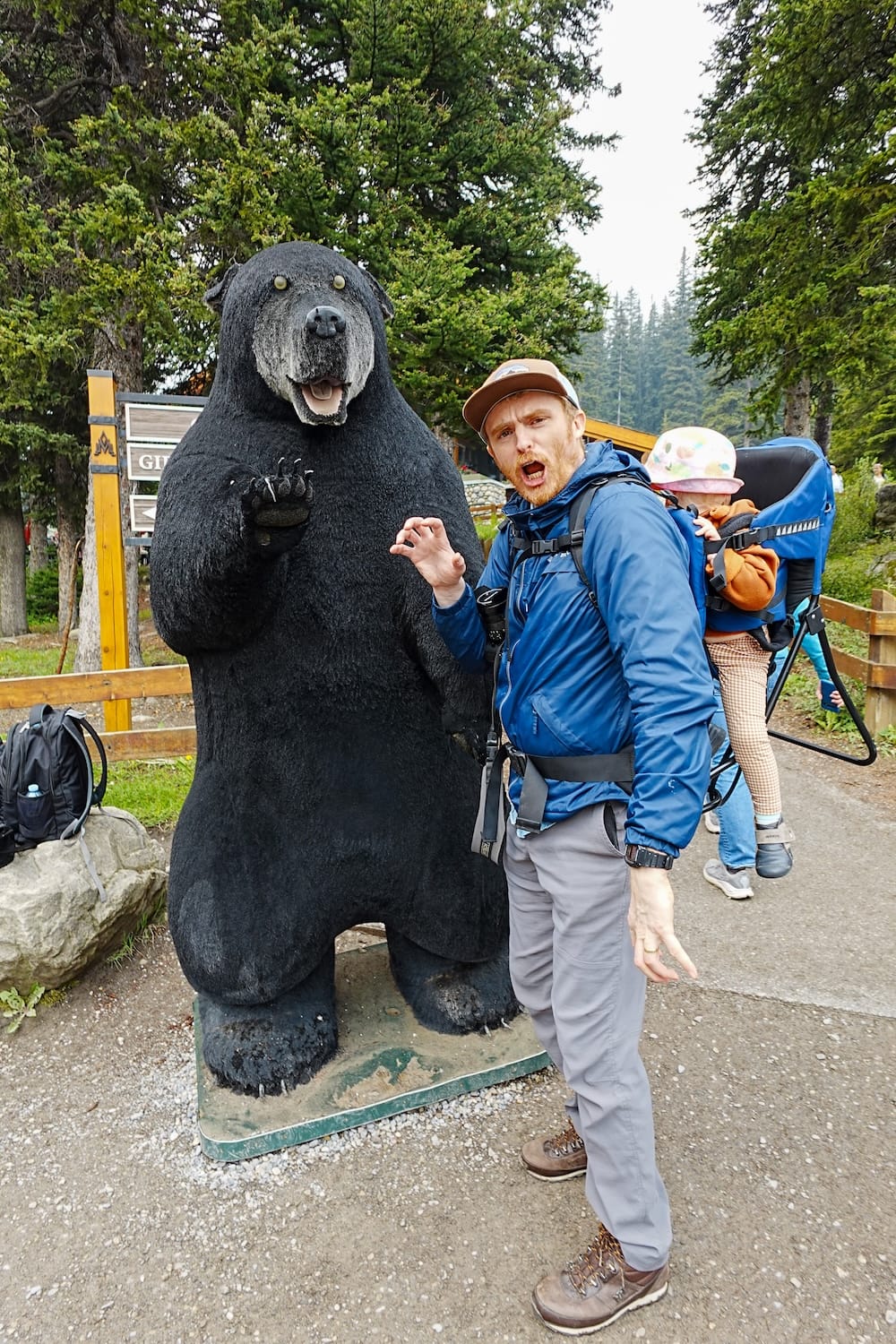
That distinction matters with roadside wildlife, where one animal can quickly turn into five stopped vehicles and twenty people trying to improve the angle of their photograph. Current Parks Canada guidance is to give bears at least 100 metres of space, stay inside the vehicle during roadside encounters and keep any viewing brief rather than helping create a wildlife jam.
I also wouldn’t attach much significance to any casual comments we made in the moment about what the bear seemed to think of us. We were excited travellers with cameras, not wildlife biologists interpreting bear behaviour. What I trust completely is the part where we couldn’t believe our luck.
Elk and deer right in Banff town
One of the stranger things about wildlife in Banff is how quickly the setting can mess with your perception of the animal.
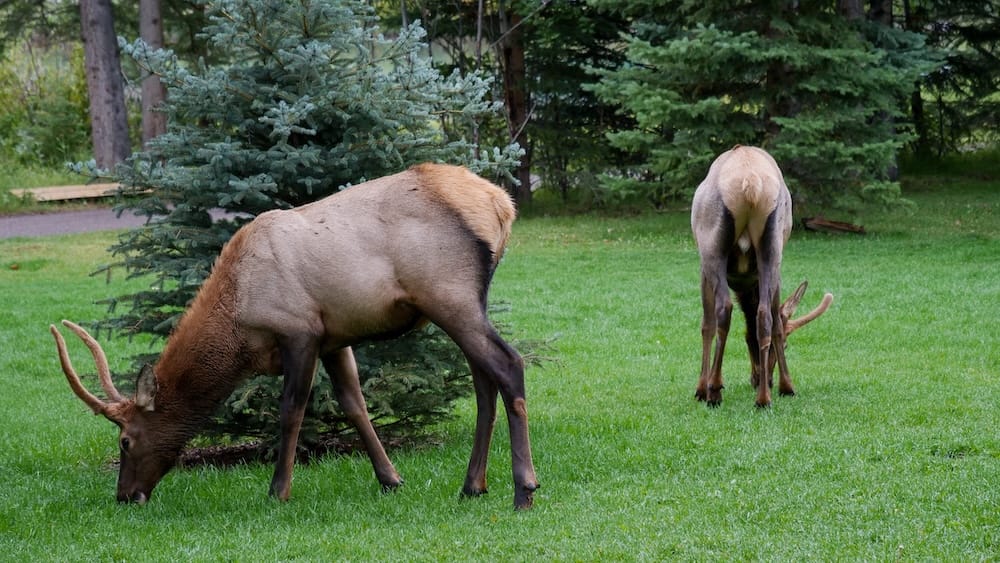
We’ve seen both elk and deer around Banff town. You can be surrounded by roads, buildings, cafés, hotels and people carrying takeaway coffee, then suddenly there is a large wild animal occupying essentially the same space.
That overlap makes sense because Banff is not an ordinary town with a national park somewhere beyond its suburbs. The townsite itself sits inside Banff National Park, along a valley bottom that wildlife also uses to move through the landscape. Large animals really do pass through developed areas.
I remember the fact of our elk and deer sightings more clearly than the exact circumstances of each one, so I’m not going to manufacture a dramatic scene where one doesn’t exist. What stayed with me was the juxtaposition: these were wild animals appearing around a functioning tourist town, not animals we had driven deep into the mountains hoping to find.
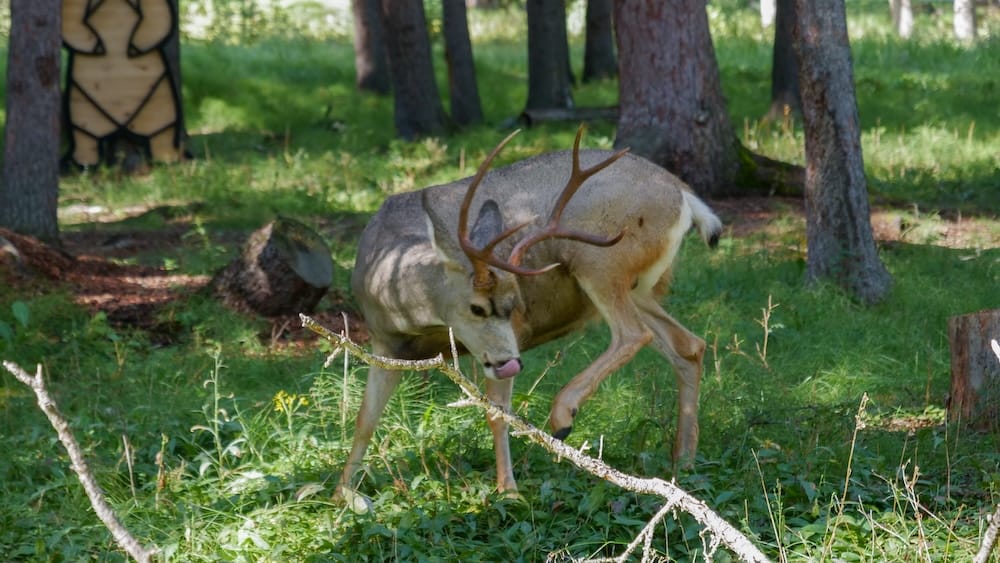
That setting can also make them look deceptively approachable. An elk standing near a hotel or road may appear completely accustomed to people, but it is still a wild animal with its own space and very little interest in participating in somebody’s selfie.
Current guidance is to remain at least 30 metres from elk and deer, and elk deserve particular caution during two parts of the year. Calving season runs roughly from mid-May into early July, when females can be highly defensive, while rutting season extends from late August into mid-October and can make males aggressive.
That is a useful reminder in Banff town because the surroundings can feel so normal. The animal hasn’t suddenly become domestic because there happens to be a restaurant fifty metres away.
Seeing elk and deer around town gradually changed how I thought about wildlife in Banff. It wasn’t something that only existed once we had driven to a remote trailhead. Sometimes it was sharing the town with us.
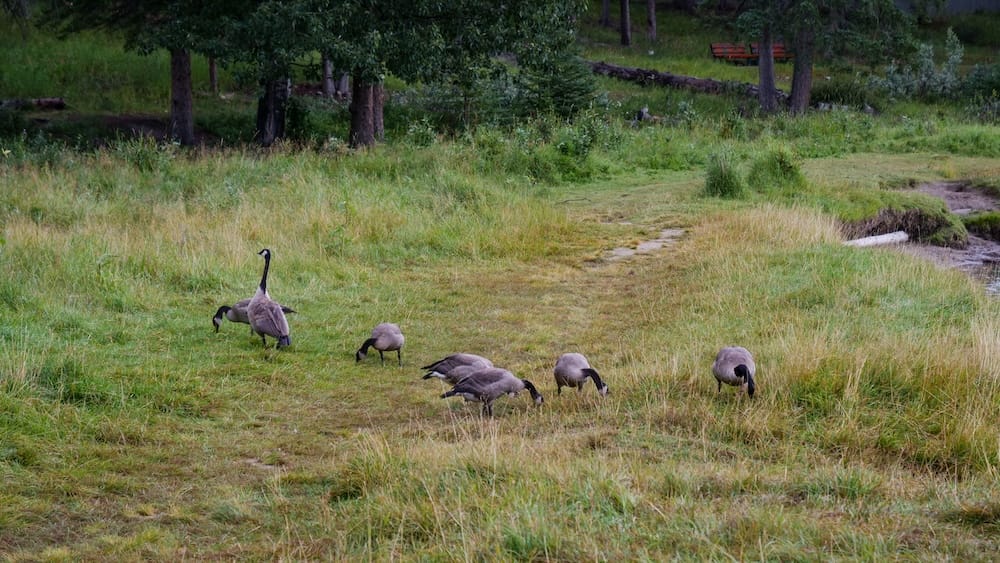
Canada geese on a completely ordinary Bow River morning
One of my favourite Banff wildlife memories involves what is probably the least marketable species in this article: Canada geese.
Audrey and I were spending a random morning walking around Banff town beside the Bow River, following the outdoor Art in Nature route and crossing a pedestrian bridge. We had very little structure to the morning and were enjoying exactly that, describing ourselves at the time as having “not really too many preconceived plans.” We agreed that those kinds of mornings could be “sometimes the most fun of all.”
Wildlife simply became part of it. We noticed Canada geese beside the river, stopped to look and carried on. Nobody is flying halfway around the world specifically hoping to complete a once-in-a-lifetime Banff goose pilgrimage, but I actually think they belong in this article precisely because they are so ordinary.
Travel wildlife is not always a black bear stepping out of the forest while the soundtrack swells. Sometimes it is geese beside a river.
That morning also captures something I would lose if I turned all of these encounters into a guide about where readers should go and find the same animals. We already liked the Bow River walk. The wildlife added to it, but our enjoyment of the morning did not depend on whether something impressive appeared. There was no sense that Banff had failed if an elk didn’t materialize before lunch.
Marmots and ground squirrels deep in the Banff backcountry
My wildlife experience changed considerably when I spent six days travelling through Banff’s backcountry on horseback. Audrey wasn’t with me on that trip; I joined a small group and rode into remote country where we stayed at Sundance Lodge and Halfway Lodge.
Once I was spending days around backcountry cabins rather than returning to Banff town every evening, the smaller animals became much more noticeable. They weren’t fleeting sightings through a car window. They were simply part of where I was living for a few days.
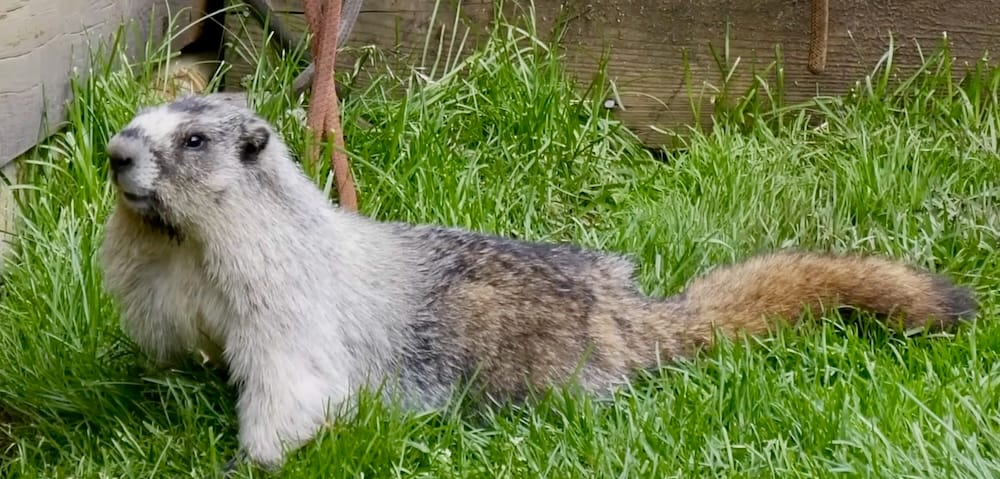
Marmots around Sundance Lodge
When I first arrived at Sundance Lodge, I was told there were marmots living around the property and that they had a habit of getting into places where they weren’t necessarily invited. Later in the trip, when I returned to Sundance, I actually saw them myself.
“Here’s our Marmot friends. Hi Marmot friends.”
Not exactly David Attenborough, but I was happy to see them.
Banff is home to marmots in its mountain environments, and what I remember about these was less some dramatic wildlife moment than the fact that they felt like part of the lodge surroundings. By that stage of the trip, seeing them around the property seemed almost neighbourly.
I’m happy leaving the identification at marmot rather than trying to retroactively attach a more precise species label than I made at the time. Banff does have hoary marmots, but my own encounter does not need taxonomic heroics to be worthwhile.
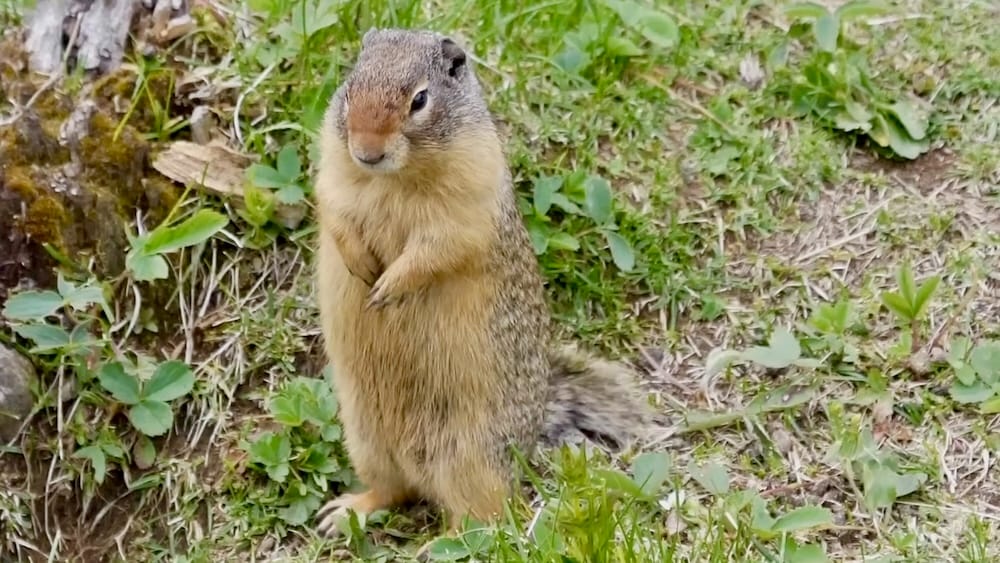
The ground squirrels that made me watch my step
Halfway Lodge had a different resident cast. “Over here on this property, we have ground squirrels, not marmots.” Apparently I had become very concerned with rodent classification by this stage of the horseback trip.
Within about five minutes of arriving, one ground squirrel had already stood upright near me, and I described it as “a cheeky little one” that seemed to be posing for the camera. It was a funny little encounter, but the real practical impact came once I started noticing their burrows.
There were holes all around parts of the property, sometimes appearing where I wasn’t expecting them, and I quickly realized that wandering away from the normal path while staring at the scenery was an excellent way to put a foot somewhere unfortunate. I found myself watching the ground much more carefully because twisting an ankle in a ground-squirrel hole halfway through a six-day horse trip would have been an especially stupid way to complicate things.
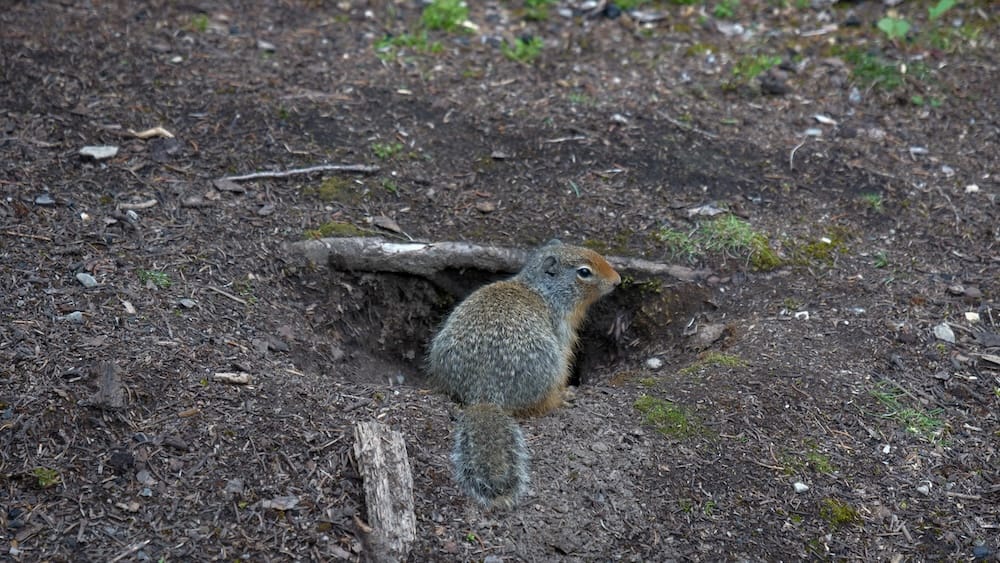
That detail is probably why the ground squirrels stick with me. Plenty of wildlife articles can tell you which small mammals live in Banff. I remember one standing up for my camera and then spending the next few days trying not to step into its front door.
Banff has more than one ground-squirrel species, so I’m keeping the identification where my experience supports it: ground squirrels.
One of our best wildlife encounters happened just outside Banff National Park
One of the strongest wildlife memories from our first Canadian Rockies trip actually happened outside Banff National Park, during the Kananaskis portion of the road trip.
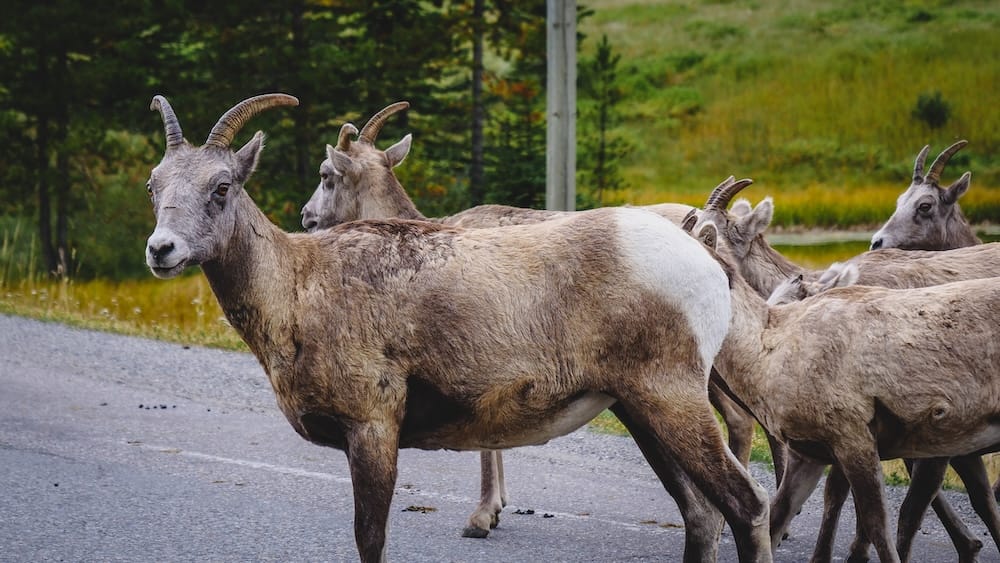
We suddenly came across a group of bighorn sheep beside the road, and this was not one of those sightings where somebody in the car yells, “I think that brown dot might have been something.” We had to stop the car.
Several sheep were grazing right beside the roadway while others crossed or stood close enough to the pavement that continuing to drive simply wasn’t an option. There were adults and smaller animals together, and the whole encounter came completely out of the blue.
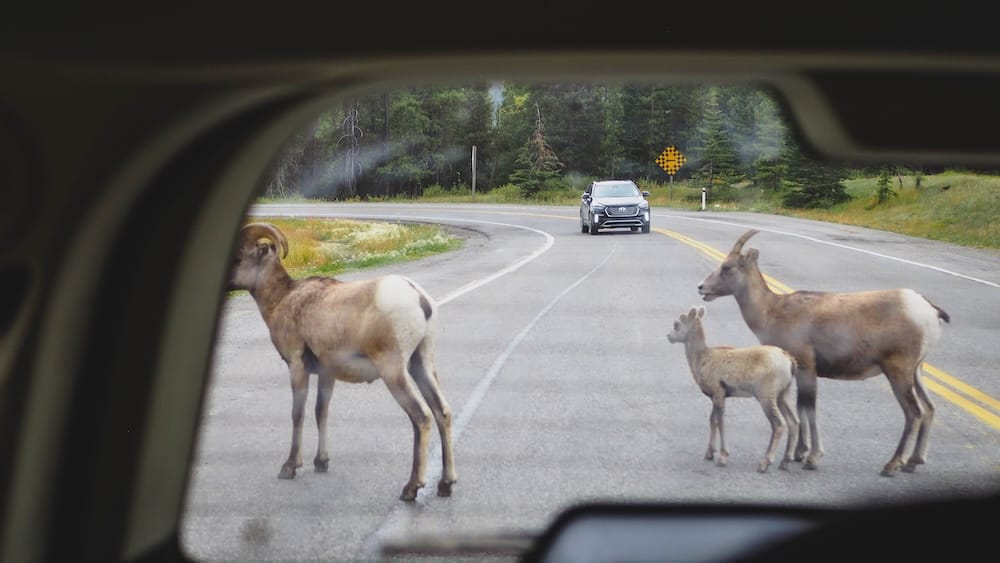
It also produced some of our best wildlife photographs from any Canadian Rockies trip. We have shots where individual sheep are standing almost perfectly for the camera, images of several animals together and a larger group scattered across the roadside. The bighorn identification is clear from their brownish coats, white rump patches and characteristic horns, including some beautifully curved horns on the larger animals.
I could easily have left this section out because the encounter happened in Kananaskis Country rather than inside Banff National Park, but that would make the article less truthful rather than more geographically tidy. This was our first Banff-centred Canadian Rockies road trip, and one of its best wildlife encounters happened just beyond the park boundary.
That is how road trips work. Animals do not care which tourism region owns the keyword.
The thing I remember most is simply the interruption. We were travelling through the mountains, the sheep appeared, and suddenly the road belonged to them for a while. We stopped because they were crossing; the animals dictated the encounter, not us.
The animal we still never saw in Banff: a moose
With a black bear, elk, deer, bighorn sheep, marmots, ground squirrels and various birds in the memory bank, you might assume that repeated Canadian Rockies trips eventually produce everything. They don’t.
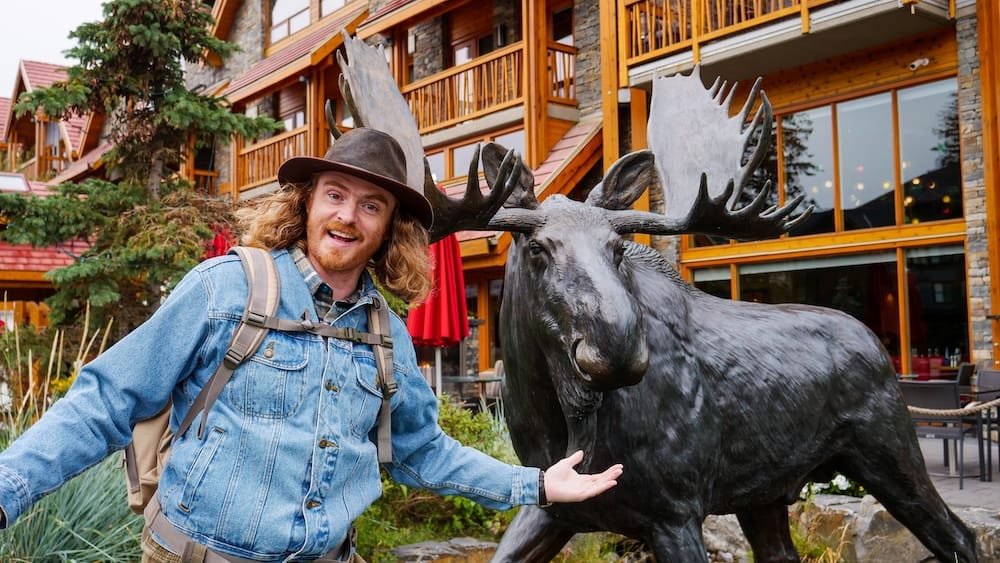
We have still never seen a moose in Banff, which is particularly funny because moose are not some mythical animal in our lives. On our own property in Southern Alberta near the Crowsnest Pass, we see them at least a few times a year.
So apparently the moose are perfectly capable of finding us at home. They just refuse to participate when we go to Banff.
There is some useful context. Moose were historically more widespread around Banff but have largely disappeared from the Bow Valley in recent years, although they still occur elsewhere in the broader park. That does not explain exactly why we never saw one, nor does it mean another visitor cannot. It simply makes our Banff non-sighting less mysterious than it might seem.
I like keeping the moose in this article precisely because we didn’t see one. Wildlife content can easily create the impression that a national park works like a vending machine: insert park pass, press B7, receive elk; stay another two days and upgrade to bear; add a week and somebody wheels out the moose.
Our trips never worked like that. The longer we spent in the Rockies, the more species we happened to encounter, but there was no point at which the wildlife checklist suddenly completed itself.
What if seeing wildlife is a priority for your Banff trip?
Our encounters were mostly opportunistic, but that does not mean everybody has to leave wildlife entirely to chance. If seeing animals is one of your major reasons for visiting Banff, a guided outing makes more sense to me than trying to reconstruct somebody else’s bear sighting from a photograph and a vague road description.
I haven’t personally taken these wildlife-specific tours, so I would treat them as planning options rather than personal recommendations. For a more focused outing, GetYourGuide currently lists a guided Banff evening wildlife safari that travels through the national park looking for animals while also covering local ecology and conservation; importantly, the tour itself makes clear that sightings cannot be guaranteed. You can check current availability for the Banff Evening Wildlife Safari.
If you would rather combine wildlife viewing with a broader introduction to Banff, there is also a small-group sightseeing option that mixes wildlife searching with scenic stops such as Lake Minnewanka, Bow Falls and viewpoints around the park. That is a different proposition from a dedicated safari, and you can compare availability for the Banff Highlights & Wildlife small-group tour.
Whichever approach you choose, I would still go in with the same expectation we developed through our own trips: a guide can put you in appropriate habitat and improve the structure of the search, but nobody can schedule a bear for 6:45 p.m.
What these encounters actually taught me about wildlife in Banff
Looking back across these trips, what strikes me most is how rarely wildlife was the original reason we were somewhere. The black bear appeared while we were travelling between Lake Louise and Moraine Lake. The geese became part of a morning Audrey and I were already enjoying beside the Bow River. Marmots and ground squirrels were around because I happened to be living at backcountry lodges for several days. The bighorn sheep literally interrupted our road trip.
Even our elk and deer sightings around Banff town fit the same pattern. The animals were moving through their landscape while we happened to be moving through ours.
That does not mean luck replaces basic wildlife sense. Parks Canada currently asks visitors to stay at least 30 metres from deer, elk, bighorn sheep and moose, and 100 metres from bears, wolves, cougars and coyotes. Feeding, enticing or disturbing wildlife is prohibited, and photography does not create some magical exemption because the light happens to be perfect.
If you need a tighter photograph, use zoom, a longer lens or crop it later rather than closing the distance. Roadside encounters deserve particular restraint too: stay in the vehicle, make sure any stop is safe and don’t help transform one animal beside the road into a traffic jam.
I also wouldn’t pretend Audrey and I were mentally running through a Parks Canada rulebook during every encounter we had over the years. Sometimes our reactions were exactly what you would expect from excited travellers: grab the camera, get the photograph, can you believe this is happening?
What repeated trips have given me is perspective on how little control we ever had over the best moments. The bear appeared and hijacked our attention for a few minutes. Bighorn sheep forced us to stop the car. A cheeky ground squirrel stood up outside a backcountry lodge. Canada geese wandered into a morning that had been going perfectly well without them.
And after all that, the moose still refused to participate in Banff—even though a few of them manage to wander onto our own property every year.
I’m fine with that. Banff has given us plenty of wildlife encounters without ever making wildlife feel guaranteed, and that unpredictability is a big part of what made the encounters memorable in the first place.
Frequently Asked Questions
What wildlife did you actually see in Banff National Park?
Across several trips, we saw a black bear, elk, deer, Canada geese, marmots and ground squirrels inside Banff National Park. We also had an excellent bighorn sheep encounter in nearby Kananaskis Country during our first Canadian Rockies road trip.
Can you expect to see a black bear in Banff?
No wildlife sighting is guaranteed. Our black bear appeared unexpectedly while we were travelling between Lake Louise and Moraine Lake, and we considered ourselves extremely lucky to see it.
Can you see wildlife right in Banff town?
We did. Audrey and I encountered both elk and deer around Banff town, showing how wild animals can move through the developed townsite even when you are nowhere near a remote backcountry trail.
Did you see the bighorn sheep inside Banff National Park?
No. Our bighorn sheep encounter happened during the Kananaskis portion of our first Banff-centred Canadian Rockies road trip, just outside Banff National Park. The sheep appeared beside the road and we had to stop while they crossed.
How far should you stay from wildlife in Banff National Park?
Current Parks Canada guidance is to stay at least 30 metres from deer, elk, bighorn sheep and moose, and at least 100 metres from bears, wolves, cougars and coyotes. Roadside wildlife should also be viewed without creating a traffic jam or approaching for a closer photograph.
Did you ever see a moose in Banff?
No. Despite several Banff trips and even my six-day backcountry horse trip, we have never seen a moose there. Ironically, we see moose at least a few times a year on our own property in Southern Alberta near the Crowsnest Pass.
This article is also available in Spanish. [Leé la versión en castellano: Fauna que vimos en el Parque Nacional Banff: nuestros encuentros reales]
This article contains affiliate links. If you book through one of these links, I may earn a commission at no extra cost to you.