
If you only have time for one, I’d give Moraine Lake the narrow edge.
That answer comes with a fairly large asterisk because Lake Louise and Moraine Lake are not interchangeable turquoise lakes where you simply choose whichever photograph you like better. Audrey and I have now visited both more than once, including seeing them back-to-back on two different trips, and my opinion of the two has become more nuanced rather than less.
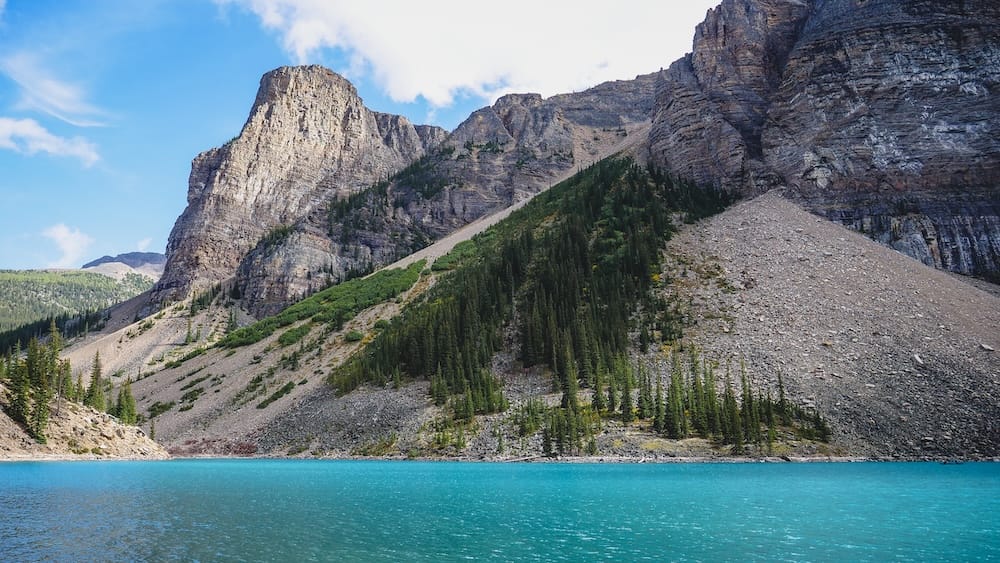
Moraine Lake impressed me immediately. On our first visit, it was one of those places we had been dying to see, and Audrey summed it up perfectly when she said it really lived up to its reputation. Years later I returned, climbed the Rockpile and had much the same reaction: the panorama is enormous, the effort required to reach it is modest, and if somebody gave me a short window for one of Banff National Park’s famous lakes, that is probably where I would send them.
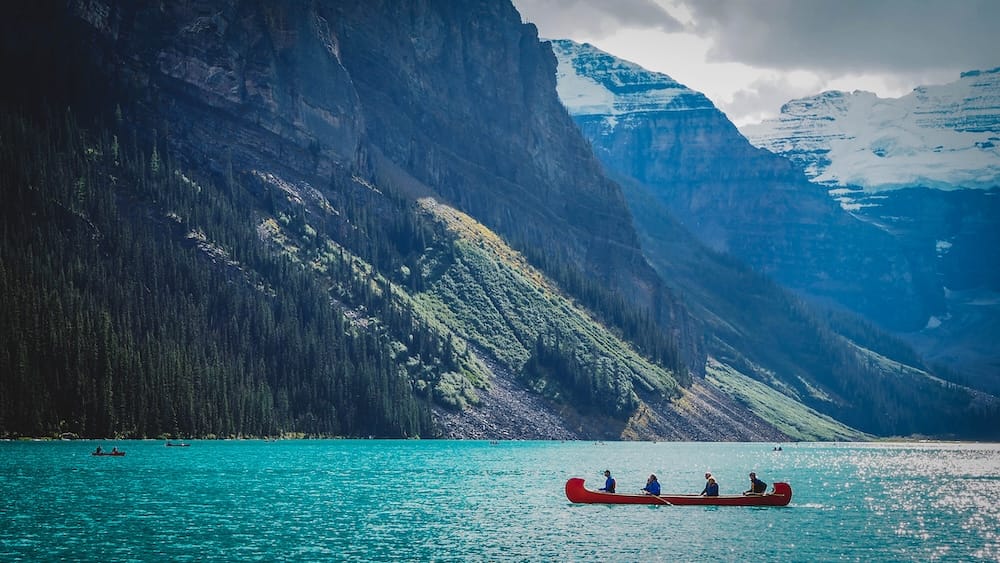
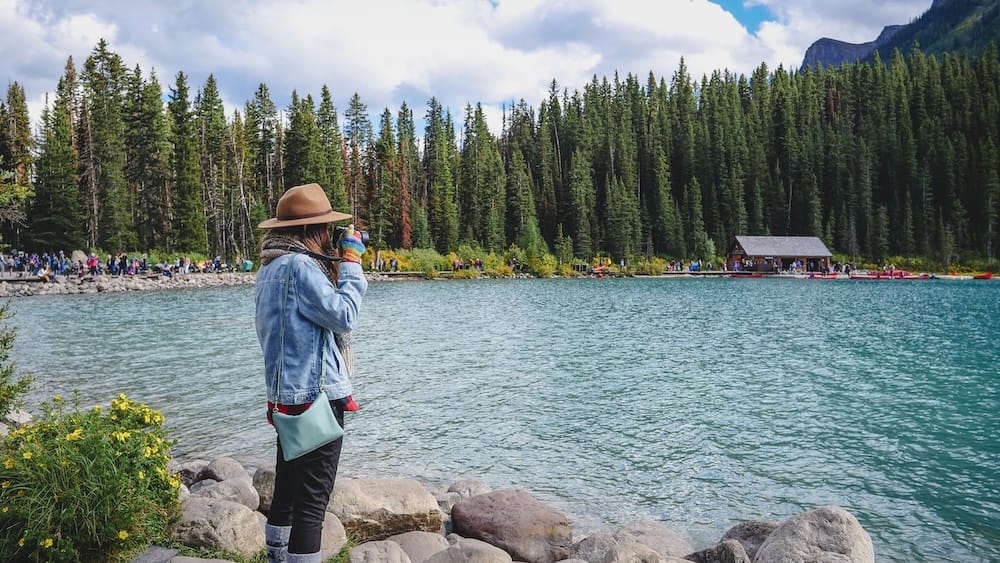
Lake Louise took longer to win me over. I always thought it was beautiful, but after our earlier trip I mostly filed it under iconic Canadian Rockies sight: see the lake, take your photos, continue with the trip. When we returned years later, the shoreline was so busy that I jokingly called it the “selfie capital of Canada.” Then we hiked away from that crowd to Fairview Lookout, and my opinion of Lake Louise changed considerably.
That difference now controls how I compare them. Moraine Lake impressed me faster. Lake Louise impressed me more the longer I stayed.
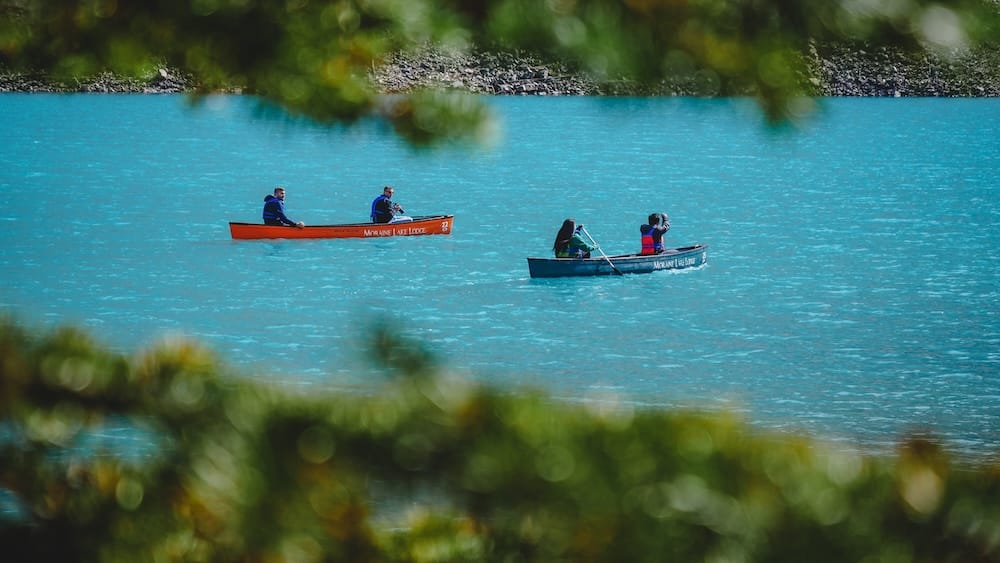
Which lake makes the bigger first impression?
For me, Moraine Lake wins this category.
On our first visit, the colour of the water immediately grabbed us, but it was really the entire setting that made the place feel so complete. The lake sits beneath this enormous wall of mountains, and once you gain a little elevation around the Rockpile, everything seems to line up into the kind of Canadian Rockies panorama you probably had in your head before arriving.
It feels almost suspiciously well arranged for landscape photography.
Lake Louise is obviously not hurting for scenery. The turquoise water, mountains and glacial backdrop are right in front of you when you reach the shoreline, and when the light cooperates it is spectacular. We’ve now seen it under different conditions on different trips, and I completely understand why it became one of Canada’s defining mountain images.
The difference is more about how quickly each destination got to me. Moraine Lake produced an immediate yes, this is exactly why we came here reaction. Lake Louise became more interesting after I started moving beyond the first view, and if your entire visit is going to be short, that distinction matters.
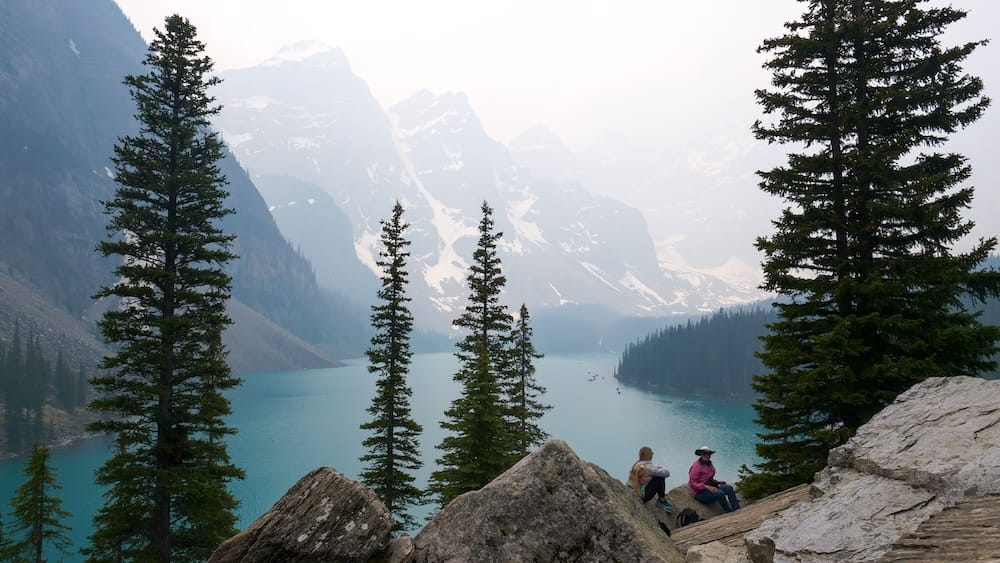
Rockpile vs Fairview Lookout: the view-for-effort contest
Our recent trip gave me a comparison I couldn’t make after the first visit because I did both short viewpoint walks on the same day.
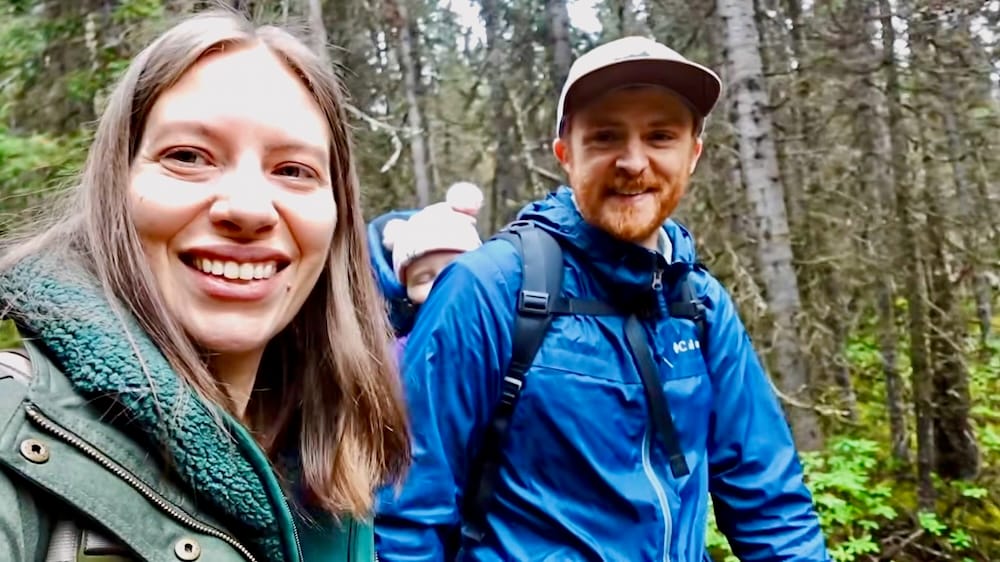
At Lake Louise, we climbed to Fairview Lookout. The trail is about 1.2 kilometres each way, gains roughly 100 metres and has an estimated return time of around 45 minutes. It is short, but Parks Canada describes it as steep, and that matched my experience perfectly.
I also had Aurelia on my back, weighing roughly 25 pounds, which improved neither my speed nor my dignity. It felt a little like volunteering to walk uphill with a decent-sized dumbbell strapped to me, except this particular dumbbell spent part of the climb wondering what her parents had done to her before eventually falling asleep and enjoying what we jokingly called her sedan-chair ride.
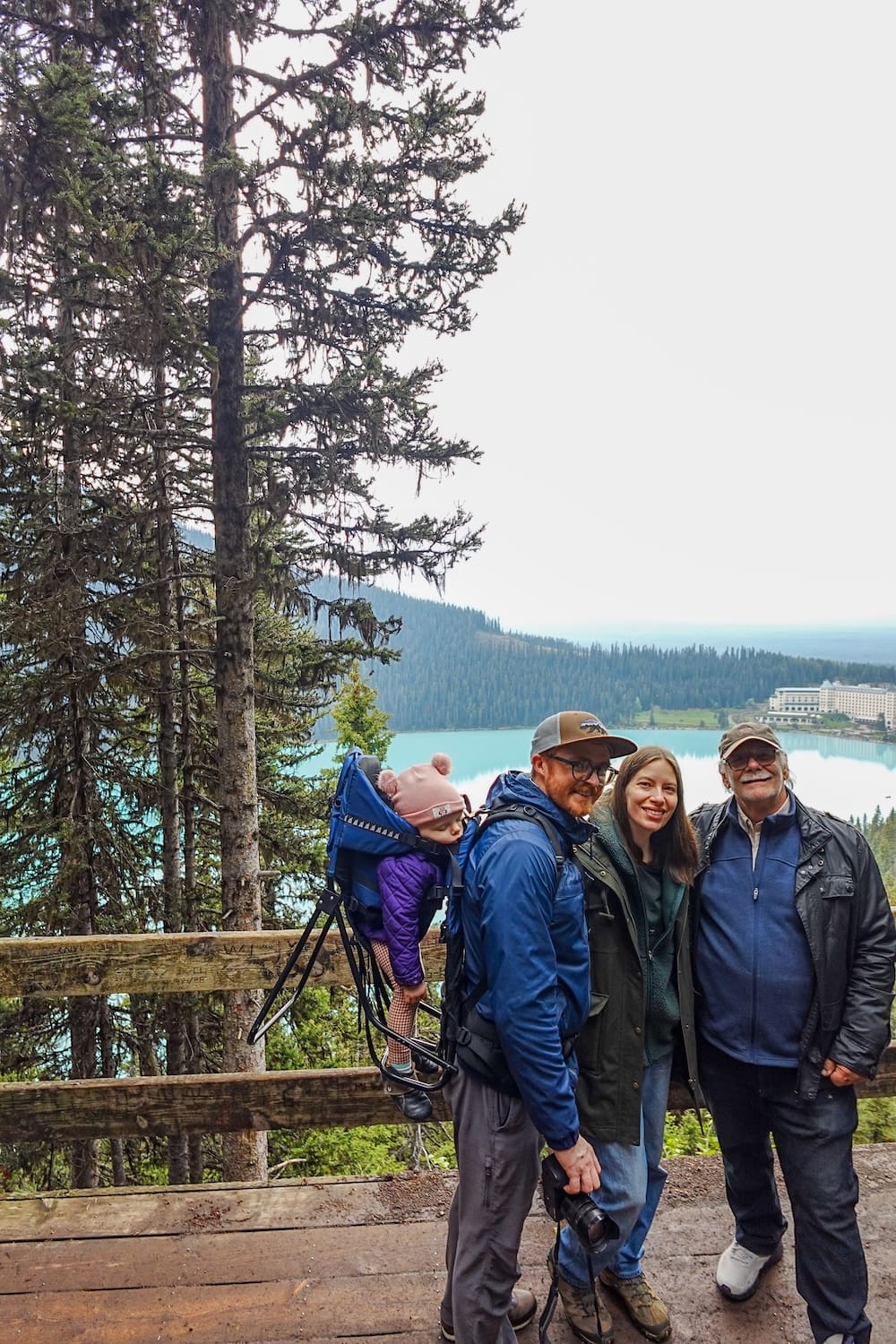
Fairview made the effort worthwhile. When we reached the lookout, my verdict was basically: totally worth it, steep, take your time. What surprised me almost as much as the view was the change in atmosphere. The Lake Louise shoreline below had been packed, but during our visit there were only around four or five other people at Fairview.
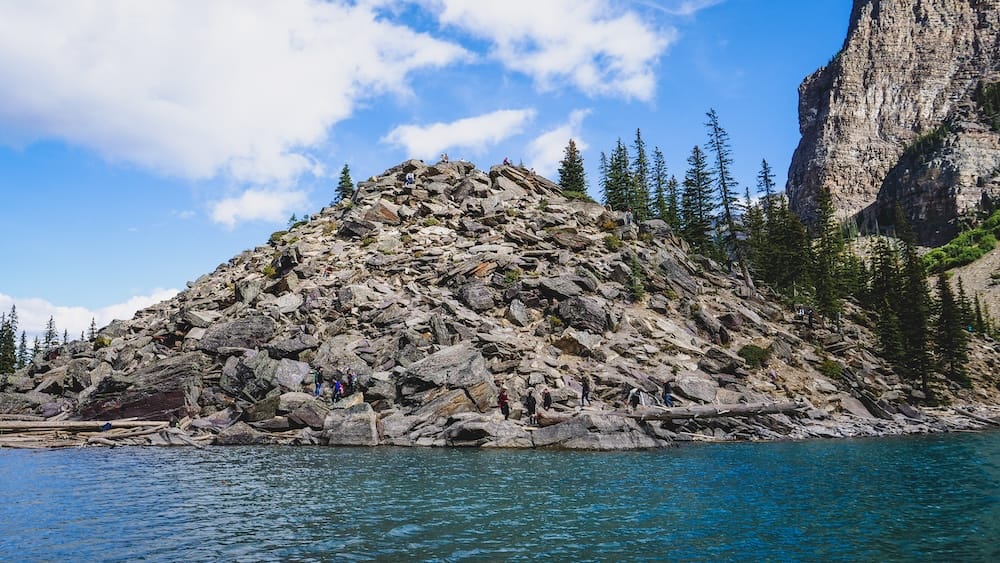
Later that day I went up the Rockpile at Moraine Lake, and physically it was a very different proposition. The official loop is roughly 0.7 kilometres in total, gains about 35 metres and takes around 30 minutes. My own impression was even simpler: I wouldn’t really call what I did a hike. It felt more like wandering uphill on steps.
The scenic payoff was enormous. From up there you get the classic elevated view across Moraine Lake and the surrounding peaks, and I remember coming back down saying the panorama was absolutely phenomenal.
There was one catch: the Rockpile was far busier than Fairview during our visit. I joked that it felt 100 times busier, which was obviously not the result of me conducting a scientific head count with a clipboard. It was just the contrast talking. Fairview had felt surprisingly peaceful; Rockpile very much did not.
Still, for maximum elevated view with minimum physical effort, Moraine Lake wins this one comfortably.
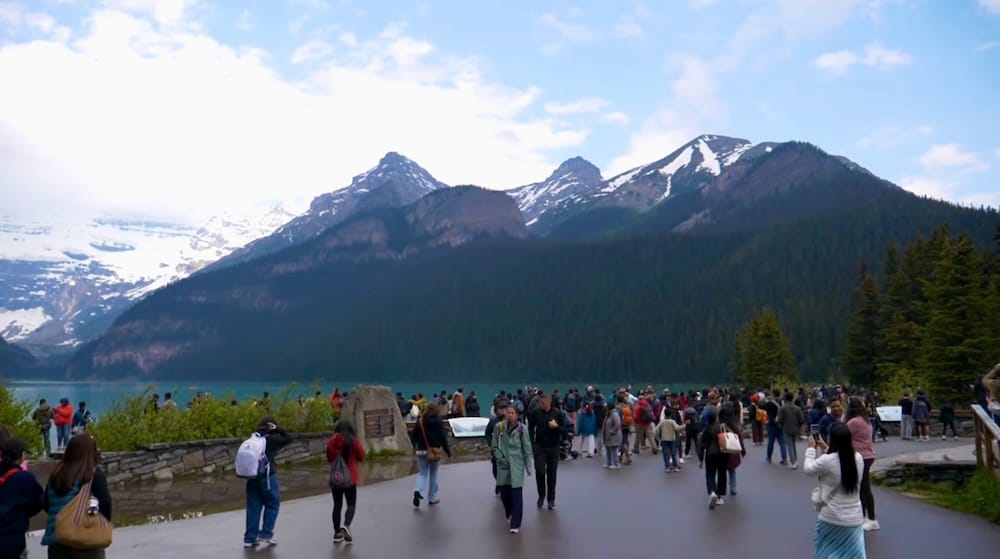
The crowd question is more complicated than “which lake is busier?”
Both places are busy enough that I would be suspicious of anyone selling either as the peaceful alternative to the other during peak visitor season.
Lake Louise handles the larger volume overall. Recent visitor-use estimates put Upper Lake Louise at around 11,000 visitors per day during the main operating season, compared with roughly 6,000 at Moraine Lake. Yet those numbers do not tell you how crowded a particular part of either destination will feel.
Our recent Lake Louise visit is a good example. We arrived early in the morning and the main shoreline was already extremely busy. If we had taken the obligatory photographs and left, that concentrated crowd would have become my entire impression of the place. Instead, we walked uphill, and by the time we reached Fairview our experience had changed dramatically. We hadn’t discovered some guaranteed secret corner of Lake Louise—another day could obviously look very different—but during our visit the crowd dropped to a handful of people.
Moraine Lake behaved differently. The Rockpile is one of the obvious places to go because it provides such a huge visual reward for relatively little effort, and plenty of other visitors make exactly the same calculation. Going uphill there did not give me the kind of crowd escape that Fairview did.
So I wouldn’t award a generic “less crowded” trophy to either lake. Lake Louise gave me the more overwhelming crowd at its main viewpoint, but it also gave me the better escape from that concentration once I walked away. That turned out to matter quite a lot to how I felt about it.
Which is better for a short or low-effort visit?
This is where Moraine Lake starts building its case for my overall narrow win.
Observed visits average around 1.5 hours at Moraine Lake and roughly 2.5 hours at Upper Lake Louise. Those figures are not recommendations for how long you should spend at either place, but they are useful scale markers because they reflect something I felt myself: Moraine Lake can deliver an awful lot very quickly.
You can see the lake, go up the Rockpile and enjoy one of the defining panoramas of the Canadian Rockies without committing to a major hike. There is also a lakeshore trail of about 1.3 kilometres one way if you want to keep walking without turning the outing into a serious mountain day.
Lake Louise works perfectly well as a short stop too. You don’t need Fairview before the lake suddenly becomes legitimate; the famous shoreline view is immediate, and the Lakeshore Trail lets you continue beside the water on a relatively straightforward walk.
But if somebody handed me a tight block of time and said, “I want the biggest scenic payoff I can get without spending half the day hiking,” I would choose Moraine Lake. The Rockpile tips it for me because it asks comparatively little and gives back a ridiculous amount.
That doesn’t mean every visitor will find it easy. Steps still matter, mobility varies enormously and a route that felt simple to me may not feel simple to somebody else. But for the ordinary sightseeing comparison, Moraine Lake wins the short-visit category by a nose.
If you have half a day, the comparison gets much more interesting
This was the category where I initially assumed Lake Louise would destroy Moraine Lake. It doesn’t.
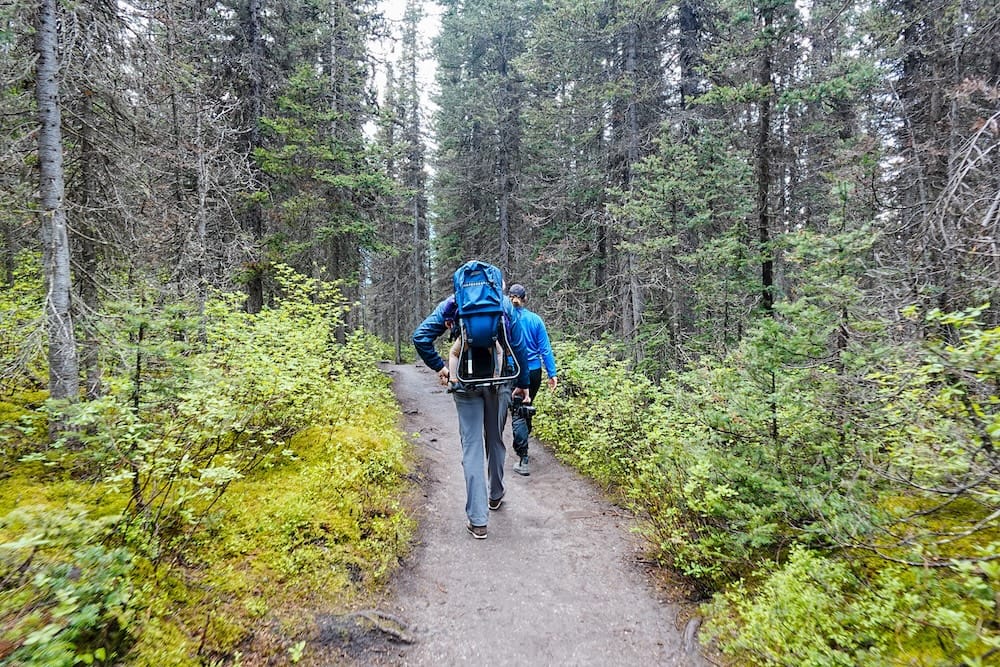
Lake Louise has a fantastic progression into bigger hiking. Lake Agnes is about 3.9 kilometres one way with 495 metres of elevation gain and an estimated 2.5 to 3 hours return. Plain of Six Glaciers stretches roughly 5.9 kilometres one way, climbs 595 metres and takes around four hours return. Link Lake Agnes with Plain of Six Glaciers via the Highline Trail and you are looking at roughly five hours of hiking.
We haven’t personally completed those longer routes, so I’m not going to tell you which climb has the better rhythm underfoot or where I’d stop for a heroic snack. What I can say from doing Fairview is that Lake Louise started making much more sense to me once the lake became a starting point rather than the entire activity.
Moraine Lake, however, has plenty of mountain behind the postcard too. Larch Valley runs around 4.5 kilometres one way with 570 metres of climbing. Eiffel Lake is roughly 5.7 kilometres one way with 560 metres of gain, Sentinel Pass pushes the elevation gain to about 750 metres, and Wenkchemna Pass becomes a major 7-to-8-hour outing with more than 1,000 metres of climbing.
We haven’t personally hiked those routes either. Their significance here is that Moraine Lake should not be reduced to a pretty viewpoint for people who don’t want to walk very far.
If serious hiking is the main reason you’re choosing between the two lakes, I would call this category a draw and pick the trail rather than the lake name. Lake Louise still has one advantage in the way I personally experienced it: the visit escalates very naturally from shoreline to easy walking to Fairview and then potentially into something much bigger. I got just far enough along that ladder to realize how much we had missed on our first visit.
Which lake is easier to visit now?
This is one comparison where our older trips are useful mainly because they demonstrate how much the rules have changed. Years ago, Audrey and I drove ourselves to both lakes. Moraine Lake already had a tiny and stressed parking situation, while later that day we reached Lake Louise in the late afternoon, waited for somebody to leave and found a space.
I would not plan a current trip around either of those memories.
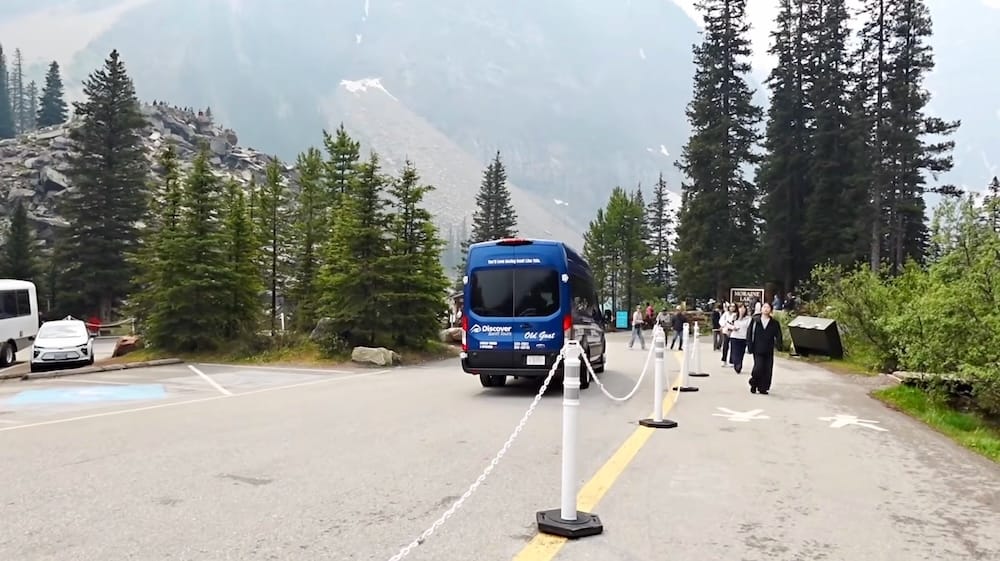
Moraine Lake Road is now closed to personal vehicles year-round. During the normal visitor season, access revolves around Parks Canada shuttles and licensed commercial transportation, with limited exceptions such as registered guests of Moraine Lake Lodge.
Lake Louise gives you more flexibility because personal vehicles can still attempt the lakeshore, but “you can drive there” should not be translated into “parking is easy.” The lot can fill by sunrise during summer, there is nowhere to wait once it is full, and Parks Canada recommends using transit or shuttles rather than building your day around finding a lakeshore space.
On our recent trip, we avoided that whole parking calculation because we visited both lakes as part of a private tour. You do not need to go private to use the same basic strategy, though. If you want the transport handled and would also like a guide rather than simply a ride, there is a current four-hour small-group experience from Banff that covers Lake Louise and Moraine Lake; you can check current Lake Louise and Moraine Lake guided-tour availability.
If you would rather keep more of the sightseeing independent, there is also a bookable round-trip shuttle from Banff that gives you time at both lakes without making you solve the Moraine Lake vehicle restriction yourself. You can compare this Lake Louise and Moraine Lake shuttle option. I would still check the current schedule and the amount of time allocated at each lake before booking, because the right transport is the one that leaves enough time for what you actually want to do once you get there.
If you’re planning a visit, I’d also check the current Lake Louise and Moraine Lake access information from Parks Canada shortly before your trip rather than relying on somebody’s parking story from years ago—including mine.
Lake Louise has one more obvious advantage: the lakeshore is a year-round destination, while normal visitor access to Moraine Lake generally runs from early June into mid-October, with exact dates dependent on conditions. So Lake Louise wins access flexibility. It does not win effortless access.
Lake Louise changed my opinion more the second time
This may be the biggest distinction between the two places for me.
Moraine Lake has been remarkably consistent. We were eager to see it the first time, arrived and thought it lived up to the reputation. When I went back years later, I still thought it was outstanding. The Rockpile added another perspective, but it didn’t overturn my original opinion because there wasn’t much that needed overturning.
Lake Louise changed more. After our first trip, I mainly thought of it as one of those places you obviously visit when you’re travelling through the Canadian Rockies: beautiful water, enormous mountain setting, famous hotel, lots of photographs, then continue with the road trip. I liked it; I just didn’t leave thinking I had barely scratched the surface.
Our second visit started in a way that could easily have made my opinion worse. The shoreline was crowded even early in the morning, and I was standing there making jokes about the “selfie capital of Canada.” Then we headed into the forest toward Fairview, reached a viewpoint we had completely missed on the first trip and suddenly found ourselves having a very different Lake Louise experience.
The crowd had fallen away, we had elevation over the lake and I stopped seeing the destination purely as that famous shoreline photograph. Fairview did something Moraine Lake didn’t need to do: it changed my mind.
It also made me curious about what else we had missed. Lake Agnes, Plain of Six Glaciers and the other routes above the lake now interest me considerably more than they would have after our first visit.
That is why I’m glad we went back. It is also why I wouldn’t treat either lake as a one-and-done place simply because you already have the classic photograph. Weather changes, light changes, your itinerary changes and sometimes doing one different thing completely alters your understanding of a destination.
Moraine Lake confirmed my opinion. Lake Louise improved it.
Lake Louise vs Moraine Lake: my head-to-head picks
| What matters most | My pick |
|---|---|
| Biggest immediate scenic impact | Moraine Lake |
| Elevated panorama for the least effort | Moraine Lake |
| Short first-time visit | Moraine Lake, narrowly |
| Year-round availability | Lake Louise |
| More flexibility in how you arrive | Lake Louise |
| Easy progression from sightseeing into a longer visit | Lake Louise |
| Serious half-day or full-day hiking | Tie — choose the route, not the lake |
| Biggest escape from the main crowd on the short hike we personally did | Lake Louise / Fairview on our visit |
| Destination that changed my opinion most on a repeat visit | Lake Louise |
| If I could visit only one during Moraine Lake season | Moraine Lake, narrowly |
| If I realistically have time for both | Visit both |
So, which should you visit?
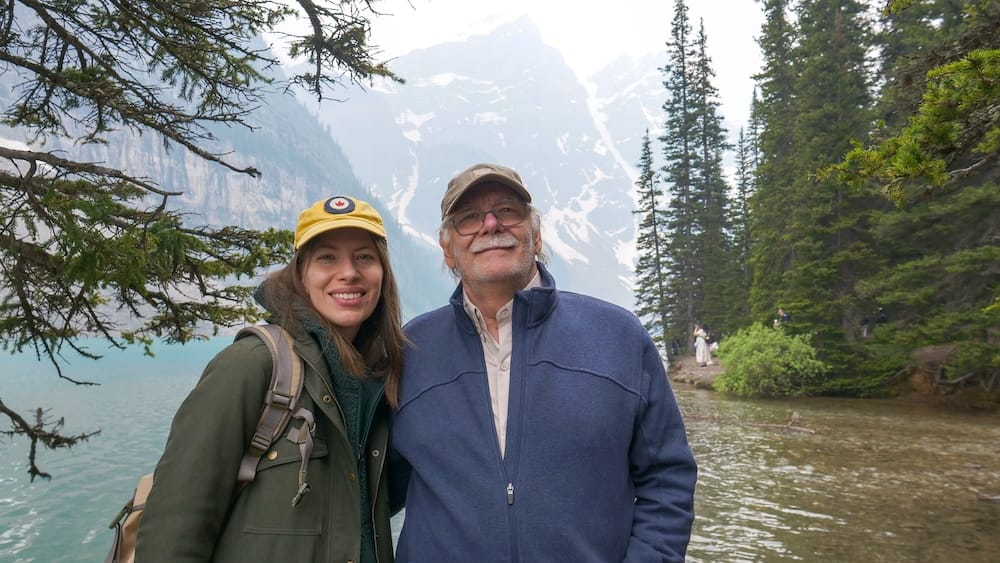
If this is your first trip to Banff National Park, both lakes are accessible during your dates and you are genuinely forcing me to choose only one, I’d pick Moraine Lake.
It is not a landslide. The combination of the lake itself and the Rockpile panorama simply gives me one of the biggest scenic returns for such a modest amount of walking, and Moraine Lake has delivered for us every time we’ve gone.
Lake Louise is the one I find more intriguing now, though, precisely because my opinion changed so much. The first time I mainly saw a beautiful, famous and heavily touristed Canadian icon. The second time I walked beyond that first impression and realized how much destination was hiding behind the photograph.
So Moraine Lake wins the head-to-head by a nose, but I would not use that verdict as an excuse to permanently cross Lake Louise off the itinerary. If you can realistically visit both, visit both.
And having now returned to both of them myself, I’d happily go back to both again.
Frequently Asked Questions
Which is better, Lake Louise or Moraine Lake?
If I could visit only one for a short first-time experience during Moraine Lake’s visitor season, I’d choose Moraine Lake by a narrow margin. Lake Louise becomes more competitive when you have several hours and want to explore beyond the shoreline.
Which lake gives you the best views for the least hiking?
Moraine Lake wins this comparison for me. The Rockpile loop is roughly 0.7 kilometres with about 35 metres of elevation gain, while Fairview Lookout at Lake Louise is about 1.2 kilometres each way with roughly 100 metres of gain and felt considerably steeper.
Is Lake Louise or Moraine Lake better for serious hiking?
I’d call serious hiking a draw and choose the trail rather than the lake. Lake Louise has routes such as Lake Agnes and Plain of Six Glaciers, while Moraine Lake provides access to longer hikes including Larch Valley, Eiffel Lake and Sentinel Pass.
Which lake is less crowded?
Neither gets a simple win. Lake Louise’s shoreline felt extremely crowded during our recent visit, but Fairview Lookout became dramatically quieter. At Moraine Lake, the Rockpile was much busier than Fairview during the same day.
Which lake is easier to visit?
Lake Louise offers more flexibility because personal vehicles can still attempt the lakeshore and the destination is available year-round. Moraine Lake Road is closed to personal vehicles year-round, so most visitors need a shuttle or licensed commercial transportation during its normal visitor season.
Can you visit both Lake Louise and Moraine Lake?
Yes, and that is what I would choose if your itinerary realistically allows it. The two lakes impressed me in different ways, and after visiting both more than once, I would happily return to both again.
This article is also available in Spanish. [Leé la versión en castellano: Lake Louise vs Moraine Lake: ¿cuál deberías visitar?]
This article contains affiliate links. If you book through one of these links, I may earn a commission at no extra cost to you.