
By the time Audrey and I squeezed onto the stools of a tiny counter shop in Sapporo’s Ramen Alley, a ticket machine in Hakodate had already beaten us once. We’d walked into that shop wanting the famous Hokkaido combination of miso, butter and corn, fumbled our way through a touchscreen, and come out having eaten salt ramen. So when we faced another machine in Sapporo, I was determined to get the butter. Mission accomplished, in a sense: two slabs of it arrived in my bowl, Audrey ended up with four egg halves, and neither of us could fully account for what we’d pressed.

That meal answers the three questions most people bring to Sapporo’s most famous dish. What actually separates Sapporo miso ramen from every other bowl in Japan? Is butter corn ramen worth ordering, or is it a souvenir you happen to eat with chopsticks? And does Ganso Sapporo Ramen Yokocho, the alley everyone points you towards, deserve one of your Sapporo meals? Here’s what we ate, what we got wrong, and what I’ve since learned about the bowl we were so busy overloading.

What Makes Sapporo Miso Ramen Different
A Bowl Built for Cold Weather
A mainstream Sapporo miso bowl comes down to three things: firm, medium-thick, wavy noodles, a thick broth made from pork or chicken bones, and a pile of stir-fried vegetables on top. Toppings, broth recipes and miso blends change from shop to shop, but those are the features to look for when someone promises you proper Sapporo ramen.
What I find more interesting is that each of those features solved a problem. After the war, Sapporo’s ramen looked much like ramen elsewhere, with thin straight noodles in a light soy broth, and that kind of soup went cold fast in a Hokkaido winter. People wanted something richer that held its heat. When hot miso ramen arrived in the mid-1950s, it fixed the temperature problem and created a new one: diners had to eat slowly to avoid scalding themselves, and the thin noodles went soggy while they waited.
The answer came from Nishiyama Seimen, a Sapporo noodle maker, which in 1955 produced a noodle designed to survive that soup. More water in the dough kept it chewy and stopped it snapping when crimped. Egg turned it yellow. The curl kept strands from sliding off your chopsticks between bowl and mouth. When I lifted my first mouthful at the counter, those noodles came up as springy yellow coils, nothing like the straight strands that came before them in Sapporo. They were built for patience and cold weather, and they’re arguably the most distinctive thing in the bowl.
If the noodle story grabs you more than the soup, there’s a way to get your hands in the dough. A hands-on ramen-making class in Sapporo has you knead, roll and cut your own noodles before they go into a bowl of soup. It’s not something Audrey and I did, but it’s a more physical way into the same story than reading about it.
No formal rulebook defines Sapporo ramen, and the city keeps tinkering. Many shops age their noodles for days after delivery to firm them up, and plenty now experiment with chicken paitan, dried-sardine or shellfish broths. The heavy miso bowl built the reputation, but the scene has kept moving around it.
Our Bowl Wasn’t the Textbook Version
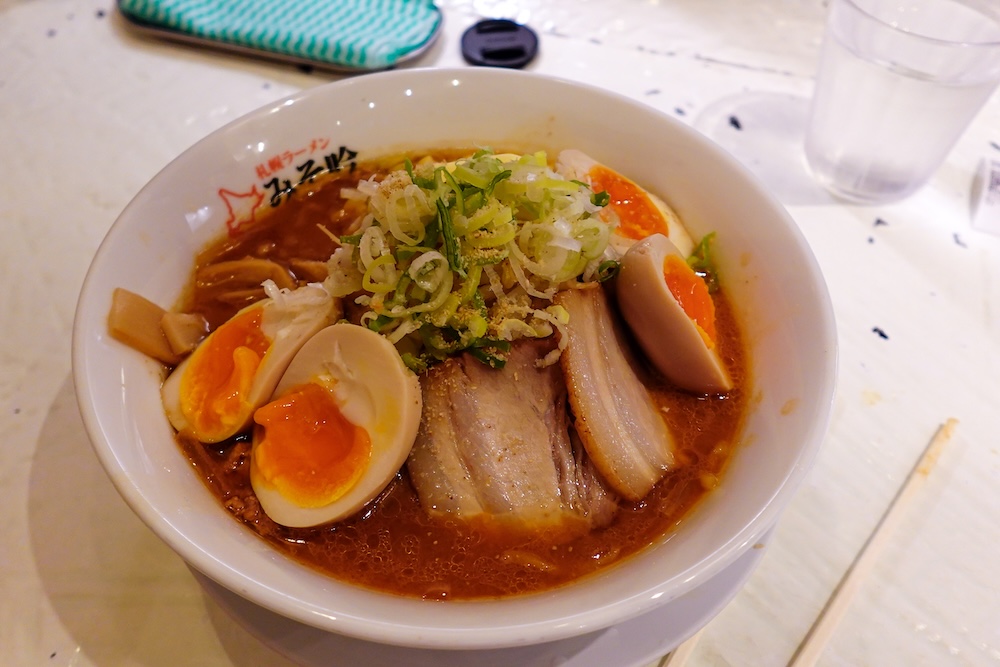
I should be upfront about the bowl I’m about to praise, because it wasn’t the archetype. Misogin, the shop we picked, builds its ramen on a clear chicken broth simmered from domestic chicken carcasses, seasons it with a house blend of Hokkaido red miso and aromatic vegetables, and pairs it with a smoother medium-thick noodle meant to sit easily in a lighter soup. Misogin is also a chain, with branches in Aomori, Aichi and Osaka, and its Sapporo flagship only moved into the alley in January 2020.
None of that dented what happened at the counter. The first spoonfuls drew “kind of nutty,” “a little bit spicy,” a tang with some kick, and a guess at sesame that I still can’t confirm, followed by “the pork is so tender and fatty.” It was a rich bowl in every way that mattered to two hungry people. It was a lighter, chicken-forward take on Sapporo miso, though, and we never tried one of the heavier pork-and-lard versions some shops are known for.
That’s worth knowing before you choose. If you want the heavyweight version, look for a shop that leans into pork bone and fat. If the idea of a lard-capped bowl sounds like a commitment, a lighter alley bowl like Misogin’s still gives you miso, curly noodles and a mountain of toppings without wiping out your afternoon.
And if you’d rather see how far the city’s ramen has wandered from miso altogether, one current option is a Sapporo ramen tasting tour with three mini bowls. Its sample lineup runs from a seafood-based bowl to a game-fowl or dipping-noodle bowl and a pork-bone bowl, so it’s a tour of Sapporo’s broader scene rather than a miso crawl. It covers about three kilometres on foot between Susukino and Tanukikoji, and every broth on the route contains chicken, pork and fish, which matters if you have dietary limits.

How Miso Compares With Hakodate’s Salt Ramen
Hokkaido has three famous regional styles, and having eaten two of them on one trip, I think the contrast explains Sapporo better than any definition. Salt ramen is so standard in Hakodate that ordering plain “ramen” gets you shio, and the city’s ramen history may be among Japan’s oldest, with an 1884 newspaper advertisement mentioning “Nankin-soba.” Our Hakodate bowl, the one we ended up with instead of butter corn, was solidly good: clear, light and clean, almost a different food from what we ate in Sapporo.
The third style, Asahikawa’s soy ramen, comes from a city we didn’t visit. There the soup usually combines pork and seafood under a layer of hot lard to keep it from cooling, with lower-moisture noodles. And our favourite spicy bowl of the whole trip came from Noboribetsu, outside the big three altogether. Set beside Hakodate’s restraint, Sapporo’s miso is the heavy, warming member of the family, the bowl you want when the weather is working against you.
Where Miso Ramen Came From
Ramen Alley is often called the birthplace of miso ramen, and it isn’t. The dish is credited to Aji no Sanpei, a shop near Odori that sits outside the alley. Its founder, Omiya Morito, created a vegetable-heavy miso ramen in the mid-1950s; sources disagree on whether it was 1954 or 1955. By his account, miso soup was the inspiration, which retires the popular story about a drunk customer demanding noodles in his miso soup. If you want the original bowl, Aji no Sanpei is the place. The alley plays a different role in Sapporo’s ramen story, which I’ll get to.

Butter Corn Ramen Is a Topping, Not a Style
How We Got It Wrong in Hakodate
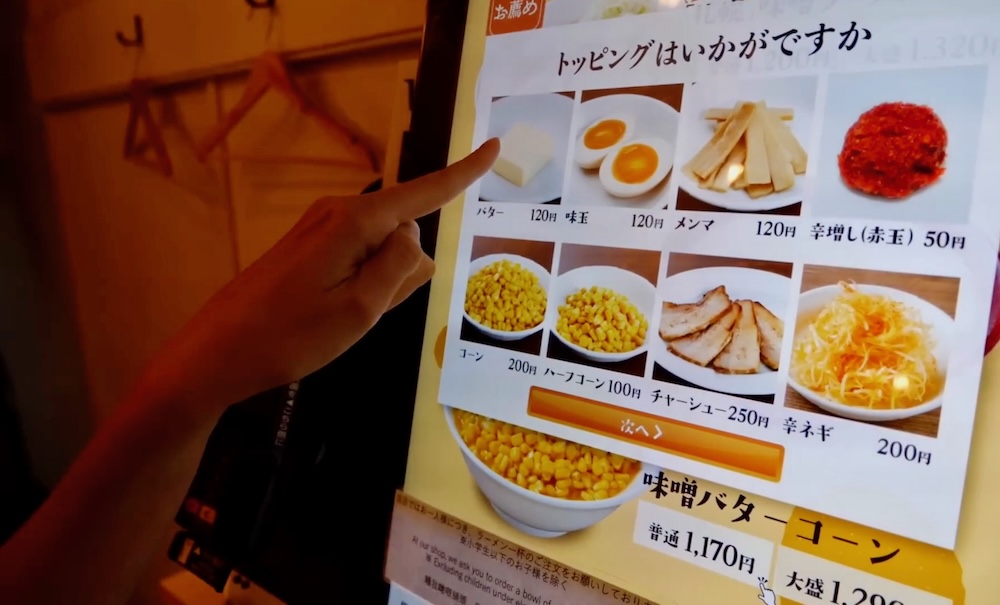
Hakodate taught us the first useful lesson about butter corn ramen, mostly by humiliating us. We’d arrived thinking “butter and corn” was a kind of ramen you could simply order. On that shop’s touchscreen ticket machine, butter and corn were listed as separate ¥120 toppings, not as a dish. Somewhere between working out the set options and figuring out where the cash went, we ordered the wrong thing and ended up with no butter or corn at all. The salt ramen was good enough that I didn’t sulk for long, but the lesson stuck: across much of Hokkaido, butter and corn are things you add.

Double Butter at Misogin
In Sapporo, we chose Misogin for an embarrassingly simple reason: its bright yellow sign was covered in pictures of ramen buried under corn and butter. Butter corn ramen is the shop’s signature, but butter, corn, half-corn, egg, bamboo shoots and chashu are also sold as separate add-ons, which is how a machine full of tempting buttons and two first-timers produces chaos. I pressed my way to double butter. Audrey pressed her way to double eggs, four halves in all, plus extra bamboo shoots. By the time the bowls landed, neither of us could remember everything we’d chosen.
My two slabs sat on a heap of corn, already beginning to soften, and eventually got stirred through the bowl. The result was very rich, and my verdict at the counter still holds: finally trying the Hokkaido version with corn and butter was a real treat, I probably didn’t need double butter, and the double butter made the whole bowl dramatically richer. Audrey’s bowl had butter too, under all those eggs, and we agreed on the spot that the extra toppings had been worth it.

Is Butter Corn Ramen Worth Ordering?
Yes, once, with a single portion of butter. The context around that answer is part of the argument. Hokkaido’s own tourism organization calls miso butter corn ramen a favourite with tourists, describing the corn’s sweetness melting into a butter-mellowed soup, then teases that skipping the butter and corn is the trick to passing as a ramen connoisseur in Sapporo. When the region’s tourism body pokes fun at its own most famous topping, you can be sure the topping isn’t what defines the dish. Sapporo’s tourism listings for the alley name miso butter corn, miso with scallops and butter, and miso with cheese as the bowls overseas visitors gravitate to.
The topping isn’t a gimmick, though. Hokkaido produces about 58% of Japan’s raw milk and roughly half of its sweet corn, so butter and corn on a miso bowl tastes like a straight line from the island’s farms. Nobody agrees on who started it: there are competing claims about particular Sapporo shops in the 1960s and 1970s and about the chains that carried it across the country. Wherever it began, it’s an add-on, not a requirement.
So order butter corn if you want the full Hokkaido version of the dish at least once, and keep it to one portion of butter, because two turns the bowl into a dairy event. If you’d rather taste the shop’s miso broth properly, order plain miso. You’ll lose nothing essential, and you’ll pass the connoisseur test.
Ordering at the Machine Without Overdoing It
Misogin’s lit sign in 2023 laid out a three-step ladder, with English subtitles under the Japanese. The Miso Ramen Irodori cost ¥1,000, the Miso Butter Corn ¥1,170, and the Miso Ramen Kiwami, everything piled on, ¥1,200. Audrey and I paid about ¥2,800 between us that night, a total I blame entirely on the extra buttons. At the time, I reckoned ¥1,000 to ¥1,300 per person was a more typical spend for one bowl in the alley.
Prices have climbed since. The alley’s official listing for Misogin now shows the butter corn bowl at ¥1,380 and both the Kiwami and the newer Misogin White (a miso ramen made with Hokkaido potato potage and melted cheese) at ¥1,400. That’s roughly 17 to 18% above what we saw on the sign, and the chain says prices vary by branch, so treat whatever the machine shows on the day as the real number. The same listing says the shop takes Visa and Mastercard, several Japanese e-money services including PayPay, and Alipay and WeChat Pay, which is handy if you’re short on yen, though worth confirming at the door.
The way to avoid my mistake is to choose your base bowl first and add one extra at most. Plain miso shows you what the shop’s broth is really like. Butter corn gives you the Hokkaido version. The everything-on bowl is for a proper appetite. Stacking extras on extras is how two people end up with ¥2,800 of ramen and four halves of egg in one bowl.

Is Ramen Alley Worth It?
What Ganso Sapporo Ramen Yokocho Is
Ganso Sapporo Ramen Yokocho is a 42-metre passage between buildings in Susukino, lined with 17 small shops focused on Sapporo miso ramen, a couple of minutes’ walk from Susukino Station on the Namboku subway line. Its roots go back to 1951, when a cluster of shops opened beside the Sapporo Toho Koraku cinema. That first lane was cleared in 1969 for road widening ahead of Sapporo’s Winter Olympics, and the alley was reborn at its current site in 1971. It turned 75 in 2026. So while it isn’t where miso ramen was invented, it’s the historic street where Sapporo’s ramen culture concentrated, and it’s still the easiest place to see a lot of that culture in a few steps.
One more naming trap: Shin Ramen Yokocho is a separate cluster of ramen shops nearby, and the Ganso alley’s own management says it has no connection to them. The Shin alley’s name grew out of an unrelated building once known as Mogura Yokocho. If you’re after the original, look for “Ganso.”

How Touristy It Felt at Misogin
Our evening at Misogin didn’t feel like eating in a famous attraction. The room seated six to ten people at most and was about half full when we arrived, and the space was so tight we kept our voices down. As far as I could tell, the people who came in after us were locals, not visitors. I can’t tell you what time it was; I have a feeling it was on the early side, but I honestly don’t remember. That matters, because the alley’s usual pattern is tourists day and night, with locals piling in late for a closing bowl after drinking in Susukino. Our quiet, local-feeling meal may have owed as much to timing as to the alley itself.
The bowl was the best ramen I’d had in Sapporo up to that point, and I’d happily send people to Misogin. That’s a verdict on one shop on one evening, not a ranking of the alley’s other 16.

When the Alley Makes Sense, and When to Eat Elsewhere
The most useful thing to know before you go is that the 17 shops keep 17 different timetables. Baisensha is listed as opening at 8 a.m. and running until 3 a.m. Shimijimi doesn’t open until 7 p.m., Shirakaba Sanso until 6 p.m., and Banraiken runs from 5 p.m. to 11 p.m. and closes on Sundays. Misogin’s listed hours are 11 a.m. to 3 p.m. and 5 p.m. to midnight on weekdays, straight through from 11 a.m. on Saturdays and days before holidays, and until 11 p.m. on Sundays and holidays, closing on December 31 and January 1. If you have your heart set on a particular shop, check its hours on the alley’s official shop guide (in Japanese) before you go.
Walk the whole alley before you commit. At 42 metres, that takes about a minute, and it lets you match a shop to what you want, whether that’s plain miso, butter corn, scallop, cheese or something spicier. If one shop has a long queue, pick another; the alley’s management has specifically asked visitors not to line up in ways that block neighbouring doors and to use shops with free seats.
Those shifting hours and crowd patterns are easier to work around if you’re sleeping nearby. Staying within walking distance of the alley means you can drop in at a quiet hour rather than committing to one visit at the busiest time, which, on our evidence, makes a real difference to how the place feels. If that suits your trip, you can compare hotels in Susukino. Just remember that Susukino is Sapporo’s nightlife district, so expect neon and late-night foot traffic outside your door.

If choosing among 17 shops on your own sounds more stressful than fun, there’s a guided version of the alley. A current night ramen crawl through Ramen Alley spends about two hours in the alley with a guide, covers how miso ramen and the alley came to be, and includes a ¥1,000 tasting credit at each of two shops. At the prices Misogin now lists, ¥1,000 won’t cover a fully loaded bowl, so expect to top up if you want the works. We ate independently and didn’t miss having a guide, but it’s a sensible shortcut if you’d rather someone else made the choices. For a wider range of guided eating, you can also browse Sapporo’s local food tours.
So is Ramen Alley worth it? For a first Sapporo bowl, yes. It puts a lot of choice within a few steps, the setting is small and atmospheric, and our meal there was excellent. It works best outside the late-night crush, with a shop chosen for the style you want, and with the understanding that it’s a good introduction rather than the whole of Sapporo ramen. If you want the origin bowl, go to Aji no Sanpei. If you want the heaviest pork-and-lard version of the style, find a shop built around it, because Misogin isn’t that shop.

If I Were Ordering My First Sapporo Bowl Again
I’d still go to the alley, still walk its 42 metres, and probably still be drawn in by a sign full of corn. I’d just press fewer buttons. One miso bowl with one portion of butter and corn would have shown me everything the Hokkaido version has to offer without turning my dinner into a dairy event, and if I wanted to understand the broth itself, I’d order plain miso and let those curly yellow noodles do the work they were invented for. The second slab of butter taught me something, but it’s a lesson I’m happy to pass on rather than repeat.

Frequently Asked Questions
What makes Sapporo miso ramen different from other ramen?
Three things set the mainstream bowl apart: firm, medium-thick, wavy noodles, a thick broth made from pork or chicken bones, and a pile of stir-fried vegetables on top. The curly yellow noodles were developed in 1955 by Sapporo noodle maker Nishiyama Seimen so they would stay chewy in scalding miso soup and cling to chopsticks, which makes them arguably the most distinctive part of the bowl.
Is butter corn ramen worth ordering in Sapporo?
Yes, at least once, but with a single portion of butter. I ordered double butter at Misogin and it made the bowl dramatically richer than it needed to be. Butter and corn are a topping you add to miso ramen rather than a separate style, so order plain miso if you want to taste the broth itself.
Is Ramen Alley the birthplace of miso ramen?
No. Miso ramen is credited to Aji no Sanpei, a shop near Odori outside the alley, whose founder Omiya Morito created it in the mid-1950s. Ganso Sapporo Ramen Yokocho is the historic ramen street, with roots going back to 1951, rather than the place the dish was invented.
How much does a bowl of ramen cost at Misogin in Ramen Alley?
In 2023, Misogin’s sign listed the Miso Butter Corn at ¥1,170 and the everything-on Kiwami at ¥1,200, and Audrey and I spent about ¥2,800 between us after adding extras. The alley’s official listing now shows ¥1,380 for butter corn and ¥1,400 for the Kiwami, but prices vary by branch, so treat the ticket machine as the final word.
When is the best time to eat at Ramen Alley?
Each of the 17 shops keeps its own hours, with some open from morning and others only in the evening, so check your target shop on the alley’s official guide. Tourists fill the alley day and night, while locals arrive late for a bowl after drinking in Susukino. Our quiet, local-feeling meal was probably on the early side, so going outside the late-night crush is a good bet.
Is Ganso Sapporo Ramen Yokocho the same as Shin Ramen Yokocho?
They’re separate places. The Ganso alley’s management says Shin Ramen Yokocho has no connection to it, so look for “Ganso” if you want the original 42-metre alley with its 17 shops.
This guide is also available in Spanish. [Leé la versión en castellano: Guía del ramen de miso de Sapporo: qué lo hace diferente, ¿vale la pena pedir ramen con manteca y choclo y vale la pena ir a Ramen Alley?]
This article contains affiliate links. If you book through one of these links, I may earn a commission at no extra cost to you.