
I went to university in Edmonton, at the U of A, and for four years I walked past the Fairmont Hotel Macdonald without ever really seeing it. It was just the castle-looking thing up on the hill past downtown — obviously not built for someone living on a student budget, so I filed it under buildings that weren’t for me and kept walking to class. It took leaving the city for years, then coming back and checking into the hotel as a guest instead of walking past it, to actually learn what I’d been ignoring the whole time I lived there.
This isn’t the story of that stay — I’ve written that elsewhere. This is the story of the building itself: why a Grand Trunk Pacific Railway hotel wound up looking like a French château above the North Saskatchewan River, what nearly happened to it in between, and what you can actually see today if you know where to look, whether or not you’re staying the night.
Built for the Railway Age: Why a Château Rose Above the River
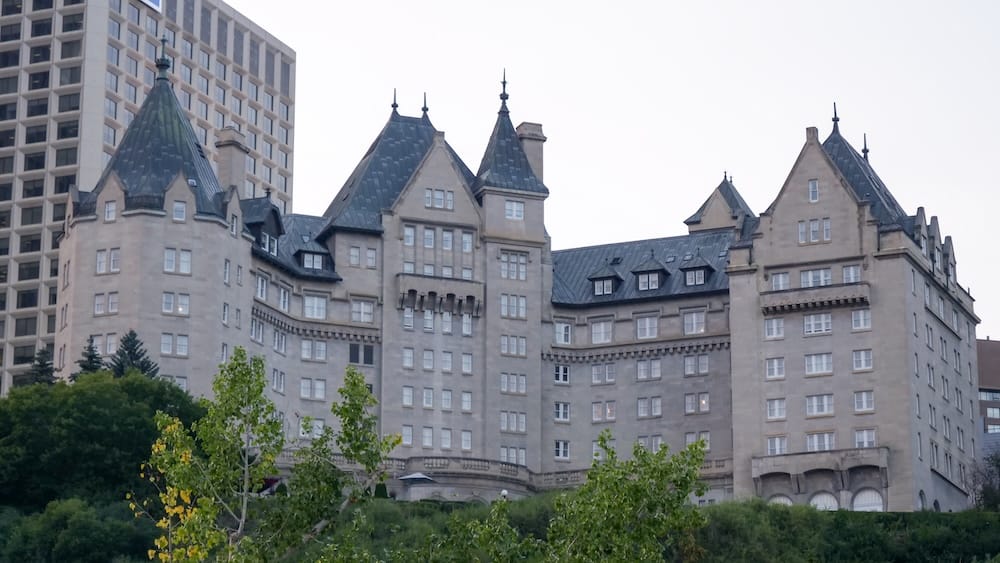
Fairmont Hotel Macdonald opened on July 5, 1915 — exactly five years, to the day, after the first Grand Trunk Pacific train pulled into Edmonton. That timing wasn’t an accident. The Grand Trunk Pacific Railway built the hotel as part of a strategy that shaped a whole era of Canadian travel: put a grand, unmistakable hotel at the end of the line, and give passengers a reason to ride the whole way there in comfort. Château Laurier in Ottawa, the Fort Garry in Winnipeg, and eventually Hotel Macdonald in Edmonton all came out of the same playbook, designed by the same Montreal firm — Ross and MacFarlane — working in the steep-roofed, turreted château style that became shorthand for “grand Canadian railway hotel” for decades afterward.
The Name on the Building
The Mac’s nickname is friendlier than its formal one. It’s named for Sir John A. Macdonald, Canada’s first prime minister — an ordinary enough naming choice for a hotel built in 1915, when Macdonald was mostly remembered as the man who helped stitch the country together. That’s not how his legacy reads anymore. Macdonald was also the architect of Canada’s residential school system, and in the years since, that history has driven the removal of his statues, the renaming of schools and university buildings that once carried his name, and a public debate that’s still very much alive. As far as I can tell, none of that fight has landed specifically on this hotel’s name — it isn’t a flashpoint the way some statues have become — but it’s part of the same larger reckoning, and worth knowing walking in, whatever you make of it.
An Architecture Walk: What The Mac Still Shows You
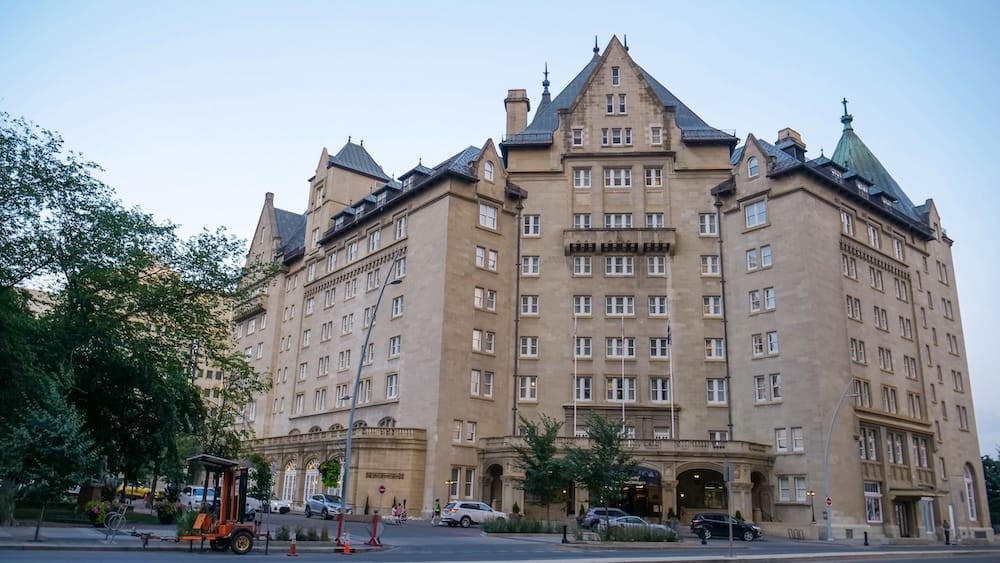
You don’t need an architecture degree to clock what’s going on with this building, but it helps to know what you’re looking at. The Mac is built in the Châteauesque style — the same steep, dormered roofline, copper roofing, chimneys, finials and turrets you’ll find on Château Laurier or the Fort Garry, all cousins from the same architectural family, built by the same firm chasing the same fantasy of a French château dropped onto the Canadian frontier. From the street on 100 Street, the effect is almost comic in the best way: eleven floors of pale limestone hemmed in by ordinary downtown office towers, turrets rising where you’d expect a flat roofline to just stop.
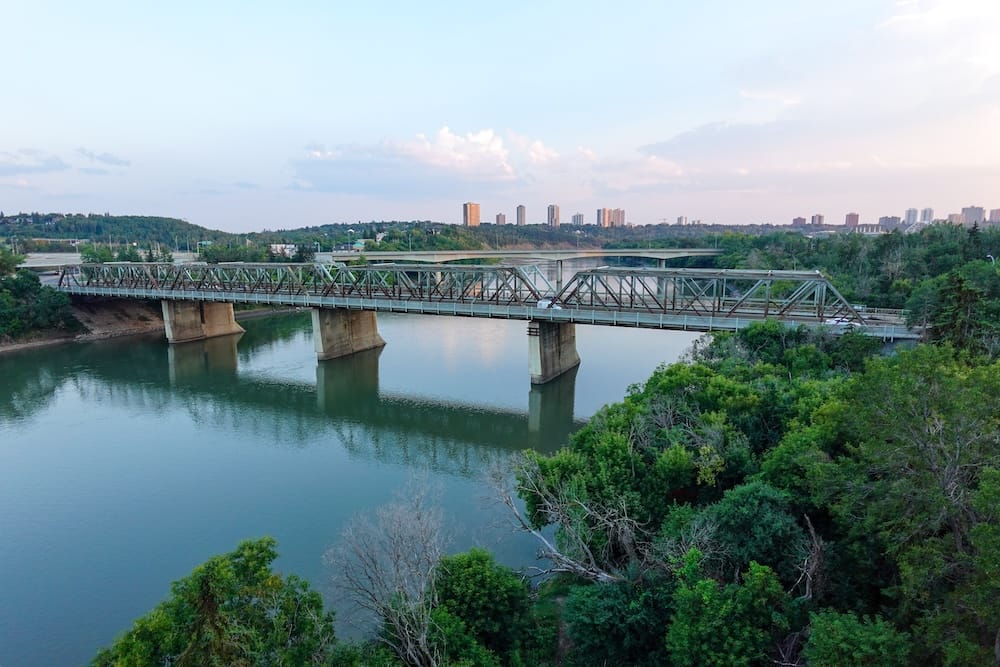
The better view, honestly, is from below. Walk down into the river valley and look back up, and the hotel does the thing it was built to do — it dominates. Long before Edmonton had a real skyline, this was the skyline, the one serious building standing over the North Saskatchewan River while everything else downtown was still figuring out what it wanted to be.
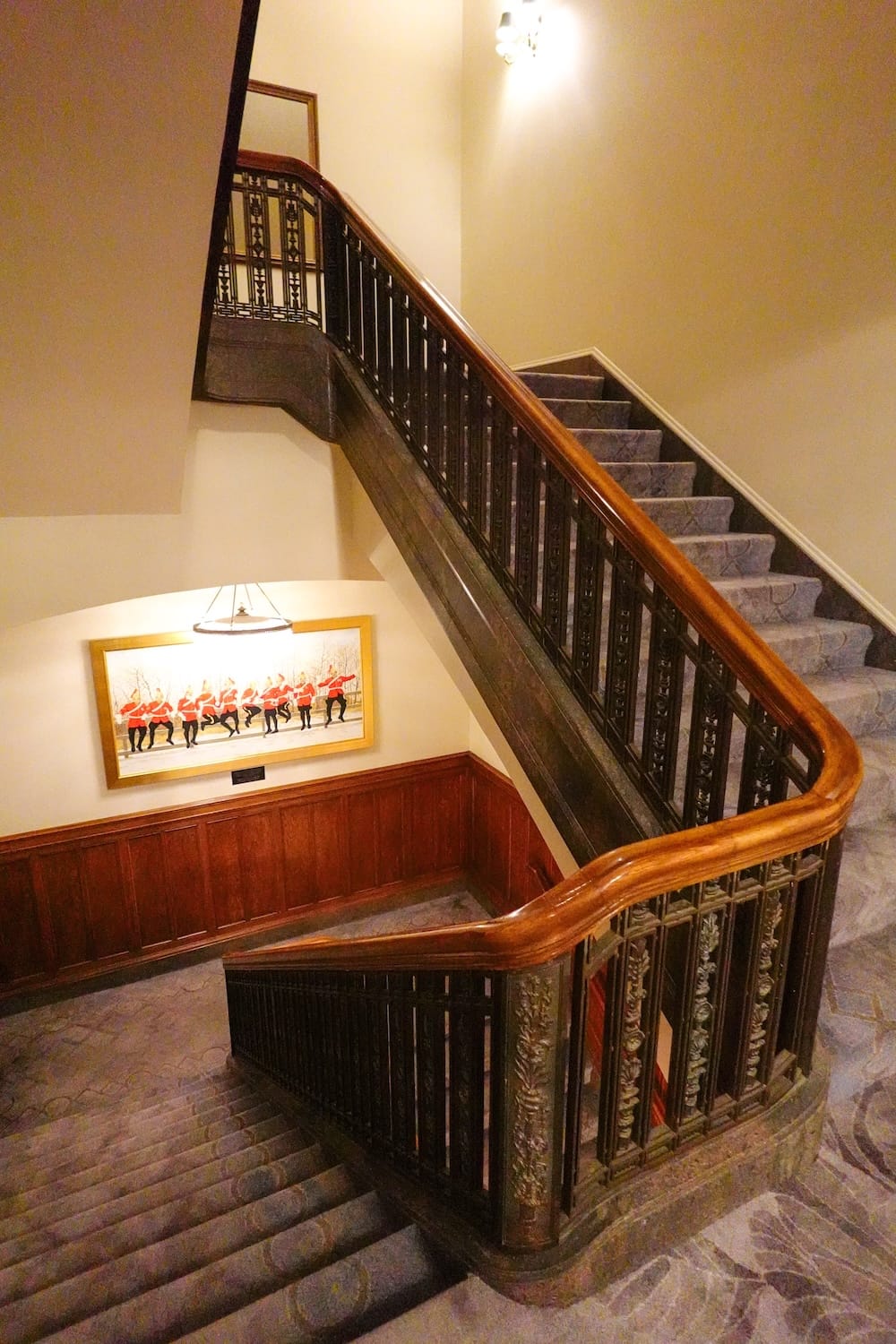
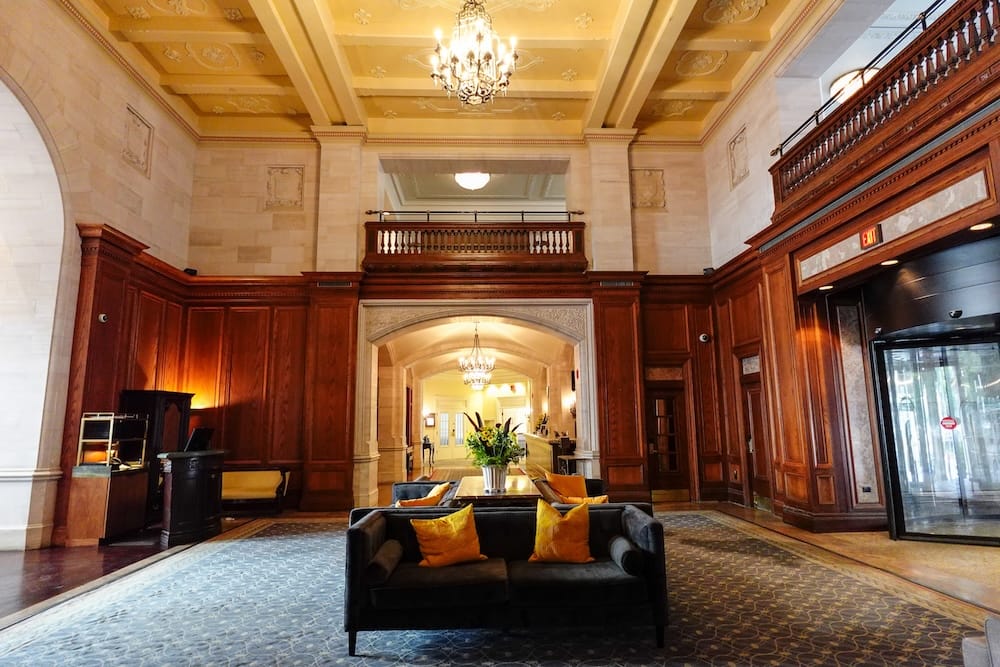
Around the back, past the terrace, the building gets less photographed and more interesting: stone arches, staircases, and the kind of detailing that only shows up if you slow down and walk the perimeter instead of beelining for the front doors. Inside, the lobby does the grand-hotel thing properly — high ceilings, dark wood, a chandelier that makes you drop your voice a little without meaning to.
One detail I like: during the hotel’s 1991 restoration, what used to be attic space became a run of turret suites, several of them named for the royalty who’s actually stayed here — King George VI and Queen Elizabeth among them, following their much-discussed 1939 visit. It’s a small thing, but a nice reminder that the building’s history isn’t sealed behind glass somewhere. You can still sleep inside a piece of it.
Closure, Restoration and a Building That Almost Disappeared
This is the part of the story most visitors never hear, and it’s the part that actually explains why the building looks the way it does today.
In the early 1950s, the hotel’s owners bolted a 16-storey addition onto the original château to handle growing demand for rooms — nearly 300 of them, in a stark, modern block that looked nothing like the building it was attached to. Edmontonians, not known for holding back, started calling the pairing “the Mac and the box it came in.” The nickname stuck, and it wasn’t affectionate.
By the early 1980s, the hotel itself was in real trouble. Decades of use had caught up with it, and in 1983 — the same year Edmonton hosted the Universiade Games — it closed its doors, badly in need of repair and without an obvious future. It could easily have ended there. In January 1985, the City of Edmonton stepped in and designated it a Municipal Historic Resource, the first building in the city to receive that protection, on top of a provincial heritage listing from the year before. That designation is the reason there’s a hotel here to write about at all.
Canadian Pacific Hotels bought the property in 1988 and spent the next few years restoring it — including, finally, tearing down “the box,” the very addition that had embarrassed the original building for three decades. The Mac reopened on May 15, 1991, restored rather than reinvented, and in 2001, after Canadian Pacific Hotels merged with Fairmont, it became the Fairmont Hotel Macdonald — the name it’s carried ever since.
Renovation, Recognition and The Mac Today
The most recent chapter is the shortest, and it’s still being written. In 2024, the hotel went through a substantial renovation of its guest rooms and meeting spaces — the kind of refresh a century-old building needs periodically if it wants to keep functioning as a real hotel and not just a heritage display case. The following year, the work paid off in a way Edmonton hadn’t seen before: in 2025, Fairmont Hotel Macdonald became the city’s first hotel to receive a MICHELIN Key, part of a wider wave of recognition for Canada’s historic railway hotels, and it also landed a spot in Condé Nast Traveler’s Readers’ Choice Awards the same year.
None of that changes what the hotel actually had to survive to get here — closed, half-demolished, restored and renamed once already, long before Michelin ever showed up with an award to give it.
The Mezzanine and a City That Grew Around a Château
All of that history is good to know. But the part of the hotel that actually got me was one I stumbled into by accident, on my way to nowhere in particular the morning after checking in.
The mezzanine floor doesn’t get talked about much — not the way the ballroom or the lounges do. It’s mostly couches, a few tables, a couple of small conference rooms, and along one wall, a run of black-and-white construction photographs from when the hotel was going up. I ended up spending part of my morning there, sprawled out on a couch like a lizard on a warm rock, doing basically nothing except looking at photographs of the hotel I was sleeping in, taken decades before it was anything more than scaffolding.
What stopped me wasn’t the construction itself — it was the river-valley shots. Photographed from down by the North Saskatchewan while the hotel was going up, it’s genuinely the only finished-looking building in the frame. Everything else is scaffolding, mud streets, and buildings that hadn’t decided what they wanted to be yet. The Mac just stands there, already looking like the OG building of Edmonton’s whole downtown core, before downtown Edmonton had much of a core to speak of. Standing at river level in 1915 and looking up at that thing must have been something.
That’s the version of this building’s history that actually lands for me — not the architect credits or the heritage bylaw, useful as those are, but the fact that I was once a broke student walking past this place assuming it had nothing to do with me, and years later I was lounging in its mezzanine like I owned it, looking at photos of the exact moment it started dominating a skyline that didn’t exist yet.
The building I walked past as a student and the building I sprawled out in as a guest are the same structure, technically. But the gap between those two experiences says something true about the place itself: the Mac has been added onto, half-demolished, closed, restored and renamed over the last century, and it’s still standing in the same spot above the river, still doing the same job it was built to do in 1915 — making Edmonton look like it belongs on a bigger map than people expect.
You don’t need to book a room to appreciate any of that. The exterior, the river-valley view, and a slow walk down into the valley are worth it on their own. But if you want to see the construction photographs that got me, or the turret suites built where the attic used to be, staying the night is still the most direct way in — you can check current rates and availability at Fairmont Hotel Macdonald to see what’s open.
This article contains affiliate links. If you book through one of these links, I may earn a commission at no extra cost to you.
This article is also available in Spanish. [Leé la versión en castellano: Historia y arquitectura del Fairmont Hotel Macdonald: la historia del castillo de Edmonton]