
I lived in Edmonton for years as a University of Alberta student, and in all that time there was no glass box quietly gliding people down the riverbank behind the Hotel Macdonald. That’s the whole reason I wanted to write this guide instead of just mentioning the thing in passing. The 100 Street Funicular didn’t exist when this was my city, and finding it there now, doing exactly what it promises, was one of the better surprises of coming back somewhere I thought I’d already figured out.
Is it actually the easiest way down to the river valley, though, or is that just the kind of line a city tells about its own infrastructure? Audrey and I rode it, and I went and checked what the alternative really involves. It earns the claim — just maybe not for the reason it sounds like it should.
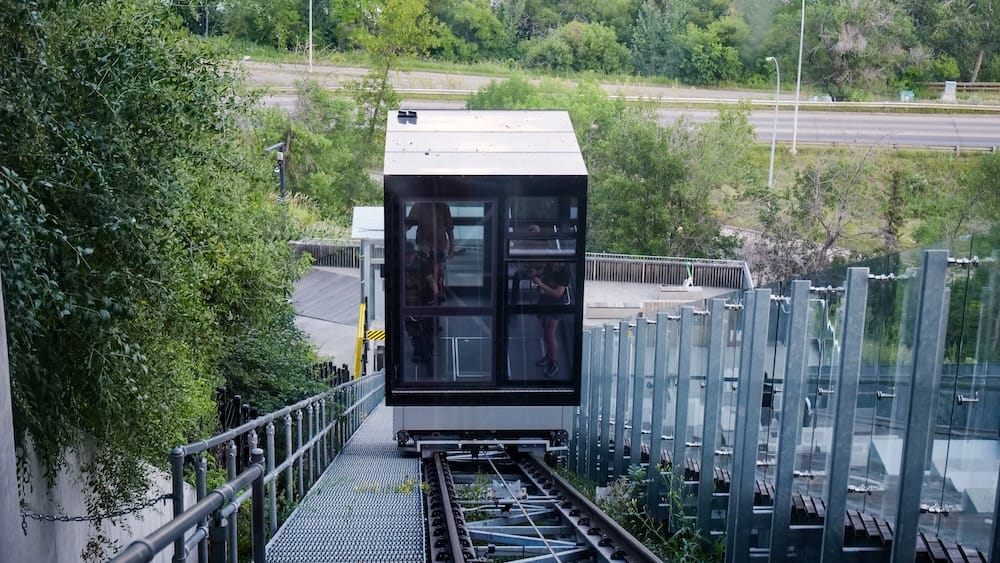
The Funicular Behind the Hotel Macdonald
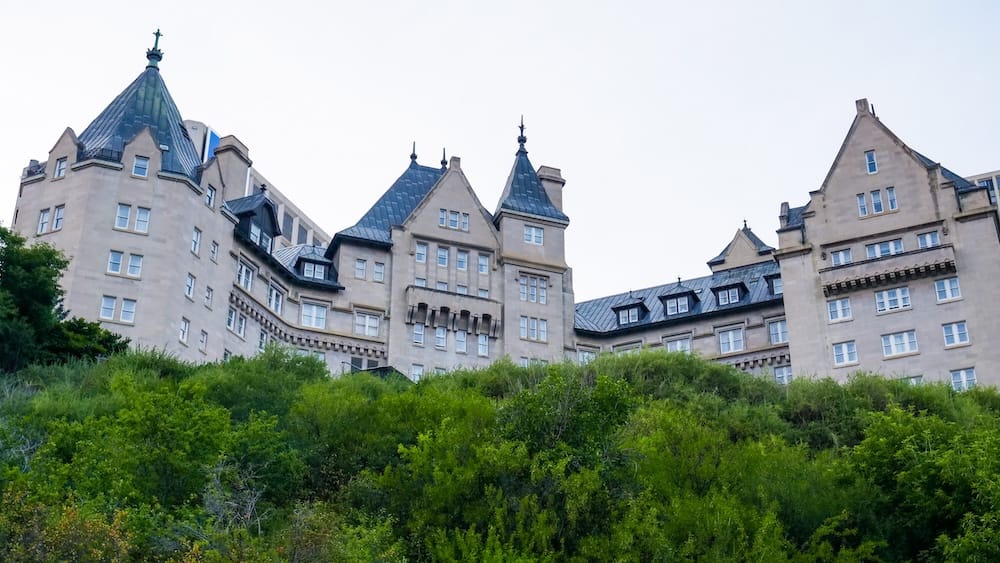
Officially, it’s the 100 Street Funicular, and the lookout at the bottom has its own name too — the Frederick G. Todd Lookout — though I’ve never heard a single person standing up there call it that. It sits right on 100 Street, immediately south of the Fairmont Hotel Macdonald. Stay there and the river valley is a two-minute walk from your lobby door — worth knowing if you’re still deciding where to base yourself downtown, and if a landmark hotel with the view built in appeals to you, it’s worth comparing current rates at the Fairmont Hotel Macdonald before you book anywhere else downtown. Stay anywhere else in the core and it’s still an easy, unplanned detour, not a trip across town.
Audrey and I found it on an after-dinner walk from the hotel, the kind where you’re not hunting for an attraction so much as somewhere to put your legs after a big meal. It’s easy to miss the first time — no big sign, no fanfare, just a sheltered platform at the top of the bank that you’d walk right past if you weren’t looking for it.
The city opened it in December 2017. Everything about it — the staircase, the promenade, the bridge, the lookout — went in as one project. Before that, if you wanted to get from downtown to the river valley on foot at this exact spot, you walked down a hill and back up it. Now you don’t have to.
What the Ride Actually Feels Like
We call it “the finic,” which is either an affectionate nickname or just what happens when you’ve said “funicular” one too many times on a hot afternoon. The cabin is glass-walled, holds up to twenty people, and takes well under a minute to reach the bottom — somewhere around 40 seconds, though it depends who’s counting. There’s no operator. You step in, the doors close, and it moves.
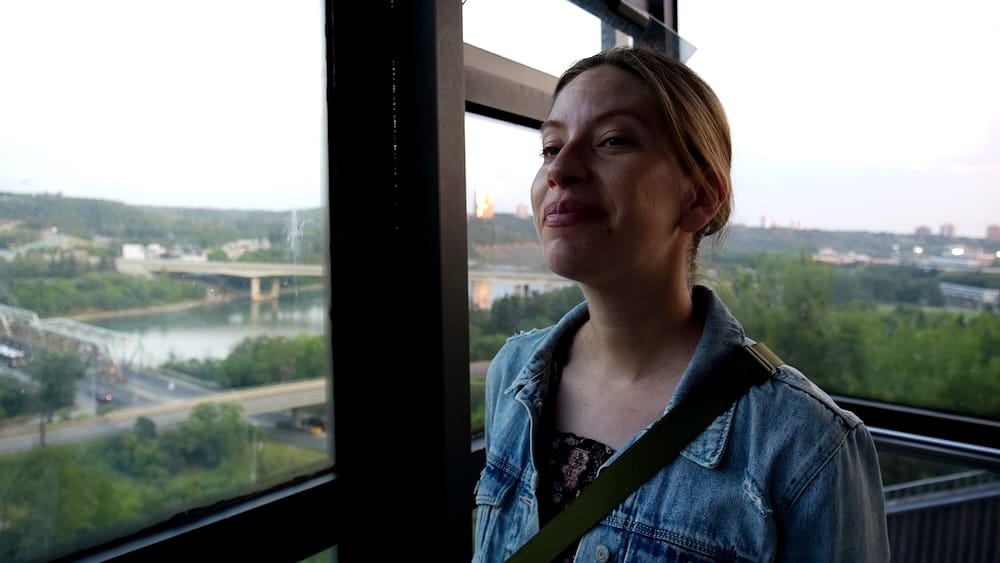
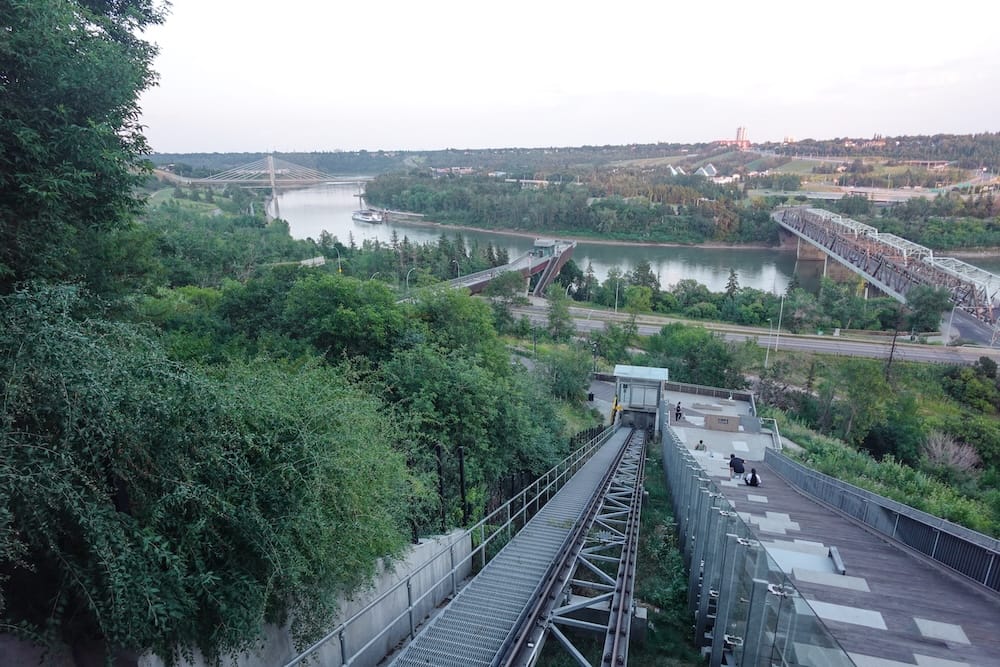
It’s not a dramatic ride, and it was never going to be. What it gives you instead is a slow, unobstructed slide down the riverbank with the North Saskatchewan opening up the whole way — a genuinely different way to arrive at a view than walking down with your eyes on your feet, watching for the next step. It isn’t heated or cooled, doesn’t play music, and there’s an emergency button if you need one, though none of that is really the point. The point is that less than a minute of doing nothing gets you a view that used to cost a hill.
170 Steps vs. Under a Minute: Is It Actually the Easy Option?
Here’s the part most guides skip: the real comparison isn’t the funicular against some longer walk through downtown. It’s the funicular against the staircase running right beside it — same corridor, same start and end points, roughly 170 wooden steps with built-in seating for anyone who wants to stop halfway.
That’s the honest version of the claim, and once you frame it that way, it holds up.
| Funicular | Staircase | |
|---|---|---|
| Time | Under a minute | A minute or two, depending on pace |
| Physical effort | None | About 170 steps |
| Accessibility | Wheelchairs, strollers, bikes | Not usable for mobility aids |
| Cost | Free | Free |
If you’re reasonably fit, the funicular doesn’t save you much time — 170 steps at a normal pace isn’t a slow process either way. What it saves you is the climb, particularly the climb back up if you’ve already done the descent once and your knees have an opinion about doing it again. And if you’re pushing a stroller, using a wheelchair, or hauling a bike, this stops being a comparison at all. The stairs simply aren’t an option, which makes the funicular the only way down rather than merely the easier one.
Worth remembering, then: for most visitors this is a convenience. For a few, it’s access.
What’s Actually Down There
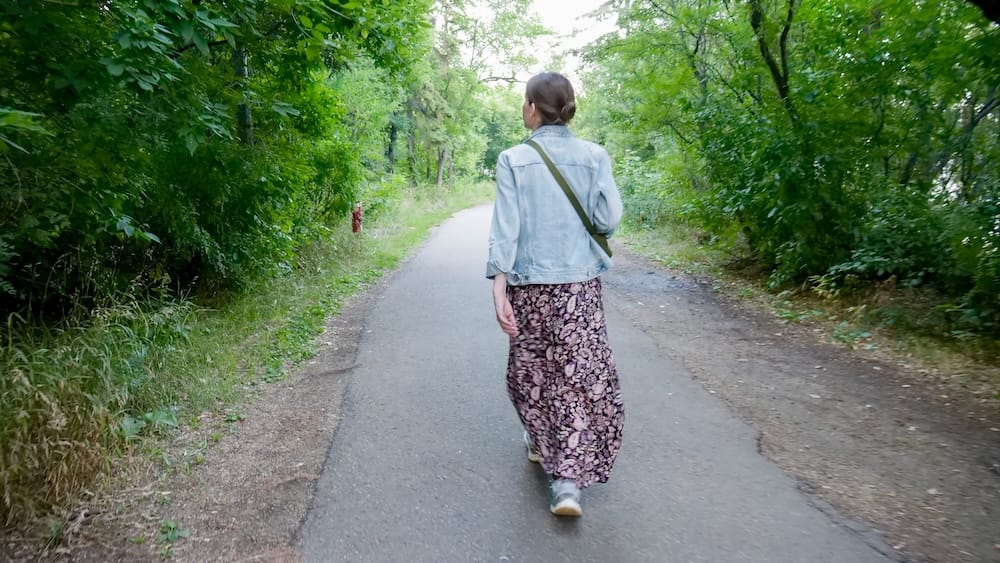
The ride lands on a promenade with a grassy seating area built around a public art installation — a run of concrete benches shaped to echo the movement of the river below. From there, a pedestrian bridge carries you over the road to the lookout itself, glass railing and built-in seating, with the view the whole trip has been promising: river to the south, the downtown skyline behind you to the north.
Keep going and a second elevator and staircase continue down from the bridge level into the river valley trail system proper, connecting to Louise McKinney Riverfront Park. The whole sequence, top of the stairs to the bottom trail landing, comes to about 260 metres — short enough that walking every step of it, funicular skipped entirely, is still a reasonable option if that’s what you’d rather do. If you’d rather make more of the trail system than a quick there-and-back, a guided Edmonton river valley bike tour covers a solid stretch of it in about three hours, bikes and helmets included — a straightforward way to see more of the valley without having to piece the route together yourself.
One practical, unglamorous note: this stretch of river valley, like a lot of urban riverfronts, has its rougher corners at times, particularly the further you get from the main lookout. Nothing about my own visit suggested any trouble, but I’d bring the same ordinary awareness here that I’d bring to any city park after dark — go while it’s light out and you won’t think twice about it.
Before You Go: Hours, Cost, and When It Won’t Be Running
It’s free, which still catches first-time visitors off guard — no ticket booth, no turnstile, nothing to buy. The funicular and its companion elevator run 7am to 9pm; the surrounding promontory, stairs, promenade, bridge, and lookout stay open longer, 5am to 11pm, so the walk is still possible outside the funicular’s own hours.
What’s worth knowing before you build a tight schedule around it: this isn’t infrastructure that runs no matter what. Edmonton closes it for the rest of the day once the temperature hits 30°C or drops to -30°C, and it’s been known to run noticeably slower below about -25°C — which, in an Edmonton winter, is not exactly a rare afternoon. The city also closes it for scheduled maintenance on the second Wednesday of every month, plus the occasional multi-day closure over the years for glass repairs or bigger maintenance work. None of this makes it unreliable, exactly — it’s a well-used piece of public infrastructure that gets treated like one. But if a smooth ride down is the whole point of your stop, it’s worth a quick check before you walk over, especially at the extremes of summer or winter.
If you’re driving in rather than staying downtown, don’t count on parking right at the site — the streets around it don’t offer roadside spots, so plan on one of the paid downtown lots nearby instead.
Is the Funicular Worth Stopping For?
For the few minutes it costs, yes. It isn’t a destination you’d build a day around, and I wouldn’t send you out of your way for it if you’re nowhere near downtown. But if you’re already there — staying at the Hotel Macdonald, wandering after dinner, or just filling the gap between the museum and the mall — it’s an easy, genuinely worthwhile few minutes, and free besides.
What stays with me isn’t really the ride itself. It’s standing at that lookout with the river valley opening up below and realizing the easiest way I’ve ever gotten down to that river had nothing to do with the Edmonton I used to live in. The city built this after I left. Standing there, that’s the part that actually got me.
Frequently Asked Questions
Is the 100 Street Funicular free to ride?
Yes. There’s no ticket, no turnstile, and nothing to buy — the funicular and its companion elevator are free, running 7am to 9pm daily.
How long does the funicular ride take?
Well under a minute, somewhere around 40 seconds for the descent, though the exact timing depends on who’s counting.
Is the funicular actually faster than walking down the stairs?
Not by much. The parallel staircase beside it is roughly 170 steps, and at a normal pace that’s not a slow walk either way. What the funicular actually saves you is physical effort, not real time.
Is the 100 Street Funicular wheelchair and stroller accessible?
Yes, and for anyone using a wheelchair, stroller, or bike, it isn’t just the easier option — it’s the only way down, since the parallel staircase isn’t usable for mobility aids.
Does the funicular ever close?
It does. Edmonton closes it for the rest of the day once temperatures hit 30°C or drop to -30°C, it runs noticeably slower below about -25°C, and the city closes it for scheduled maintenance on the second Wednesday of every month, plus occasional multi-day closures for repairs.
Where is the funicular located?
Right on 100 Street in downtown Edmonton, immediately south of the Fairmont Hotel Macdonald — a two-minute walk from the hotel lobby, or an easy, unplanned detour from anywhere else in the core.
What’s at the bottom of the funicular?
A promenade with public art seating, a pedestrian bridge over Grierson Hill Road, and the Frederick G. Todd Lookout, with views of the North Saskatchewan River and the downtown skyline. A second elevator and staircase continue further down into the river valley trail system.
Is there parking near the funicular?
Not directly at the site — the surrounding streets don’t offer roadside parking, so plan on one of the paid downtown lots nearby if you’re driving in.
This guide is also available in Spanish. [Leé la versión en castellano: Guía del Funicular de la Calle 100 en Edmonton: La vista más fácil al valle del río en el centro]
This article contains affiliate links. If you book through one of these links, I may earn a commission at no extra cost to you.