
You’ve slept in Hakodate, you haven’t seen any of it yet, and you have one full day. A lot of one-day plans online handle that by starting at the morning market, crossing town to Goryokaku, doubling back for the waterfront and Motomachi, and finishing at the ropeway after dark. It looks efficient on a map, but I don’t think it survives contact with the trams and the opening hours.

Audrey and I went all in on the western half of the city in a single day, so this is the route in the order we did it. It also covers the opening times that decide the order and a plain accounting of what you leave behind, because a day in Hakodate is really a choice about which part of the city you give it to.
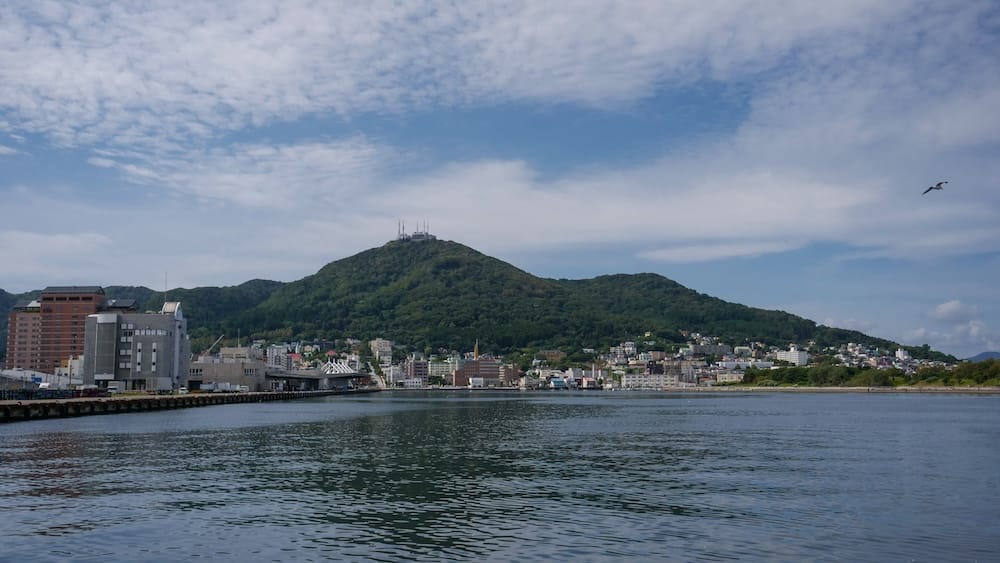
So, Is One Day Enough for Hakodate?
It’s enough for the western half, and it isn’t enough for Hakodate. We did the market, the harbour, the slopes, the churches and the ropeway in one day, a hot and humid one, and it held together with room to eat. Goryokaku, the museums and the hot-spring district were still waiting on other days, and my honest view is that you can cram a lot into one day here without doing the whole place justice.
The city’s own tourism site seems to plan it the same way. It publishes its one-day suggestions as separate themed courses, for the trams, for photography, for history and for culture, not as a single plan for everything. The photography course follows our western loop closely, running from a morning start at Mashu-maru to the ropeway at sunset. The plans that stack everything into one day tend to skip what it costs to cross town between the two halves of the city, and that cost is what decides the day. It also makes where you slept matter more than usual, since the plan that follows opens at a market a couple of minutes from the station, so if you’re still choosing a room, compare hotels near Hakodate Station before you settle on a base.
The Loop: Market, Waterfront, Motomachi, Ropeway
I didn’t keep track of what time Audrey and I reached each stop, so the timing below comes from opening hours and walking distances, not from memory.
Market and Waterfront First
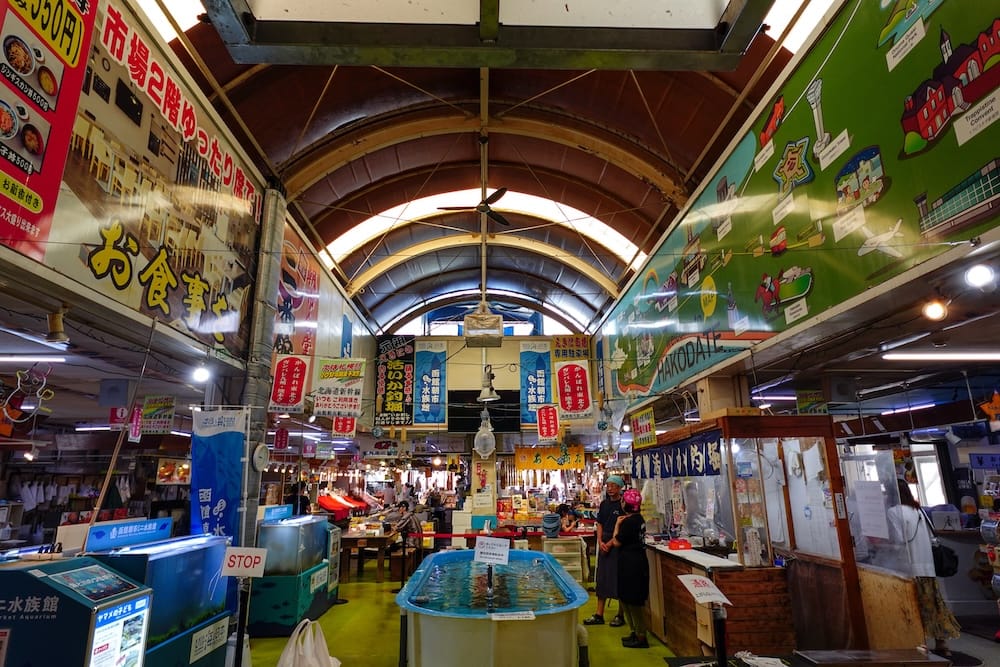
We took the tram into town and began at the morning market, a couple of minutes on foot from Hakodate Station. It’s the one stop in the day with a deadline. The stalls get going around 5:00 from May to December and around 6:00 from January to April, and most of them wrap up by early afternoon. We weren’t there at opening and it was already busy, and I’d imagine it’s busier still a couple of hours earlier. The place turned out to be far bigger than we’d expected, with a second section and an even bigger food court behind it, so give it more than a quick breakfast. If you’d rather have a guide steer you through it, one currently listed option is a guided tasting tour of the market, about an hour and a half with the tastings included.
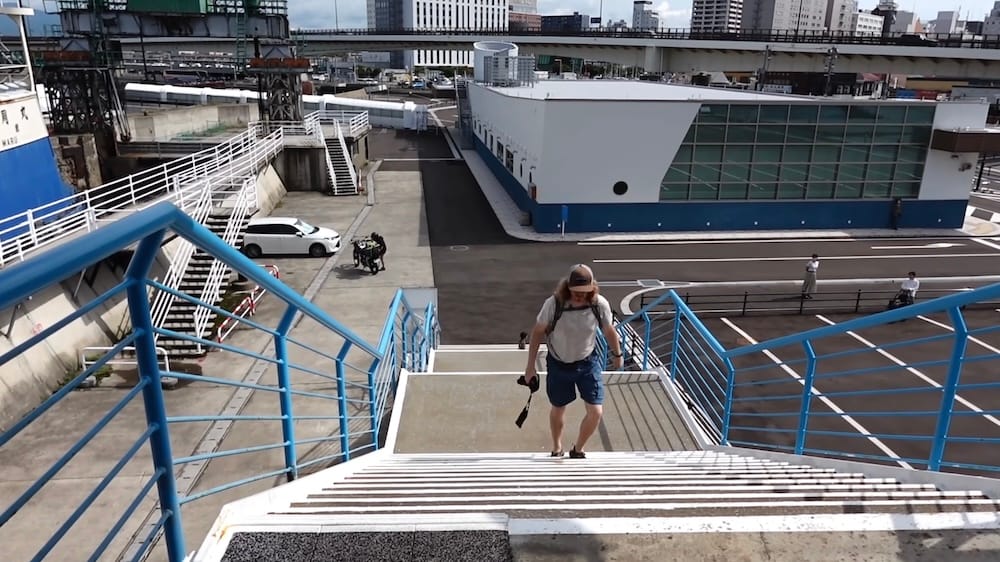
Mashu-maru, the old Seikan ferry, is moored about five minutes’ walk from the station. It opens at 8:30 from April to October and 9:00 in winter, with last entry an hour before closing. We only found it because we were wandering the port with no great plan and no great sense of direction, which says something about how densely the west is packed. We paid ¥500 to go aboard (check the current price), and the deck gives you some of the nicest views over the city, so I’d go even if ships aren’t your thing.
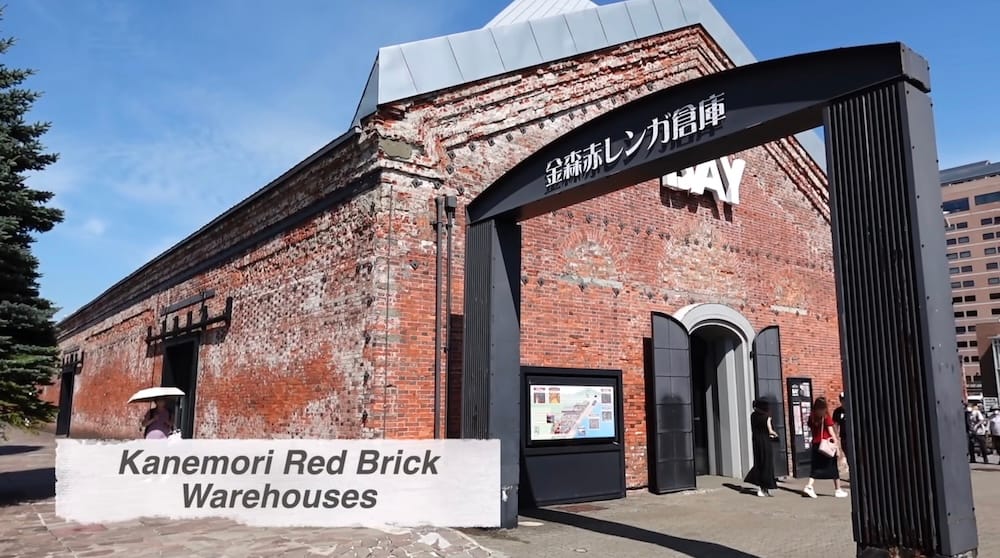
From there the red brick warehouses at Kanemori are roughly ten minutes along the waterfront. They hold shops, restaurants and snack stands, with hours that vary by store, so the complex can double as lunch.
Hachimanzaka and Motomachi’s Churches
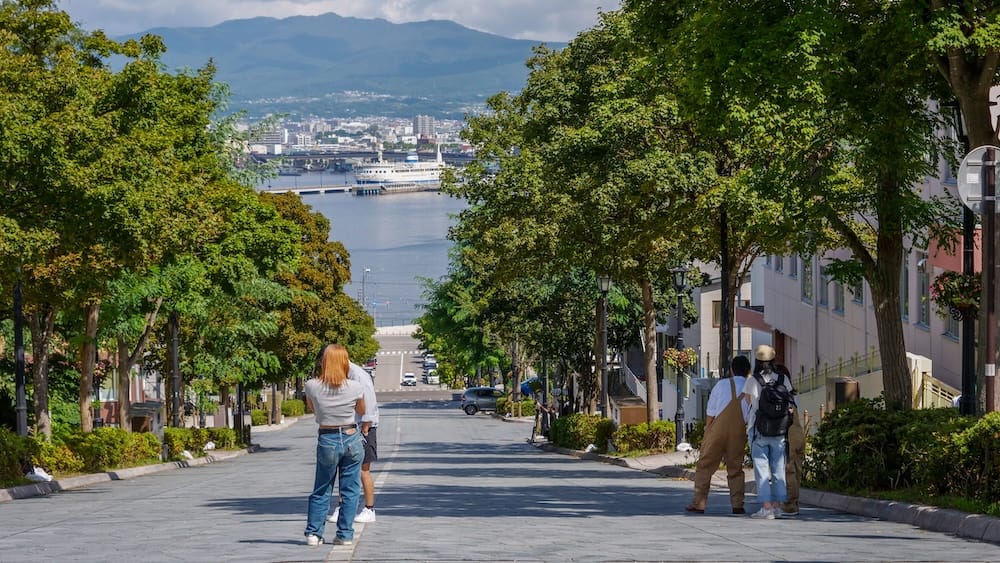
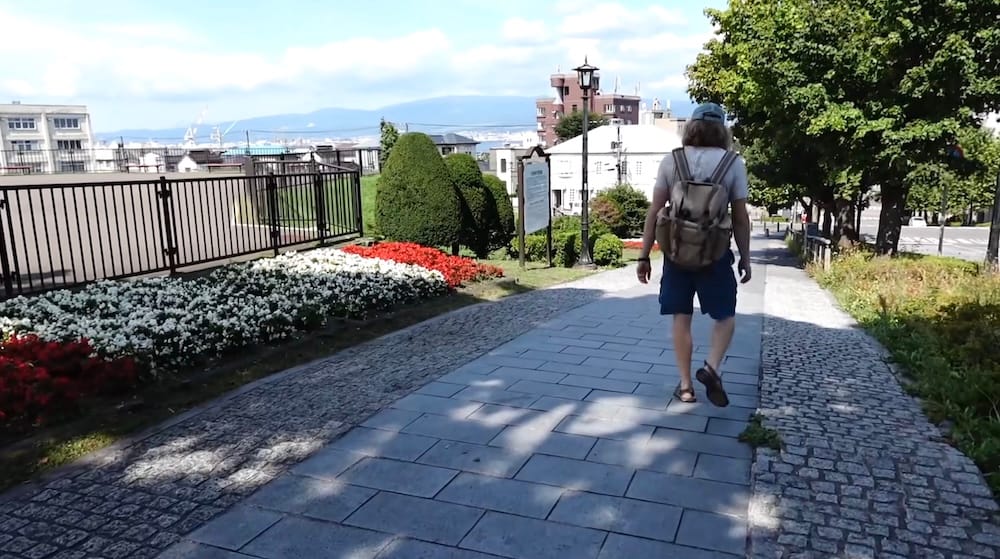
Hachimanzaka is the slope everyone photographs, a wide stone-paved street lined with trees, with stairs beside it and a view down to the harbour as the reward. Audrey and I climbed it on a hot, humid day, and if yours is the same I’d do the climb before the afternoon.
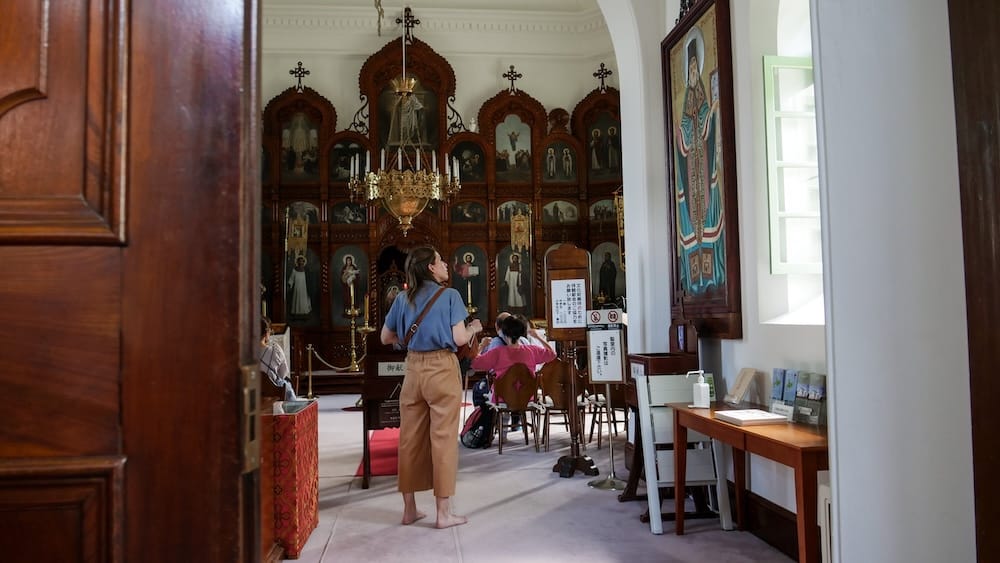
Motomachi’s three churches are where opening hours start to bite. The Orthodox church is open from 10:00 to 17:00 on weekdays and 10:00 to 16:00 on Saturdays, but on Sundays only from 13:00 to 16:00, and it’s closed from late December until mid-March. The Catholic church is open Monday to Saturday from 10:00 to 16:00 and on Sundays from 12:00 to 16:00. St. John’s welcomes visitors to its exterior, with the interior open by reservation from May to November. We visited all three. If your day lands on a Sunday, shift the whole Motomachi leg later, because the Orthodox church won’t let you in before 13:00. If the hills and the hours sound like a lot to juggle, a small-group walk covering Motomachi and the red brick warehouses is currently listed at about three hours, and you can check availability for the guided Motomachi and warehouse walk, which hands the sequencing to someone else.
The Ropeway, the Hall and the Way Down
The ropeway base is about a ten-minute walk from the Jujigai tram stop, which is five or six minutes from Hakodate Station by tram, and the first departure is at 10:00, so it can’t be your opening move. In 2026 the gondola leaves on the quarter hour, with extra runs when it’s busy. A return ticket is ¥1,800, the same as when we rode it, and one way is ¥1,200. We noticed you can ride up and walk back down, but we took the return, so I can’t tell you how that walk goes.
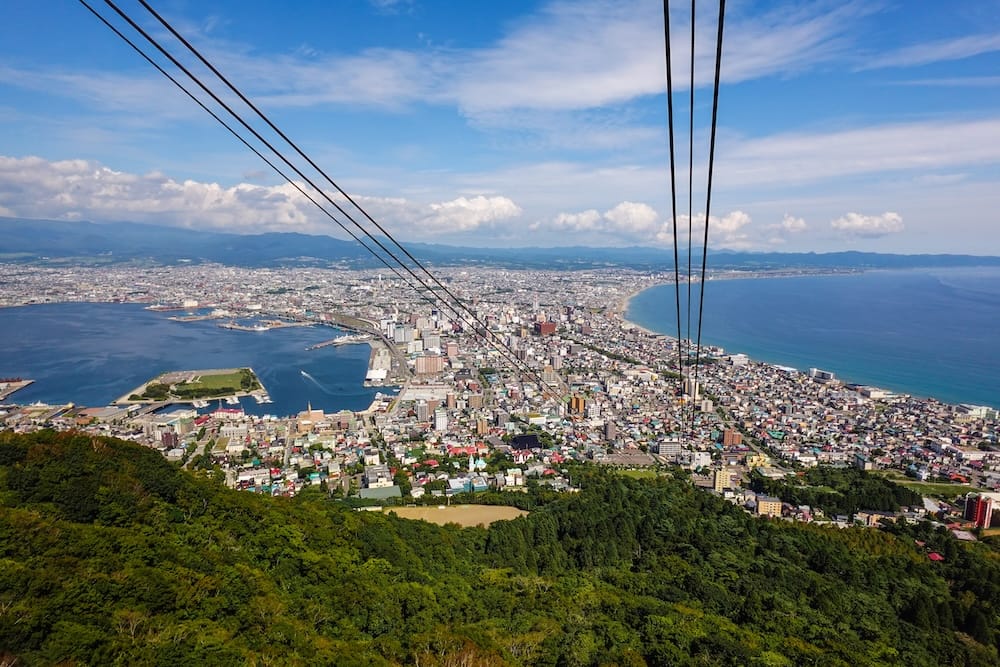
What I can tell you is what a clear day looks like from the top. In the heat, the breeze up there was a relief, and until we arrived we had no idea how big the city is. Beyond the port there’s a beach on the far side, then mountains, then farmland, and none of it is visible from the harbour.
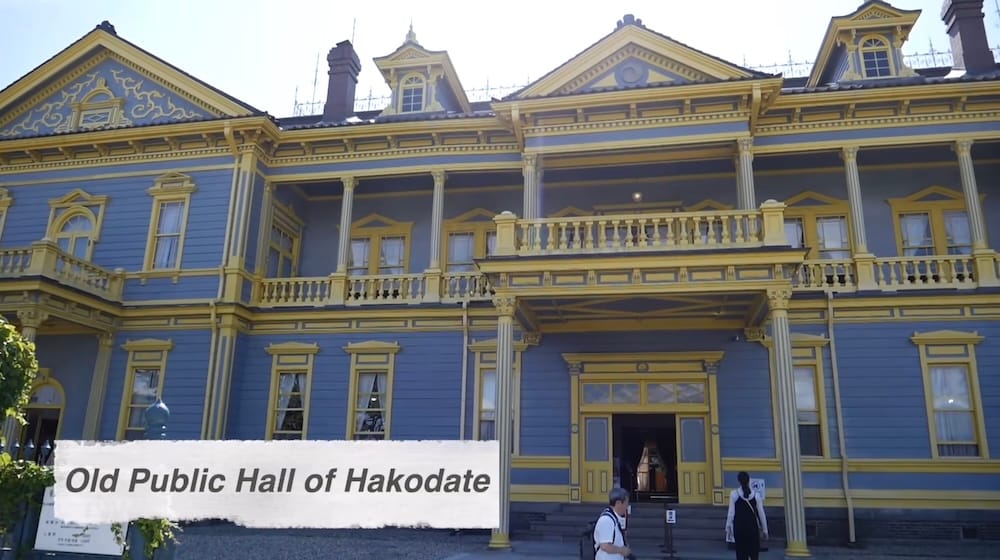
The Old Public Hall is about ten minutes on foot from the ropeway. We took our shoes off at the door, borrowed slippers, wandered through and skipped the costume rental. From April to October it closes at 18:00 Tuesday to Friday and 19:00 Saturday to Monday, and in winter at 17:00, with last entry 30 minutes before. On the way down we cut through Motomachi Park, which has harbour views and made a good route back to the waterfront.
Most of the loop is walkable. We used the tram to get into town, and a single ride runs about ¥210 to ¥260 depending on distance, so the ¥800 day pass only starts to pay once you add Goryokaku or a hotel outside the centre.
What to Prioritize When the Clock Is the Boss
The hours make the case for the order: the market first, Mashu-maru when it opens, the churches after 10:00 (or 13:00 for the Orthodox one on a Sunday), and the ropeway when you reach its base. Every stop below is one Audrey and I did, and the verdicts are my reading of how the day works, not something we tested by dropping stops.
| Stop | Verdict | What limits it | If you’re short |
|---|---|---|---|
| Morning market | Keep | Opens around 5:00 (6:00 January to April); most stalls finish by early afternoon | Go early, eat once, move on |
| Mashu-maru | Keep | Opens 8:30 (9:00 November to March); last entry an hour before closing | Walk the deck for the views |
| Kanemori warehouses | Flexible | Hours vary by store; doubles as lunch | Walk the waterfront and snack |
| Hachimanzaka | Keep | Steep, and hard in heat | Climb early on a hot day |
| Motomachi churches | Flexible | Orthodox opens 10:00 (13:00 on Sundays), Catholic 10:00 (12:00 on Sundays), St. John’s interior by reservation | Look at the exteriors |
| Ropeway | Flexible | First ride 10:00; ¥1,800 return or ¥1,200 one way; annual closure | Ride it by day when you reach the base |
| Old Public Hall | Flexible | Closes between 17:00 and 19:00 depending on day and season | Skip the interior |
The market, Mashu-maru and the climb are the fixed points, because they’re either tied to a clock or they are the point of the route. The warehouses, the churches and the hall stretch or shrink to fit, and cutting any one of them doesn’t break the loop. The ropeway is the one stop where you decide when to go, and that decision needs its own section below.
What to Skip, and What Skipping Costs
Goryokaku is the obvious rival to the western loop, and it costs more than most plans admit. It’s a separate inland outing, about sixteen minutes from the station by tram plus a walk of around ten minutes, and the tower is open from 9:00 to 18:00 with last admission at 17:50, longer over Golden Week. Because you go via the station, the crossing between the fort and the waterfront runs roughly 35 to 45 minutes door to door each way by my arithmetic. That’s about an hour and a half in transit before you’ve seen anything, and a proper visit to the park and the tower brings the whole detour to three or four hours. Adding it means giving up either the Motomachi leg or the ropeway.
The only way I can see to soften that arithmetic is to stop relying on trams. A full-day private driver-guide is currently listed that links Goryokaku, Kanemori, Hachimanzaka and the ropeway, along with a couple of other stops, in about eight hours, with entry and ropeway fares extra. If you’re set on both halves, you can see what the eight-hour driver-guide day includes, and it’s worth confirming the guide’s language before you book. We did everything on foot and by tram, so I can’t say how it feels.
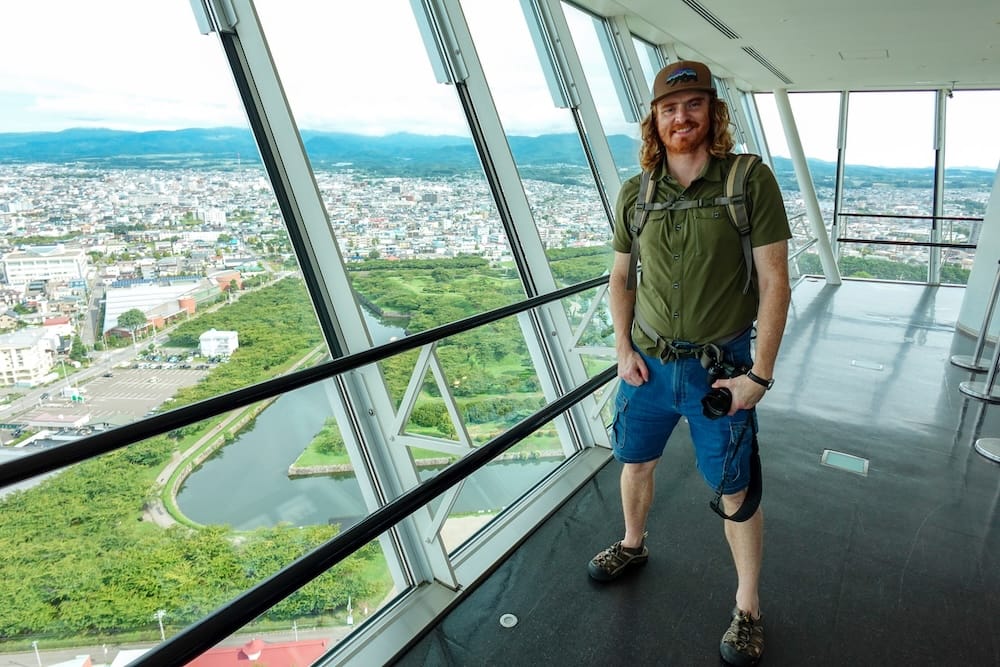
We did Goryokaku on a different morning, walking the park before the tower opened and waiting out the last ten minutes at the door. From the top you can see the whole port, and it gave us a completely different perspective from the ropeway, so we’d visit both. That’s the trade. Swap one for the other and you gain the tower and give up the mountain or the slopes, and I’d rather tell you that plainly than pretend either is optional. If you do make the swap, there’s a guided walk through the fort and up the tower that starts from either Goryokaku or the station.
The museums are the other thing a day drops. We spent a rainy day in two of them, and I’m not much of a museum person, but they beat my expectations. The Museum of Northern Peoples is in the Bay Area, about ten minutes from the station by tram plus a short walk, and it’s open 9:00 to 19:00 from April to October and 9:00 to 17:00 from November to March. That makes it the natural swap on a wet day, and a joint ticket covers it with the Old Public Hall and two other city facilities at ¥840 for all four, so check at the door. I’d leave Yunokawa, the hot-spring district, for another trip. We never made it there, so I can’t tell you what you’d be missing.
When the Weather or the Season Changes the Plan
Rain and Winter
The western loop copes with rain better than you’d expect, because the indoor stops are already in it. Mashu-maru, the Kanemori warehouses, the Old Public Hall and the Museum of Northern Peoples all sit inside the same loop, so a wet day becomes a swap and not a write-off. What suffers are the climb, the church exteriors and, if cloud or fog sits on the mountain, the ropeway.
Winter shortens the day. The market opens at 6:00, the Orthodox church is closed until mid-March, St. John’s interior is shut, and Mashu-maru, the Northern Peoples museum and the Old Public Hall all close around 17:00. That leaves a working day of roughly nine to five.
Should the Ropeway Be a Dusk Finale?
That depends on the season, and it’s why the ropeway is the plan’s real decision. Sunset comes around 16:10 in late December and around 19:15 in late June. The lights look best about half an hour after sunset, which is also when the crowds peak. So in December the view starts around 16:40, just as the museums are closing anyway, while in June it means waiting until after 19:45 for a day that began around 8:30. In the 2026 timetable the last ascent leaves at 21:30 through September and at 20:30 from October 1.
There’s an annual maintenance closure too, October 20 to November 8 in 2026. While it lasts, the road stays open and the Route 1 climbing bus from Hakodate Station takes about half an hour. From November 9 the road closes to buses, taxis and rental cars until mid-April, leaving the ropeway and your legs. The operator’s live status page shows what’s running, and the city’s Mt. Hakodate page has the closure calendar and a crowd forecast.
We rode by day, mid-loop, on a clear day, so I can’t tell you what the city looks like from the top after dark. I’d still make a daytime ride the default. You can take it at the moment you’re standing at the base station, whereas a dusk finale is a bet on the weather. If you’d rather leave the sequencing to someone else, a four-hour private walk is currently listed that starts at Hakodate Station and finishes on the summit after dark, with the ropeway fare not included, and you can see the current times for that night-view walk. We didn’t take it, so I can’t speak to how it goes, and it does nothing to make the weather more cooperative.
How I’d Spend the Day
Start at the market and be at Mashu-maru when it opens. Work along the waterfront to the warehouses, climb into Motomachi once the churches open, and ride the ropeway when you reach its base. Come down through the Old Public Hall and Motomachi Park. Leave the evening view for a winter day, when it fits inside the day, or for a second night, when it doesn’t. Goryokaku and the museums belong to another day, with the museum as your plan B if it rains.
That’s the day we had, and I’d repeat it. What I can’t tell you is that the other half of the city works in a day, because we never tried to squeeze it in. If you do, the ropeway and the Motomachi leg are the two stops I’d expect you to end up trading away. And if you’re still choosing where to sleep the night before, browse Hakodate hotels across the city and match the base to the half you’re planning to do.
Frequently Asked Questions
Is one day enough for Hakodate?
It’s enough for the western half of the city, and it isn’t enough for the whole of Hakodate. Audrey and I did the market, the harbour, the slopes, the churches and the ropeway in one hot, humid day, and it held together with room to eat. Goryokaku, the museums and the hot-spring district were still waiting on other days, and you can cram a lot into one day here without doing the place justice.
What is the best order for one day in Hakodate?
I’d start at the morning market, be at Mashu-maru when it opens, work along the waterfront to the red brick warehouses, and climb into Motomachi once the churches open. The ropeway comes when you reach its base, since the first ride is at 10:00, and the Old Public Hall and Motomachi Park make the walk back down. The opening hours mostly dictate that order.
Do the Motomachi churches open on Sundays?
They do, but later. The Orthodox church is open weekdays from 10:00 to 17:00 and Saturdays from 10:00 to 16:00, but on Sundays only from 13:00 to 16:00, and it’s closed from late December until mid-March. The Catholic church opens Monday to Saturday from 10:00 to 16:00 and on Sundays from 12:00 to 16:00. On a Sunday I’d shift the whole Motomachi leg later.
Can you fit Goryokaku into the same day?
You can, but it costs about three to four hours. The fort is about sixteen minutes from the station by tram plus a walk of around ten minutes, and the crossing to the waterfront runs roughly 35 to 45 minutes door to door each way by my arithmetic. That’s why I treat Goryokaku as a swap for the Motomachi leg or the ropeway, not an add-on.
Should you ride the Mt. Hakodate ropeway by day or at dusk?
I’d make a daytime ride the default, because you can take it whenever you reach the base station, while a dusk finale depends on the weather. We rode by day on a clear day, so I can’t speak to the view after dark. Sunset comes around 16:10 in late December and around 19:15 in late June, which decides whether dusk fits inside the day.
When is the Mt. Hakodate ropeway closed?
There’s an annual maintenance closure, October 20 to November 8 in 2026. While it lasts, the road stays open and the climbing bus from Hakodate Station takes about half an hour. From November 9 the road closes to buses, taxis and rental cars until mid-April, leaving the ropeway and your legs. The operator’s live status page shows what’s running.
What changes on a rainy day or in winter?
In rain, the western loop already has indoor stops in it, including Mashu-maru, the Kanemori warehouses, the Old Public Hall and the Museum of Northern Peoples, so a wet day becomes a swap and not a write-off. In winter the day shrinks to roughly nine to five, the market opens at 6:00, and the Orthodox church is closed until mid-March.
Is the tram day pass worth it for one day in Hakodate?
Usually not for the western loop alone. Most of it is walkable, and a single ride runs about ¥210 to ¥260, so the ¥800 day pass only starts to pay once you add Goryokaku or a hotel outside the centre.
This guide is also available in Spanish. [Leé la versión en castellano: Itinerario de un día en Hakodate: Qué priorizar (y qué dejar afuera)]
This article contains affiliate links. If you book through one of these links, I may earn a commission at no extra cost to you.