
Goryokaku ended up being one of my favourite places in Hakodate, and the funny thing is that I had already reached that conclusion before we ever went up Goryokaku Tower.
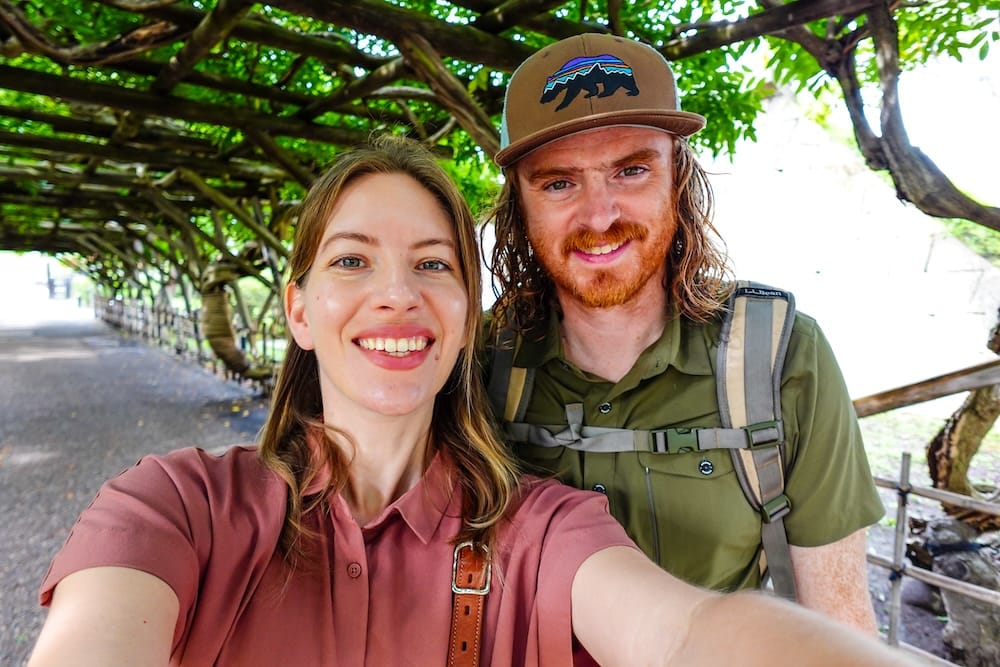
Audrey and I arrived early on a bright morning, before the Tower had opened, so we did the obvious thing and started wandering around the park. We crossed the moat, walked through the fortified grounds, climbed onto sections of the old earthworks and stopped at the reconstructed Hakodate Magistrate’s Office. At the same time, school kids were cycling past, locals were out jogging and other people were simply using the grounds as their neighbourhood park.
That combination really worked for me. Goryokaku felt historic without feeling frozen in time. Had there been no observation tower whatsoever, I still would have left thinking it was one of the best places we visited in Hakodate.
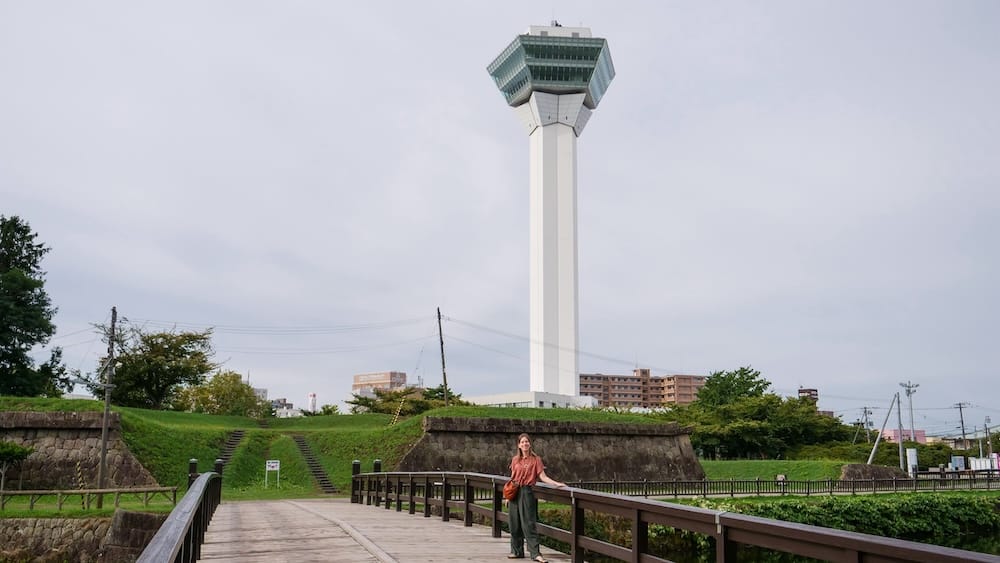
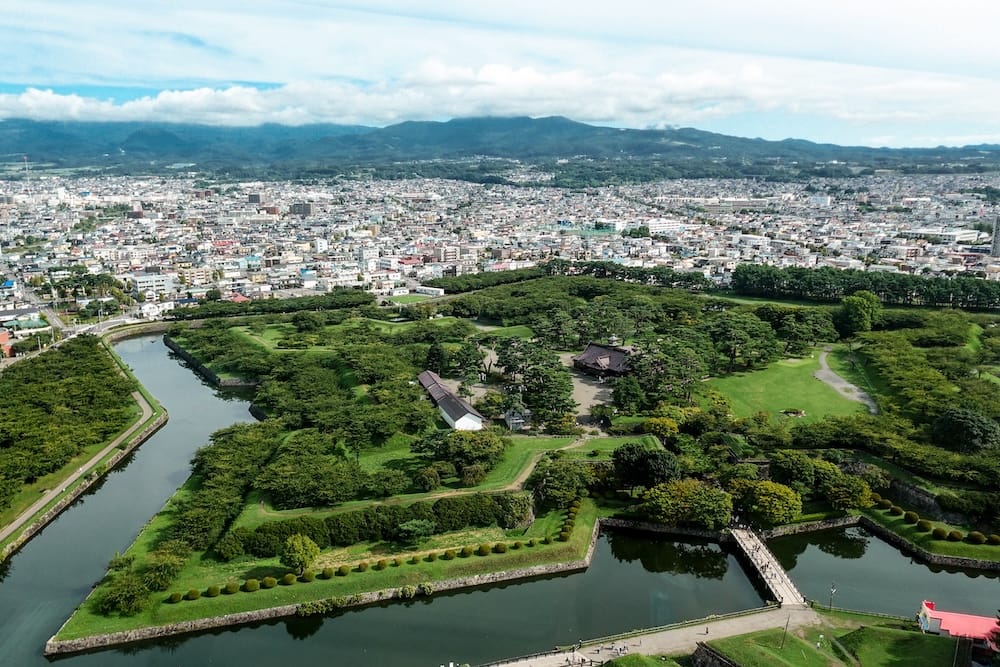
Then the Tower opened. Once Audrey and I went up and looked down on the whole five-pointed fort, the geometry we had been walking through finally snapped into place. The Tower was the cherry on top because it showed us something the park itself simply cannot: the complete star.
For a first visit, I think that relationship is the key to understanding Goryokaku. Give the park enough time to become a place rather than a photo stop, then go up the Tower and see what you have just been walking through from above.
Why Goryokaku is shaped like a star
Goryokaku looks so distinctive from the air that it is easy to assume the shape exists partly for visual effect. In reality, its geometry was defensive.
Construction began in 1857 during the final years of the Tokugawa shogunate, and the fort was nearly complete by 1864, when the Hakodate Magistrate’s Office moved inside. Its design drew on European fortification techniques that had developed for an age of guns and cannon. The projecting points of a star fort reduced blind spots and allowed defenders to cover neighbouring stretches of wall more effectively than they could with a simpler enclosure.
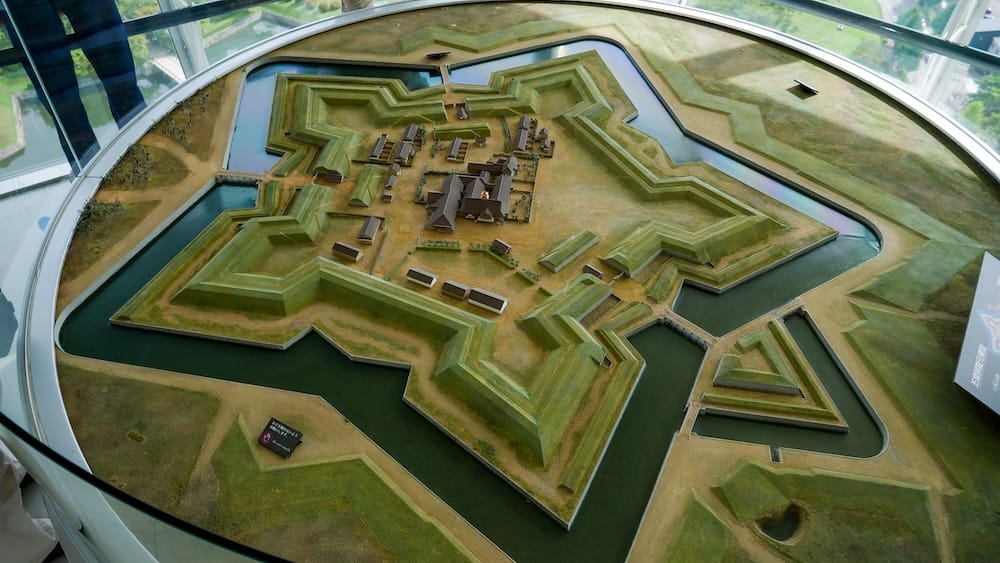
You do not need to turn your Hakodate holiday into a military-engineering seminar, but knowing this before you walk around changes what you are looking at. The angular earthworks, points and moat are not decorative landscaping that happened to photograph nicely from a tower.
Goryokaku later became one of the major sites in the fighting that accompanied the end of the shogunate. Former Tokugawa forces occupied the fort in 1868, and the conflict around Hakodate continued into 1869 before they surrendered.
The transformation that followed is almost as interesting from a visitor’s perspective. Goryokaku eventually opened as a public park in 1914, so today you are walking through a former military and administrative site that has also spent more than a century functioning as an ordinary city park. That second identity was impossible for us to miss.
Walking Goryokaku Park at ground level
I would not arrive at Goryokaku and immediately make a beeline for the elevator.
The park is free, and it is much larger on the ground than the tidy star on a map makes it appear. The moat runs for roughly 1.8 kilometres, while the broader historic site has a perimeter of around 3 kilometres. The main earthworks rise about five to seven metres in places, so once you start moving through the fort there is plenty of physical structure to explore.
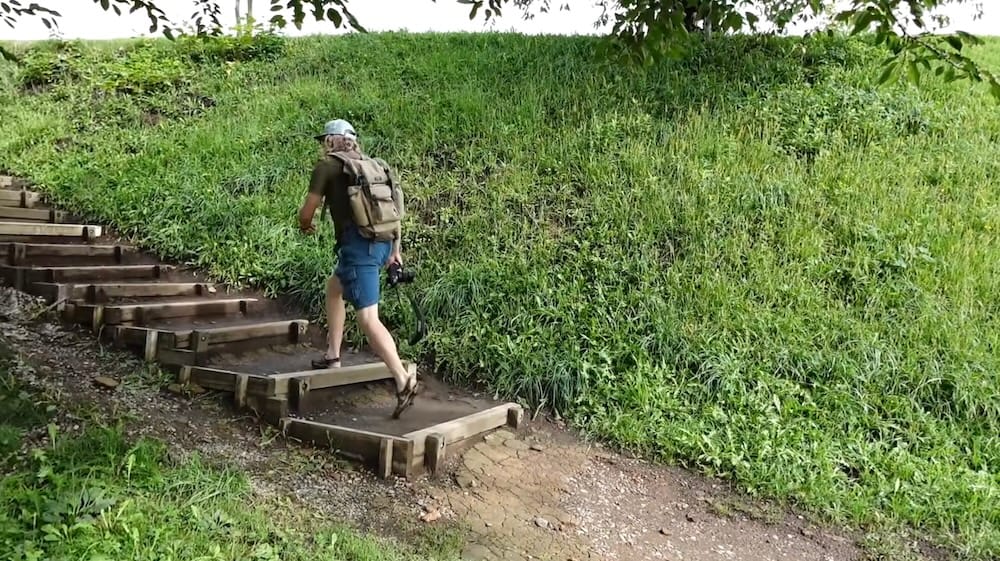
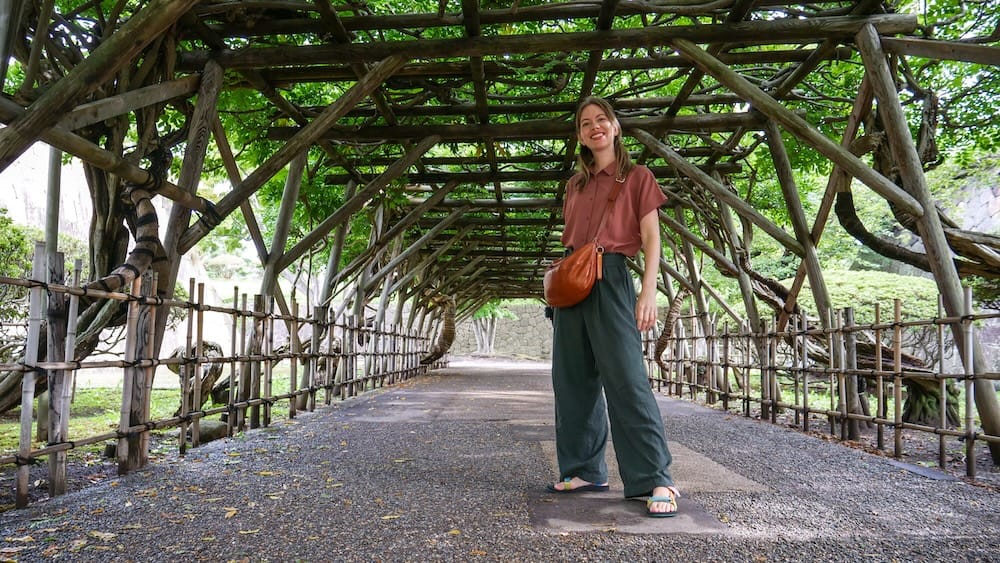
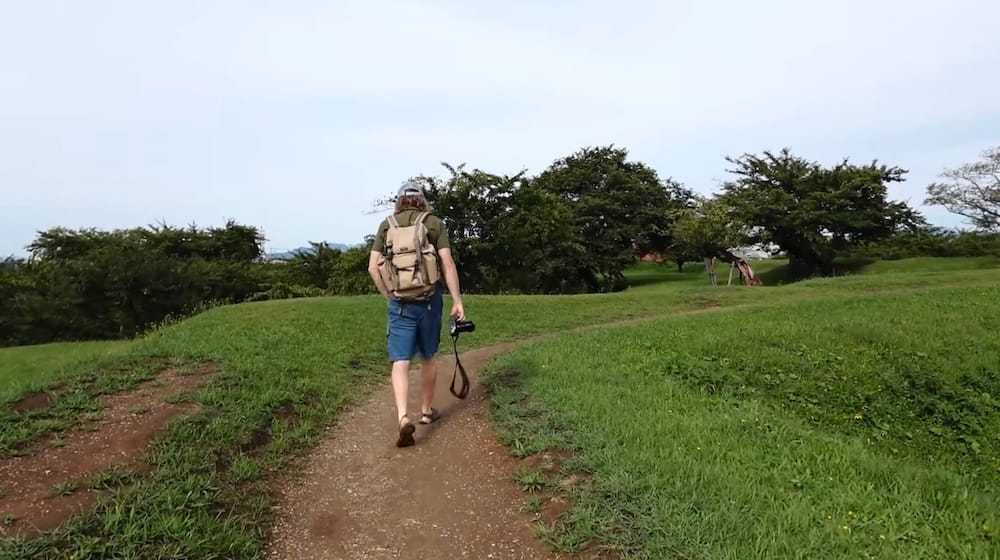
Audrey and I crossed the bridges and wandered through the interior without much urgency. At one point we found what felt almost like a little hidden walking route, climbed some steps onto the fortified walls and ended up with a higher view over the moat and toward the mountains. Those are the moments I tend to remember more than dutifully checking off every named feature; we had not arrived with a carefully choreographed circuit of Goryokaku, and we were simply poking around and seeing where the paths took us.
What stood out even more was how many locals were using the park as part of normal life. We saw schoolchildren riding bicycles, people out walking and joggers making their rounds through a place that tourists had travelled across Japan to visit. I remember thinking that if this were my local park, I would use it all the time.
It gave Goryokaku a completely different feeling from a historical attraction designed mainly to funnel visitors between signs and exhibits. The fortifications were still there, the moat was still there and the history was obviously central, but life had grown around the place rather than being kept at arm’s length.
If you want a longer walk, there is also an approximately 1.8-kilometre promenade around the outer moat. You certainly do not need to complete the entire loop to have a worthwhile visit, but it is useful context if you are wondering whether Goryokaku is somewhere you can linger.
It absolutely is.
The Hakodate Magistrate’s Office sits at the heart of the fort
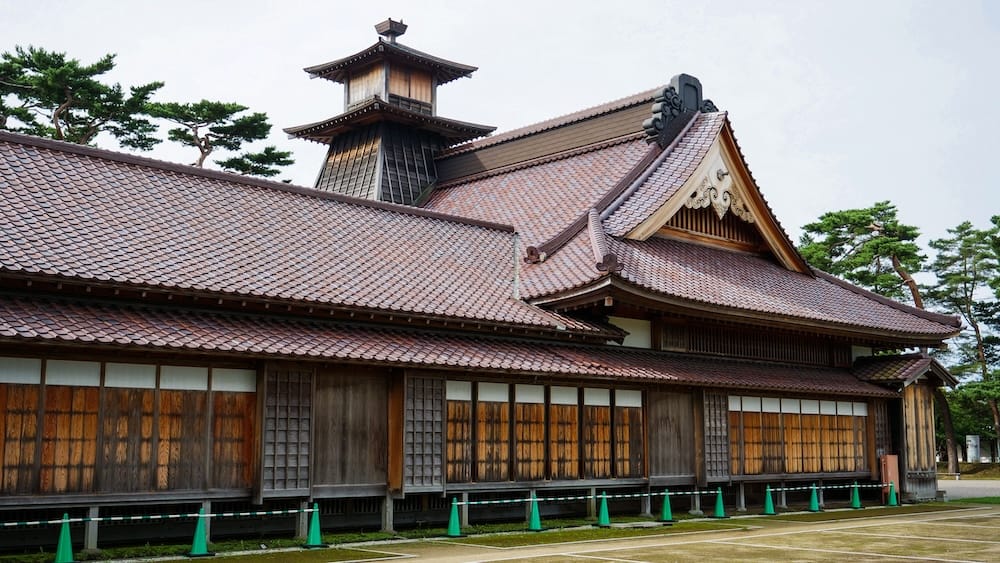
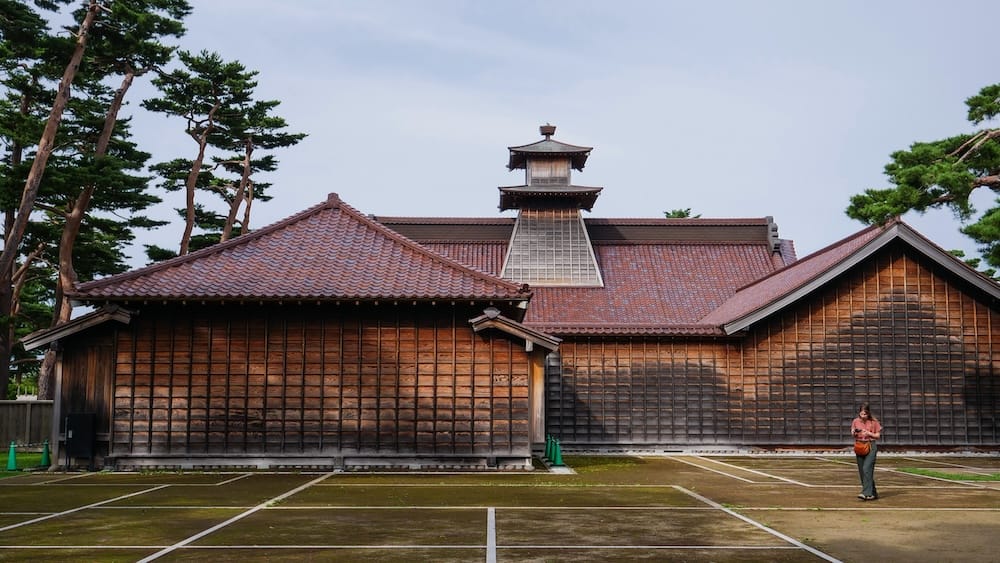
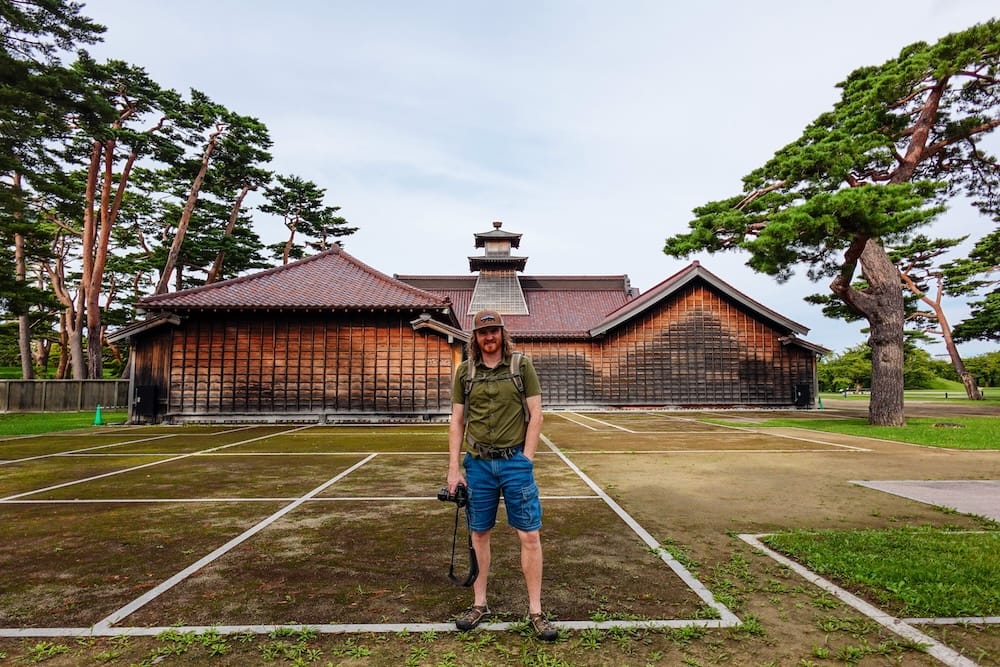
Near the middle of Goryokaku is the reconstructed Hakodate Magistrate’s Office, one of the most obvious reminders that the fort was once an active government centre rather than simply a collection of earthworks.
The original office was completed during the development of Goryokaku in the 1860s and dismantled in 1871. The present reconstruction opened in 2010 after extensive historical work, and what you see today represents roughly one-third of the former building.
We only experienced it from outside because the office was closed during our visit. Even so, one detail stuck with us: markings on the ground show where other portions of the original complex once stood. Looking from the reconstructed building across that footprint gave us a much better sense of how substantial the place had been. Our reaction was basically, wow, this thing was huge.
If the building is open when you visit, the interior is a separate paid attraction with reconstructed rooms, historical displays and information about both the original complex and the reconstruction. Adult admission is currently ¥500. Normal hours are 9:00 to 18:00 from April through October and 9:00 to 17:00 from November through March, with final admission 15 minutes before closing.
There are a few practical details worth knowing if you want to go inside. Shoes come off, large baggage may be refused because there is no luggage storage in the building, and strollers are not permitted. Wheelchair visits are possible, although the traditional-style entrance creates an extra step and visitors may need to transfer to an indoor wheelchair.
Because Audrey and I did not get inside, I cannot tell you whether I personally think the interior is worth paying for. What I can say is that missing it did not make Goryokaku feel incomplete. The park itself had already won me over.
If the history is the part you most want explained rather than pieced together independently, there is also a current Goryokaku Star Fort and Tower guided history tour. We did not take this tour ourselves, but the current itinerary is unusually focused: it covers Goryokaku Park, the Magistrate’s Office and the Tower with an English-speaking guide, with Tower observation-deck access included.
Why Goryokaku Tower changes the experience
After exploring the fort, Audrey and I walked over to Goryokaku Tower and discovered that we had once again been just a little too efficient. It was almost opening time, which meant Audrey and I had reached that familiar travel stage of hurry up and wait.
Once we finally went up, I understood immediately why the Tower matters.
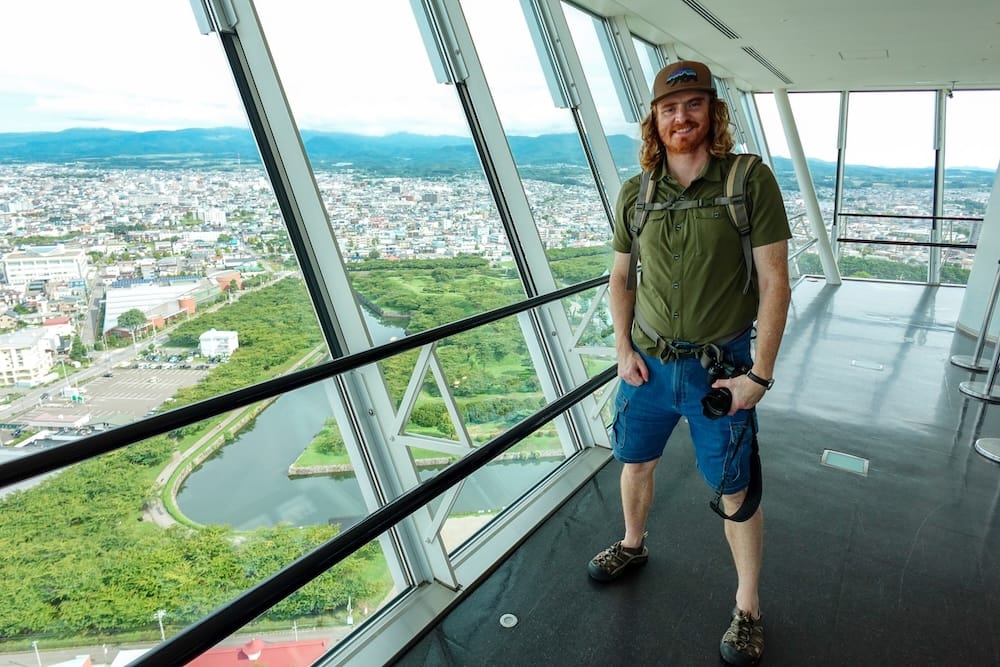
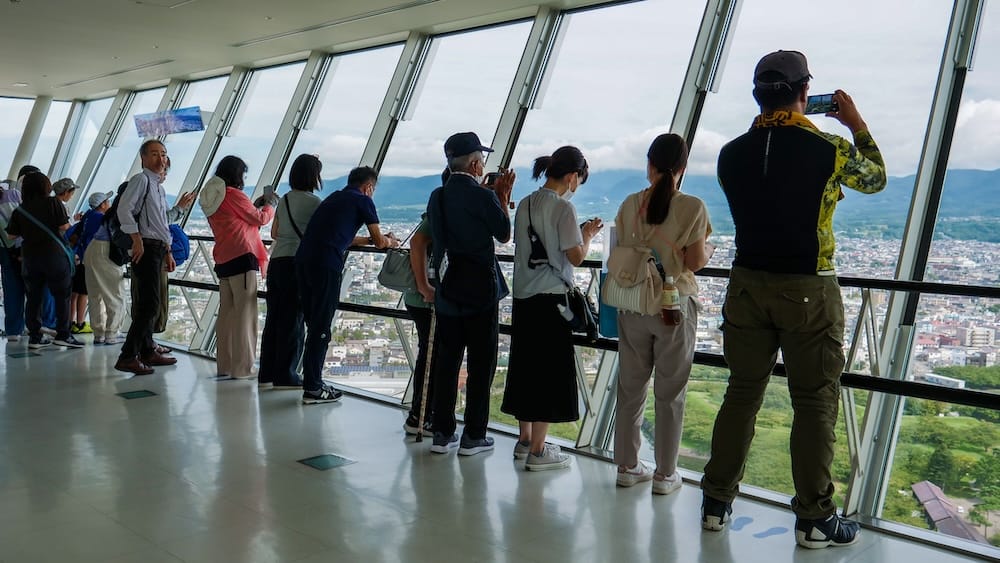
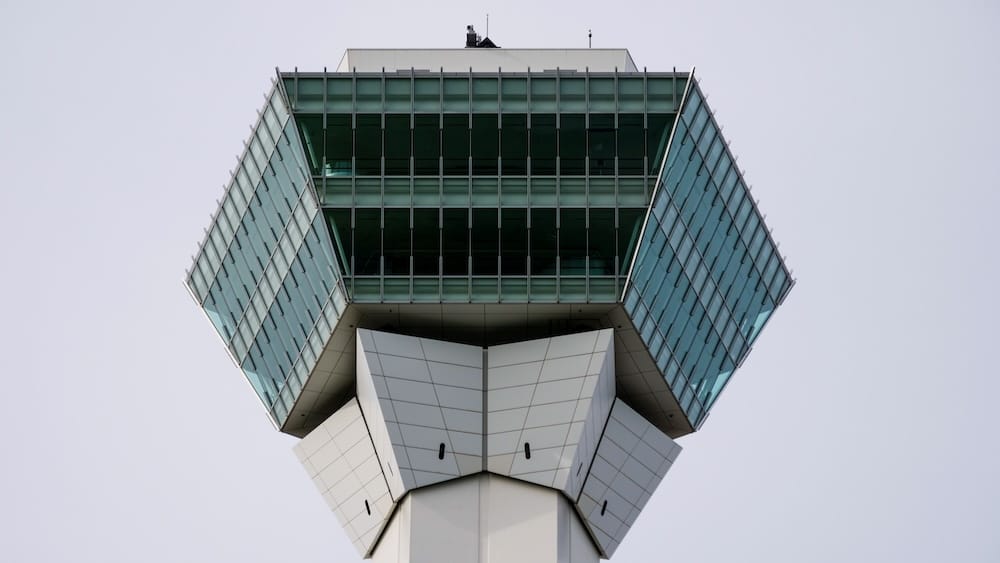
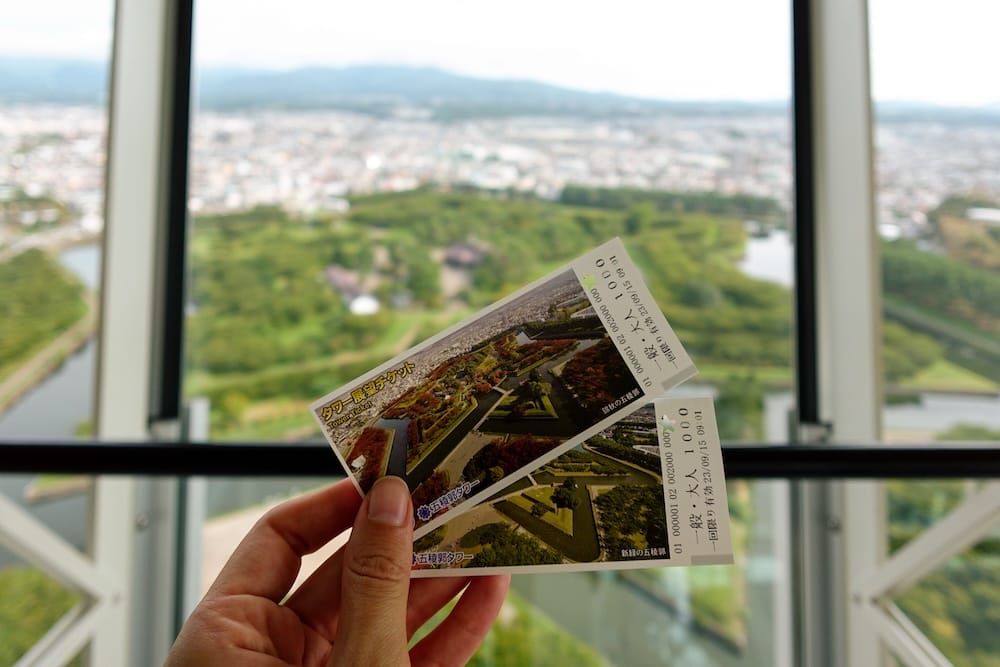
The current structure rises 98 metres, with observation levels at roughly 86 and 90 metres. From up there you can look almost straight down across Goryokaku, and suddenly all of those bends, walls and sections of moat that felt disconnected while you were walking become one coherent design.
That was the big reveal for me. At ground level, I knew intellectually that we were inside a five-pointed star fort, but I never felt as though I could mentally assemble the whole shape while standing in it because the scale works against you. You are simply too close.
From the Tower, it becomes obvious.
This is why I think walking first works so well. You spend time inside the fort experiencing its details at human scale, and only afterward do you get the aerial explanation. The Tower does not improve a bad park. It explains a very good one.
Current regular admission is ¥1,200 for adults, ¥900 for junior and senior high school students and ¥600 for elementary school students, with younger children admitted free. Regular hours are currently 9:00 to 18:00, with final admission at 17:50. Special periods can have different hours, so I would still check the current schedule if you are visiting around a holiday or major event.
If you already know you want the aerial view and prefer to arrange the admission part before you arrive, Booking.com currently offers a standalone Goryokaku Tower admission ticket. It is ticket-only rather than a guided experience, so you still handle the park, transport and historical context yourself.
There is more to the Tower view than the star
I went up expecting Goryokaku Tower to be almost entirely about looking down at Goryokaku. That would have been enough for me, but the broader view ended up being a pleasant surprise.
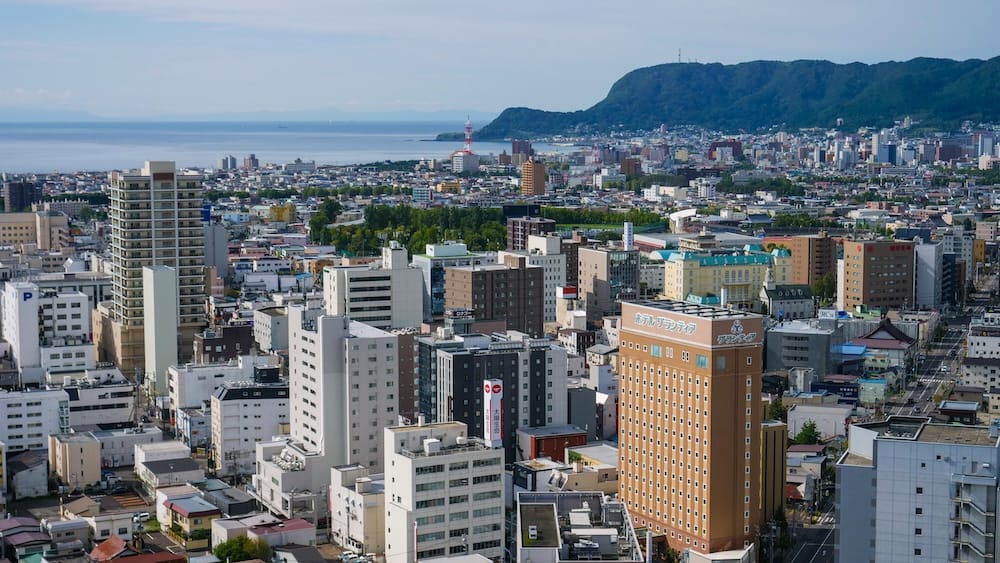
We could see toward Hakodate’s harbour and port, and once again we were reminded just how spread out the city is. We happened to visit with blue skies and excellent visibility, which obviously helped, but on clear days the view can extend toward Mt. Hakodate, the Tsugaru Strait and the Yokotsu mountain range.
I liked having that wider context because it places the fort within Hakodate rather than isolating it as a historical exhibit surrounded by modern city. Still, the star is the reason the Tower works so well. Plenty of observation decks can give you a skyline; very few can show you something directly below that is almost impossible to understand properly from the ground.
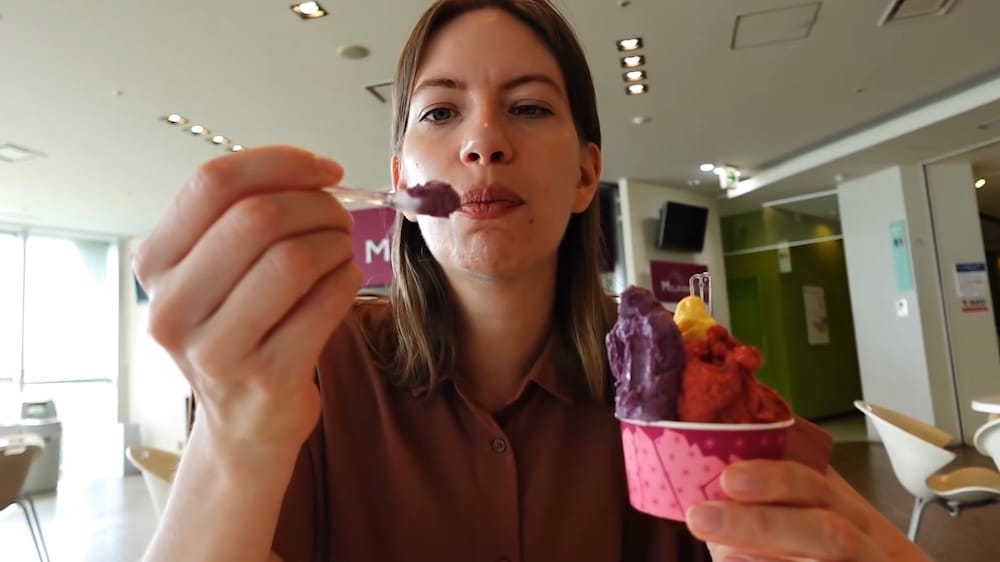
On the way back down, we also stopped at Milkissimo inside Goryokaku Tower for gelato. We went for three flavours that were pretty new to us: northern winter berry, pumpkin and purple sweet potato. The berry was the easy winner for both of us, but after that we disagreed—I preferred pumpkin over the sweet potato, while Audrey put the sweet potato second. It was a small part of the visit, but after walking the fort and spending time up at the observation deck, sitting down with three slightly unusual Hokkaido gelato flavours was a pretty good way to finish.
Goryokaku Tower did not feel like a repeat of Mt. Hakodate
By this point in our trip, we had already ridden the Ropeway up Mt. Hakodate, so another paid elevated viewpoint could easily have felt redundant.
It didn’t.
From Mt. Hakodate, the attraction is the larger shape and setting of the city: water, harbour, urban area and the narrow geography spreading below the mountain. At Goryokaku Tower, your attention is pulled inward toward one very specific object—the fort directly beneath you. We could actually see Mt. Hakodate from Goryokaku Tower, which made the difference between the two perspectives even easier to understand.
Having done both in daylight, I would not dismiss one simply because your itinerary already includes the other. They solve different visual problems. Mt. Hakodate helps you understand Hakodate; Goryokaku Tower helps you understand Goryokaku.
How to get to Goryokaku
For most visitors staying around central Hakodate, the tram is one of the easiest ways to reach the area.
From around Hakodate Station, take the tram to Goryokaku-koen-mae. The potentially misleading part is the “Goryokaku Park” in the stop name: you are not stepping off directly beside the Tower. Allow roughly 10 to 15 minutes of walking from the tram stop to the park and Tower area.
That is not a major inconvenience, but it is enough of a walk that I would factor it into your timing.
There is another naming trap worth knowing. JR Goryokaku Station is not the convenient station for sightseeing at Goryokaku Park. If you are travelling by rail, do not see the matching name and assume you have found the obvious gateway to the fort.
Bus services can get you somewhat closer, depending on the route, with some stops leaving only around five to ten minutes of walking. There are also services stopping very close to Goryokaku Tower, which may be useful if minimizing walking matters to you.
If you are driving, neither Goryokaku Tower nor the Magistrate’s Office has its own private visitor parking, although paid municipal lots are available nearby. I would not rent a car solely for this attraction if the rest of your Hakodate sightseeing already works by tram and on foot.
Current Goryokaku prices and hours
The easiest way to plan the visit is to remember that the park, Tower and Magistrate’s Office are three related attractions with different operating hours:
- Goryokaku Park: free; currently 5:00–19:00 from April through October and 5:00–18:00 from November through March.
- Goryokaku Tower: currently ¥1,200 for adults; regular hours 9:00–18:00, with last admission at 17:50.
- Hakodate Magistrate’s Office: currently ¥500 for adults; 9:00–18:00 from April through October and 9:00–17:00 from November through March, with entry ending 15 minutes before closing.
The Tower also has toilets, a multipurpose restroom, a nursing room and lockers. Small lockers currently cost ¥300 and large ones ¥500, and you need to retrieve your belongings while the Tower is still open.
Elevators serve the Tower, and assistance is available for visitors who cannot use the normal stairs between observation levels. There is also a tactile model of the fort for visitors with visual impairments. The park itself includes a much wider variety of paths and historical terrain, so I would not assume every part of the grounds offers the same level of access as the modern Tower.
If you are visiting before November 15, 2026, exterior repainting and repair work is currently underway at Goryokaku Tower. The Tower remains open during the work, but the exterior may not look exactly as it normally does.
Independent, guided or cruise visit: which Goryokaku option fits?
We visited Goryokaku independently, and I still think that is the straightforward option for travellers who are comfortable using Hakodate’s tram system and reading up on the history themselves. But Goryokaku is also one of those attractions where paying for interpretation can make sense because the shape, late-shogunate history and reconstructed Magistrate’s Office give a guide something substantial to explain.
The current bookable options also solve quite different problems, so I would choose based on why you are considering a tour rather than treating them as interchangeable versions of the same product. I have not personally taken the guided options below; this matrix is based on their current published itineraries and inclusions.
20:36 – Goryokaku Tower
| Visit style | Best for | What you get | Main trade-off | Booking option |
|---|---|---|---|---|
| Independent park + Tower | Travellers who want maximum flexibility and are happy exploring the history on their own | Walk the free park at your own pace, then visit the Tower for the aerial view | No guide or transport is included with the Tower ticket; you organize the tram, walking and historical context yourself | Check standalone Tower tickets |
| Focused Goryokaku history tour | History-focused visitors who want the fort properly explained rather than simply photographed | Roughly 2.5–3.5 hours with an English-speaking guide covering Goryokaku Park, the Magistrate’s Office and the Tower; Tower observation-deck access is included | This is a deeper, paid interpretation of a site that is otherwise quite easy to visit independently | See the focused Goryokaku guided tour |
| Private Hakodate tour with guide and vehicle | Travellers who want Goryokaku folded into a broader Hakodate sightseeing day without handling city transport | A six-hour private tour with an English-speaking licensed guide and vehicle; Goryokaku Park can be selected as one of up to four Hakodate stops | Goryokaku is only one part of the day, so this is not the choice for someone wanting several hours focused on the fort itself | Check the private Hakodate guide-and-vehicle tour |
| Group cruise shore excursion | Cruise passengers who mainly need port transport and several Hakodate highlights organized into one day | A seven-hour shore excursion with port pickup and broader Hakodate sightseeing; current itineraries allocate about 60–90 minutes to Goryokaku | Goryokaku gets less time than on the focused tour, and attraction admission fees are currently separate | Compare the current cruise shore excursion |
– Gelato (winter berry, purple sweet potato and pumpkin)
If Goryokaku is the main reason you are booking anything, the focused history tour is the cleanest match because the entire experience revolves around the fort rather than squeezing it between unrelated Hakodate stops. For most independent travellers, though, I would not overcomplicate things: the park is easy to explore on your own, the Tower is right beside it and the tram gets you into the area without needing a full-day tour.
The broader private and cruise options make more sense when the problem you are actually trying to solve is transportation, limited port time or fitting several Hakodate attractions into the same day.
Arriving before the Tower opens can actually work in your favour
Our early arrival was accidental, but I would happily do it again.
Goryokaku Park currently opens at 5:00 in the morning, while both the Tower and Magistrate’s Office normally begin operating at 9:00. Unless you are one of those alarming people who genuinely enjoys sightseeing at dawn, there is no reason to interpret that as a recommendation to arrive at five. Arriving sometime before nine, though, can make a lot of sense.
It gives you a chance to experience the park without immediately thinking about tickets and elevators, and it naturally divides the visit into two parts. We walked around the moat and fortifications, saw the Magistrate’s Office, watched local life unfold and generally got our bearings before going up.
By the time we reached the observation deck, we had context for what we were seeing below. I would rather experience Goryokaku that way than start with the perfect aerial overview and then walk through the park merely confirming things I had already seen.
Give yourself permission to linger
I would also avoid treating Goryokaku as something you need to “complete.” A focused visit can cover the central fort and Tower without consuming a huge portion of your day, while at the other end of the spectrum you can walk much more of the moat, spend time inside the grounds, add the Magistrate’s Office and simply sit somewhere for a while.
We leaned toward the second approach. Goryokaku came near the end of our Hakodate stay, after we had already done most of the sightseeing we hoped to fit in, and that removed some of the usual travel pressure. We were not standing there thinking about the next four attractions or trying to optimize every 20 minutes of the day.
We could wander, and Goryokaku is particularly good for that.
If your schedule is tight, I would at least walk into the fort rather than visiting only the Tower. If you have more time, let the place breathe. The outer moat promenade alone is around 1.8 kilometres, so there is plenty of room to stretch the experience without manufacturing things to do.
How I would visit Goryokaku again
If I returned to Hakodate tomorrow, I would follow almost the same sequence. I would start in the park, cross the moat and spend enough time inside the fort to appreciate the earthworks, historic core and local atmosphere. If the Magistrate’s Office were open, I would probably go inside this time because that is the obvious piece of the visit we missed.
Then I would head up the Tower.
For me, the order matters because my strongest memory of Goryokaku is not simply the famous star-shaped photograph. It is school kids cycling through a historic fort, joggers making their morning rounds, the old earthworks above the moat and the feeling that this major historical site still belongs to the everyday life of Hakodate.
The Tower gave us something completely different: perspective. From the park, Goryokaku became one of my favourite places in the city. From the Tower, I finally understood what I had been walking through.
Frequently Asked Questions
Is Goryokaku Park free to visit?
Goryokaku Park is free. The Tower and Hakodate Magistrate’s Office are separate paid attractions, so you can still walk the moat, bridges, earthworks and central fort without buying an admission ticket.
Should I visit Goryokaku Park before going up the Tower?
I preferred doing the park first. Walking through the fort gave me a feel for the moat, earthworks and scale at ground level, and the Tower then revealed how those pieces fit together into the five-pointed star.
How do I get to Goryokaku from central Hakodate?
From around Hakodate Station, the tram to Goryokaku-koen-mae is one of the easiest options. The stop is not directly beside the fort, so allow roughly 10 to 15 minutes to walk from the tram stop to the park and Tower area.
Is Goryokaku Tower worth visiting if I already plan to visit Mt. Hakodate?
I did not find the two viewpoints redundant. Mt. Hakodate gave me the broader shape and setting of the city, while Goryokaku Tower was much more about looking directly down on the fort and understanding its geometry.
Can you visit the Hakodate Magistrate’s Office inside Goryokaku?
Yes, when it is open the reconstructed Magistrate’s Office is a separate paid attraction inside the fort. Audrey and I only saw it from outside because it was closed during our visit, so I cannot give a firsthand verdict on the interior.
What are the current Goryokaku Park and Tower hours?
Goryokaku Park is currently open from 5:00 to 19:00 from April through October and 5:00 to 18:00 from November through March. Goryokaku Tower’s regular hours are currently 9:00 to 18:00, with last admission at 17:50.
This guide is also available in Spanish. [Leé la versión en castellano: Guía de Goryokaku: parque, torre y cómo visitar el fuerte estrella de Hakodate]
This article contains affiliate links. If you book through one of these links, I may earn a commission at no extra cost to you.