
We went out looking for ramen and somehow ended up eating pumpkin tempura, stretchy mozzarella cheese, Hokkaido potato mochi, Indian butter chicken and strawberry sweets. All in the middle of downtown Sapporo, at a food festival we hadn’t even known was happening when we set out that morning. Spontaneity, at its finest.
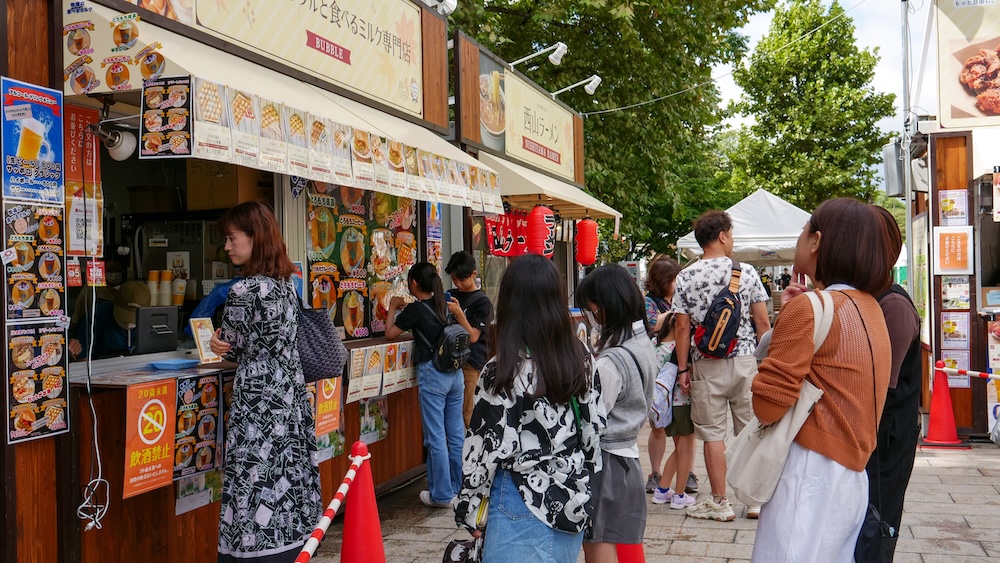
Audrey and I were exploring the city and filming our Sapporo travel guide when we stumbled upon Sapporo Autumn Fest in Odori Park. Suddenly, our perfectly sensible plan to sit down with steaming bowls of noodles seemed considerably less appealing than wandering among food stalls and sampling whatever caught our attention. Ramen would still be there tomorrow; this sprawling outdoor feast wouldn’t be around all year.
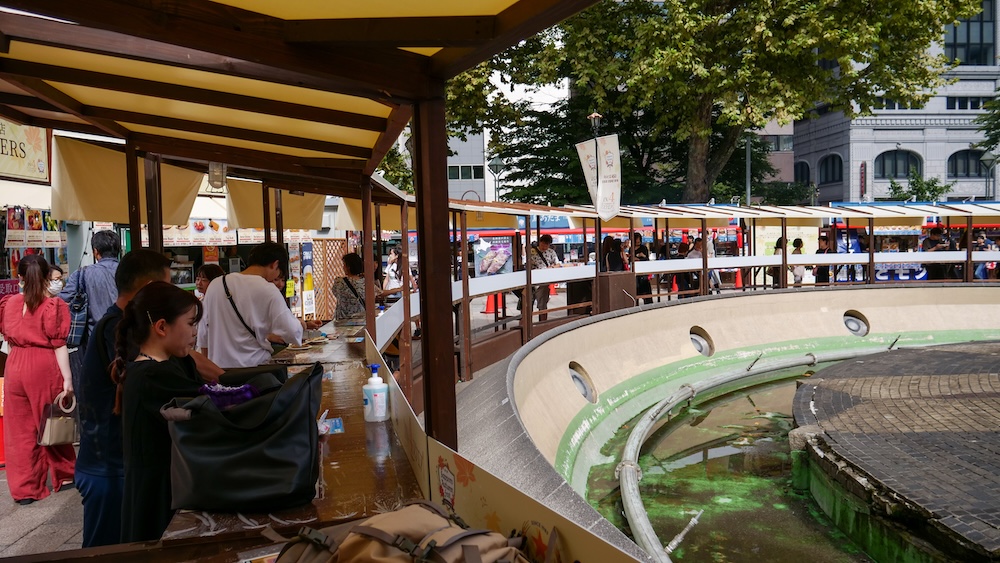
The scale caught me off guard. Whole sections of the park were filled with wooden stalls, people inspecting menus and a mixture of Hokkaido specialities, Japanese favourites and international dishes. We only had a short window before returning to our filming schedule, yet this unplanned lunch became one of my favourite food experiences in Sapporo. Here’s what made it so enjoyable, what we actually ate and whether I’d rearrange a September trip to include it.
Stumbling Upon Sapporo Autumn Fest
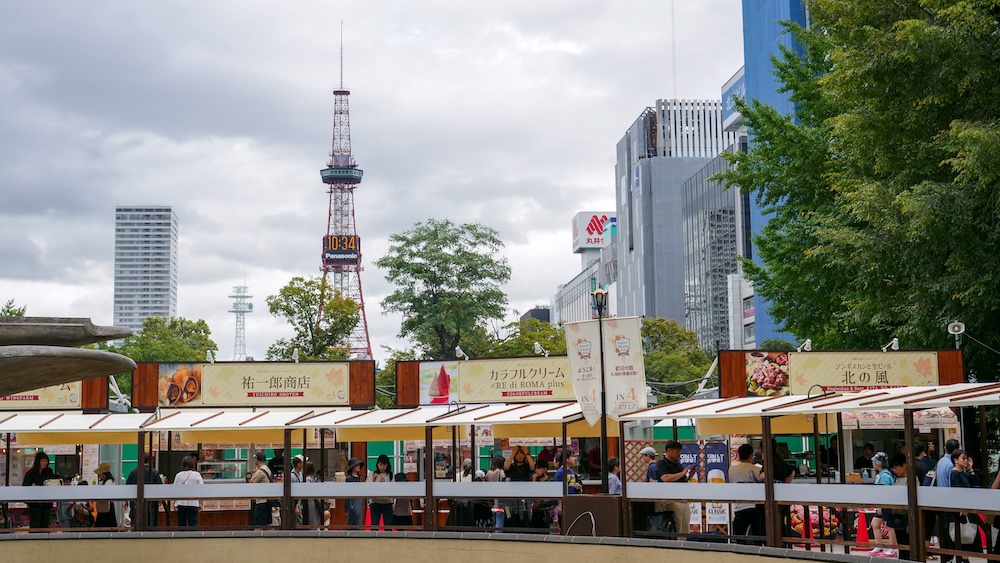
Odori Park cuts through central Sapporo, with the TV Tower at its eastern end, office buildings and shops along the edges, and enough greenery to offer a welcome break from downtown streets. We’d already been on our feet exploring the city, so lunch was meant to be straightforward: find a ramen restaurant, order something comforting and get back to sightseeing.
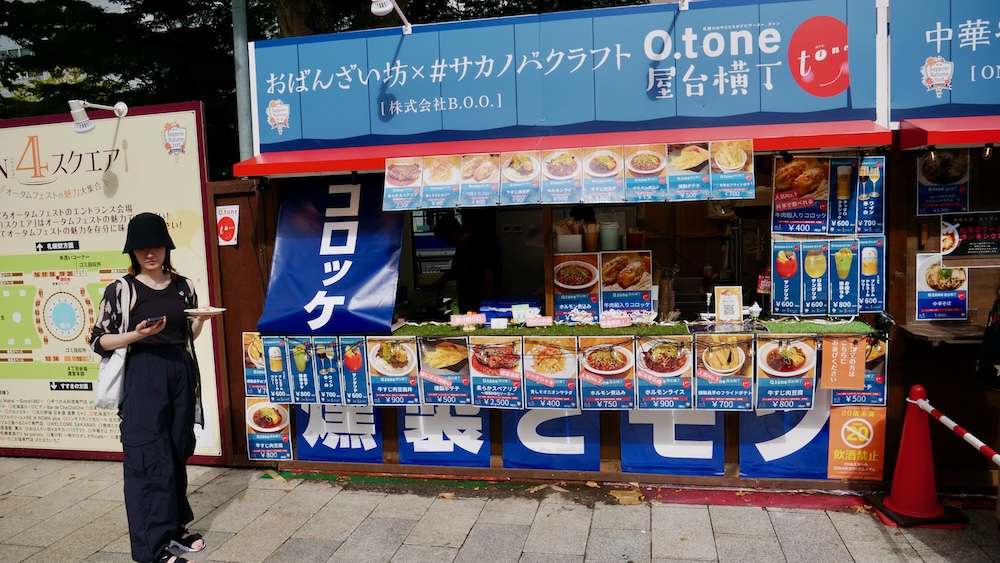
Instead, we encountered an extraordinary concentration of food stalls. Colourful Japanese menus advertised fried snacks, grilled meats and desserts; vendors prepared dishes in front of customers while people examined the displays and decided what to order. The turnout was certainly impressive, and the festival seemed to stretch much farther through the park than we expected. It certainly wasn’t a little neighbourhood market beside a fountain.
What really grabbed us was the variety. Alongside regional Hokkaido dishes were Indian curries, cheese-filled creations and strawberry sweets, none of which featured in our original lunch plan. We decided to walk around before buying anything, although every new menu made choosing more difficult. Sapporo has plenty of ramen shops, and we could visit one another day. When a seasonal festival turns up unexpectedly in front of you, it seems a shame to march past in search of something you can eat anytime.
What Is Sapporo Autumn Fest?
Sapporo Autumn Fest is an annual outdoor food festival in Odori Park, generally held from September into early October. It began in 2008 to celebrate food from Sapporo and across Hokkaido, bringing regional producers, restaurants, agricultural products and local specialities into the heart of the city. It’s grown into a substantial seasonal event, with reported attendance topping two million visits over the course of a festival.
Hokkaido has a distinctive food identity within Japan. Potatoes, corn, dairy products, seafood and meat are all important to the island’s food culture, and different communities have their own specialities. Given how enormous Hokkaido is, visiting those towns individually would require considerably more than a few days in Sapporo. I like the idea of bringing their foods into one central location, where you can try something from a region you might never reach on this particular trip.
In recent editions, the festival has occupied seven sections of Odori Park over roughly one kilometre. Around 300 businesses participate across the event, though not all are serving simultaneously; some rotate during the festival. The different areas have their own identities, which helps explain why there’s so much more here than a single row of similar-looking stalls.
For example, the 8-chome Hokkaido Market brings together foods associated with municipalities around the island, while 5-chome has featured ramen, curry and other northern favourites. The 7-chome area concentrates on drinks and dishes to accompany them, 10-chome leans into meat, and 11-chome has featured restaurant chefs and a beer terrace. The eastern areas around 4- and 6-chome contribute their own food stalls and changing programmes. Names and lineups can shift between editions, so treat this as a sense of the layout rather than a permanent stall directory.
That range also explains the international food. The festival celebrates Hokkaido, but restaurants serving dishes from elsewhere are part of Sapporo’s dining culture too. You can spend your visit pursuing local specialities, mix them with something familiar or take the rather haphazard approach we did. During the rest of the year, Odori Park is somewhere to stroll or photograph the TV Tower; at Autumn Fest, substantial stretches become outdoor dining areas filled with people enjoying their food.

What We Ate at Sapporo Autumn Fest
We browsed before ordering, partly to see what was available and partly because there was no obvious place to begin. The portions also looked well suited to trying several dishes rather than committing to a huge lunch at the first stall. With so many possibilities, filling up immediately would have been a particularly unfortunate tactical error.
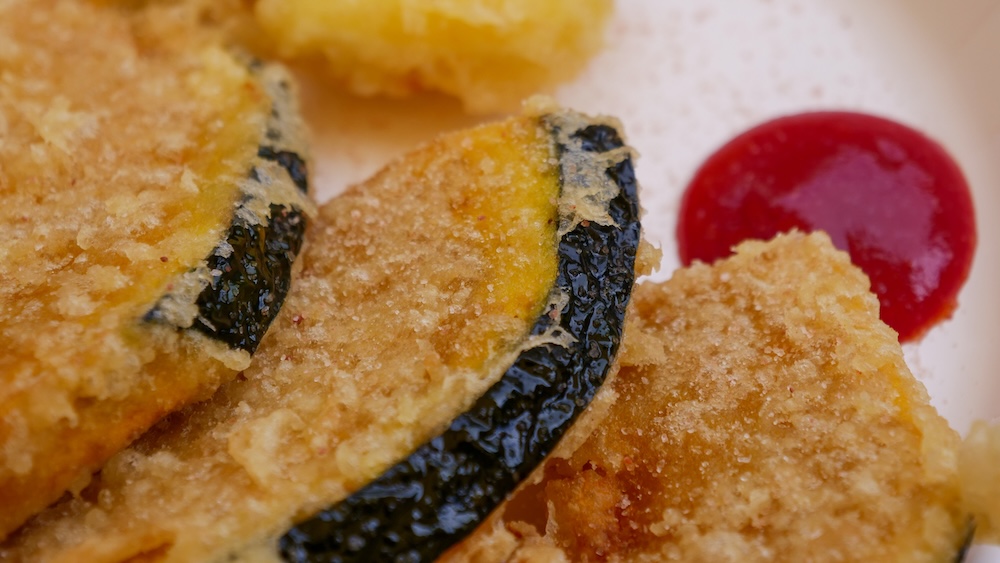
Pumpkin Tempura, Mozzarella Tempura and Hokkaido Imo Mochi
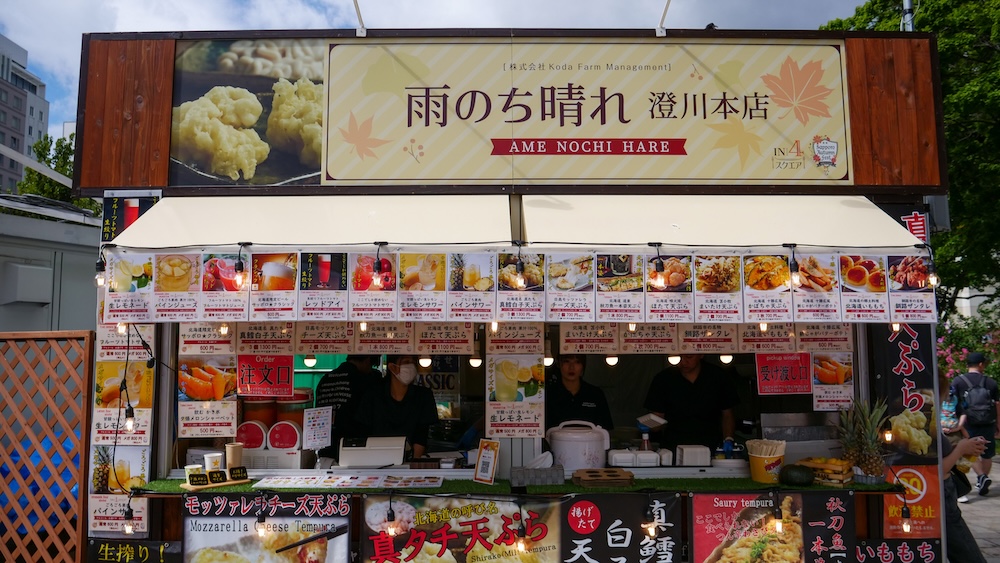
Our first stop was a stall called Ame Nochi Hare, where we picked three distinctly different snacks. The pumpkin tempura became an immediate favourite. Pumpkin already has a natural sweetness I enjoy, but the crispy, golden batter gave it another dimension, contrasting nicely with the soft vegetable underneath. We had ketchup alongside it, although the pumpkin was doing most of the work.
The next dish, mozzarella tempura, was the biggest surprise of our entire festival lunch. On paper it sounds straightforward enough: take mozzarella, coat it in batter and fry until the outside turns crisp and the centre melts. In practice, biting into it produced an absurdly long strand of cheese that refused to separate from the rest of the portion. I was trying to eat the thing without looking completely ridiculous, and failing rather spectacularly.
It tasted as entertaining as it looked, with a crunchy coating and an unapologetically rich, gooey middle. I wouldn’t pretend it was a particularly wholesome snack, but I also hadn’t travelled to Japan to conduct a nutritional audit of my lunch. Between the pumpkin and mozzarella, the stall had already won me over.

Our third item was imo mochi, a Hokkaido speciality whose name escaped me almost immediately after ordering. Despite the word mochi, it isn’t made like the familiar glutinous-rice sweets. This preparation uses mashed potatoes and potato starch, shaped into soft, slightly chewy pieces. Ours came as three rounded portions under a glossy dark sauce that combined sweetness and savoury flavour.
The texture was the most interesting part, quite different from both the tender pumpkin and stretchy cheese. One stall had introduced us to a familiar vegetable done exceptionally well, an outrageous fried-cheese creation and a regional potato dish we’d never encountered before. That, to me, was the point of exploring Autumn Fest rather than ordering one conventional lunch.
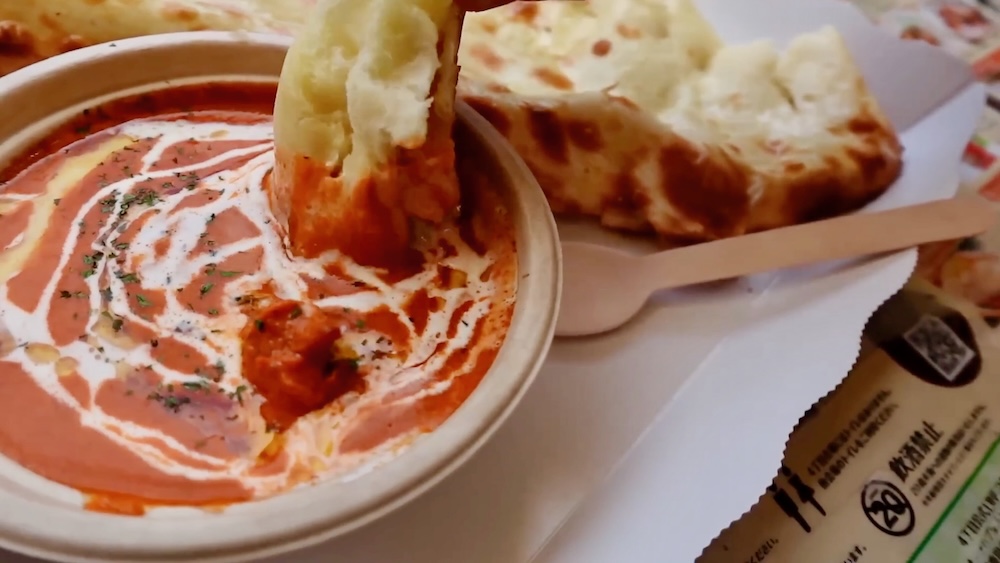
Fresh Cheese Naan and Butter Chicken
Our next choice took a sharp turn away from traditional Hokkaido food: Indian curry and cheese naan from Taj Mahal, a restaurant business established in Sapporo in 1982. It might seem an odd direction at a regional harvest festival, but we were enjoying the mix of cuisines too much to enforce any rules about what belonged on our plates.
Watching the naan being made was certianly fun. The dough was handled and filled with cheese before going into a traditional oven, then handed over fresh and almost too hot to pull apart immediately. Once we managed it, there were generous strands of melted cheese inside, with lovely browned patches across the bread’s surface.
The butter chicken arrived in a rich reddish-orange curry sauce with cream swirled over the top. We’d tear off pieces of naan and dip them into the sauce, which made a fantastic combination of warm bread, melted cheese and creamy curry. The butter chicken was delicious, but the freshly prepared naan stole the show for me. By now, we’d assembled a lunch of fried pumpkin, potato mochi, mozzarella and Indian food without the slightest concern for whether any of it belonged together. That’s half the pleasure of a festival like this.

Strawberry Mochi for Dessert
Audrey, hands down, has more of a sweet tooth than I do, so we weren’t going to wander past the dessert stalls without investigating. One vendor specialised in strawberry sweets, with different mochi treats and skewers on display. Audrey chose a strawberry mochi dessert that she described as combining fresh strawberries and red bean paste, a rather different finish from all the savoury food we’d just eaten.
Japanese sweets often have a more restrained sweetness than the cakes and pastries we’re used to, and the fruit, soft mochi and bean paste offered an appealing change of texture. Audrey was very much in her element. We’d now sampled Japanese fried snacks, a Hokkaido potato speciality, Indian curry and strawberry sweets, yet there were still numerous dishes we hadn’t even considered ordering.
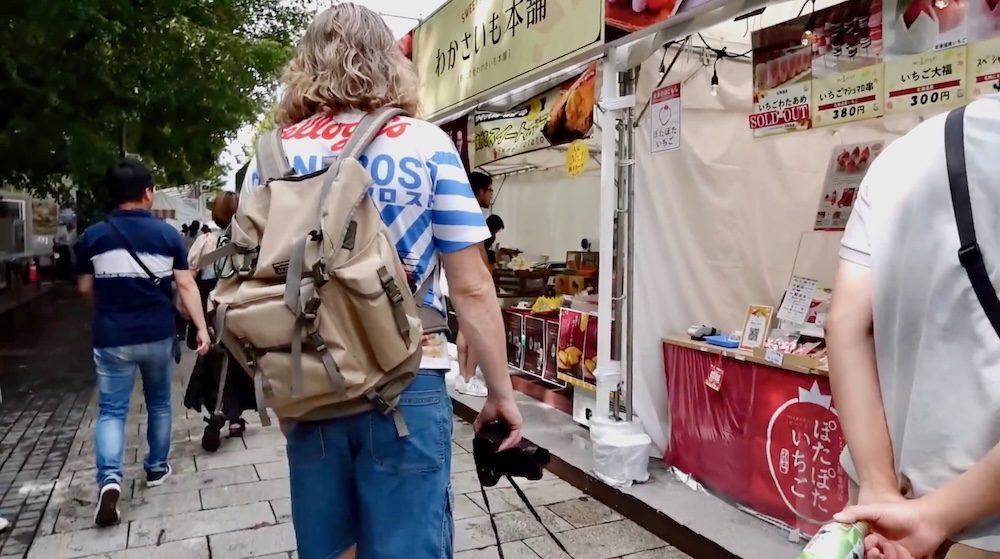
The Atmosphere: Crowds, Queues and Eating Outdoors
Autumn Fest was busy. And I mean properly busy. People inspected menus, waited for dishes to be prepared, carried plates between stalls and settled into the eating areas. I was impressed by the turnout, but also by how organised the event felt. Wooden stalls were arranged in defined sections, menus were easy to spot and there were places to pause with your food, including covered counters and seating areas.
We could generally move around comfortably, although the lines weren’t evenly distributed. A few vendors had queues long enough to discourage us from ordering, while others were far easier to approach. With so many alternatives available and a limited amount of time, I preferred to keep exploring rather than spend a large portion of our visit waiting for one dish. That doesn’t mean the popular stalls weren’t worth it; we simply made different choices.
The prices also felt reasonable for Japan. This wasn’t Southeast Asian backpacker street-food cheap, but the portions were satisfying without being enormous, which suited our plans perfectly. I’d much rather leave a festival having tasted several interesting things than spend my entire appetite on one huge serving.
We were probably there for less than an hour, because there was more of Sapporo to explore and film. I could easily have lingered for another hour or two, sampling more food, finding somewhere to sit and doing some people-watching. The smell of cooking, the chatter around the stalls and the sheer variety made it enjoyable even when we weren’t actively eating.
How to Visit Sapporo Autumn Fest
When Does It Take Place?
Autumn Fest generally runs from September into early October, with stalls operating from daytime into the evening. At the most recent event, opening hours were approximately 10 a.m. to 8:30 p.m., with orders ending a little earlier. Exact dates, hours, themes and vendor lineups can change, so check the official Sapporo Autumn Fest website before your trip rather than assuming a previous schedule still applies.
It’s particularly worth checking the programme if there’s a specific regional speciality you want to try. Some vendors appear throughout the festival, while others participate for limited periods or rotate between days. If you’re simply after a varied lunch, though, I’d resist planning every bite in advance. Browsing and discovering something unfamiliar was a big part of what made our visit enjoyable.
Where Is It, and How Do You Get There?
The festival occupies sections of Odori Park in central Sapporo. Odori Subway Station is a convenient approach for the eastern areas around 4- and 5-chome, while Nishi 11-chome Station serves the western end. There’s no compulsory starting gate, so you can enter near whichever section interests you and work your way along the park. The event doesn’t provide dedicated parking within Odori Park, making public transport the simpler option.
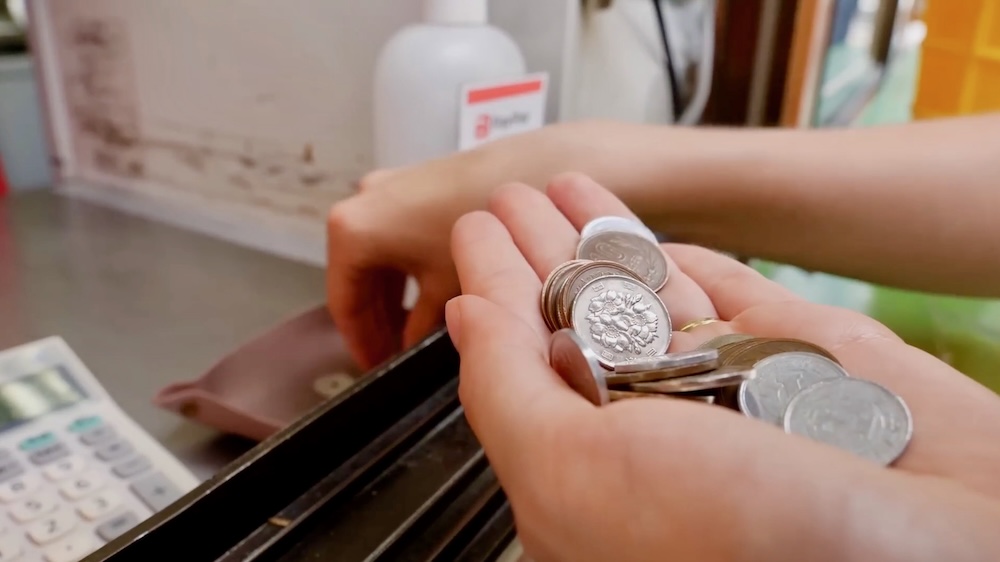
Admission, Payments and Practical Tips
General admission was free at the most recent event. So, you could browse without buying a ticket; food and drinks were purchased separately. Payment rules deserve attention because cashless options were available throughout the festival and certain sections operated on a cashless-only basis. I’d carry a usable electronic payment method and check the current arrangements rather than assuming cash works at every stall.
The festival has dedicated places to eat and dispose of rubbish, although the exact facilities vary between sections. Follow the event’s guidance about where to eat and use the designated waste-collection points; the organiser also asks visitors not to bring outside food into the festival area. It’s all fairly straightforward once you’re there, but useful to know before arriving with a picnic from somewhere else.
Weekends and holiday afternoons tend to be particularly busy. Thus, weekdays or earlier visits may be more comfortable if queues bother you. We sampled several dishes in less than an hour, but I’d suggest allowing 90 minutes to two hours if you want to browse multiple sections and sit down without feeling rushed. You could spend much longer exploring the full kilometre, although there’s no prize for eating at every stall. Above all, arrive hungry.
Where to Stay and Other Food Experiences in Sapporo
If you’re building a Sapporo stay around food and central sightseeing, you don’t need to book accommodation for Autumn Fest alone. The park is well connected by subway, and choosing a convenient city-centre base will also help with restaurants, shopping and other attractions. Two places worth comparing for location are The Royal Park Canvas Sapporo Odori Park, across from the TV Tower near the eastern end, and Hotel Resol Trinity Sapporo, facing the park farther west near Odori Station. These are researched location options, not hotels Audrey and I personally stayed in; I’d compare room types and current rates before deciding.
Autumn Fest itself is an event I’d explore independently, but if the food is what draws you to Sapporo, a guided experience elsewhere in the city could be an enjoyable addition. The private, personalised Sapporo food tour is designed around a local host and adaptable tasting stops, while the guided Sapporo tasting tour with 10-plus dishes and drinks follows a more structured multi-venue format. They’re separate city food tours, not guided visits to Autumn Fest, and we haven’t taken either ourselves. Check the latest inclusions and departure details, particularly if you have dietary preferences or limited time.
Is Sapporo Autumn Fest Worth Visiting?
Absolutely. If you’re going to be in Sapporo while Autumn Fest is running, I’d make time for it. The festival combines a lively atmosphere with the chance to sample several unusual dishes in one place, and I loved the mixture of Hokkaido food and international offerings. Pumpkin tempura and the Indian food were highlights, while the mozzarella tempura was the biggest surprise. Audrey enjoyed the savoury dishes too, though the strawberry dessert was particularly up her alley.
Would I organise an entire Sapporo holiday around it? Probably not. Truth be told. And that’s no criticism of the festival. On a two-to-four-night stay, I’d still want time for ramen in Ramen Alley, a seafood breakfast near the Central Wholesale Market, the Sapporo Beer Museum and some of the city’s parks and unusual attractions. Autumn Fest works beautifully alongside those experiences without needing to swallow a full sightseeing day.
If we returned during the festival, I’d slow down, try a few more regional dishes and give myself time to enjoy the atmosphere. Our original plan had been a perfectly ordinary ramen lunch, and instead we stumbled into one of the most eclectic meals of our Hokkaido trip. I’m glad we didn’t march straight past it in search of noodles. Sometimes the best thing you can do with an itinerary is abandon it for lunch.
This article contains affiliate links. If you book through one of these links, I may earn a commission at no extra cost to you.