
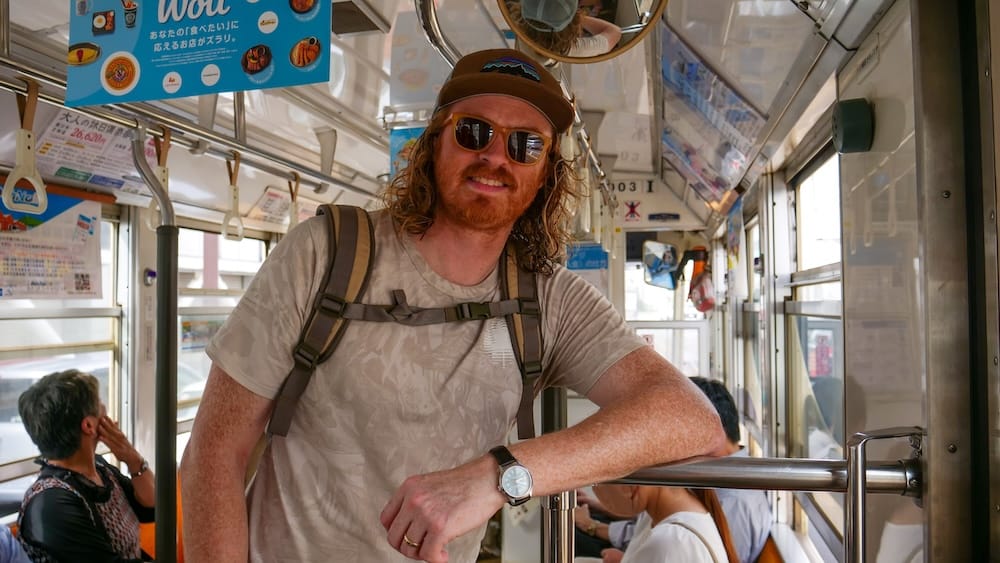
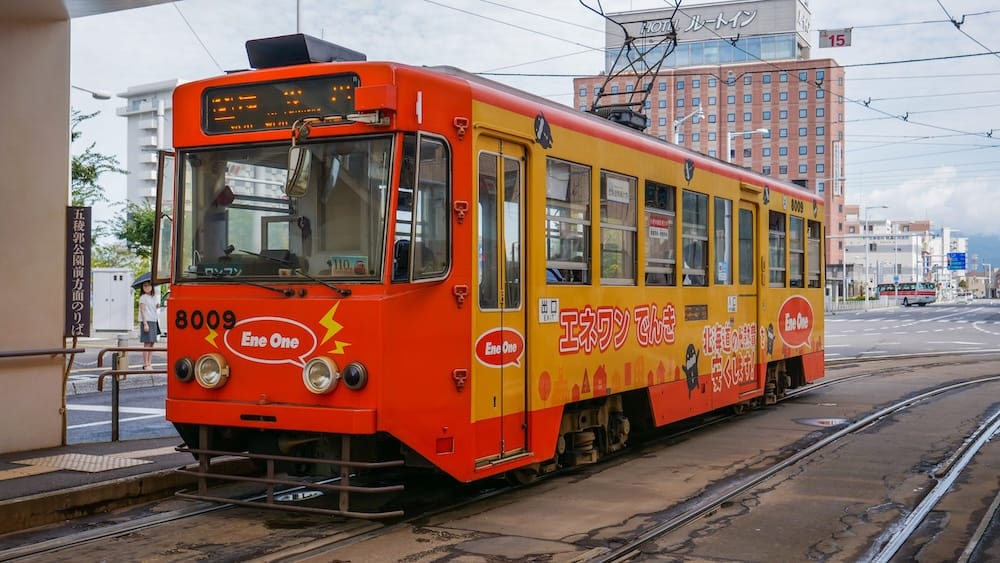
Hakodate’s trams ended up becoming part of our daily routine almost immediately. Lines 2 and 5 both ran close to where we were staying, which was particularly useful because our accommodation wasn’t right beside most of the attractions we wanted to visit. We would ride into the part of the city we wanted to explore, get off, and then do most of the interesting sightseeing on foot.
That combination suited Hakodate extremely well. I found the city very pleasant to walk around, but it is more spread out than you might expect when you first look at it on a map. There is also a big difference between spending your energy climbing the streets of Motomachi because the hills, churches and harbour views are part of what you came to see, and using those same legs to cover a long ordinary stretch of city just to reach Motomachi in the first place.
After sweating our way up Hachimanzaka on a hot, humid day, I had absolutely no objection to letting the tram do some of the work.
For a first-time visitor, the good news is that Hakodate’s tram network is quite manageable. There are only two routes to understand, they share a long central corridor, and the riding procedure becomes straightforward once you have done it once. Google Maps was definitely our friend during the trip, but I don’t remember us making any major tram mistake or having one of those moments where you suddenly realize you have been travelling confidently in the wrong direction for the past 20 minutes.
The main thing is knowing what to look for before that first ride.
Start With Hakodate Tram Lines 2 and 5
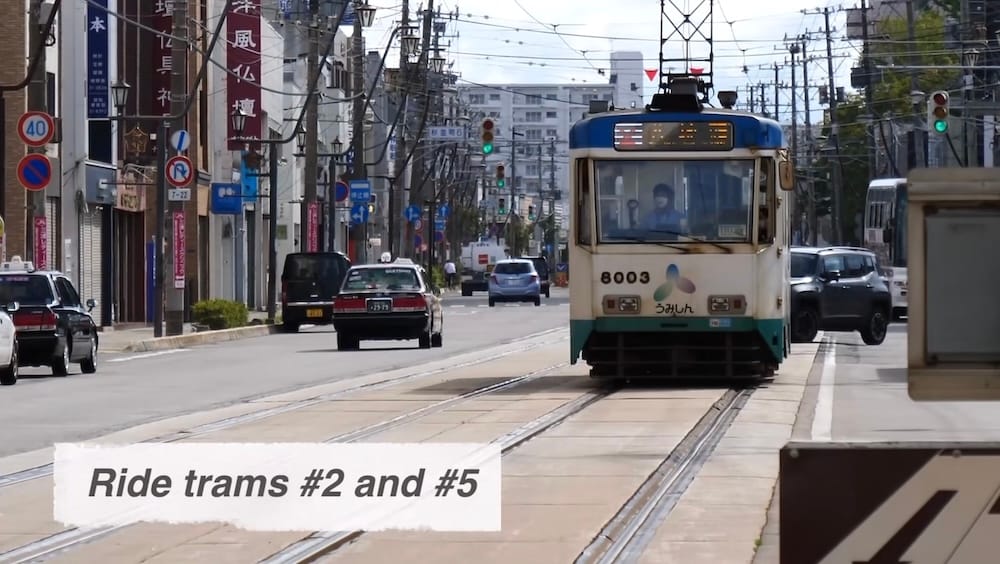
Hakodate currently has two tram routes, numbered 2 and 5. You do not need to memorize every stop before arriving, and I certainly wouldn’t spend an evening doing that when there are more enjoyable ways to prepare for Japan.
What matters is understanding the shape of the network. Both routes run along the same corridor from the Yunokawa side of Hakodate through areas including Goryokaku-koen-mae and Hakodate-Ekimae before reaching Jujigai in western Hakodate. For many sightseeing journeys along this shared section, either Route 2 or Route 5 can work.
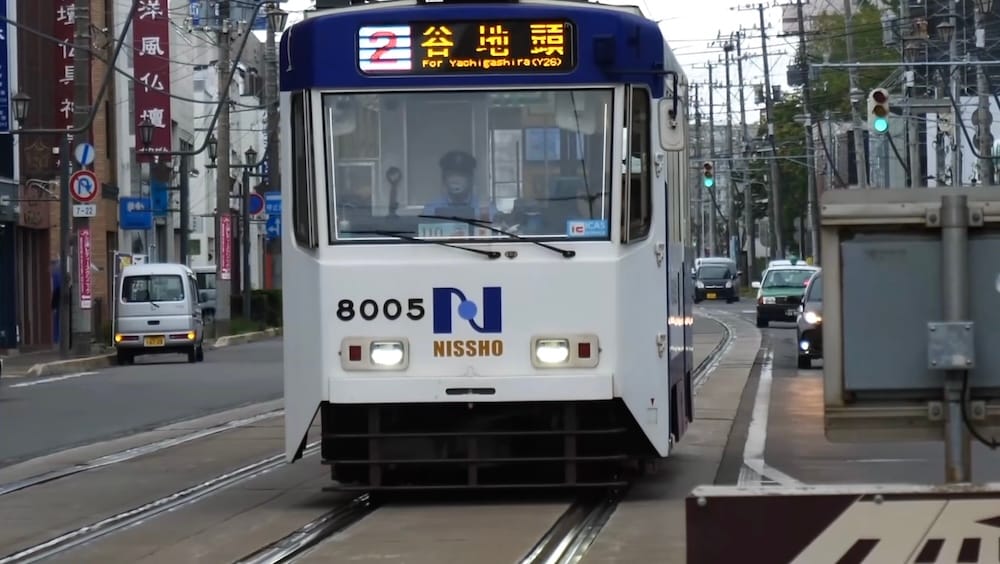
The important change comes at Jujigai. From there, Route 2 continues toward Yachigashira, while Route 5 heads toward Hakodate Dock-mae. There is no direct through service connecting the ends of those two western branches, so Jujigai is the place to keep in your head if you are trying to understand how the network fits together.
That branch matters more than memorizing colours, diagrams or every intermediate stop. If you are travelling along the shared corridor, the distinction between 2 and 5 may barely affect you; once you continue west of Jujigai, you need to pay more attention to the destination.
I would also get into the habit of checking the destination displayed on the tram rather than relying entirely on the route number. Some services can terminate before the furthest end of a route, including at intermediate stops, so “I need tram 5” is not quite as useful as “I need tram 5 going to the destination that serves my journey.”
This sounds more complicated on paper than it felt while we were there. Both routes served the stop near our accommodation, and on the shared section we could often simply use whichever useful tram came first. If you are still deciding where to base yourself, it is worth comparing Hakodate hotels on a map and checking how each location relates to the tram stops you expect to use rather than looking only at straight-line distance from one attraction.
How to Ride the Hakodate Tram for the First Time
This is the part I would read before arriving because once the physical sequence makes sense, most of the mystery disappears.
I have a fuzzy memory of our own boarding procedure and perhaps taking a ticket from a machine, but I would not trust myself to reconstruct every detail of that years later. The current procedure is much more useful than my imperfect recollection anyway.
Before you board
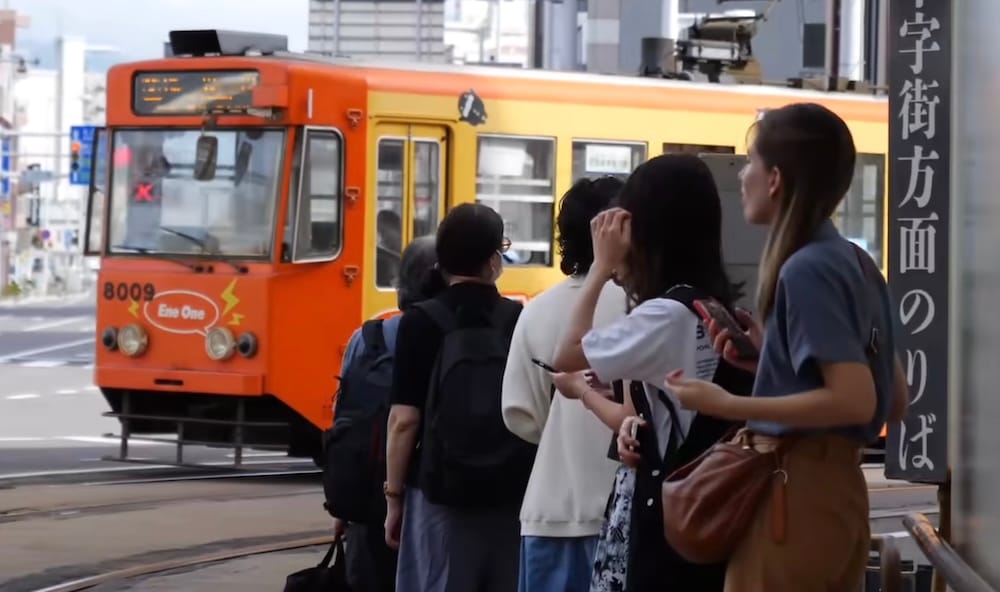
Check the route number, the direction you are travelling and the destination displayed on the tram. If you are staying within the long section shared by Routes 2 and 5, either line may be suitable, but west of Jujigai you need the correct branch.
Google Maps was what we leaned on during our trip. Rather than trying to learn the network like we were studying for an exam, we used it to work out which tram would take us where we wanted to go and followed our progress as we travelled.
Boarding
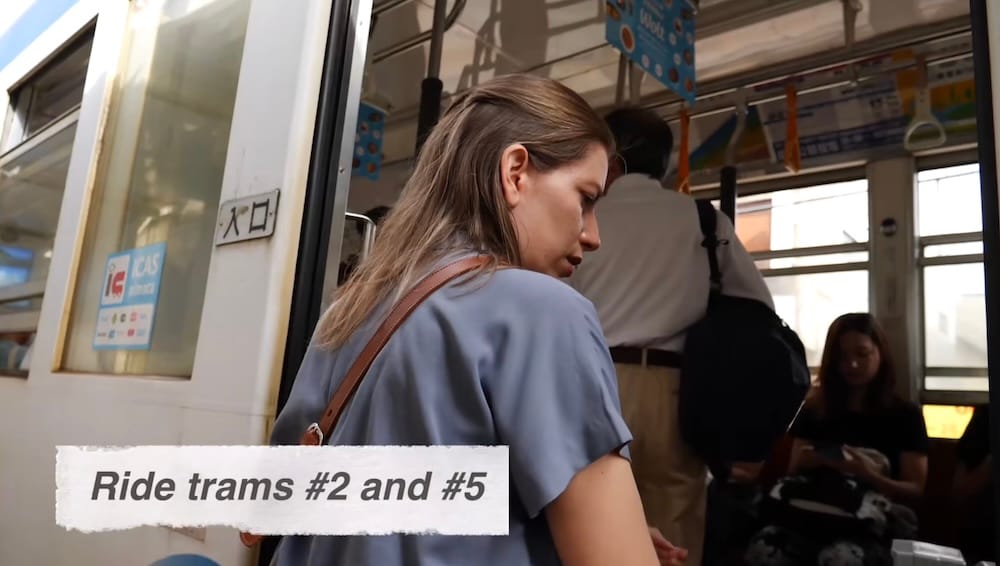
Current riding instructions direct passengers to board through the passenger boarding door away from the front driver and payment area. Depending on how a particular vehicle is described, you may see this referred to as the rear or central boarding door; the useful distinction is that the front is where you eventually pay and exit.
If you are paying with cash, take a numbered ticket when you board. If you are using a compatible IC card, tap the card on the reader instead. The numbered ticket is not the fare itself; it identifies where you boarded so the fare display can later tell you how much you owe.
Following your stop
You do not need to spend the entire ride nervously counting stops. Current onboard announcements include stop names in English, and Hakodate has also made the numbered-ticket system easier for unfamiliar passengers by using stop numbers alongside fare information.
When your stop is approaching, press one of the stop-request buttons. Google Maps can still be useful while you are onboard, especially until you develop a feel for the route. Hakodate publishes tram timetable data that feeds into Google Maps, which probably explains why it worked so naturally for us as a navigation aid.
Paying and getting off
Passengers leave through the front of the tram. If you are paying cash, look at the fare display and find the fare corresponding to the number on your boarding ticket, then put the numbered ticket and the exact fare into the farebox as you exit.
The farebox is not going to hand you change back like a supermarket cashier, so if you need smaller money, use the change machine near the front before paying. It is much nicer to sort that out before reaching the driver than to discover the problem while everyone behind you is also trying to get off.
If you are using an IC card, tap again when you exit. If you are travelling on a tram pass, show the active pass to the driver instead. Once you have completed that sequence once, the whole system feels considerably less exotic.
Cash, IC Cards or a Tram Pass?
Adult single fares are currently distance-based and range from ¥250 to ¥300:
- ¥250 for trips up to 2 km
- ¥270 up to 4 km
- ¥290 up to 7 km
- ¥300 beyond 7 km
Major interoperable IC cards are accepted, including familiar options such as Suica, PASMO, Kitaca and ICOCA. You tap when boarding and again when exiting. One useful exception to remember is SAPICA, which is not accepted on the Hakodate tram system.
If you are already travelling around Japan with a compatible IC card, that is probably the least fussy option. Cash works perfectly well too; you simply need to remember the numbered-ticket and exact-fare procedure.
Hakodate also has several current pass products. The tram-only one-day pass costs ¥800 and is valid from the first tram through the end of service on the selected day. The 24-hour tram pass costs ¥1,130, but it works differently because it is valid for 24 hours from activation rather than just for one service day.
There are also combined Hakodate Tram and Hakodate Bus passes, currently priced at ¥1,600 for one day and ¥2,600 for two consecutive days.
I would not buy a pass automatically just because there is one. If you plan to ride repeatedly, it may make sense; if you are only taking a few journeys, individual fares keep things simple. The exact break-even calculation depends on where you are travelling, and there is no need to turn a sightseeing day into an accounting exercise unless the savings genuinely matter to you.
One detail is worth knowing if you use a smartphone pass: a screenshot is not accepted. You need to display the active ticket itself. If the same phone also contains a mobile IC card such as Suica or PASMO, be careful around the reader when you are travelling on the digital pass so you do not accidentally interact with the IC system instead.
Google Maps Was Our Friend
We do not speak Japanese, and I don’t remember Hakodate’s tram system creating much language-related stress for us. Google Maps did a lot of the work, particularly when we were deciding which tram to take and following the journey to our stop.
The current tram system also gives international visitors some useful backup. Stop names are announced in English, and major stops have additional multilingual announcements. That does not mean every scrap of information around the network is perfectly translated or that I would stop paying attention altogether, but this is not a transport system I would avoid because you don’t speak Japanese.
I would keep an eye on three things: the route number, the displayed destination and your progress on the map. Between those, we found Hakodate fairly easy to navigate.
Where the Tram Is Most Useful for Sightseeing
The easiest mistake is imagining that a tram stop beside the name of an attraction means you step off directly at its entrance. Hakodate works better if you think of the tram as something that gets you into the correct sightseeing area, after which your feet take over.
Hakodate Station and Morning Market
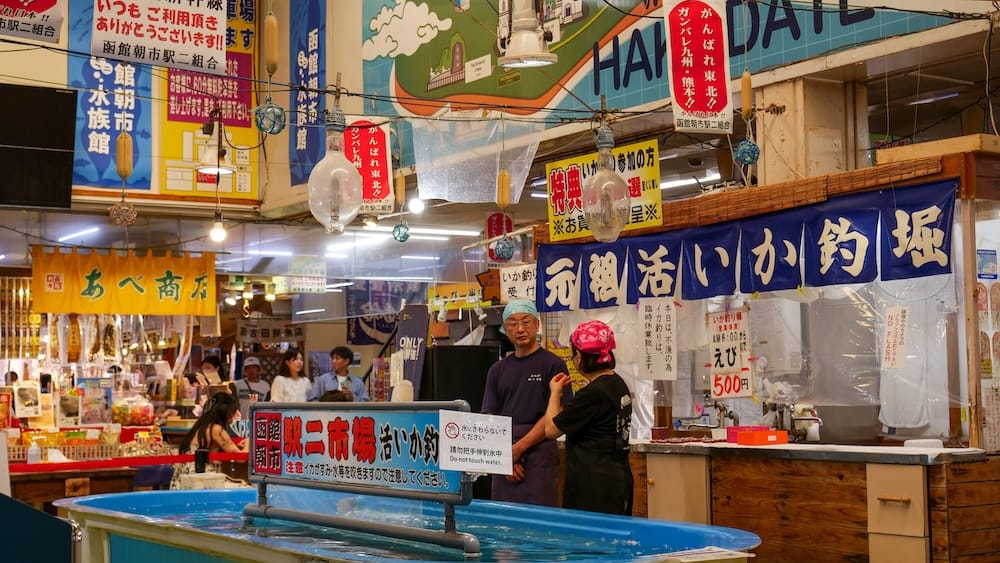
Hakodate-Ekimae is the obvious tram stop for Hakodate Station and the Morning Market. The market is right beside the station, so once you arrive in this area, walking is the natural way to continue.
Bay Area and Motomachi
Jujigai is one of the most useful stops for western Hakodate. From Hakodate Station, the tram ride is roughly five minutes, and from Jujigai you can continue on foot toward the Bay Area, Kanemori Red Brick Warehouses, Motomachi and several of the city’s historic sights.
This is where our tram-and-walking strategy made the most sense. Hachimanzaka is around a six-minute walk from the Jujigai area, and the hills are part of the attraction rather than an inconvenience you can eliminate completely. We climbed around Motomachi on a hot, humid day and certainly felt it, which made me appreciate having avoided unnecessary walking elsewhere.
Jujigai is also useful for reaching the Mt. Hakodate Ropeway, although you still have roughly a 10-minute walk to the Ropeway station. Again, the tram gets you into the right neighbourhood; it does not deliver you to the ticket counter.
Goryokaku
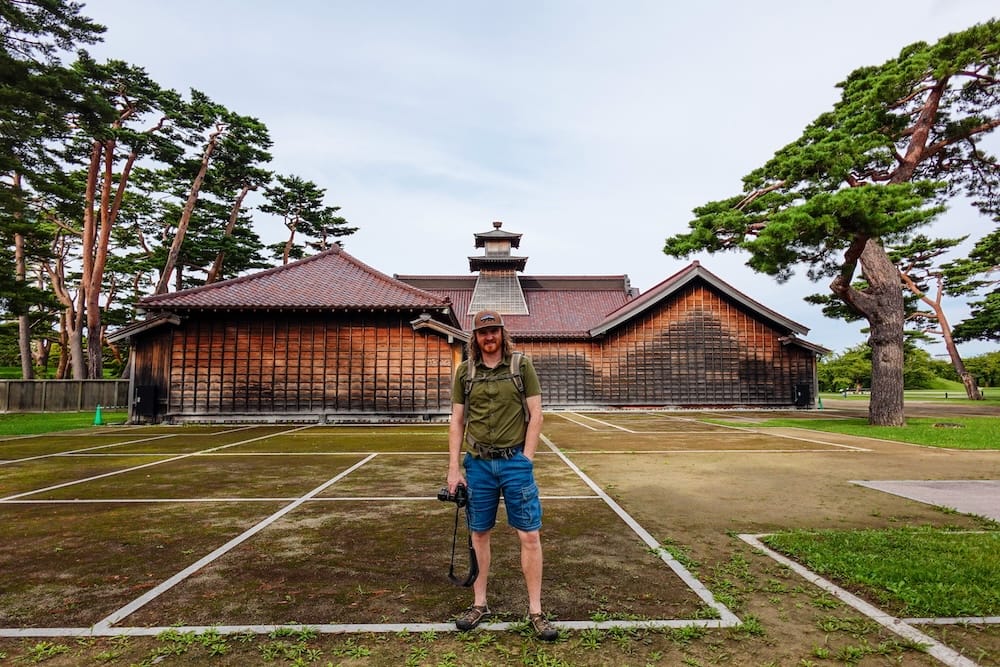
For Goryokaku, Goryokaku-koen-mae is the tram stop to know. From Hakodate Station, the ride is roughly 17 minutes, followed by around a 13-minute walk to the Goryokaku area. That was not a problem for us because we were heading there to walk around the park anyway, but the “-mae” in the stop name should not trick you into expecting zero walking at the other end.
Yunokawa Onsen
At the eastern end of the useful visitor corridor, Yunokawa-onsen is roughly 30 minutes by tram from Hakodate Station. We did not visit Yunokawa Onsen on this trip, so I cannot give you a personal verdict on the district, but it is useful for understanding how far the tram extends across the city.
What Riding the Tram Was Actually Like
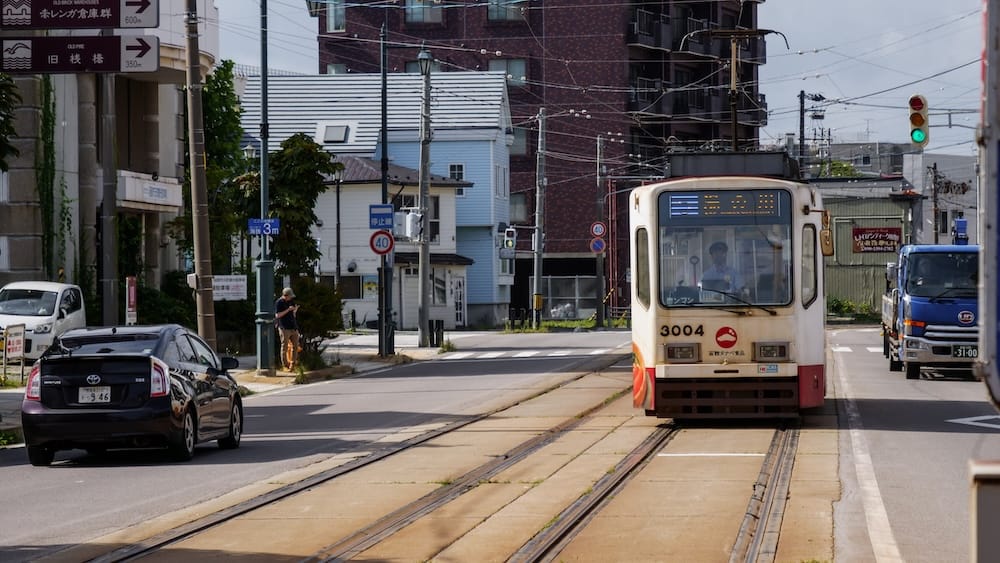
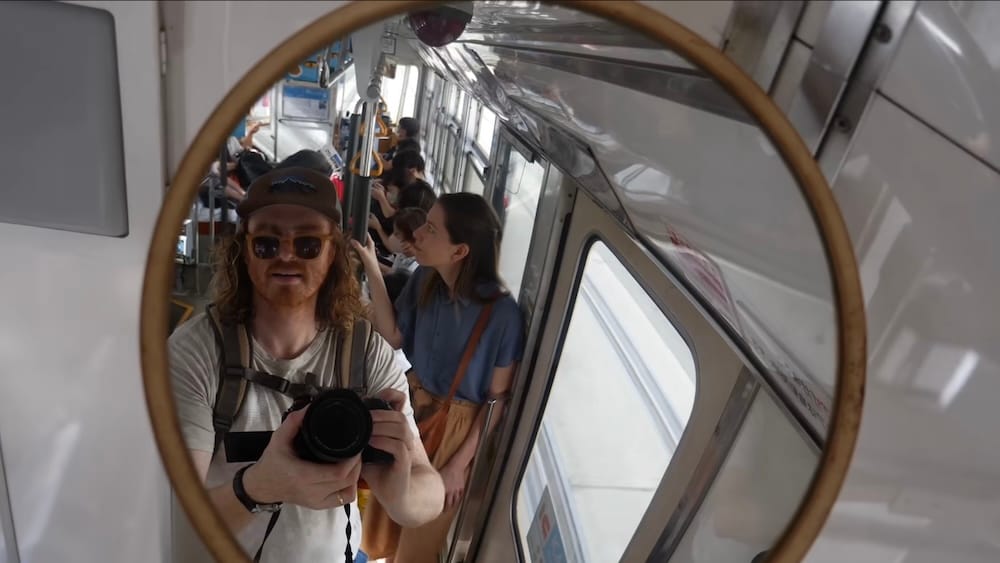
Our rides were generally comfortable, though crowd levels varied quite a bit. Sometimes the tram was busy; other times there were not many passengers aboard at all. I would not pretend I studied Hakodate commuting patterns closely enough to tell you exactly which departure will be packed, but I also would not approach the system assuming you are guaranteed an empty seat.
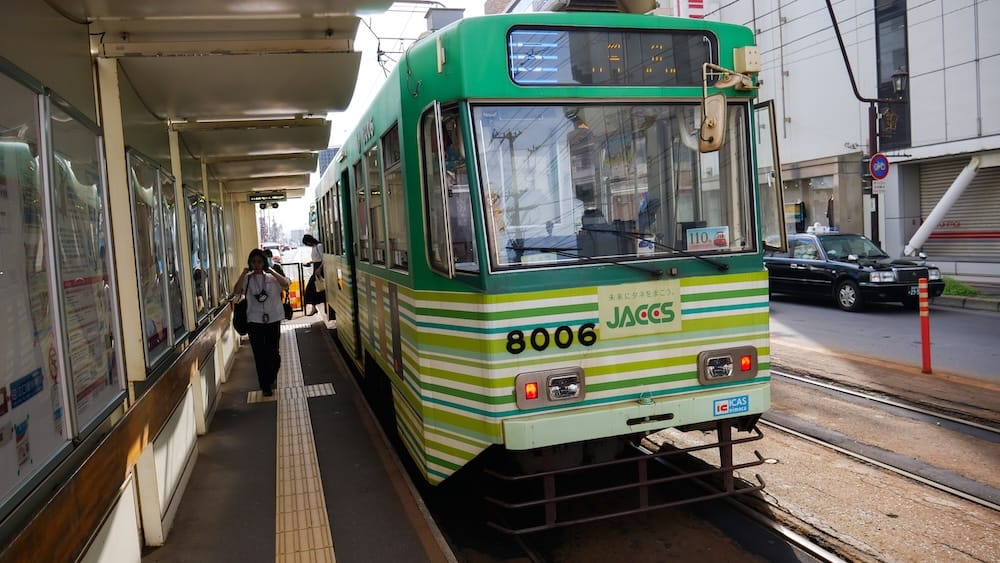
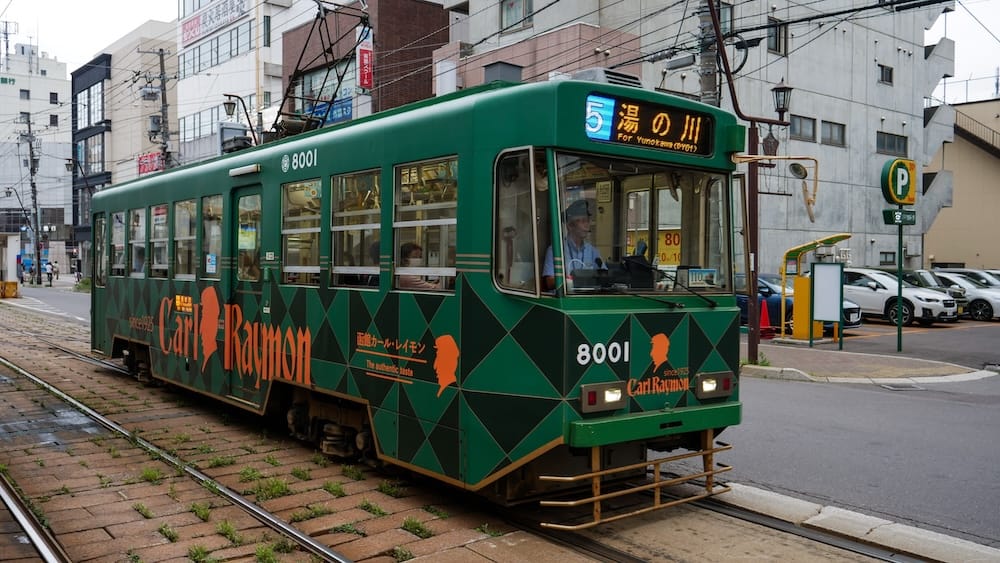
What I remember more clearly is the character of the trams. They have a slightly old-fashioned, rustic quality that made them more enjoyable than completely anonymous public transport. They reminded me a little of riding the trams in Hong Kong, although without the double-decker vehicles or anything approaching the intensity of Hong Kong happening around them.
Most importantly, I do not remember us struggling with the system. We were visitors figuring it out as we went, Google Maps was helping us along, and the tram simply became part of the trip. That is more reassuring to me than claiming it is somehow impossible to make a mistake.
If low-floor boarding matters
Accessibility needs a little more planning because Hakodate operates a mixed fleet rather than identical low-floor vehicles across every service.
Specific partially low-floor and ultra-low-floor trams operate on the network, and the city publishes schedules for those vehicles. If you use a wheelchair or otherwise need lower-floor boarding, I would check the current low-floor timetable rather than assuming whichever tram arrives next will have the same boarding setup.
We did not use the network from a wheelchair-accessibility perspective ourselves, so I would not make a blanket claim that every tram and stop offers the same experience.
Do Not Memorize an Old Frequency From a Blog Post
Hakodate revised its tram timetable in May 2026, which is a good reason not to build your trip around an old article promising that a tram arrives every six, eight, fifteen or however many minutes.
For ordinary daytime sightseeing, service is frequent enough that we never felt compelled to obsess over the schedule, but exact intervals vary by stop, route, direction and time. I would use Google Maps or the current stop-specific timetable when the timing actually matters, particularly if you are connecting with a train or trying to reach somewhere before closing.
That is a more useful habit than memorizing a frequency that may already be outdated by the time you visit.
How I Would Use the Tram on Another Hakodate Trip
If I returned to Hakodate and followed a similar sightseeing itinerary, I would use the tram much the same way we did the first time. I would not ride it for every tiny journey, but I also would not try to prove something by walking the entire city when the most interesting walking happens inside the sightseeing areas themselves.
I would ride to Jujigai and then wander through Motomachi and the waterfront. I would take the tram toward Goryokaku, get off and accept that my legs still had work waiting for them. I would use the tram for the connecting kilometres that add little to the day and save my energy for the streets, parks, hills and attractions that actually brought me to Hakodate.
That is really the point of the system for me. The tram does not replace walking in Hakodate; it makes the walking more worthwhile.
Frequently Asked Questions
Is the Hakodate tram easy to use for first-time visitors?
Yes. Hakodate has only two tram routes, 2 and 5, and they share a long central corridor before splitting after Jujigai. We found the system straightforward once we started using it.
How do you pay for the Hakodate tram?
Cash riders take a numbered ticket when boarding and pay the exact fare at the front when exiting. Compatible IC-card users tap when boarding and again when getting off, while pass users show the active pass to the driver.
How much does the Hakodate tram cost?
Adult single fares are currently distance-based from ¥250 to ¥300. The tram-only one-day pass costs ¥800, while the 24-hour tram pass costs ¥1,130 and is valid for 24 hours from activation.
What is the difference between Hakodate tram Routes 2 and 5?
Routes 2 and 5 share the corridor from the Yunokawa side of Hakodate through Goryokaku-koen-mae and Hakodate-Ekimae to Jujigai. After Jujigai, Route 2 continues toward Yachigashira while Route 5 heads toward Hakodate Dock-mae.
Can I use Suica or PASMO on the Hakodate tram?
Yes. Major interoperable IC cards including Suica, PASMO, Kitaca and ICOCA are accepted. SAPICA is a useful exception to remember because it is not accepted on the Hakodate tram system.
Which tram stops are useful for Hakodate sightseeing?
Hakodate-Ekimae is useful for Hakodate Station and Morning Market, Jujigai for the Bay Area, Motomachi and the Mt. Hakodate Ropeway approach, and Goryokaku-koen-mae for Goryokaku.
Should I buy a Hakodate tram pass?
I would not buy one automatically. Whether a pass makes sense depends on how many rides you plan to take and the distances involved, so individual fares may be simpler for a lighter tram day.
This guide is also available in Spanish. [Leé la versión en castellano: Guía del tranvía de Hakodate para quienes visitan por primera vez]
This article contains affiliate links. If you book through one of these links, I may earn a commission at no extra cost to you.