
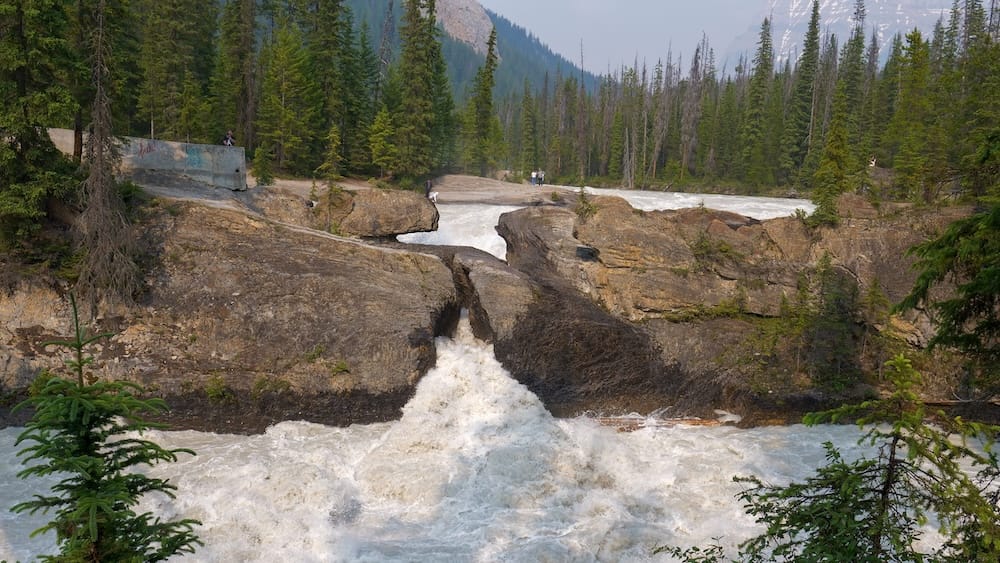
Natural Bridge was the final sightseeing stop of our very full day in Yoho National Park. By then we had already been to Takakkaw Falls and Emerald Lake, so I wasn’t expecting this comparatively small attraction to leave much of an impression. Then I saw the water ripping through the rock.
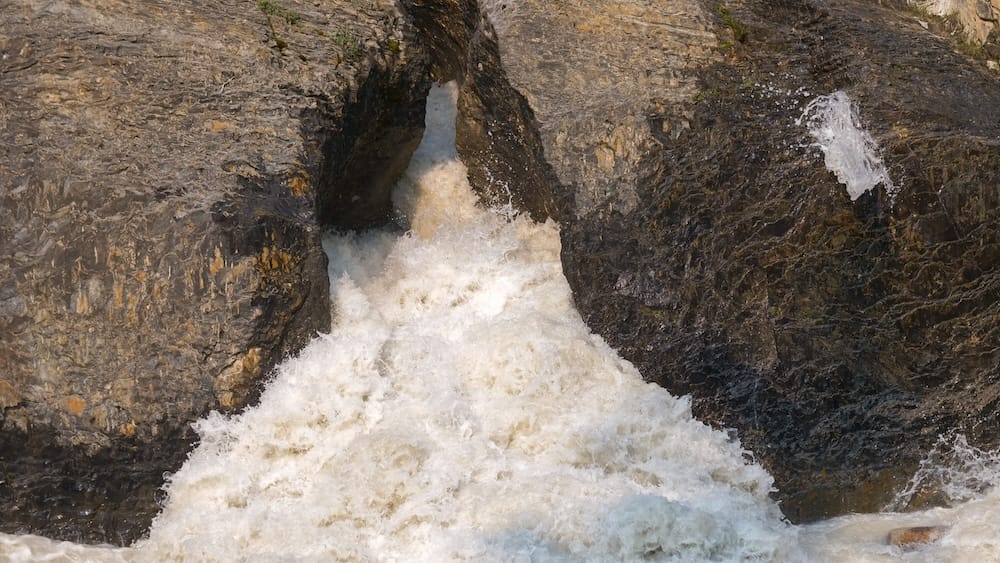
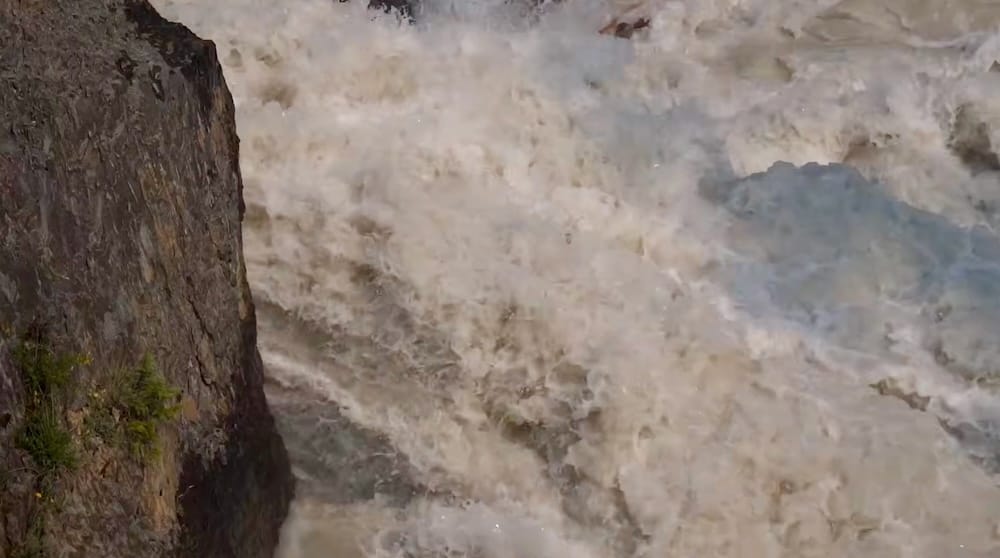
That was the whole show for me. The flow during our visit was downright fierce, squeezing through narrow channels and hammering against the formation with enough force that the place felt less like a scenic viewpoint and more like Mother Nature reminding everyone who was actually in charge. After a day dominated by huge mountains, colourful lakes and waterfalls, Natural Bridge managed to stand out for a completely different reason.
It also asks remarkably little from you. You don’t need several hours or a substantial hike to understand what makes the place interesting. If you’re already exploring Yoho, particularly if you’re driving Emerald Lake Road, I think Natural Bridge is absolutely worth the stop. For most people, I would give it around 20–30 minutes and move on without trying to turn it into something bigger than it is.
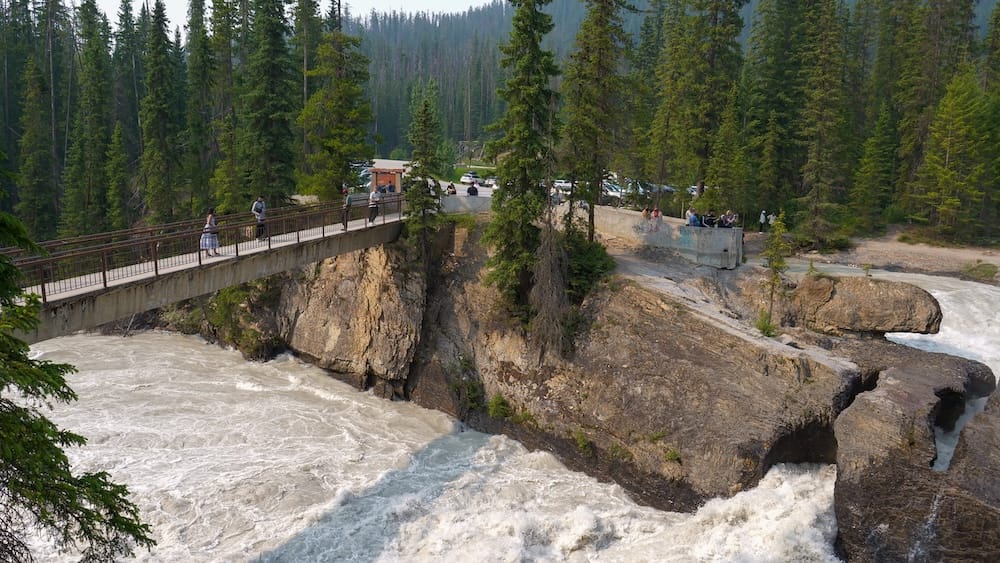
Is Natural Bridge in Yoho National Park Worth Stopping For?
For me, yes. The key is getting the scale right.
Natural Bridge isn’t where I would allocate a major chunk of a Yoho National Park day, and I certainly wouldn’t sacrifice Emerald Lake or another experience I really wanted just to tick it off a list. Its appeal is almost the opposite: you can see something genuinely unusual without blowing up the rest of your itinerary.
The attraction sits along Emerald Lake Road, a few kilometres west of Field, British Columbia, with its own parking area. Once you’ve stopped, the experience is concentrated around the Kicking Horse River and the rock formation rather than requiring a long approach. That makes it particularly easy to combine with Emerald Lake if you’re already travelling that road.
Our timing probably helped shape my verdict. We reached Natural Bridge late in an already ambitious sightseeing day, and nobody needed another major undertaking. What we got instead was a short, visually intense finale. I could stand there watching the river force its way through the rock, take some photos and enjoy the spectacle without committing to another long walk.
If I had only a tiny amount of time in Yoho and had to start cutting things, Natural Bridge would eventually lose out to the park’s larger attractions. But with half an hour to spare while already nearby, I would stop again without hesitation.
What Are You Actually Looking At?
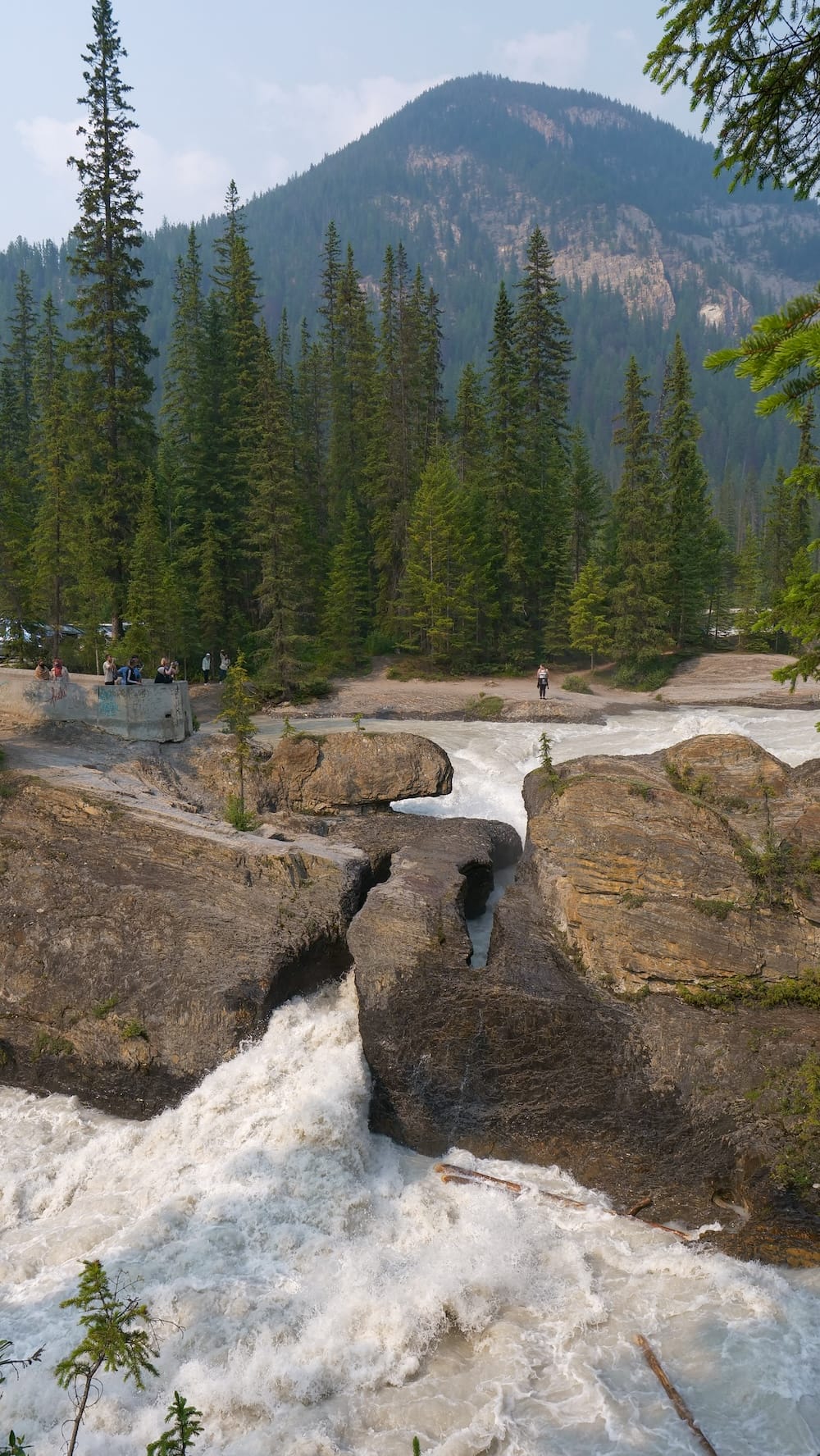
Natural Bridge is exactly what the name suggests: a section of resistant rock spanning part of the Kicking Horse River after the river gradually worked its way underneath.
The formation developed from what was once more like a waterfall over resistant limestone. Water found joints and weaker openings in the rock, then kept dissolving and eroding material beneath the harder layer. Over time, those openings enlarged enough for the river to reroute underneath, leaving the bridge-like section above.
You can read that explanation in a few sentences and understand it intellectually, but the attraction made much more sense to me once I was standing there. This isn’t geological history sealed behind glass. The river is still flowing through the formation, and during our visit it looked anything but gentle.
The Kicking Horse River receives glacial meltwater, and conditions vary through the year. We had also been dealing with heavy rain around our trip, although I wouldn’t pretend to know exactly how much that contributed to the volume we saw. What I can say from experience is that the water on our visit was pretty insane. It was moving with enough violence that I had zero desire to get clever around the rocks.
That sense of active erosion is what separates Natural Bridge from a random roadside photo stop. You’re looking at the result of water altering the landscape while the same process continues right in front of you.
How Much Time Do You Need at Natural Bridge?
I’d budget 20–30 minutes for a straightforward visit. That isn’t an official Parks Canada duration, and nobody is timing you; it’s simply a realistic amount of time to walk around the main viewing area, look at the formation from different angles, take photographs and linger a little without pretending there’s an afternoon’s worth of sightseeing here.
Current sightseeing tours often allocate roughly 15–20 minutes to Natural Bridge, which gives a useful sense of scale. I prefer adding a little buffer because rushing between a vehicle and a viewpoint every fifteen minutes is not my favourite way to experience the Rockies.
If you’re considering a guided day rather than driving yourself, pay attention to what happens after that short Natural Bridge stop. One current Yoho-focused itinerary gives Natural Bridge about 20 minutes before allowing substantially more time at Emerald Lake and Takakkaw Falls, which is a sensible balance if Yoho itself is the priority. You can check the current Emerald Lake, Natural Bridge and Takakkaw Falls itinerary. A broader Banff-and-Yoho option gives Natural Bridge about 15 minutes while also combining Lake Louise, Moraine Lake, Emerald Lake and Johnston Canyon; if covering more major sights matters more than depth at any one stop, you can see the current multi-stop Banff and Yoho tour itinerary. Tour routes and stop times can change, so I would check the current breakdown before booking rather than assuming that seeing “Natural Bridge” in the attraction list tells you how much time you’ll actually get there.
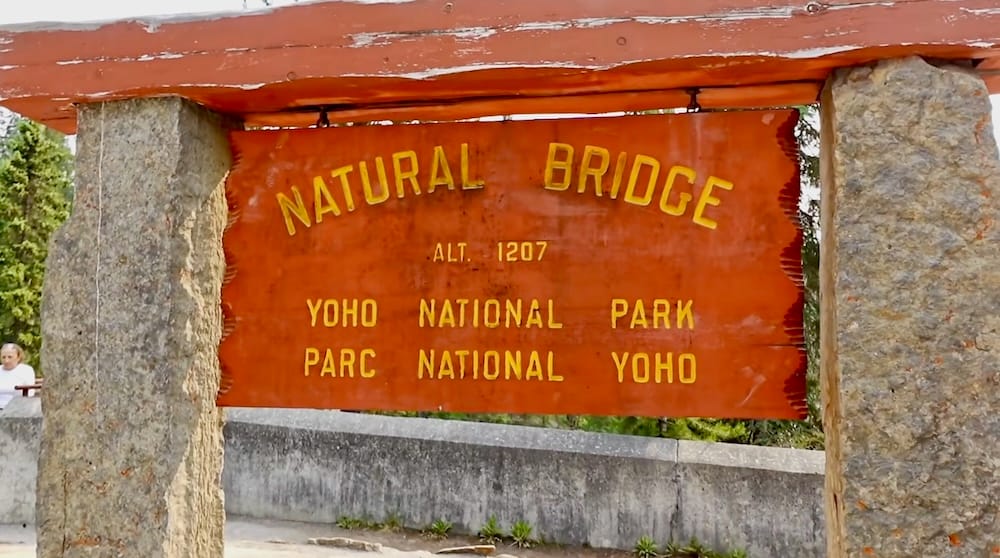
Natural Bridge has a dedicated parking area on Emerald Lake Road, and the road normally remains open year-round, although temporary closures can still happen. Parks Canada also lists washrooms and interpretive exhibits at the site, which makes this a practical place to stretch your legs during a longer day.
The site carries an official accessibility symbol, but I would be careful about translating that into a promise that every viewing position or surface will suit every wheelchair, stroller or mobility requirement. The current information isn’t detailed enough for me to make that leap.
I also wouldn’t assume that a small attraction automatically means guaranteed parking. There is a parking area; that is useful. Whether you find the place wonderfully quiet or arrive at exactly the same moment as everybody else is another matter.
Longer trails also begin around the Natural Bridge parking area, but those are separate activities. You don’t need to hike several kilometres to justify coming here, and I actually think adding unnecessary complexity misses one of the stop’s best qualities: Natural Bridge works because it doesn’t demand much of your day.
What About Natural Bridge in Winter?
One of the things our guide told us has stuck with me because it sounded almost absurd while we were standing beside such powerful water. She said that winter conditions can become so different that people sometimes walk across the area.
I could barely imagine it. Looking at the river on our visit, crossing anywhere near it was approximately the last activity on my personal wish list.
That seasonal contrast is fascinating, but I would not interpret what our guide told us as permission to climb onto the formation or wander across river ice. Parks Canada currently tells visitors at Natural Bridge to stay on marked trails and warns that the rocks are unsafe. Winter also introduces hazards such as thin ice, and footprints made by somebody else are not evidence that a surface is safe for you.
The Natural Bridge parking area does remain useful in winter as a trailhead for winter routes, so this isn’t simply a summer-only part of Yoho. The experience can change dramatically with snow and ice. What shouldn’t change is the basic rule that a spectacular frozen scene does not require you to test how frozen it really is.
That’s one of the things I find so interesting about this place. We saw the river looking almost violent, while winter can completely alter its appearance and character. Natural Bridge feels like a particularly obvious example of the landscape setting the terms rather than visitors doing so.
Natural Bridge or More Time at Yoho’s Bigger Attractions?
This is where the worth-it question becomes more useful than simply asking whether Natural Bridge is beautiful.
If you’re already travelling along Emerald Lake Road and have 20–30 minutes available, the opportunity cost is tiny. You pull in, see a distinctive geological formation, watch the Kicking Horse River work its way through the rock, take some photos and continue with your day. For anyone interested in rivers, geology or photography, it’s an especially easy addition.
The equation changes if you’re badly pressed for time. If stopping means cutting Emerald Lake painfully short, missing Takakkaw Falls, abandoning a hike you genuinely care about or turning the rest of your day into a frantic race against the clock, I’d skip Natural Bridge first.
That’s not because I disliked it. Quite the opposite. It’s because Natural Bridge doesn’t need to pretend to be more important than it is.
Emerald Lake rewarded us for spending more time there. Natural Bridge impressed me precisely because it didn’t require much time at all. Those are different kinds of value, and I think a good Yoho itinerary has room for both when the day allows it.
My Verdict on Natural Bridge
Natural Bridge is worth visiting if you’re already exploring this part of Yoho National Park. Give it roughly 20–30 minutes, enjoy the formation for what it is, and resist the travel-blog temptation to transform every scenic stop into an “unmissable half-day experience.”
What stayed with me wasn’t the amount of time we spent there. It was the force of the river. Even after a day filled with much larger attractions, watching that water hammer through the rock made Natural Bridge memorable on its own terms.
I’d stop again. Mother Nature put on a pretty convincing sales pitch.
Frequently Asked Questions
Is Natural Bridge in Yoho National Park worth visiting?
Yes. I think Natural Bridge is worth a short stop if you’re already exploring Yoho, especially along Emerald Lake Road. I would not build an entire day around it or sacrifice a larger attraction you care more about.
How much time do you need at Natural Bridge?
I’d allow about 20–30 minutes for a straightforward visit. That gives you time to see the rock formation, walk around the main viewing area, take photographs and linger a little without treating it as a major half-day attraction.
Where is Natural Bridge in Yoho National Park?
Natural Bridge sits on Emerald Lake Road a few kilometres west of Field, British Columbia, with a dedicated parking area.
Do you need to hike to see Natural Bridge?
No. The main attraction does not require a substantial hike. Longer trails begin around the parking area, but they are separate activities rather than necessary parts of seeing Natural Bridge.
Can you walk across Natural Bridge in winter?
Our guide told us winter conditions can become very different, but I would not treat that as permission to walk across the formation or river ice. Parks Canada tells visitors to stay on marked trails and warns that the rocks are unsafe.
Is Natural Bridge better than Emerald Lake?
I wouldn’t frame it that way. Emerald Lake rewarded us for spending more time there, while Natural Bridge impressed me because it worked as a short stop. If I were severely pressed for time, I would cut Natural Bridge before a larger Yoho attraction I really wanted to see.
This guide is also available in Spanish. [Leé la versión en castellano: Natural Bridge en el Parque Nacional Yoho: ¿vale la pena parar?]
This article contains affiliate links. If you book through one of these links, I may earn a commission at no extra cost to you.