
Edmonton’s River Valley was never an attraction to me when I lived in the city.
It was just where I went.
I jogged there, walked the trails and inline skated whenever I wanted to escape streets and traffic for a while. It was my tranquil escape in Edmonton, although I probably would not have described it quite so sentimentally when I was a university student sweating my way along the river.
Coming back more than a decade later changed the equation.
Audrey and I were now visitors trying to fit the River Valley into a sightseeing trip, and I suddenly understood the problem facing anyone who searches for “Edmonton River Valley” before arriving.
Where exactly are you supposed to go?
Edmonton maintains more than 160 kilometres of multi-use River Valley trails. There are parks, bridges, viewpoints and connections all over the place. That sounds fantastic until you are standing downtown with half a day left and wondering whether “explore the River Valley” means a twenty-minute lookout stop or disappearing into the trees until dinner.
My advice is to forget about trying to conquer it.
For a first visit, decide how much walking you actually want.
If you mainly want the views, there is an extremely easy downtown option. If you want a proper but manageable walk, the Kinsmen Park, Walterdale Bridge and Queen Elizabeth Park area makes much more sense. And if you genuinely want the River Valley to be one of the main activities of your day, you can start linking those central parks together.
The important wrinkle is that distance alone does not tell you how hard any of this will feel. Edmonton sits high above the North Saskatchewan River in places, so getting down into the valley—and eventually climbing back out—can be more demanding than the riverside walking itself.
That little detail matters a lot.
The River Valley I Remember From Living in Edmonton
When I lived in Edmonton, I used the River Valley in the most ordinary possible way.
I did not research viewpoints. I was not making lists. I was not trying to determine which park offered the most efficient ratio of skyline views to leg fatigue.
I just went down there.
I would jog, walk or inline skate along the trails, and that routine is a big reason I still consider the River Valley such an important part of Edmonton.
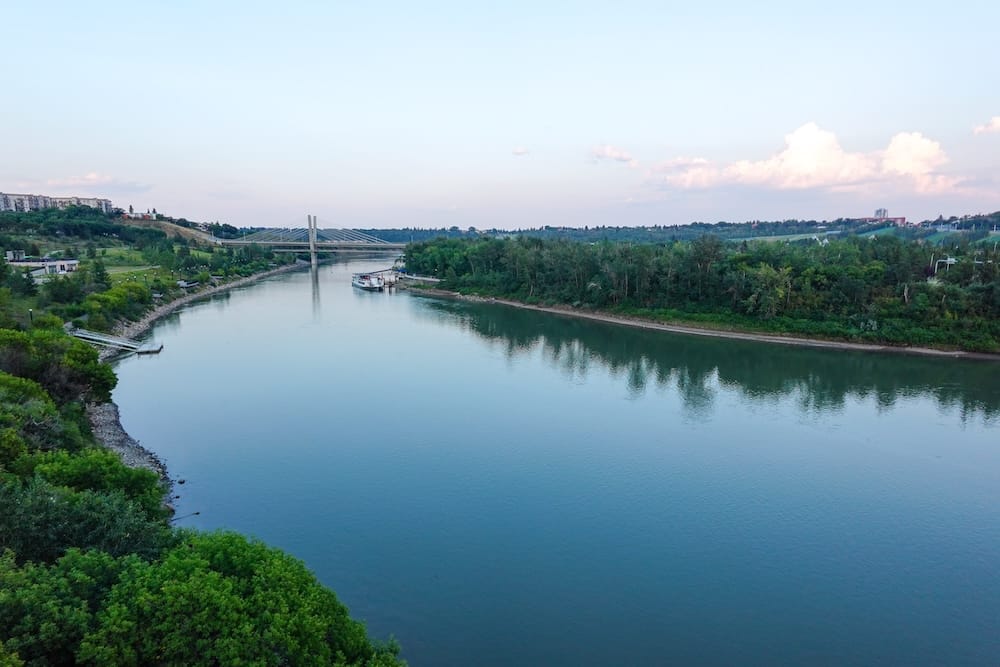
If your whole visit stays around downtown buildings, indoor attractions, West Edmonton Mall and restaurants, you can come away with a strangely incomplete picture of the city. The North Saskatchewan River cuts a broad green corridor through Edmonton, and once you drop below street level the atmosphere changes quickly.
On our return trip, I was also struck by how much the River Valley infrastructure had developed since I lived here. The trail system felt expanded, and some of the newer access points made it much easier to connect downtown sightseeing with time beside the river.
That mattered for us because Audrey was in her third trimester during this trip.
We were happy to walk. We were less interested in wasting energy on unnecessary hill climbing when somebody had conveniently built a machine to handle that part for us.
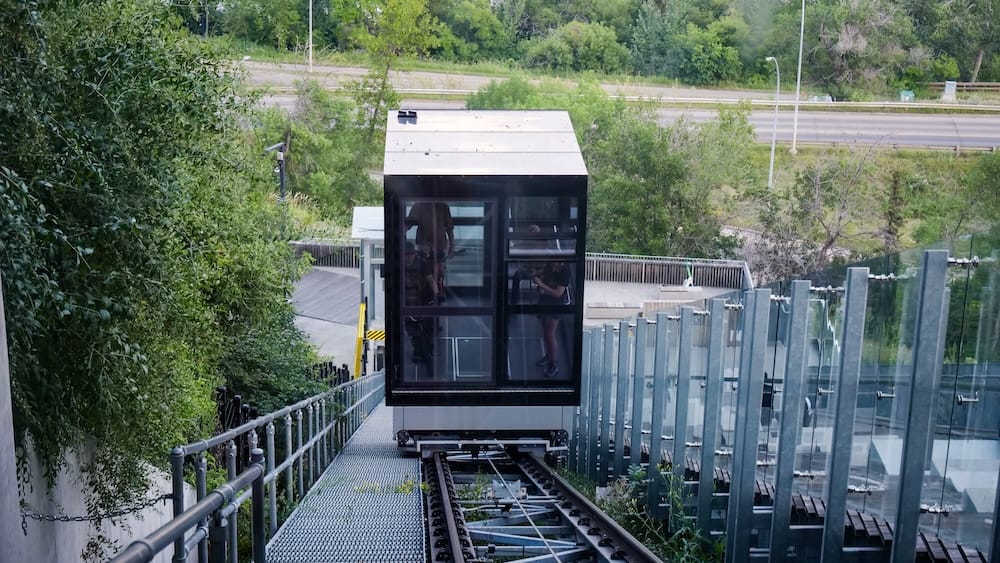
Enter the 100 Street Funicular.
The Easiest River Valley Experience From Downtown
I knew immediately that the 100 Street Funicular was new because I definitely did not have this luxury when I lived in Edmonton.
Audrey and I encountered it while staying downtown at the Fairmont Hotel Macdonald. From around the hotel and upper riverbank you get broad views over the North Saskatchewan River, and we wanted to head down for an evening walk.
We personally stayed at the Fairmont during this trip, so if that same river-valley setting appeals to you, you can check current Fairmont Hotel Macdonald availability on Booking.com. It is a splurge rather than a requirement for enjoying the River Valley, but having this part of Edmonton immediately outside made it very easy for us to turn an evening at the hotel into a riverside walk.
Instead of trudging down the slope, we could ride.
Excellent development.
The funicular connects the downtown side with the River Valley below, and a pedestrian bridge leads toward the Frederick G. Todd Lookout. There is also an elevator connecting the lookout area with the trail system lower down.
What I like about this setup is that you can decide how ambitious you feel after you arrive.
You do not have to commit beforehand.
If you mainly want the view
For the least demanding introduction to Edmonton’s River Valley, this is where I would start.
The built access from the upper area through the funicular, promenade, bridge and lookout is compact, and you get the key visual ingredients: the river, the valley and downtown rising above it.
This is a particularly useful option if you are short on time or simply tired. City trips can become ridiculous when every attraction apparently requires another six kilometres of walking. Sometimes you have already been sightseeing all day and just want to look at something beautiful without earning it through suffering.
The funicular, elevator and lookout infrastructure is designed to accommodate wheelchairs, walkers, strollers and bicycles.
I would not extend that statement to the entire River Valley. Edmonton’s trails vary significantly in surface and grade. Accessibility here applies to the specific built connection, not every path you might wander onto once you reach the bottom.
The funicular can also close for maintenance, outages or extreme temperatures, so if riding it is important to your plans, check the current 100 Street Funicular information before heading over.
If you still have some walking in you
This is where I think the funicular is at its best.
Ride down, enjoy the view, and then keep going.
Louise McKinney Riverfront Park provides a downtown gateway into the River Valley trail network. Once you are at river level, you can spend your energy on the part you presumably came for: walking beside the North Saskatchewan River.
That was our reaction immediately.
Save the legs getting down. Use them for the riverside.
It sounds almost embarrassingly obvious, but Edmonton’s topography makes this one of the most useful planning principles in the entire article.
If easy downtown access to the River Valley is a major part of how you are choosing your base, you can compare hotels in Downtown Edmonton on Booking.com. I would prioritize location over trying to find a hotel attached to one particular trail; being able to reach the central riverbank easily gives you much more flexibility.
For a Short Walk, Head Toward Kinsmen and Walterdale
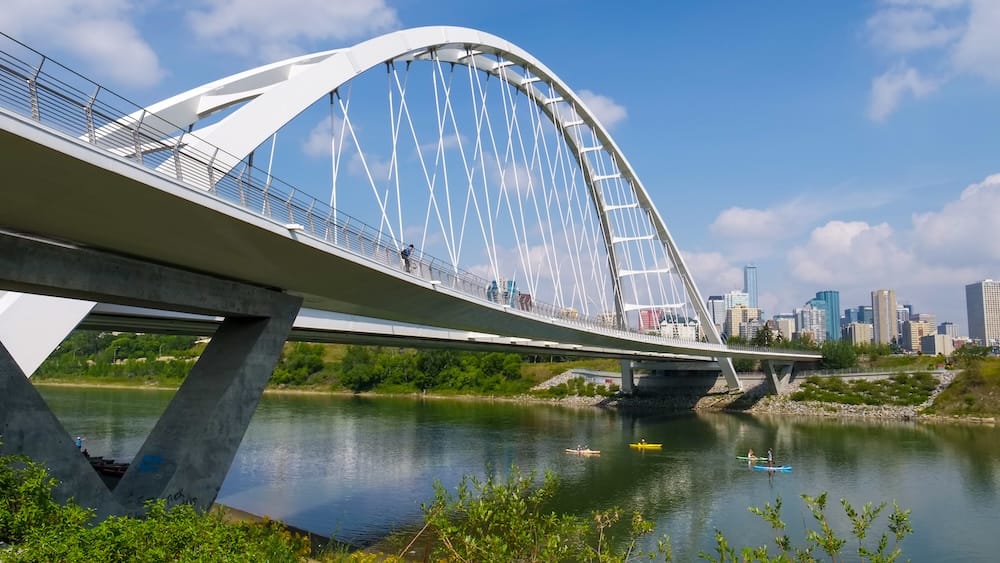
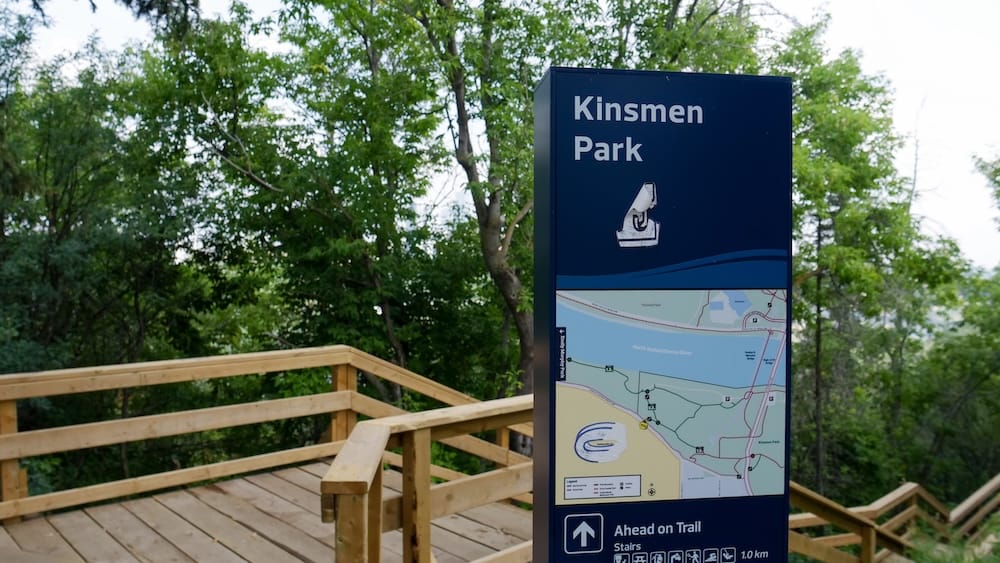
If I had a visitor who wanted more than a lookout but did not want the River Valley to consume the day, I would point them toward the central area around Kinsmen Park, Walterdale Bridge and Queen Elizabeth Park.
This was also part of the River Valley we explored when Audrey and I returned to Edmonton.
It brought back the version of the city I remembered: paths, trees, river views and plenty of space where downtown feels much farther away than it actually is.
The park-to-park distance between Kinsmen Park and Queen Elizabeth Park is only about 0.8 kilometres, which makes this a useful building block for a shorter outing.
But there is a catch.
Once you are inside Queen Elizabeth Park, the main east-west paved multi-use path is relatively flat with gentle inclines.
Getting there from above can be a different story.
Access from Saskatchewan Drive can involve steep slopes or stairs. So you can have two people heading for exactly the same park and experiencing two completely different levels of difficulty depending on where they enter.
That is classic River Valley planning.
A line on a map looks harmless. The riverbank has other ideas.
This is why I would think about your starting point before worrying too much about the total distance.
The visual payoff around here is excellent as well. Queen Elizabeth Park has views toward downtown and Walterdale Bridge, which gives the walk a proper sense of place. You are not simply following a green path that could belong to any city. The bridge and Edmonton skyline keep appearing through the landscape.
If you are visiting before the end of the 2026 construction season, be aware that trail and road renewal has been taking place on the east side of Queen Elizabeth Park Road. Conditions will eventually change again, which is exactly why I would check Edmonton’s current River Valley trail cautions and closures before committing to a particular route.
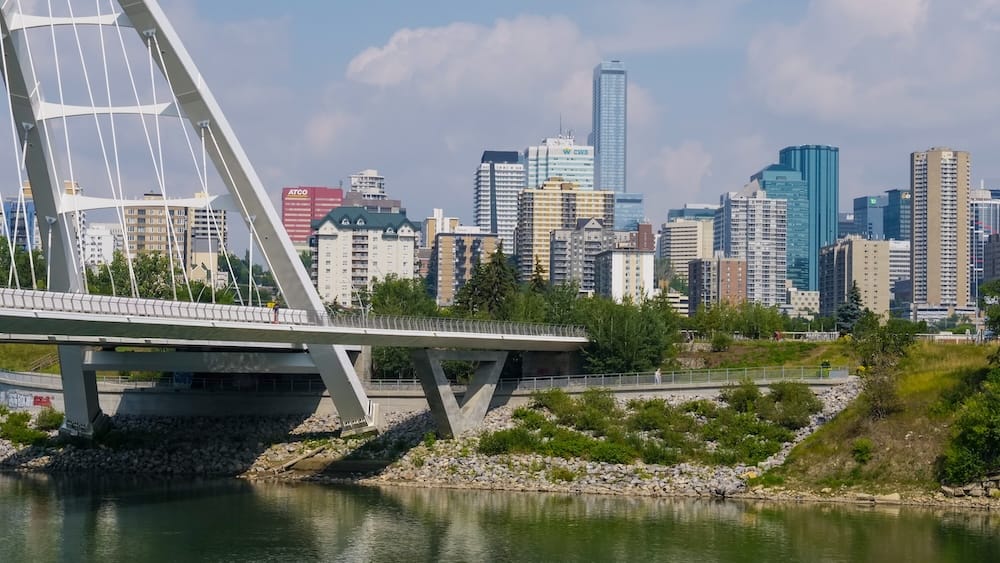
The Two River Valley Views I Would Prioritize
You could easily turn Edmonton viewpoints into their own giant list, and I do not think that helps much here.
For a first River Valley experience, I would think about two different kinds of view.
The first is the downtown-side view around the 100 Street Funicular and Frederick G. Todd Lookout.
This is the efficient option.
You get the big-picture relationship between downtown, the river and the valley without needing to spend much time walking.
The second is the Queen Elizabeth Park and Walterdale Bridge perspective.
This one makes more sense if you actually want to walk. The skyline and bridge become part of the route rather than something you travelled specifically to photograph.
I never stood there with a clipboard assigning scores to Edmonton viewpoints, so I am not going to declare some dramatic winner.
They solve different problems.
If I had very little time, I would choose the funicular and lookout.
If I wanted a River Valley walk, I would rather head toward Kinsmen, Queen Elizabeth Park and Walterdale Bridge.
That is a much more useful distinction than arguing over which view is objectively prettier.
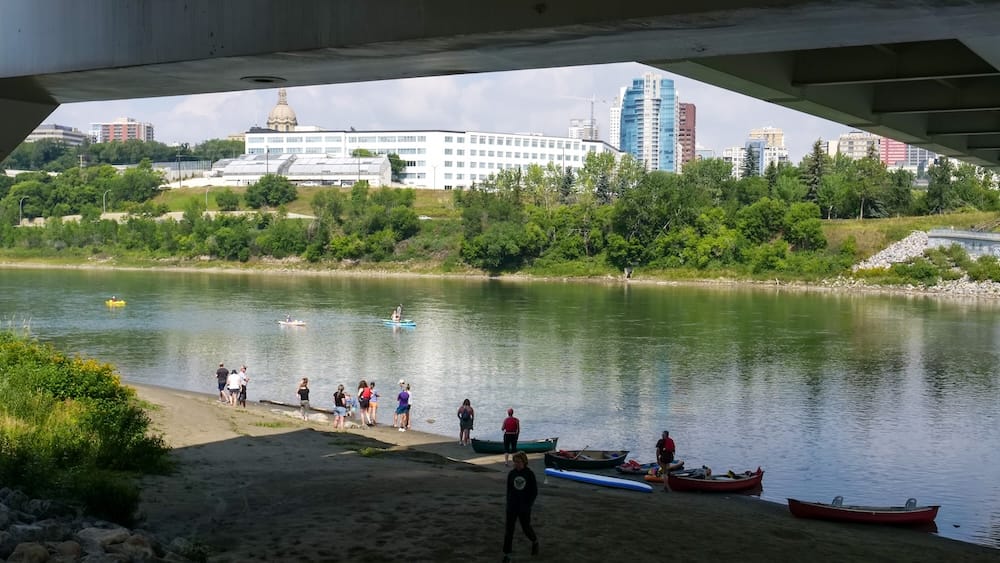
How Much River Valley Do You Actually Want?
This is the decision I wish more Edmonton planning advice made easier.
| Experience | Commitment | Effort | What you get | Best fit |
|---|---|---|---|---|
| 100 Street Funicular + Frederick G. Todd Lookout | Very short | Lowest | River Valley, river and downtown views | Tight schedules, tired legs, mobility-conscious sightseeing |
| Kinsmen Park + Queen Elizabeth Park / Walterdale area | About 0.8 km between Kinsmen and Queen Elizabeth, plus whatever exploring you add | Low to moderate once at valley level; access can add steeper climbing | A real walk, greenery, Walterdale Bridge and skyline views | Visitors wanting a manageable River Valley outing |
| Kinsmen toward Louise McKinney Riverfront Park | About 3.8 km park-to-park | Moderate because of added distance and access choices | A more substantial central River Valley walk | Visitors making the valley one of the main activities of the day |
I would not attach strict sightseeing times to these.
Walking pace is only part of it.
If Audrey has her camera out, we are moving differently than someone power-walking through the park. Add a viewpoint, a bathroom stop, a wrong turn or the need to retrace your route and suddenly a mathematically precise walking time becomes meaningless.
The distance figures are useful for understanding scale.
That is enough.
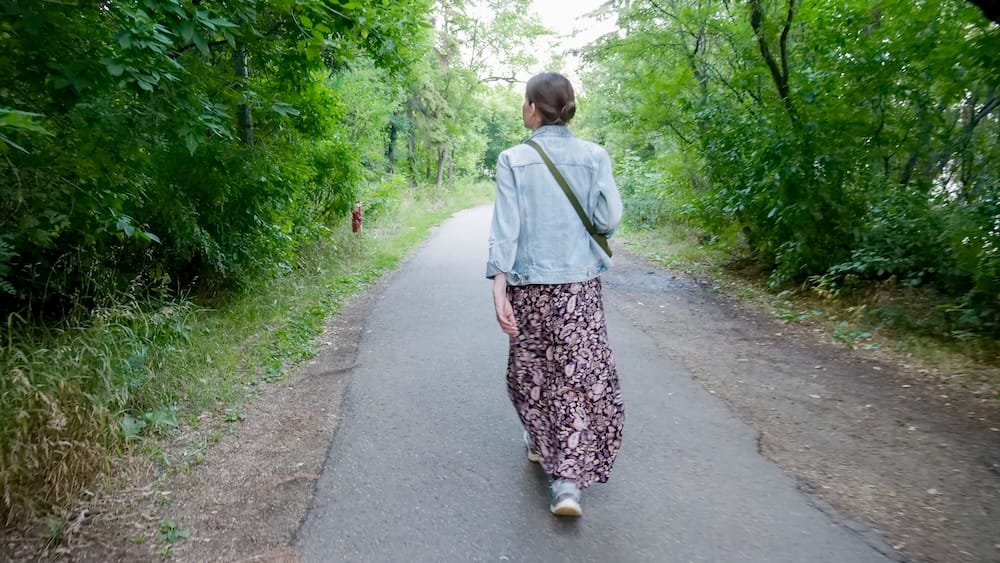
“Easy” Depends More on the Hill Than the Trail
One of the biggest mistakes you can make with Edmonton’s River Valley is assuming an urban park must be flat and manicured everywhere.
Some stretches come pretty close to that.
Others do not.
Edmonton’s paved multi-use trails are generally broad asphalt paths. There are also granular trails with rougher gravel surfaces, which can be more difficult for wheelchairs or anyone who needs predictable footing.
Grade is even more important.
On Edmonton’s River Valley trail maps, slopes between 5 and 9 percent are treated as moderate because they can challenge people with reduced mobility. Anything at 10 percent or above falls into a more difficult category and can challenge most users.
That explains something I noticed instinctively when we returned.
The important question is not always, “How long is this walk?”
Sometimes it is, “How am I getting down there?”
A relatively short path at river level can be straightforward. Add a steep climb back to Saskatchewan Drive and the same outing suddenly feels very different.
If you are planning around limited mobility, pregnancy, young children, fatigue or simply a strong personal objection to climbing hills while on vacation, pay attention to the access route.
There is no prize for choosing the most exhausting entrance.
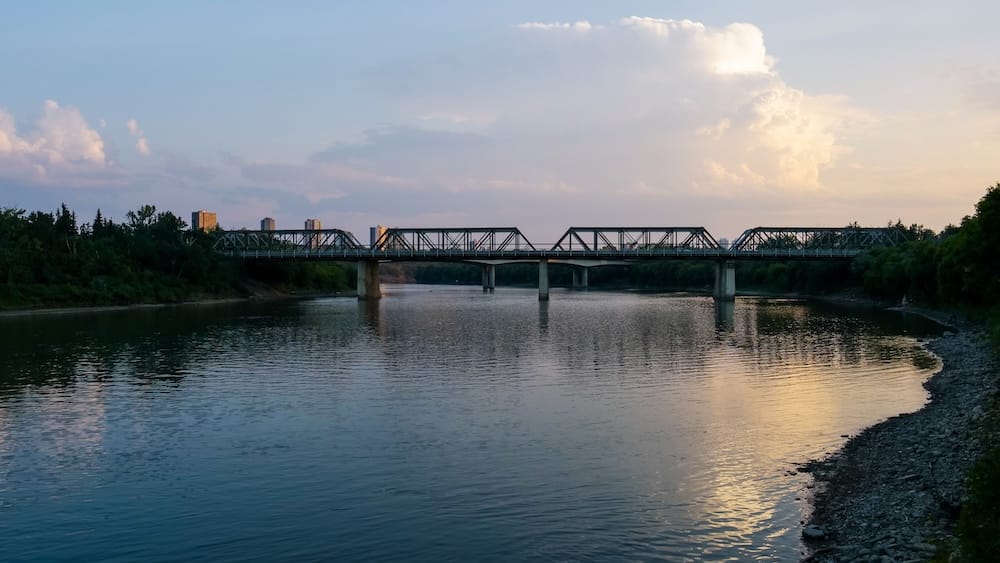
Summer and Winter Are Different River Valley Experiences
Our return visit happened during summer, and that is the version of the River Valley I can speak about personally from this trip.
Winter requires a different mindset.
Paved River Valley paths are included in Edmonton’s snow-clearing system, but that does not mean every trail instantly returns to bare summer pavement after a snowfall. Gravel routes remain in more natural winter condition, and packed snow or ice can completely change how a familiar walk feels.
Temporary closures can also happen because of construction, erosion, flooding, silt or ice.
This is another reason I prefer keeping the route flexible instead of arriving with an overly elaborate plan.
Check conditions. Pick your section. Walk what makes sense that day.
Wildfire smoke can create the same kind of uncertainty in warmer months. If Edmonton is smoky during your visit, check the live Edmonton Air Quality Health Index rather than trusting a travel article written weeks, months or years earlier to tell you whether conditions are suitable.
This is outdoor travel. Conditions get a vote.
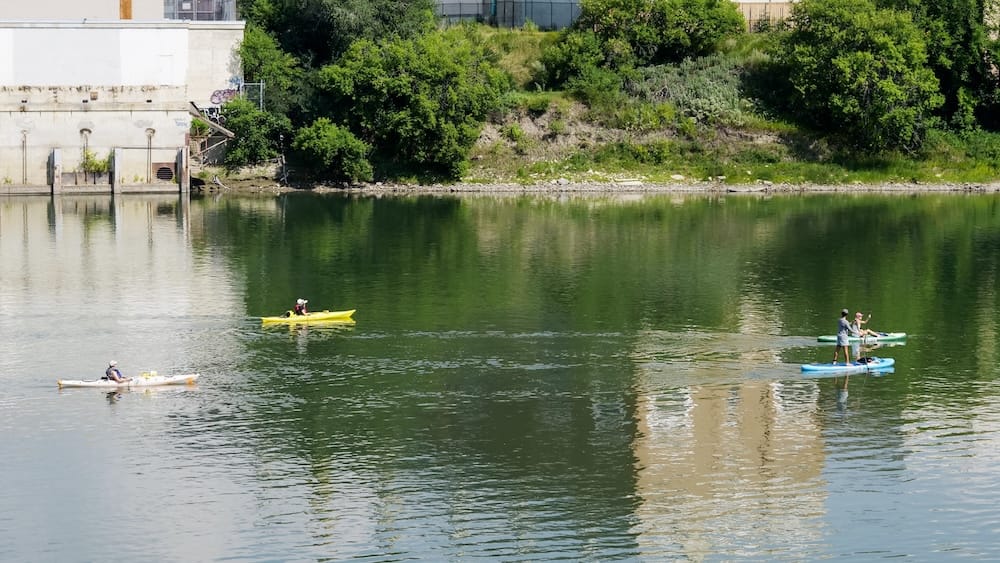
How I Would Do the River Valley on a First Edmonton Trip
If I were showing someone Edmonton for the first time, I would start by asking how much of the day they actually wanted to spend in the River Valley.
That answer decides almost everything.
If sightseeing time was tight, I would use the 100 Street Funicular and Frederick G. Todd Lookout. You get a strong introduction to the valley without sacrificing half the day.
If we wanted a short proper walk, I would head toward Kinsmen, Queen Elizabeth Park and Walterdale Bridge, while paying attention to how we entered and exited the valley.
And if the River Valley itself was one of the reasons for the day out, I would connect more of the central parks and let the walking become the activity.
That third option is closest to how I knew this place when I lived in Edmonton.
I never came down here thinking I needed to complete something.
I walked. I jogged. I inline skated. I spent some time away from the city above me and eventually went home.
Returning years later, I was happy to discover that some of the access had become easier.
The underlying appeal had not changed.
Edmonton’s River Valley is still where I would go when I want to see the city breathe a little.
So make time for it.
Just choose the amount that fits your trip.
Frequently Asked Questions
What is the easiest way to experience Edmonton’s River Valley from downtown?
For the lowest-effort introduction, I would use the 100 Street Funicular and Frederick G. Todd Lookout. The funicular removes much of the steep bank descent while still giving you river, valley and downtown views.
Where should I go for a short Edmonton River Valley walk?
The Kinsmen Park, Queen Elizabeth Park and Walterdale Bridge area works well for a manageable central outing. Kinsmen and Queen Elizabeth Park are about 0.8 kilometres apart, although your total distance depends on how much you explore.
Is Edmonton’s River Valley flat and easy to walk?
Not everywhere. Some paved paths are relatively gentle, but access into and out of the valley can involve steep slopes or stairs. Trail surfaces and grades also vary, so the starting point can matter as much as the distance.
Is the 100 Street Funicular accessible?
The funicular, elevator and lookout infrastructure is designed to accommodate wheelchairs, walkers, strollers and bicycles. That does not mean every connected River Valley trail has the same accessibility.
Can you walk Edmonton’s River Valley in winter?
Yes, but winter conditions are different from the summer experience I had on this trip. Paved River Valley paths are included in Edmonton’s snow-clearing system, while gravel trails remain in more natural winter condition and snow or ice can change the effort required.
How much time should I allow for Edmonton’s River Valley?
I would choose by commitment rather than force a fixed duration: use the funicular and lookout for a quick introduction, Kinsmen and Queen Elizabeth Park for a shorter walk, or connect more central parks if you want the River Valley to become a main activity.
This guide is also available in Spanish. [Leé la versión en castellano: Guía del River Valley de Edmonton: caminatas, vistas y formas fáciles de recorrerlo]
This article contains affiliate links. If you book through one of these links, I may earn a commission at no extra cost to you.