
Friends had done a fairly thorough job of lowering our expectations before we reached Milan. According to the advance reviews, Italy’s fashion capital was grey, businesslike, expensive and nowhere near as rewarding as Rome, Florence or Venice. A place to change trains, perhaps. Buy an overpriced handbag if your financial judgment had temporarily collapsed. Then leave.
That was not the Milan we found.
Milan does make you work a little harder. It does not fling ancient ruins, Renaissance masterpieces and crooked postcard streets at you every forty metres. It is a functioning modern city with offices, trams, apartment blocks, financial districts and sharply dressed people moving with considerably more purpose than I normally manage before lunch.
But once we stopped expecting Milan to behave like a different Italian city, it opened up. The Duomo rooftop was spectacular. Sforza Castle was a complete surprise. The food was excellent. Navigli came alive after dark. Porta Ticinese gave us Roman columns, street art and a route through the city that felt lived-in rather than assembled from a sightseeing checklist.
With three full days to explore Milan, Audrey and I hit the ground running. We visited the major landmarks, wandered through neighbourhoods, took a canal cruise, hunted for murals and ate enough cheese, butter, bread and pastry to put our trousers under structural pressure.
This Milan travel guide keeps that real trip at its centre. When I say we climbed, ate, filmed, photographed or stood around looking confused, that is firsthand. Current ticketing, transport, hotel and attraction advice is researched and clearly separated from our experience. No fake memoir. No pretending I became an expert on every Milan neighbourhood during a three-day visit.
Milan Travel Guide at a Glance
| How long to stay | Two days covers the greatest hits. Three days is much better if you also want neighbourhoods, food, museums and Navigli without marching around like your holiday has a performance review. |
| Book first | The Last Supper if it matters to you, followed by a timed Duomo and rooftop visit. |
| Best central walking zone | Duomo, Galleria Vittorio Emanuele II, Brera, Sforza Castle and Parco Sempione. |
| Best evening area | Navigli and Darsena for canals, outdoor tables, aperitivo and people-watching. |
| Best walk from our trip | Sant’Eustorgio to Porta Ticinese, Colonne di San Lorenzo and Navigli. |
| Getting around | Walk within neighbourhood clusters and use the metro or tram for the longer jumps. |
| Do you need a car? | No. Parking, traffic and restricted zones turn a car into an expensive object you spend the holiday worrying about. |
| Our biggest surprise | Milan became much more enjoyable after dark and once we stopped treating it as a conventional sightseeing city. |
Top 20 Things to Do in Milan, Italy
These twenty experiences come from our own three-day visit. I have reorganized them geographically so the guide is easier to use, but the core remains what Audrey and I genuinely saw, ate and did in Milan.
The Duomo and Historic Centre
1. Visit Milan Cathedral
Italian: Duomo di Milano
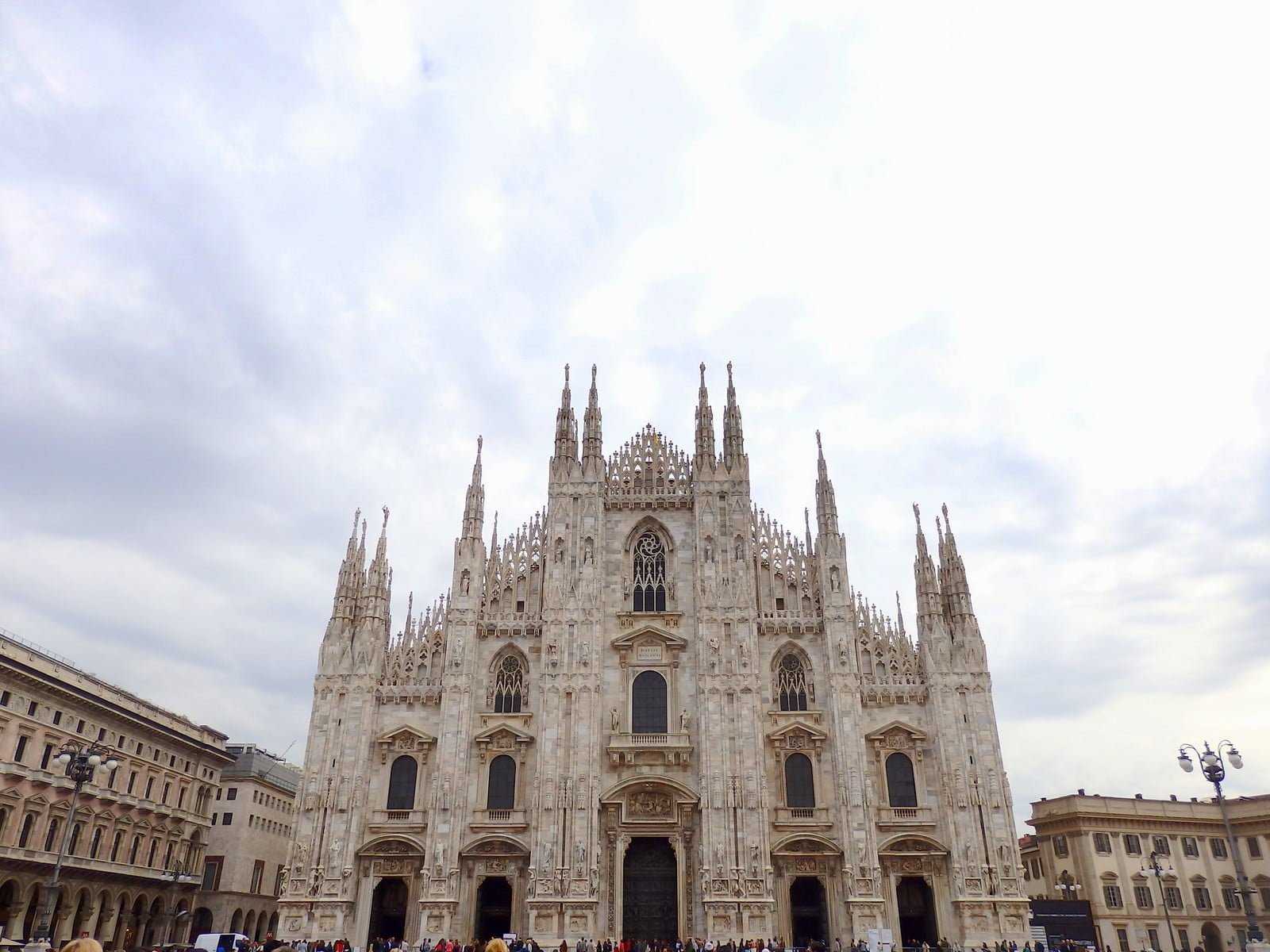
Our first major stop was Il Duomo, Milan’s unmistakable centrepiece and the obvious place to begin a first visit. Construction started in 1386 and continued for centuries, which helps explain why the cathedral feels less like one building and more like an architectural obsession passed from one generation to the next.
The exterior is covered in pale Candoglia marble, giving it an off-white colour that can pick up hints of pink depending on the light. The façade, spires, statues, gargoyles and flying buttresses are so elaborate that trying to absorb the whole building from Piazza del Duomo is hopeless. You need to stop looking at it as one object and start examining it piece by piece.
The interior is darker and more restrained than the exterior, with enormous columns, stained glass, chapels, monuments and archaeological remains below the cathedral. Security screening is required, and this remains an active place of worship rather than an unusually ornate indoor photo studio. Dress accordingly.
Do not assume that “a Duomo ticket” refers to one universal experience. The cathedral, terraces, museum, archaeological area, stairs, lift and guided visits are sold in different combinations. Check the official Duomo di Milano website before choosing.
2. Walk Among the Spires on the Duomo Terraces

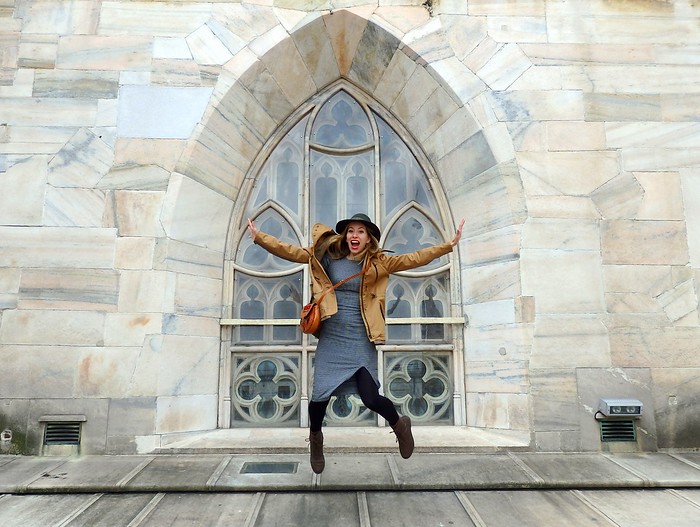
Climbing onto the cathedral rooftop was one of the coolest things we did in Milan. The city views were excellent, but the real thrill came from being able to walk beside the architecture instead of craning our necks at it from the square.
From street level, the spires look decorative. Up close, they become a dense stone forest of saints, pinnacles, carvings, buttresses and bizarre little details that nobody standing below could possibly notice. It is one of those rare attractions where the closer inspection is even better than the famous distant view.
We also learned that individuals and organizations can help fund the cathedral’s endless preservation work by adopting a spire. Sadly, my budget was operating closer to the adopt-a-pastry level.
You can normally choose between stair and lift access. The lift saves energy, but it does not remove every step or uneven surface from the full rooftop route. Travellers with limited mobility should read the current accessibility information carefully because wheelchair access reaches part of the first terrace rather than every corner of the roof.
Timed entries can sell out during busy periods. Early visits generally mean fewer elbows in your photographs, while late-afternoon light can be beautiful on the marble.
Travellers who want the architecture explained rather than merely photographed can check this guided Duomo and rooftop tour on GetYourGuide. It includes the cathedral and terraces, but confirm the current language, lift arrangements and meeting point before booking.

3. Walk Through Galleria Vittorio Emanuele II
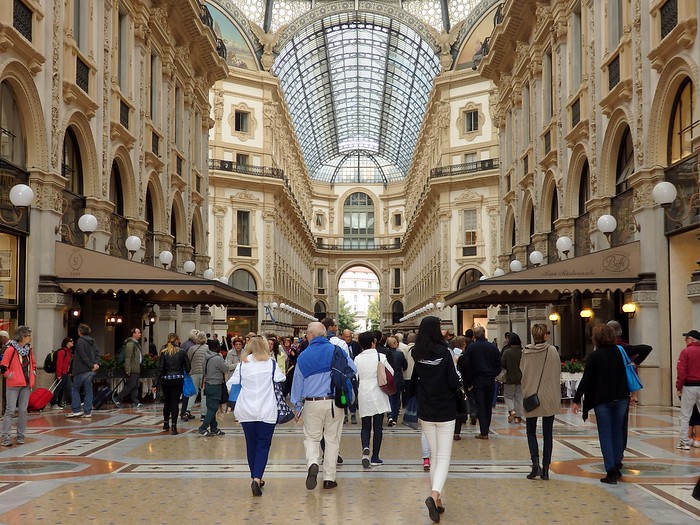
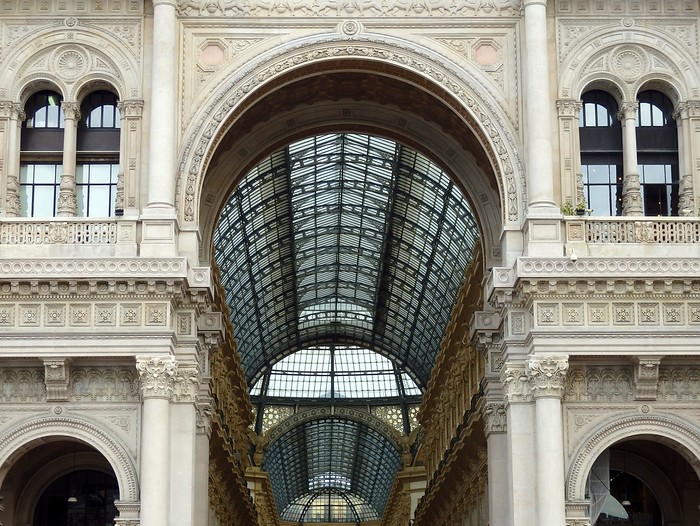
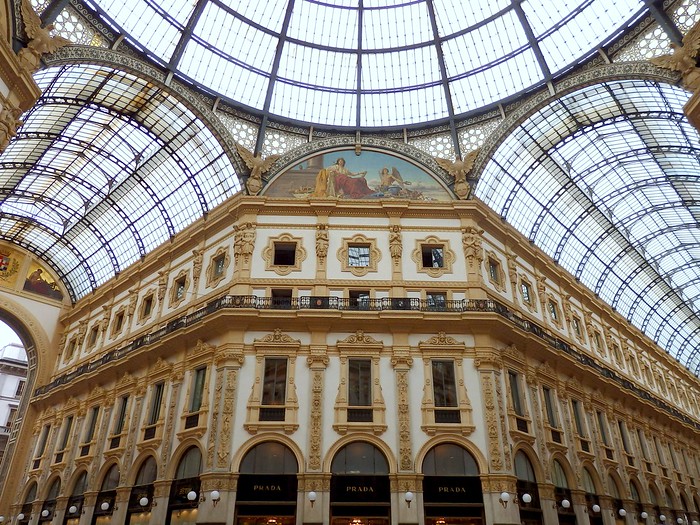
For upscale designer shopping, Galleria Vittorio Emanuele II is the place to be. It is one of the world’s oldest grand shopping arcades, connecting Piazza del Duomo with Piazza della Scala beneath an extravagant glass-and-cast-iron roof.
We were not there to purchase luxury handbags. Audrey has pointed out that even if she had the money, she could think of better uses for it than buying a bag that costs more than many people’s cars. I struggle to disagree. For that kind of money, I would expect the handbag to carry me.
The reason to visit is the building. Look down at the mosaics, up at the dome and along the symmetrical façades. The shops may feel intimidating, but walking through the Galleria is free and it sits directly beside the Duomo. You almost have to make an effort to avoid it.
You may notice visitors grinding a heel into the mosaic bull. The tradition is supposed to bring good luck. The bull has endured a great deal in the name of positive energy.
4. Visit the Duomo Museum
If the cathedral and terraces leave you wanting more, the Grande Museo del Duomo explains the immense construction project in greater depth. Its collection includes sculptures, stained glass, tapestries, architectural models and pieces removed from the cathedral for preservation.
This is where the Duomo begins to feel less like a finished monument and more like a living worksite that has required centuries of labour, fundraising, repair and replacement stone. In other words, the largest home-renovation project in Milan, except nobody can agree that the kitchen is finally done.
The museum makes the most sense for visitors with a serious interest in art, architecture or the cathedral’s history. If you only have half a day in Milan, prioritize the cathedral and terraces. With a longer visit, the museum adds worthwhile context and is easy to combine with them.
5. Browse Via Torino and Find San Satiro
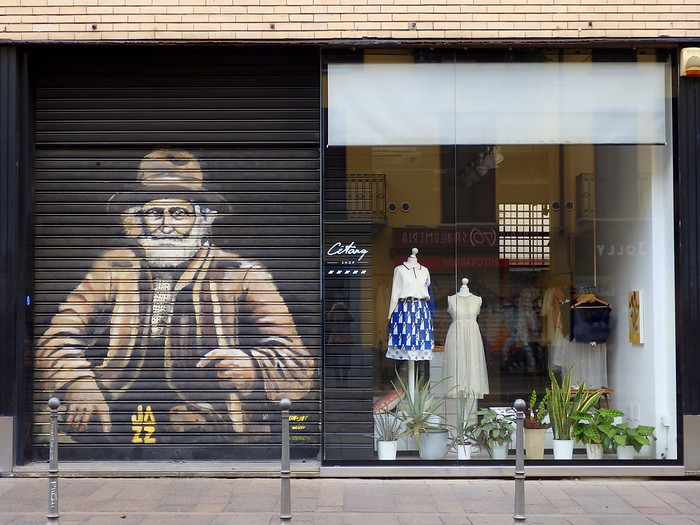
Because Milan is one of the fashion capitals of the world, we could not visit without doing at least a little shopping. We walked along Via Torino, a busy commercial street running southwest from the Duomo with international chains, shoe stores, smaller shops and a thick current of pedestrians.
Via Torino is more affordable and accessible than the luxury boutiques around the Galleria and Fashion District. It also forms a useful walking connection between Piazza del Duomo and the historic southern route toward Colonne di San Lorenzo and Porta Ticinese.
One worthwhile stop we missed is Santa Maria presso San Satiro, just off Via Torino. Bramante used forced perspective to make the church’s shallow choir appear far deeper than the space actually allows. It is free to enter and takes little time, which is my preferred combination when a sightseeing schedule is already threatening mutiny.
Castle, Museums, Chinatown and Modern Milan
6. Explore Sforza Castle
Italian: Castello Sforzesco
Something that genuinely surprised us was discovering a castle in the middle of Milan. Perhaps we had done a poor job researching the city. Perhaps castles should simply announce themselves more aggressively.
Sforza Castle was rebuilt in the fifteenth century for the Duke of Milan on the remains of earlier fortifications, then altered repeatedly as rulers, armies and governments came and went.
The complex is enormous. You can cross the courtyards, inspect the defensive architecture, wander through the former moat and continue directly into Parco Sempione. Audrey also remembers trying to attract the attention of stray cats hanging around the empty moat, which was probably not the cultural legacy the Sforza family had in mind.
The courtyards are free to enter, but the museums require admission. The most significant works include Michelangelo’s unfinished Rondanini Pietà, produced near the end of his life, and rooms associated with Leonardo da Vinci.
If your time is limited, walk through the castle and park. If you enjoy sculpture, decorative arts, musical instruments, archaeology or Milanese history, you can disappear into the museums for much longer.
7. Walk Through Parco Sempione and Consider Triennale Milano
Parco Sempione spreads out behind Sforza Castle and gives you an easy break from stone courtyards, ticket lines and the slow realization that your feet are no longer enjoying Europe.
It is one of the most logical places in central Milan to stop, eat something inexpensive or sit down without being expected to order another coffee.
On the western side of the park, Triennale Milano explores Italian design, architecture, visual culture and contemporary creativity. Some spaces are free while temporary exhibitions require tickets.
Triennale is especially useful for visitors drawn to Milan because of design rather than Renaissance painting. It also fits naturally into a castle-and-park day instead of requiring another cross-city expedition.
8. See Milan’s Modern Skyline
Milan is steeped in history, but it is not trapped inside it. We took a hop-on-hop-off bus partly because it helped us reach areas beyond the compact historic centre and see a completely different architectural side of the city.
I am normally skeptical of hop-on-hop-off buses. They can feel like sightseeing for people who have surrendered control of their legs. In Milan, however, it helped us understand the city’s scale and see districts we would not have reached during such a short visit.
The Porta Nuova area now centres on Piazza Gae Aulenti, the Unicredit Tower, landscaped public spaces, pedestrian routes and the nearby Bosco Verticale residential towers. The towers are covered in trees and plants, but they are private homes rather than observation decks. Admire them from outside. Do not arrive expecting to knock on somebody’s door and request a vertical-forest tour.
Continue into Isola for cafés, independent businesses, street art and an older neighbourhood texture pressing against the polished new skyline. That contrast is far more interesting than seeing the development as one self-contained futuristic district.
Travellers with limited time or mobility can compare Milan sightseeing and hop-on-hop-off options on GetYourGuide. Check the loops carefully because some routes focus on the historic centre while others extend toward CityLife, San Siro, Navigli or Porta Nuova.
9. Visit Milan’s Chinatown
Milan’s Chinatown centres on the pedestrian-friendly Via Paolo Sarpi. It is home to Italy’s largest Chinese community and has developed over roughly a century into an area of restaurants, bakeries, supermarkets, dumpling counters, fashion businesses, bars and creative spaces.
Our original reason for visiting was straightforward: we wanted Chinese food and shops selling ingredients we had not seen elsewhere. But describing the district merely as somewhere to buy “exotic vegetables,” as the old article did, is dated and reductive. Sarpi deserves better than being treated like a novelty supermarket aisle.
The area works well for a casual lunch or early evening food crawl and can be combined with Parco Sempione, Arco della Pace and Cimitero Monumentale. The cemetery is free, architecturally elaborate and much closer to an open-air sculpture museum than the name suggests.
10. Notice Milan’s Cycling Culture

Another thing we noticed was that locals seemed to cycle everywhere. We did not rent bicycles ourselves, so this is not an inspiring account of Audrey and me conquering Milan on two wheels. It is simply one of the most visible parts of everyday city life.
Visitors can use the BikeMi sharing system with daily or weekly subscriptions. It works best for point-to-point trips rather than holding one bicycle hostage for the entire day, since individual rides have time limits and charges can vary by bicycle type.
Watch the tram tracks. A front wheel entering one at the wrong angle can convert an elegant Milan cycling experience into a very public medical demonstration. Quieter routes, parks, Navigli, Porta Nuova and broader modern streets are less intimidating than plunging directly into central traffic.
Porta Ticinese, Roman Milan and Navigli
One of the best ways to understand Milan beyond the headline sights is to follow the route we walked from our apartment near Sant’Eustorgio toward Piazza del Duomo. It connects religious history, Roman columns, street art, shopping streets and canals without feeling like an itinerary assembled by somebody dragging pins around Google Maps from another continent.
11. Visit the Basilica of Sant’Eustorgio
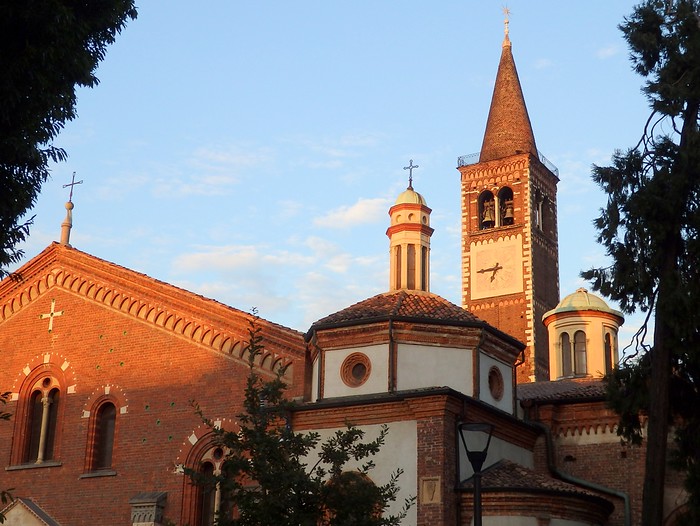
We visited the Basilica of Sant’Eustorgio because it was close to where we were staying. Not every meaningful travel discovery begins with deep historical research. Sometimes the church is simply down the road.
Sant’Eustorgio is one of Milan’s oldest churches and is traditionally associated with relics of the Three Magi. The relics were taken to Cologne in the twelfth century, although portions were returned to Milan in 1903. The star-topped bell tower still reflects that connection.
The church itself is free to enter, while the museum and Portinari Chapel require admission. The chapel is particularly important for its Renaissance frescoes and makes the complex worthwhile for art lovers who want more than a quick look around another old church.
12. Search for Street Art Around Porta Ticinese

Milan has plenty of street art, and you often stumble across it when you are not looking. We spotted some of our favourite pieces around Porta Ticinese and near Sant’Eustorgio.
Audrey’s favourite was a strange lizard or alien-like face painted near the basilica. She recognized the artist’s recurring character from another European city but could not remember where she had seen it. This is how travel memory normally behaves: the colourful alien survives forever while the useful location information evaporates.
Street art changes constantly, which is why precise mural addresses age badly. Walls are repainted, shutters change, construction appears and yesterday’s landmark becomes today’s beige rectangle.
Porta Ticinese, Navigli, Isola and the Leoncavallo area have all been associated with street art. Treat the search as an excuse to wander rather than a guarantee that one particular mural will still be waiting obediently for your photograph.
13. Stop at Colonne di San Lorenzo

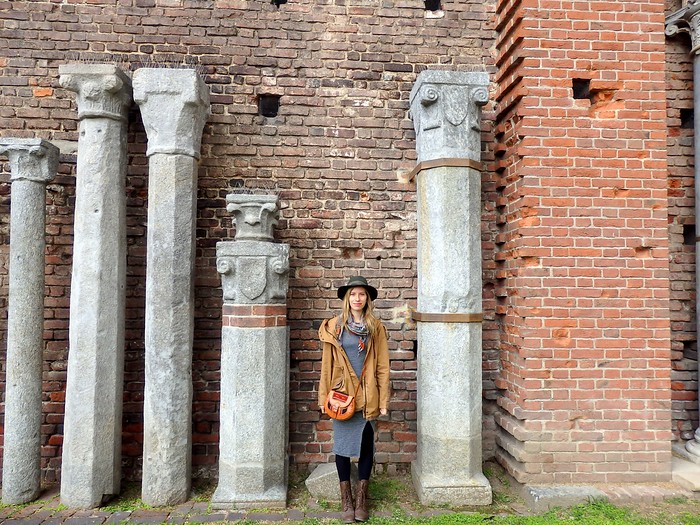
On our first morning, Audrey and I skipped the tram and walked toward the centre along Corso di Porta Ticinese. That is how we came across Colonne di San Lorenzo rather than arriving with a meticulously colour-coded Roman-ruins schedule.
The sixteen marble columns are among the most visible remains of Roman Milan. They were reused and moved to their current arrangement in late antiquity, standing today between a busy street and the Basilica of San Lorenzo.
The contrast is what makes them memorable. Trams, bicycles, bars, apartments and crowds carry on around an ancient colonnade that has somehow become ordinary neighbourhood scenery.
The columns are free and require little time. Combine them with Sant’Eustorgio, Porta Ticinese, Via Torino, Darsena or Navigli rather than creating a separate cross-city pilgrimage to sixteen pieces of marble.
14. Take a Navigli Canal Boat Tour
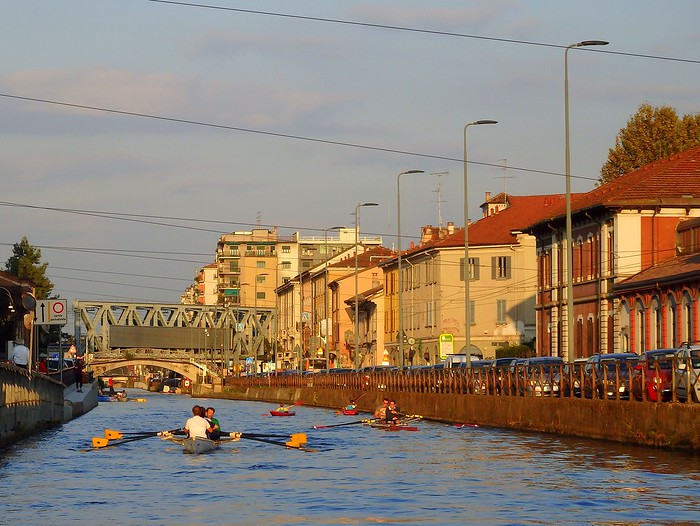
Another activity we tried was a boat tour through Milan’s canal system. The Navigli existed before Leonardo da Vinci, but he studied and worked on engineering improvements connected to Milan’s waterways. It is more accurate to call him an important contributor than the man who personally dug every canal with a Renaissance shovel.
A cruise shows the district at a slower pace, passing bridges, churches, converted workshops, apartments and street art. Ours lasted roughly an hour, making it easy to fit before aperitivo or dinner.
Do not expect Venice. Navigli is a compact urban canal district, not a city floating on water. The pleasure is seeing another side of Milan and easing into the evening as the streets and outdoor tables begin filling up.
Current cruises vary in commentary, route and whether a drink or aperitivo is included. You can compare Navigli canal cruises on GetYourGuide, but read the recent reviews and inclusions rather than assuming every boat provides the same experience.
15. Eat Along the Navigli Canals
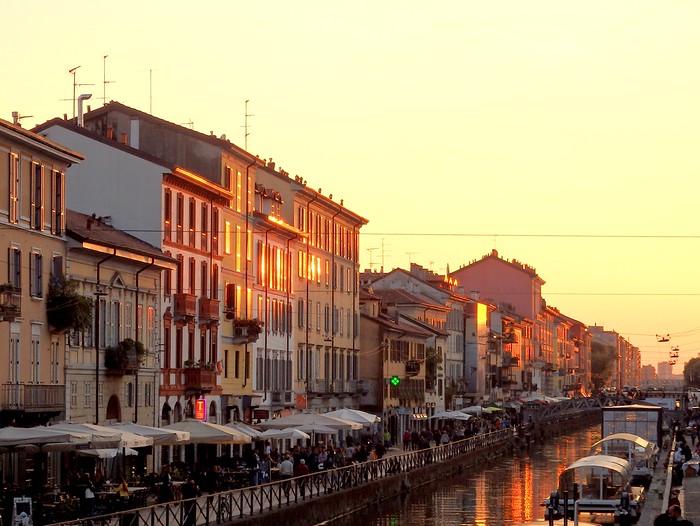
Navigli becomes far livelier once the sun goes down. Cafés, bars and restaurants spill toward the water, people gather on the bridges and the whole district feels less hurried than the business-heavy Milan we had been walking through during the day.
Allow time for a canal-side drink or meal rather than arriving, photographing the water and immediately leaving. The atmosphere is the point.
The obvious waterfront tables are also the busiest and can be noisy. If every menu facing the canal looks inflated or every table is occupied, walk one or two streets back. You can still enjoy the water before and after dinner without paying entirely for the furniture’s orientation.
16. Experience Milanese Aperitivo
For the best-value drink-and-food combination we encountered in Milan, we finally tried aperitivo on our last night.
We immediately wondered why we had waited.
Aperitivo is fundamentally a pre-dinner social ritual. You order a drink, sit with friends and receive accompanying snacks or small plates. The amount of food varies enormously. Some bars provide olives, chips, cheese or a carefully composed plate. Others offer something closer to what we experienced: a buffet that appeared to have swallowed dinner.
We went to Manhattan along Navigli and paid €10 per person at the time. That historical price included a cocktail and access to lasagna, ravioli, vegetables, French fries, pizza, cold cuts, cheese, cakes and a custard-like dessert.
Audrey ordered a Bellini. I chose a thick piña colada with enough coconut to qualify as a small meal by itself. We had expected a few snacks and found enough food to remove dinner from the evening entirely.
The open buffet did not mean you were supposed to build a Las Vegas food mountain on one plate. We understood it as grazing food rather than an endurance event, although restraint becomes more theoretical once lasagna, ravioli, pizza and dessert are sharing a table.
We arrived around 6:30 p.m. and the place was already busy. Going early can help you find a table. Just remember that our price and buffet came from that specific visit; modern aperitivo formats differ from one bar to the next.
Eating Our Way Around Milan
17. Start the Day With an Italian Breakfast
Before arriving in Milan, we were not entirely sure what an Italian breakfast looked like. We had recently been travelling through England and Ireland, where breakfast could involve eggs, sausages, beans, tomatoes, mushrooms, toast and enough food to make lunch feel like an administrative error.
Italian breakfast was the opposite: coffee and something sweet. A cornetto, pastry, biscuits, cake or bread with jam. Small. Civilized. Suspiciously enjoyable.
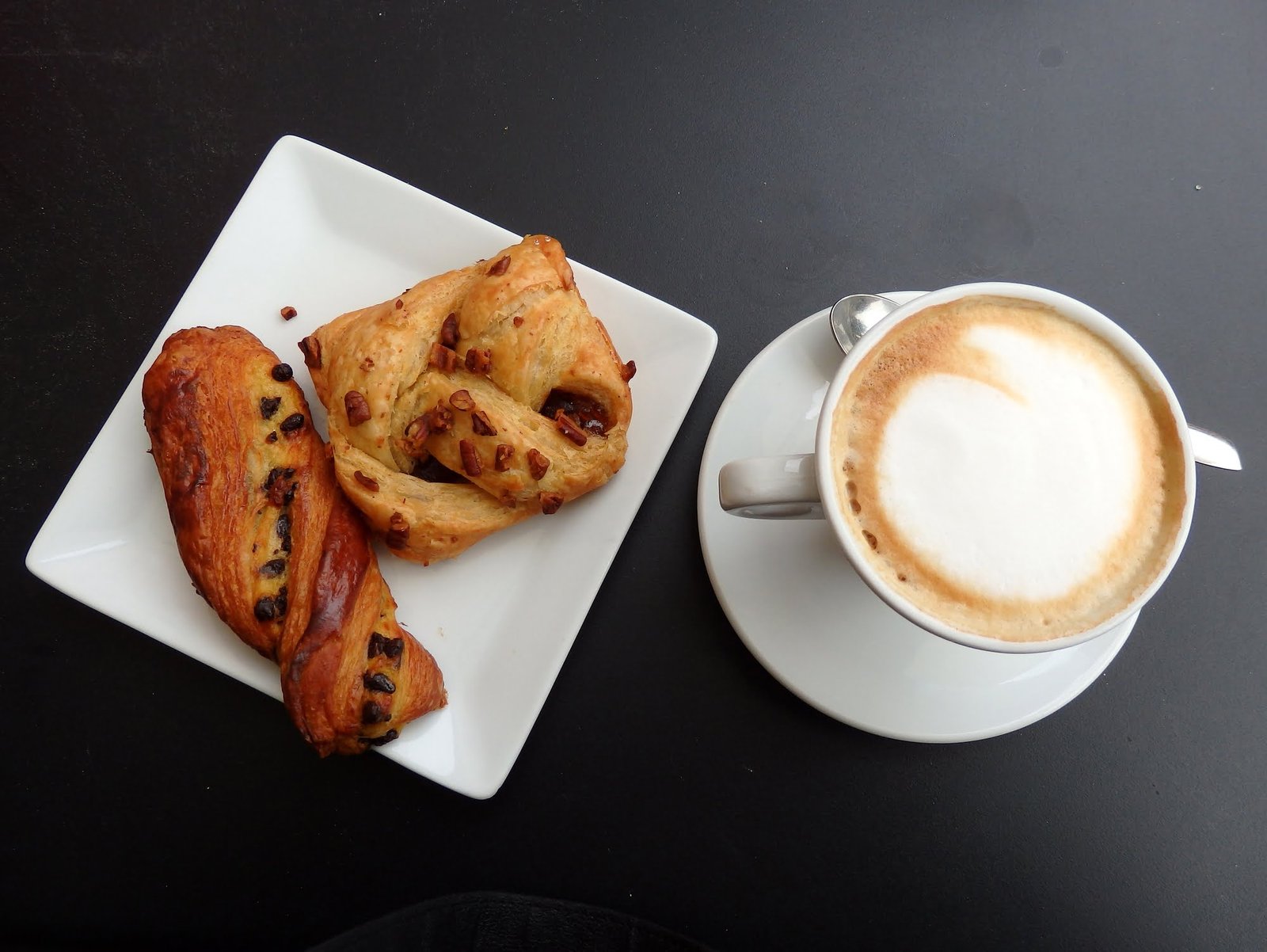
On our first morning, we sat down at a café for cappuccinos and pastries. Audrey chose a buttery twisted pastry with chocolate chips. I selected mine because I could see walnuts on top and had no idea what was inside. This is the full sophistication of my pastry-selection process.
The filling tasted like pecan pie.
“Pie for breakfast,” Audrey announced. “He’s a happy boy.”
She knows me well.
Our two cappuccinos and two pastries cost €5 during that trip. Do not treat that as a current Milan price promise, but the basic format remains one of the simplest and most pleasant ways to start the day.
18. Try Risotto alla Milanese
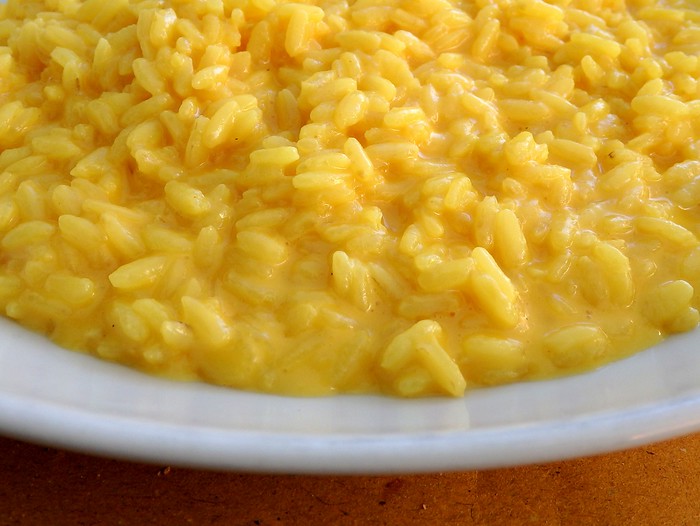
On our first full day, we found a small local restaurant and ordered risotto alla Milanese for dinner. We arrived at approximately 6:20 p.m., which explained why the dining room was nearly empty. Milan was not deserted. We had merely arrived for dinner at an hour when many locals were probably still contemplating coffee.
By the time the risotto appeared, I was already four slices into the bread basket. Strong preparation.
Risotto is rice, not pasta. The starchy grains release starch while gradually absorbing stock, creating a creamy texture without turning into porridge. Risotto alla Milanese receives its golden colour from saffron and is commonly finished with butter and cheese.
Our plates arrived loose, creamy, intensely cheesy and buttery. The recipe looked simple, but that simplicity was exactly why it worked. There was nowhere for poor rice or careless cooking to hide.
We both cleaned our plates and were beyond stuffed. Risotto may traditionally be served as a first course, but our stomachs were under no contractual obligation to respect Italian menu architecture.
The risotto cost €7 during our visit. That is historical colour, not a prediction of what your dinner will cost now.
19. Eat Thick Milanese Pizza al Trancio
Before arriving in Italy, I was already salivating over the opportunity to try Italian pizza. What I ended up liking most in Milan was pizza al trancio: thick, fluffy slabs buried beneath a generous amount of cheese.
We found the shop by accident while walking. The pizzas initially looked a little like focaccia. One slice came with salami and mozzarella, while the other had mozzarella, small tomatoes and basil. The person serving us called it pizza al trancio and cut the enormous slices into manageable pieces.
We carried them to a park just as it started raining, which is how many romantic Italian food scenes actually unfold: balancing a plate, searching for shelter and trying not to let water dilute the cheese.
The dough was thick but airy, with a crisp base and far more cheese than the thin pizzas we had also tried. It reminded us a little of the generous pizza culture in Buenos Aires and, in another way, Chicago deep dish.
When forced to choose between thin and thick, I preferred the thick Milanese slice. More dough. More cheese. More food. This was not a complex philosophical conclusion.
Our two large slices cost €7 during the trip.
Travellers who want broader context instead of randomly pointing at menus can check this Milan food tour with risotto, wine and multiple tastings. The current menu can change, so confirm what is actually included and do not arrive after eating a heroic hotel breakfast.
Milan After Dark
20. Revisit Milan at Night
On our final night, we went for one last walk around the city. Milan felt completely different once office hours ended, the lights came on and the largest daytime crowds began thinning out.
Return to the Duomo after dark if you can. The illuminated façade becomes more dramatic, while the piazza starts feeling less like an attraction queue and more like a public square again.
Navigli also belongs to the evening. Sunset reflections, crowded bridges, clinking glasses and outdoor tables are not background details there. They are the experience.
This became one of our most important Milan lessons. The city does not reveal everything between 9 a.m. and 5 p.m. If you retreat to your hotel immediately after sightseeing, you miss a large part of what makes it enjoyable.

Milan Travel Video
What to Book Before Visiting Milan
Milan is not a city where every attraction can be approached with the same relaxed plan of arriving whenever your breakfast ends. Some places are easy to walk into. Others can sell out before your plane leaves home.
Book The Last Supper First
We did not see Leonardo da Vinci’s Last Supper during our visit. That is precisely why it belongs in this planning section rather than being quietly smuggled into our firsthand recommendations.
If seeing it matters to you, book it before designing the rest of your itinerary. Reservations are mandatory even for free or reduced admissions, and official tickets are released in scheduled blocks. Visits are tightly controlled for conservation, normally last only 15 minutes and require visitors to arrive well before the booked time with identification.
Check the official Last Supper information and ticket-release page first. Official admission should be your starting point, not an afterthought once a reseller has already tripled the cost.
If official tickets are unavailable or you specifically want an art historian’s explanation, check this guided Last Supper visit on GetYourGuide. Confirm the visitor-name requirements, cancellation terms and exact meeting time before paying.
Once you secure a slot, treat it as the fixed point of that day. Sforza Castle, Sant’Ambrogio, the Science and Technology Museum, Brera and central Milan can all be arranged around it depending on the time.
Reserve the Duomo and Rooftop
The Duomo is easier to book than The Last Supper, but popular rooftop slots can still fill during weekends, holidays and peak travel periods.
Choose your product carefully:
- Very limited time: cathedral and terraces.
- Photography priority: terraces early or late in the day.
- Architecture and history priority: cathedral, terraces, museum and archaeological area.
- Reduced mobility: read the current accessibility details before selecting lift access, because not every section of the roof is step-free.
How Many Days Do You Need in Milan?
One day is enough to see the Duomo, Galleria, Sforza Castle and perhaps Navigli, but it will feel compressed. Two days gives you a respectable city break. Three days allows Milan to become more than a checklist with lunch squeezed between timed entries.
| Time Available | What It Realistically Allows |
|---|---|
| 1 day | Duomo, terraces, Galleria, Sforza Castle and one evening area. |
| 2 days | Historic centre, castle, Ticinese, Navigli, food and one museum or booked attraction. |
| 3 days | A balanced first visit including neighbourhoods, modern Milan, multiple museums and slower meals. |
| 4–5 days | A relaxed Milan stay or a city visit plus one Lombardy day trip. |
A Realistic 2-Day Milan Itinerary
Day 1: Duomo, Galleria, Castle and Milan at Night
- Begin with a timed Duomo and rooftop visit.
- Walk through Galleria Vittorio Emanuele II.
- Stop at San Satiro or Museo del Novecento if time and interests allow.
- Walk via Brera or Via Dante to Sforza Castle.
- Continue through Parco Sempione.
- Return to the centre after dark or have aperitivo in Brera, Porta Venezia or Navigli.
Day 2: Roman Columns, Street Art and Navigli
- Visit Sant’Eustorgio and the Portinari Chapel if interested.
- Walk through Porta Ticinese and look for street art.
- Stop at Colonne di San Lorenzo.
- Continue toward Via Torino and the centre, or reverse the route from the Duomo.
- Return to Darsena and Navigli in the late afternoon.
- Take a canal cruise, have aperitivo and stay for dinner or an evening walk.
If your Last Supper reservation falls on either day, rebuild the route around that fixed time. Do not attempt to force it into an already overstuffed schedule unless you enjoy turning leisure into competitive logistics.
A More Relaxed 3-Day Milan Itinerary
Day 1: Duomo, terraces, Galleria, Via Torino, San Satiro and evening views.
Day 2: Sforza Castle, Parco Sempione, Brera, one art or design museum and The Last Supper if booked.
Day 3: Sant’Eustorgio, Porta Ticinese, Roman columns, Navigli, canal cruise and aperitivo.
Travellers more interested in contemporary architecture can replace Brera with Porta Nuova, Isola, Bosco Verticale and Chinatown. Families may prefer Porta Venezia, the gardens and the Natural History Museum.
Where to Stay in Milan
We stayed in a local apartment near Sant’Eustorgio as part of the Blogville project. The location worked well because we could walk through Porta Ticinese toward the centre and reach Navigli easily in the evening.
We did not stay at the hotels below, so these are researched options to compare—not personal reviews dressed up in a bathrobe.
| Area | Best For | Main Advantage | Trade-Off |
|---|---|---|---|
| Duomo / Centro Storico | Very short first visits | Walk to major landmarks | Expensive and heavily touristed |
| Brera | Art, atmosphere and first-time visitors | Central, attractive and walkable | Higher accommodation prices |
| Navigli | Nightlife and aperitivo | Evening atmosphere on your doorstep | Noise and weekend crowds |
| Porta Romana | Food and a calmer local base | Residential feel with metro access | Longer walks to northern sights |
| Porta Venezia | Museums, architecture and diversity | Good transport and active evenings | Less convenient for Navigli |
| Isola / Porta Nuova | Modern architecture and design | Contemporary public spaces | Less historic atmosphere |
| Milano Centrale | Airport transfers and day trips | Excellent railway connections | Practical rather than romantic |
If you like Navigli but value sleep, consider staying on a side street within walking distance rather than directly above the busiest canal bars. A canal view becomes less romantic at 2 a.m. when the people below are still enjoying theirs at full volume.
Milan Hotels Worth Comparing
- Check availability at Room Mate Collection Giulia — a highly central option steps from the Duomo for travellers willing to pay for maximum walkability.
- Check rooms at Maison Borella on the Naviglio Grande — best suited to travellers who want historic canal atmosphere and accept that Navigli is not a monastery after dark.
- Check availability at Hotel Berna near Milano Centrale — a practical base for airport transfers, early trains and day trips.
For the broadest inventory, compare Milan hotels on Booking.com using the map rather than sorting only by price. A cheap room on the wrong side of your daily itinerary can extract repayment in transit time and exhausted arguments.
What to Eat in Milan
Our strongest firsthand food experiences were breakfast pastries, risotto alla Milanese, pizza al trancio and aperitivo. Milan has considerably more traditional food than we managed to consume in three days, despite a committed effort.
| Dish | What It Is | Firsthand? |
|---|---|---|
| Risotto alla Milanese | Saffron risotto finished with butter and cheese | Yes |
| Pizza al trancio | Thick Milanese-style pizza sold in large slices | Yes |
| Aperitivo food | Snacks or small plates served with an early-evening drink | Yes |
| Cotoletta alla Milanese | Breaded veal cutlet, traditionally bone-in | No |
| Ossobuco | Braised veal shank, often served with saffron risotto | No |
| Mondeghili | Milanese meatballs traditionally made from cooked leftover meat | No |
| Cassoeula | Rich pork-and-cabbage dish associated with colder weather | No |
| Michetta | Light, hollow, flower-shaped Milanese bread roll | No |
| Panettone | Milan’s famous enriched sweet bread | No |
Travellers specifically seeking traditional Milanese cuisine can look for the DeCA label—Denominazione di Cucina Ambrosiana—which identifies participating restaurants committed to serving a minimum range of traditional dishes using recognized methods and ingredients.
It is a more useful filter than choosing whichever menu displays the largest photograph of risotto outside the Duomo.
Which Milan Museum Should You Choose?
Milan has too many museums to treat them as one interchangeable category. Pick according to what you actually enjoy rather than visiting the institution somebody else declared mandatory and spending two hours pretending a medieval altarpiece has changed your life.
| Your Interest | Best Fit | Why |
|---|---|---|
| Old Masters | Pinacoteca di Brera | One of Milan’s major collections of Italian painting |
| Twentieth-century Italian art | Museo del Novecento | Central location beside the Duomo |
| Italian design and architecture | Triennale Milano | Design-focused programming beside Parco Sempione |
| Contemporary art and architecture | Fondazione Prada | A major cultural complex south of the centre |
| Large installations | Pirelli HangarBicocca | Industrial-scale exhibition spaces with free admission |
| Natural history and dinosaurs | Museo Civico di Storia Naturale | Our firsthand choice and particularly good for families |
| Duomo architecture | Grande Museo del Duomo | Explains the cathedral’s construction and decoration |
| Milanese history | Sforza Castle museums | Multiple collections inside one enormous complex |
Visit the Natural History Museum
Italian: Museo Civico di Storia Naturale di Milano
We dropped by the Museum of Natural History mainly because we were curious about the dinosaur displays. It is particularly well suited to families, but calling it merely a children’s museum would be unfair.
The museum covers geology, palaeontology, zoology, minerals, ecosystems and evolution across more than twenty rooms. Its dioramas have an old-school museum quality, while the dinosaur skeletons and prehistoric animals supply the immediate drama.
It sits inside the Indro Montanelli Gardens near Porta Venezia, making it easy to combine with the park, Villa Reale, Corso Venezia and the surrounding Liberty-style architecture.
Overlooked and Free Things to Do in Milan
Not every worthwhile stop requires a timed ticket, guided explanation or small financial sacrifice.
- Santa Maria presso San Satiro: Bramante’s illusionistic shallow apse near Via Torino.
- Cimitero Monumentale: elaborate funerary sculpture and architecture with free admission.
- Basilica of Sant’Ambrogio: one of Milan’s most important Romanesque churches.
- Colonne di San Lorenzo: Roman columns integrated into a busy modern neighbourhood.
- Sforza Castle courtyards: free to cross even if you skip the museums.
- Parco Sempione: central green space behind the castle.
- Galleria Vittorio Emanuele II: grand architecture without a luxury-shopping budget.
- Piazza Gae Aulenti and BAM: modern public spaces near Bosco Verticale.
- Darsena and Navigli: free to explore, although drinks have a habit of following.
Getting Around Milan
Milan currently has five metro lines—M1 through M5—supported by trams, buses, suburban trains, taxis, bike sharing and a largely flat central core.
Current ATM Ticket Options
As of July 2026, the standard Mi1–Mi3 options include:
| Ticket | Current Price | Best For |
|---|---|---|
| 90-minute ticket | €2.20 | Visitors walking heavily and taking occasional rides |
| 24-hour ticket | €7.60 | A transport-heavy sightseeing day |
| 3-day ticket | €15.50 | Frequent use across a three-day city break |
You can also pay contactlessly on ATM services with a compatible card or device. Use the same card or device throughout so the system can calculate the applicable fare correctly. Contactless ATM payment does not automatically cover every regional railway or suburban service outside the urban system.
Check current fares and rules on the official ATM ticket page before travelling.
Metro, Tram or Walking?
- Walk: Duomo, Galleria, Brera, Sforza Castle, Via Torino and much of the centre.
- Metro: longer jumps to Porta Nuova, Isola, Centrale, Porta Venezia or outer museums.
- Tram: slower but more atmospheric journeys when you are not in a rush.
- Taxi: luggage, late nights, mobility gaps or moments when another scenic walk may end a relationship.
Do Not Rent a Car for Central Milan
Milan’s central Area C is a regulated traffic zone with electronic gates and weekday charging hours. Add parking rules, tram lines and dense traffic, and a rental car becomes an expensive metal problem following you around the city.
Use trains for common day trips and collect a car after leaving Milan if the rest of your itinerary genuinely requires one.
Getting From Milan’s Airports to the City
Linate Airport
Linate is the most convenient airport for central Milan. Metro line M4 links the airport with San Babila in roughly twelve minutes using the normal urban fare. From San Babila, transfer to M1 or walk toward the Duomo.
Malpensa Airport
The Malpensa Express runs to both Milano Cadorna and Milano Centrale.
- Cadorna: approximately 37 minutes and convenient for Sforza Castle, Brera and parts of the historic centre.
- Centrale: approximately 51 minutes and convenient for station-area hotels, onward trains and eastern connections.
The current one-way fare is €15. Check official Malpensa Express schedules and fares before travelling.
Bergamo Orio al Serio Airport
Direct coaches connect Bergamo Airport with Milano Centrale. They are straightforward, but travel times depend much more heavily on road traffic than the Linate metro or Malpensa railway.
Leave a sensible buffer for the return journey, especially during commuter hours, major events or bad weather. The airport has no sympathy for the beautiful traffic jam you photographed.
Is the YesMilano City Pass Worth It?
The official YesMilano City Pass combines public transport with different selections of attractions. As of July 2026, the main products include a 24-hour Flash pass and two three-day passes with different Duomo access and museum inclusions.
A pass may make sense if you plan to visit the Duomo, Sforza Castle museums, Museo del Novecento and Natural History Museum while using public transport heavily.
It is less compelling when your itinerary focuses on walking, free churches, neighbourhoods, food, Navigli and only one major paid attraction.
Price the individual places you genuinely intend to visit before buying. Do not add museums purely to “recover” the cost of a pass. That is how a holiday becomes an accounting exercise.
Review current inclusions on the official YesMilano City Pass website. Never assume the pass solves the difficult Last Supper reservation unless it explicitly says so.
Milan Accessibility Planning
Milan has improved accessibility, but the reality still varies by station, historic building, pavement, lift status and attraction.
- M3, M4 and M5 stations and trains are designed to be accessible.
- Older M1 and M2 stations vary, although accessibility upgrades continue.
- The ATM app and website provide real-time lift, stairlift, stop and arriving-vehicle information.
- Historic trams are not all equally convenient for wheelchairs or reduced mobility.
- The Duomo interior and museum have accessible routes, but wheelchair rooftop access reaches only part of the first terrace.
- Cobblestones and uneven surfaces occur in Brera, Navigli, castle areas and older streets.
Check the ATM real-time accessibility service shortly before travelling rather than assuming that a lift shown on an old map is working that day.
Visiting Milan With Children
We did not visit Milan with children, so this section is based on current planning research rather than invented memories of Audrey and me negotiating with a toddler beneath the Duomo.
- Natural History Museum: dinosaurs, fossils, animals, minerals and dioramas.
- Parco Sempione: open space after visiting Sforza Castle.
- Leonardo da Vinci Museum of Science and Technology: useful for engineering, transport and hands-on interests.
- MUBA: a children’s museum with workshops that normally require advance booking.
- Trams: a simple city ride can become an activity when little legs are tired.
- Food: pizza slices, pastries, simple pasta and gelato are rarely the hardest part of family negotiations.
When to Visit Milan
Spring
Spring offers comfortable walking weather, greener parks, outdoor tables and major cultural events. April’s Design Week can transform neighbourhoods across Milan, but it also raises hotel demand and turns casual accommodation planning into a costly lesson.
Summer
Summer brings long evenings and an active canal district, but midday heat can make tightly packed sightseeing unpleasant. Schedule indoor attractions during the hottest part of the day and use the evenings properly.
Some attractions add seasonal late openings. Others change hours or close temporarily. Always check current schedules instead of trusting a permanent promise written during somebody else’s summer.
Autumn
Early autumn is excellent for walking, food and outdoor evenings without peak summer heat. Fashion and design events can still raise room prices during specific weeks.
Winter
Winter suits travellers interested in museums, galleries, aperitivo bars, risotto, ossobuco and fewer hours spent sweating in attraction queues. Days are shorter and the weather can be grey or foggy, but Milan’s indoor culture and heavier regional food make considerably more sense in the cold.
Major Milan Events That Affect Your Trip
- Milano Design Week and Salone del Mobile: usually in April, with events spreading far beyond the formal fairgrounds.
- Fashion Weeks: seasonal industry events that increase demand even though most runway shows are not public tourist attractions.
- Large football matches and concerts: can affect transport around San Siro and other venues.
- Trade fairs: Milan’s business calendar can raise hotel prices even when ordinary visitors have no idea an event is happening.
Check the city calendar before booking accommodation. A shockingly expensive Tuesday hotel may have less to do with your planning incompetence than with half an industry arriving for the same convention.
Best Day Trips From Milan
Do not rush out of Milan during a two-day first visit. The city deserves more than one monument-filled morning before being abandoned for a lake.
With four or more days, or on a return trip, Milan becomes an excellent railway base.
| Destination | Approximate Direct Train Time | Best For |
|---|---|---|
| Bergamo | About 48–50 minutes | Medieval Città Alta, views and a destination we explored during our wider Lombardy trip |
| Como | About 40 minutes | The easiest introduction to Lake Como |
| Varenna | About 64 minutes | A more scenic lake-village atmosphere and ferry connections |
| Monza | As little as 9 minutes | Royal Villa, a vast park and motorsport interests |
Bergamo has special relevance to our trip because we continued exploring the region after Milan.
Lake Como is easy to visit independently by train, but an organized trip can simplify transport between Como, Bellagio and the boat portion. Travellers who would rather hand the logistics to somebody else can check this full-day Como and Bellagio tour from Milan. Compare the time spent in each town, boat format, group size and seasonal itinerary before booking.
Train fares and schedules change. Check Trenord before departure, and remember that reaching a town is not necessarily the same as reaching its prettiest district. Bergamo station, for example, sits below Città Alta, while Lake Como itineraries may involve boats and additional local transport.
What We Missed in Milan
We covered a surprising amount in three days, but this was not a comprehensive conquest of Milan. We missed:
- Leonardo da Vinci’s Last Supper
- Pinacoteca di Brera
- Museo del Novecento
- Fondazione Prada
- Santa Maria presso San Satiro
- Cimitero Monumentale
- Basilica of Sant’Ambrogio
- Traditional cotoletta, ossobuco and mondeghili
These are the places and foods I would investigate on another visit. Milan still owes me several meals.
Milan Trip Frequently Asked Questions
How many days do you need in Milan?
Two days is enough for the headline sights, but three days is better if you also want neighbourhoods, museums, food and Navigli without rushing through the city.
What should you book first in Milan?
Book The Last Supper first if it matters to you, then reserve a timed Duomo and rooftop visit. The Last Supper is the harder reservation and should anchor the rest of that day.
Is the Duomo rooftop worth visiting?
Yes. Walking among the spires was one of our favourite Milan experiences, and the rooftop gives you both close architectural detail and broad views over the city.
Can you visit Milan without renting a car?
Absolutely. Milan is well served by metro, trams, buses and trains, while central neighbourhoods are highly walkable. A car adds parking, traffic and restricted-zone complications.
Which Milan neighbourhood is best for a first visit?
Duomo and Brera are the easiest central choices for first-time visitors. Navigli is better for nightlife, while Milano Centrale is most practical for airport transfers and day trips.
Is Milanese aperitivo enough for dinner?
Sometimes. Our buffet-style aperitivo was substantial enough to replace dinner, but modern aperitivo formats vary from a few snacks to a much larger spread.
Which Milan airport is easiest for the city centre?
Linate is the most convenient because metro line M4 connects it directly with central Milan. Malpensa and Bergamo airports require longer rail or coach transfers.
Milan Travel Guide: Final Thoughts
Milan surprised us because it improved once we stopped asking it to behave like a different Italian city.
The Duomo terraces were genuinely spectacular. Sforza Castle was a complete surprise. The Galleria was worth visiting for its architecture even though our shopping budget was more Via Torino than Prada. Navigli came alive in the evening, the street art gave us something to search for and the food supplied most of the trip’s best running commentary.
Milan is not a city where every street is romantic or every attraction essential. Some areas feel businesslike. Some distances tempt you into unnecessary transit. Some famous experiences demand far more advance planning than visitors expect. And yes, parts of it can feel grey.
But dismissing it as boring is lazy.
Three days gave us enough time to understand that Milan’s appeal is spread between monumental architecture, ordinary neighbourhood life, design, food, canals, museums and the hours after sunset. It does not always shout. Sometimes it expects you to pay attention.
We hope this Milan travel guide, video and collection of photographs helps you plan a visit that goes beyond standing in Piazza del Duomo for twenty minutes before catching a train somewhere supposedly more Italian.
If you have visited Milan and discovered somewhere we missed, feel free to share it in the comments below.
Our trip to Milan, Lombardy was part of the #Blogville project, where we stayed in a local apartment and participated in cultural activities, museum visits, restaurants, arts and entertainment around the city. The experiences and opinions described above are our own.
This article contains affiliate links to Booking.com and GetYourGuide. If you book through one of them, I may earn a commission at no extra cost to you. I have placed them where they solve an actual planning problem rather than turning every mention of Milan into a booking ambush.
Loved reading this post about Milan! The city looks incredible, and your photos capture its charm perfectly. I’m keeping an eye out for Black Friday flight deals, hoping to find a good fare to explore places like Milan soon. Thanks for the inspiration!
“Great list of things to do in Milan! I love how you included both the must-sees and some hidden gems. Can’t wait to explore!”
Hi Samuel,
I absolutely loved your post about the 20 things to do in Milan! The photo essays are fantastic and really capture the essence of the city. I’m planning a trip to Milan soon, and your blog has given me so many great ideas. The recommendations on places to visit, eat, and explore are super helpful. I can’t wait to check out the Duomo di Milano and stroll through the Navigli District. Thanks for sharing such insightful and engaging content!
Awesome info, thanks! We’re planning to be there for just three days next summer as well, so this will be a great list to work from. Side note: the caption in your first photo in the photo essay section has a bit of a humorous typo!
beautiful city! Love the Duomo and Leonardo Da Vinci’s paintings :))
Thanks! They are stunning to see in person.
Going to milan this year, we just came back from venice and that was beautiful. Duomo looks spectacular in these pictures.
That is cool to hear! We’ve yet to visit Venice but it sure is a high priority.
I’ve been to Milan but I must say the coffee there isn’t as great as the one in naples. From what I heard they filter the water in such a way to make the coffee taste even better, not sure if that is entirely true but you do get a big difference.
Great ideas. I found Milan to be a “less Italian” city than other cities in the country, so I was a bit disappointed at first. I think I need to give it another go with a more open mind.
I’ve only made a pit stop at the train station in Milan and did a quick tour. Definitely need to spend more time and check out the Chinatown there – who knew?
Gorgeous pictures of a gorgeous place in this article, sir. Milan is a fun historic city that both works hard and plays hard.