
I was somewhere around kilometer 18 when I genuinely started calculating the cost of a helicopter rescue, or at the very least, wondering if a team of locals could carry me out on a sedan chair. My feet were throbbing in a rhythm that felt entirely disconnected from my heartbeat, and every downward step on the jagged granite sent a shockwave of regret up my spine.
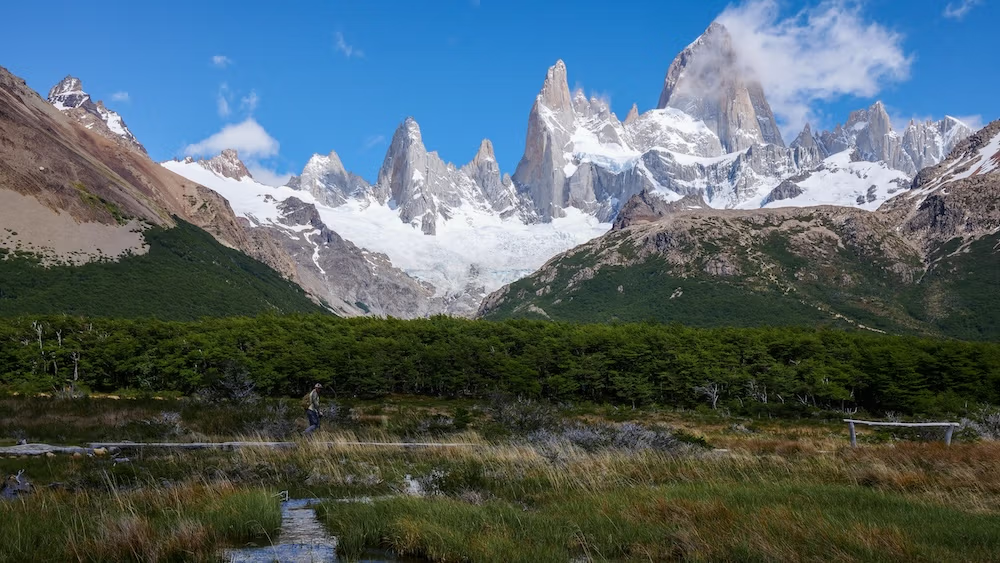
Let’s get one thing straight before we dive into the logistics of Patagonia: Audrey and I did not arrive in El Chaltén, the undisputed trekking capital of Argentina , in peak physical condition. Thanks to a steady, unapologetic diet of garlic pizza and heavy pours of wine over the previous weeks, Audrey’s jeans no longer fit. She was strictly confined to leggings. I, meanwhile, was sporting what I affectionately refer to as “bulbous plumptitude”. We are foodies at heart , masquerading as trekkers for the camera.
But as we documented this entire journey for our YouTube channel, we realized something profound. Every photograph, every wide-angle video, and every drone shot we captured completely failed to convey the sheer, terrifying scale of Mount Fitz Roy.
Here is the unfiltered, blister-inducing reality of why this mountain feels impossibly larger in person, exactly what it takes to stand at its base in 2026, and why you should probably budget for a 12-hour coma afterward.
Fitz Roy Scale Perception Matrix: Why It Feels Bigger With Every Step
| Stage of the Journey | What Your Brain Thinks | What’s Actually Happening | Why Photos Fail Here | What You Feel in Person |
|---|---|---|---|---|
| El Chaltén Town | “Nice mountain in the distance” | You’re seeing the massif compressed across kilometers of valley | Telephoto compression flattens depth and merges peaks | Calm, curious, slightly underwhelmed |
| First Trail Sections | “This seems manageable” | You’re moving toward the massif but still lack strong scale references | Wide shots shrink vertical rise and exaggerate foreground | Optimistic, confident, slightly fooled |
| Laguna Capri Viewpoint | “Okay… this is bigger than expected” | You finally get a clean line of sight to the massif’s vertical faces | Photos still can’t capture how much vertical wall fills your field of vision | First moment of real awe |
| Mid-Trail Approach | “Where did the mountain go?” | Terrain blocks your view as you enter valleys and forested sections | Cameras can’t show the psychological effect of losing visual contact | Disoriented, questioning, conserving energy |
| Final Moraine Climb | “This is harder than it looked” | Steep elevation gain over loose rock with no visual payoff | Photos don’t communicate effort, fatigue, or instability | Fatigue, doubt, tunnel vision |
| Laguna de los Tres Reveal | “This is… way bigger than I imagined” | You’re now directly beneath the massif with full vertical exposure | Cameras fail to capture peripheral overwhelm and true scale | Shock, disbelief, emotional hit |
| Lingering at the Lake | “It doesn’t look as big in my photos” | Your brain is processing scale through movement and depth cues | The image collapses depth, distance, and verticality into a flat frame | Confusion + appreciation mismatch |
| Looking Back Later | “Why do my photos look underwhelming?” | You’ve lost the physical context that created the perception | Photos lack motion, fatigue, and spatial awareness | Nostalgia mixed with mild frustration |
The Anatomy of an Icon: Why Fitz Roy is the “Everest of the South”
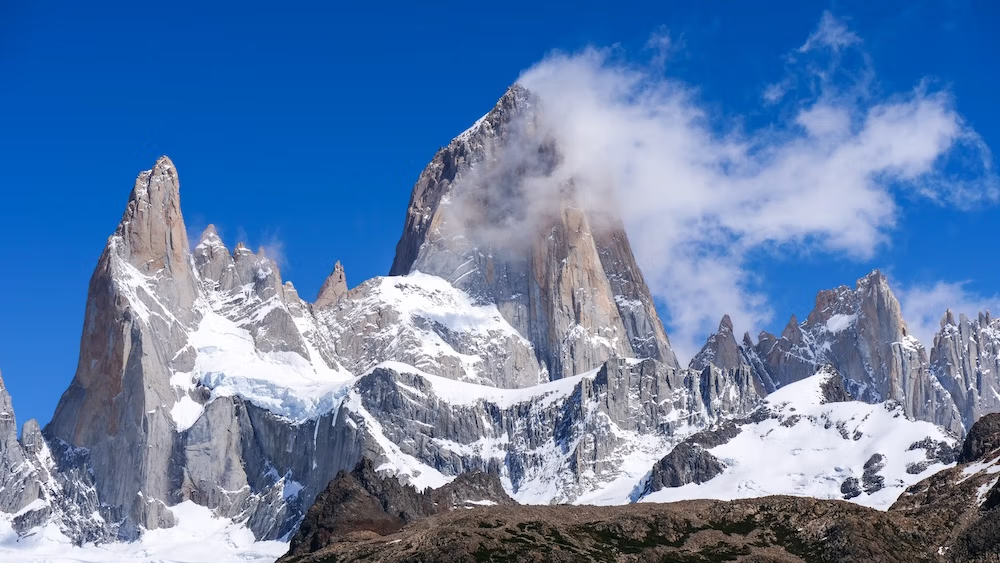
Before you strap on your boots and subject your legs to the grueling final ascent, you need to understand exactly what you are looking at. When you finally reach Laguna Capri and stare at the mountain, you will likely be rendered completely speechless. The peak is so undeniably majestic that it almost doesn’t look real; it legitimately looks like a high-end CGI rendering. It is, hands down, the most magnificent mountain we have ever laid eyes on.
If the jagged silhouette looks oddly familiar to you, you aren’t experiencing altitude sickness. The central spire, flanked by its neighboring needles, is the exact outline used for the Patagonia clothing brand logo. Standing at the base, I pulled off my Patagonia hat, held it up to the horizon, and realized I was looking at a perfect 3D mirror image of the logo.
But why does it look so imposing? Why does it feel so much larger in person than in those wide-angle photos? It comes down to three massive geological realities:
- The Vertical Prominence: While the summit sits at a modest 3,405 meters (11,171 feet) above sea level, its true fame comes from its “Vertical Rise.” Mount Fitz Roy has a prominence of 1,951 meters (6,401 feet). This means it shoots nearly two kilometers straight up from the valley floor. Your brain simply cannot process a sheer vertical wall of that magnitude when compressed into a 2D photograph.
- The “Un-Erodible” Granite: Unlike the crumbly, sedimentary rock found in many other mountain ranges, Fitz Roy is composed almost entirely of Tertiary Igneous Granite. This exceptionally hard rock resists erosion, which is why it maintains those terrifyingly sharp, “CGI-perfect” spires instead of smoothing out over time.
- The “Smoking Mountain” Phenomenon: Long before it was named after Captain Robert FitzRoy of the HMS Beagle, the indigenous Aonikenk people called it Cerro Chaltén, which translates to “Smoking Mountain.” Because of the extreme Patagonian wind and atmospheric pressure, the peak is almost constantly shrouded in fast-moving clouds that look exactly like smoke.
We happily admit that we are just foodies who pretended to be trekkers for the day. We complained about our throbbing feet and the brutal gravel inclines. But for professional mountaineers, Fitz Roy is a completely different beast.
While hiking to the lagoon at its base is considered an intermediate-to-difficult walk, actually summiting Mount Fitz Roy is widely regarded as one of the most technically demanding climbs on planet Earth. Because the granite walls are so sheer, and the Patagonian weather windows are so violently unpredictable, climbers will often wait weeks in El Chaltén just for a six-hour window to attempt the vertical ascent.
Here is the hard data on what makes this peak a global legend:
| The Mountain Reality Check | Metric & Classification | The “Faux-Trekker” Translation |
| Absolute Elevation | 3,405m (11,171 ft) | Modest on paper, but wildly deceptive in person. |
| Vertical Prominence | 1,951m (6,401 ft) | The reason the mountain completely swallows your peripheral vision. |
| Rock Composition | Tertiary Igneous Granite | Explains the sharp, impossible-looking spires. |
| Original Name | Chaltén (Smoking Mountain) | The namesake of the town, owed to the constant “smoke-like” cloud cover at the summit. |
| Climbing Difficulty | Extreme (Grade VI) | Walking to the base will give you stiff legs; summiting it requires elite technical mountaineering skills. |
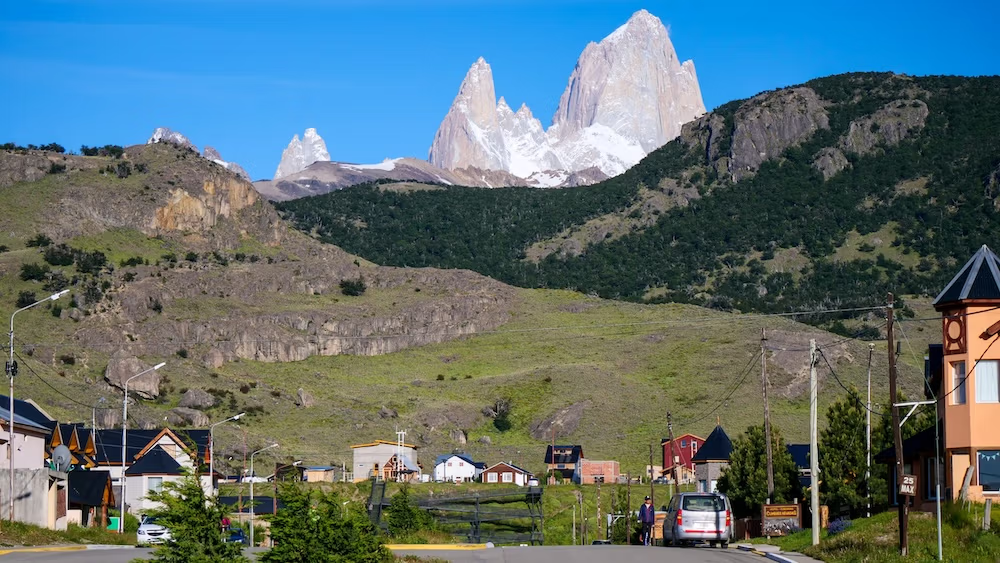
The Optical Illusion of the Patagonian Horizon
If you look at the raw data, Mount Fitz Roy’s absolute elevation is 3,405 meters (11,171 feet). That is modest compared to the Andes’ highest peaks or the Himalayas. But absolute elevation is a deceptive metric. The secret to Fitz Roy’s dominating presence is its “Vertical Rise” or prominence. The mountain shoots up nearly 2,000 meters (roughly 6,400 feet) almost straight up from the valley floor.
When you stand at Laguna Capri and stare at the North Pillar face, it looks so perfect, so impossibly majestic, that it almost doesn’t look real. I actually said out loud that it looked like high-end CGI.
There is a psychological reason for this. Cameras compress foregrounds and backgrounds into a neat 2D rectangle. The human eye, however, relies on foveal vision. We physically scan the massive granite spires, building a mental 3D model. Furthermore, above the treeline, there are no visual reference points—no power lines, no cabins, no trees. Your brain loses its “measuring stick,” causing the sheer vertical wall of rock to overwhelm your peripheral vision. It is a vestibular sense of awe that an iPhone sensor simply cannot replicate.
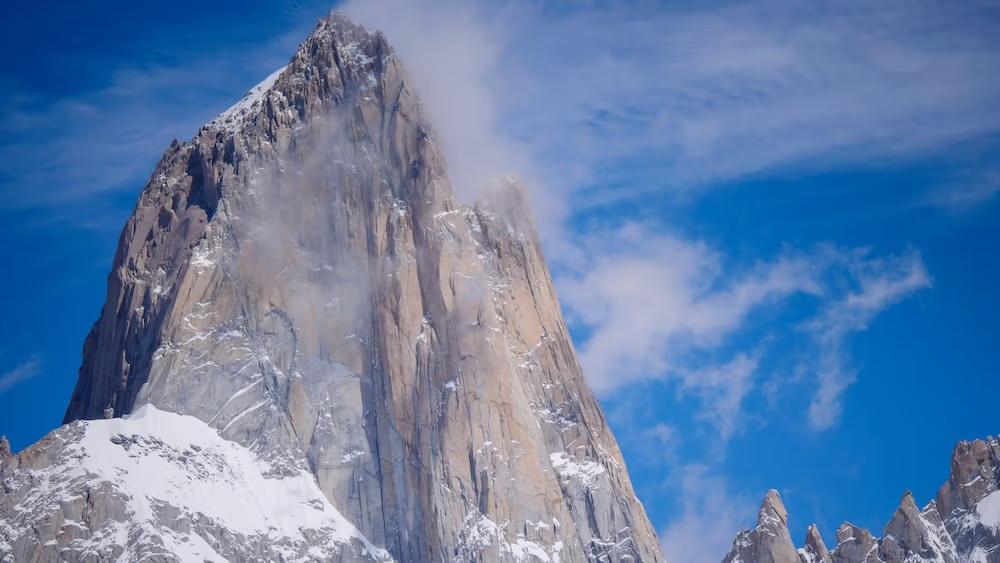
The Cathedral of Granite: How Fitz Roy Hacks Your Brain
When we first woke up in town and caught our first glimpse of Mount Fitz Roy against a cloudless sky, it looked entirely magical. It was a perfect, jagged silhouette that fueled our naive, garlic-pizza-stuffed excitement. But the mountain is a master manipulator. It actively plays tricks on your depth perception, shifting from a pretty postcard to a terrifying wall of rock depending on where you stand.
To understand why the photos you take will inevitably disappoint your friends back home, you have to break down the three visual phenomena that make this specific peak so overwhelming in person.
The Massif Effect (It’s a Cathedral, Not a Spire)
In every photograph of Fitz Roy, your eye is selfishly drawn to the highest point. You assume you are hiking to see one exceptionally tall mountain. But when you are physically standing in Los Glaciares National Park, you realize it is not a single peak—it is a sprawling, jagged neighborhood of massive granite spires.
When you look at Fitz Roy, you are simultaneously being dwarfed by its “supporting cast.” To the left sits Aguja Poincenot, an impossibly sharp peak that looks like a massive tectonic shark fin, alongside the jagged Aguja Saint Exupéry. If Poincenot were located anywhere else on the planet, it would be the most famous mountain in that country. But here, it’s just the sidekick. The gaps between these monstrous spires are choked with ancient, hanging glaciers that crack, rumble, and echo across the valley floor. It is the sheer, panoramic width of this entire massif that completely overloads your peripheral vision and overwhelms the human eye.
The “Fire Rock” Physics If you manage to heed my warning and drag your tired legs out of bed by 1:30 AM to catch the sunrise, you will witness the “Alpenglow”—the moment the mountain turns an insane, neon red. This isn’t just a pretty lighting effect; it is pure optical physics, and it directly contributes to that fake, “CGI” feeling.
Because the eastern face of Fitz Roy is a massive, sheer, un-eroded wall of Tertiary Igneous Granite facing directly toward the Patagonian sunrise, it acts like a 6,000-foot movie projection screen. When the low angle of the morning sun breaches the horizon, its light passes through a thicker slice of the Earth’s atmosphere. The shorter blue wavelengths scatter away (Rayleigh scattering), allowing only the pure, intense red and orange wavelengths to hit the rock. Because the granite is so sheer and reflective, it literally looks like the mountain is glowing from the inside out.
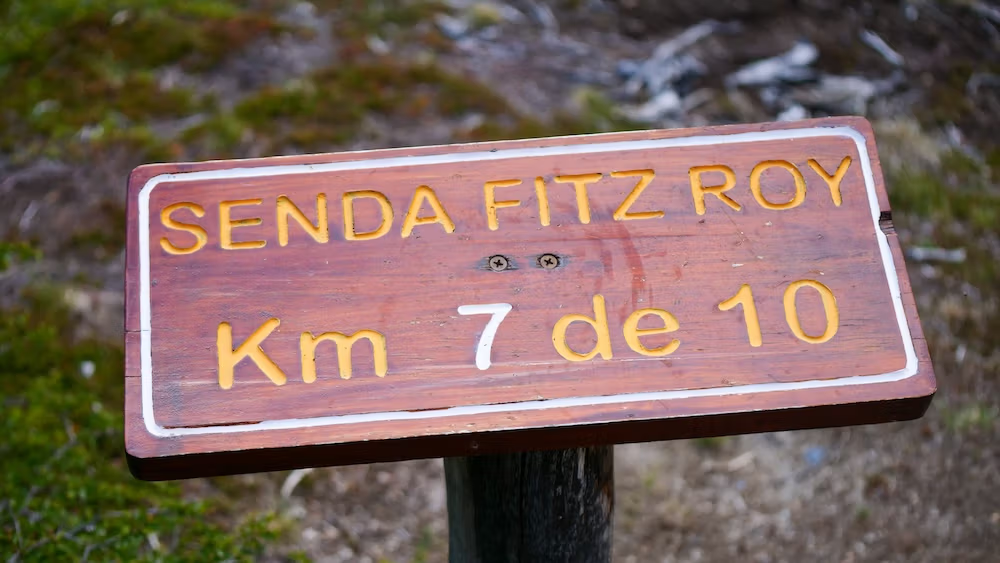
The “Peek-a-Boo” Moraine Illusion
The most brilliant trick Fitz Roy plays on you is the geographical game of hide-and-seek along the trail. The mountain constantly shifts its scale, messing with your head as your physical exhaustion peaks.
Here is exactly how the visual journey breaks down, and why the final reveal is so uniquely shocking:
| Trail Marker | The Visual Reality | The Psychological Effect |
| El Chaltén (Km 0) | The peak is visible from the streets, towering over the colorful houses. | The Postcard: It looks beautiful and entirely manageable. You feel invincible. |
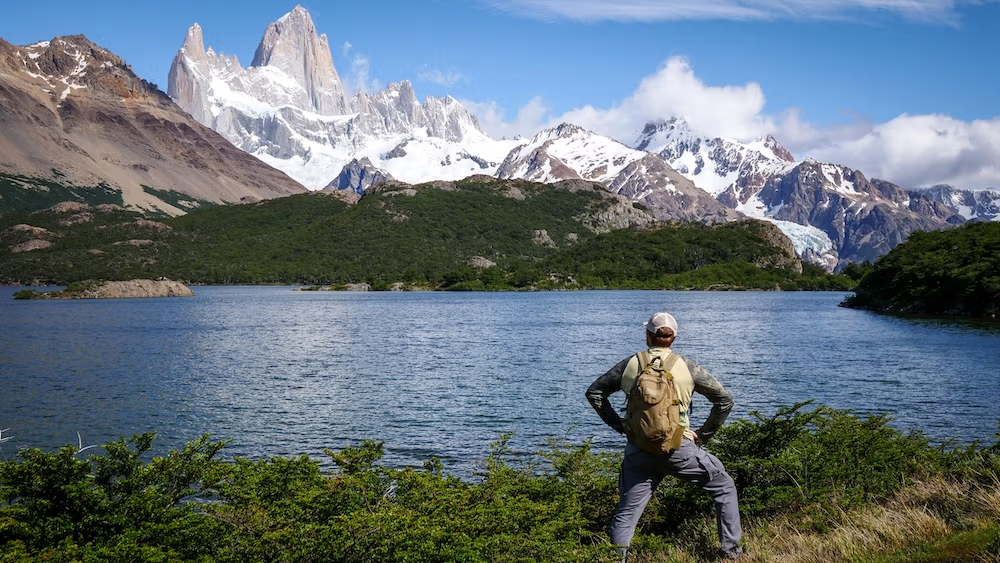
| Laguna Capri (Km 4) | The first unobstructed, wide-angle view of the massif across the water. | The Tease: It suddenly looks massive, but it feels safely distant. You are so mesmerized you might forget you have 6km left. |
| The Final Climb (Km 9) | You hit the brutal, rocky bottleneck. Because you are climbing up the steep angle of the moraine wall, the mountain actually dips out of view. | The Blind Slog: You are stripped of your visual motivation. You are climbing completely blind, staring only at the loose gravel and the boots of the person in front of you. |
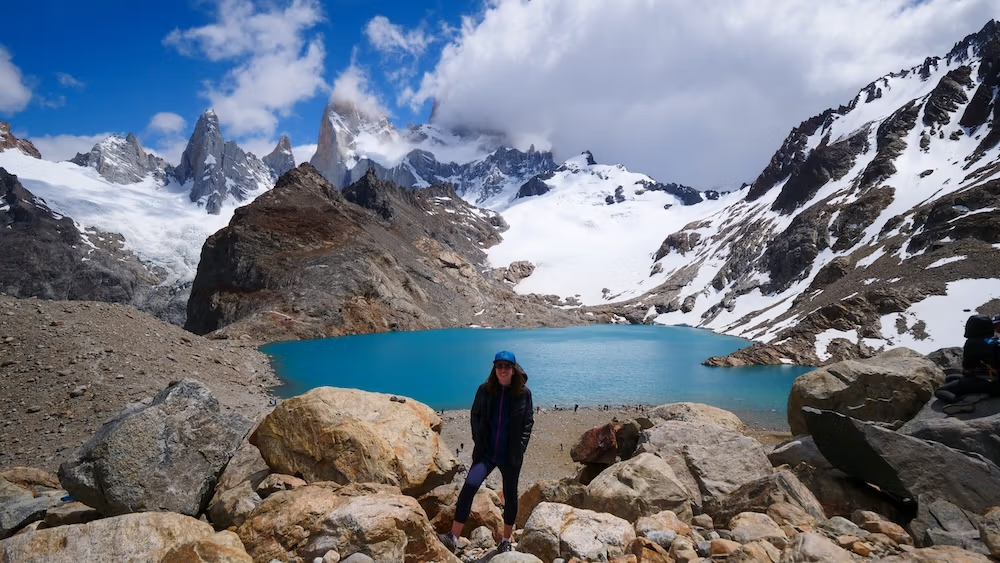
| Laguna de los Tres (Km 10) | You crest the top of the moraine, and the mountain explodes back into your field of vision. | The Reality Check: The peak doesn’t just reappear; it dominates the sky from the cerulean water’s edge to the heavens. Because you suddenly see tiny, ant-sized humans standing on the edge of the lagoon for scale, your exhausted brain finally registers how impossibly large the wall of rock actually is. |
The Price of Admission and the Wi-Fi Limbo
The “free paradise” era of El Chaltén is officially over. As of late 2024 and continuing strictly into 2026, access to the northern trails of Los Glaciares National Park requires a mandatory fee, processed through manned “Portales” (Gates) at the trailheads.
But before you even worry about park fees, you have to survive the town’s digital infrastructure. El Chaltén has a frontier feel—a little colorful oasis nestled in a dramatic valley. It also has the internet connectivity of a 1990s dial-up modem. When we checked into our incredibly spacious $54 USD/night room at the Vertical Lodge , we couldn’t even process the credit card payment. The Wi-Fi dropped constantly all afternoon, forcing us to try multiple times before the transaction finally went through.
[Samuel’s Connectivity Reality Check] Do not rely on Apple Pay or your mobile data. Your 5G will die the moment you enter town. There is free Wi-Fi in the central plaza if you have patience, but you must carry physical Argentine Pesos for emergencies, private reserves, and tipping. Download all offline maps before you leave El Calafate.
Here is the exact financial breakdown of trail access as of 2026:
| 2026 Park Access Tier | Cost (ARS / Approx USD) | The Hidden Strategy |
| 1-Day Pass | $45,000 ARS (~$35 USD) | The 50% Rule: If you buy a 1-day ticket in person, your second consecutive day is 50% off if you return within 72 hours. |
| 3-Day Flexipass | $90,000 ARS | Best for standard visitors. Valid for 3 entries over a 7-day period. |
| 7-Day Flexipass | $157,500 ARS | Best for slow travelers or those building in weather buffer days. |
| Reserva Los Huemules | $28,000 ARS (~$22 USD) | Private land. Cash only. Strict 9 AM to 6 PM hours. |
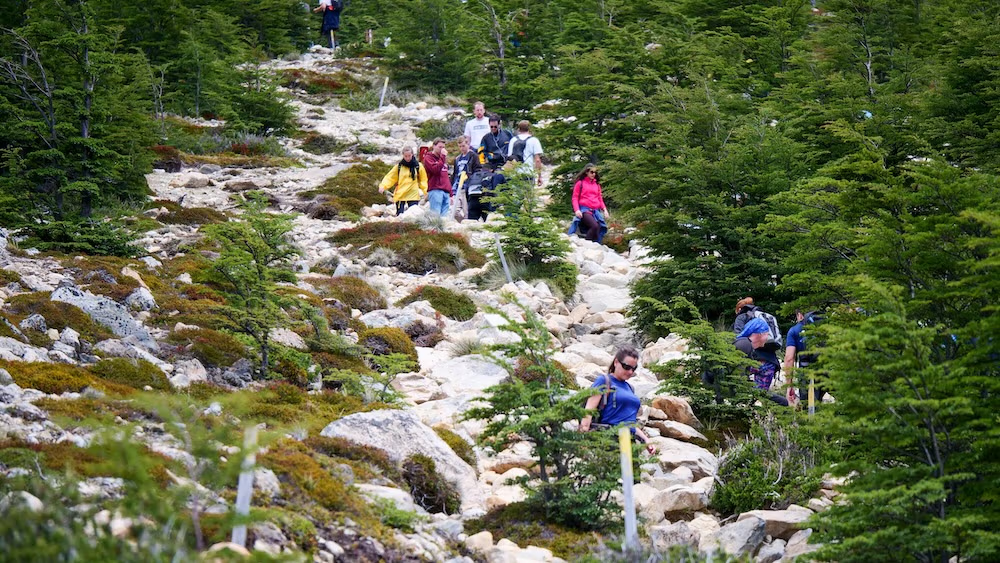
The Trail to Laguna de los Tres: A Lesson in Gluttony
Our grand attempt at the Fitz Roy base (Laguna de los Tres) started with high ambition and immediate logistical failure. We left our trail map on the nightstand. Thankfully, finding the trailhead just requires walking north along San Martín until you hit the signage.
Because El Chaltén caters specifically to hikers, most hotels, including ours, start serving breakfast early—around 6:00 or 6:30 AM. They also offer packed lunchboxes, which we ordered the night before for about $10 USD each.
By 9:00 AM, barely an hour into the hike, my “foodie” instincts took over. I was so greedy and hungry that I stopped to devour almost my entire lunchbox sandwich.
The trail itself is incredibly well-marked, with wooden posts every single kilometer. This is a psychological lifesaver, allowing you to gauge your pace and decide if you have the energy for side trails. Around kilometer three, you hit a fork in the road: right to a viewpoint, or left to Laguna Capri. Take the left. Laguna Capri is where the majestic, postcard-perfect view of Fitz Roy hits you right in the face.
It was also near here that the physical realities of our gear became apparent. My plastic bowl, containing a very tasty rice, egg, and carrot salad, shattered inside my backpack. I was forced into a panicked, mid-trail buffet, eating the salad as fast as possible to prevent it from permanently dressing my spare socks.
[The “Alpenglow” Timing Trap] You will hear travelers talk about catching the sunrise at the summit. If you arrive at the actual time of sunrise, you are too late. The famous fiery orange glow on the granite (the Alpenglow) happens 30 to 45 minutes before the sun crests the horizon. If sunrise is at 6:00 AM, you must be on the trail from town no later than 1:30 AM to clear the 10km ascent in the dark.
Surviving Kilometer Nine: The Granite Bottleneck
Up until kilometer eight, we were feeling cocky. The trail was scenic and fairly flat. We had plenty of daylight, considering Patagonian summer sunsets stretch past 10:00 PM. We joked that we weren’t even tired.
Then we hit Kilometer Nine.
This is the longest, toughest kilometer of the entire trek. You gain 400 vertical meters in a painfully short distance, scaling a steep, ancient glacial moraine made entirely of loose, jagged granite boulders.
This is where the 11:00 AM Bottleneck happens. Everyone hits this narrow, single-file track at the same time. You are dodging descending sunrise-hikers while trying to pull your own weight up gravely switchbacks.
Furthermore, as of 2026, park rangers are enforcing a strict “Rubber Tip” rule. If you are using trekking poles (which you absolutely should ), they must have rubber caps. Bare metal tips scar the fragile granite on the moraine, and hikers have been turned back or fined for non-compliance. Also, do not even think about packing a drone to capture the scale of the peak; Aeroscope detection at the park headquarters means flying a drone will result in swift confiscation and a $2,500 USD fine.
When we finally crested the top, exhausted and ravenous, the view of Laguna de los Tres’ cerulean waters beneath Fitz Roy made every burning muscle worth it. The wind at the top, however, was ferocious. We had to duck behind a large boulder just to shield ourselves enough to choke down our last granola bar and a few candies.
| The Final Kilometer Reality Check | Metric / Detail |
| Elevation Gain | 400 meters (1,312 feet) in under 1,000 meters of distance. |
| Terrain Reality | Loose scree, gravel, and massive granite steps. |
| Crowd Density | Extreme bottleneck between 11:00 AM and 2:00 PM. |
| Required Gear | Rubber-tipped trekking poles , heavy windbreaker, layers. |
The 12-Hour Coma and the “Write-Off” Day
Most travel blogs will give you an aggressive itinerary: hike Fitz Roy on Monday, Cerro Torre on Tuesday, and a glacier trek on Wednesday. Those bloggers are either lying, or they are professional athletes.
The 20-plus kilometer round trip destroyed us. The descent was an absolute struggle. We put the cameras down and took breaks not for convenience, but out of pure soreness and exhaustion.
We waddled back to our hotel, ate dinner, and were passed out in bed by 8:30 PM. We slept for 10 to 12 hours.
The entire next day—Day Three of our trip—was an absolute write-off. We were so impossibly stiff that we hardly left the room, venturing out only to forage for calories.
This is exactly why we booked six nights in El Chaltén, and why you should too. You need buffer days. Day Four brought horrendous weather; the winds were so insane we could barely stand on our feet outside, forcing us to declare a “cafe day”.
[The Windguru Mandate] Do not look at Apple Weather or AccuWeather for El Chaltén. Those apps pull data for the valley floor. You can leave town in a light breeze and hit 60+ mph wind chills at the lagoon. You must check Windguru or Windy and look specifically at the elevation models for the peaks.
The Laguna Torre Redemption and The Foxy Lady Pivot
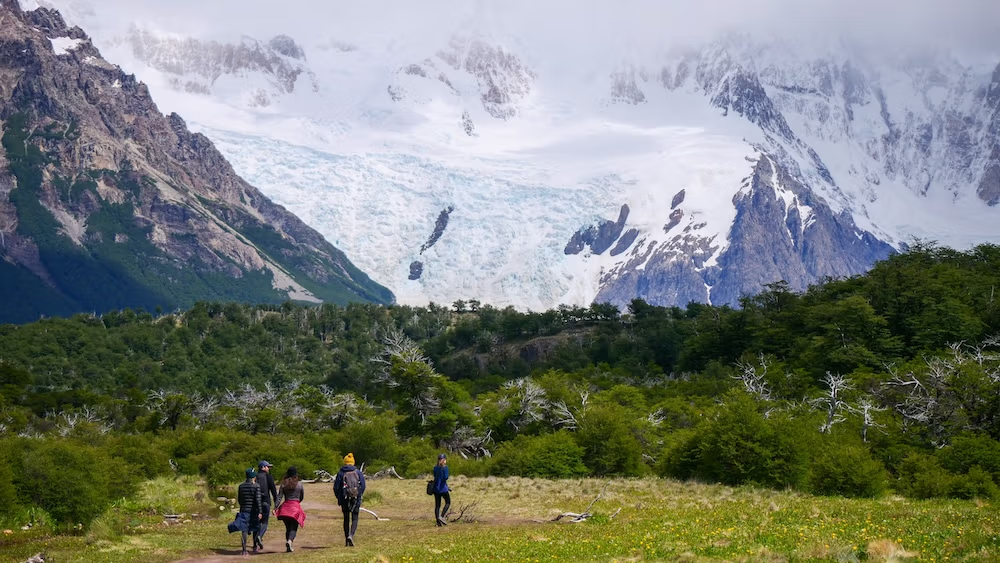
By Day Five, our legs had finally remembered how to function, and the weather cleared. We set out for Laguna Torre, an 18-kilometer loop that offers a much flatter, friendlier profile with only about 250 meters of elevation gain.
This trail was a revelation. After climbing past the thundering Cascada Margarita waterfall at kilometer 0.7 , the path levels out into a wide, spectacular valley. We hiked through what looked like a haunted forest , skipped over streams, and actually had the breath to enjoy the journey. We moved slower than turtles, taking endless breaks to admire the landscape.
When we reached Laguna Torre at kilometer nine , the iconic mountain peaks were unfortunately hidden behind dense cloud cover. The lagoon waters looked a bit murky, like a cold café au lait, with a few small icebergs floating near the rocky shore. It lacked the jaw-dropping “wow factor” of a clear Fitz Roy day. But honestly? We didn’t care. As a pure hiking experience, Laguna Torre was infinitely more enjoyable and relaxing.
The relative ease of the hike also allowed us to make record time on the return trip, fueled entirely by the primal motivation of extreme hunger. We completed the 3-hour return leg in just 2 hours and 20 minutes.
We had originally planned a sophisticated evening—perhaps some gourmet pasta and a bottle of fine Argentine Syrah at Senderos, a boutique, six-table restaurant hidden inside a high-end guesthouse near the bus terminal where we previously had an incredible blue cheese and walnut risotto.
But the mountain changes you. About five minutes into our descent, Audrey and I looked at each other and simultaneously realized we didn’t want elegance. We wanted grease.
We pivoted immediately to La Zorra (The Foxy Lady). We went all-in on “Shake Shack level” gourmet burgers. I ordered a spicy Mexican-style burger loaded with jalapeños and guacamole, while Audrey got one piled high with bacon. We ordered a massive plate of cheesy fries covered in bacon bits and washed it all down with pints of local craft beer (a Golden Ale for me).
We chased that 3,000-calorie triumph with double scoops of artisanal ice cream on the main drive—Super Dulce de Leche and coconut for me, mascarpone and pistachio for Audrey.
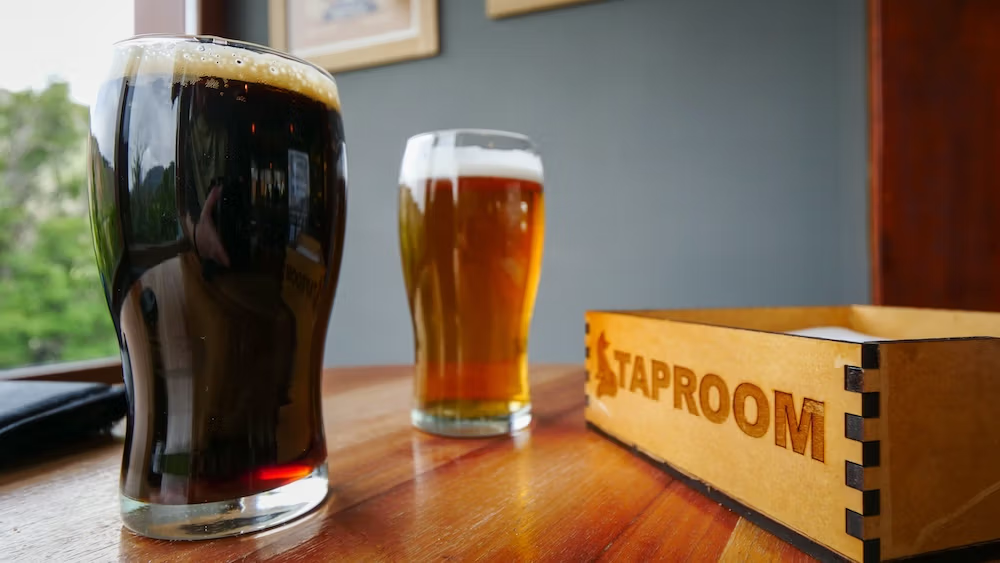
| Post-Hike Triage: Where to Eat When You Can Barely Walk |
| La Zorra (The Foxy Lady) |
| Senderos |
| La Waflería |
What We Missed (But You Shouldn’t)
Because we required so much recovery time, we tackled the trails from the standard town trailheads. If you are planning your trip, you should look into these highly tactical alternatives that we skipped:
The Hostería El Pilar “One-Way” Hack: Instead of doing the standard out-and-back from town to Fitz Roy, you can book a private shuttle or taxi (roughly $40,000 ARS / ~$32 USD) to drop you off 17km north of town at Hostería El Pilar. You start your hike here, bypass the steep initial climb out of El Chaltén, get an exclusive view of the Piedras Blancas Glacier, hit Laguna de los Tres, and then hike down into town. It turns a repetitive loop into a dynamic point-to-point journey.
Reserva Natural Los Huemules: When Fitz Roy is swallowed by impenetrable clouds, do not force the hike. Pivot to this private reserve located up the valley. It costs about $28,000 ARS (cash only) and offers pristine, uncrowded trails leading to the Glaciar Cagliero. It is heavily strictly managed (9 AM to 6 PM hours), but it is the ultimate backup plan when the national park trails are overcrowded or weather-beaten.
The Final Descent
We arrived in Patagonia as foodies seeking a pretty photo, and we left as thoroughly humbled faux-trekkers. We endured the pain, the extreme stiffness, and the broken salad bowls, but we also left with incredibly strong legs and memories that a camera could never properly capture.
El Chaltén requires effort. It requires patience with the Wi-Fi, respect for the wind, and a willingness to accept that a 20-kilometer hike over glacial moraines will absolutely break you for a day or two. But when you finally stand at the base of that impossible, CGI-looking peak, you’ll understand exactly why the photos are lying to you.
Make sure to check out our full video series on our YouTube channel to see our raw reactions to the wind, the trails, and the burgers. And whatever you do, pack the rubber tips for your poles, carry cash, and maybe do a few squats before you get on the plane.
FAQ: Why Fitz Roy Feels Bigger In Person Than It Looks in Photos
Do I need to be in peak physical condition to hike to Mount Fitz Roy?
Nope. But you will absolutely pay for it if you aren’t. Audrey and I arrived in full foodie mode, having done zero exercise and a whole lot of eating. We managed the 20-plus kilometer trek, but the final kilometer up the moraine to Laguna de los Tres is brutally steep and rocky. The descent left us fantasizing about being airlifted out. We were so stiff the next day that we slept for 12 hours and refused to leave the room.
Is Los Glaciares National Park free to enter from El Chaltén?
Not anymore. The days of free trekking in El Chaltén are officially over. As of late 2024 and continuing into 2026, there is a mandatory daily fee of $45,000 ARS (roughly $35 USD) to access the main trails. You can also grab a 3-day or 7-day Flexipass if you plan to stay a while, which you should do to account for necessary weather delays and recovery days.
What should I do if Fitz Roy is completely covered in clouds?
Pivot. Do not waste your energy on the brutal Laguna de los Tres hike if the peak is hidden. The extreme Patagonian weather dictates everything here. Instead, tackle the Laguna Torre trail. Even on a cloudy day, the hike through the forest and along the river is incredibly enjoyable, and you still get to see the glacier and little icebergs floating in the lagoon.
Do I actually need trekking poles for these hikes?
100%. We didn’t use them, and our knees screamed at us on the way down. The final push up to Laguna de los Tres is steep, exposed, and heavily gravelly. Just remember that park rangers now strictly enforce a “rubber tip” rule to protect the fragile granite, so leave the bare metal tips in your bag or you might get fined.
Can I just buy all my hiking food at the supermarkets in town?
Barely. The grocery stores in El Chaltén feel much more like limited general stores. The food selection is highly restricted, and fresh produce is shockingly expensive—we paid about a dollar for a single apple. Your best bet is to buy your main snacks in El Calafate before taking the bus up , or rely on the $10 USD packed lunchboxes that most hotels offer.
Will my cell phone data work while trekking?
Never. Your mobile data is going to drop the second you enter the park, and even in town, it is basically non-existent. The Wi-Fi at hotels goes down constantly, which makes even paying for your room a massive headache. Download your offline maps before you arrive, and bring physical cash for restaurants, private reserves, and taxis.
Is it worth paying extra for a hotel with breakfast included?
Absolutely. This is a trekking town, so the logistics are built around hikers. Most accommodations, like the Vertical Lodge where we stayed, start serving a full breakfast as early as 6:00 AM or 6:30 AM specifically so trekkers can get on their way. Getting those calories in early without having to hunt for an open cafe is crucial for a 20-kilometer day.
What is the best reward meal after a massive 20km hike?
Grease. We originally planned for an elegant dinner with Argentine wine, but the mountain completely changed our minds. We went straight to La Zorra for gourmet, Shake Shack-level burgers loaded with bacon and jalapeños, huge plates of cheesy fries, and local craft beer. When you burn that many calories and your feet are throbbing, high-calorie comfort food is the only correct answer.
Project 23 Argentina: This guide is also available in Spanish. [Lea la versión en castellano: Por qué el Fitz Roy se siente más grande en persona que en fotos]