
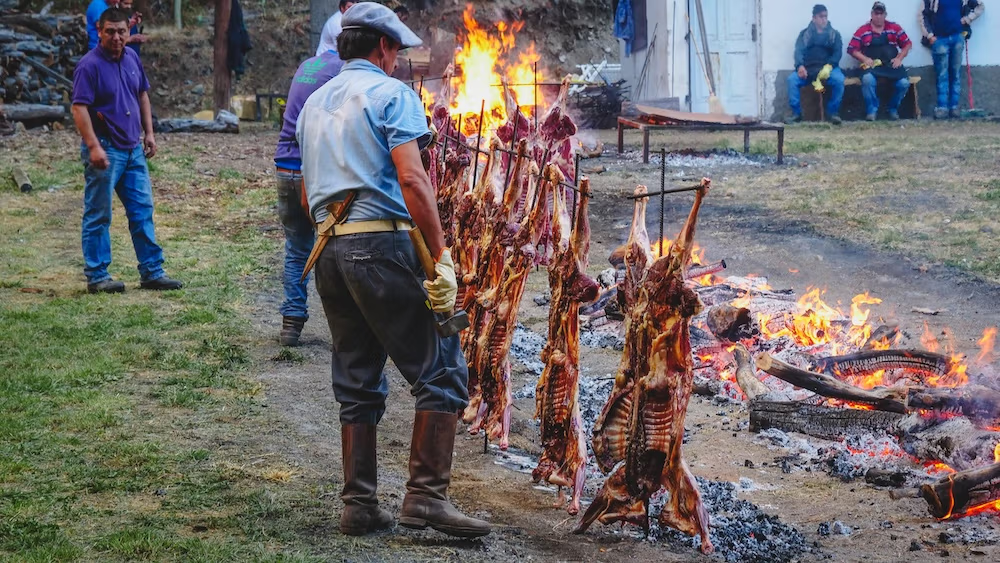
There is a distinct, deeply bewildering type of silence that only hits when you pull up to a massive, barren country field in the middle of nowhere, look around at a small herd of unimpressed horses, and realize you have arrived for the country’s biggest barbecue festival exactly twenty-four hours before it actually begins. Whoops. Our map and the fragmented online bulletin boards had promised us an immediate, legendary wall of fire, smoke, and roasting meat in Cholila. Instead, Audrey, our local friend Valentin and I were left standing in the dust, completely out-negotiated by local calendar realities and staring at a locked gate. This was our introduction to the deceptive spatial and administrative reality of Patagonia—a region where ordinary human scheduling, travel distances, and digital timelines completely collapse under the weight of geographical friction.
What planners fail to understand is that a centimeter on a map here does not translate to a predictable unit of highway velocity or a reliable arrival window. Between the winds sweeping off the massive ice fields and the tire-shredding reality of unpaved secondary routes, overland transit in this corner of South America is an active negotiation with the elements. To navigate it successfully, you have to throw out your conventional highway assumptions and learn the invisible mechanics of the road.
The Topography of Delays: Pavement Realities Across Regional Corridors
The primary deception of Patagonian travel lies in the transition from smooth asphalt to the unpredictable world of regional unpaved tracks. When looking at a route map, a driver sees a continuous line and assumes uniform highway speeds. In reality, the corridors connecting major destinations are fragmented by varying surface qualities that can instantly double your calculated travel time.
| Route Corridor | Surface Profile | Map Distance | Standard Digital Estimate | Lived Overland Transit Time | Prime Variable Delay |
| El Calafate to El Chaltén (RN 40 to RP 23) | Paved Highway | ~215 kilometers | 2 hours 45 minutes | 3.5 to 4.5 Hours | Severe aerodynamic crosswinds and tour bus platoons. |
| Tres Lagos to Lago Cardiel Junction (RN 40 Central) | Heavy, Unpaved Gravel | ~72 kilometers | 1 hour | 2 to 2.5 Hours | Severe deep washboarding, sharp volcanic shale, and ruts. |
| Bariloche to El Bolsón (RN 40 North) | Mountainous Pavement | ~130 kilometers | 1 hour 45 minutes | 2.5 to 3 Hours | Winding Andean passes, slow-moving heavy freight trucks, and localized potholes. |
| Hornopirén to Caleta Gonzalo (Carretera Austral / Route 7) | Mixed Paved/Gravel + Maritime Link | ~60 kilometers (land) | 3.5 hours | 6 to 8 Hours | Dual-stage ferry scheduling bottlenecks and weather cancellations. |
| El Calafate to Torres del Paine (via Paso Río Don Guillermo) | Paved to Border Gravel | ~280 kilometers | 4 hours | 6 to 8 Hours | Dual-country immigration processing and strict agricultural screening queues. |
The Patagonia Time Multiplier: How to Translate Map Time into Real Time
The single most useful thing you can do when planning Patagonia is stop asking, “How many kilometers is it?”
That question is not useless, but it is incomplete.
A better question is: “What kind of kilometers are these?”
A paved lake road near Bariloche is not the same thing as a wind-exposed highway across the steppe. A gravel section of Route 40 is not the same thing as a short city transfer in Esquel. A border road is not just a road. A ferry corridor is not just a ferry. Every stretch has its own little personality disorder.
So when your map gives you a neat travel estimate, treat it as the optimistic version written by a robot that has never had to pee on the side of a wind-battered highway while guanacos stare at it.
The Patagonia Map-Time Multiplier
| Route Type | What the Map Says | What You Should Add | Why It Slows Down |
|---|---|---|---|
| Smooth paved road between major towns | Base estimate | Add 25–40% | Wind, trucks, photo stops, fuel stops, and slower curves |
| Mountain pavement with lake viewpoints | Base estimate | Add 40–60% | Tight bends, scenic pullouts, slow traffic, and narrow shoulders |
| Heavy gravel or washboard road | Base estimate | Double it | Tire protection, ruts, dust, and constant speed management |
| Border crossing route | Base estimate | Add 2–4 hours | Immigration, customs, agricultural checks, and bus waves |
| Ferry-dependent route | Base estimate | Add half a day | Boarding queues, weather holds, missed sailings, and fixed schedules |
| Remote park shuttle or single daily bus | Base estimate | Add a full safety window | One missed departure can erase the entire day |
This is not pessimism. This is emotional self-defense.
If the drive says four hours and you build the whole day around arriving in exactly four hours, you are not planning. You are gambling with better fonts.
For most Patagonia travel days, I now use a simple rule: if the route crosses open steppe, gravel, a border, a ferry, or a rural bus system, I assume the map is only telling me the beginning of the story.
The real travel time is the map estimate plus Patagonia being Patagonia.

Aerodynamic Friction: The Invisible Steering Governor
We stepped out of our alpine quarters on our final morning in Esquel to buy bus tickets in the pouring rain. Within three blocks, the cheap umbrella we had purchased down the street was caught by a localized gust, bending the metal support ribs completely inside out and leaving us soaking wet. In town, it is a nuisance that ruins your gear; out on the open pampa, the wind is a physical structural barrier that actively dictates vehicle velocity.
When driving a standard rental car across the high plateaus along Route 40, sustained crosswinds regularly touch velocities between 80 and 110 kilometers per hour. For a high-profile vehicle or a small-displacement rental engine, this creates a massive aerodynamic penalty. The vehicle does not glide through space; it fights forward. Drivers are forced to drop down into third or fourth gear just to keep the car tracking straight, which manually caps safe cruising speeds well below the posted limits.
This aerodynamic resistance has a compounding effect on fuel economy. Small engines working overtime against a massive headwind can experience a drop in fuel efficiency by up to forty percent. This creates a critical situation on long stretches between remote service outposts where fuel is already a volatile resource.
The Car Door Structural Hinge Warning
When pulling over at scenic viewpoints along open plateaus, always park the vehicle facing directly into the oncoming wind. Popping a door handle while the vehicle is turned downwind allows gusts to catch the wide metal panel, violently ripping it from your grip and bending the steel hinges outward past their mechanical stops. Standard rental insurance policies uniformly exclude wind damage to door frames, resulting in immediate, non-negotiable out-of-pocket replacement charges at vehicle drop-off.
The Physics of Washboard Dirt Tracks
To understand the delays on the unpaved sections of Route 40 or the secondary roads leading to remote trailheads, you have to understand the mechanical reality of the serrucho. This rhythmic, corrugated washboarding is carved into the loose dirt by the weight of heavy four-wheel-drive tires bouncing over the surface. It behaves less like a road and more like a continuous physical vibrator.
Driving over deep washboarding presents a classic mechanical illusion. If you maintain a highly cautious speed of 30 kilometers per hour, the entire frame of your vehicle vibrates so intensely that it threatens to loosen the dashboard fittings. This intense rattling often tempts drivers to accelerate up to 70 kilometers per hour, where the ride suddenly feels smoothly deceptive.
This smoothness is a dangerous illusion. At higher speeds on gravel, your tires are actually skipping along the tops of the dirt ridges rather than maintaining continuous mechanical contact with the ground. The moment you need to apply the brakes or make a sudden steering correction to avoid a stray guanaco, the vehicle enters a violent lateral skid. A disciplined, steady pace of 40 to 50 kilometers per hour is required to preserve structural control, turning what looks like a quick one-hour drive into a slow, focused journey.
Administrative Bottlenecks and Border Mechanics
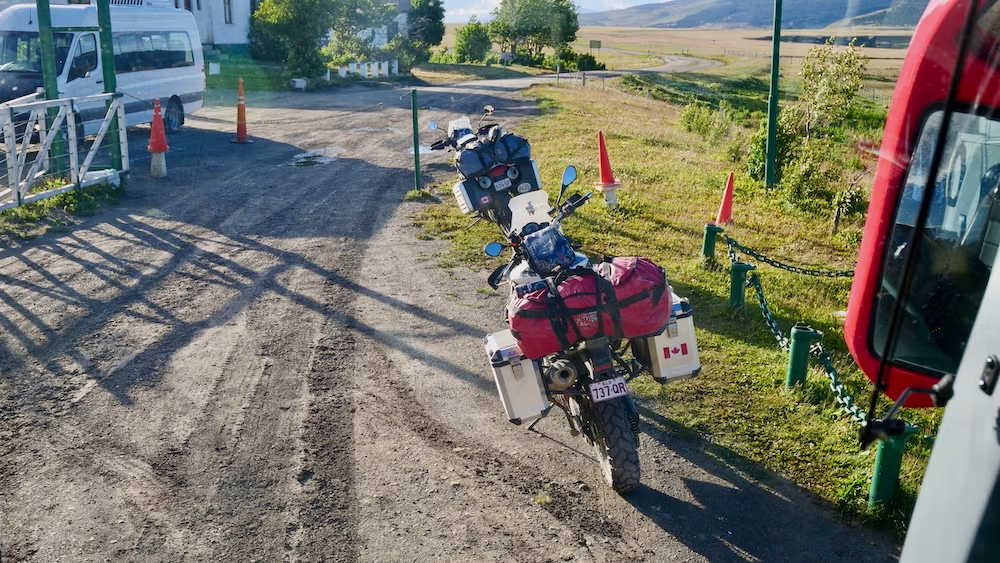
The geographical proximity of Argentine and Chilean highlights can tempt travelers into planning ambitious cross-border day trips. On a map, driving from El Calafate over to the trailheads of Torres del Paine looks like a straightforward morning commute. What the map fails to show is the bureaucratic processing window that acts as a mandatory time drain.
Crossing through border outposts like Paso Río Don Guillermo involves navigating two separate immigration buildings, handling physical vehicle permit clearances, and undergoing rigorous biosecurity screening by the Chilean agricultural authority. The lines here do not move with airport efficiency. If your vehicle arrives behind a convoy of commercial tour buses, a three-hour delay can instantly rewrite your daily itinerary.
Furthermore, these border stations have rigid operational protocols. If you arrive with fresh apples, unpasteurized artisanal cheeses, or raw trail mix intended for a multi-day hike, the agricultural scanners will seize them on the spot. Failing to explicitly declare any organic matter on the physical customs paperwork can quickly hit your budget with substantial, non-negotiable administrative fines, dragging your transit timeline down while official paperwork is slowly filed.
The Reality of Remote Fuel Queues
Adopting an urban driving mindset where fuel stations are taken for granted can completely derail an overland journey through the central steppe. Isolated fuel stops, such as the single-pump operations found in Bajo Caracoles or Tres Lagos, do not follow a predictable, continuous supply schedule. They rely on single tanker trucks traveling immense distances across vulnerable routes.
If a delivery truck faces mechanical issues or regional road closures, a station can easily sit empty of regular unleaded fuel for 24 to 48 hours. When fuel does arrive, long queues of transient tourist traffic quickly form down the highway, turning a simple five-minute top-off into a two-hour community event.
The unwritten rule for survival across these open stretches is to treat a half-full tank as an absolute emergency. Stopping to top off at every single pump you encounter, regardless of what your dashboard gauge reports, is the only reliable way to insulate your travel timeline from local infrastructure interruptions.
Local Micro-Transit Rules: The Inter-Provincial Changeover
Even local public bus transit is subject to unique internal boundaries that can catch independent travelers off guard. On our journey from El Bolsón out to the glacial waters of Lago Puelo, Audrey and I booked a standard regional bus ticket expecting a continuous, 40-minute point-to-point ride. Instead, we encountered a fascinating look at regional transit mechanics.
Because El Bolsón sits within the province of Río Negro and Lago Puelo rests inside the boundaries of Chubut, local labor regulations mandated a physical operational pause right at the provincial border line. The bus pulled to a complete stop, and every single passenger was required to exit the vehicle on foot, carry their loose daypacks across the line, and board an entirely separate, waiting vehicle run by the exact same company.
The entire process was smooth, and the drivers handled the transfer with practiced efficiency, but it illustrates how administrative details can reshape travel. The local bus transit fare for this route runs between $0.75 and $1.00 USD, making it a highly economical option, provided you account for the physical changeover step.

Micro-Logistics: Navigating the Cultural Dining Engine
When your overland journey successfully brings you into a regional hub, the logistical negotiations simply shift from the highway to the dining room. Patagonian dining operates on an entirely different evolutionary timeline than North American or European restaurants. Meals are not treated as a quick pause between activities; they are structured, multi-hour community commitments.
[TYPICAL RESTAURANT OPERATIONAL ROUTINE]

Show up precisely at opening time (often 12:00 PM for lunch)
  │
  ▼
Receive complimentary regional bread basket with localized spreads
  │
  ▼
Execute main course ordering (Portions are massive; sharing is standard)
  │
  ▼
Sip regional Malbec or soda water while the grill master works
  │
  ▼
Consume meal over a mandatory minimum of two relaxed hours
  │
  ▼
Request the physical invoice (Check for separate pasta/sauce billing)
We sat down for a weekend lunch at Raices, a popular regional Italian eatery in Trelew, eager to try the local artisanal pasta dishes. It was here that Audrey and I ran straight into a unique Argentine menu mechanic: the split-invoice system for pasta. In most international restaurants, when you order a plate of gnocchi, the sauce is an integrated component of the price. Here, you pay one base fee for the physical pasta shape, and a entirely separate fee for the accompanying sauce, which can quickly double the anticipated cost of the dish.
Our total bill for two pasta mains, a small half-bottle of house wine, and a shared dessert came out to around $30–35 USD. The food was outstanding—especially the stuffed gnocchi filled with bacon, plums, and walnuts—but the pricing structure requires close attention if you are tracking your daily cash flow.
The High Cost of Independent Movement: Shuttles vs. Car Rentals
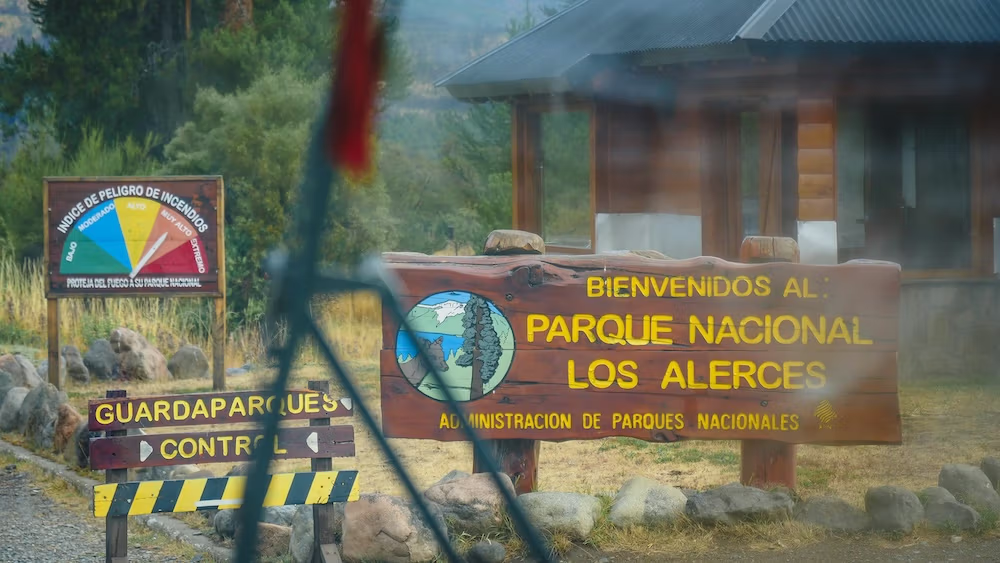
For travelers looking to bypass the structural hazards of self-driving, organized regional shuttles offer an alternative pathway, though they trade personal flexibility for rigid operational schedules. For instance, when arranging a day trip from Esquel into the ancient forests of Los Alerces National Park, independent transport requires careful planning.
During the shoulder months or low season, local bus operators frequently scale back to a single daily departure that exits town in the early morning and returns late in the evening. Tickets cannot be reserved online ahead of time, requiring you to physically walk down to the terminal ahead of schedule to secure a seat.
Round-trip bus tickets for this park corridor run around $12–15 USD per person, while the mandatory foreigner park entry fee is roughly $8–10 USD. If you miss that single evening return shuttle, you are effectively stranded in the park overnight, making a rental car a highly valuable investment despite the driving hazards.

Accommodations and the Reality of Rustic Interiors
The physical challenges of the region do not end when you pull into your evening lodging. The charming log cabins and rustic stone apartments that define Patagonian architecture often come with distinct layout quirks that demand physical awareness.
During our time in Trelew, we booked a spacious two-bedroom loft apartment that cost approximately $50–60 USD per night. It was the largest space we had found, featuring beautiful exposed timber ceilings and a central gas heater that was absolutely essential for countering the chilly morning drop to 7 degrees Celsius. However, the apartment’s unique structural layout introduced some unexpected physical friction.
The second-level loft was reached via a beautiful, solid-wood spiral staircase that sat directly beneath a heavy, unyielding structural roof beam. Being on the taller side, I spent the week constantly ducking my head to avoid the low ceiling clearance. One evening, I miscalculated the distance, hit my shoulder hard against the framing, lost my balance completely, and went cascading straight down the stairs onto my back.
Thankfully, there were no broken bones, but my neck and back remained incredibly sore for the rest of the journey. When renting these beautiful, timber-framed spaces, remember that historical character often includes low clearance thresholds and tight architectural corners that reward slow, measured movements.
The Walkability Index: What We Missed But You Shouldn’t
Because Patagonian transit centers around centralized terminals, understanding the exact walking distance between your platform and your accommodation can save you immense physical stress. Most regional hubs are highly walkable, but localized terrain variations can turn a short distance into a grueling workout if you are hauling heavy gear.
The Esquel Terminal Corridor
The main train terminal for La Trochita sits exactly three blocks north of the primary bus station in Esquel. The route follows a continuous, gentle incline along paved sidewalks, making it incredibly straightforward to navigate on foot with standard rolling luggage. If your accommodation rests within the central commercial grid of town, you can comfortably forgo a local taxi permit entirely.
The San Martín Mountain Incline
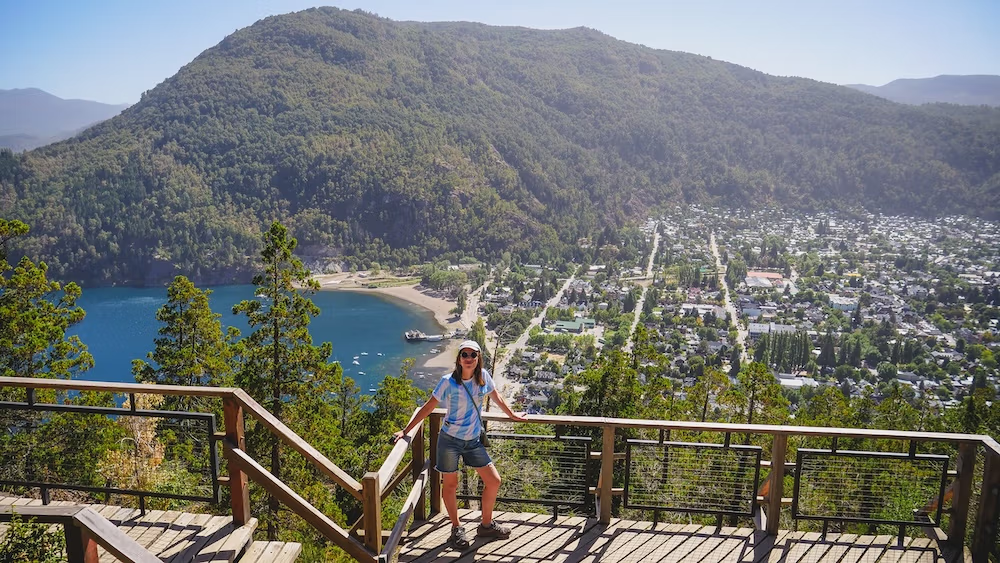
In contrast, navigating the streets of San Martín de los Andes requires a deeper understanding of local topography. Our apartment was situated roughly fifteen to twenty minutes away from the main commercial center. On a map, this looks like a quick casual stroll.
In reality, the path leading north out of the valley center shifts onto a steep, continuous incline along rough gravel paths. Dragging heavy four-wheel spinner bags up this grade over loose stones will quickly strip the rubber right off the wheels, turning what looks like a simple walk into an exhausting physical haul.
Advanced Resource Mapping: Solving the Travel Equation
To keep your transit planning fully accurate, the following breakdown maps out the real-world costs and operational windows for major regional connections based on the most current data.
[REGIONAL INFRASTRUCTURE REALITY MANUAL]

La Trochita Steam Train (Esquel Station)
  ├── Ticket Cost: ~$30–40 USD per person
  ├── Operational Pattern: Departs Saturdays at 10:00 AM (High season adds daily runs)
  └── Payment Mechanic: Requires physical Banco Patagonia bank transfer

Cantina El Náutico (Puerto Madryn Seafood Special)
  ├── Menu Special Cost: ~$12–15 USD per person
  ├── High-Trust Inclusions: Appetizer, Seafood Main, Whole Bottle of Wine, Dessert
  └── Operational Rule: Arrive exactly at opening to avoid massive cruise passenger lines

Welsh Tea Rooms (Gaiman / Trevelin Corridors)
  ├── Comprehensive Set Cost: ~$13–16 USD per set
  ├── Standard Operating Hours: Strictly 2:00 PM to 7:00 PM (Closed for morning hours)
  └── Strategic Advice: Split one set between two adults to avoid intense sugar fatigue
The True Return on Effort: Optimizing Your Route Architecture
When finalizing your route architecture across the vast expanses of the southern steppe, you must brutally assess whether a specific highway corridor delivers enough aesthetic value to justify its mechanical toll.
The High-Yield Core: Paved Lake Loops
Focusing your itinerary on the paved networks connecting Bariloche, Villa La Angostura, and San Martín de los Andes delivers an exceptional return on physical effort. The famous Seven Lakes Route spans roughly 107 kilometers of pristine, fully paved highway that can be comfortably driven in a single day, offering continuous views of glacial water and old growth forests without risking undercarriage damage.
The Skip Candidate: The Full Central Route 40 Steppe
Driving the massive, barren central expanse of Route 40 between Esquel and El Calafate should be explicitly categorized as a conditional route. Unless you are a self-contained overland enthusiast or a long-distance motorcyclist looking to cross a specific geographical box, this stretch involves hundreds of kilometers of monotonous washboard dirt tracks, high tire-puncture risks, and highly volatile fuel supplies. For standard vacations, it is infinitely more efficient to use regional flights between primary hubs, keeping your energy focused on the trails rather than the mechanics of survival.

The Practical Packing Pivot: Lessons from the Road
Our final evening in San Martín de los Andes was spent treating ourselves to a mountaintop afternoon tea, looking out over the calm waters of Lake Lácar while consuming heavy slabs of rustic cheesecake and dulce de leche tarts. Audrey and I sat inside a cozy heated cabin, fully insulated from the mountain chill, watching the low clouds slowly roll across the peaks. It was the perfect image of a serene summer holiday.
Yet, our packs downstairs told a completely different story of the trip. They were stuffed with unbudgeted flannel shirts, heavy wool hats, and thick socks we had to quickly purchase at outdoor outfitter stores in Esquel because our initial packing list assumed a uniform, balmy South American summer.
Patagonia does not conform to the neat categories of your calendar or the clean timelines of your digital devices. It demands physical adaptability, a healthy respect for the variables of the road, and a willingness to embrace the unexpected detours. Once you learn to read the true mechanics of the map, the journey shifts from a logistical battle into the ultimate travel asset.
FAQ
Can you use a standard credit card at fuel stations along Route 40?
Rarely in remote sectors. While major service plazas in regional hubs accept international credit cards seamlessly, the isolated single-pump stations deep in the steppe routinely lose their satellite communication links due to power cuts or heavy cloud cover. When the terminal drops offline, the station operators revert strictly to cash-only transactions. Always keep a secure physical cash reserve in your vehicle to avoid being stranded at an empty pump dead zone.
What is the actual speed limit on unpaved gravel roads in Patagonia?
Technically 60 km/h, but practically much lower. While regional transport signs might show a maximum speed of 60 or 70 kilometers per hour for gravel tracks, attempting to maintain that velocity over heavy washboarding is a recipe for a structural disaster. Sharp, loose volcanic shale can easily slash through thin sidewalls, and hidden ruts will instantly puncture an unshielded oil pan. A disciplined, highly focused speed of 40 to 50 kilometers per hour is the realistic threshold for preserving mechanical control of your vehicle.
Do I need an international driving permit to rent a car and drive in Patagonia?
Yes, it is highly recommended. While your standard domestic driver’s license is frequently accepted at corporate rental check-out counters in major hubs like Bariloche or El Calafate, local traffic police checkpoints along provincial highways routinely demand a valid International Driving Permit. Failing to produce one during a routine administrative stop can lead to intense bureaucratic delays and steep localized fines that will instantly throw off your daily travel timeline.
Are there public restrooms available along the long highway stretches?
Absolutely not. Once you leave the municipal boundaries of the primary towns, public restroom infrastructure completely disappears. Long highway corridors feature zero rest stops, gas stations can be hundreds of kilometers apart, and the flat steppe offers zero natural cover. Independent travelers should pack a reliable personal sanitation kit, carry a clean changing mat for family travel, and utilize municipal facilities completely before hitting the open road.
Is it safe to drive at night across the Patagonian steppe?
No, avoid it completely. Driving after twilight outside the major town limits introduces massive environmental hazards. Wandering wildlife, specifically large herds of agile guanacos and choiques, frequently move across the asphalt as temperatures cool, creating severe high-impact collision risks. Furthermore, sudden localized pavement degradation, unpaved construction detours, and deep potholes become entirely invisible in the pitch black, deep inside cell-service dead zones.
How much cash should I carry when traveling between regional hubs?
Roughly $150 to $200 USD equivalent per transit day. Because remote electronic card terminals are highly volatile and automated teller machines frequently run entirely dry of physical paper currency during peak summer travel seasons, carrying hard cash is a vital security measure. Ensure your reserve is broken down into small-denomination local bills, as small-town outposts and rural border diners are rarely equipped to change large physical notes.
Can you cross the Argentina-Chile border with a standard rental car?
Only with a pre-arranged international permit. You cannot simply roll up to a border crossing checkpoint like Paso Río Don Guillermo in a standard rental vehicle and expect to pass. Rental agencies require a minimum of 72 hours’ advance notice to issue the specialized legal authorization documentation and cross-border insurance certificates required by customs officials. This administrative permit incurs a distinct additional fee, which usually ranges from $80 to $120 USD depending on the agency.
What happens if I miss a scheduled ferry connection on the Carretera Austral?
Your itinerary slips by at least 24 to 48 hours. The maritime ferry links across sections like the Hornopirén to Caleta Gonzalo corridor operate on rigid, seasonal capacity limits. Missing your specific pre-booked sailing means your vehicle drops to the back of a volatile standby queue that can take days to clear during peak summer travel. If severe weather or heavy swells trigger a safety cancellation, the entire overland transit corridor grinds to a temporary halt.
Project 23 Argentina: This guide is also available in Spanish. [Lea la versión en castellano: Tiempos de viaje en la Patagonia explicados: por qué las distancias engañan]