
One of the things that surprised me most about Noboribetsu Onsen was how much we could see and experience without spending a single yen on admission. We’re talking about walking through an active volcanic landscape, watching steam rise from bubbling pools, soaking our feet in a naturally heated river and stumbling across enormous demon statues carrying clubs that look capable of causing some serious damage.
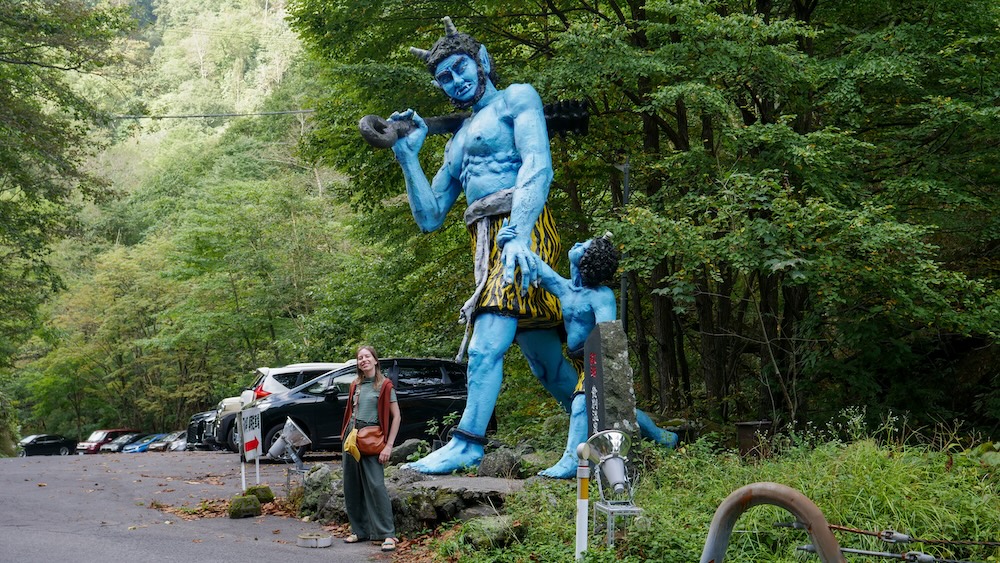
Audrey and I spent two nights in this hot-spring town in Hokkaido, and while we’d specifically booked an onsen hotel to enjoy the baths, traditional accommodation and meals, our daytime adventures were every bit as memorable. We explored on foot, followed forest trails between geothermal attractions and wandered around town discovering some of its stranger sights. For a place with such a well-established tourism industry, the amount of worthwhile free sightseeing was remarkable.
What might surprise you is that Jigokudani Hell Valley, Noboribetsu’s headline attraction, wasn’t actually my favourite. That honour went to the Oyunuma River Natural Footbath, where an early start and a lingering case of jet lag helped us enjoy an incredibly peaceful morning surrounded by steam, trees and running water.
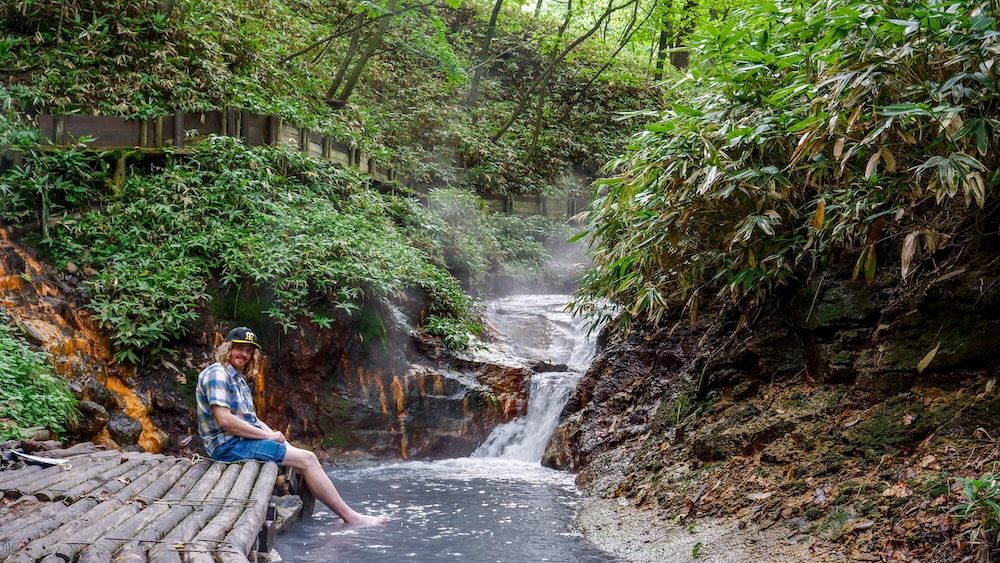
I’d hate to choose between the three main geothermal attractions, though, because each offers something different. Hell Valley is the visual spectacle, Oyunuma is a marvel of nature that rewards a longer walk, and the natural footbath is somewhere you can settle in and enjoy the surroundings without feeling the need to keep moving. Throw in the town’s colourful demons, mechanical King Enma and rumbling geyser, and you’ve got a surprising amount to explore.
Here are the free attractions I’d prioritize in Noboribetsu Onsen, what we genuinely enjoyed about them and what you should know before heading out.
1. Oyunuma River Natural Footbath: my favourite free experience
If I could return to just one place in Noboribetsu tomorrow, it would be the Oyunuma River Natural Footbath.
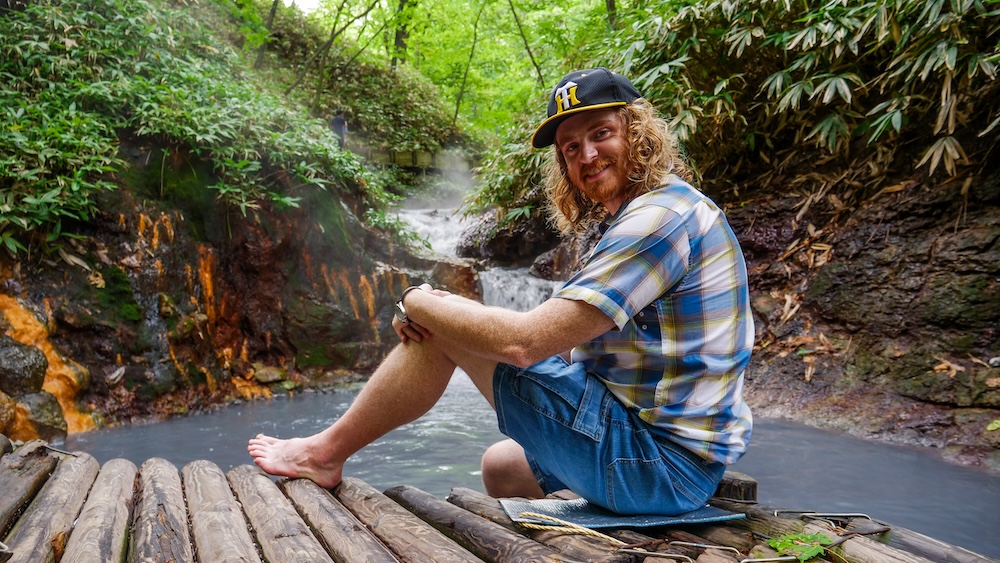
There are plenty of places in Japan where you can enjoy an onsen, but sitting beside a naturally heated river in the middle of a forest feels entirely different from bathing inside a hotel. At Oyunuma, geothermal water flows downstream into a designated riverside footbath, where visitors can take off their shoes, sit along the bank and soak their feet while surrounded by nature.
Audrey and I headed out early that morning, partly because we were still struggling with jet lag. We weren’t exactly operating on a normal schedule, but for once that worked in our favour. Noboribetsu had plenty of hotels and visitors, yet walking through town at that hour felt incredibly peaceful. By the time we reached the footbath, we had encountered hardly anybody.
The setting was gorgeous. Lush trees surrounded the river, steam drifted above the water and mineral-coloured rocks lined the banks. The water had a milky grey-blue appearance, and when we dipped our feet in, we discovered a layer of fine black volcanic sand along the bottom.
I remember the temperature being a bit of a shock initially. The water was properly hot, and it took a moment to get comfortable, but once I’d adjusted, I started digging my toes into the sand and enjoying the sensation. Between the warmth, the sound of the flowing river and the natural surroundings, I could have happily spent the entire morning there.
I even declared, “I could literally just do this all day.” I wasn’t exaggerating much.
What made the experience especially memorable was how quiet everything felt. There was another couple finishing up when we arrived, and a few more visitors eventually appeared, but for a while we had this wonderful stretch of river essentially to ourselves. We lingered for approximately half an hour, which was considerably more enjoyable than rushing in, taking a photograph and carrying on.
It’s that peaceful side of rural Japan that I’d always imagined experiencing. The town itself may be a popular tourist destination, but sitting beside the river with hardly anybody around felt wonderfully removed from all of that.
Naturally, the sulfur smell provided Audrey with an opportunity to question whether the rotten-egg aroma was coming from the geothermal activity or from me. After years of travelling together, apparently I’m still the prime suspect whenever something smells suspicious.
What to know before visiting the natural footbath
The footbath is free, although getting there takes more effort than visiting an attraction along the main shopping street. You’ll need to follow the designated walking routes through the geothermal and forested area, and those approaches can be affected by seasonal conditions or maintenance.
There were seating platforms along the river when we visited, along with small padded mats that visitors could use. I’d bring a towel from your accommodation to dry your feet afterwards, and sandals can make removing your footwear a little easier. We continued hiking after our soak, so having dry feet before putting our socks and shoes back on was important.
One practical detail worth checking is the opening window. Hokkaido’s official visitor information lists 8:00 a.m. to 5:00 p.m., while Noboribetsu’s local attraction listing doesn’t specify the same daily hours. Paths have also experienced temporary maintenance closures, and winter conditions may restrict access. Before planning an early visit, check the current Oyunuma River Natural Footbath information and any trail notices.
I’d aim for an early visit within the permitted access period if a peaceful atmosphere is your priority. Just don’t expect our good fortune with the crowds to be guaranteed, and stick to the designated footbath rather than trying to enter other geothermal waterways.
Staying overnight in Noboribetsu Onsen also makes an early start more appealing. We spent two nights at Park Hotel Miyabitei, where you can check current room and meal-plan options. Its location in the onsen district worked well for exploring the geothermal attractions on foot, and having breakfast and dinner included in our reservation meant we could concentrate on sightseeing between meals. Just check which meals are included in the particular rate you choose, since the options differ.
For me, the footbath was Noboribetsu at its best: completely free, wonderfully scenic and the sort of place where the biggest challenge was convincing myself to leave.
2. Jigokudani Hell Valley: the most spectacular free attraction
If you’re visiting Noboribetsu for the first time and have only enough time to see one major attraction, Hell Valley would be my recommendation for its sheer visual impact.
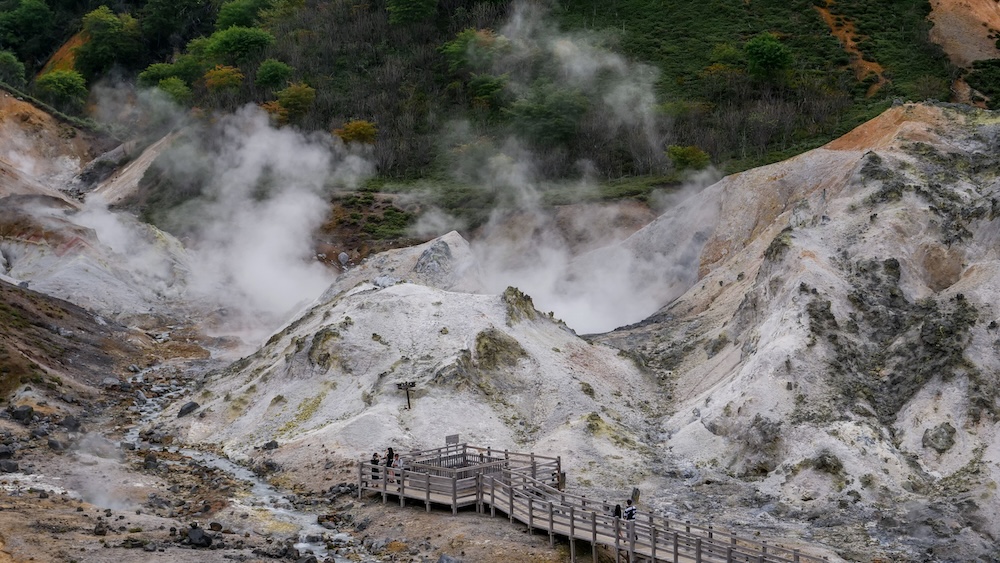
Jigokudani is an active geothermal landscape filled with steam vents, bubbling pools and mineral-stained volcanic ground. The basin stretches approximately 450 metres across, and walking through it feels a little like you’ve wandered onto the set of a science-fiction movie. There are pale rocks, patches of orange earth and steam emerging from seemingly every direction.
Audrey and I spent a good amount of time exploring the paths and wooden boardwalks, stopping whenever something unusual caught our attention. The colours were particularly striking. Some of the exposed ground was so vividly orange that it looked as though it were burning, while nearby pools bubbled and gurgled like enormous cauldrons.
You could hear the geothermal activity as well as see it. We stood watching boiling water and steam rising from vents, fascinated by just how active the landscape was. It wasn’t difficult to understand why Noboribetsu had developed an entire demon theme around a place like this.
Another thing that caught me off guard was the heat. The weather wasn’t especially hot during our visit, yet the geothermal activity created its own warm, humid environment. Standing near some of the steam vents, you could physically feel the heat coming off the ground. Between that and the sulfur smell, there was no mistaking the fact that something extraordinary was happening beneath us.
I’m somebody who enjoys taking photographs and filming while travelling, so having the freedom to stop repeatedly was a big part of the appeal. We’d walk a little farther, encounter another remarkable view and inevitably find ourselves stopping again. Some of the landscapes looked almost painted, with colours and textures that seemed too strange to be natural.
How much of Hell Valley can you see for free?
The main Hell Valley viewing area and public sightseeing paths are free, and you don’t have to complete a lengthy hike to appreciate the scenery.
There’s an observation area near the Park Service Center, reached by a ramp with a maximum gradient of 8%. That’s useful for visitors who want a shorter approach, although it doesn’t mean the surrounding forest trails and boardwalk network have the same accessibility.
The official walking map identifies the Jigokudani Pathway as 568 metres, with an estimated walking time of ten minutes. That’s one particular section of the walking network, rather than the total time required to visit Hell Valley, stop for photographs or continue towards Oyunuma.
If you’re arriving by car, there’s another distinction worth knowing: entry to Hell Valley is free, but the designated parking area has a charge of ¥500 for passenger cars.
There’s also an illuminated walking experience called Onibi no Michi, which brings a different atmosphere to the Hell Valley approach after dark. Published information lists illumination from sunset until approximately 9:30 p.m., subject to operating conditions. We explored the area during daylight, so I can’t offer a firsthand comparison with the evening experience, but it’s another free possibility worth knowing about if you’re staying in town.
For a first-time visitor, Hell Valley is the place that immediately shows you why Noboribetsu is such an unusual destination. The natural footbath may have been my favourite, but the volcanic scenery here is difficult to beat.
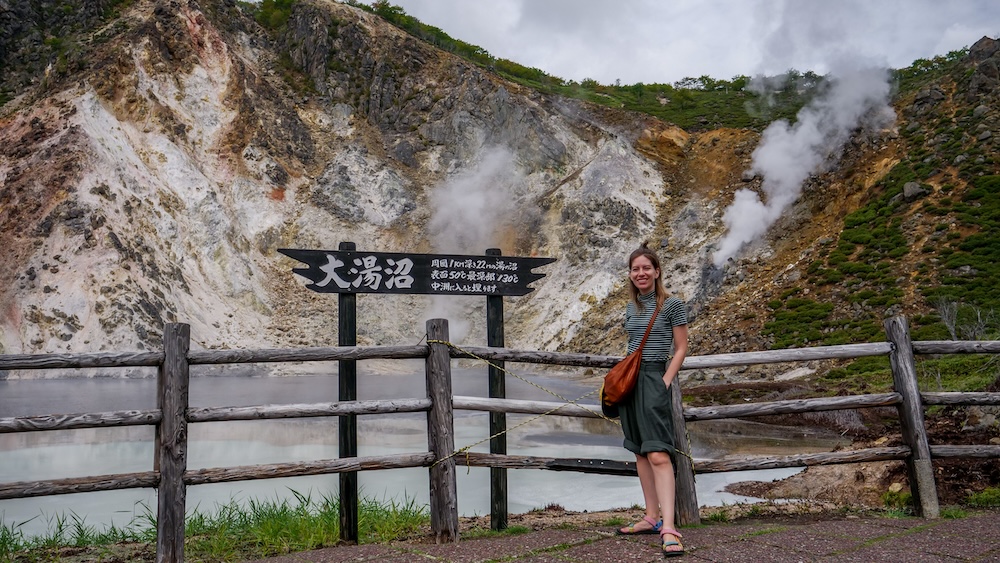
3. Oyunuma: a geothermal lake and an enjoyable hike
Oyunuma deserves its own place on this list because it offers a different experience from Hell Valley, even though the two attractions are connected by Noboribetsu’s wider geothermal landscape.
Hell Valley is all about exposed volcanic ground, bubbling pools and steam vents scattered across a dramatic basin. Oyunuma, meanwhile, is a substantial geothermal lake, approximately one kilometre in circumference, with steam rising from its surface and volcanic slopes surrounding the water.
It formed through the activity of Mt. Hiyori, and the water is considerably hotter than anything you’d want to enter. Surface temperatures can reach approximately 40–50°C, with hotter geothermal water emerging from below. This is very much a place for sightseeing, not swimming.
What I enjoyed most was combining Oyunuma with the surrounding walks. Audrey and I found the trails interesting without feeling that we were undertaking some major mountain expedition. We’d walk through forested sections, come upon another geothermal feature and stop to admire the scenery before continuing.
It was a satisfying way to explore because the walking itself felt like part of the attraction. You weren’t simply following a path to reach one viewpoint and then returning by the same route; the surrounding landscape offered plenty to look at along the way.
We even encountered deer during our wider geothermal walks. Coming from Alberta, where deer sightings are hardly unusual, I hadn’t expected to be watching them relaxing around volcanic scenery in Hokkaido. One was lying down looking rather comfortable, apparently enjoying a much lazier morning than we were.
Oyunuma is free to visit, but the walking commitment deserves some consideration. The official map identifies multiple connecting paths, including an Oyunuma Pathway of 298 metres with a ten-minute estimate and an Oyunuma Scenic Pathway of 388 metres with a fifteen-minute estimate. Those are individual trail sections, not the complete walking time from Noboribetsu Onsen or Hell Valley.
The available approaches can also change with the season, and Oyunuma’s parking area has winter restrictions. I’d check the current walking routes before committing to a particular circuit.
For visitors who enjoy hiking, I’d certainly make time for Oyunuma. Hell Valley may grab your attention immediately, but Oyunuma adds a wonderful sense of scale to the area’s geothermal activity, and the surrounding forest makes the outing particularly enjoyable.
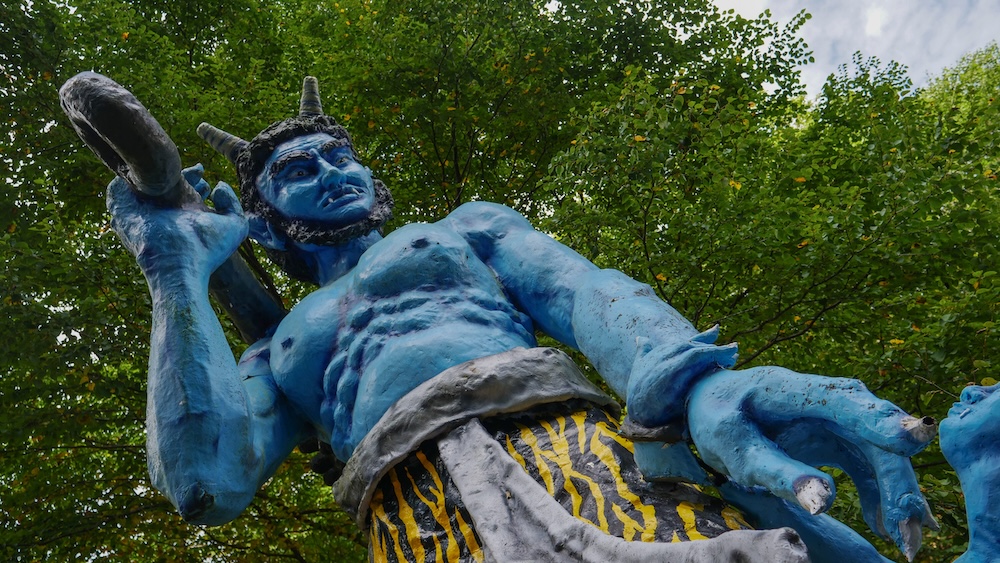
4. Explore Noboribetsu’s colourful demon statues
You could easily spend your visit focusing entirely on hot springs and volcanic scenery, but Audrey and I also loved the unusual attractions scattered around Noboribetsu Onsen itself.
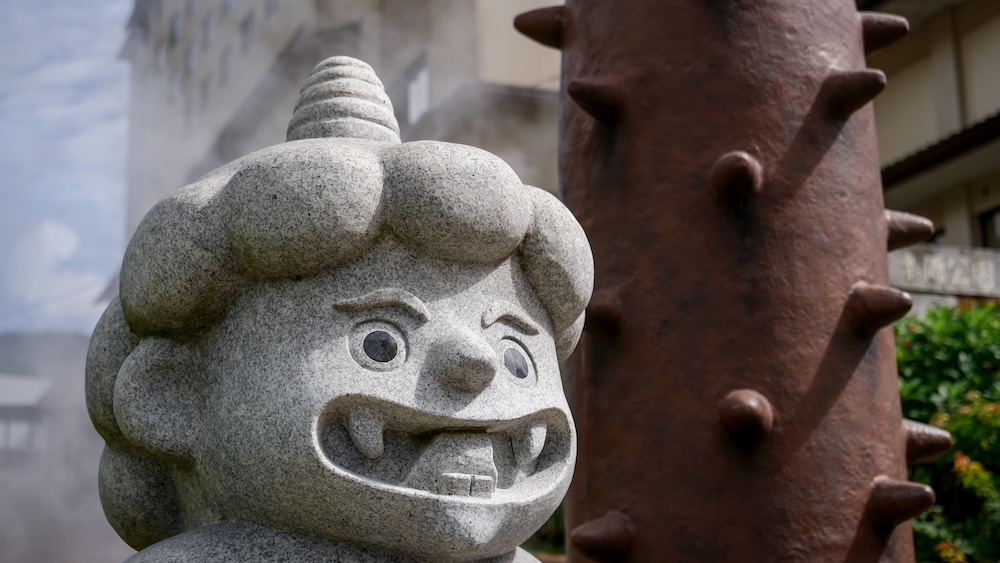
The town is full of oni, the horned demons that feature prominently in Japanese folklore. Noboribetsu’s volcanic landscape and Hell Valley mythology have given these creatures a particularly important role locally, where they’re depicted as guardians associated with the hot springs.
And they’re not exactly subtle.
Some of the statues are enormous, brightly coloured figures armed with massive spiked clubs. They’ve got horns, snarling expressions, enormous teeth and the general appearance of creatures you wouldn’t want to encounter down a dark alley.
We came across several while exploring the streets, and they made wandering around town much more entertaining. You’d be walking past a hotel or heading towards another attraction when suddenly there was a giant blue demon staring down at you.
Find the different oni around town
Several of the figures are concentrated around the central onsen district, including the streets near Gokuraku Dori, while others stand near shrines and geothermal attractions.
Different demon statues are associated with wishes for things like success in examinations, luck in love and prosperity in business. We had a rather amusing discussion about which one might be most useful to visit.
As far as I was concerned, business prosperity seemed the obvious choice. I’m long finished with school, so the examination demon wasn’t much use to me, and Audrey and I were already married. Might as well work on improving the business!
Some of the sculptures are particularly impressive. The Demon Shrine, for example, has a standing red figure measuring approximately 3.5 metres and a seated blue figure measuring around 2.2 metres.
There’s an established 60-minute central-town demon walking course that links several of these sights, although you don’t have to complete an organized circuit to enjoy the statues. We had plenty of fun discovering them as we explored independently.
If you’ve already spent hours among the geothermal trails, these smaller attractions provide a nice change of pace without requiring you to undertake another lengthy hike.
Watch King Enma transform at Enmado
Of all Noboribetsu’s unusual town attractions, Enmado might be the strangest.
It’s a small shrine-like structure housing a mechanical representation of King Enma, the ruler who judges the dead in Japanese Buddhist tradition. At certain times of day, the figure comes to life with drumming and a transformation that turns its face red, alters its expression and reveals a rather intimidating set of fangs.
Audrey and I watched the performance, and it’s wonderfully theatrical for something you can enjoy without paying an admission fee.
The published showtimes are 10:00, 11:00, 13:00, 15:00, 17:00, 20:00 and 21:00, although the mechanism has experienced occasional interruptions. Performances resumed on August 21, 2026, following repairs, but further maintenance or weather conditions can still cause cancellations.
I’d check the current Enmado performance information if seeing King Enma transform is important to you. Unlike the demon statues outside, this is one attraction where arriving at the right time makes a real difference.
Visit Yuzawa Shrine and its demon guardians
Yuzawa Shrine offers a quieter experience, although you’ll need to work a little harder to reach it.
Audrey and I climbed a steep stone staircase and encountered two more demon figures guarding the shrine, one red and one blue, complete with oversized clubs. Looking at one of those clubs, I couldn’t help thinking of Bam-Bam from The Flintstones. The Japanese version was considerably more threatening.
After the climb, we found ourselves in a peaceful shrine setting away from the activity of the town below. We had the place to ourselves during our visit, which made it a lovely little stop.
We didn’t encounter an admission fee, although current access conditions and hours aren’t as clearly documented as those of Noboribetsu’s main geothermal attractions. I’d treat it as an optional addition, particularly if you’re already nearby and don’t mind tackling the staircase.
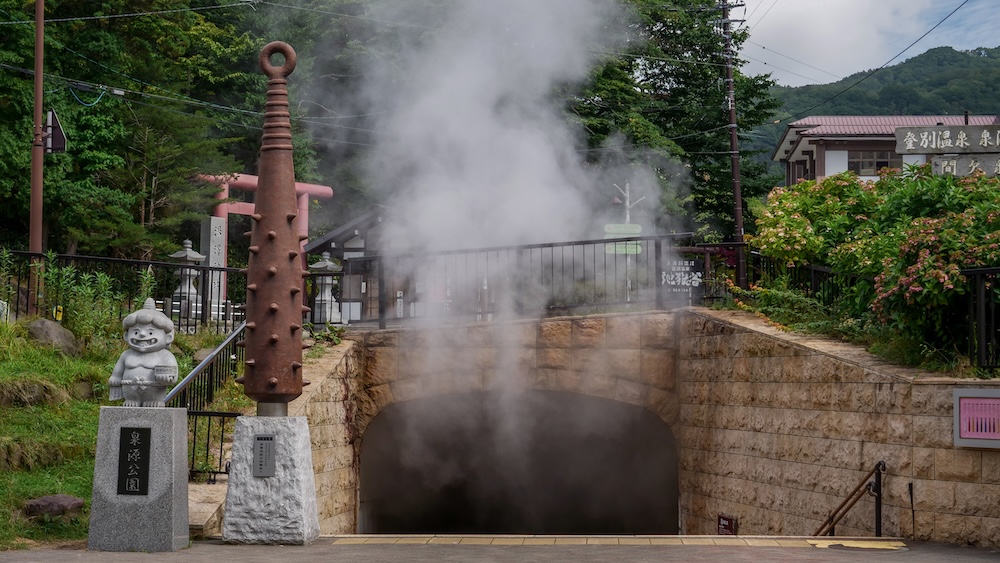
5. See the geyser at Sengen Park
Sengen Park is another place where Noboribetsu reminds you that the ground beneath the town is anything but ordinary.
The park surrounds a natural geyser that periodically bubbles, rumbles and releases steam. It’s right in the onsen district, so you don’t have to venture deep into the forest to encounter geothermal activity.
Audrey and I stopped by on separate occasions and saw the geyser behaving differently each time. During one visit, the water was gurgling away; on another, steam was rising much more noticeably. You could hear activity beneath the surface and smell that familiar sulfur aroma drifting through the air.
The geyser is described as becoming more active at intervals of approximately three hours, but I wouldn’t build a tightly scheduled visit around that figure. Nature doesn’t operate according to your sightseeing spreadsheet, and the exact timing and intensity can vary.
Sengen Park is free, and I’d recommend stopping if you’re exploring the central streets or visiting the nearby demon attractions. Even if you don’t catch the most dramatic activity, it’s fascinating to see hot water and steam emerging from beneath what otherwise looks like an ordinary Japanese town.

How much free sightseeing can you fit into Noboribetsu Onsen?
One of the advantages we had was spending a couple of nights in Noboribetsu rather than arriving for a rushed excursion. We could head out walking, stop whenever we wanted and linger at places we particularly enjoyed, without worrying about catching a tour bus twenty minutes later.
That made an enormous difference at the natural footbath, where spending half an hour with our feet in the water was part of what made the experience so memorable.
If you’re building a similarly relaxed visit, the location of your accommodation matters more than simply finding the cheapest room anywhere in Noboribetsu. The onsen district is separate from the JR railway station area, so I’d concentrate on comparing accommodation in Noboribetsu Onsen itself if your priority is exploring the geothermal attractions and town on foot. It’s worth checking the exact property location rather than assuming every hotel labelled Noboribetsu offers the same walking convenience.
Not everyone will have the same amount of time, though, and the important thing is recognizing that Noboribetsu’s free attractions have quite different walking and timing requirements.
| Free attraction | Why I’d visit | Walking commitment | What to consider |
|---|---|---|---|
| Jigokudani Hell Valley | Otherworldly volcanic scenery | Shorter viewpoint visit or longer walks | Geothermal conditions and trail access |
| Oyunuma | Impressive geothermal lake and hiking | More involved walking | Connecting trails and seasonal restrictions |
| Oyunuma River Natural Footbath | Relaxing in a beautiful natural setting | Forest-trail access plus soaking time | Current access, water temperature and crowds |
| Demon statues | Quirky, entertaining town sightseeing | Shorter walks between selected figures | Locations are spread around town |
| Enmado | Mechanical King Enma performance | Short central-town visit | Performance schedule and possible cancellations |
| Yuzawa Shrine | Peaceful shrine and demon guardians | Steep staircase | Physical effort |
| Sengen Park | Natural geyser activity | Short central-town stop | Eruption timing is approximate |
What if you only have two or three hours?
I wouldn’t particularly want to be in that position, because my instinct would be to visit Hell Valley, Oyunuma and the natural footbath. Having experienced all three, I’d find it difficult to recommend skipping any of them.
But I’d also be reluctant to promise that you can enjoy all three properly in such a short window.
The walking times on the official maps can be misleading if you don’t look closely at what they’re measuring. A ten-minute path here and a fifteen-minute trail there don’t necessarily add up to a complete twenty-five-minute excursion. You still need to account for the connecting routes, terrain, photographs and time spent actually enjoying the attractions.
We spent approximately half an hour at the natural footbath alone, and that was hardly excessive given how much we loved the place.
If I had very limited time and could only choose one major attraction, I’d prioritize Hell Valley for its dramatic scenery and comparatively straightforward main-viewpoint access. It provides a wonderful introduction to what makes Noboribetsu unusual without necessarily requiring the longer geothermal circuit.
If you’re more interested in a peaceful outdoor experience than spectacular volcanic views, you might reasonably prefer the natural footbath instead. Just make sure the trail is open and you’ve allowed enough time to reach it comfortably.
For somebody who wants a shorter combination of free sights, Hell Valley’s principal viewpoint and some of the central demon attractions would be a sensible approach, with Enmado or Sengen Park added according to timing and location.
There’s also the question of how you’re getting to Noboribetsu in the first place. If you’re based in Sapporo and don’t want to arrange the regional transport yourself, a guided day trip can solve that particular problem, but I’d pay close attention to how much time it actually gives you at the free attractions. For example, this guided Noboribetsu and Lake Toya day tour from Sapporo currently allocates approximately 35 minutes to Jigokudani. That could work for a quick look at Hell Valley as part of a broader Hokkaido excursion, but it wouldn’t give you anything approaching the leisurely geothermal experience we enjoyed. We travelled independently rather than taking this tour.
Allow several hours for the bigger geothermal outing
If your intention is to explore Hell Valley, Oyunuma and the natural footbath in one outing, I’d give yourself a generous chunk of the day.
The attractions sit within a connected network of trails, but the complete walking commitment depends on which route you choose, where you begin and whether all the necessary paths are open. An organized scenic-forest walk covering the principal geothermal attractions is advertised at approximately three hours, which provides some sense of the outing’s scale, although that’s not a guaranteed duration for an independent visit.
There is a more focused organized alternative for visitors who want the geothermal walking experience but are starting in Sapporo. A guided Hell Valley and Oyunuma River footbath excursion combines the outdoor sightseeing with transport from Sapporo and a separate paid-bathing experience at Dai-ichi Takimotokan. The underlying valley and footbath sights remain free to visit independently; the tour fee covers the organized travel, guiding and included hotel bathing. It’s an option worth distinguishing from the faster sightseeing circuits, though we didn’t personally take it, and the footbath portion still depends on trail access and seasonal conditions.
I’d rather allow extra time than find myself racing through the very places I’d travelled to see. Noboribetsu is especially enjoyable when you can stop and appreciate the scenery, rather than constantly checking whether you’re running behind schedule.
What if you don’t want a long hike?
You can still enjoy several worthwhile free attractions without committing to the full forest and geothermal trail system.
Hell Valley has its main observation area, while the central demon statues, Enmado and Sengen Park offer alternative stops within the town. The principal Hell Valley ramp has a documented maximum gradient of 8%, but that doesn’t mean every approach or surrounding attraction is suitable for all mobility levels.
There are hills, steps and uneven paths in parts of Noboribetsu, and we even encountered a road section without a sidewalk where cars were travelling surprisingly quickly. It’s worth paying attention to where you’re walking rather than assuming everything will be a gentle paved stroll.
Audrey and I genuinely enjoyed the exercise, and we appreciated being able to choose how far to explore. Other visitors may prefer a shorter outing, and there’s nothing wrong with that.
Which free attractions would I recommend most?
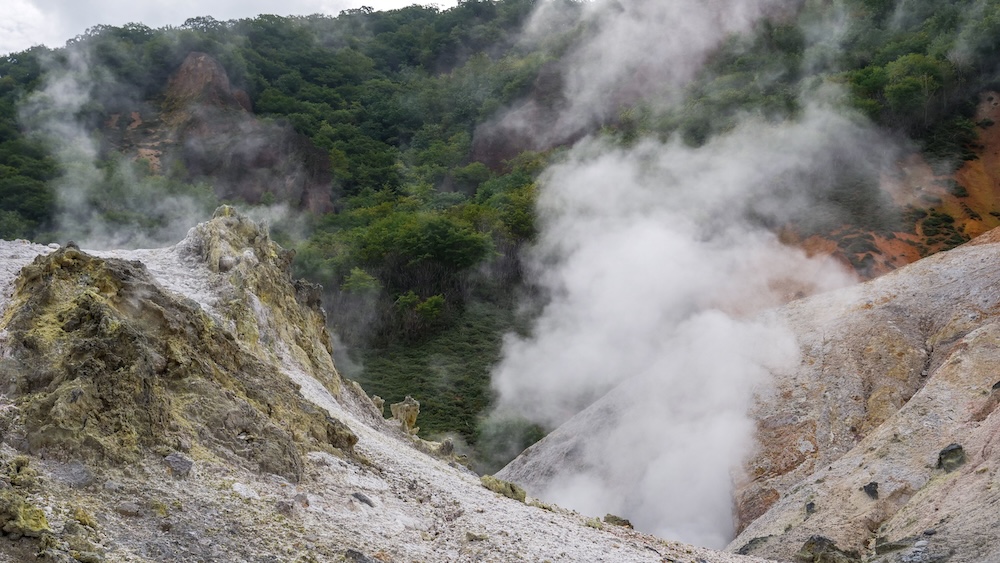
For sheer spectacle, Hell Valley would be my first recommendation. It’s the attraction that most immediately communicates what makes Noboribetsu different from other Japanese destinations, with steam, bubbling pools and vividly coloured volcanic ground spread across the landscape.
If you enjoy walking and want to experience more of the geothermal surroundings, Oyunuma is well worth the additional effort. I loved the contrast between the forest trails and the steaming water, and exploring that wider landscape was one of the most satisfying parts of our stay.
But if we’re talking about the experience I personally enjoyed most, the Oyunuma River Natural Footbath wins.
I can still picture that early morning: Audrey and I sitting beside the river, steam drifting through the trees, our feet buried in fine volcanic sand and hardly anybody around. We were slightly jet-lagged, had nowhere urgent to be and were thoroughly enjoying doing very little.
Even the demon attractions left a lasting impression. Those enormous, ridiculous-looking creatures made the town fun to explore, and I wouldn’t skip them simply because they’re smaller than the geothermal highlights.
When I think back on Noboribetsu, what stands out isn’t how many attractions we managed to visit or how much money we saved. It’s that we had time to enjoy an extraordinary part of Japan without constantly needing to buy a ticket, arrange an activity or rush to the next stop.
And as far as I’m concerned, the only thing better than discovering a free natural hot-spring footbath is having enough time to sit there until you’re genuinely ready to leave.
Frequently Asked Questions
What are the best free things to do in Noboribetsu Onsen?
My top recommendations are Jigokudani Hell Valley, Oyunuma geothermal lake and Oyunuma River Natural Footbath. All three offer different experiences, from dramatic volcanic scenery to forest walks and relaxing in naturally heated water. Audrey and I also loved exploring the demon statues, watching King Enma at Enmado and visiting Sengen Park.
Is Jigokudani Hell Valley free to visit?
Yes. The main observation area and public sightseeing paths at Jigokudani Hell Valley are free to enter. You can admire the geothermal landscape without completing the longer walking trails. If you’re driving, however, the designated parking area has a separate charge of ¥500 for passenger cars.
Is the Oyunuma River Natural Footbath free?
The designated natural footbath is free to use, and it was my favourite experience in Noboribetsu. We spent approximately half an hour soaking our feet in the warm river surrounded by forest. Bring a small towel, and check current trail conditions before visiting because maintenance and seasonal restrictions can affect access.
Can you visit Hell Valley, Oyunuma and the natural footbath in two or three hours?
It’s possible to explore parts of the geothermal area within that window, but I wouldn’t count on enjoying all three attractions comfortably without rushing. Walking times on local maps describe individual trail segments, not the entire outing. I’d allow several hours if you want to visit all three, take photographs and spend some proper time at the footbath.
Do you need to pay to see the demon statues and King Enma in Noboribetsu?
No admission fee is required for the public demon statues or Enmado’s mechanical King Enma performance. The statues can be enjoyed while exploring the onsen district, but Enmado operates at scheduled times and performances can be interrupted by maintenance or weather. Check the current schedule if you want to see the transformation.
Can you enjoy Noboribetsu Onsen without doing a long hike?
Absolutely. Hell Valley has a principal observation area reached by a ramp with a maximum gradient of 8%, and several demon attractions, Enmado and Sengen Park can be visited around the central town. However, the broader trails, steep shrine steps and some uneven approaches won’t suit every mobility level, so choose your stops according to your comfort and ability.
This guide is also available in Spanish. [Leé la versión en castellano: Las mejores cosas gratis para hacer en Noboribetsu Onsen: Valle del Infierno, baño natural de pies y demonios]
This article contains affiliate links. If you book through one of these links, I may earn a commission at no extra cost to you.