
Once the bus from JR Noboribetsu Station drops you in the onsen town, do you need anything else to get around: taxis, a rental car, another bus? For most of what brings people here, the answer is no.
Audrey and I spent two nights in Noboribetsu Onsen in late September. Apart from the bus up from the station, we did everything on foot: the hotel, the restaurants, Hell Valley, the forest trail out to Oyunuma, the natural footbath and Yuzawa Shrine. We even walked the main loop backwards. Here’s what’s within walking range, where the walking gets harder, what to put on your feet, and where walking stops being an option.
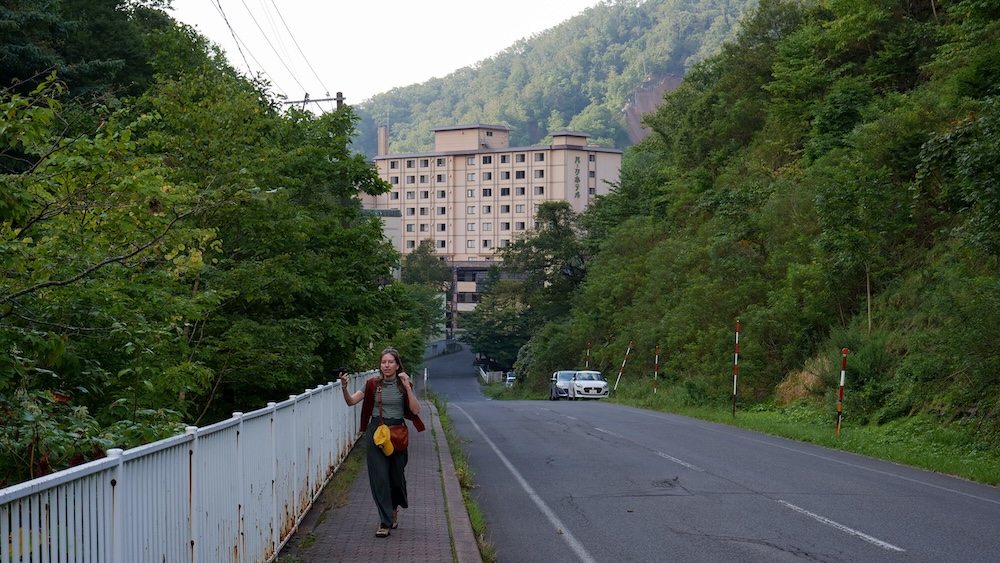
The Short Answer: Yes, If You’re Happy on Your Feet
Noboribetsu Onsen is walkable. The town is compact and easy to explore on foot, and it doesn’t take much effort to cover the main areas. There wasn’t a single point, in town or out in the valley, where we wished we had a car or had called a taxi.
One caveat: Audrey and I are in decent shape and we like walking and hiking, so for us the whole thing felt relatively easy. Audrey found it just fine too. If you’re a reasonably fit walker, you’ll probably feel the same. If stairs or hills are a real obstacle for you, read the section on who will find it harder before you build a plan around walking.
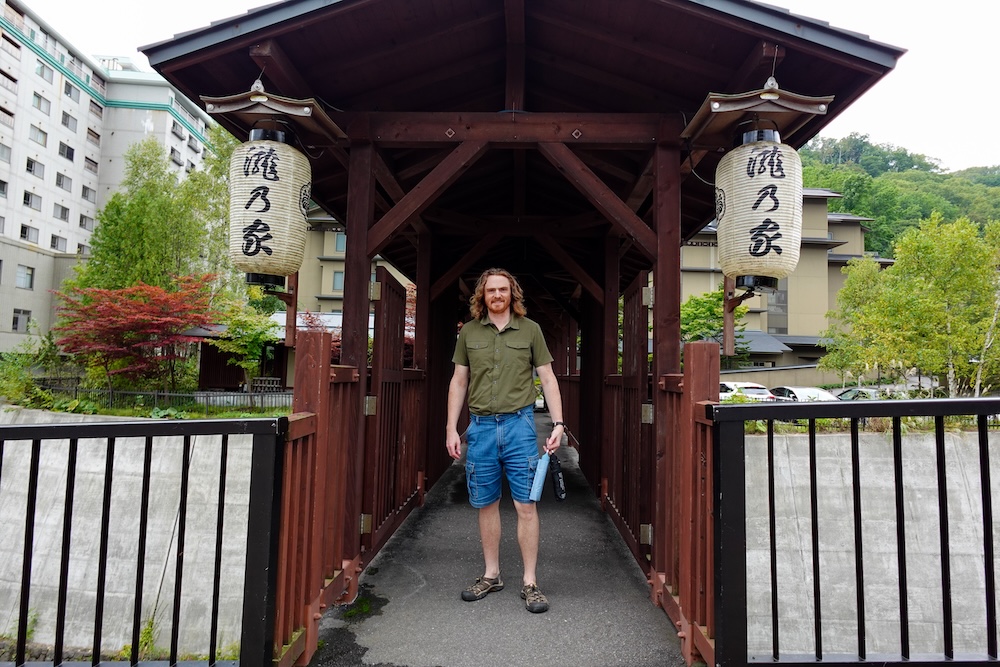
What You Can Reach on Foot
The town core
The bus terminal is the place to get your bearings. From where the bus drops you, more or less everything is within walking distance: the hotels, the restaurants, the main street. Our hotel, Park Hotel Miyabitei, was an easy stroll from the restaurants and every attraction we wanted to see. That walkability is exactly why where you sleep matters more than which hotel it is. When you compare places to stay in Noboribetsu, check that the address says Noboribetsu Onsen-cho. That puts the town and the valley on your doorstep instead of a bus ride away.
What nobody mentions is that it’s a hilly town. On arrival we had to wheel our suitcases up the hill a bit to the hotel. It wasn’t a massive effort, but it was good exercise after a train and a bus. Even when places are close together, expect to go up and down a bit between them.
A few things sit just minutes from the terminal. Enmado is about a five-minute walk. So is the base station of the ropeway to Bear Park, which then takes about seven minutes to carry you up the mountain. We didn’t go to Bear Park, but getting to the ropeway doesn’t need any transport.
The geothermal loop
This is where your feet really earn their keep. Hell Valley, Oyunuma and the natural footbath are linked by boardwalks and forest paths, so you can walk them as one loop that starts and ends in town.
The distances:
- From the bus terminal to the Park Service Center at the entrance to Jigokudani (Hell Valley) is about 850 metres.
- From there it’s roughly another 940 metres out to the viewpoint over Oyunuma, the steaming crater lake.
- Then it’s about 480 metres down to the footbath.
- From the footbath back to the terminal is about 1.5 km.
That’s a little under 4 km for the whole loop. Treat those figures as route lengths, not walking times, because the path climbs, drops and has stairs. The standard course out to the footbath takes about two hours. Hell Valley on its own takes about 30 minutes, and adding time at the footbaths stretches it to about 90 minutes.
Yuzawa Shrine sits near the entrance to Jigokudani, at the top of its own steep stone staircase. It’s an easy add-on at either end of the loop.
What’s beyond walking range
Walking range ends sharply at the edge of the onsen town and its valley. We didn’t go to any of the following places, but it’s worth knowing where the line falls so you don’t plan to walk somewhere you can’t reach on foot.
JR Noboribetsu Station is about 8 km away, so it’s the bus or a taxi; you can’t walk from the train to Hell Valley. Date Jidaimura, the Edo-period theme park, is in a different part of Noboribetsu, about 10 minutes away by car or taxi. Lake Kuttara is about 15 minutes by car. All three need wheels.
| Place | How far from the bus terminal | What the walking is like | Did we walk it? |
|---|---|---|---|
| Hotels, restaurants and the main street | Within walking distance | Paved, with some uphill | Yes, including wheeling luggage up the hill |
| Enmado and the Bear Park ropeway station | About 5 minutes | Paved | No, but they’re close |
| Jigokudani (Hell Valley) entrance | About 850 m | Paved, then boardwalks | Yes |
| Oyunuma viewpoint | About 940 m beyond the entrance | Forest path that gradually steepens | Yes |
| Oyunuma River Natural Footbath | About 480 m beyond the viewpoint | Forest path and high steps | Yes |
| Yuzawa Shrine | Near the valley entrance | Steep stone staircase | Yes |
| JR Noboribetsu Station | About 8 km | Not walkable; take the bus | No, we took the bus |
| Date Jidaimura | About 10 minutes by car | Not walkable | No |
| Lake Kuttara | About 15 minutes by car | Not walkable | No |
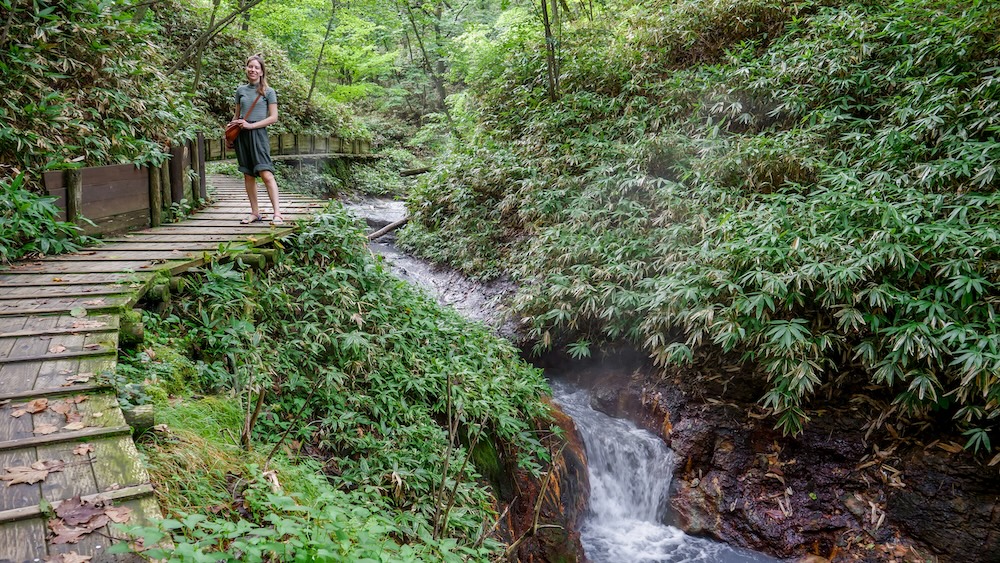
How We Walked It: The Loop Backwards
The standard route starts at Hell Valley and finishes at the footbath. We did it in reverse.
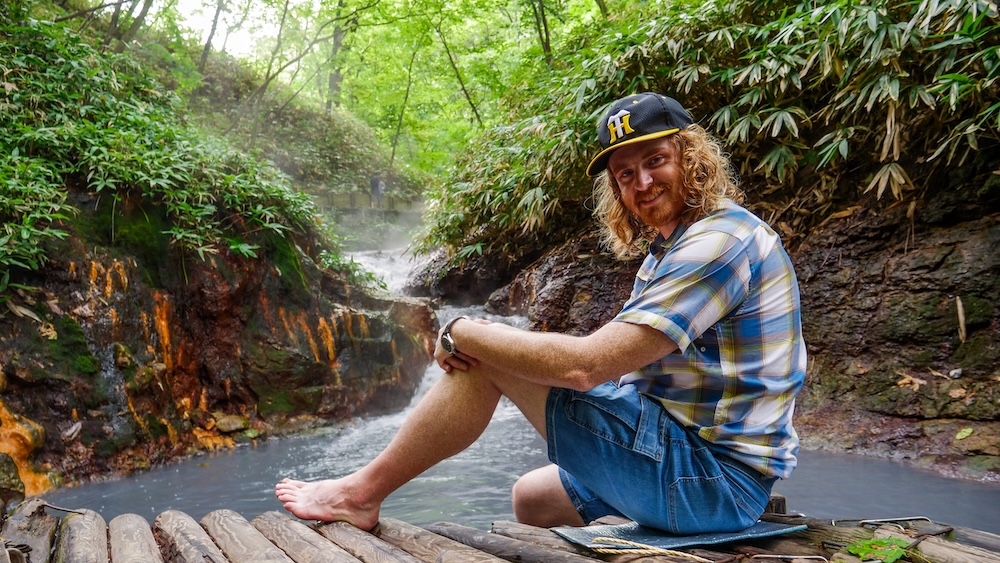
We set out shortly after breakfast, through a town so quiet we passed hotel after hotel without seeing anyone. One stretch of road had no sidewalk, and some of the cars came through quickly, so keep your wits about you there. Our first stop was the natural footbath. A small group was just finishing as we arrived, and once they’d left we had the river to ourselves. We sat with our feet in the hot water for a good half hour before moving on.
From the footbath, the trail climbs up through the forest toward Oyunuma. On that stretch we kept joking that the trail was about to get much harder. It didn’t; we just kept walking. Along the way the ground came alive: ponds bubbling and steaming like a cauldron, steam rising from vents, and three deer near one of the ponds, one of them lying down for a lazy morning. Back home in Alberta we see deer all the time, so it was fun to discover that this part of Japan has them too. The geothermal activity, though, was something we were not expecting coming from Canada.
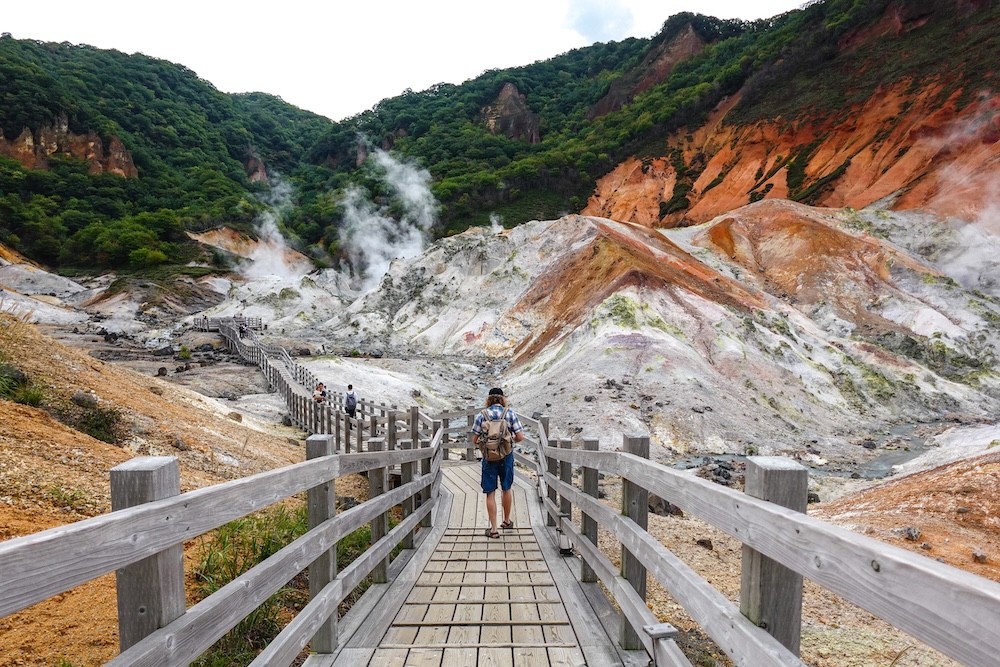
The trail brought us into Hell Valley, where we followed the boardwalks through the steam, the orange earth and the bubbling vents. From there we climbed the steep stone staircase to Yuzawa Shrine and had the place to ourselves. Then we headed back down into town, where everything else was a short stroll away.
Walking it our way has one trade-off. On the standard route, you walk down the steep, high steps to the footbath and then return along a different path. Do it backwards and you climb those steps instead of descending them. In return, you get the footbath at the start of the day, while it’s still quiet. Either way, there are toilets at Oyunuma, roughly halfway round.
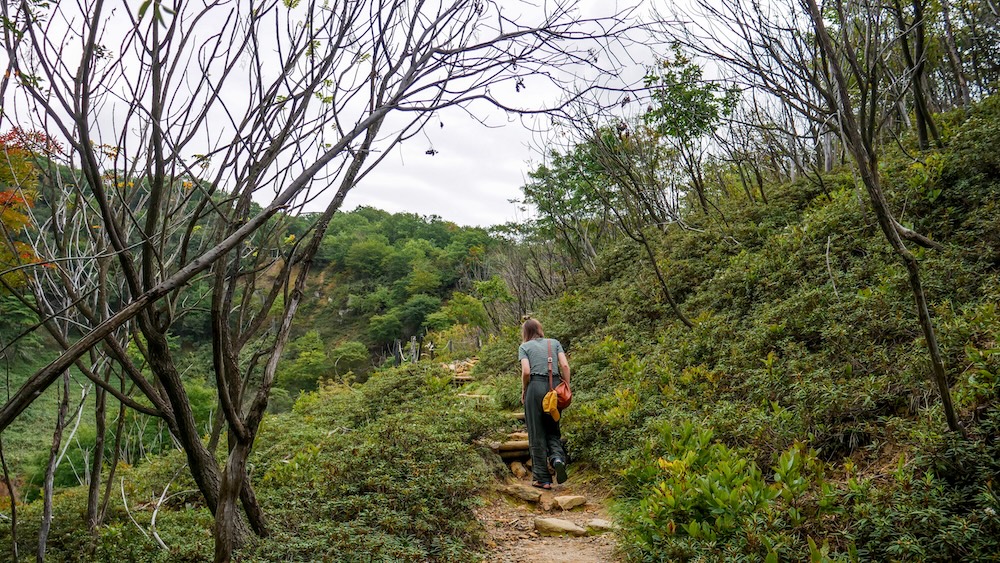
Where the Effort Comes
Distance isn’t the issue. Nothing on the loop is far, and the whole circuit is under 4 km. The effort comes in short bursts.
The first is the slope. The town is built on a hillside, so you’ll go up and down between hotels and sights. If your hotel is up the hill, as ours was, you’ll be wheeling your bags up it on arrival.
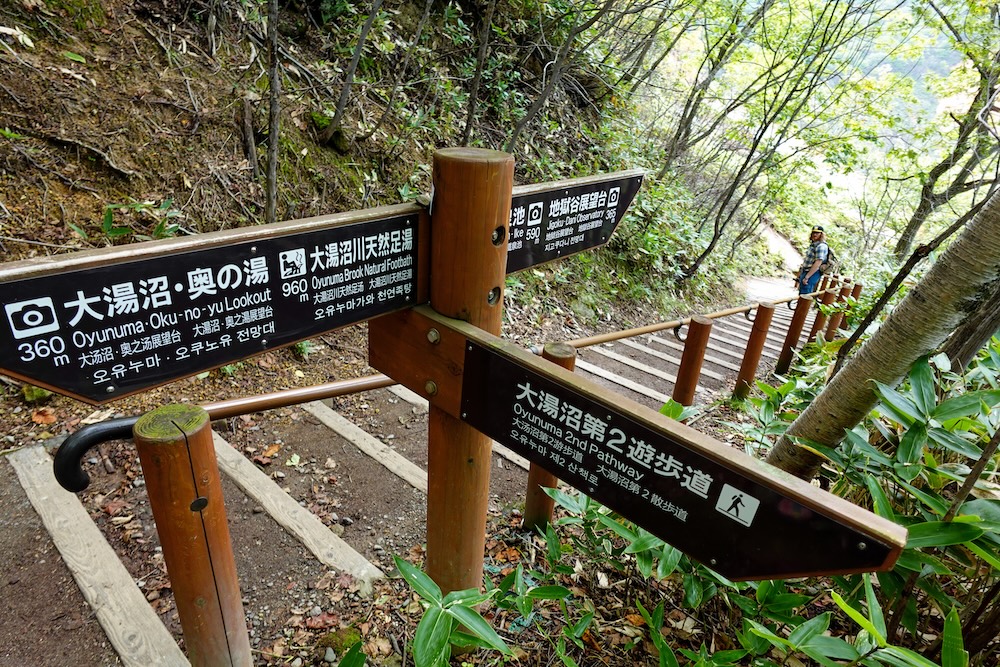
The second is the stairs: the steep stone flight up to Yuzawa Shrine, and the high steps between Oyunuma and the footbath. The path toward Oyunuma also gets steeper as you go. None of it slowed us down much, but you’ll feel it in your legs.
The third is the heat, which surprised us. Hell Valley doesn’t feel like a normal walk in the woods. The forecast that day was only 22 to 24°C, but between the springs, the hot ground and the steam vents, the valley felt warm and humid. On a mild day, you can still end up sweating.
The last is that road without a sidewalk. It’s only a short stretch, but the traffic moves quickly.
What to Wear and When to Walk
I did the whole loop in Keen-style sandals: the protection and grip of a shoe, with the convenience of slipping them on and off. They were perfect for the footbath. For the forest trails and stairs, proper hiking shoes would probably have been better, although I managed fine. If you’re only bringing one pair, choose something with real grip. If the footbath is a priority, slip-ons save you a lot of fiddling with laces while your feet are wet.
Take a small towel from your hotel so you can dry your feet after the footbath and keep walking without squelching. If the ground is muddy, the Park Service Center at the Jigokudani entrance lends out rain boots, and it also has volunteer guides who can walk the course with you. If you’re coming from Sapporo for the day and would rather have the whole thing arranged from the start, one current option is a guided day tour from Sapporo that walks Hell Valley and the footbath, with an English-speaking guide and bath entry at Dai-ichi Takimotokan included. I haven’t done it myself, so check the itinerary for how much walking time it allows.
Timing matters too. The footbath is open from 8:00 to 17:00, so get there at opening if you want it quiet. Walk the forest paths in full daylight. In 2026, Noboribetsu City reported brown bear sightings around dusk on the road up to the onsen town, and it advises avoiding early mornings and evenings near sighting areas. Before you set off, check the tourism association’s notices for path closures and recent sightings.
We walked in late September, with every path open. Winter is a different situation. Snow closes the boardwalks beyond the main Jigokudani path, and the trail to the footbath can close completely, so the full loop described here may not be possible.
Who Will Find It Harder
The town itself is manageable for most people who don’t mind a few slopes. The forest section is the hard part: unpaved paths, steep high steps and uneven ground. That makes it tough going with a stroller, with a wheelchair, or if you’re unsteady on stairs.
There is a wheelchair-accessible ramp, with a gradient of up to 8%, from the Park Service Center to the Jigokudani observation deck, which gets you a proper look into Hell Valley without any steps. I can’t vouch for accessibility beyond that, so check with the Park Service Center before you commit to more of the route.
If walking is difficult for you, the realistic picture is this: the town core and the Hell Valley viewpoint are within reach, but the full loop out to Oyunuma and the footbath is a real walk with real stairs.
Stay Up the Hill and Walk the Rest
The rule I’d give anyone is simple. Book a room in the onsen town itself, not near the station, and use the bus only for the trip up the hill. After that, your feet will do. Wear shoes with grip, pack a hotel towel, and start the loop in daylight. Then choose your direction: Hell Valley first for the standard route, or the footbath first, as we did, if you’d rather have the river to yourself and don’t mind climbing the steps afterwards. Save the taxis for the station, Date Jidaimura and Lake Kuttara.
Frequently Asked Questions
Is Noboribetsu Onsen walkable?
Yes. The town is compact and easy to explore on foot, and the geothermal loop through Hell Valley, Oyunuma and the footbath connects to it by boardwalks and forest paths. Audrey and I needed no transport once we were up the hill, though we’re both reasonably fit walkers.
How long is the walking loop through Hell Valley and Oyunuma?
A little under 4 km. It’s about 850 m from the bus terminal to the Jigokudani entrance, roughly 940 m more to the Oyunuma viewpoint, about 480 m down to the footbath, and about 1.5 km back to the terminal. The standard course takes about two hours.
Can you walk to Noboribetsu Onsen from JR Noboribetsu Station?
No. The station is about 8 km away, so take the bus or a taxi up to the onsen town. Date Jidaimura and Lake Kuttara also need a car or taxi.
What shoes should you wear for walking in Noboribetsu Onsen?
I did the loop in Keen-style sandals, which were perfect for the footbath and fine on the trails, but proper hiking shoes would have been better for the stairs. Audrey managed one forest stretch in flip-flops, which is doable but not ideal.
Which direction should you walk the loop?
The standard route goes Hell Valley first and descends the high steps to the footbath. We did it backwards, starting at the footbath while it was quiet, which means climbing those steps instead.
Is the walk accessible for wheelchairs or strollers?
Partly. A ramp with a gradient of up to 8% runs from the Park Service Center to the Jigokudani observation deck. Beyond that, the forest paths have unpaved sections and steep high steps, which are tough with a stroller, a wheelchair or unsteady legs.
This guide is also available in Spanish. [Leé la versión en castellano: ¿Es caminable Noboribetsu Onsen? Qué podés recorrer a pie]
This article contains affiliate links. If you book through one of these links, I may earn a commission at no extra cost to you.