
Most one-day plans for Noboribetsu read like shopping lists: Hell Valley, the footbath, the geyser, the demon statues, Bear Park, a bath, maybe a theme park on the way out. Clock times get bolted on afterwards, as if every hour in the onsen town were worth the same as every other. In my experience they really aren’t. The best of Noboribetsu rewards slow, early time and falls apart when you rush it, while most of the rest is short, close together and perfectly happy to be squeezed into whatever’s left.
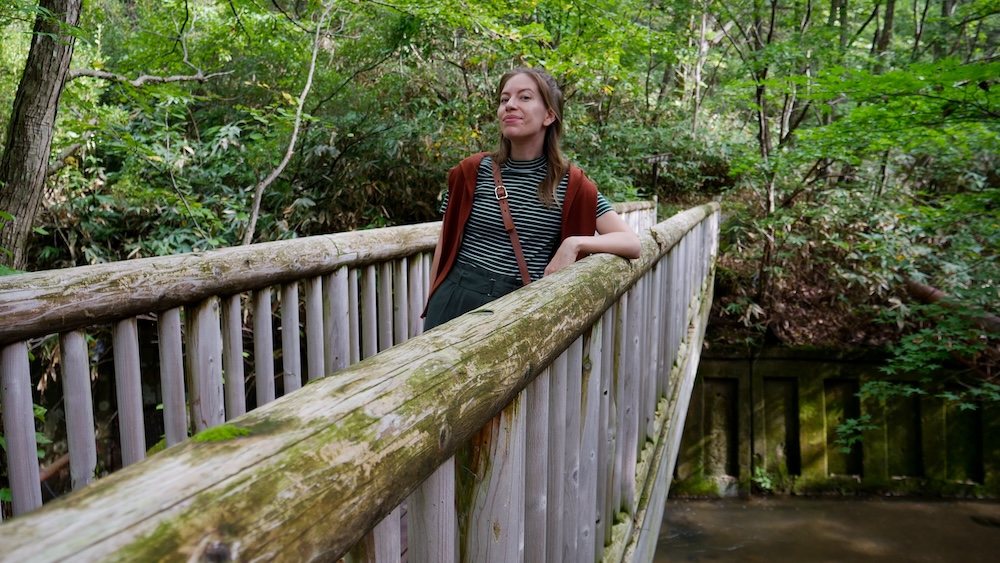
Audrey and I spent two nights in Noboribetsu Onsen in late September. Our arrival day vanished into the train from Hakodate, the bus up the hill, checking in, dinner and the hotel baths, so the middle day was our one full day of sightseeing. We spent that morning walking from the natural footbath through Oyunuma and Hell Valley, climbed the stairs to Yuzawa Shrine, stopped at Enmado and sat down for ramen just after 11. The afternoon went to ice cream and wandering around town. Those outdoor hours ended up among my favourite things we’d done almost anywhere in Japan.
That day gave me a simple rule. See the three big natural attractions first, the footbath, Oyunuma and Jigokudani, and give the town whatever time is left afterwards. Below is how I’d sequence it, whether you wake up in the onsen town or step off a train from Sapporo. It covers when the buses and lunch hours start making decisions for you, what I’d cut first, and what one day simply can’t hold.
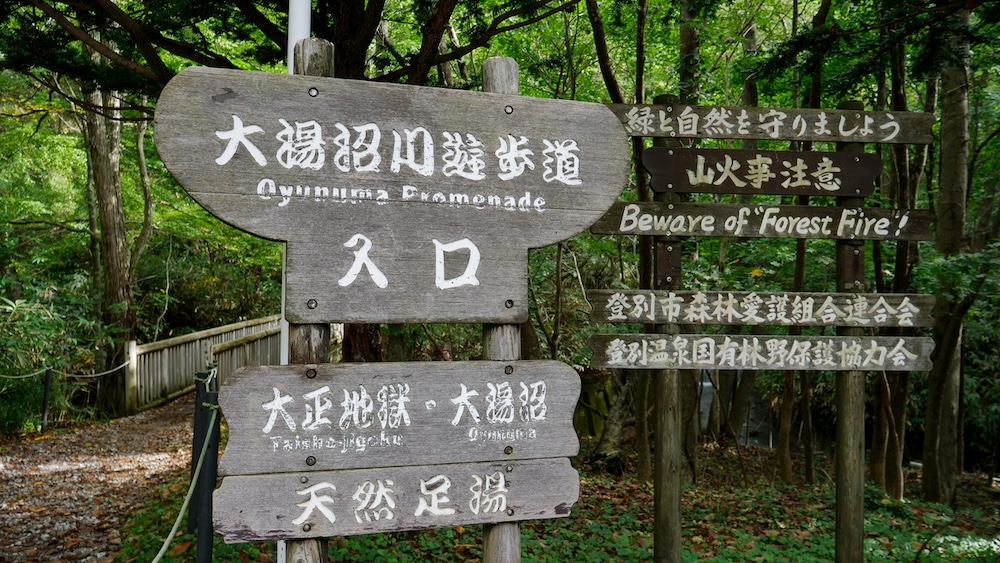
Where Your One Day Actually Starts (and Ends)
Before choosing what to see, figure out where your day begins. A morning that starts at a hotel in the onsen town and one that starts on a platform are very different days. JR Noboribetsu Station isn’t in the hot-spring district at all, so the last leg is always a local Donan Bus uphill. When we arrived, the timetable was posted outside the station and the next bus was about half an hour away. That’s fairly normal rather than unlucky: on the current weekday timetable, buses up to the onsen town run roughly every 20 to 40 minutes through the day. The fare is ¥450 per adult, and Suica, Kitaca and other transport IC cards aren’t accepted. Visa contactless works only on certain services, so carry cash. Depending on how far up you’re going, the ride takes up to about 27 minutes. Check the current Donan Bus timetable for your travel date.
The detail that changes a one-day plan is easy to miss on that timetable. Some buses don’t stop at the town terminal. They continue uphill past the hotels to a stop called Ashiyu iriguchi, the footbath entrance, about a three-minute walk from the Oyunuma River Natural Footbath. On the current weekday schedule, the first station departure running all the way there leaves at 10:25 and arrives at 10:52, and a couple more follow before lunch. A day visitor can therefore start exactly where Audrey and I started and walk the loop back towards town, instead of beginning at Hell Valley with everyone else.
From Sapporo, the limited express to JR Noboribetsu takes roughly 70 to 75 minutes, and every seat on those trains is reserved, so sort that out before the day rather than at the ticket machine. If you’re carrying bags between Hakodate and Sapporo, there’s luggage storage in the onsen town. It has recently charged ¥500 to ¥700 per item, accepting bags between 9:00 and 16:30, and they need collecting by 17:00.
Not everyone wants to juggle a reserved train, two buses and a timetable on a day that’s supposed to be relaxing. One guided day trip from Sapporo follows almost exactly the route I’m recommending: Hell Valley, a forest walk of about half an hour out to the footbath, then a soak at Dai-ichi Takimotokan, with the transport arranged and an English-speaking guide. Audrey and I didn’t take it, so before you check the guided Hell Valley, footbath and Takimotokan day trip from Sapporo, look at how long it actually gives you at each stop and what’s currently included. Be more wary of the broader coach tours that pair Noboribetsu with Lake Toya. Some give Hell Valley only about half an hour, which gets you a look at the steam but nothing like the day described here.
The far end of the day is just as fixed. The footbath closes at 17:00 and the last bus down from the footbath stop leaves at 17:05, which is a neat bit of scheduling unless you’re still sitting in the river. From the main terminal in town, the last bus to the station currently goes at 20:35. After that, it’s a taxi.
Here’s how those edges shape a realistic day:
| Part of the day | Staying in the onsen town | Arriving by train and bus |
|---|---|---|
| Start | Footbath from its 8:00 opening, as we did | 10:25 station bus straight to Ashiyu iriguchi (10:52); earlier buses end at the town terminal, so begin at Hell Valley instead |
| First two-plus hours | Footbath → Oyunuma → Jigokudani | The same loop, in whichever direction your bus allows |
| Heading into town | Yuzawa Shrine and Enmado | The same, if an Enmado performance lines up |
| Lunch | From about 11:00 | Aim to sit down by about 1:30, before the lunch-only counters close |
| Afternoon | Wandering, ice cream, Sengen Park, demon statues | The same, shorter |
| Optional finish | A paid day-use bath | Dai-ichi Takimotokan stops selling tickets at 18:00; Sagiriyu’s last entry is 20:30 |
| Hard edges | Footbath closes at 17:00 | Last bus from the footbath stop at 17:05; last bus from town at 20:35 |
Spend the Morning on the Three Natural Attractions
The footbath, Oyunuma and Jigokudani behave less like three stops than like one continuous walk through steaming forest and volcanic ground. The standard course from Hell Valley, past Tessen Pond and the Oyunuma lookout, down to the footbath, takes about two hours before you’ve sat down anywhere; Jigokudani on its own takes around half an hour. Break the loop into separate outings and you’ll spend more time retracing your steps than enjoying any of it. That’s why it gets the freshest part of the day.
Audrey summed it up well on our last morning. To her, the hikes were very easy, but just enough to keep you stimulated: you’d walk for a while, reach the next spot, have your mind blown, and then do it all over again. That rhythm is the whole point of the morning, and it’s precisely what disappears when you treat the loop as a checklist.
Before heading into the forest, one practical note. Noboribetsu City confirmed brown bears crossing the road into the onsen town around dusk twice during the summer of 2026, and its advice is to avoid being out near sighting areas in the early morning and after dark. Walk the forest sections in full daylight and keep an eye on local notices. We set off shortly after breakfast, in full daylight.
Which Way Round
The standard loop starts at Hell Valley and ends at the footbath, descending a run of high steps on the way down to the river. We did it backwards. Leaving our hotel shortly after breakfast, we walked out to the footbath first and then climbed up through Oyunuma into Hell Valley. That means climbing those steps instead of descending them. The payoff was a footbath with almost nobody else around: a couple was just finishing when we arrived, and for a while there were only a handful of people in total.
Which direction suits you comes down to how you arrive. Staying in the onsen town, I’d go footbath-first again without hesitation, and that early, unhurried start is the best argument I know for sleeping up the hill rather than down by the railway. If you’re still choosing, compare hotels within walking distance of the trails in Noboribetsu Onsen rather than anything near the station. Arriving on the 10:25 bus or later, riding straight to Ashiyu iriguchi lets you copy our order and work your way back towards town and lunch. On an earlier bus that ends at the terminal, you’re already at the Hell Valley end, so walk the standard direction. Either way, I’d keep the loop together rather than chopping it up.
Oyunuma River Natural Footbath
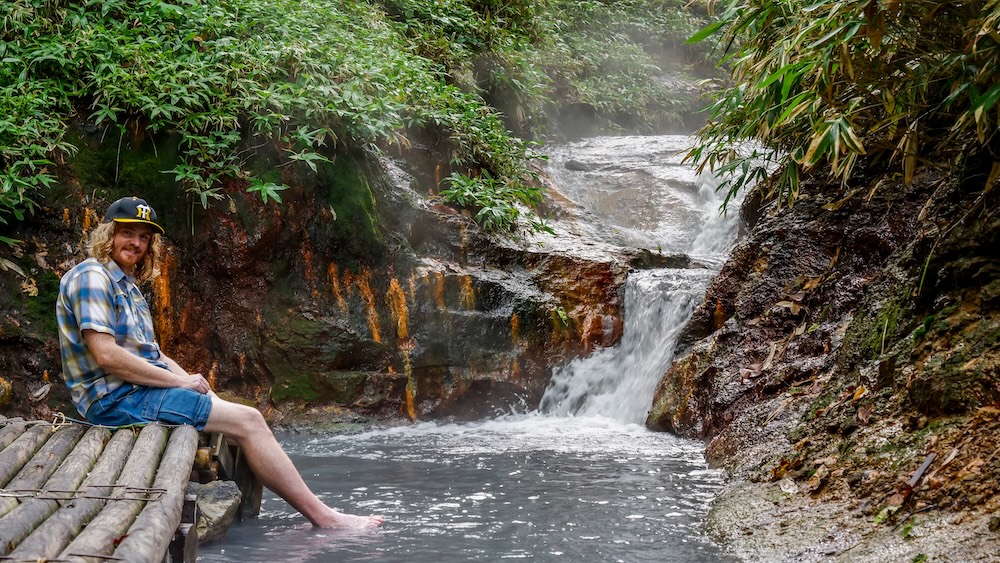
If the day starts slipping, this is the stop I’d defend hardest. It’s a hot-spring river running through the forest, with seating along the bank and dark volcanic sand underfoot. The water is a bit of a shock at first and then almost absurdly pleasant. We stayed about half an hour. Sitting there with my feet in the water, I genuinely felt you could arrive with your head full of anxiety and problems and walk away with it clear. I didn’t want to leave, and I remember asking whether that was all we were doing that day, adding that I’d be completely okay with it.
That feeling is exactly what makes it risky on a schedule. The footbath is free and open from 8:00 to 17:00, but there’s no towel rental, and we only had one because we’d brought it from our hotel. Day visitors should pack their own small towel, and shoes you can slip on and off will save you wrestling with laces while your feet are still wet. The trail out to it typically closes through the snowy months and occasionally shuts for maintenance, so check the footbath’s current status before building your morning around it.
Oyunuma, Then Hell Valley
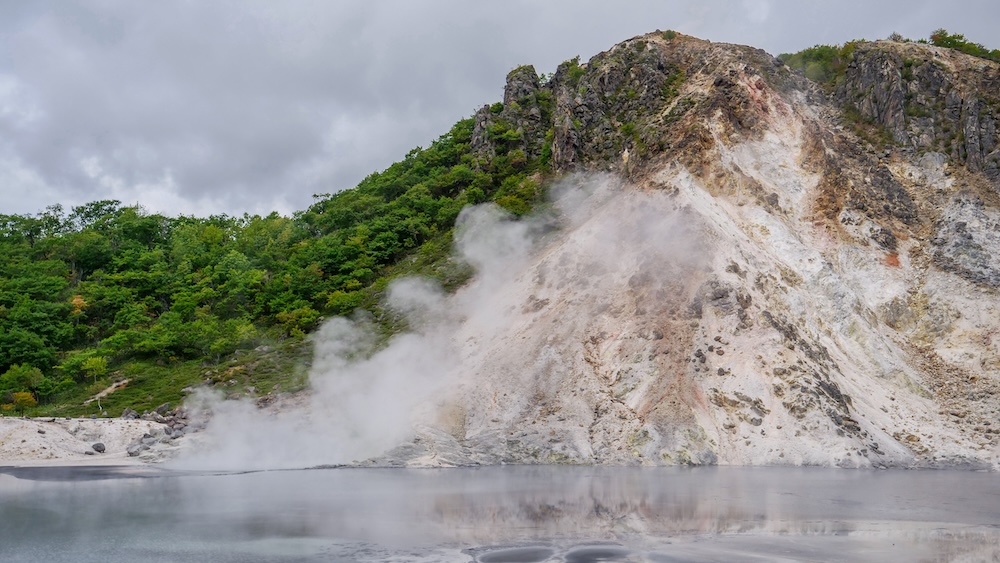
Oyunuma sits at the quiet middle of the loop: a gourd-shaped crater lake about a kilometre around, fed from below by sulphur springs that reach roughly 130°C at depth. We could hear it gurgling and bubbling away like a giant teal cauldron. There are toilets around this point, roughly halfway round the circuit, which is worth knowing if you’re doing the full loop.
Then comes Jigokudani, the main attraction and the one place I’d never let a timetable hurry me. The ground turns orange, white and rust-coloured, steam pours from vents all around the boardwalks, and the whole valley feels alive. Take the time to walk the trails properly rather than grabbing a photo at the first viewpoint and turning back. Dress lighter than the forecast suggests, too. On our late-September day the forecast was only 22 to 24°C, yet between the hot ground, the springs and the steam vents, the valley felt warm and humid. If walking is difficult, a ramp with a maximum gradient of 8% runs from the Park Service Center to the observation deck, giving you a proper look into the valley without the trail.
Yuzawa Shrine and Enmado on the Way Down
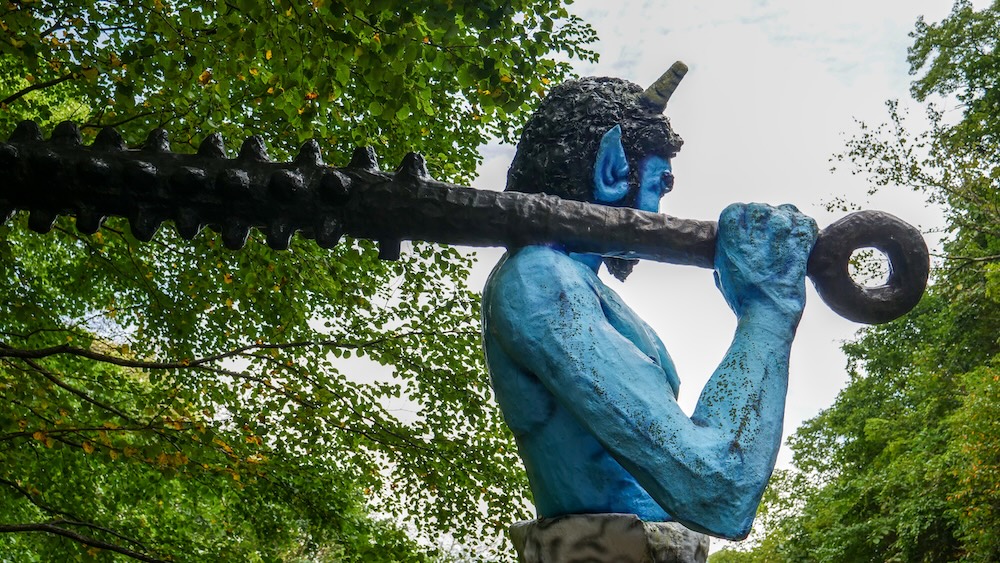
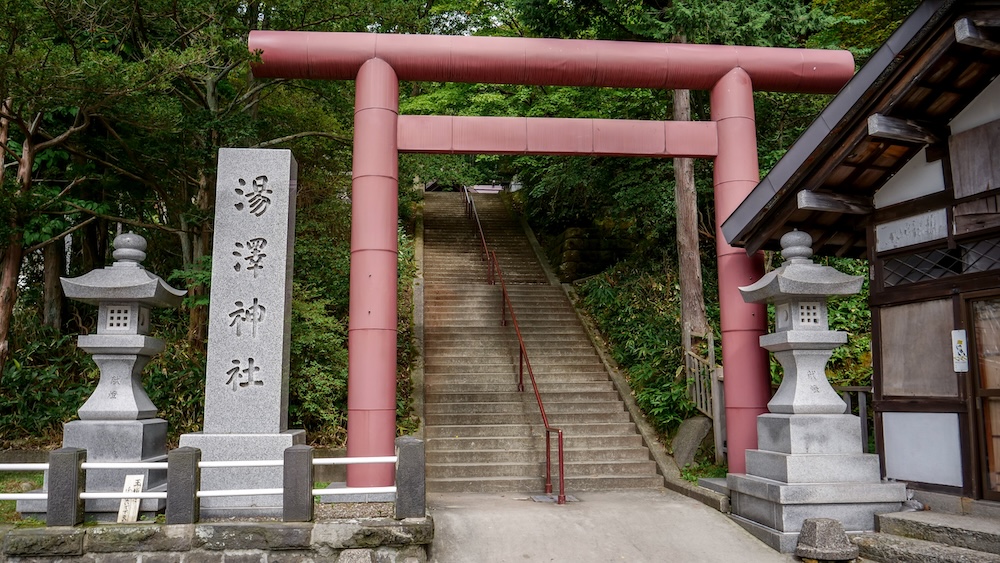
Leaving Hell Valley, the first two town attractions fall neatly between the walk and lunch, exactly as they did for us. Yuzawa Shrine sits at the top of a steep stone staircase guarded by a blue demon and a red demon, each holding a spiked club. Honestly, the first thing they reminded me of was Bam Bam from The Flintstones. The climb is a short leg-burner, and our reward was having the whole shrine to ourselves.
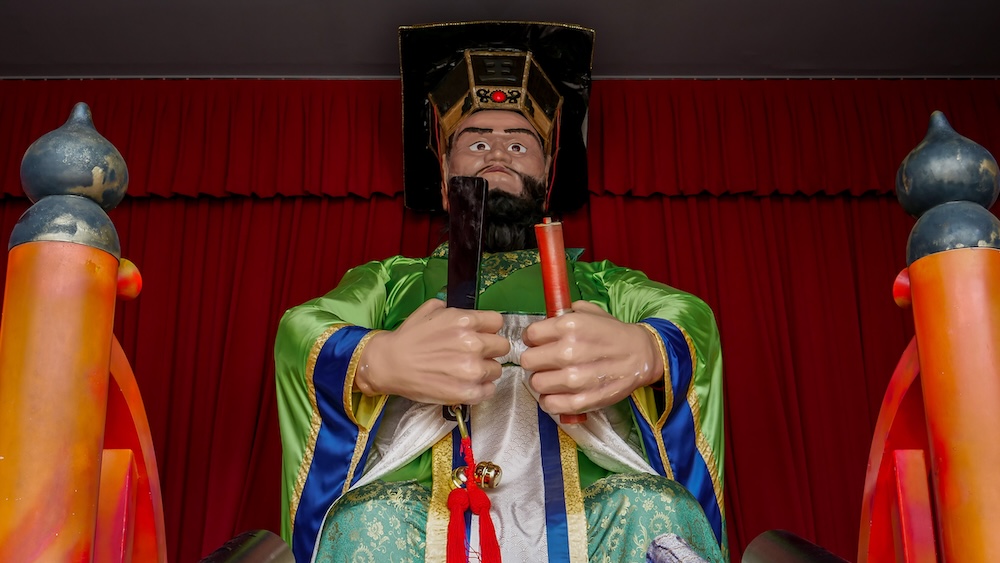
A little further along is Enmado, home to a giant mechanical King Enma, ruler of the underworld. The hall is free and open from 9:00 to 21:00. Its draw is a performance in which the king’s calm expression turns red and furious, fangs and all, and that happens several times a day at fixed times posted outside the hall. If you’re passing just as one begins, perfect. If you’ve just missed one, I wouldn’t stand around for 40 minutes while the lunch counters are getting ready to close.
Treat Lunch as a Timing Problem
On a one-day visit, lunch can’t just drift. Many of the ramen and soba counters in the onsen town are lunch-only, opening around 11:00 or 11:30 and closing by mid-afternoon, often at 14:00 or 15:00. I’d aim to sit down somewhere between about 11:00 and 1:30. A day visitor starting at the footbath off the 10:25 bus should still manage that comfortably, but it doesn’t leave much slack for lingering elsewhere.
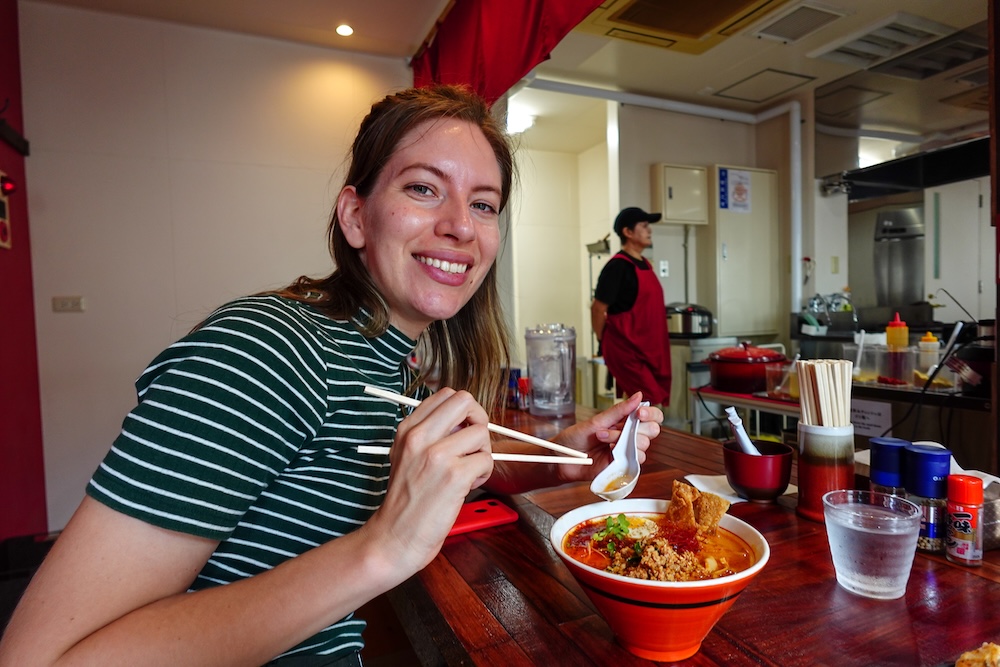
We ate at a little counter-style ramen shop about a block from Enmado. It was the only place we found open at 11, which is honestly the whole reason we ended up there. Audrey ordered the Enma Ramen, a fiery, nutty bowl that was the most colourful ramen either of us had seen, and after one taste I declared it the best ramen I’d ever had. Normally I’m the one who orders better. My own miso ramen with its big slabs of pork was excellent, and her bowl still left mine in the dust. We liked it so much that we went back for another round before our train to Sapporo. For planning purposes, though, lunch here has a window, and a late morning can quietly close it on you.
The Afternoon Belongs to the Town
Once the walk and lunch are behind you, the pressure lifts. Everything else in Noboribetsu Onsen is compact, free to look at and easy to stretch or shrink depending on how much daylight and energy remain. We started our afternoon with honeycomb ice cream, wonderfully creamy and not overly sweet, then spent the rest of it wandering the town with no real agenda.
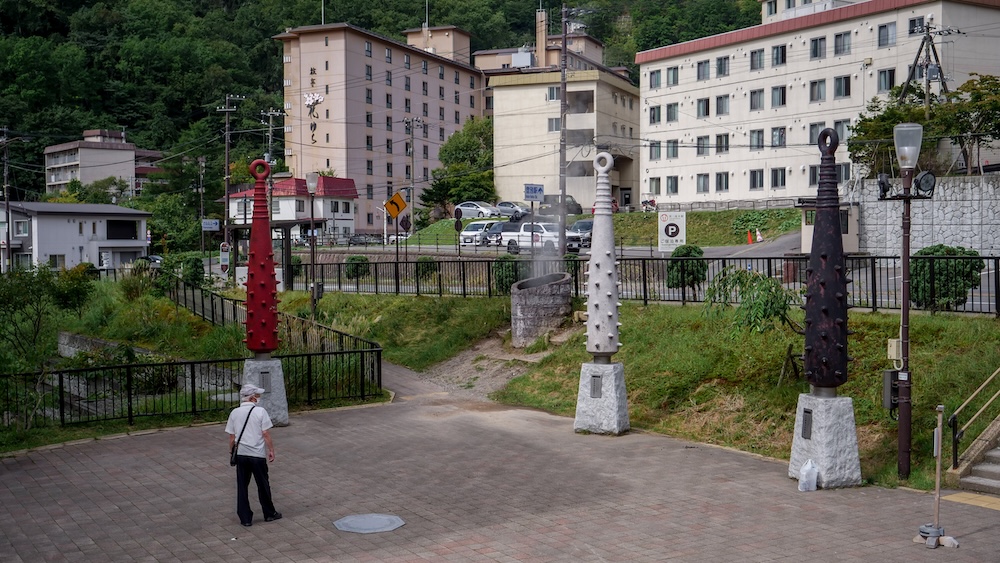
Demon statues are scattered all over town, and some promise particular kinds of luck: passing exams, finding love, or business success. School was long behind us and we already had the love part covered, so business prosperity was the obvious pick. Treat it as a five-minute diversion rather than an item on the plan.
Sengen Park is the one spot that can lure you into waiting. Its geyser erupts roughly every three hours, on its own schedule rather than a dependable clock. We passed it on two different days: the first time the water was bubbling and gurgling away, and the next day there was nothing but steam. I’d treat it as a stop to pass by rather than wait for. If it’s erupting, enjoy the show; if it isn’t, carry on.
Ending the Day in Hot Water
A full onsen bath is the natural way to finish a day here, and you don’t need a hotel room for it. We bathed as hotel guests, so I can’t personally speak for the day-use options. As of late 2026, Dai-ichi Takimotokan charges ¥2,500 per adult for day bathing, with tickets sold from 9:00 to 18:00 and everyone out by 21:00. The small Sagiriyu public bath costs only a few hundred yen and takes its final entry at 20:30. Prices and conditions change, so check the current day-use onsen listings before you go. If you’re staying past dark, Hell Valley is also illuminated from sunset until 21:30, though that leaves very little margin before the last bus.
My priorities differ from many one-day plans on this point. A good bath is an excellent way to end the day, but I wouldn’t shave time off the footbath or Hell Valley to stretch out a soak. You can find a hot bath almost anywhere in Japan. A hot river through the forest, followed by a walk through a steaming volcanic valley, is what made Noboribetsu unforgettable for us.
What I’d Drop When the Day Shrinks
Buses run late, mornings slip, and suddenly you have less time than you planned for. If that happens, this is the order I’d cut things in:
- Waiting around for the Sengen Park geyser
- The paid bath
- The luck-granting demons and any aimless wandering
- Enmado, unless a performance happens to coincide with your arrival
- The stairs up to Yuzawa Shrine
The walk itself is what I’d hold on to longest. I’d only lose the footbath if the trail were closed or the clock left room for nothing beyond a quick look at Hell Valley. If you’re down to a few hours rather than most of a day, the choices get harsher, and I’d plan that visit differently rather than compressing this one.
What One Day Can’t Hold
Noboribetsu has several bigger attractions that often appear on one-day lists. Audrey and I didn’t visit any of them, but each takes a meaningful bite out of a single day:
- Noboribetsu Bear Park. It’s reached by a ropeway of about seven minutes, starting from a station roughly five minutes’ walk from the town terminal. The operator suggests allowing 60 to 90 minutes in the park itself.
- Date Jidaimura. The Edo-period theme park is about ten minutes away by car.
- Marine Park Nixe. It sits about five minutes’ walk from JR Noboribetsu Station, which makes it better suited to a travel day.
- Lake Kuttara. It’s around 15 minutes away by car.
Any of them can be worth your time. In a single day, though, every hour spent at one comes straight out of the walk, and that’s a trade I wouldn’t make. If two or three of them feel non-negotiable, that’s your sign Noboribetsu needs more than a day, and probably a night in the onsen town.
That’s how our own visit worked. We stayed at Park Hotel Miyabitei, a big resort-style onsen hotel with buffet dinners and a basement full of baths rather than an intimate little ryokan, and its location is what made our footbath-first morning so easy. We walked out after breakfast, and the trails, the restaurants and everything else we wanted to see were all within walking distance. If that kind of base suits you, check current rooms and meal plans at Park Hotel Miyabitei, keeping in mind that room types and meal inclusions vary, so read the plan rather than assuming it matches ours. If you’d rather weigh a smaller ryokan or a different budget first, browse the wider range of places to stay in Noboribetsu and stick to addresses in the onsen town itself.
With one day, I’d stop trying to see everything and decide what you’re willing to rush. For me, that’s the town. The geyser can be dormant, Enmado can be between performances, and the bath can be shorter than you’d like, and the day still holds up. A hurried footbath and a sprint through Hell Valley wouldn’t. Get those right, sit down for lunch before the counters close, and let the rest of Noboribetsu Onsen fit around them before the last bus heads down the hill.
Frequently Asked Questions
How long does the Hell Valley, Oyunuma and footbath walk take?
The standard course from Hell Valley past Tessen Pond and the Oyunuma lookout down to the footbath takes about two hours before you sit down anywhere, while Jigokudani on its own takes around half an hour. I’d keep the whole loop together and give it the freshest part of the day.
Can you take a bus directly to the Oyunuma River Natural Footbath?
Some Donan Bus services from JR Noboribetsu Station continue past the town terminal to the Ashiyu iriguchi stop, about a three-minute walk from the footbath. On the current weekday timetable, the first one leaves the station at 10:25 and arrives at 10:52, so check the timetable for your travel date.
When does the footbath close, and when is the last bus?
The footbath is open from 8:00 to 17:00, and the last bus down from the footbath stop leaves at 17:05. From the main terminal in town, the last bus to the station currently departs at 20:35.
When should you eat lunch on a one-day visit?
Aim to sit down somewhere between about 11:00 and 1:30. Many of the ramen and soba counters in the onsen town are lunch-only, opening around 11:00 or 11:30 and closing by mid-afternoon. We ate just after 11 at the only place we found open at that hour.
Can you use an onsen in Noboribetsu without staying overnight?
Yes. As of late 2026, Dai-ichi Takimotokan charges ¥2,500 per adult for day bathing, with tickets sold from 9:00 to 18:00, and the small Sagiriyu public bath takes its final entry at 20:30. We bathed as hotel guests, so I haven’t tried these myself, and in a single day I’d fit a bath in after the walk rather than instead of it.
Is there time for Noboribetsu Bear Park in one day?
Bear Park is reached by a ropeway of about seven minutes, and the operator suggests allowing 60 to 90 minutes in the park itself. Audrey and I didn’t visit, and every hour there comes straight out of the geothermal walk, which is a trade I wouldn’t make in a single day.
What should you cut if you’re short on time?
Start by skipping any wait for the Sengen Park geyser, then the paid bath, the luck-granting demons, Enmado unless a performance lines up, and finally the Yuzawa Shrine stairs. I’d hold on to the footbath, Oyunuma and Hell Valley longest.
This guide is also available in Spanish. [Leé la versión en castellano: Un día en Noboribetsu Onsen: qué priorizar]
This article contains affiliate links. If you book through one of these links, I may earn a commission at no extra cost to you.