
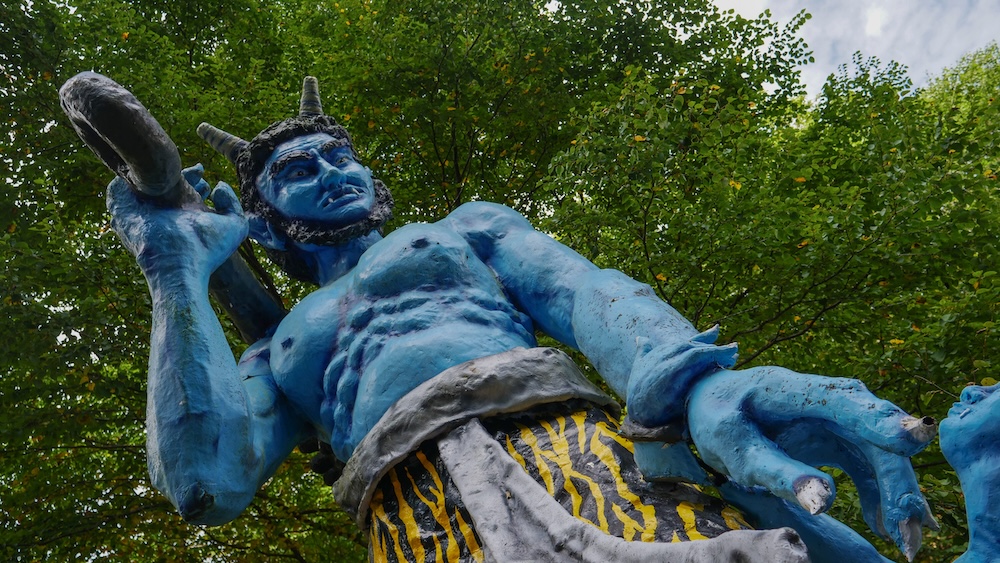
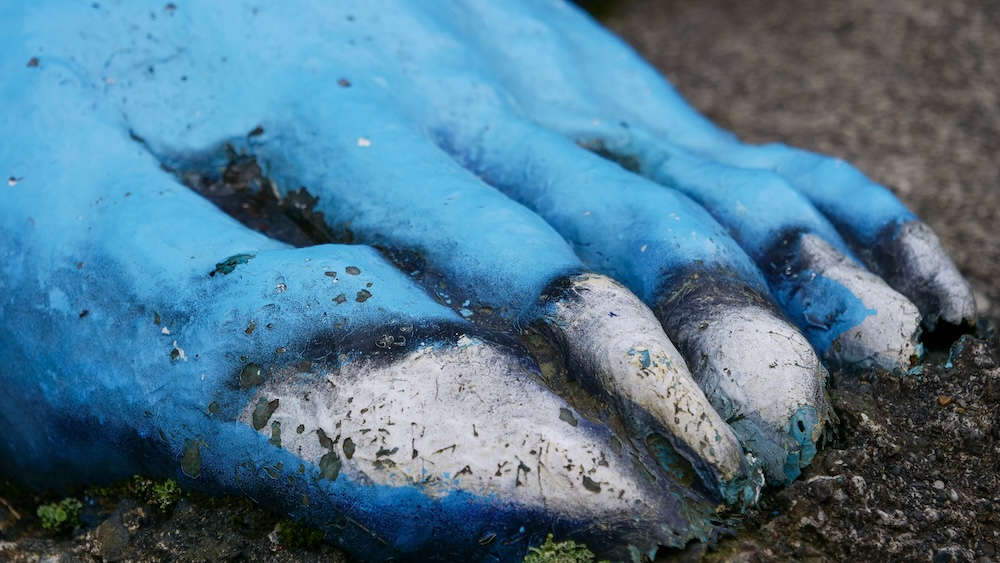
One of the first things that caught my attention in Noboribetsu Onsen wasn’t the hot springs or even the steam rising from the volcanic landscape. It was a collection of enormous blue demons with horns, vampire-like teeth and spiked clubs that looked capable of doing some serious damage. Quite the welcoming committee for a Japanese hot-spring town. They were much bigger than I’d imagined, so I started photographing them from odd angles and taking close-ups of their gigantic feet and toenails.
Audrey and I spent a couple of nights in Noboribetsu, and the oni kept popping up as we explored. We encountered red and blue guardians near a shrine, smaller figures associated with different kinds of good fortune, and a mechanical King Enma whose face turned decidedly unpleasant when his scheduled performance began. Yet we hadn’t arrived with a list of demon statues to tick off. They just made an already peculiar town more entertaining to wander around.
I’d approach Noboribetsu’s demons the same way we encountered them: enjoy the surprises, but know which ones need a little forethought. The central figures are relatively easy to combine on foot, while others lie farther out, the shrine involves steps, and catching King Enma’s transformation depends on the clock.
Why are there demons all over Noboribetsu?
Noboribetsu Onsen sits beside Jigokudani, or Hell Valley, where steam escapes from the earth, geothermal water bubbles and the smell of sulfur follows you around. Having walked through that landscape, I can understand how an underworld theme took hold here. You don’t need a particularly vivid imagination when the ground is practically doing the special effects for you.
The colourful oni are associated with that environment. In local tradition, the Yukijin are guardians of the hot springs, connected with protection against illness and misfortune. It’s a funny contrast: characters with enormous fangs and menacing clubs performing a benevolent role. The statues aren’t all identical, either. Some are welcoming figures, others are linked with specific wishes, and a few belong to distinct shrine installations.
King Enma is another matter. He’s the judge and ruler of the underworld in Japanese Buddhist tradition, rather than simply one more oni. That’s why Enmado is different from the statues lining the streets, and why it’s worth knowing which figures you’re looking at.
The giant blue oni and the other oversized welcome demons
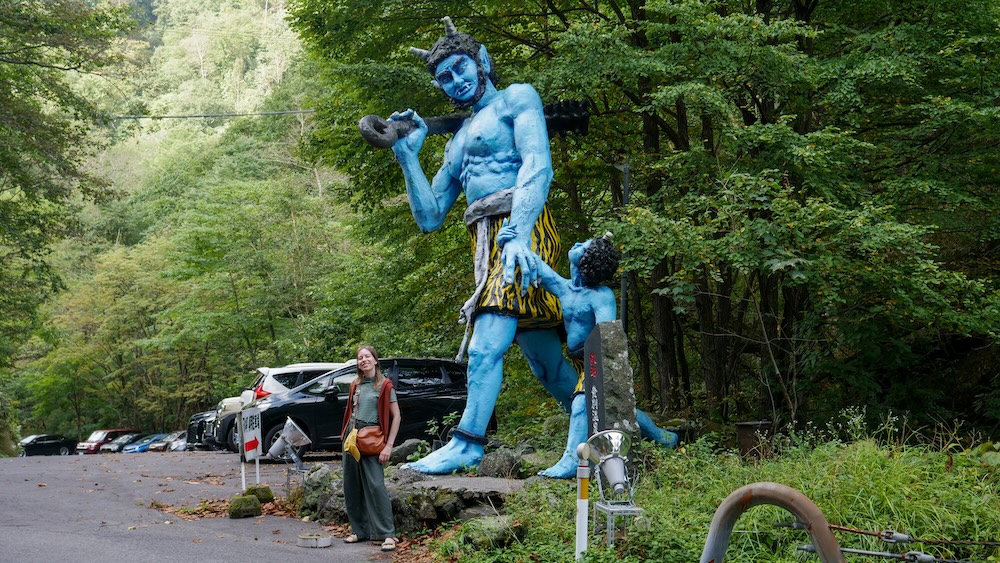
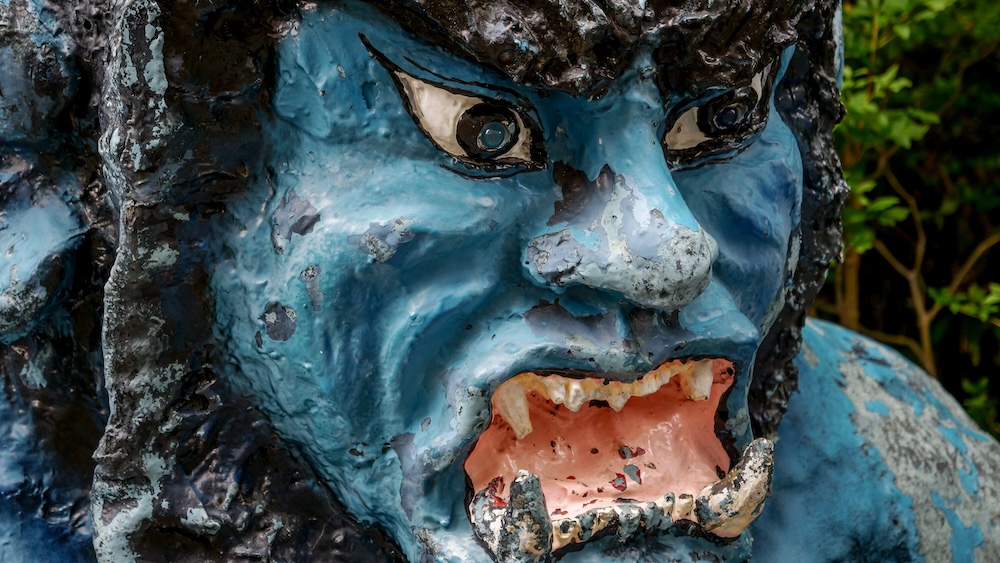
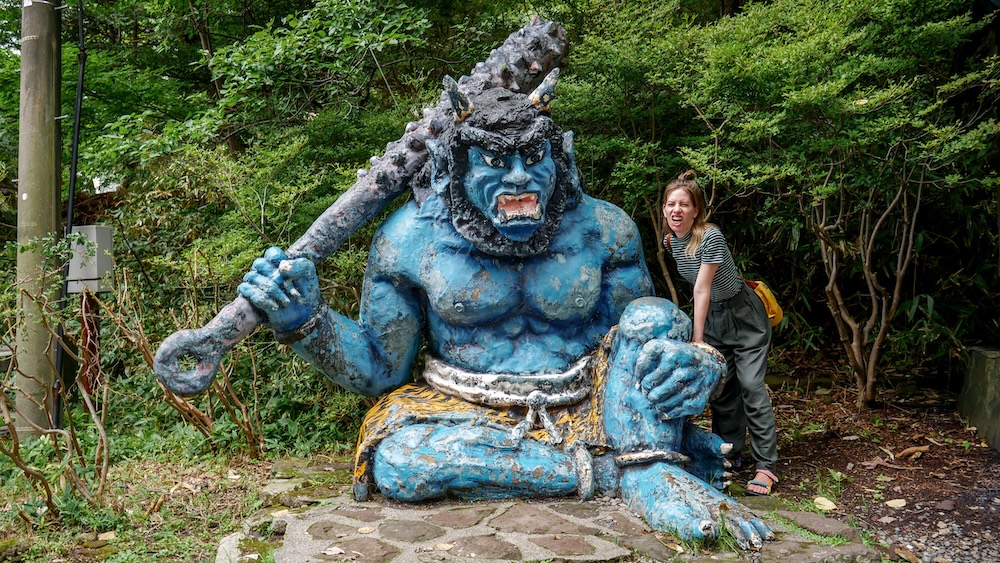
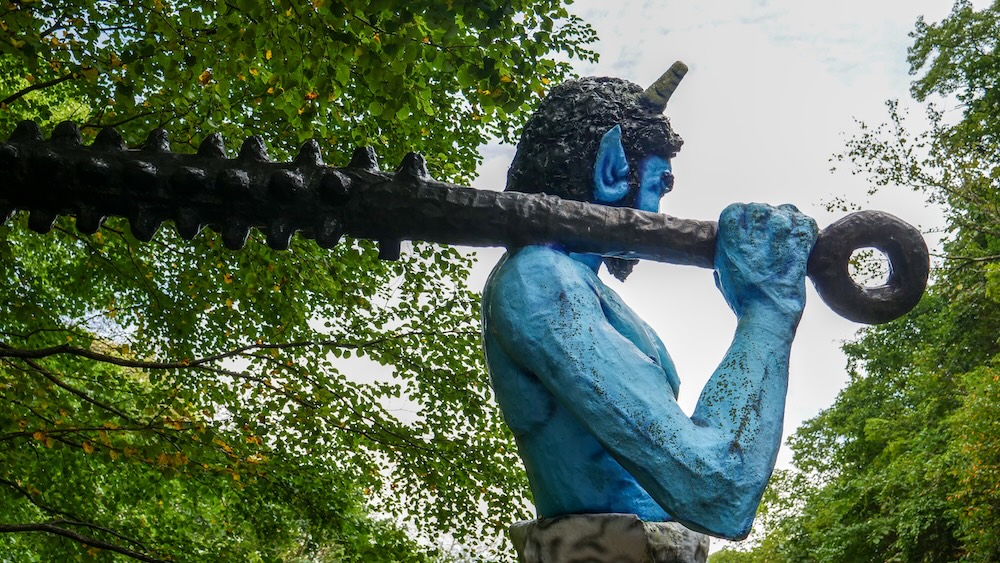
The huge blue figures were easily my favourites. Up close, their exaggerated faces are wonderfully ridiculous: horns, enormous teeth and those clubs bristling with spikes. I remember joking that the weapons looked capable of doing some serious damage, even though the figures themselves were more entertaining than intimidating. Photographing them became half the fun, especially once I stopped taking conventional full-length pictures and started looking at the odd details.
Noboribetsu has several large demon installations, so it’s worth distinguishing them rather than sending somebody after my blue, club-carrying favourites to the wrong place. One officially identified blue installation is the Parent and Child Demon Statue on the road toward the Oyunuma River Natural Footbath. The parent stands around 5 metres tall, the child around 2 metres, and the pair are holding hands. It’s a distinctive sight in its own right, although I can’t confidently identify it as the exact group I photographed during our stay.
Then there’s the red giant at the Noboribetsu-Higashi Expressway Interchange, which is a separate landmark altogether. This figure stands an extraordinary 18 metres high and weighs approximately 18 tonnes, pointing arriving visitors toward the onsen town. It’s hard to compete with that for sheer scale, but its position matters: the interchange is outside the compact pedestrian centre. If you’re arriving by car along that road, it may fit naturally into the journey; it isn’t a statue you’ll just stumble across while strolling along Gokuraku Street.
You may also see older photographs of a welcome demon outside JR Noboribetsu Station. The station and Noboribetsu Onsen are separate places, and there’s another wrinkle: an official notice says the station statue was temporarily removed for construction beginning in April 2025. That notice was still displayed when checked in October 2026, without a confirmed return date. I wouldn’t build a photo stop around it without first checking whether it’s back.
Red and blue oni at Yuzawa Shrine
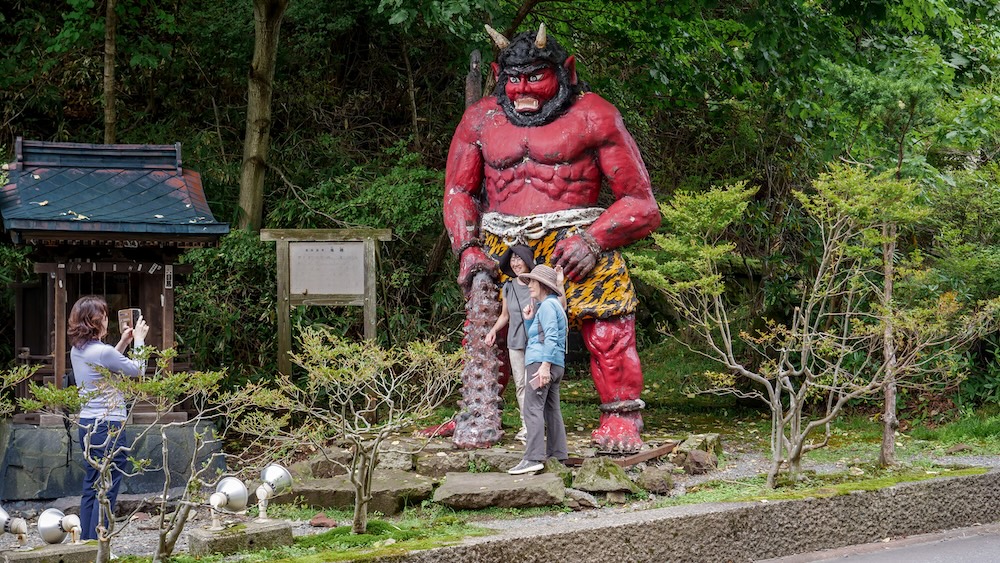
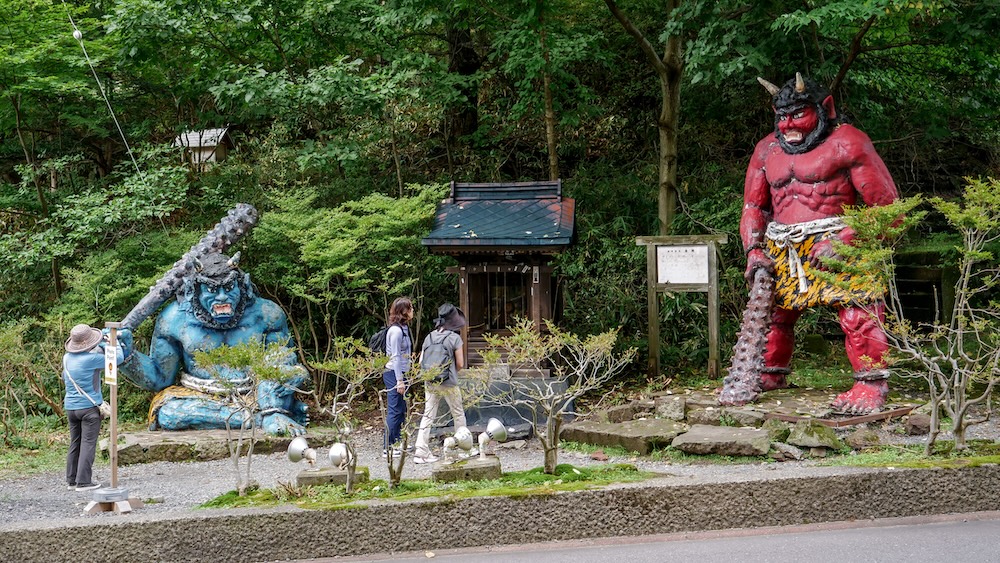
We encountered another memorable pair while visiting Yuzawa Shrine. A red demon and a blue one, both armed with clubs, greeted us around the entrance area. One of the weapons immediately reminded me of Bam-Bam from The Flintstones, which probably wasn’t the comparison its sculptor had in mind. The bright colours and exaggerated expressions fit right in with the wonderfully eccentric character of Noboribetsu.
It’s worth being precise about the setting. The figures stand at the small Nembutsu Demon Shrine, also called Onibokora, near Yuzawa Shrine; the two aren’t the same shrine. The standing red oni is about 3.5 metres tall, while the seated blue one is roughly 2.2 metres. Between them is a smaller enshrined figure associated with a much older local tradition. That historical association shouldn’t be taken to mean the large painted guardians themselves are centuries old.
Audrey and I carried on up the steep stone staircase to Yuzawa Shrine, where the surroundings felt like a quiet escape from the hotel streets below. We had the place to ourselves on that visit, which was a lovely reward for the climb. If you’re mainly interested in photographing the red and blue guardians, you don’t necessarily have to do everything we did; if you want to explore the upper shrine as well, allow for the stairs. They matter more than the relatively short distance might suggest, especially if walking uphill is difficult for you.
Demons for exams, love and business success
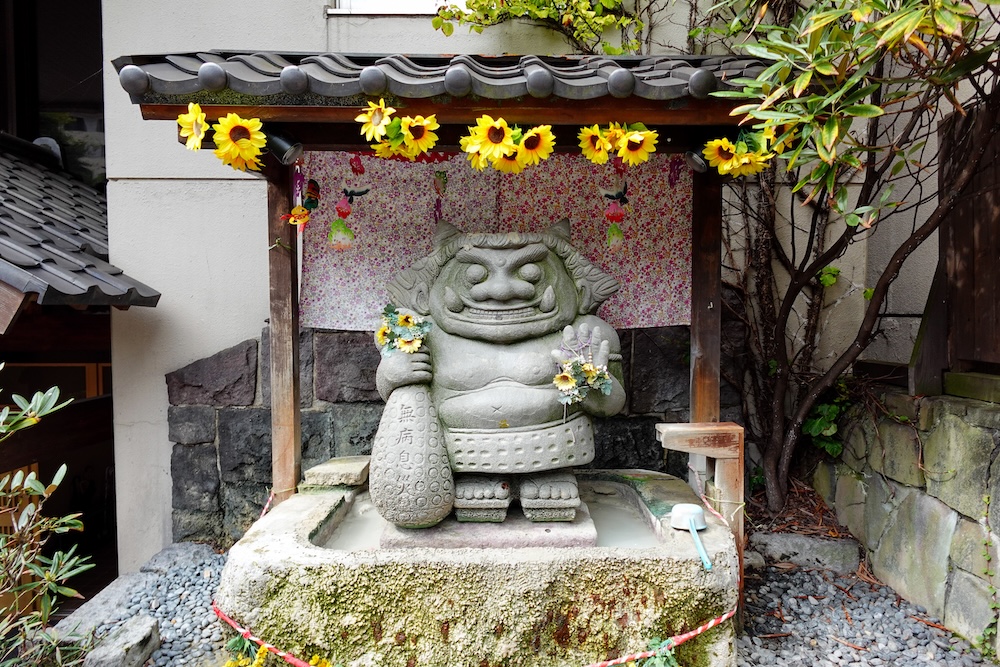
Not every figure is enormous or armed like it’s preparing for battle. Around Gokuraku Street, smaller statues are associated with particular wishes: passing exams, finding or fulfilling love, and prosperity in business. Their different purposes are part of the fun of finding them.
Audrey and I discussed which one would be most useful to us. I went straight for business success. I wasn’t in school anymore, so exam luck wasn’t much use, and we were already married, which seemed to take care of the love department. Improving the business sounded like a more practical request, even if I wasn’t seriously expecting a demon statue to sort out the books for me.
These figures are associated with the central shopping area, and there’s a walking course that connects them. We talked about the different statues during our travels, although I wouldn’t claim we individually made it to every one of them. If there’s a particular wish or figure you want to find, the local walking map is useful; otherwise, they’re well suited to the more casual style of exploring we enjoyed. There are other odd little installations nearby, including Yukake Kizo, a figure installed in 1996 and associated with wishes for good health and recovery through the hot springs. That’s a traditional symbolic association, of course, not a promise of medical results.
Sengen Park’s demon clubs and rumbling geyser
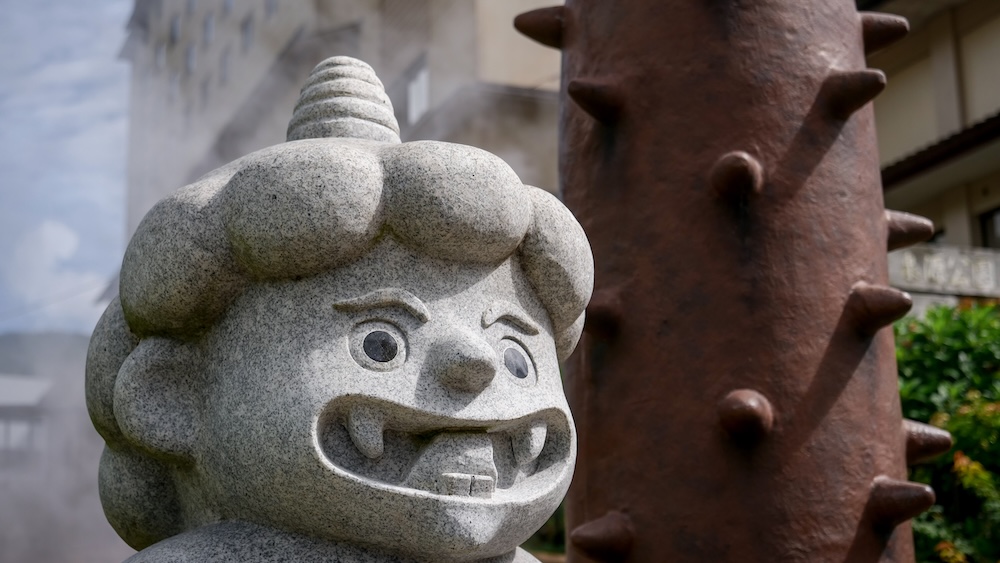
Sengen Park is another easy place to encounter Noboribetsu’s unusual combination of folklore and geothermal activity. The Nine Demon Clubs installation is associated with a local legend; the display includes eight coloured clubs arranged together, while the ninth has a separate symbolic role. Don’t assume the name means you’ll find nine identical clubs standing neatly in a row.
We visited Sengen Park and were rather more distracted by the geyser. We’d seen water gurgling there on one occasion and returned to find steam rising, with noises coming from below the ground. The whole thing prompted a joke about an angry demon waking up, which seemed appropriate given everything else we’d encountered in town. The geothermal activity does an admirable job of supporting the mythology without mechanical assistance, and the park adds a distinctive stop to a walk through the onsen district without requiring a detailed study of the nine-club legend.
Enmado: plan around King Enma’s transformation
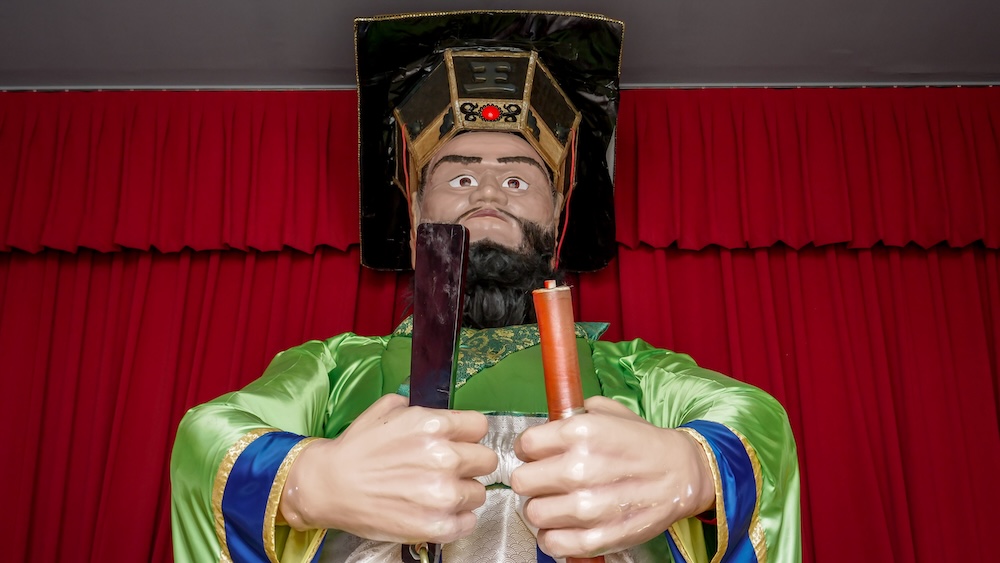
Enmado is the one demon attraction I’d actually check the time for. Audrey and I watched its scheduled performance, and it was much more entertaining than simply passing another statue in the street. The attraction houses a large mechanical figure of King Enma, associated with a karakuri float built in 1993 for Noboribetsu’s 30th Hell Festival.
When Enma is sitting still, you can admire the figure without much happening. Then the performance starts: drumming rings out, his face turns red, his eyebrows change and fangs appear as his expression becomes increasingly furious. It’s a wonderfully theatrical little spectacle, and seeing that transformation in person is the entire point of planning around a show. I wouldn’t describe it as genuinely terrifying, although a young child might find that suddenly angry face startling.
The published official schedule checked in October 2026 lists performances at 10:00, 11:00, 13:00, 15:00, 17:00, 20:00 and 21:00, with no admission charge. Those times are useful for planning a morning walk or an evening in town, but they’re not a guarantee. Mechanical problems interrupted the shows in August 2026, and performances officially resumed on August 21 with a warning that further maintenance could cause cancellations. Weather can affect operations, too; an older hotel guide also lists a different seasonal timetable.
If seeing Enma transform matters to you, check the current Enmado performance information and any recent notices before arranging your day around a particular showing. There’s no reliable fixed show duration to build into a tight connection, either. I’d leave some flexibility rather than plan to race from a performance straight onto a bus. An overnight stay makes the timing easier. Audrey and I stayed at Park Hotel Miyabitei, within walking distance of the central sights, so we could enjoy the town without planning everything around a bus. If that kind of base appeals to you, you can check rooms at Park Hotel Miyabitei. You don’t have to stay in Noboribetsu to enjoy Enmado, though, if a performance fits your visit.
A casual walk past Enmado might show you the stationary figure, but only a scheduled performance delivers the drumming, moving face and fangs. It’s the one demon-related stop where I’d plan ahead.
Hell Valley gives the demon theme its setting
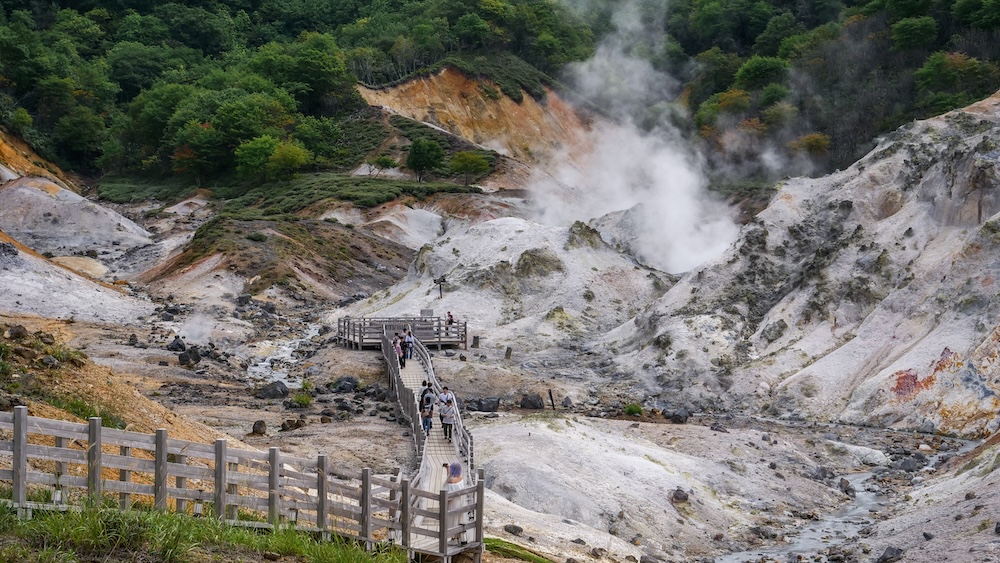
I enjoyed the oni statues for their absurdity, but Jigokudani Hell Valley is where the underworld theme becomes a little easier to understand. Audrey and I walked through an astonishing volcanic landscape of bleached rock, orange soil, bubbling pools and steam pouring out of the ground. There was a strong sulfur smell, and in places you could feel heat coming from the geothermal activity rather than simply from the weather.
We could hear water gurgling and watch steam escape from openings in the earth, sometimes in several directions at once. It’s a peculiar feeling to walk through somewhere that seems so visibly active. After seeing the cartoonishly fierce guardians around town, I found it fascinating to encounter a landscape that could have inspired their whole underworld association.
The main Hell Valley viewing area sits close to Noboribetsu Onsen, with the principal access described as roughly five minutes on foot from the onsen bus terminal. That doesn’t mean you can explore the entire geothermal trail network in five minutes; the walks toward Oyunuma and the surrounding forest take considerably longer. For this demon-themed visit, however, you don’t need to hike every trail to appreciate the steam, exposed volcanic terrain and connection with the town’s imagery. Save the more detailed walking decisions for a dedicated Hell Valley outing, and check current trail access before committing to longer routes.
If you are based in Sapporo and mainly want to see the geothermal scenery, a guided day trip to Hell Valley and Lake Toya is an alternative to arranging the regional transport yourself. Just read the itinerary carefully: this is a broader Hokkaido sightseeing tour, not a demon-statue walk, and it does not promise time to catch Enmado’s transformation.
Do you need a demon-hunting itinerary?
For most people, I don’t think so. The central Gokuraku Street figures are close enough together to work into an ordinary walk between restaurants, shops and other attractions. That’s how it felt to us; just don’t expect every statue in the wider Noboribetsu area to fit into the same circuit.
There are two useful official options if you’d rather have a bit of structure. A 30-minute Demon Statue Course covers selected central figures, including Yukake Kizo and statues associated with exams and love. The broader 60-minute Power Spot & Demon Course adds other wish-related stops and Sengen Park, along with a shop stop. Those are suggested walks, not guaranteed completion times, and neither automatically includes the giant interchange statue, a Yuzawa Shrine climb, all of Hell Valley or the scheduled Enmado performance.
If you want to explore independently over a couple of days, where you sleep makes a difference. We enjoyed having the onsen district on our doorstep; you can compare hotels in Noboribetsu Onsen rather than accidentally choosing a property closer to JR Noboribetsu Station and facing the journey uphill for every walk.
The official Noboribetsu walking map is handy for seeing how Gokuraku Street, the shrine area and Hell Valley relate to one another. We also encountered a road section without a sidewalk during our stay, so keep an eye on traffic rather than assuming every connection is a dedicated pedestrian path. The shrine stairs and longer geothermal trails deserve their own assessment if you have limited mobility; a short distance on a map tells only part of the story.
| If you especially want to… | What I’d focus on | What to plan for |
|---|---|---|
| Enjoy demons without a fixed route | Gokuraku Street and nearby figures | Wander at your own pace |
| Watch a transformation | Enmado | Confirm a current performance time |
| See the red-and-blue guardians | Nembutsu Demon Shrine area | Extra stairs if continuing to Yuzawa Shrine |
| Understand the underworld setting | Main Hell Valley viewing area | Separate it from longer trail hikes |
| Photograph an outlying giant | Specific blue or red welcome installation | Check its location before making a detour |
Which demon attractions would I prioritize?
My personal favourites were the enormous blue oni. Photographing their huge faces, spiked clubs and comically oversized feet was more entertaining than it probably had any right to be, although I’d check the specific blue installation before making a detour.
I’d also keep the red-and-blue guardians near Yuzawa Shrine in the mix, particularly if you’re comfortable with the staircase and want something beyond the main street. Hell Valley deserves a place in a Noboribetsu visit because the actual volcanic landscape gives the demon imagery a context that no colourful statue can reproduce. And if you can arrange the timing, watch King Enma transform at Enmado. That’s the one attraction I’d make a deliberate appointment with.
Otherwise, go for a walk, look around and see what appears. Noboribetsu is one of the few places where you can set out for an ordinary stroll through a hot-spring town and end up photographing a demon’s toenails. I wouldn’t want to plan all the spontaneity out of that.
Frequently Asked Questions
Do you need to follow a demon-statue walking route in Noboribetsu?
No. I enjoyed encountering the oni naturally while walking around Noboribetsu Onsen, particularly Gokuraku Street. If you prefer a route, there are official 30-minute and 60-minute demon-themed courses, though neither covers every outlying statue or a timed Enmado performance.
When does King Enma transform at Enmado?
The schedule published in October 2026 lists 10:00, 11:00, 13:00, 15:00, 17:00, 20:00 and 21:00. Performances are free, but mechanical maintenance, weather and possible seasonal changes can affect them. Check the current Enmado information before planning around a specific time.
Are the giant blue oni and the red expressway demon in the same place?
No. The red welcome demon stands at the Noboribetsu-Higashi Expressway Interchange, outside the central pedestrian area. A separate blue parent-and-child statue installation is on the road toward the Oyunuma River Natural Footbath.
Is Yuzawa Shrine the same as the Nembutsu Demon Shrine?
No. The standing red and seated blue oni flank the nearby Nembutsu Demon Shrine, also called Onibokora. Audrey and I continued up the steep stone staircase to Yuzawa Shrine; visitors mainly interested in the guardian statues do not necessarily need to complete that climb.
Can you visit Hell Valley as part of a Noboribetsu demon walk?
Yes. The main Jigokudani Hell Valley viewing area is close to Noboribetsu Onsen, and its steaming volcanic landscape helps explain the town’s underworld imagery. Longer trails toward Oyunuma are separate outings and take more time.
This guide is also available in Spanish. [Leé la versión en castellano: Guía de los demonios de Noboribetsu: estatuas oni, Enma y Valle del Infierno]
This article contains affiliate links. If you book through one of these links, I may earn a commission at no extra cost to you.