
Laguna Capri is the hike we recommend when you want the Fitz Roy postcard without committing to the full “final boss” day. It’s the Fitz Roy Lite option: short enough to fit into a half-day, scenic enough to feel like a major win, and popular enough that you’re not wandering around Patagonia alone.
I ended up doing Laguna Capri during our El Chaltén trip in full foodie mode: big breakfasts, shameless photo stops, a proper lunchbox picnic, and the occasional internal monologue of “why is the air attacking me?” That’s the sweet spot for this guide: real trail strategy + experience .
Our own Laguna Capri day started with full Patagonia optimism: bluebird skies, Fitz Roy looking fake-phenomenal-from-town, and Audrey and I walking out the door convinced we were organized. Spoiler: we were not. We were already in “camera distraction” mode, which is great for memories and terrible for efficiency—so if you’re the kind of hiker who stops every 90 seconds to point at a mountain and whisper “what is that?”, this guide is for you.
If you only remember one thing: Laguna Capri is not a consolation prize. It’s a genuinely beautiful destination hike with a classic Fitz Roy view—perfect for your first day in town, a short-weather-window day, or a “we want epic scenery but also an equally epic dinner” day.
Laguna Capri at a glance
Laguna Capri is on the same main trail that leads toward Mirador Fitz Roy and Laguna de los Tres. You start from El Chaltén’s main northern trailhead, climb steeply right away, cruise through lenga forest, hit a big signed fork after roughly 3 km, and then dip down to the lagoon.
Quick stats (realistic planning ranges)
One thing I loved about El Chaltén: the whole town understands hiking. Most places serve breakfast ridiculously early because everyone is chasing weather windows. At our lodge, breakfast started at 6:30 a.m., which is basically a gift to anyone trying to be a responsible trekker (or at least someone pretending to be one).

🧾 Quick Booking: Your El Chaltén Travel Essentials 🥾✨
🎒 Your Travel Toolkit (Book These 4 Things)
| ✅ What to book | 💡 Why it’s worth it | 🔗 Quick link |
|---|---|---|
| 🥾 Tours & experiences | Easy way to lock in a glacier day, a Lago del Desierto adventure, or a guided option when weather turns moody | Browse El Chaltén tours on Viator |
| 🏨 Hotels & stays | El Chaltén sells out fast in peak season — booking early = better locations + fewer “only the priciest rooms left” moments | Find El Chaltén hotels on Booking.com |
| 🚗 Car rentals (optional) | Best for freedom days: Ruta 40 viewpoints, flexible timing, photo stops, and a smoother Lago del Desierto run | Compare car rentals in El Calafate (gateway to El Chaltén) on DiscoverCars |
| 🚌 Bus tickets | The classic El Calafate ↔ El Chaltén route is simple — but popular departure times fill up | Book El Calafate → El Chaltén buses on Busbud |
👉 One-click backup (reverse direction): Book El Chaltén → El Calafate buses on Busbud
| Metric | What to plan for | Why it varies |
|---|---|---|
| Distance (round-trip) | 8–10 km | GPS tracks differ and people wander the shoreline |
| Elevation gain | 250–400 m | Steep start, gentler middle, small rolling sections |
| Time on feet | 3–5 hours | Pace, wind, photo stops, and lagoon lounging time |
| Difficulty | Easy–moderate | “Easy” by El Chaltén standards; still a steep first km |
| Best for | Half-day Fitz Roy view | High reward per step, flexible scheduling |

The “Destination Snapshot: pick your vibe”
| Option | Vibe | Best for | Ideal stay | Don’t miss |
|---|---|---|---|---|
| Laguna Capri | Fitz Roy Lite | Half-day hikers, first-timers | 2–7 nights in town | Lunchbox picnic at the lagoon |
| Laguna de los Tres | Trophy day | Strong legs + stable forecast | 3–7 nights | The final steep push viewpoint |
| Laguna Torre | Moody masterpiece | Scenic variety lovers | 2–7 nights | Glacier lake drama even in mixed weather |
| Chorrillo del Salto | Recovery win | Tired legs + easy payoff | Any stay | “We still hiked today” energy |

Entry fees, tickets, and the visitor center
El Chaltén’s main trails sit within Los Glaciares National Park’s “Portada El Chaltén” zone, and access is ticketed. Fees can change, but the published daily pass for foreign visitors (general) is AR$45,000, with lower categories for Argentine nationals and certain resident/student categories. Always check the official parks site before you hike so your budget stays grounded in reality.
Practical note: the system is geared toward online purchase, and you’ll want to sort it before you’re standing at the trailhead doing the Patagonia “please load” stare at your phone.
If you can, also swing by the visitor center in town (when open) for:
- Trail condition updates (snow/ice, closures, wind advisories)
- Daylight timing reminders
- Current winter procedures and any special safety requirements
We’re biased because this saved us stress: when we arrived in town, we got maps and rules/info early on, and it immediately made the trails feel more “DIY confident” instead of “DIY chaos.” Even if you’re only doing Capri, having the official info in your brain makes every junction decision calmer.
Trailhead logistics (and our “don’t be us” moment)
The Laguna Capri trail starts at the north end of El Chaltén, at the end of Avenida San Martín where the road stops and the hiking begins. El Chaltén is wonderfully walkable, so most people just stroll to the trailhead.
Here’s how our morning started: crystal-blue sky, Fitz Roy looking outrageous from town, and two very confident hikers who had—hypothetically—forgotten their map. Not the end of the world, but it added unnecessary stress at exactly the moment you want your brain to feel calm and competent.
Our version of forgetting the map was extra special because we left it behind on the nightstand like true professionals. That led to a classic first-day stumble: one wrong turn, a longer walk than expected, and the immediate realization that you do not want to rely on mobile data here. It was the perfect reminder that “offline map downloaded” is not an optional personality trait in Patagonia.
Do the 60-second check before you leave:
- Offline map downloaded (or a paper map)
- Water topped up
- Wind/rain layers in the bag
- Snacks you actually want to eat
- A rough plan: “Capri only” or “Capri + maybe extend” with a turnaround time
Also: factor in where you’re staying in town. From our end of El Chaltén, just walking to the start point took a meaningful chunk of time (since we were closer to the bus terminal) before we even began “official hiking.” It’s not a problem—just plan for it so your snack schedule doesn’t start negotiating with reality at 9 a.m.

The hike, step-by-step (how it actually feels)
Laguna Capri is simple to follow, but it has a few key moments that shape your day. Patagonia is not the place to pretend you’ll “figure it out later,” so here’s the route in the most usable format: what your body feels, what you see, and when you decide things.

0.0–1.0 km: the steep wake-up climb
The trail begins with a message from gravity: welcome to El Chaltén, please sweat immediately.
It’s not technical, but it is steep enough that a fast start can backfire. Audrey and I went with short steps, steady breathing, and frequent “photo stops” that were definitely artistic and absolutely not cardio recovery. (Okay, they were cardio recovery.)
This is me in my happy place, by the way: trekking in Patagonia with Fitz Roy somewhere ahead, pretending I’m disciplined while my camera keeps demanding “one more angle.” The steep first kilometer is where we gave ourselves permission to hike—slow, chatty, breathy, and weirdly proud of every tiny flat-ish patch of trail.

Mirador Río de las Vueltas: first reward, first morale boost
Early on you hit Mirador Río de las Vueltas, with a broad look over the valley and river below. Everyone pauses here because it’s the first big “Patagonia is real” moment of the day.
The name is perfect: Río de las Vueltas is basically the river doing an S-curve flex through the valley. I also learned something about myself here: I was already eating part of my lunch like it was a recovery day and not a big hike day. It was only 9 a.m. and I had zero regrets at the time.

Here is also where you realize the most important truth about Laguna Capri: you get great scenery quickly, which makes the rest of the hike feel like a bonus rather than a debt.

1.0–2.0 km: still climbing, but rhythm arrives
The climb continues, but it starts to feel more cruisable. This is where your legs stop complaining quite so loudly and your brain shifts from “why” to “wow.”

2.0–3.0 km: lenga forest and wind shelter
Around the 2 km area you move into taller lenga forest. On windy days this is a gift. El Chaltén wind has the emotional subtlety of a drum solo, so any shelter feels like the universe giving you a hug and a bit of reprieve.

Just after ~3.0 km: the fork that decides your day
This is the big navigation moment. There’s a signed fork where one direction continues toward the larger Fitz Roy objectives, and the other leads to Laguna Capri.
On our hike, the fork felt refreshingly clear: one direction pulls you toward a mirador/continuation of the Fitz Roy objectives, and the other angles you toward Capri (and the nearby campsite). This is where Audrey and I stopped, did the honest check-in, and basically said: “Okay, Capri first. Then we’ll decide if we’re heroes or just regular people who like dinner.”
Even if you’re only doing Capri, pause here for a quick assessment:
- How’s the wind?
- How’s the visibility?
- How do our legs feel (honestly)?
- Are we still on schedule?
If Capri is your goal: commit, turn, and enjoy the fact you’re about to get a ridiculous view without needing to fight the full-day battle.

Fork to lagoon: the gentle descent into paradise
After the junction, the trail trends more gently and you drop down toward the lagoon. It feels like Patagonia is rewarding you for the earlier climb by letting your quads relax before the payoff.

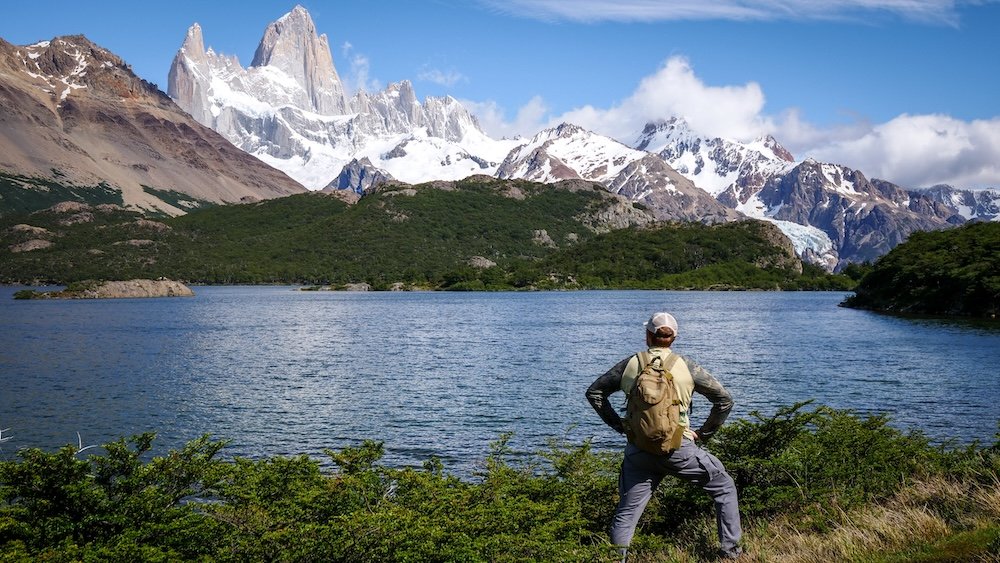
And then it opens up: water in the foreground, forest framing, and Fitz Roy looking like someone turned the “drama” slider to 200%.
We also hit peak “foodie trekker” energy around this part of the trail: lunchbox snacks, little sugar boosts, and the strategic realization that eating now prevents future sulking. Our lunchboxes were classic hiker fuel—rice salad, fruit, a muffin, granola bar, and a suspicious amount of candy—because nothing says “mountain athlete” like chewing sweets while staring at granite giants.
Kilometer-by-kilometer cheat sheet
The kilometer markers in El Chaltén deserve their own round of applause. We loved them because they turn your hike into manageable bites: you always know how you’re tracking, and you can make smarter calls about side trails (or decide to play it safe) based on real progress instead of vibes.

| Segment | What it feels like | What to do |
|---|---|---|
| 0–1 km | Steep, sweaty, immediate effort | Go slow, sip water, don’t sprint |
| 1–2 km | Climb continues but feels smoother | Find a rhythm, snack lightly |
| 2–3 km | Forest cruise, calmer wind | Settle in, enjoy the shelter |
| ~3 km fork | Decision point | Reassess, pick your plan |
| Fork → lagoon | Gentler, slightly downhill | Save your best snack for the lake |
| Lagoon time | Maximum reward | Eat, chill, photos, don’t rush |

What Laguna Capri is like (the payoff, the vibe, the linger strategy)
Laguna Capri is not a “touch the sign, leave” kind of destination unless you’re operating on a some super-strict schedule.
The best version of this hike includes a proper sit-down. We’re talking: layers on, lunchbox out, stare at the mountain like a happy idiot.

The view (and why it’s so iconic)
On a clear day you get the classic Fitz Roy composition: the lagoon in front, dark green forest, and the jagged granite skyline behind. It’s the kind of view that makes you laugh because it looks unreal. We had a genuine “is this CGI?” moment.
Audrey and I genuinely stood there doing the Patagonia version of speechless: pointing at Fitz Roy, laughing, and trying to explain to our future selves that yes, it really looked this ridiculous in real life. Also: the “welcome to paradise” moment pairs nicely with the practical reality that the campground area nearby has basic facilities (think outhouse energy). We used it, felt instantly more civilized, and then celebrated with a very serious muffin bite like we’d earned it.
Wildlife: condors are a real possibility
We had condors circling overhead on our hike, which is the sort of Patagonia moment that instantly makes you feel tiny in a good way.
Not just “a condor,” either—we had three circling above us at one point, which caused an immediate full stop and a very mature reaction: “LOOK! LOOK! LOOK!” They’re so big and effortless in flight that it makes you feel tiny…in the best possible Patagonia way.

If Fitz Roy is hiding in clouds
This happens. More than you’d think. Fitz Roy has a long-standing hobby of disappearing behind cloud at the exact moment you arrive. If conditions are safe, give it a little time. Peaks can reveal themselves quickly, and a “moody day” can turn into a dramatic skyline cameo in 10 minutes.

Photography notes (simple, useful)
- Early morning light is often softer and the trail is calmer.
- If it’s windy, reflections usually vanish, but water texture looks great.
- Walk the shoreline a little to find angles with fewer people and better framing.
Capri only or extend? The honest decision matrix
Laguna Capri is already a win. Extending toward Mirador Fitz Roy or even Laguna de los Tres can be amazing—if the day is stable, you started early, and your legs still feel like they belong to you.
Here’s the most honest matrix we can offer, based on our personal experience and real Patagonia weather:

| Question | Green-flag answer | If your answer is “no”… |
|---|---|---|
| Is wind/visibility stable? | Yes, and it’s staying consistent | Capri only. Don’t gamble. |
| Are we on schedule? | Ahead or comfortably on time | Capri only. Late starts compound. |
| Do we have enough food/water? | Yes, plus extra snacks | Capri only. Hunger makes bad calls. |
| Do we feel good, not just “fine”? | Yes, we’re cruising | Capri only. “Fine” becomes “why?” later. |
| Are we still enjoying this? | Honestly yes | Capri only. Fun is the point. |
If you want a personal truth: we love ambition, but we love finishing days happy even more. A lot of El Chaltén greatness comes from choosing the right challenge on the right day—not forcing a bigger hike just because the trail continues.
Personal example: when we reached Capri, we had the exact two-option moment—loop back and keep it half-day pleasant, or continue onward toward the bigger objective. It was early, the weather was cooperating, and we were making good time (thank you, kilometer markers), so Audrey and I went for it. That decision turned a “Fitz Roy Lite” day into a full-on endurance day—amazing, but definitely not something you want to improvise late in the afternoon.
Timing, crowds, and weather (the three things that secretly decide your day)
Best time of day
Earlier is better for:
- Calmer wind (often)
- Better light
- Fewer people
- More flexibility if you decide to extend
That said, we are not here to shame late starts. Sometimes the bakery wins. We get it. Seriously, we do. Just keep the plan simpler if you start later.
I hiked in peak summer daylight mode, and it still surprised me: it gets bright insanely early and the evening hangs on forever. That extra daylight buys you flexibility, but it doesn’t make you invincible—wind can ramp fast, clouds can roll in, and your legs can start wobbling like jell-o if you let the day get too ambitious.
Start time matrix
| Start time | What the day feels like | Best for |
|---|---|---|
| 7:00–8:30 | Quiet trail, great light, calmer vibe | Photographers, peak-season sanity |
| 8:30–10:00 | Normal busy day, still comfortable | Most travelers |
| 10:00–12:00 | Crowds build, wind risk rises | Slow mornings, Capri-only plan |
| After 12:00 | You’re gambling with daylight and weather | Only with stable conditions and fast pace |
The wind reality (Patagonia’s signature move)
El Chaltén wind isn’t a rare event; it’s a recurring character. Laguna Capri has sheltered forest sections, but viewpoints and the lagoon can feel exposed.
| Wind vibe | What it feels like | What we do |
|---|---|---|
| Manageable | Hair is annoyed | Keep going, layer smart |
| Spicy | You’re leaning into gusts | Shorten exposed stops, keep moving |
| Aggressive | Balance is a negotiation | Consider turning back early |
| Unhinged | The air is doing violence | Turn around and celebrate with dessert |
Turnaround times and “don’t let the mountain write your schedule”
Because Laguna Capri is “short,” people get casual about time. The dangerous move is not doing Capri late—it’s doing Capri late and then improvising an extension because you feel good for 20 minutes at the lagoon.
We like setting a simple hard turnaround time before we start walking. Not because we’re strict, but because Patagonia weather loves surprise endings.
| If you start… | Capri-only plan feels best | “Maybe extend” only if everything is green |
|---|---|---|
| 7:00–8:30 | Turn around whenever you’re satisfied | Set an extension decision deadline (example: noon) |
| 8:30–10:00 | Plan to leave the lagoon by early afternoon | Only extend if you’re ahead of schedule and wind is stable |
| 10:00–12:00 | Capri only, no debate | Extensions become stressful fast |
| After 12:00 | Consider a shorter viewpoint day instead | Extensions are a “don’t” |
A good rule of thumb: if you’re asking, “Can we make it?” you’re already borrowing against future comfort. If you’re asking, “Do we still want to?” you’re thinking like a smart hiker.
A simple half-day timeline (so you can plan meals like an adult)
Classic morning version
- 8:30 breakfast (big, salty, real food)
- 9:15 start hiking
- 10:00 Mirador Río de las Vueltas (pause, photos, water)
- 11:00–11:30 junction + commit to Capri
- 12:00–12:45 lagoon picnic + peak staring
- 14:00 back in town and immediately hungry again
Late-start bakery version
- 10:30 start hiking (no guilt, just honesty)
- 11:15 first viewpoint
- 12:30 junction + Capri
- 13:00–13:30 quick lagoon hang (wind often ramps later)
- 15:00–16:00 back in town for a café and a nap you claim you don’t need
If conditions are chaotic: the “still a win” backup plan
If wind is roaring or visibility is sketchy, you can still have a great day without pushing to the lagoon:
- Hike to Mirador Río de las Vueltas, reassess, and decide if the forest feels comfortable
- If gusts are slapping you around at exposed spots, treat it as a short hike and head back
- If you’re cold, don’t wait to be miserable—layer up early and keep moving
- If you need a no-hike day, lean into the El Chaltén café culture and call it “strategic recovery”
Patagonia rewards people who pivot on purpose without drama.
What to pack (smart, light, and not delusional)
Laguna Capri is short enough that you can overpack out of fear or underpack out of optimism. The best approach is boring and effective: layers + wind protection + snacks.
Micro-gear matrix
| Item | Must-have? | Why |
|---|---|---|
| Windproof layer | Yes | Patagonia wind is relentless |
| Rain shell | Yes | Weather can flip quickly |
| Warm mid-layer | Yes | You cool fast when you stop |
| Gloves + beanie | Recommended | Wind + sweat = chill |
| Sunscreen + sunglasses | Yes | UV can be savage even when cool |
| Offline map | Yes | Confidence and safety (learn from us) |
| Headlamp | Yes | Short hike doesn’t mean short day |
| Poles | Optional | Great for knees, helpful on slick sections |
| Microspikes | Seasonal | Huge help on ice and packed snow |
Layering guide (how to stay warm without carrying your entire closet)
The trick in El Chaltén is not “dress warm.” The trick is dress so you can adapt every 15 minutes:
- You’ll heat up fast on the climb.
- You’ll cool down instantly when you stop.
- Wind turns sweat into a refrigeration system.
| Conditions | What we wear on the move | What we add when we stop |
|---|---|---|
| Mild + calm | Base layer + light wind layer | Mid-layer if sitting long |
| Mild + windy | Base layer + windproof shell | Beanie/gloves + mid-layer |
| Cool + windy | Base + mid-layer + wind shell | Add puffy or extra fleece |
| Wet / mixed | Base + shell (venting!) | Dry layer if you have it |
Water, toilets, and cell signal (the unsexy details that matter)
- Water: bring enough for a half-day. Even if you’re not thirsty, wind and sun can dry you out.
- Toilets: use a bathroom in town before you start. If you’re lingering at the lagoon, knowing where the basic facilities are helps everyone stay civilized.
- Cell signal: assume it’s not reliable when you need it most. Download your offline map and don’t build your safety plan around a loading spinner.
We learned this fast: mobile data can be unreliable, and even Wi-Fi in town can be spotty at the exact moment you want it to behave. The practical takeaway is simple—download what you need before hiking so your safety plan isn’t a loading spinner.
Blister and knee survival (tiny tips, huge impact)
- If your shoes are new, Laguna Capri is not the day to “break them in.”
- Wear socks you trust, not socks you found at the bottom of your bag like a mystery artifact.
- If your knees complain on descents, slow down, shorten your stride, and consider poles on future hikes. Pride is expensive; knees are priceless.
Food strategy: the lunchbox culture
One of the best El Chaltén upgrades is ordering a lunchbox from town—simple, filling, and perfect for a lagoon picnic. Ours was peak hiker fuel: rice salad, muffin, fruit, a little candy, granola bar energy. Not fancy, but at Fitz Roy’s feet it tastes like a Michelin star.
Also, the lunchbox thing makes even more sense when you realize some rooms don’t have a mini-fridge or a communal kitchen setup you’d actually want to rely on. For us, ordering the night before and grabbing it in the morning was the simplest way to guarantee a proper lagoon picnic without doing a stressful food scavenger hunt.
The snack rule that prevents bad moods
- Eat something small every 30–45 minutes.
- Drink water even if it’s cold.
- If you’re cranky, you’re probably hungry (or windy, or both).

Camping at Laguna Capri and seasonal notes
Camping near Laguna Capri can be a great strategy if you want early, quieter lagoon time and better odds of calm conditions. Park systems and rules (including reservations and fees) have changed in recent seasons, so confirm current requirements before you plan an overnight.
Seasonally:
- Summer: long daylight, busiest trails, best odds for dry conditions.
- Shoulder season: fewer people, more variable weather, bring warmer layers.
- Winter: snow/ice likely, short daylight, and extra safety procedures may apply (including registration and traction gear depending on current policy).

How Laguna Capri fits into a smart El Chaltén trip
Our favorite El Chaltén rhythm is: big day, recovery day, weather-flex day, big day, easy buffer. Patagonia laughs at rigid itineraries, so building in flexibility keeps the trip fun.
Laguna Capri shines as:
- Your first big “wow” hike after arrival
- A high-payoff day when you don’t want full-day fatigue
- A great plan when weather is mixed and you still want Fitz Roy energy
Capri vs the other classics (quick comparison)
| Hike | Time | Difficulty vibe | Payoff | Best for |
|---|---|---|---|---|
| Laguna Capri | Half day | Steep start, then chill | Fitz Roy lagoon view | Fitz Roy Lite day |
| Laguna de los Tres | Full day | Final boss climb | Iconic viewpoint | Trophy day |
| Laguna Torre | Full day | Steady scenic variety | Glacier lake drama | Moody scenery fans |
| Chorrillo del Salto | 1–2 hours | Easy | Waterfall | Recovery day win |
Common mistakes, safety, and trail etiquette
Mistakes we see all the time
- Going too fast in the first kilometer and paying for it later.
- Starting late and trying to extend because “it’s not that far.”
- Underestimating wind and getting chilled at the lagoon.
- No offline map and then feeling stressed at the junction.
Our simple safety rules
- Pack layers even if the morning looks perfect.
- Decide your turnaround time before you start.
- If visibility drops or wind ramps, shorten the plan early.
- Leave plenty of daylight margin for the walk back.
Trail etiquette that makes Patagonia nicer
- Let faster hikers pass and keep the trail moving.
- Pack out every wrapper (even the tiny candy ones).
- Keep noise low—people came for mountains, not your playlist.
- Respect camping and toilet rules (the park can’t clean up after thousands of people daily).
The post-hike reward plan (essential)
We consider this an “essential” part of training: after Laguna Capri, you deserve a meal that feels slightly irresponsible and a drink that tells your legs, “we did it.”
El Chaltén understands this assignment.

✨ Ready to lock in your El Chaltén plan?
- 🥾 Browse El Chaltén tours on Viator
- 🏨 Find El Chaltén hotels on Booking.com
- 🚗 Compare El Calafate car rentals on DiscoverCars
- 🚌 Book El Calafate → El Chaltén buses on Busbud
Laguna Capri Hike in El Chaltén FAQ (Trail Time, Difficulty, Tickets, Camping, and Weather Tips)
Is Laguna Capri worth it if I’m not doing Laguna de los Tres?
Yep. You still get a classic Fitz Roy view across a lagoon, and it feels like a complete Patagonia experience without the full-day grind.
How hard is the Laguna Capri hike?
Moderate. The first kilometer is steep enough to make you sweat; after that it becomes much more comfortable.
How long does it take to hike Laguna Capri?
Most hikers land around 3–5 hours round-trip, depending on pace and how long you lounge by the lagoon.
Can I do Laguna Capri as a half-day hike?
Absolutely. Start in the morning and you can be back for a late lunch.
Where is the Laguna Capri trailhead?
At the north end of El Chaltén, at the end of Avenida San Martín, at the main Fitz Roy trailhead.
Do I need a guide for Laguna Capri?
Nope. The trail is popular and well marked. You just need basic preparedness and weather awareness.
Is Laguna Capri crowded?
Often, yes—especially in peak summer. Starting early makes a big difference.
What’s the best time of day for photos?
Early morning is usually best for softer light and fewer people. Windier afternoons can still look dramatic, just with fewer reflections.
What if Fitz Roy is in the clouds when I arrive?
Wait a bit (if conditions are safe). Peaks can reveal quickly, and sometimes you’ll get a dramatic “curtain lift” moment.
Is Laguna Capri a good hike in windy weather?
Sometimes. The forest sections are sheltered, but the lagoon can be exposed. If gusts get aggressive, shorten your lagoon linger time and head back.
Can I camp at Laguna Capri?
Yes, there’s a camping area near the lagoon. Confirm current reservation rules and fees before planning an overnight.
Is Laguna Capri doable in winter?
Yes, but winter conditions can mean snow/ice, shorter daylight, and additional safety procedures. Get local advice and carry traction if needed.
Are trekking poles necessary?
Optional but certainly handy. They’re great for knees on descents and very helpful in slippery conditions.
Are there kilometer markers on the trail?
Yes, and they’re surprisingly motivating. They keep the hike feeling bite-sized and help you manage time.
What’s the single biggest mistake people make on this hike?
Starting late and then trying to extend. Late starts plus changing weather is where “easy hike” turns into “stress hike.”
Is Laguna Capri good for beginners?
Yep. As long as you pace the steep start, bring layers, and keep your plan realistic, it’s one of the best beginner-friendly “big view” hikes in El Chaltén.
Is it worth doing Laguna Capri if I’m only in El Chaltén for one day?
Yes—especially if you want a Fitz Roy view without gambling everything on a longer trek. It’s a smart, high-reward choice.
Project 23 Argentina: This guide is also available in Spanish. [Lea la versión en castellano: Guía de Trekking a Laguna Capri: El Mejor Sendero Corto “Fitz Roy Lite” en El Chaltén]
Further Reading, Sources & Resources
Want to double-check the latest fees, trail rules, maps, and weather before you lace up? Here are the most useful official + local resources we’ve discovered to keep your Laguna Capri plan grounded in reality and as up-to-date as possible.
Official park fees, tickets, and planning (Los Glaciares / El Chaltén)
- https://www.argentina.gob.ar/parquesnacionales/tarifas
National Parks fee table (includes the “Los Glaciares – Portada El Chaltén” entry). - https://www.argentina.gob.ar/interior/ambiente/parquesnacionales/losglaciares/tarifas
Los Glaciares–specific tariffs page, including notes on when current prices took effect and where to buy. - https://www.argentina.gob.ar/interior/ambiente/parquesnacionales/losglaciares/actividades
“Plan your visit” hub for Los Glaciares (North Zone), including official downloads and visitor info. - https://www.argentina.gob.ar/parquesnacionales/patagonia-austral/recomendaciones-para-visitar-el-parque-nacional-los-glaciares
Official safety/recommendations page (useful for common-sense rules, preparedness, and park guidance).
Official maps and trail PDFs (North Zone / El Chaltén)
- https://www.argentina.gob.ar/sites/default/files/folleto_senderos_zona_norte_pnlg_ingles_digital.pdf
Official North Zone trails brochure (English), with maps and key trail references (including the Capri/Fitz Roy corridor). - https://elchalten.tur.ar/wp-content/uploads/2020/12/EL-CHALTEN-TURISMO-MAPA.pdf
El Chaltén tourism map PDF (handy for town layout + trail context).
Local trail descriptions and practical hiking detail
- https://elchalten.tur.ar/laguna-capri/
Local tourism page for Laguna Capri with a simple overview and basic expectations. - https://elchalten.com/v4/en/laguna-capri-trek-el-chalten.php
Local hiking write-up with practical trail notes (good for quick confirmation of what you’ll encounter).
Weather reality-check
- https://www.argentina.gob.ar/smn
Argentina’s national meteorological service (best starting point for official forecast context before hiking).
Notes on accuracy
- Fees, rules, and camping procedures can change (sometimes mid-season). Always treat the official APN pages above as the final word.
- Trail distance/time stats vary depending on GPS tracks, shoreline wandering, and how long you linger at the lagoon. Use ranges, not single numbers.
- Weather is the boss in El Chaltén (wind/visibility especially). Even with a “short” hike like Capri, check conditions the day of and set a turnaround plan.