
Before I’d ever set foot in the Canadian Rockies, I could have named the sights without much research. Lake Louise. Moraine Lake. The Icefields Parkway. Every Banff itinerary I’d seen online repeated the same four or five names, and I’d absorbed them the way you absorb a city’s skyline before you visit — secondhand, but confidently. Takakkaw Falls wasn’t on that list. I hadn’t heard the name before the day we drove out to see it, and if you’d asked me that morning to guess the biggest surprise of a day that also included Lake Louise and Moraine Lake, I wouldn’t have guessed a waterfall I couldn’t have pronounced an hour earlier.
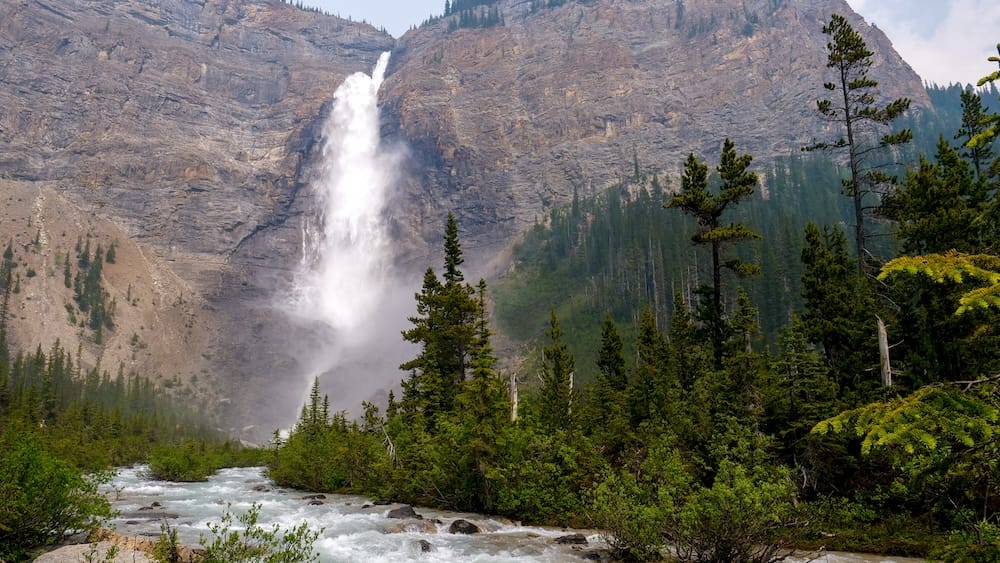
It ended up being exactly that. Not because the other stops disappointed — they didn’t — but because nothing had prepared me for what a waterfall could actually feel like up close, and because the drive to get there turned out to be part of the experience rather than a detour from it.
The Drive Up: What the Switchback Approach Is Actually Like
By the time we turned off toward Takakkaw, we’d already done Lake Louise, Moraine Lake, and a stop at the Spiral Tunnels to watch a freight train work its way down the mountain in a slow figure-eight. We were tired in the pleasant way a good day makes you tired, and I assumed the next stop would be more of the same: park, walk a short distance, take some photos, move on.
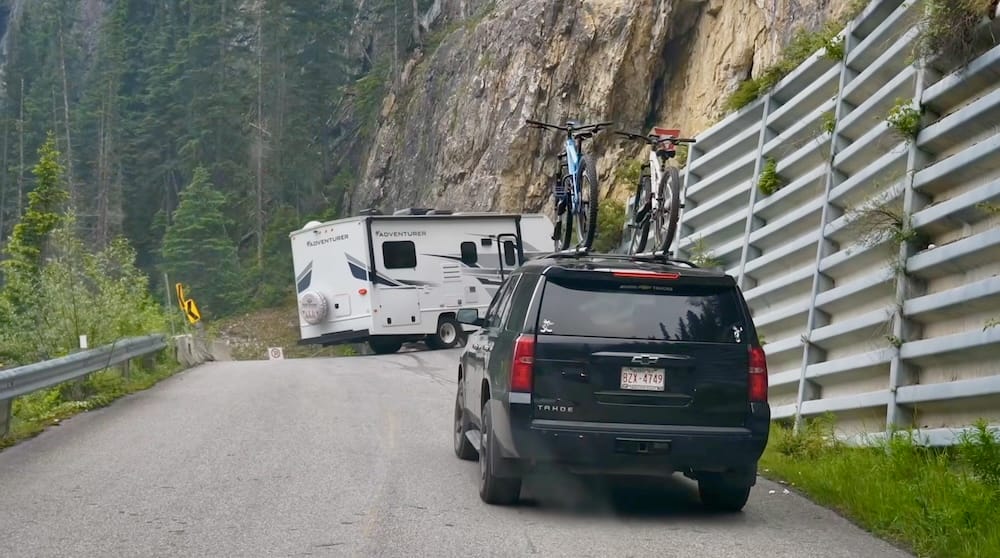
Then the road started climbing, and it climbed the way roads climb when someone decided a mountain wasn’t going to dictate the route. Yoho Valley Road switches back on itself hard enough that you can watch the pavement you were just on appear again below you, and somewhere in the middle of that climb, one of us said out loud what we were all thinking: it’s like a zigzag up. That drew an immediate agreement about needing to be a good driver to manage it, and there was real relief in the car when we made the top in one shot. No joke, someone added, and nobody argued.
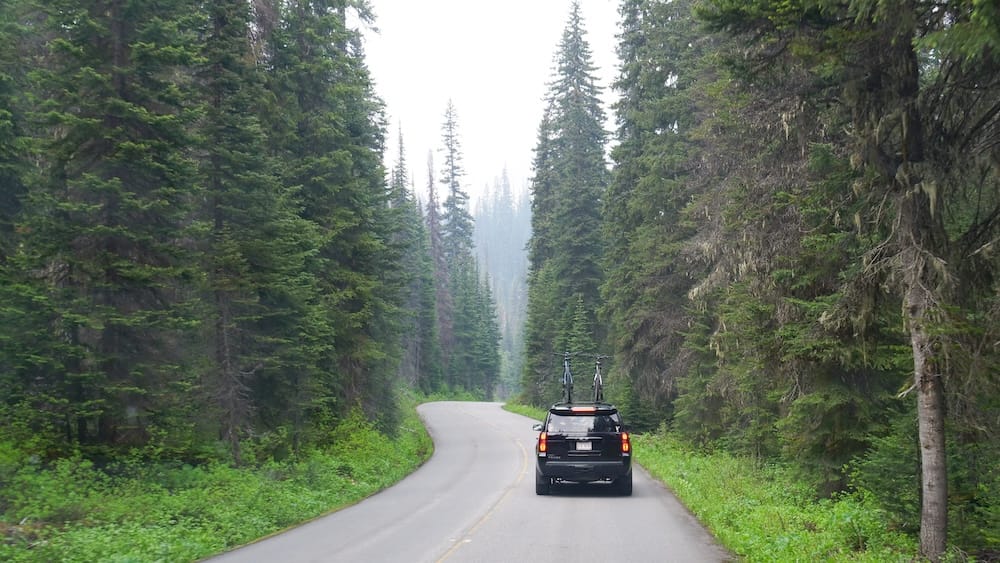
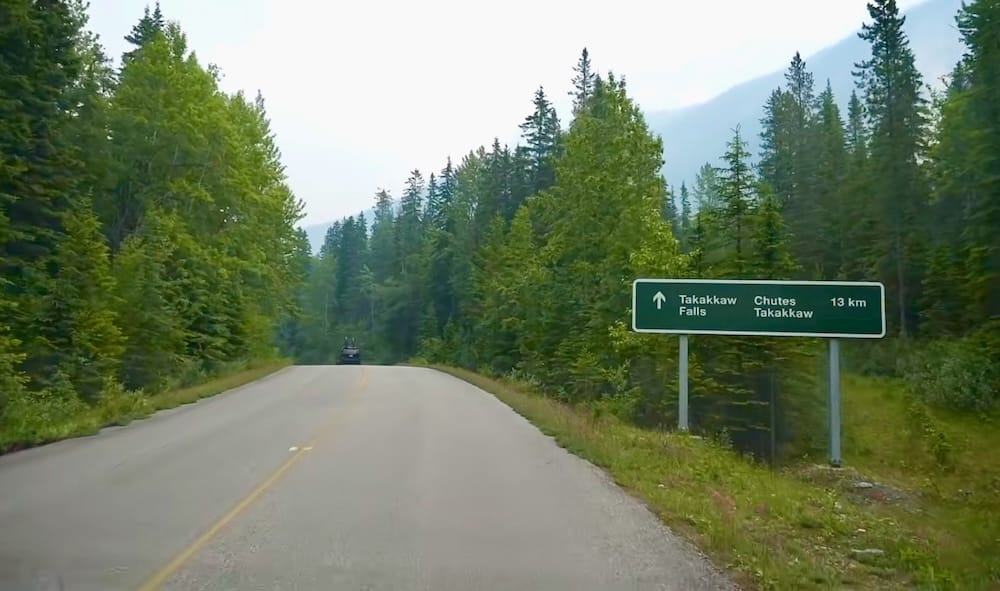
That climb runs for around 14 kilometres and takes twenty to twenty-five minutes if you’re not stopping, with two switchbacks tight enough that anything over seven metres — a big RV, anything towing a trailer — struggles to get around them. Trailers aren’t allowed on the road at all. If you’re self-driving in a standard car or a smaller van, none of this is dangerous, but it is a real driving experience, not a formality between you and the parking lot. We hit some traffic on the way up, which surprised me a little given how remote it felt — apparently that’s normal in peak season, when everyone else touring Yoho that day funnels up the same narrow road at the same time.
We also caught our first glimpse of the falls partway up, before we’d even parked, which did more to build anticipation than any photo I’d seen beforehand. There’s something about watching a waterfall grow larger through a windshield, switchback by switchback, that a still image just can’t replicate.
Keep in mind, too, that this climb is only possible for about four months of the year. Yoho Valley Road closes for the winter due to avalanche risk, generally reopening sometime in mid-June and closing again by mid-October, with the exact dates shifting slightly depending on that year’s snowpack. Outside that window, Takakkaw Falls isn’t reachable by car at all — worth checking current road status before you build a day around it.
Arriving at the Falls: Scale, Mist and Getting Soaked
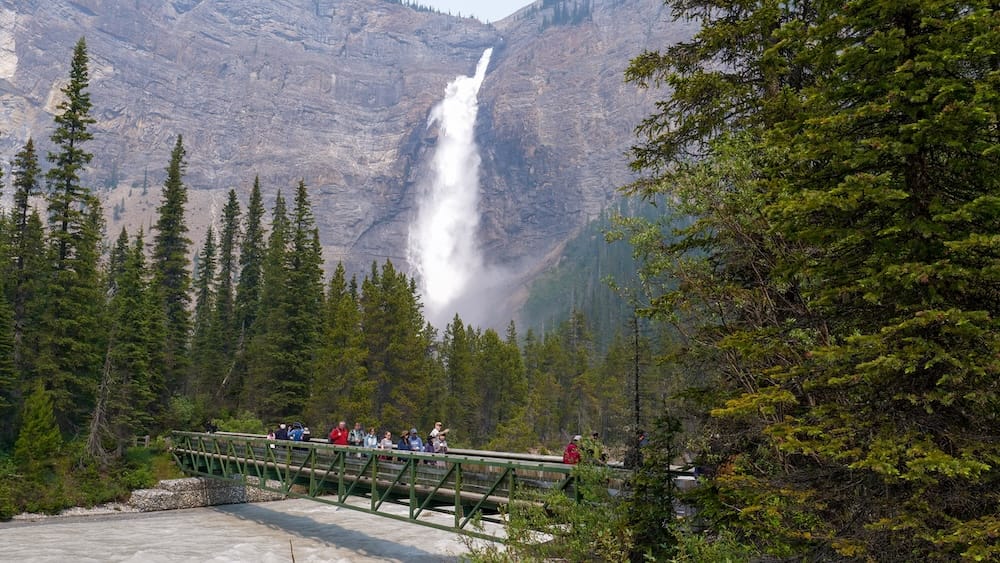
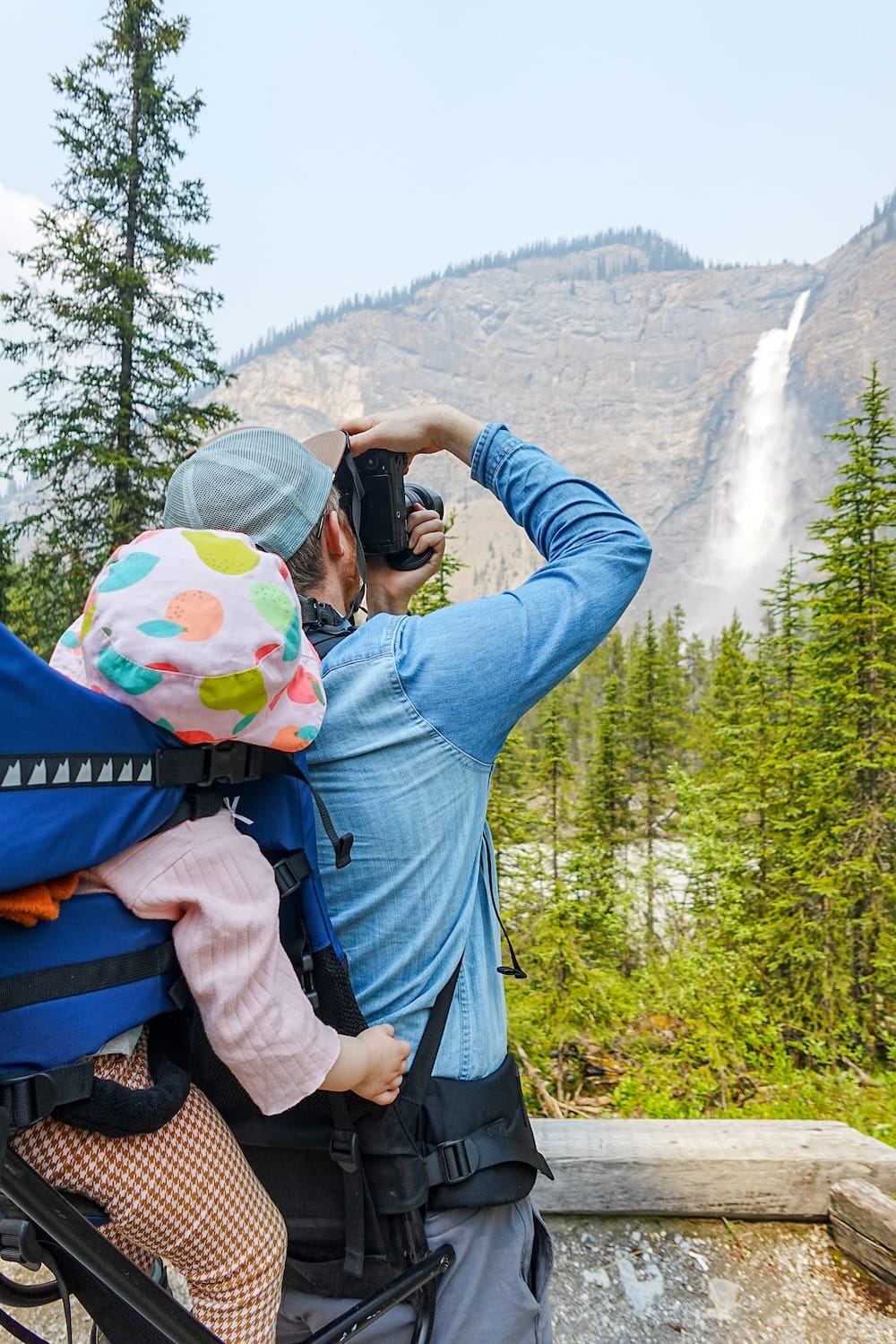
We parked, got out, and started walking, and the air changed almost immediately — cooler, damper, carrying the particular mineral smell of a forest that gets rained on by something other than rain. The trail from the lot to the base is short, paved, and basically flat, the kind of path you could push a stroller down or navigate in a wheelchair without trouble. That accessibility is almost misleading, because it undersells what’s waiting at the end of it.
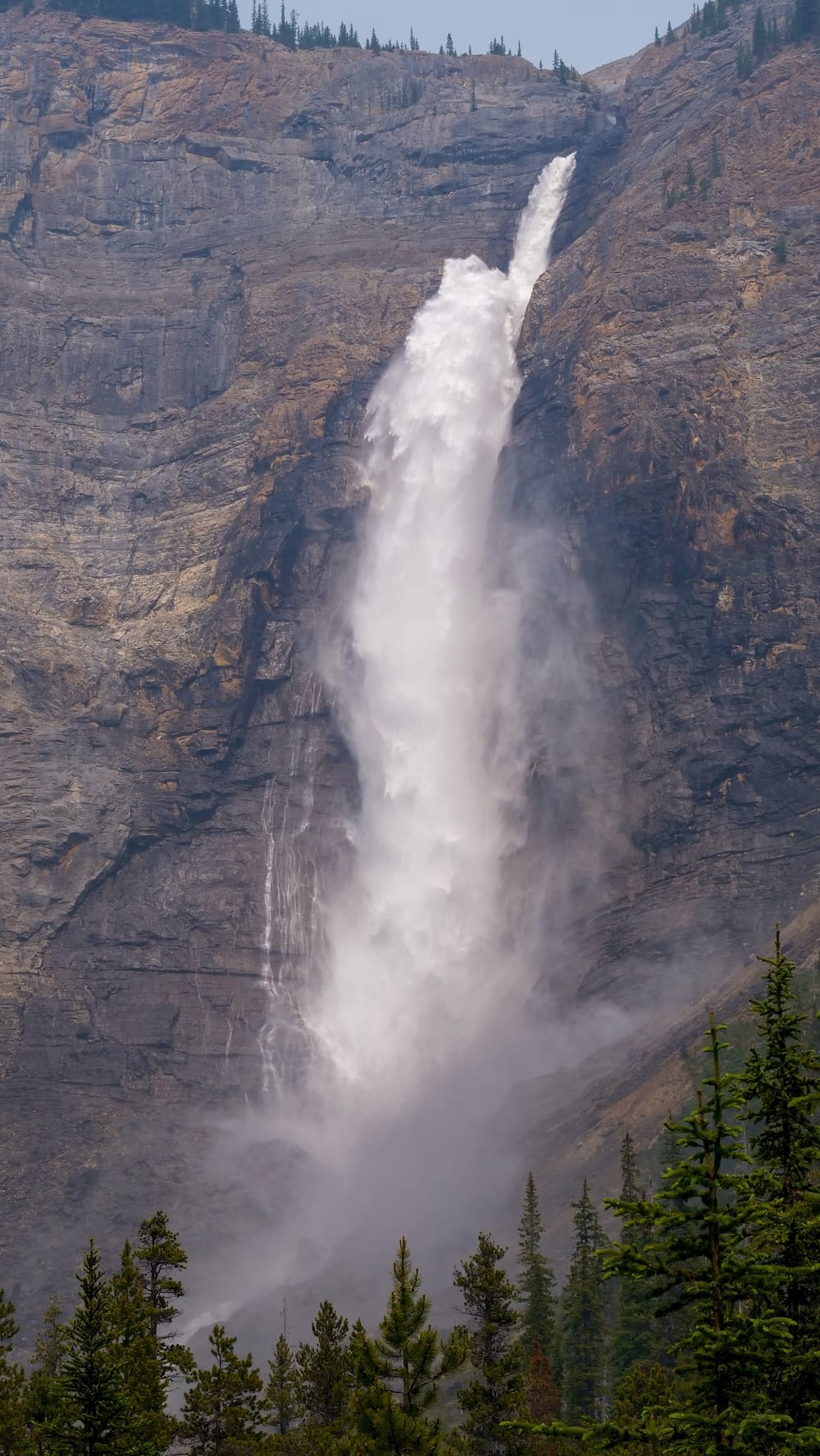
Takakkaw Falls is one of the tallest waterfalls in Canada — commonly cited as the second-highest in the country, with a total drop somewhere around 375 metres and a single uninterrupted plunge of roughly 250 to 260 metres depending on which measurement you trust. The name itself is Cree, loosely translated as “it is magnificent,” which is the rare piece of tourism trivia that turns out to undersell the thing it’s describing rather than oversell it.
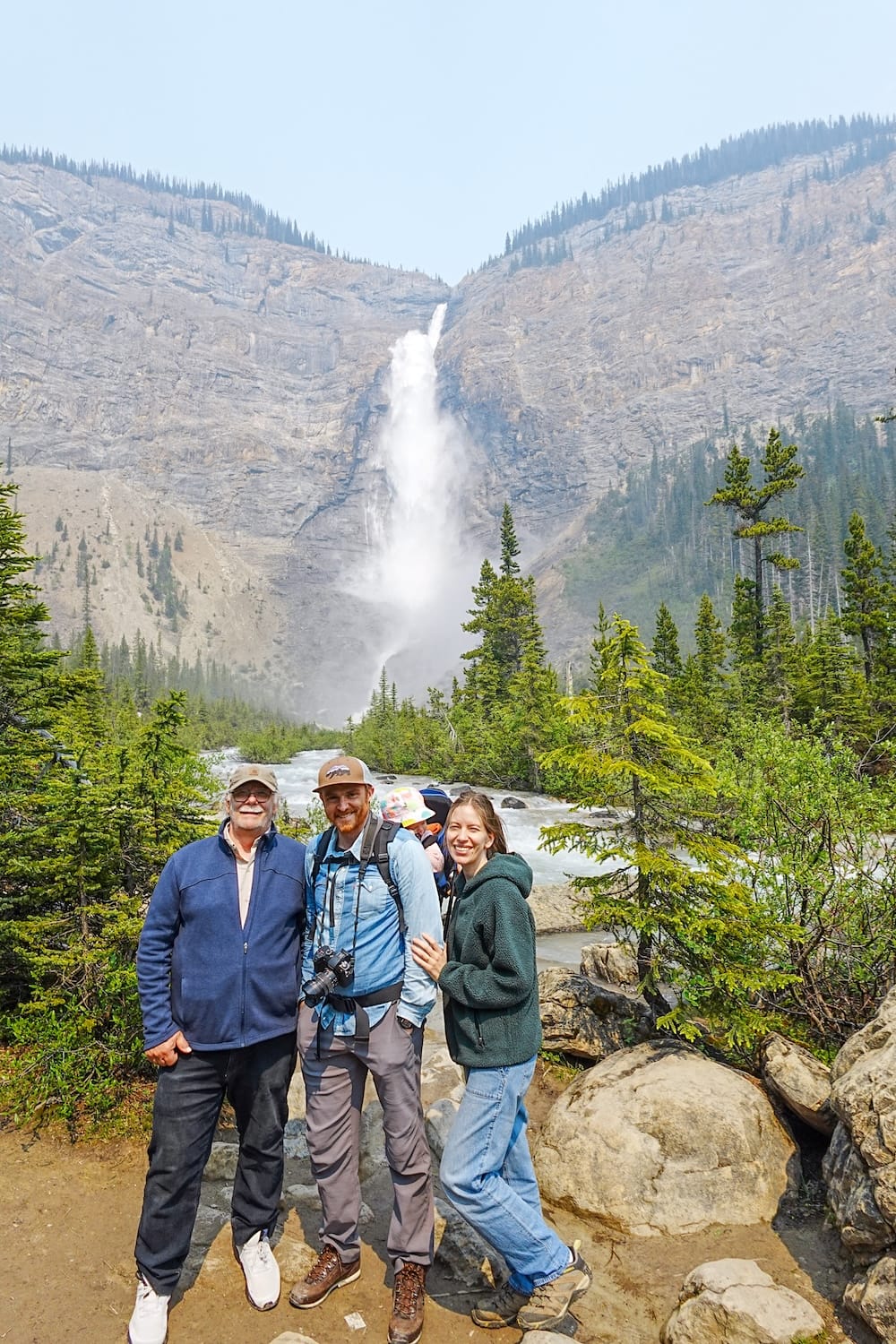
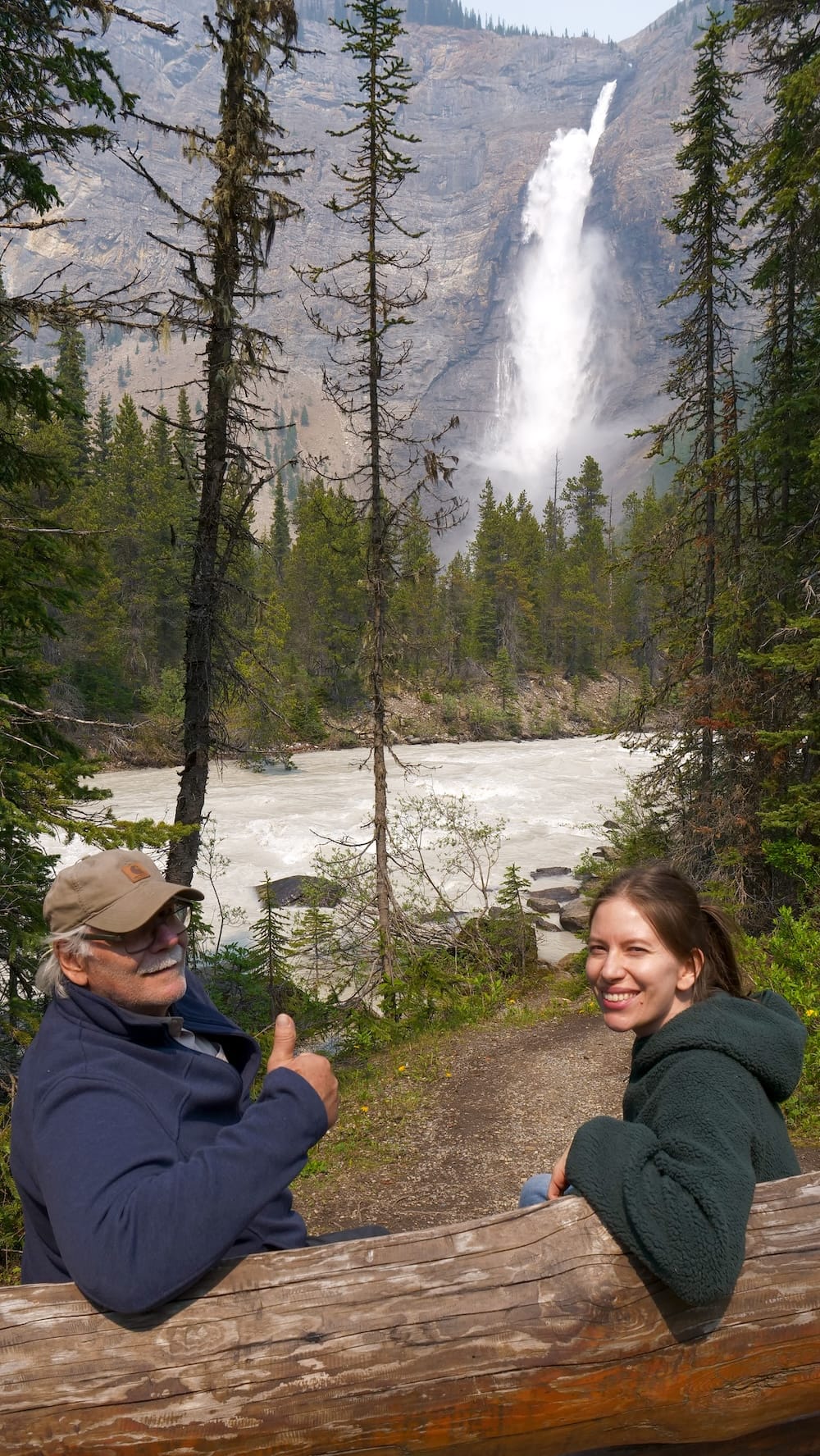
We’d been watching the falls grow on the drive up, and I still wasn’t ready for what it felt like to stand near the base. The sound arrives before anything else — a low, constant roar you feel as much as hear. Then the mist starts, gently at first, cool against the skin like standing in front of an open freezer on a hot day. We kept walking, and the mist stopped being gentle. Within a few dozen more steps it turned into wind-driven spray, soaking, the kind of intensity where glasses fog and streak until they’re functionally useless and you’re laughing because there’s nothing else to do about it. It’s not an exaggeration to call it a shower — it’s the closest thing to standing in one, fully clothed, outdoors, with a mountain doing the work instead of a showerhead. We were drenched within a couple of minutes, and neither of us minded.
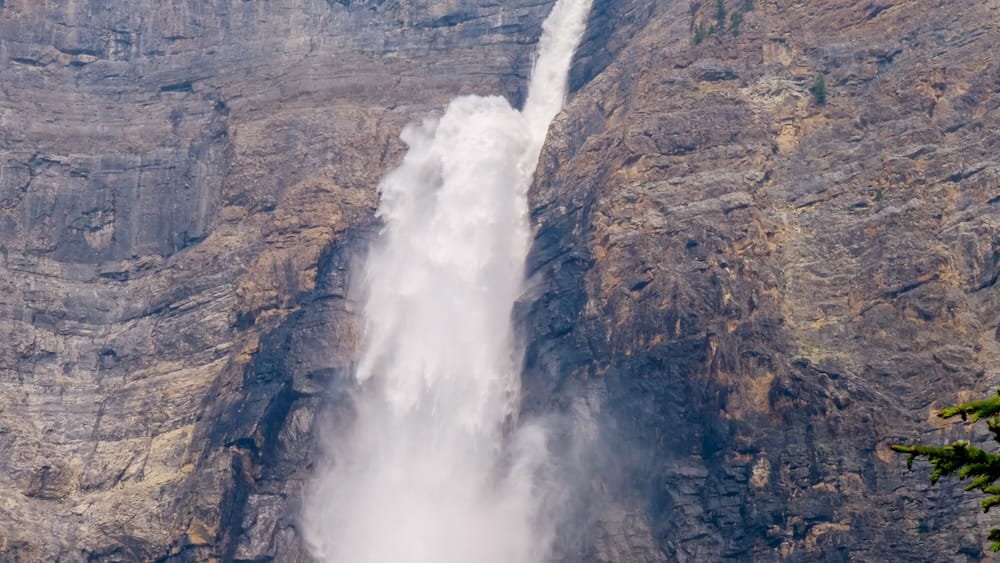
The falls are fed by glacial meltwater off the Daly Glacier, and the flow — along with the intensity of that mist — tends to peak in the warmer months when the glacier is melting fastest. We happened to be there deep in that stretch, which probably explains why it hit us as hard as it did. That physical intensity isn’t unique to us, either: the spray gets strong enough in peak season that it’s not unusual for people to stop short of the base rather than get soaked. I’d go the other direction. If you’re going to get drenched by a Canadian waterfall once in your life, you could do a lot worse than this one.
Why Takakkaw Falls Loses the Popularity Contest (and Maybe Shouldn’t)
What I keep turning over, though, is this: nothing about that experience felt like a lesser version of Lake Louise or Moraine Lake. If anything, the physical scale and intensity of Takakkaw hit harder than either of those postcard-famous lakes did that same day. And yet if you asked a hundred people planning a Banff trip to name their must-see stops, I’d bet very few would say Takakkaw Falls, while almost all of them would say Lake Louise or Moraine Lake without hesitating.
I don’t think that’s about quality. I think it’s about geography and timing. Lake Louise and Moraine Lake sit inside Banff National Park itself, close enough to town that they anchor almost every Banff itinerary before a visitor has even left home. The Icefields Parkway has decades of postcard photography behind it and a built-in reason to drive it — it’s the road to Jasper. Takakkaw Falls sits across a provincial border in a different national park, down a switchback road that most people have never heard mentioned until they’re already planning the trip in detail. It isn’t competing on merit. It’s competing on proximity and pre-existing fame, and it’s losing that particular contest against excellent company.
Which is really the argument for going anyway. If Takakkaw Falls existed almost anywhere else — without Lake Louise fifteen minutes one direction and Moraine Lake fifteen minutes the other — I think it would be a standalone headline attraction, somewhere people would build entire trips around. It just happens to exist in the one pocket of the world with enough spectacular competition to keep it behind the names that get said first.
Practical Details: Getting There, Parking and What to Bring
We saw all this from the back of a private tour van, not from behind our own steering wheel, so I can tell you exactly what the drive and the falls felt like, but I can’t speak to every detail of navigating it independently. The logistics below come from digging into what a self-driving visitor actually needs to know, not from something we personally tested.
Takakkaw Falls sits roughly 93 kilometres from Banff townsite, and depending on traffic and how many stops you make along the way, that translates to somewhere between an hour and an hour and twenty minutes of driving each direction — not counting any time at Lake Louise, the Spiral Tunnels, or anywhere else you fold into the same day. The parking lot at the end of Yoho Valley Road is small relative to how popular the falls have become, and it fills up during the busiest midday hours in July and August. Arriving early in the morning or later in the afternoon avoids both the parking scramble and the thickest crowds at the base.
One detail that catches a lot of people off guard: you don’t need a separate pass to enter Yoho on top of whatever you’re using for Banff. A standard Parks Canada day pass or an annual Discovery Pass covers entry into Yoho, Kootenay, Jasper, and the other Rocky Mountain national parks along with Banff itself, so as long as your pass is valid for the day you’re travelling, you’re covered crossing the provincial border into British Columbia. There’s no second gate fee waiting for you at Takakkaw.
If you don’t have a vehicle, or you’d simply rather not navigate a switchback mountain road yourself, guided day tours running from Banff, Canmore, and Calgary regularly include Takakkaw Falls, usually paired with Emerald Lake and the Natural Bridge as a full Yoho day. You can check current availability for one of these full-day Yoho tours if you’d rather leave the switchbacks to someone else. It’s a reasonable way to see all three without any of the driving anxiety, and it solves the parking problem entirely, since someone else is responsible for finding a spot.
Whichever way you get there, pack for getting wet. A light rain layer is enough — you’re not going to need a full poncho — but assume that if you walk to the base in peak season, you’re coming back damp. We didn’t bring anything to stay dry and didn’t regret it, but that was a choice we made on purpose, not an accident I’d recommend everyone repeat.
Is Takakkaw Falls Worth Adding to Your Banff Itinerary?
Yes, and more emphatically than I expected to say it before we went. The drive alone is worth it for anyone who enjoys a good mountain road, and the payoff at the end is physically unlike anything else we saw that day — closer to weather than to a scenic overlook. If your Banff trip already has room for a full day exploring Yoho National Park, don’t let Takakkaw get relegated to a five-minute photo stop on the way to Emerald Lake. Give it the time to actually walk to the base and feel what the fuss should be about.
If I’m being honest about trade-offs: this is a real detour, not a quick add-on, and it only works within a roughly four-month window each year. But given how little most people know about it going in, and how much bigger it feels than its reputation suggests, it earned a spot on our list of the day’s best surprises — and I think it deserves a spot on yours too.
Frequently Asked Questions
How far is Takakkaw Falls from Banff?
Takakkaw Falls sits roughly 93 kilometres from Banff townsite. Depending on traffic and how many stops you make along the way, plan on somewhere between an hour and an hour and twenty minutes of driving each direction, not counting time at other stops like Lake Louise or the Spiral Tunnels.
Do I need a separate park pass to visit Takakkaw Falls?
No. A standard Parks Canada day pass or an annual Discovery Pass covers entry into Yoho National Park along with Banff, Kootenay, Jasper, and the other Rocky Mountain national parks, so a pass valid for your travel day covers you crossing into British Columbia as well.
Is the drive to Takakkaw Falls difficult?
It’s a real driving experience rather than a formality. Yoho Valley Road climbs about 14 kilometres with two tight switchbacks, and vehicles over seven metres or anything towing a trailer will struggle, since trailers aren’t permitted on that stretch at all. In a standard car or smaller van, it isn’t dangerous, but expect a genuine mountain climb, and possibly some traffic in peak season.
When is Yoho Valley Road open?
The road is seasonal, generally open from mid-June to mid-October and closed the rest of the year due to avalanche risk. Exact opening and closing dates shift slightly year to year depending on snowpack, so it’s worth checking current road status before building a day trip around it.
How long is the walk from the parking lot to Takakkaw Falls?
It’s short, paved, and basically flat, easy enough for a stroller or a wheelchair to manage without trouble. That easy access is a little deceptive, though, given how physically intense the falls feel once you’re standing near the base.
Will I get wet at Takakkaw Falls?
Almost certainly, especially in peak season. The mist turns into genuine wind-driven spray as you approach the base, strong enough that some visitors choose to stop short rather than get soaked. A light rain layer is enough if you’d rather stay dry, but going in without one and accepting the soaking is part of the experience.
Is Takakkaw Falls worth visiting compared to Lake Louise or Moraine Lake?
Yes. The physical scale and intensity rival those two more famous stops, and in some ways hit harder. Takakkaw simply loses the popularity contest because it sits across the provincial border in a different national park, competing for attention against attractions that are closer to Banff and already famous before most people arrive.
Can I visit Takakkaw Falls without a car?
Yes. Guided day tours departing from Banff, Canmore, and Calgary regularly include Takakkaw Falls, usually paired with Emerald Lake and the Natural Bridge as a full Yoho day, which also solves the parking problem entirely.
This guide is also available in Spanish. [Leé la versión en castellano: Excursión a las cataratas Takakkaw desde Banff: qué esperar del camino y en las cascadas]
This article contains affiliate links. If you book through one of these links, I may earn a commission at no extra cost to you.