
Nothing makes you appreciate a wood-fired Patagonian pie more than surviving a 17-hour overnight bus ride where the “dinner” was a single piece of sad, cold bread with a solitary flake of cheese and oregano on top.
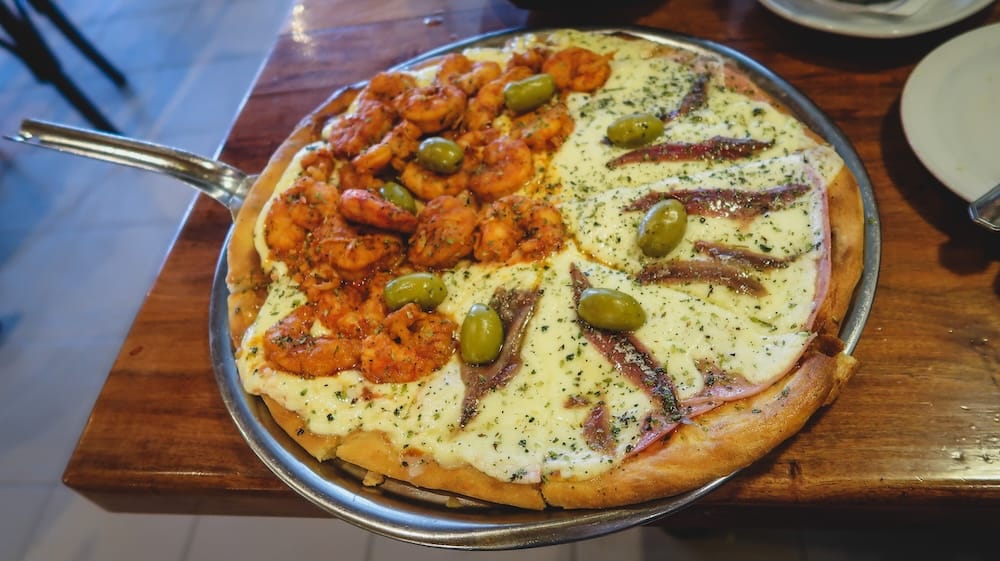
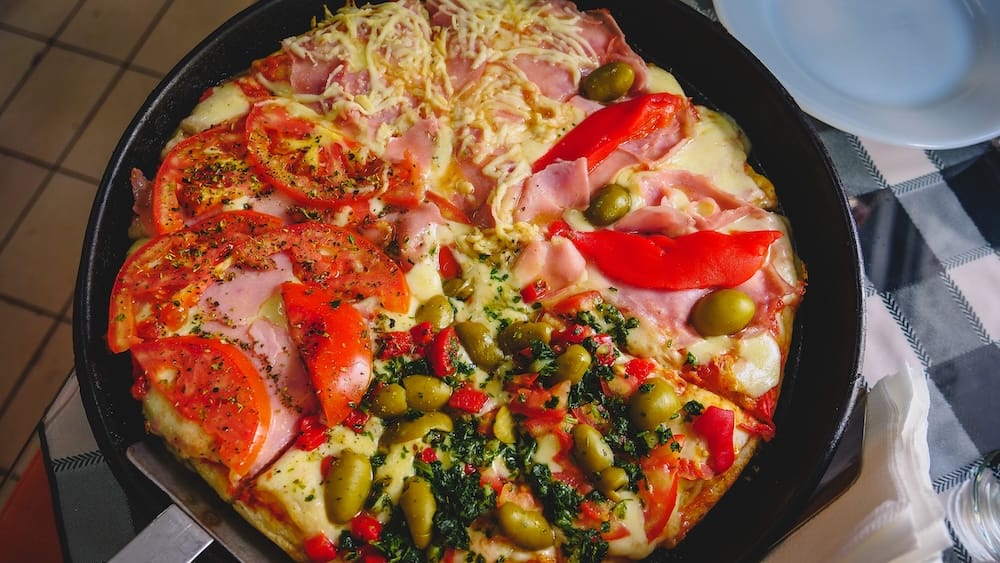
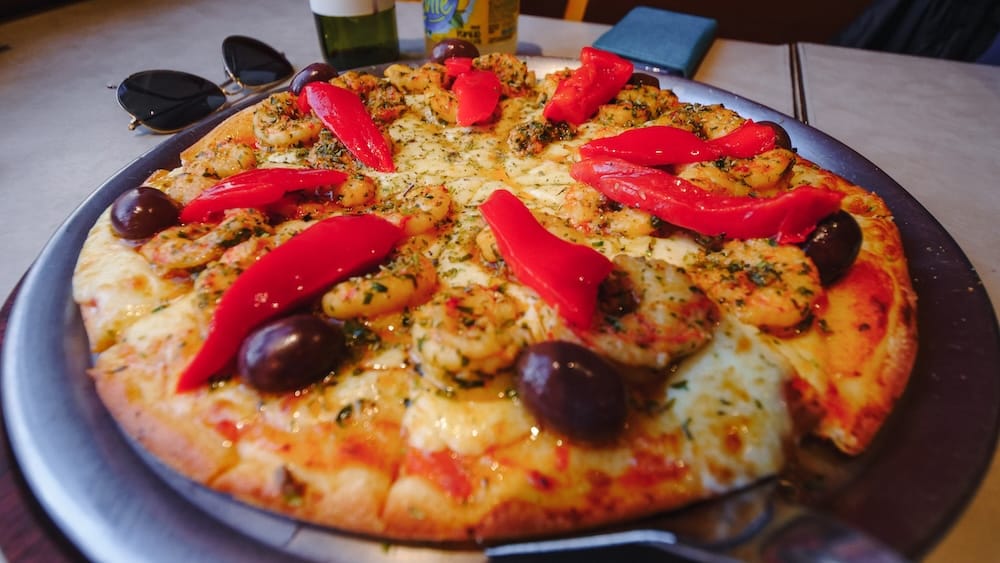
That was the baseline Audrey and I were operating on when we rolled into Puerto Madryn. We were functioning in a deep, bus-induced travel haze, dragging our bags through the coastal wind, desperately hunting for calories. By sheer luck, we stumbled out of our delirium and into a local spot offering a 50% off pizza special during the exact 4:00 PM to 8:00 PM “dead zone”—that dreaded afternoon window when everything in Argentina is usually shuttered tight. We ordered a massive half-and-half pie: one side completely buried under a mountain of fresh coastal shrimp, the other a brutally salty, brilliant mix of anchovies and green olives. The crust was thin, blistered, and buttery.
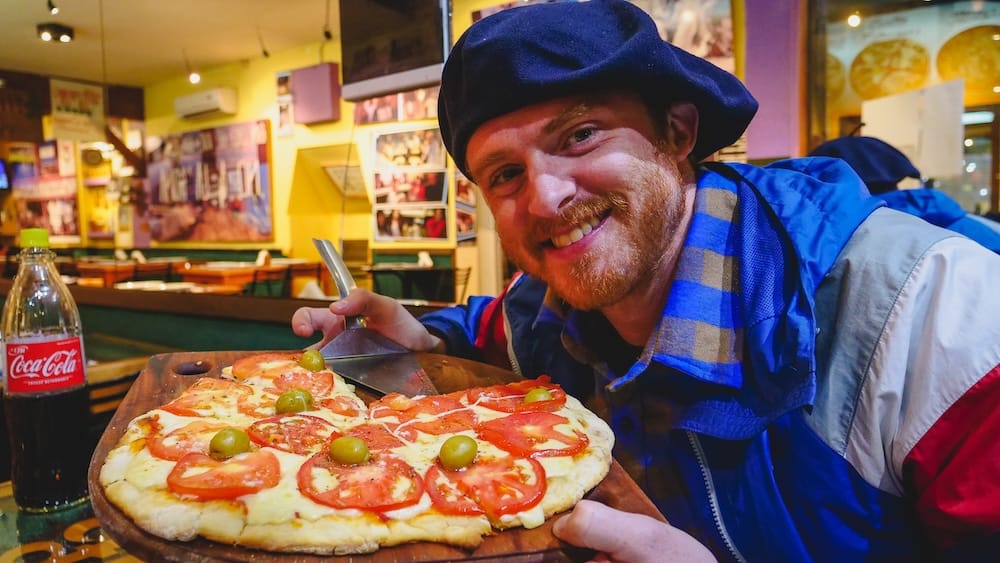
It was a total caloric eureka moment. And it was also the moment we realized that pizza in southern Argentina is a completely different beast than the famous, cheese-avalanche slices you find up north in the capital.
If you’ve been following our adventures on our YouTube channel, you know we’ve eaten our weight in Argentine carbs. But as we transition from the urban grid of Buenos Aires to the towering peaks and wind-swept steppes of Patagonia, the culinary rulebook gets thrown out the window. You aren’t just changing latitudes; you are dealing with entirely different flavor profiles, cooking methods, logistical hurdles, and recent economic realities.
Tearing Up the Blueprint: Why Southern Slices Break All the Rules
When tourists think of Argentine pizza, they are almost exclusively picturing the Buenos Aires style. But the further south you go into the Lake District and the Andean steppes, the geography forces a culinary evolution. The pizzerias in Bariloche, El Bolsón, and Ushuaia aren’t trying to replicate the capital; they are building something rugged, artisanal, and heavily influenced by the mountain environment.
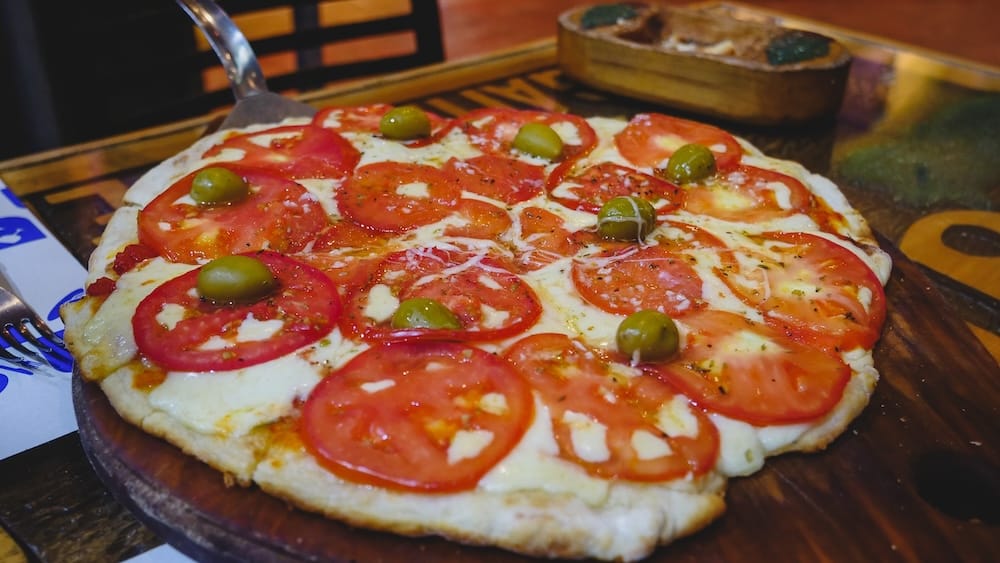
The fundamental difference lies in the foundation. Buenos Aires is famously loyal to the “al molde” (pan-baked) or “media masa” style. It’s a thick, doughy, fluffy crust engineered with one primary structural goal: to support an almost obscene, overflowing blanket of mozzarella cheese. It’s heavy, it’s greasy, and it’s undeniably delicious when you want comfort food.
Patagonia, however, leans heavily into the “a la piedra” (stone-baked) or sourdough (masa madre) tradition. The crust is thinner, blistered, and rustic. But the true secret—the detail that generic food guides completely miss—is the fuel. True Patagonian pizzerias operating open clay ovens (hornos de barro) fire their pies using native woods like Lenga or Ñire . This isn’t a marketing gimmick. The Lenga wood burns hot and imparts a distinct, sweet-smoky flavor profile to the dough and the local toppings that a standard commercial gas oven in Buenos Aires simply cannot replicate.
Furthermore, the cheese takes a backseat down south. In the capital, the cheese historically overcompensated for lower-quality local tomatoes. In Patagonia, the focus shifts to the premium local harvest. You are trading standard ham for smoked trout, wild boar (jabalí), smoked venison, Patagonian lamb, and locally foraged morillas (mushrooms).
[Samuel’s Caveman Confessional]
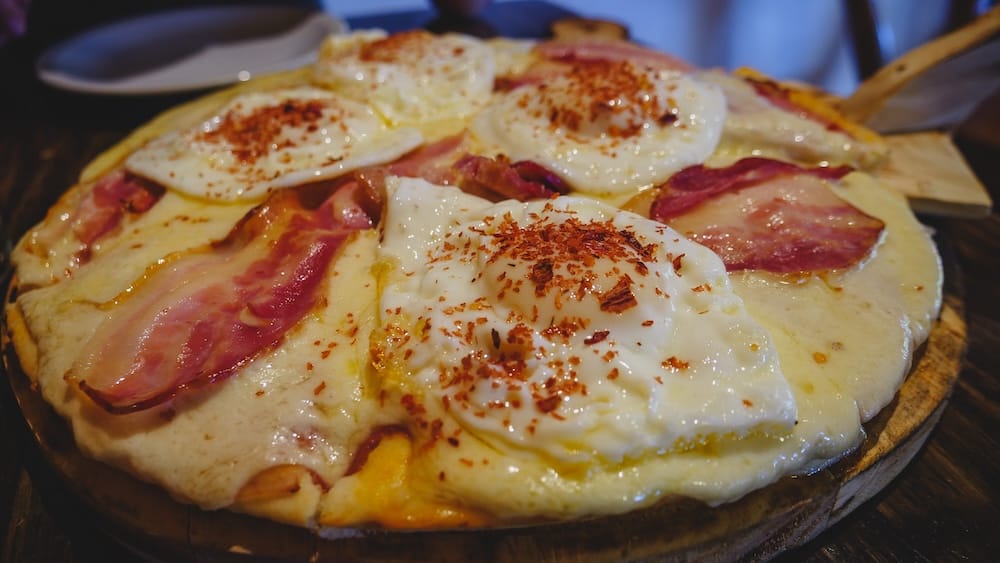
Sometimes, Patagonian pizza isn’t gourmet; it’s pure mountain survival food. In El Bolsón, a town famous as a nature lover’s playground, we dragged our exhausted, hiker-hungry bodies into a bakery called Confitería La Reina (or Novena depending on who you ask). We ordered the “Patagonian Pizza.” I don’t know what I expected, but it wasn’t a dense, massively thick pie smothered in mozzarella, cooked ham, huge strips of bacon, and four fried eggs. It utterly shattered any expectation of what pizza was supposed to be. I ditched the knife and fork entirely, grabbed the heavy slice with my bare hands, and just gave the mozzarella a massive caveman stretch. It was an absolute mess, and it was exactly the caloric payload we needed.
To help you visualize the split, here is the exact breakdown of what you are dealing with:
| Culinary Feature | The Buenos Aires Baseline | The Patagonian Reality |
| Crust Architecture | “Al Molde” – Thick, pan-baked, spongy interior with a crispy, fried-like bottom. | “A la Piedra” – Thin, stone-baked, rustic, sourdough-leaning, blistered edges. |
| The Heating Element | Commercial gas ovens optimized for high-volume, late-night production. | Open clay ovens (hornos de barro) fired by native Lenga or Ñire wood. |
| The Cheese Ratio | Overflowing. An absolute avalanche of Muzzarella meant to dominate the palate. | Balanced. Cheese acts as a binder for high-quality regional meats and vegetables. |
| Signature Toppings | Fugazzeta (cheese-stuffed onion), Fainá (chickpea flatbread), standard ham. | Wild boar, smoked venison, Patagonian lamb, trout, fried eggs, local mushrooms. |
| Beverage Pairing | Moscato wine, sweet cider, or standard liters of Quilmes/Imperial beer. | High-ABV Regional Craft Beer (Amber ales, IPAs) or cool-climate Pinot Noir. |
Surviving the Capital: The Buenos Aires Cheese Avalanche
Before we dive fully into the southern mountains, we have to establish the baseline. If your trip to Patagonia starts with a few days in Buenos Aires (as most do), you will inevitably find yourself on Avenida Corrientes staring down legendary institutions like Pizzería Güerrín.
The geography of dining here is flat, brilliant, and chaotic. The pizzerias stay open until 2:00 AM or 3:00 AM, catering to theater-goers and night owls. The traditional way to eat here is “al corte” (by the slice), consumed while standing up at narrow, crowded counters (de parado).
But here is where the friction hits the uninitiated tourist. If you wander into Güerrín at 21:00 with your rolling luggage or a massive backpack, you will be physically destroyed by the crowd. Eating a heavy, dripping, cheese-laden BA slice while standing up, bumping shoulders with aggressive street vendors and locals, is incredibly difficult.
The Fix & The “Reheat” Trap: If you want to survive BA pizza culture, you must master the Golden Window. Arrive strictly between 17:30 and 18:30. This is the quiet hour before the local dinner rush begins. You can easily secure a table in the back room (el salón) and eat comfortably with a knife and fork. Furthermore, do not fall for the tourist “reheat” trap. Ordering a single slice at the counter often means getting a lukewarm piece that’s been sitting out. Always order a whole pie to guarantee it comes fresh out of the oven, or explicitly ask the server: “¿Qué acaba de salir?” (What just came out?). A standard mid-range whole pie in BA right now will run you roughly ARS 15,000 to 20,000 ($10.60 to $14.15 USD).
The Mountain Schedule: Why We Survived on Cake in Esquel
Once you fly south, the 24/7 convenience of the capital evaporates. Patagonian pizzerias operate on strict, unforgiving mountain-town hours, and this clash of schedules is the number one friction point for active travelers.
If you want to know what hiking in Patagonia is really like, it’s returning from the trail completely ravenous, only to realize the local pizzeria doesn’t open for another three hours. During our time in Esquel, we finished a grueling afternoon hike to Cerro de la Cruz. We were operating on pure travel delirium and wanted nothing more than a massive pizza. But the reality of the Argentine dining schedule hit us hard: the pizzerias don’t fire up their ovens until 20:00 (8:00 PM) at the earliest, with peak times hitting around 21:00 or 22:30.
We were so aggressively “peckish” by 17:00 that we conceded defeat and went to a café to eat cake and pastafrola (quince tart) just to triage our hunger until dinner time.
[The Sit-Down Surcharge]
When you finally do make it to dinner time in Patagonia, be prepared for a hidden fee. Unlike BA slice shops where you just pay for the pizza you eat standing up, sit-down Patagonian spots charge a mandatory cubierto (table cover fee). Now, expect this to be roughly ARS 2,900+ (about $2.00 – $3.00 USD) per person. You are charged this the moment you sit down, regardless of what you order. It usually covers the breadbasket, but it can catch budget backpackers off guard when the final bill arrives.
The Financial Shock: From Groceries to Gourmet Slices
Years ago, during our first deep dive into the Chubut province, we rented an apartment in Trelew. We were exhausted, so we ordered an 8-slice Quattro Stagioni pizza delivered straight to our door. I specifically remember looking at the receipt: the massive pizza, complete with a mountain of cheese and garlic, cost exactly 500 pesos. The crazy part? Earlier that day, we had bought a week’s worth of groceries, and the grocery bill was also exactly 500 pesos (roughly $13 USD at the time).
Today, navigating Patagonian pizza prices requires an entirely different strategy. The hyperinflation in Argentina has rewritten the rules, and the “Patagonia Tax”—the extra cost added to goods due to the immense distance from northern supply chains and high tourist demand—pushes prices significantly higher than in Buenos Aires.
If you are dining in hubs like Bariloche, Ushuaia, or El Calafate, you need to budget between ARS 25,000 and 35,000+ ($17.60 to $24.75 USD) for a whole gourmet pizza, plus an additional ARS 5,000 to 6,000 per pint of local craft beer.
But there is a massive local loophole that generic travel forums miss: The Efectivo Discount. Many top Patagonian spots (like Mafalda Pizzería or El Mundo in Bariloche) offer a strict 10% to 15% discount if you pay in cash (efectivo), bypassing the credit card terminals entirely. However, do not assume you can just hit an ATM to get this cash. Argentine ATMs have severely low withdrawal limits and charge exorbitant fees, completely negating the discount. The actual workaround is to bring crisp, unblemished $100 USD bills from home and exchange them at the “Dólar Blue” rate (currently hovering around 1,415 ARS to 1 USD) at local Western Unions or cuevas. Armed with stacks of pesos, you trigger the local discounts and suddenly those premium wild boar pizzas become incredibly affordable.
| Pizza Economic Index | Expected Cost (ARS) | USD Equivalent (Blue Rate) | The Local Workaround |
| BA Mid-Range Pie | ~15,000 – 20,000 | $10.60 – $14.15 | Order whole to avoid cold slices. |
| Patagonian Gourmet Pie | ~25,000 – 35,000+ | $17.60 – $24.75+ | Pay in efectivo (cash) for a 10-15% discount. |
| Craft Beer (Pint) | ~5,000 – 6,000 | $3.50 – $4.25 | Hit Happy Hour before the 20:00 pizza rush. |
| The “Cubierto” Fee | ~2,900+ per person | $2.00+ | Mandatory sit-down fee; cannot be avoided. |
The Bustillo Gauntlet: Transit Reality in the Lake District
You cannot talk about Patagonian pizza without talking about the physical effort required to reach it. Let’s use San Carlos de Bariloche as our prime example, as it is the undisputed culinary capital of the Lake District.
Do not romanticize the logistics here. While Buenos Aires is a flat, brightly lit grid that is infinitely walkable, Bariloche’s best artisanal pizzerias and breweries are not in the downtown core. They are strung along Avenida Bustillo, a narrow, winding, two-lane road that hugs the cliffside of Nahuel Huapi Lake for over 20 kilometers. Places like Brava (famous for its open clay oven) or Lupino Pizzería (renowned for sourdough crusts and natural wines at Km 16) require a dedicated transit mission.
There are virtually no sidewalks on Bustillo. Walking between kilometer markers in the pitch black after a few pints of Amber Ale is genuinely dangerous due to blind corners and speeding drivers.
You are entirely dependent on the public bus (Línea 20 or 55). And here is where the friction hits: The bus gets wildly unreliable after 22:30. If you are enjoying a slow, late-night pizza at Km 16, you run a very real risk of being stranded in the dark, forced to pay exorbitant rates for a private remis (local taxi) to get back downtown.
The Transit Fix: Finish your dinner and be standing at the Bustillo bus stop no later than 22:00. Furthermore, you cannot pay for these buses with cash or a credit card; you must use a SUBE transit card. Because physical SUBE cards are notoriously difficult to find in Patagonia, you must download the “App SUBE” on an NFC-enabled smartphone before your trip. This allows you to use the newly implemented SUBE Digital to tap your phone directly on the bus reader (rides cost up to ARS 1,895 / $1.34 USD depending on distance).
| Transit & Accessibility Triage | Distance / Location | Walkability Rating | The Reality Check |
| Buenos Aires (Av. Corrientes) | Downtown Grid | High (Flat, lit 24/7) | Beware rolling luggage in chaotic crowds. |
| Bariloche (Downtown) | Civic Center | Moderate (Hilly) | Easy access to traditional spots like El Mundo. |
| Bariloche (Av. Bustillo Km 10-20) | Lakeside Highway | Zero (Dangerous at night) | Must use Línea 20 bus or pre-book a remis. |
| El Bolsón & Trevelin | Town Centers | High (Grid layout) | Very easy to walk post-dinner, safe at night. |
Regional Flavor Profiles: From Coastal Salt Bombs to Andean Woods
The beauty of the southern provinces is that the pizza adapts to the micro-climates. Our experiences ranged from goofy, impromptu feasts to genuine culinary revelations.
Take Esquel, for example. After our “cake before pizza” survival tactic, we finally sat down to a massive Pizza Napoletana that came with delicious little garlicky bread bites. I was wearing a ridiculous, fake green Gaucho hat I had bought in Korea, feeling absolutely triumphant. The pizza was heavily laden with cheese, a deep buttery crust, and copious amounts of garlic. It was unpretentious, goofy, and exactly what the foodie-hiker persona demands.
If you are building your own itinerary, here is the un-sugarcoated breakdown of the exact venues, flavor profiles, and current operational realities you need to target. We didn’t film at every single one of these, but our extensive ground research and local network vetting makes this the ultimate hit list.
The Puerto Madryn Coastal Anomaly
While the Andean towns focus on smoked forest meats, the coastal edge of Patagonia utilizes the Atlantic. That half-and-half pizza we found during the 4-to-8 PM miracle window was a masterclass in regional adaptation. If you are near the Valdés Peninsula watching whales, skip the standard ham and look for Langostinos (prawns/shrimp) or heavily salted anchovy and green olive pies. The seafood turnover here is incredibly fresh, cutting through the heavy cheese perfectly.
Trevelin’s Cozy Marathon: El Refugio
Trevelin is a tiny Welsh settlement near the Chilean border. Pizzerias in towns this small usually have highly erratic hours, but El Refugio Pizzería is a rare anomaly, operating continuously from 12:00 PM to midnight. You walk into a massive, rustic wood cabin with a roaring fireplace and are handed a menu with 42 different varieties of pizza. They are known for quirky, hyper-local toppings—think blue cheese, celery, and walnuts—paired with draft Berlina beer. At roughly ARS 20,000 to 26,000 ($14.00 – $18.30 USD) a pie, it’s one of the most reliable post-hike triage centers in the region.
Bariloche’s Sourdough Kings: Lupino
Located way out at Km 16 on Bustillo, Lupino is for the pizza purist. They specialize in masa madre (sourdough) crusts that take days to ferment, paired with an excellent natural wine list. It features a dog-friendly garden (say hi to Panchito the dog), but the logistics are tight: they are strictly open Wednesday through Sunday, from 19:00 to 23:00, with peak chaos hitting right at 20:30. At ARS 28,000 to 35,000 a pie, it is a premium experience that requires you to master the Línea 20 bus schedule.
The Traditionalist Hub: El Mundo (Bariloche)
If you are staying in downtown Bariloche, don’t want to fight the Bustillo bus gauntlet, and just want a reliable, family-vibe pie, El Mundo is the anchor. Peaking around 21:00, they are also highly regarded for having an excellent, dedicated Gluten-Free menu with a separate kitchen space to prevent cross-contamination. Remember, this is a prime spot to deploy your crisp $100 bills for the strict 10% efectivo discount.
The Liquid Pairing Protocol: Swapping Moscato for Mountain IPAs
If you’ve ever polished off a massive al molde slice at 1:00 AM on Avenida Corrientes, you know the traditional Buenos Aires pairing: a tiny glass of sweet Moscato wine, maybe a cider, or a sweating, communal liter bottle of commercial Quilmes. It is an absolute rite of passage. But let’s be brutally honest—waking up with that heavy, dough-and-Quilmes hangover under the stifling city humidity is a physical challenge.
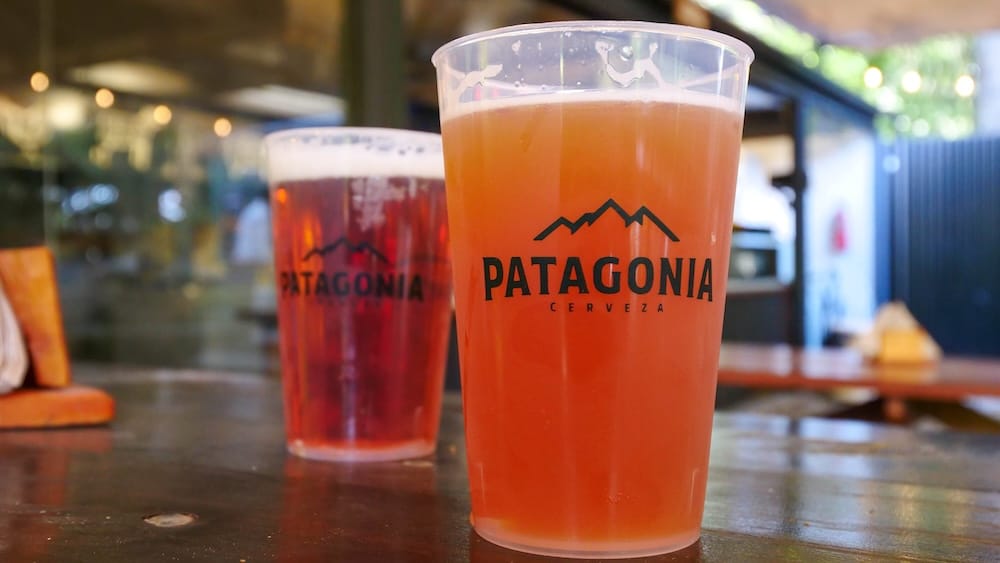
When you head south, the beverage ecosystem completely shifts. Patagonia is the undisputed craft beer capital of South America, and the sweet-smoky flavor profile of Lenga wood-fired pizza demands a much more complex pairing.
Instead of a generic commercial lager, you are washing down your wild boar pizza with high-ABV Amber Ales and aggressively hopped IPAs from legendary local breweries like Berlina or Manush. Sitting at a rustic wooden table in El Bolsón, our legs completely shot from hiking all morning, trading that city hangover for a crisp, mountain-brewed IPA paired with a hot slice was pure, unmatched nectar. And if beer isn’t your speed, the cool-climate vineyards of the nearby Río Negro valley produce world-class Pinot Noirs. The earthy, high-acid profile of a Patagonian Pinot cuts through the richness of smoked venison or local trout toppings with surgical precision.
The Historical Split: When Neapolitan Dough Met Alpine Smoke
To understand why a pizza in Bariloche looks and tastes so fundamentally different than one in the capital, you have to look at the historical collision of immigrants. It’s an exercise in culinary anthropology that completely explains the menu.
- The Northern Foundation (Buenos Aires): BA pizza was born primarily from Genoese and Neapolitan immigrants. They arrived in a city where high-quality tomatoes were historically scarce or expensive, but dairy and wheat were abundant. Their solution? The cheese avalanche. The dough became thicker to support an absolute mountain of mozzarella, compensating for the lack of rich tomato sauce.
- The Southern Evolution (Patagonia): When those Italian traditions migrated south into the harsh, freezing steppes of Patagonia, they slammed directly into German, Swiss, and Welsh pioneer cultures. These were people who survived the winters by smoking meats, fermenting doughs, and foraging in the forests.
They essentially looked at the Italian flatbread and completely localized it. That collision is exactly why standard ham and fluffy pan crusts were violently replaced by heavy sourdoughs (masa madre), smoked wild boar, venison, and earthy morillas (local mushrooms).
Fainá, Merkén, and the Table Etiquette Culture Shock
The culture shock of Patagonian pizza isn’t just what’s on the pie; it’s what happens the second it hits the table.
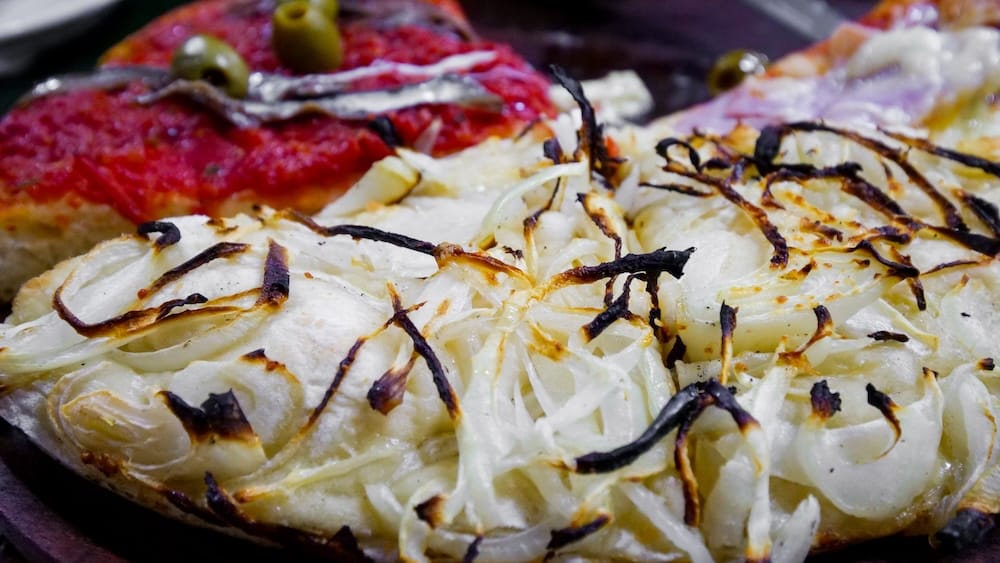
In BA, the condiment game is incredibly rigid. You order your slice of Muzzarella, and you top it with a slice of Fainá (a dense, oily chickpea flatbread), maybe dusting it with some crushed red pepper before eating it standing up.
In Patagonia, dining is a sit-down, communal event, and the table condiments are heavily influenced by the Andean environment and the nearby Chilean border. Instead of Fainá, your table will likely feature small bottles of garlic-infused olive oils and shakers of merkén—a glorious, traditional Mapuche smoked chili powder that elevates a simple cheese slice into the stratosphere.
[Samuel’s Caveman Confessional: The Vampire of Esquel]
I have a deeply unapologetic addiction to raw garlic. While we were filming in Esquel, Audrey essentially accused me of being a vampire repellent because I was absolutely drowning my slices in it. But when you are served a massive, heavy pizza alongside those glorious, doughy, garlic-soaked bread bites they specialize in down there, traditional table manners go out the window. Between the merkén, the infused oils, and eating massive, heavy slices entirely with my bare hands, the Patagonian pizza experience requires you to embrace your inner caveman.
The Language of the Oven: Your Tactical Phrasebook
Knowing the history and the flavor profiles is useless if you can’t actually navigate the menu. The Spanish you learned for ordering in Buenos Aires won’t help you uncover the best local deals or specific cooking methods in the south.
Before you step foot in a mountain-town pizzeria, screenshot this tactical cheat sheet.
| The Local Phrase | The English Translation | The Tactical Advantage |
| “¿El horno es a leña?” | Is the oven wood-fired? | The ultimate quality check. If they are just using gas in Patagonia, turn around and find a place burning Lenga wood. |
| “Bien cocida, por favor.” | Well done / crispy, please. | Sourdough crusts in the mountains are sometimes served slightly soft in the center. Use this to guarantee a charred, blistered edge. |
| “¿Tienen descuento pagando en efectivo?” | Do you have a cash discount? | The most important phrase on this list. This single question can instantly shave 10% to 15% off your final bill. |
| “¿Qué carne ahumada tiene la especial de la casa?” | What smoked meat is on the house special? | Bypasses the boring tourist options and forces the waiter to reveal if they are using local boar, venison, or trout. |
| “¿Qué acaba de salir?” | What just came out? | Crucial if you are ordering by the slice (al corte) to avoid the dreaded lukewarm “reheat” trap. |
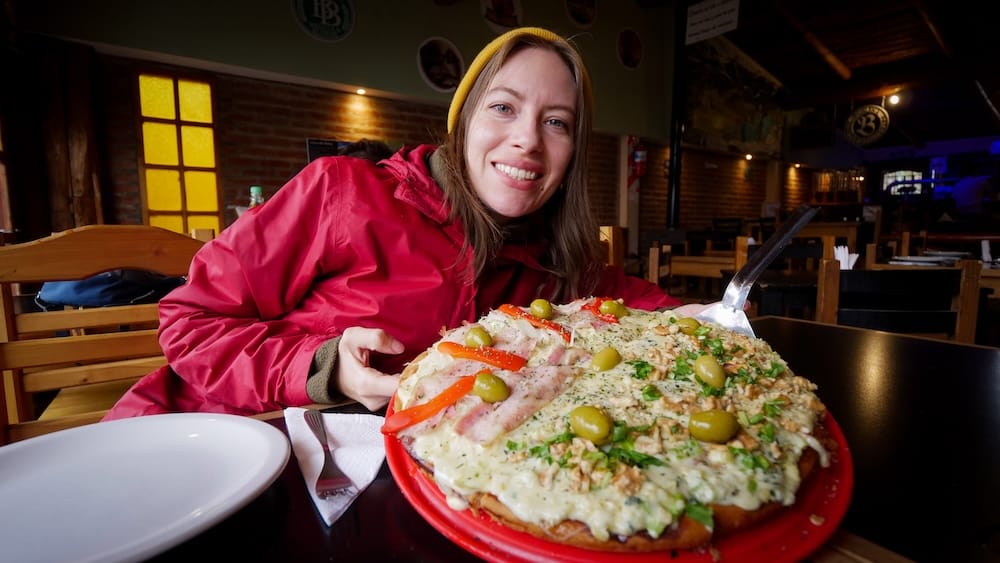
The Patagonian Pizza Decision Matrix: Pick the Right Pie for Your Trip
Not every Patagonian pizza experience is trying to do the same thing. Some pies are pure post-hike recovery food. Some are topping showcases built around local ingredients. Some are all about the smoky crust. And some are worth the transit mission only if you care deeply about dough.
| Traveler Type | Best Pizza Style | Best Place Fit | Why It Works | Trade-Off |
|---|---|---|---|---|
| First-time Patagonia visitor | Wood-fired a la piedra pie | Bariloche or Trevelin | Gives you the clearest contrast with Buenos Aires pizza | Usually pricier than a standard city pie |
| Post-hike calorie hunter | Heavy cheese-and-protein pizza | El Bolsón or Esquel | Big payoff when you’re starving and need real fuel | Less refined, more brute-force comfort |
| Topping purist | Regional specialty pie | Puerto Madryn or Bariloche | Lets local seafood, smoked meats, or mushrooms shine | May be less cheese-forward than expected |
| Dough purist | Masa madre / sourdough pie | Lupino-style places in Bariloche | Best for people who care about fermentation, blistering, and structure | Requires timing and transport discipline |
| Budget-conscious backpacker | Reliable downtown sit-down pie | El Mundo or similar central spots | Easier access, lower transit risk, cash discounts possible | Less dramatic than the highway or destination pizzerias |
| Casual traveler | Half-and-half pizza | Puerto Madryn or any flexible pizzeria | Best way to sample multiple regional profiles in one meal | Harder to fully commit to one signature local topping |
| Beer-first traveler | Smoky meat pizza with craft beer | Bariloche or El Bolsón | The mountain beer scene is half the experience | Easy to miss the last bus if you linger |
| Family / low-friction traveler | Centrally located traditional pizzeria | Downtown Bariloche or Trevelin | Safer, easier, more predictable hours and access | Less “quest-like” than the more remote pizza spots |
Regional Patagonian Pizza Snapshot: Pick Your Flavor Profile
Patagonia is too large and too regionally diverse to talk about “the pizza” as if it’s one single thing. Coastal Patagonia eats differently than the Lake District, and the small mountain towns behave differently again.
| Place | Pizza Personality | Best Toppings to Look For | Crust / Oven Clues | Traveler Reality |
|---|---|---|---|---|
| Puerto Madryn | Coastal anomaly | Shrimp, anchovies, olives | Thin, blistered, often lighter than expected | Afternoon timing luck matters a lot |
| Bariloche | Lake District artisan capital | Wild boar, smoked meats, mushrooms | Sourdough, wood-fired, premium pies | Transit planning is part of dinner |
| El Bolsón | Hiker survival mode meets mountain comfort | Bacon, eggs, big cheese, hearty combinations | Rustic, heavy, caloric, less precious | Best after a long active day |
| Esquel | Practical mountain-town comfort | Garlic-heavy pies, classic loaded combos | Buttery crusts, serious sit-down energy | Timing can be brutal if you arrive hungry too early |
| Trevelin | Cozy wood-cabin pizza culture | Blue cheese, walnuts, creative local combos | Fireplace atmosphere, reliable whole-pie culture | Lower-friction than Bariloche |
| Ushuaia | Premium southern outpost | Smoked or seafood-leaning combinations | Heavier tourist pricing, stronger Patagonia tax | Expect higher costs and more planning |
| Buenos Aires baseline | Cheese avalanche slice culture | Fugazzeta, muzzarella, fainá pairings | Thick al molde or media masa, gas ovens | Easy to access, chaotic to eat at peak hours |
The Final Slice
Whether you are eating thick, 4-egg survival slices with your bare hands in El Bolsón, or navigating the pitch-black lakeside roads of Bariloche for a sourdough masterpiece, Patagonian pizza is an adventure in itself. It forces you to slow down, adapt to the mountain schedule, and embrace the local ecosystem.
For more deep dives into the realities of South American travel, including our exact hiking routes and full food tours, make sure to check out our upcoming destination guides and the full Argentina playlist on our YouTube channel. Bring your appetite, pack your SUBE app, and remember: always order the whole pie.
Part 1: The Visual FAQ
Is Patagonian pizza expensive compared to Buenos Aires?
Absolutely. Thanks to the “Patagonia Tax” and heavy tourist demand, a gourmet pie in Bariloche or Ushuaia will run you ARS 25,000 to 35,000+, whereas a standard BA pizza is closer to ARS 15,000 to 20,000. To soften the blow, always bring crisp US dollars to exchange at the Dólar Blue rate and specifically ask for the efectivo (cash) discount.
Can I just grab a quick slice on the go in Patagonia?
Nope. Unlike the fast-paced, standing-room-only al corte slice shops in Buenos Aires, pizza in the south is a sit-down, communal event. You’re ordering a whole pie, sitting at a rustic wooden table, and usually paying a mandatory cubierto (table cover fee) just to sit down.
Do I need to tip on top of the ‘cubierto’ fee?
Yes. The cubierto is strictly a sit-down charge that goes to the restaurant (often covering the breadbasket and table linens). It is not a tip for the waiter. Leave around 10% in cash (propina) on the table if the service was good.
What makes the crust different down south?
The wood. While Buenos Aires relies heavily on commercial gas ovens for their thick al molde crusts, Patagonian pizzerias use open clay ovens fired by native Lenga or Ñire wood. It gives their thinner, sourdough-based crusts a distinct sweet-smoky flavor you just can’t replicate in the capital.
Will restaurants be open right after my afternoon hike?
Highly unlikely. Argentine mountain towns adhere to a strict, unforgiving dining schedule. Most pizzerias won’t fire up their ovens until 20:00 (8:00 PM) at the earliest. If you finish a hike at 5:00 PM and are completely starving, you’ll have to bridge the gap at a café with some cake and coffee to survive until dinner time.
What is a true “Patagonian” topping?
Local ingredients. You’re trading standard city ham for wild boar (jabalí), smoked venison, Patagonian lamb, smoked trout, and earthy morillas (mushrooms). And if you’re out in El Bolsón, apparently it means a massive mountain of bacon and four fried eggs.
Can I pay with a credit card at most pizzerias?
Usually. However, paying with plastic often means missing out on the lucrative 10% to 15% discount that many local Patagonian spots offer for paying in physical cash (efectivo). Save the card for emergencies and pay in pesos to stretch your travel budget.
Can I order two different types of pizza on the same pie?
100%. Going mitad y mitad (half and half) is practically a national pastime in Argentina. It’s exactly how we tackled our pizza in Puerto Madryn—one half loaded with local coastal shrimp, the other side packed with salty anchovies. It’s the perfect tactical move to sample the heavy regional meats without committing to a massive, whole pie of wild boar.
Project 23 Argentina: This guide is also available in Spanish. [Lea la versión en castellano: Pizza Patagónica — Por qué es distinta a la pizza de Buenos Aires]