
Calgary and Edmonton are only about 300 kilometres apart, so getting between Alberta’s two biggest cities should be straightforward. It mostly is. The part that deserves a bit more thought is whether you should drive, take the bus or fly.
We actually got to test the bus option in both directions during our 2024 Alberta trip, and the two rides could hardly have been more different.
From Calgary to Edmonton, Audrey and I took Red Arrow. The bus was nearly empty, very comfortable and dropped us downtown almost comically close to my old Edmonton life. We got off near 104 Street and 99 Avenue, literally across the street from where I used to live when I was a university student.
Going back to Calgary, we took FlixBus. It was much cheaper, completely full and nowhere near as comfortable. Our pickup point on Jasper Avenue also had us wondering whether we’d made some terrible navigational mistake. We were standing in this strange-looking spot with no obvious bus terminal atmosphere whatsoever, looking at each other like, “Are we seriously supposed to wait here?”
Then a few other passengers materialized.
Okay. We’re not crazy.
The bus eventually arrived packed to the gills, there wasn’t a single spare seat, and our driver seemed to be having one of those days where the entire world had personally offended him. Still, the fare was significantly lower, and we made it back to Calgary just fine.
Those two rides taught me something useful about this route: “take the bus” isn’t really one option. The operator, departure point, arrival point, price and comfort can change the experience considerably.
Driving gives you more freedom. Flying gives you the shortest time in the air. But for plenty of travellers, especially if you’re staying centrally in Edmonton, the bus deserves serious consideration.

Calgary to Edmonton: The Short Version
The direct drive from Calgary to Edmonton is roughly 300 kilometres along Highway 2, better known as the Queen Elizabeth II Highway or QEII. In normal conditions, you’re looking at around three hours before stops, traffic, construction or weather start adding themselves to the equation.
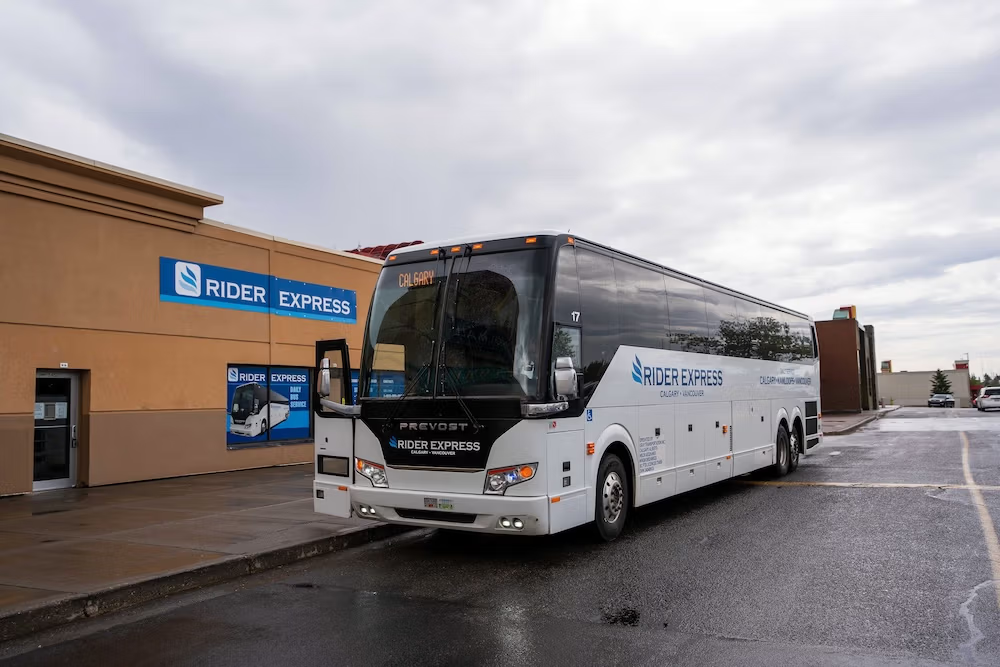
Several intercity bus companies currently serve the corridor, including Red Arrow, FlixBus, Rider Express and Ebus. Depending on the operator and exact stops, the ride generally takes somewhere around four to five hours.
You can also fly nonstop between Calgary International Airport and Edmonton International Airport. The actual flight is only around 50 to 60 minutes.
That makes the choice look obvious until you compare the whole trip instead of just the part where the vehicle is moving.
| Option | Biggest Advantage | Biggest Drawback | Best Fit |
|---|---|---|---|
| Drive | Flexibility and your own vehicle in Edmonton | Fuel, parking, traffic and weather | Groups, road trips and travellers who need a car afterward |
| Bus | No driving and several useful city/airport stop combinations | Longer ride and fixed schedule | Solo travellers, couples and central Edmonton stays |
| Fly | Very short flight | Airport time and ground transfers at both ends | Connections, onward flights and travellers already at YYC |
If I were making this decision for a straightforward Calgary-to-Edmonton city trip today, I’d think less about which option is theoretically fastest and more about where I was starting, where I was staying and what I planned to do once I arrived.

Driving From Calgary to Edmonton
Driving is the cleanest option if you already have a vehicle.
You leave when you’re ready, point yourself north on the QEII and arrive wherever you actually want to go in Edmonton. There are no fixed departure times, no luggage allowances and no need to figure out how to get from an intercity stop to your hotel.
For families and groups, the economics also start tilting toward the car pretty quickly.
A bus or plane charges each passenger. Your car doesn’t suddenly demand another fuel tank because three people climbed inside.
That doesn’t make driving free, of course. You still need to consider fuel, parking and possibly a rental car if you don’t already have one. If your decision depends on renting rather than using your own vehicle, it’s worth comparing current Calgary car rental options before assuming the road automatically works out cheaper.
If you’re staying downtown, you’re also taking the vehicle into an area where parking costs money and the car may spend most of the trip sitting there doing absolutely nothing.
The Question I’d Ask Before Driving
Forget the Calgary-to-Edmonton highway for a moment.
Do you actually want a car once you’re in Edmonton?
That matters more than people realize.
When I lived in Edmonton, I walked, jogged and used public transportation all over the place. On our return trip, Audrey and I again relied heavily on transit. We used the LRT, took buses and planned one particularly busy sightseeing day around public transportation because we wanted to save our legs.
I was actually impressed by how much the system had expanded since my university days.
Edmonton is still a geographically spread-out city, so I’m not going to pretend transit is equally convenient for every possible itinerary. A car is handy if you’re bouncing between distant neighbourhoods, staying somewhere poorly connected or heading beyond Edmonton.
But if you’re staying downtown and your plans revolve around downtown, the river valley, the University area and attractions reasonably connected by transit, you don’t automatically need one.
That changes the value equation.
If you’re going to use your car constantly, drive from Calgary.
If you’re going to pay to park it for three days while wandering around downtown on foot and taking the LRT, the bus starts looking much better.
Driving in Winter Is a Different Calculation
A normal-weather Calgary-to-Edmonton drive is straightforward enough that the three-hour estimate is useful.
Alberta weather, naturally, reserves the right to laugh at estimates.
Snow, ice, collisions and construction can all change conditions quickly. There has also been ongoing work along sections of Highway 2 around Red Deer, so I wouldn’t treat any travel-time estimate as a promise.
Before leaving, check Alberta 511 for current road conditions, construction and incidents.
That live information matters far more than anything I can permanently write here.
Taking the Bus From Calgary to Edmonton
This is the option we know best from actual experience, and I came away more positive about it than I expected.
The main lesson was that I wouldn’t choose a Calgary-to-Edmonton bus on price alone.
Where it picks you up and drops you off can be just as important.
Red Arrow, FlixBus, Rider Express and Ebus all currently serve the corridor in different ways. Depending on the schedule, buses can use downtown locations, Calgary International Airport and transit-connected stops on the Calgary end, with a similarly varied collection of downtown, airport and transit locations in Edmonton.
That can make one operator much more convenient than another even when its ticket costs a bit more.
Our Red Arrow Ride From Calgary to Edmonton
Our 2024 Red Arrow trip was about as painless as intercity bus travel gets.
The bus was nearly empty.
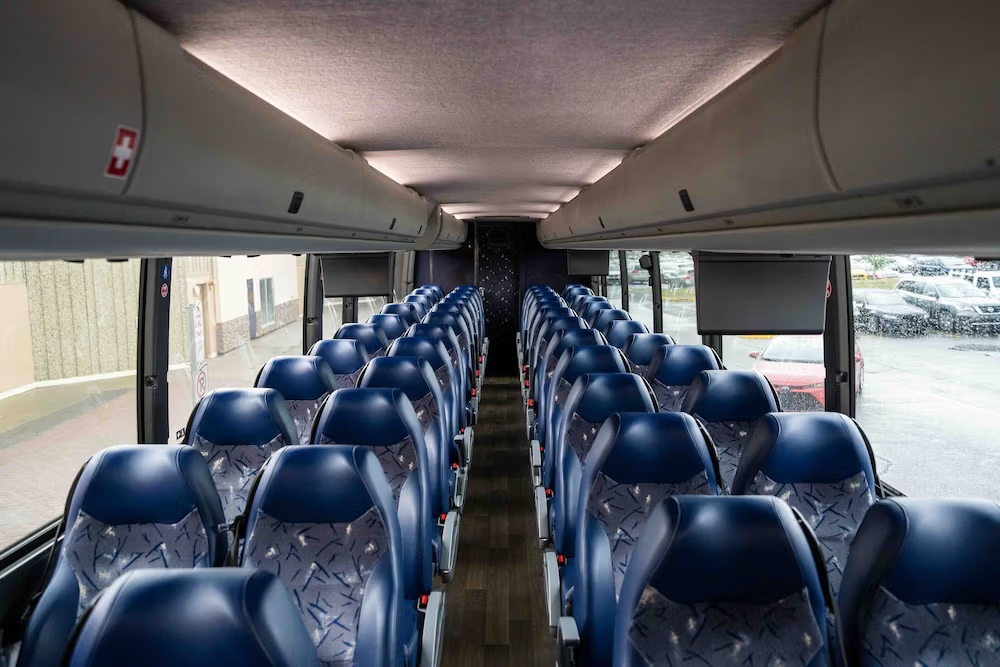
That’s obviously not something I would expect on every departure, but on our trip it meant plenty of space and a quiet, relaxed ride. The seats were comfortable and the whole experience felt easy.
Then we arrived in downtown Edmonton.
This part made me laugh.

Our stop was near 104 Street and 99 Avenue, basically across the street from where I used to live. After being away from Edmonton for well over a decade, I had somehow travelled back into the city and been deposited almost directly into my old neighbourhood.
Talk about arriving on familiar ground.
That downtown drop-off also demonstrated exactly why stop location matters.
We didn’t arrive at some remote terminal and then spend another half hour figuring out how to reach central Edmonton. We were already there.
For someone staying downtown, that is hard to beat.
Our FlixBus Ride Back to Calgary
Our FlixBus experience was almost the opposite.
First came the pickup.
We were waiting around Jasper Avenue in downtown Edmonton at a location that didn’t exactly scream “major intercity transportation hub.” For a while Audrey and I genuinely wondered if we’d misunderstood the instructions.
Nothing about the surroundings made me think, yes, clearly this is where a large coach to Calgary will arrive.
Then another passenger showed up.
Then another.
You could almost feel the collective reassurance spreading among us.
Apparently we were all waiting in the right weird spot.
When the FlixBus arrived, it was completely full. Not mostly full. Every seat was taken.
That naturally made it feel much tighter than our nearly empty Red Arrow ride.
Our driver was also having a rough day. I’ll leave it at that. Maybe he’d been driving for hours. Maybe somebody had annoyed him before we arrived. Maybe Alberta’s highways had finally broken his spirit. Whatever the reason, warmth and cheerfulness were not overflowing from the driver’s seat.
I wouldn’t turn one driver’s mood into a judgment about an entire company, but it was part of our particular ride.
The trade-off was price.
Our FlixBus tickets were considerably cheaper than Red Arrow, and we appreciated that. We gave up some comfort and gained some savings.
For our two trips, I would summarize them this way:
Red Arrow was the better ride. FlixBus was the better bargain.
That’s based on our experience in 2024, not a promise that your bus will have the same load, driver or fare.
How I’d Choose a Bus Now
I would start with the stops, not the logo.
- where the bus leaves from in Calgary;
- where it arrives in Edmonton;
- whether those locations connect easily with your hotel or onward transport;
- the departure and arrival times;
- then the fare.
A $10 or $20 saving disappears pretty quickly if it creates an extra taxi ride at both ends.
Likewise, I would happily pay a little more for a downtown-to-downtown journey if that eliminates a bunch of fiddling around with luggage.
This is also where accommodation planning and transport planning overlap. If you’re leaning toward the bus because you want a car-free Edmonton stay, it makes sense to compare current Edmonton accommodation options before choosing your coach. A hotel near the right arrival stop or LRT connection can make the bus considerably more practical.
Current schedules also vary by operator. Red Arrow, Rider Express and Ebus can serve combinations that include downtown Calgary and YYC, while Edmonton stops can include downtown, Southgate, YEG and other locations depending on the particular service. FlixBus also uses transit-connected stops.
Always check the exact stop printed for your departure. Don’t assume the place where Audrey and I boarded in 2024 is necessarily where your bus will leave now.
Who Is the Bus Best For?
If you’re travelling solo and staying somewhere central in Edmonton, I’d put the bus near the top of the list.
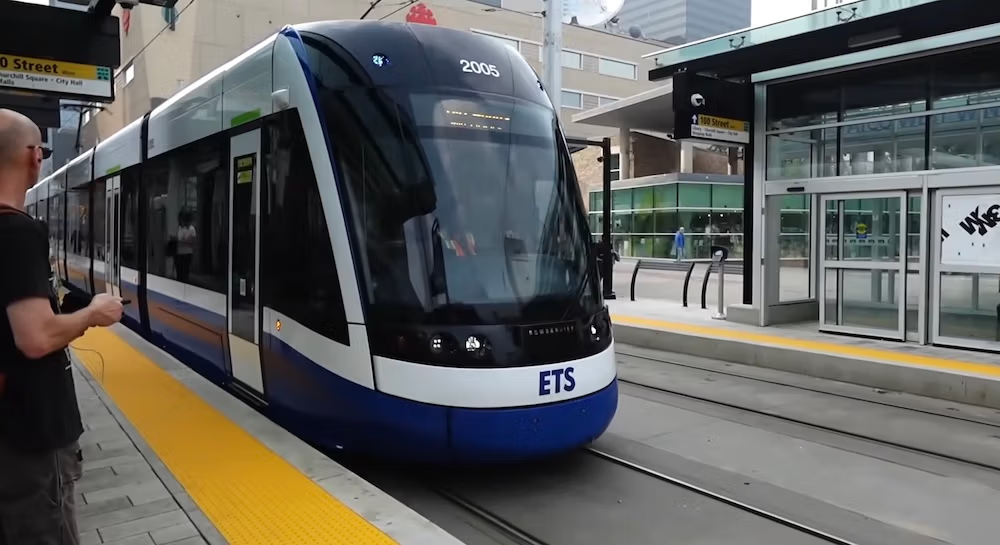
You don’t need to rent a car. You don’t need to drive. You don’t need to pay for downtown parking. And depending on the service you choose, you can arrive somewhere already connected to Edmonton’s transit network.
Couples can also make the bus work very well.
The calculation becomes less obvious as your group grows because you’re purchasing individual tickets for every passenger. Four bus tickets are competing against the operating cost of one car.
Luggage is another consideration. Coach baggage allowances are generally quite workable, but they differ by company, so check before showing up with half your worldly possessions.
For Audrey and me, the bus was a perfectly reasonable way to move between Calgary and Edmonton. Having now done it in both directions, I wouldn’t hesitate to consider it again.
I’d just pay more attention to which bus.

Flying From Calgary to Edmonton
Flying is the strange one.
On paper, it destroys the competition.
Calgary to Edmonton nonstop is roughly 50 to 60 minutes in the air. Air Canada and WestJet currently operate the route multiple times daily, with Air North also serving Calgary from Edmonton on selected days.
Fifty minutes versus roughly three hours driving?
Case closed.
Except the plane doesn’t pick you up at your Calgary hotel and drop you on Jasper Avenue.
The One-Hour Flight Is Not a One-Hour Trip
If you’re beginning somewhere in Calgary, you first need to reach Calgary International Airport.
Then you have to allow time for check-in, security, boarding and all the other little rituals modern aviation has invented to make a 50-minute flight consume a chunk of your day.
WestJet currently recommends arriving two hours before a domestic departure.
You may breeze through much faster. You may not. Either way, that time belongs in the comparison.
Then you fly to YEG.
And YEG is not downtown Edmonton.
If you take public transit, ETS Route 747 connects Edmonton International Airport with Century Park Transit Centre. From there, a downtown traveller continues on the LRT.
A taxi or rideshare simplifies that part, but now you’re adding another expense.
Suddenly the little one-hour flight has grown legs.
For a downtown Calgary to downtown Edmonton trip, I wouldn’t assume flying saves meaningful time at all. Depending on schedules and airport processing, driving can be extremely competitive and a bus can avoid much of the airport friction while delivering you closer to where you actually want to be.
If flying still suits the way your trip is structured, you can compare current Calgary-to-Edmonton flight options rather than relying on a fixed fare or schedule quoted in an article.
When Flying Does Make Sense
There is one scenario where my opinion changes quickly:
you’re already at YYC.
If you’re flying into Calgary from somewhere else and Edmonton is the next stop on your itinerary, the biggest disadvantage of flying has partially disappeared. You’re already at the airport.
The same applies if Calgary–Edmonton is part of a larger flight itinerary or you’re continuing onward from YEG.
Then the short flight becomes much more logical.
But here’s another wrinkle: several intercity buses also currently pick passengers up at Calgary International Airport.
So even at YYC, I wouldn’t automatically book the plane.
I would compare the next sensible bus departure against the next sensible flight and ask which one actually gets me where I’m going sooner and with less hassle.
That’s the kind of comparison that matters.
Drive vs Bus vs Fly: What Would I Choose?
Now that I’ve travelled between the cities by bus in both directions, the decision feels much less theoretical.
I would drive if I needed the car afterward
If I already had a vehicle and planned to explore Edmonton widely, continue elsewhere in Alberta or travel with a larger group, I’d drive.
Three-ish hours is hard to argue with when the car remains useful after arrival.
The flexibility is the real selling point.
I would take the bus for a central city trip
For a solo traveller or couple staying downtown, I think the bus is very competitive.
Our Red Arrow trip demonstrated just how convenient a good downtown drop-off can be. We stepped off the coach basically in my old neighbourhood and were immediately in central Edmonton.
No airport transfer. No parking garage. No rental counter.
If comfort mattered most and the price difference wasn’t huge, my own 2024 experience would make me lean Red Arrow.
If price mattered more, I’d absolutely compare FlixBus. Our ride was much fuller and less comfortable, but we saved a meaningful amount of money.
That’s a trade I’d happily consider again.
I would fly when I was already in the airport system
For an ordinary Calgary-to-Edmonton city trip, flying would be my third choice.
The flight is impressively short. The complete journey isn’t.
But if I’d just landed at YYC and a convenient Edmonton flight was waiting? Different story.
Then I’d compare it seriously with the airport bus options.

Do You Need a Car in Edmonton Once You Arrive?
One reason I’m comfortable recommending the bus is that I’ve actually lived without relying on a car in Edmonton.
When I was a student, I walked and took public transportation constantly. I even used to jog ridiculous distances around the city when I wanted to go somewhere.
Returning years later, Audrey and I again used Edmonton’s transit network extensively.
The LRT has grown since my university days, and several useful visitor areas now sit along rail or bus corridors. If you’re staying centrally, you can build a very respectable Edmonton trip without a car.
That doesn’t mean Edmonton suddenly became compact.
It absolutely did not.
Some destinations are much easier with a vehicle, and the farther your plans spread from the central transit corridors, the more valuable a car becomes.
But for a short downtown-focused visit, I wouldn’t rent a vehicle automatically.
That makes the Calgary–Edmonton bus more useful than it might initially appear.
My Bottom Line: Drive, Bus or Fly?
For most travellers, I would narrow it down like this:
Drive if you already have a vehicle, you’re travelling with several people, your Edmonton plans are spread across the city, or you’re continuing onward on an Alberta road trip.
Take the bus if you’re travelling solo or as a couple, staying centrally and don’t need a car afterward. We’ve personally done the trip in both directions, and despite having two very different rides, I’d use the bus again.
Fly if you’re already at Calgary airport, connecting by air or have a flight schedule that happens to fit your trip exceptionally well.
And if you’re choosing between the buses, don’t look only at price.
Our Red Arrow ride was quiet, spacious and comfortable, with a brilliantly convenient downtown Edmonton drop-off. Our FlixBus return was cheaper, packed and a bit rougher around the edges.
Both got the job done.
That is probably the most useful lesson I can give you about travelling from Calgary to Edmonton: there isn’t one magic answer hidden in the advertised journey time.
The best option is the one that makes the whole trip easier—not just the 300 kilometres in the middle.
Frequently Asked Questions
What is the fastest way to get from Calgary to Edmonton?
Driving takes roughly three hours in normal conditions, while the nonstop flight itself is only about 50 to 60 minutes. For a city-to-city trip, though, airport access, check-in, security and the transfer from YEG can erase much of flying’s apparent advantage.
Which bus companies travel between Calgary and Edmonton?
Red Arrow, FlixBus, Rider Express and Ebus currently serve the Calgary–Edmonton corridor in different ways. I would compare the exact pickup and drop-off points before looking at fare alone because terminal location can change the convenience of the whole trip.
How did Red Arrow and FlixBus compare on our trip?
Our 2024 Red Arrow ride from Calgary to Edmonton was nearly empty, comfortable and dropped us downtown close to where I used to live. Our FlixBus return was much cheaper but completely full and less comfortable. For us, Red Arrow was the better ride and FlixBus the better bargain.
Do you need a car after arriving in Edmonton?
Not necessarily. Audrey and I used Edmonton’s LRT and buses extensively, and a central, transit-oriented trip can work well without a car. A vehicle becomes more useful when your plans spread across distant neighbourhoods or continue beyond Edmonton.
When does flying from Calgary to Edmonton make sense?
Flying makes the strongest case when you are already at Calgary International Airport, connecting through YYC or continuing onward by air from Edmonton. If you are starting in central Calgary, I would compare the full airport-to-airport journey with driving and the bus.
What should I check before booking a Calgary-to-Edmonton bus?
Start with the exact Calgary departure point and Edmonton arrival stop, then check whether they connect easily with your hotel or onward transport. After that, compare departure times and fares. A cheaper ticket can lose its advantage if it creates extra transfers at both ends.
This guide is also available in Spanish. [Leé la versión en castellano: Cómo ir de Calgary a Edmonton: ¿auto, micro o avión?]
This article contains affiliate links. If you book through one of these links, I may earn a commission at no extra cost to you.