
Rain in Banff has a special talent for making an expensive mountain trip feel like it has gone slightly off the rails. You arrive wanting those enormous Rocky Mountain views, look outside and discover that somebody has apparently misplaced the mountains behind a wall of grey cloud.
Audrey and I have had exactly that kind of weather in Banff. We’ve walked around town when it was cold and wet, ducked into museums, stopped for something warm to eat and then watched the conditions change almost comically fast. On one occasion it had been raining less than five minutes earlier when suddenly we were looking at blue sky and sunshine. We called it a “master class in Mountain weather,” which still feels about right.
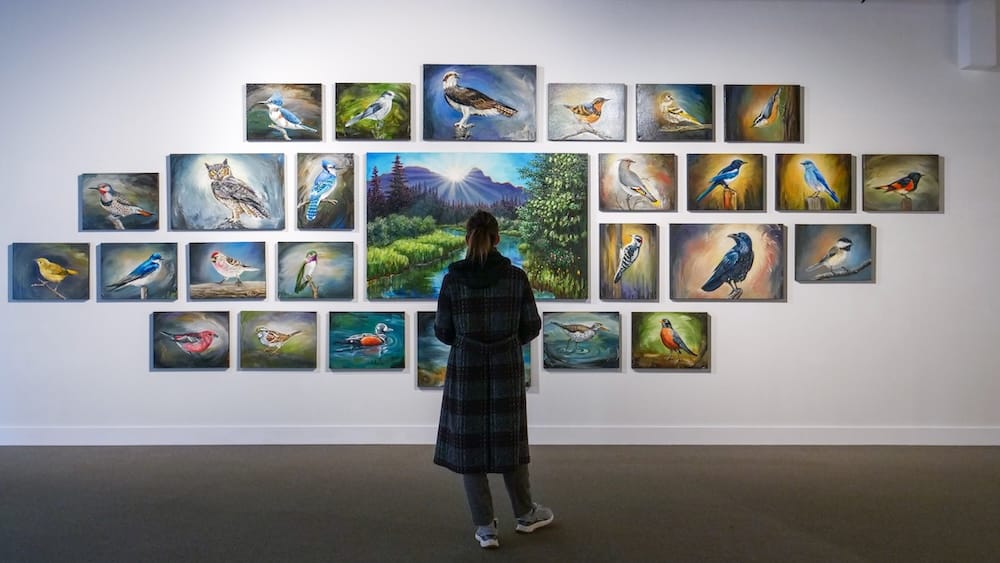
That doesn’t mean every shower politely disappears before you finish your coffee. Mountain conditions around Banff can shift dramatically through the day, but they can just as easily stay miserable. What our trips taught me is that the smartest rainy-day strategy isn’t to surrender the entire day or desperately replace every outdoor activity with something indoors.
Banff town works better if you stay flexible. Pick a worthwhile indoor anchor, get something warm to eat if you’re cold, keep the day geographically compact and take advantage of short outdoor windows when they actually appear. You don’t need to spend eight hours hiding from the Rockies just because the Rockies are temporarily hiding from you.

Rain in Banff can change ridiculously quickly
One of the most useful lessons from our Banff trips was learning not to emotionally cancel the day because of what the weather happened to be doing at that exact moment.
During one visit, Audrey and I were walking toward a canoe activity after a spell of rain. Less than five minutes earlier it had been wet and gloomy; suddenly the clouds began breaking and we had sunshine and blue sky. The change happened quickly enough that we were standing there commenting on how absurdly unpredictable the mountain weather was.
I still wouldn’t turn that into the old mountain cliché of just wait five minutes and the weather will change. Sometimes it does. Sometimes you wait five minutes and discover that the rain has become more committed to the relationship.
The useful lesson is simply that conditions in Banff can vary considerably through the day and even across relatively short distances. A miserable view from your window at breakfast tells you what is happening at breakfast. It is not a legally binding agreement between you and the atmosphere for the rest of the afternoon.
That makes Banff town particularly useful because you can retreat somewhere worthwhile without abandoning the possibility of getting outside again later.
Museums are the best fixed anchors for a wet Banff day
I’m not somebody who travels all the way to the Canadian Rockies thinking, Excellent, how can I maximize my time indoors? If the mountains are visible, I want to see the mountains.
But Audrey and I have visited three museums in Banff town, and none felt like somewhere we went merely to kill time. That makes them much more useful on a rainy day than the sort of generic indoor attraction you grudgingly endure while staring out the window waiting for the clouds to leave.
They’re also different enough that I wouldn’t bother trying to rank them into some artificial first, second and third place. Your better choice depends on what interests you, how much time you need to fill and, importantly, what is actually open.
Banff Park Museum
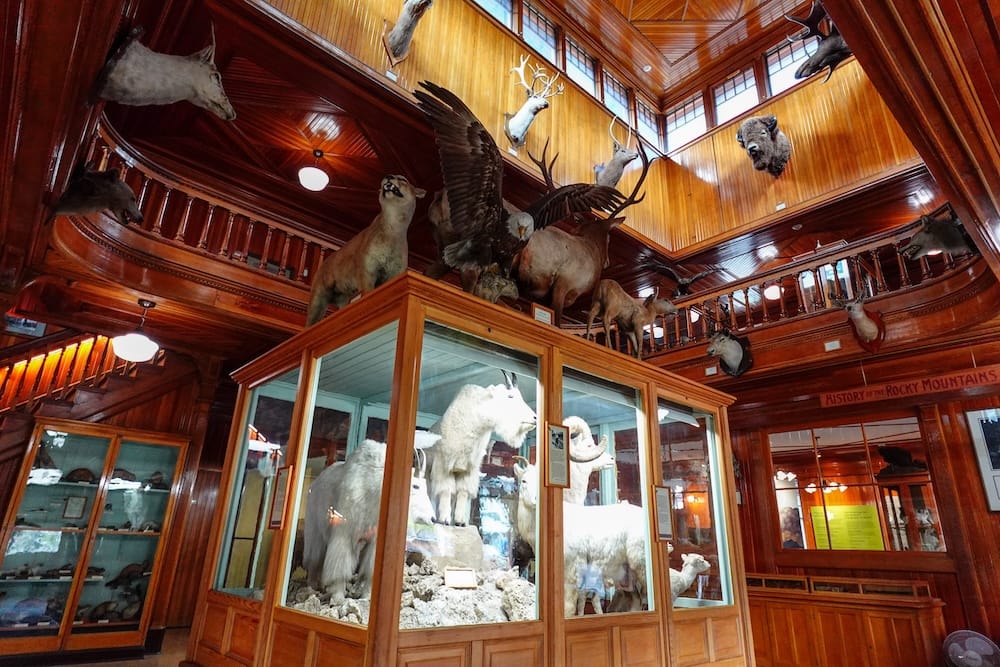
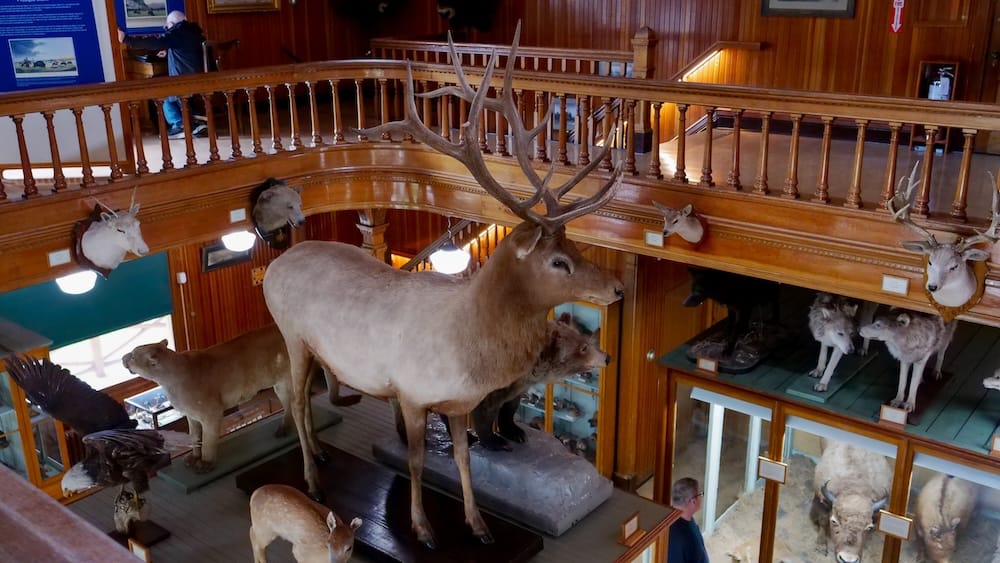
Banff Park Museum was the strangest of the three for me, in a good way. Walking inside felt a little like stepping back in time because the historic building and its huge collection of vintage zoological and botanical specimens are almost inseparable from the experience.
Audrey and I spent a lot of time looking at the animals and realizing how badly we had apparently estimated the size of Canadian wildlife. The bison looked enormous. Even the beaver was much bigger than we expected. I also became particularly interested in one of the darker wolf specimens because it reminded me of our dog Togo.
For a rainy day, one of the museum’s strengths is that you don’t have to commit half your afternoon. A visit can work in roughly half an hour if you’re waiting for a shower to move through, although you could obviously stay much longer if the rain outside has settled in for the day.
The catch is its schedule. At the time of writing, Banff Park Museum operates from May 15 to October 15, Thursday through Monday, from 9:30 a.m. to 5 p.m. So it is not the magical year-round rainy-day solution that some generic Banff lists make museums sound like. If the heavens open on a Tuesday, your brilliant plan to smugly outmanoeuvre the weather has already failed.
Buffalo Nations Museum
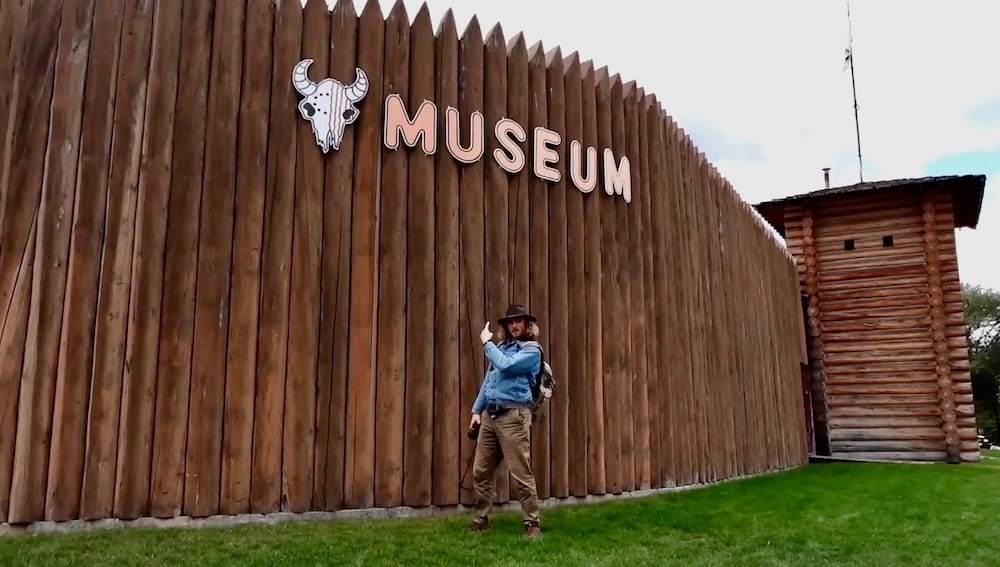
The institution Audrey and I visited under its older Buffalo Nations Luxton Museum name is now presented as Buffalo Nations Museum, and this was a much more substantial stop than simply popping inside until a shower passed.
We spent more than an hour looking through displays and stayed to watch part of a documentary. The museum focuses on the cultures, traditions and histories of First Nations connected with the Northern Plains and Canadian Rockies, which gave our Banff trip an entirely different dimension from the usual progression of mountain, lake, another mountain, another lake.
It currently opens daily from 10 a.m. to 6 p.m., making it a particularly useful option when Banff Park Museum isn’t available.
What I remember most is that we didn’t leave congratulating ourselves for successfully hiding from bad weather. We had actually enjoyed the museum. That is an important difference because a rainy-day activity should still be worth doing even if the sun suddenly appears halfway through it.
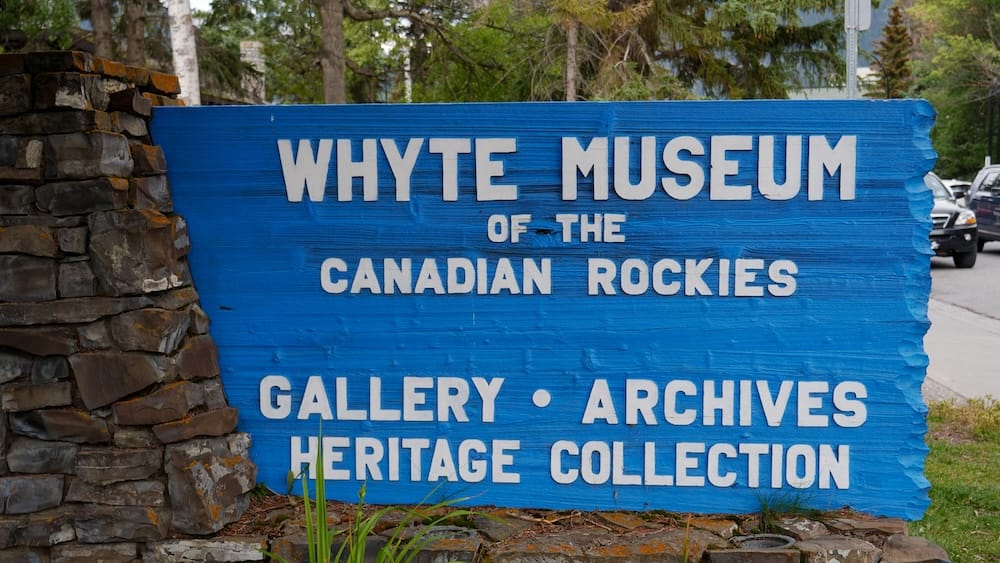
The Whyte
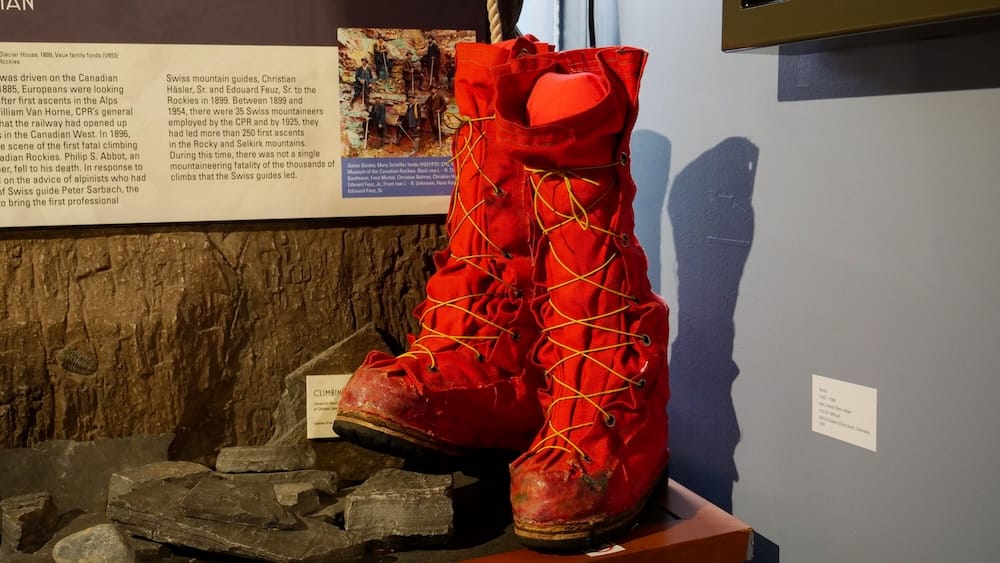
The Whyte probably connected most directly with my own interests. I particularly enjoyed the Rockies artwork and the material connected with the museum’s founders, and some paintings of Lake O’Hara had the dangerous effect of making me leave with yet another place added to my future travel list.
Apparently that’s how my travel planning works now: go indoors to escape the rain, come back outside with another trip to organize.
The Whyte currently opens daily from 10 a.m. to 5 p.m., apart from specified holiday closures. Its heritage material explores the Canadian Rockies through art, artifacts and archival collections, while other exhibitions rotate, so I wouldn’t expect you to walk in years later and reproduce our exact visit.
That rotating element is actually another reason I prefer talking about these museums by what they offer rather than pretending I can permanently rank them. Banff Park Museum gives you natural history in a very distinctive historic setting. Buffalo Nations Museum offers a completely different cultural focus. The Whyte leans into the art and history of the Rockies. On a rainy day, choose the one that actually interests you rather than trying to complete all three like a wet-weather scavenger hunt.

If you’re cold and wet, lunch is not wasted time
One of the easiest traps on a bad-weather travel day is feeling that every hour still needs an attraction attached to it. Museum, gallery, shop, museum, activity. Keep moving. Defeat precipitation through productivity.
Sometimes the correct rainy-day activity is lunch.
During one cold spell in Banff, Audrey reached the point where she wanted exactly one thing: something warm. We stopped at Peak Cafe on Banff Avenue, where she ordered a huge bowl of soup while I had ginger beef. Her logic was beautifully uncomplicated. It had been cold outside, and she wanted soup.

Peak Cafe is still operating on Banff Avenue, but the wider lesson matters more to me than turning this into a restaurant recommendation. If you’re damp, cold and hungry, sitting down for an hour can warm you up, improve your mood and give the weather another opportunity to change while you are doing something you needed to do anyway.
That isn’t sacrificing part of your Banff day. It’s far better than marching miserably around town because the itinerary says you should be enjoying yourself.
If the rain has properly settled in and you want to make food the activity rather than simply stop for lunch, there is also a current three-hour Castle Food Experience inside the Fairmont Banff Springs. It includes five food-and-beverage pairings while moving through different parts of the hotel and learning about its history. I haven’t done this particular tour, so I’d treat it as a researched option rather than a personal recommendation, but it is one bookable experience that genuinely makes sense when being indoors is part of the appeal. It is currently listed as unsuitable for children under 14, so it is clearly a better fit for adults than every Banff family. You can check current availability for the Banff Springs Castle Food Experience.
Use short outdoor windows instead of gambling on a major excursion
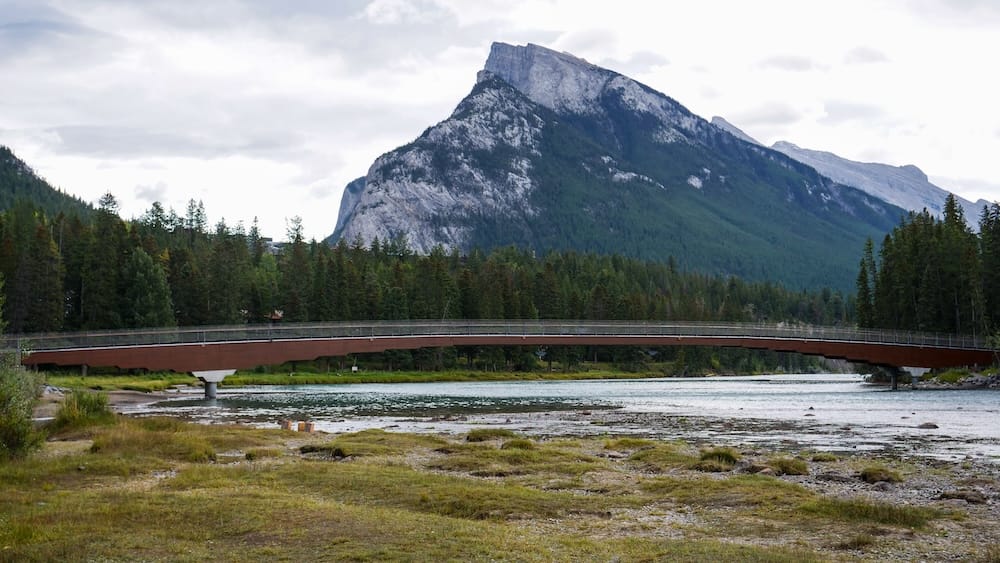
When the rain does ease, Banff town gives you plenty of ways to get outside without making a huge commitment.
Audrey and I have had mornings beside the Bow River where we barely had a plan at all. On one trip we described ourselves as having very few preconceived plans and agreed that those mornings can sometimes be the most fun. That kind of wandering becomes even more useful when the weather is uncertain because you can expand or shrink the outing as conditions dictate.
The central Bow River Trail is particularly good for this. The stretch from Central Park toward Fenland Trail is about 0.9 kilometres, has no elevation gain and takes roughly 10–15 minutes. You can keep going if the weather holds, but you don’t have to turn twenty minutes of blue sky into an ambitious hiking expedition.
Cascade of Time Garden is another easy option when conditions improve. We’ve wandered its paths and landscaped areas before, and it works well precisely because you don’t need to dedicate half a day to it.
This is also where Banff’s compact geography becomes valuable. If you’re already around the town centre, I wouldn’t respond to a temporary clearing by immediately jumping in the car and racing toward some distant part of the national park. By the time you find parking and drive somewhere, the clouds may have reorganized the entire operation.
Parking itself can become part of the friction. During summer, downtown lots often fill by around 10 a.m., while the larger public parking area at the train station is roughly an eight-minute walk from downtown. On an uncertain-weather day, I’d rather park once and connect museums, food, the river and short central walks than spend every clearing playing musical chairs with the car.
Of course, “walkable” and “pleasant to walk in a downpour” are not the same thing. Eight minutes in drizzle is barely worth discussing. Eight minutes while rain comes sideways suddenly feels like an expedition.
Be careful paying for mountain views when you can’t see the mountains
Rain becomes a more interesting problem when the next decision involves a substantial ticket rather than a free walk.
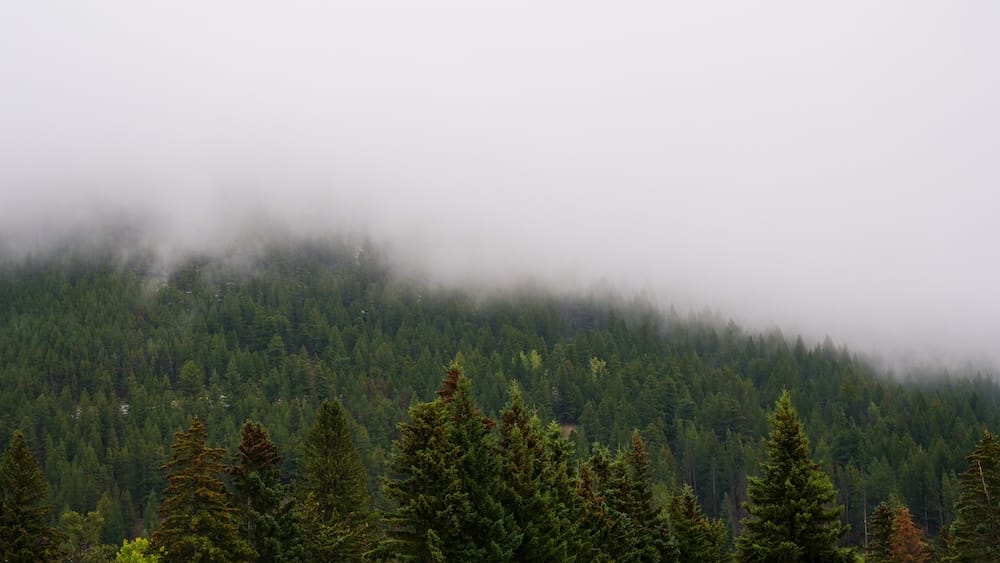
The Banff Gondola is a good example. We’ve ridden it ourselves and had favourable conditions, so the mountain panoramas were a major part of what made the experience worthwhile for us. I haven’t tested it under thick cloud and pouring rain, and I wouldn’t pretend otherwise.
There are indoor elements at the summit, including an interpretive centre, theatre and dining, so the Gondola doesn’t become completely useless the second raindrops appear. But if your main reason for buying a ticket is to look across the mountains and the mountains have vanished into cloud, that matters.
The booking rules make the decision more consequential. Direct Gondola tickets are currently non-refundable, and online changes can generally be made up to 48 hours before the scheduled visit. Closer to the booking, you need to contact the operator and see what can be arranged.
For me, that creates a much better rainy-day question than simply asking whether the Gondola is open: what are you actually paying for?
If you already have tickets and conditions are improving, your decision is very different from somebody standing downtown with no booking while Sulphur Mountain is completely buried in grey. An attraction can be operating normally and still offer less value under the conditions that matter most to you.
If visibility improves and you decide the Gondola still makes sense for your day, GetYourGuide currently lists the same core round-trip summit experience with access to the observation deck and interpretive centre. I would still check the conditions before committing rather than booking simply because rain has created an empty space in your itinerary. You can check current Banff Gondola ticket availability.
My simple rainy-day rule for Banff town
I wouldn’t build a rigid 9-to-5 rainy-day itinerary because the entire point is that you don’t know what the weather will do. What works better is deciding the next move from the conditions you actually have.
| What is happening? | What I would consider |
|---|---|
| Light or intermittent rain with decent visibility | Stay central and look for a short Bow River or garden window |
| Sustained rain | Pick an open museum and give the weather some time |
| You’re cold, wet or hungry | Stop for a warm meal instead of forcing another attraction |
| Low cloud is hiding the mountains | Be cautious about spending mainly for panoramic views |
| You already have a paid booking | Check the change and cancellation conditions before abandoning it |
| The weather suddenly improves | Do something nearby instead of launching a complicated cross-park mission |
The decision really comes down to a few ordinary things: how hard it is raining, whether visibility is poor, what is open, what you have already paid for, how much time you’ll spend transitioning between places and whether you are cold or hungry enough that another attraction sounds considerably less appealing than soup.
That last variable gets ignored far too often in travel planning. There is no medal for enduring Banff badly.
Did rain ruin Banff for us?
No, although I’m not going to start pretending I prefer rain to clear skies. If Banff wants to hand me sunshine and unobstructed Rocky Mountain views, I will graciously accept.
What surprised me was how little a spell of bad weather had to derail the town itself. We genuinely enjoyed the museums rather than treating them as consolation prizes. Audrey’s enormous bowl of hot soup made perfect sense after being cold outside. We already liked wandering beside the Bow River without a rigid plan, which made those brief outdoor windows easy to use when they appeared.
And sometimes the weather really did change almost ridiculously fast.
So if I had another wet day in Banff town, I wouldn’t spend breakfast mourning the itinerary. I’d choose an indoor anchor that I actually wanted to visit, keep the rest of the day loose, eat something warm when necessary and be cautious about spending heavily on mountain views while the mountains were invisible.
Then, if the clouds suddenly lifted, I’d go straight back outside.
Banff doesn’t owe me the sunshine five minutes from now. That’s precisely why I wouldn’t waste the five minutes I have complaining about the rain.
Frequently Asked Questions
What can you do in Banff town on a rainy day?
Museums are some of the most dependable indoor anchors, while a warm meal can give you time to dry out and see whether conditions improve. If the rain eases, short Bow River walks or the Cascade of Time Garden can fit into a small weather window without committing to a major excursion.
Does rain in Banff usually clear quickly?
Banff’s mountain weather can change remarkably quickly, but I would never assume every shower will disappear within a few minutes. We experienced rain turning into blue sky and sunshine very fast, but the practical lesson is to stay flexible rather than count on the weather improving.
Which museums did you visit in Banff?
Audrey and I visited Banff Park Museum and Buffalo Nations Museum, while I also particularly enjoyed The Whyte for its Rocky Mountain art and history. Banff Park Museum has a more limited seasonal schedule, so check that it is open before relying on it as your rainy-day anchor.
Is the Banff Gondola a good rainy-day activity?
It depends on why you want to go. We rode the Banff Gondola in favourable weather and the mountain views were a major part of the experience for us. If low cloud is hiding those views, I would think carefully before paying mainly for scenery you may not get.
Can you still walk around Banff when the weather is unsettled?
Yes, when conditions allow. The central Bow River Trail works particularly well for short outdoor windows because the section from Central Park toward Fenland Trail is about 0.9 kilometres, has no elevation gain and takes roughly 10–15 minutes.
Did rain ruin Banff for us?
No. We genuinely enjoyed the museums, Audrey appreciated a huge bowl of hot soup after being cold outside, and short periods of better weather gave us chances to get back outdoors. I would still choose clear mountain views over rain, but bad weather did not derail Banff town for us.
This guide is also available in Spanish. [Leé la versión en castellano: Banff en un día de lluvia]
This article contains affiliate links. If you book through one of these links, I may earn a commission at no extra cost to you.