
I thought I had a pretty good idea of what a Japanese city looked like. There would be temples, shrines and parks that seemed to belong to another century, then you’d turn a corner and find office towers, vending machines and all the modern conveniences Japan does so well. I’d seen those contrasts plenty of times. What I hadn’t expected was to arrive in Hakodate and find myself looking at Russian Orthodox domes, a Gothic church tower and a grand blue-and-yellow public hall, all within walking distance of a working harbour.
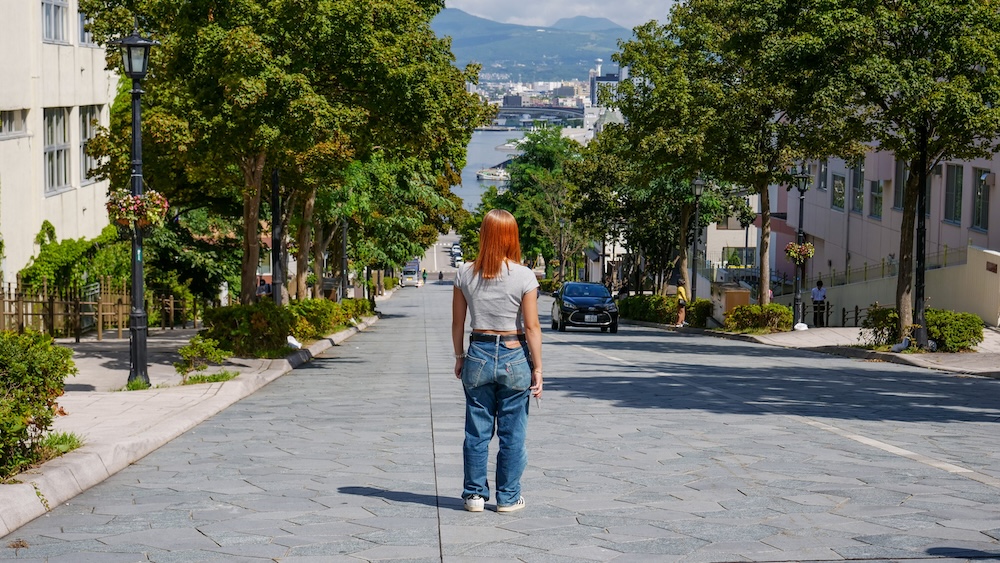
Audrey and I were exploring Motomachi, the historic neighbourhood on the slopes above the water. We were already getting a proper workout from the hills, and every few streets brought another building that didn’t fit my mental picture of Japan. Down below were red-brick warehouses. Farther inland, we’d visit an enormous star-shaped fortress. For the first time in my travels around Japan, I found myself wondering why a city looked quite so different from what I’d expected.
Hakodate reminded me a little of Busan in South Korea, though Busan is on a much bigger scale. Both have that port-city character that sets them apart from the capitals of Tokyo and Seoul. But Hakodate’s architectural mix was something else. I wanted to understand how such different buildings ended up sharing the same city.
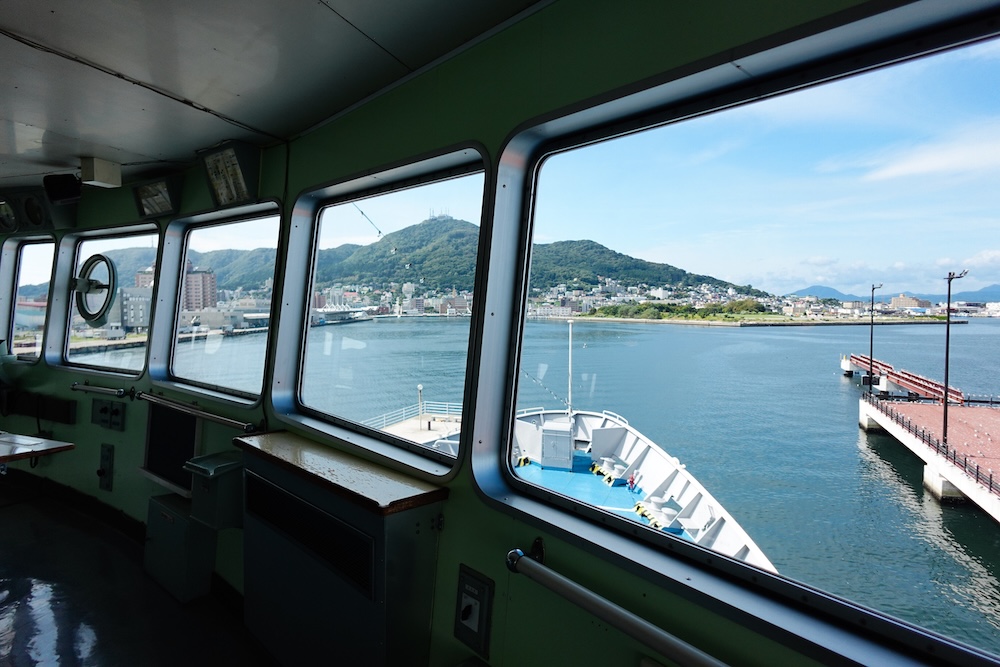
The port brought the world to Hakodate, but the city was already here
Hakodate didn’t begin when Western ships turned up in the nineteenth century. Southern Hokkaido has a much longer history involving Indigenous Ainu communities, settlement and trade across northern Japan. That’s worth remembering, because the familiar story of a Japanese port suddenly opening to the outside world can make everything that came before sound like a blank page.
What changed during the 1850s was the nature of Hakodate’s international connections. Foreign ships gained access for provisioning in 1855, followed by the opening of full international commerce in 1859, the same year as Yokohama and Nagasaki. Diplomats, merchants and missionaries established themselves around the port, and a neighbourhood of religious buildings, foreign-influenced architecture and Japanese commercial enterprises developed above the waterfront.
You can still appreciate that relationship on foot. In Motomachi, the harbour is rarely far from view, and the streets climbing the mountain seem to lead from one architectural surprise to another. The buildings are concentrated enough that you can see several traditions in a single outing, rather than travelling across a vast metropolis to find them.
It’s tempting to describe the result as East meeting West and leave it there. I think that sells Hakodate short. Different groups were building for different purposes, and many of the people adapting those overseas ideas were Japanese. Even the apparently old streetscape was repeatedly changed by fires and reconstruction. The streets themselves have been rebuilt often enough that appearances can be deceptive.
Three churches within a short walk, and three different histories
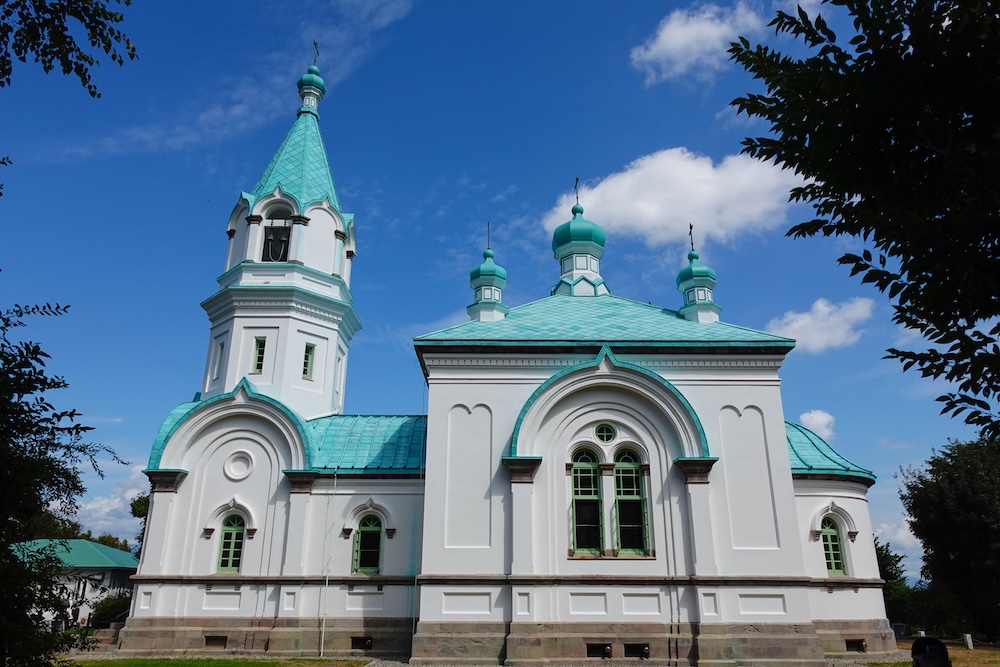
Motomachi’s churches were the first thing that really caught my attention. Imagine walking along a hillside in Japan and passing a white Orthodox cathedral with copper-green domes, a Catholic church whose Gothic-style tower rises over the rooftops, and an Anglican church with an unusual cross-shaped roof. You don’t need to know much about architecture to recognize that these buildings come from very different traditions.
The Hakodate Orthodox Church traces its beginnings to the Russian consular presence in 1858. The building we saw, however, was completed in 1916. Its Russian- and Byzantine-influenced design was the work of Izō Kawamura, a Japanese Orthodox deacon and architect. I love that detail. You can look at those domes and immediately think of Russia, but the person responsible for designing the surviving cathedral was Japanese.
The Motomachi Roman Catholic Church dates its institution to 1859, though its present building was reconstructed in 1923. Its tall bell tower and green spire make a completely different impression from the Orthodox church. Hakodate St. John’s Church adds yet another architectural chapter: the Anglican community began in 1874, but the distinctive building there today was completed in 1979. It isn’t even particularly old compared with its neighbours.
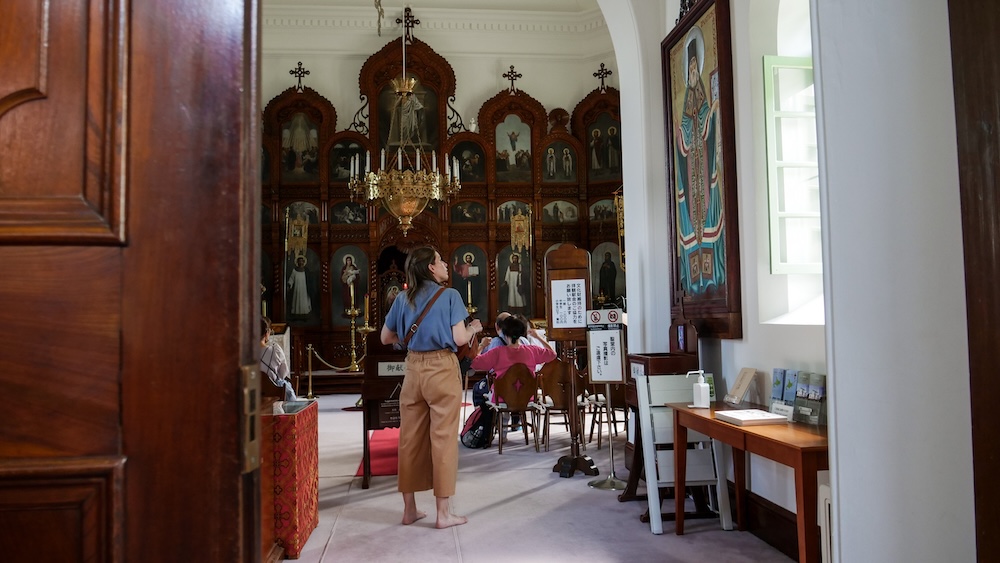
Audrey went inside the Orthodox church, where she saw the religious artwork and iconostasis. We explored the neighbourhood around all three, and what struck me was how naturally these contrasting buildings sat among Japanese streets and homes. They weren’t exhibits arranged in a heritage park. They were part of an actual city, used and rebuilt by religious communities over generations.
That’s why the dates matter. A church founded in the 1850s doesn’t necessarily occupy a building from the 1850s. When you look at Motomachi today, you’re seeing the legacies of nineteenth-century international connections through structures built at several different points in the twentieth century.
I liked poking around Motomachi at our own pace, but if you prefer someone to explain the architectural oddities as you go, there’s a guided walk through Motomachi and the red-brick warehouses. It covers the churches, Hachimanzaka and the Old Public Hall. It’s a three-hour tour we haven’t taken, and the uphill sections still require some legwork.
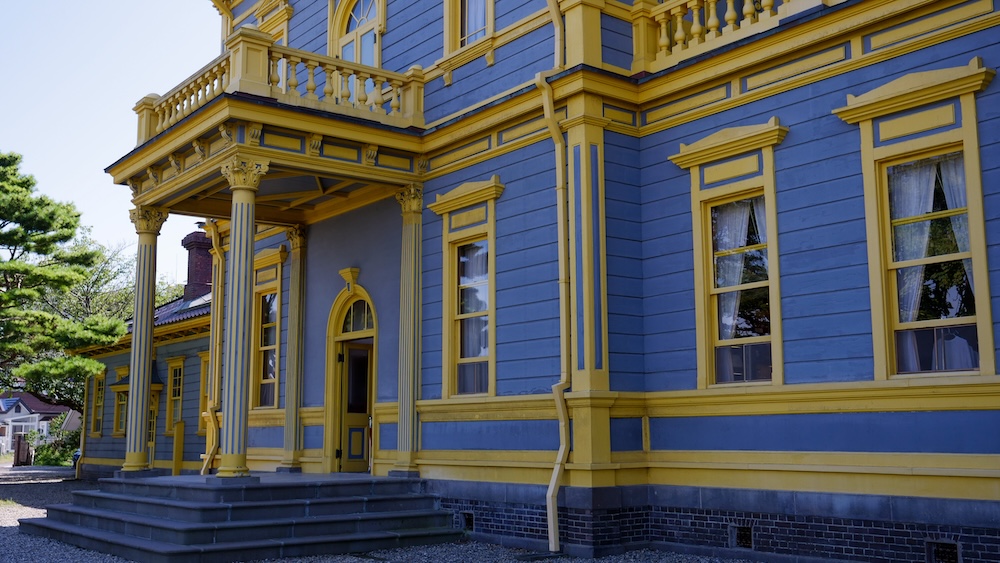
The blue-and-yellow public hall has a very Japanese backstory
Of all the buildings we encountered in Motomachi, the Old Public Hall of Hakodate Ward was the one I was happiest we went inside. Its pale blue exterior, yellow accents, balconies and columns almost demand a photograph. But after buying our tickets, removing our shoes and putting on the provided slippers, Audrey and I got to wander through the historic interior as well. I enjoyed that more than simply ticking off another handsome facade.
From the outside, you could easily assume the hall was built for a foreign administration. In fact, it was a Japanese civic project. Completed in 1910, it was designed by municipal engineer Asajirō Konishi, with most of its construction funding donated by local merchant Teppei Sōma. Japanese people weren’t merely living alongside imported architecture; they were choosing and adapting Western-influenced designs for their own public institutions.
The date points to another part of Hakodate’s story. A major fire in 1907 destroyed the hall’s predecessor, and the blue-and-yellow building rose in its place. It wasn’t the only disaster to reshape the streets. Large fires in 1878 and 1879 prompted street widening and straightening, while the catastrophic 1934 fire brought further changes to the city’s layout and firebreaks. The Hakodate you walk through now is partly the result of rebuilding decisions made after those losses.
There’s an even more surprising contrast nearby. We passed Higashi Honganji Hakodate Betsuin, a Buddhist temple that looks traditional from the street. Its main hall was rebuilt in 1915 using reinforced concrete, reproducing familiar temple forms with a then-modern building material. It was Japan’s first temple building to recreate traditional temple architecture in reinforced concrete. The public hall looks Western but served Japanese civic life; the temple looks centuries older than its engineering. You would never guess all that just from the rooflines.
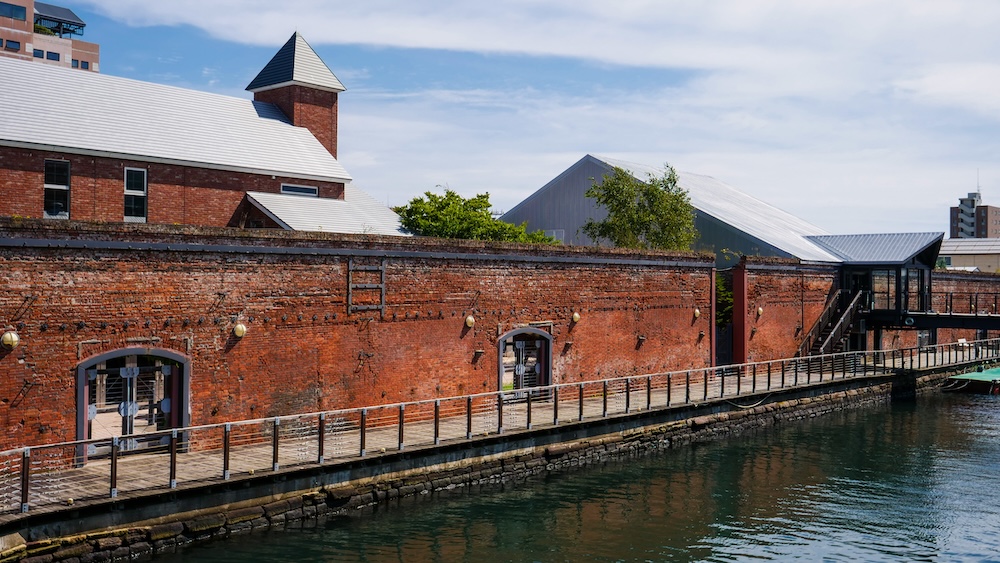
Those red-brick warehouses were built for work, not photographs
The Kanemori Red Brick Warehouses are another piece of Hakodate that looks wonderfully atmospheric today. Audrey and I visited the waterfront complex, where the old buildings now contain shops, restaurants and places to pick up snacks. It’s easy to forget that they once had a much less glamorous job: keeping commercial goods such as dried seafood, kelp and rice in storage. Brick offered practical advantages, including fire resistance.
The business belonged to Kumashiro Watanabe, a Japanese entrepreneur who established his warehousing operation in 1887. After the earlier buildings burned in 1907, the familiar Kanemori brick warehouses were rebuilt in 1909. They were eventually adapted for shopping and leisure decades later, with the modern commercial transformation beginning in 1988. Different structures within the larger complex have different origins, but the main point is clear enough: these were working buildings tied to a Japanese merchant’s business in a busy port.
Here’s a connection I particularly enjoy. In Motomachi Park, we photographed a monument to the Four Heavenly Kings of Hakodate, businessmen recognized for helping develop the city. Watanabe was one of them. So there’s a monument up on the hill honouring a man whose business left its mark down on the waterfront. It’s a connection between the port and the neighbourhood above that I wouldn’t have guessed from their appearance alone.
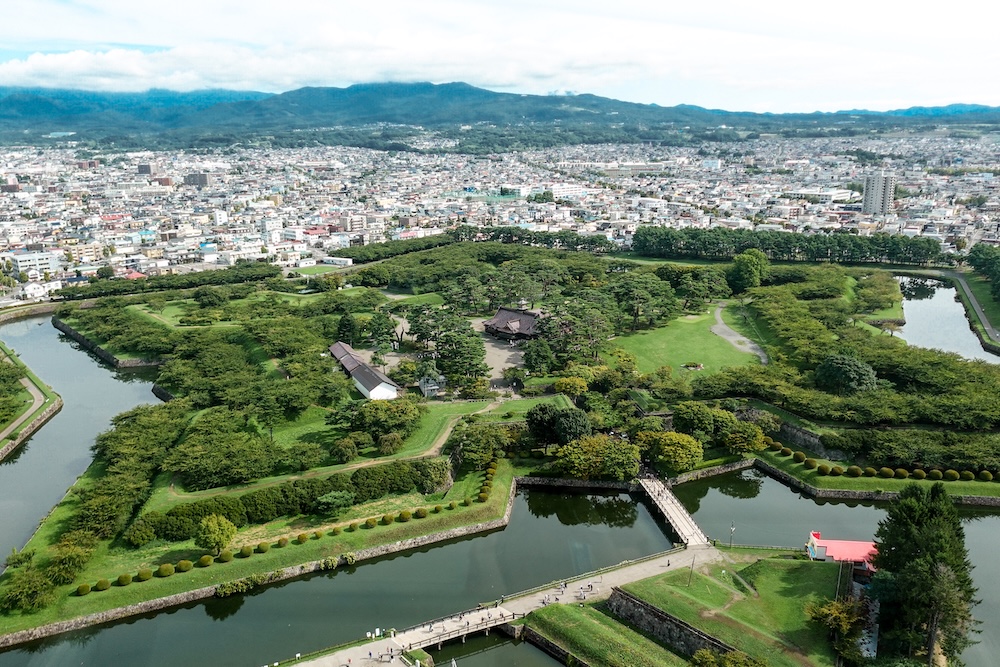
And then there’s a fortress shaped like a star
Just when you think you’ve accounted for Hakodate’s churches, civic buildings and port commerce, Goryokaku arrives to complicate things further. Audrey and I explored the park early in the morning, walking among the moats, bridges and defensive earthworks before the observation tower opened. At ground level it felt like a lovely place for locals to go walking or jogging, which is a fairly remarkable second life for a former fortress.
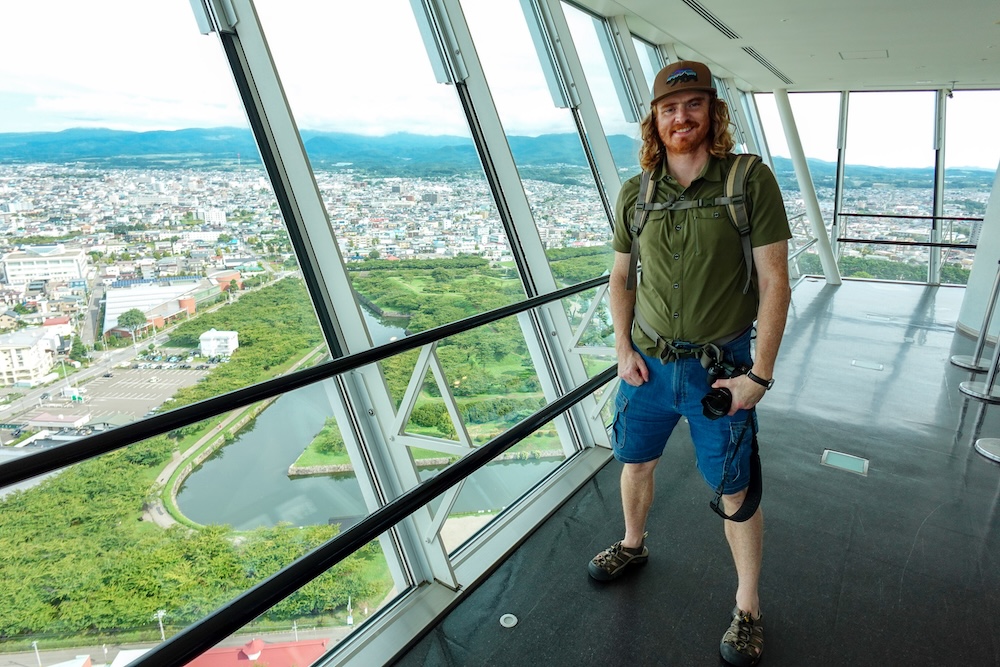
The full design only becomes obvious from Goryokaku Tower. Looking down, we could see the five-pointed star formed by the defensive walls and surrounding water. There’s a reason for that shape beyond looking terrific from an observation deck. European-style bastion fortifications were designed so defensive positions could help protect neighbouring sections of wall against artillery attacks.
But Goryokaku wasn’t built by a European army. Japanese engineer Ayasaburō Takeda drew on European military-engineering ideas, including knowledge passed on by French naval personnel. Construction began in 1857, and the government offices moved into the substantially completed fort in 1864. This was a Japanese administrative and defensive project in a port whose international importance was growing.
The fortress later became connected with the Republic of Ezo and the fighting that ended in 1869, but that chapter came after its original construction. What interests me here is the decision to borrow a military design because it offered a practical advantage. Goryokaku’s walls had very little in common with Motomachi’s church towers, except that both show Japanese builders finding uses for ideas that came from elsewhere.
If the military history interests you more than the usual sightseeing, a guided Goryokaku fort and tower history tour covers the earthworks, reconstructed Magistrate’s Office and tower viewpoint. We walked the park and visited the tower independently, so I can’t vouch for this particular guide’s commentary.
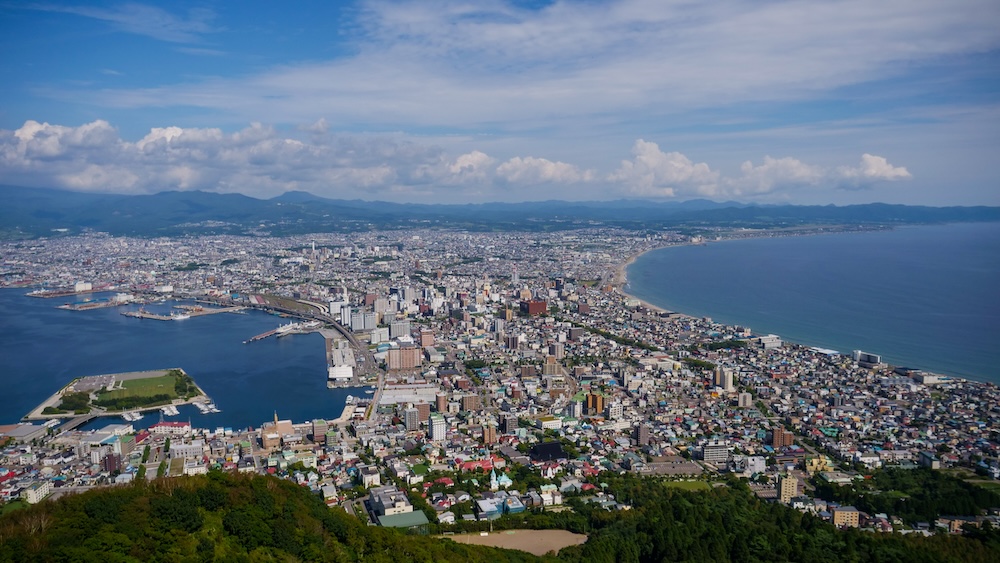
The shape of Hakodate makes all these contrasts harder to miss
We were reminded pretty quickly that Hakodate’s geography doesn’t go easy on your legs. Climbing Hachimanzaka in hot, humid weather, with the harbour stretching out below us, had me questioning whether all that hiking in the Canadian Rockies had done me much good. Still, I wouldn’t have wanted to miss those steep, tree-lined streets. The views help explain why Motomachi is such a memorable place to wander.
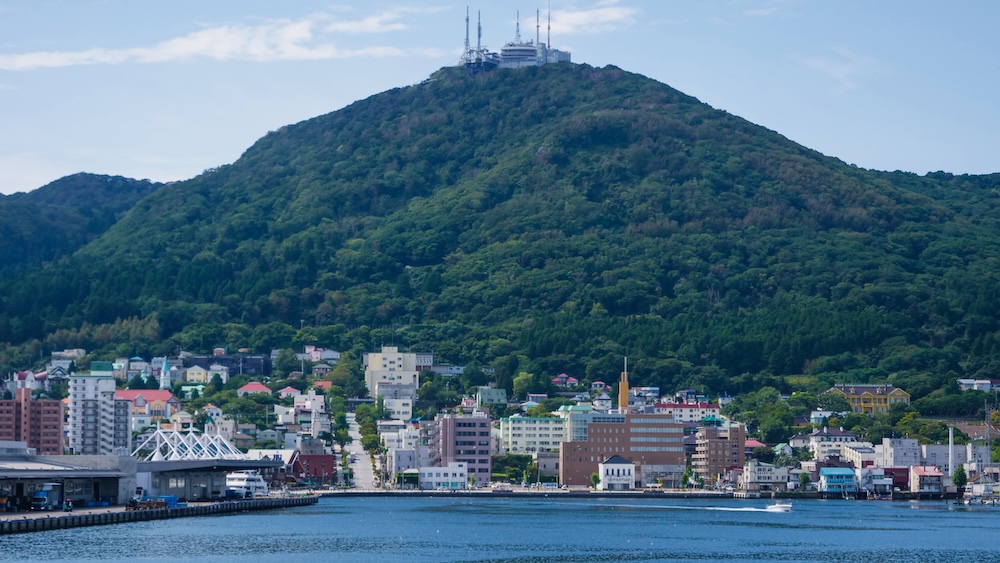
The old district sits above the harbour at the foot of Mt. Hakodate, with churches and public buildings rising behind the waterfront. That closeness creates some wonderful views: an ornate church roof in one direction, the port in another, and streets descending toward the water. Even the trams we used to get around contributed to the character of the place. I remember comparing the experience to riding trams in Hong Kong, although Hakodate’s were a different proposition altogether.
Then we took the Mt. Hakodate Ropeway up in daylight, and the city turned out to be much larger than we’d understood from the streets below. From above, we could see water on different sides, the built-up area spreading inland, mountains in the distance and farmland beyond. Hakodate occupies a narrow land connection formed by accumulated sediment—a tombolo—between Mt. Hakodate and the larger Hokkaido landmass. It’s an unusual setting, and that shape makes the historic harbour district especially recognizable.
Our later view from Goryokaku Tower added another perspective. Hakodate wasn’t all quaint streets and churches; it was also a spread-out, functioning Japanese city. That’s part of what made the historic architecture stand out so much to me. You could enjoy those strange contrasts in Motomachi, then take a tram and find yourself somewhere with a completely different atmosphere.
A different picture of what a Japanese city can be
Nagasaki, Yokohama and Kobe have their own histories of international exchange and Western-influenced buildings. I’m not about to award Hakodate some imaginary prize for being Japan’s most European-looking city. I can only tell you how it struck me, and after years of travelling around Japan, this particular combination genuinely caught me off guard.
I could go from a working harbour up steep streets to churches belonging to different traditions, step inside a public hall commissioned by Japanese residents in a Western-influenced style, then head across the city and look down on a star fortress built for Japanese defence. All of it was Hakodate. Even the buildings that initially seemed the least Japanese turned out to have deeply local stories.
Before coming here, I’d pictured Japanese cities through the familiar contrast of old temples and modern urban life. I still love that contrast, but Hakodate made me realize how much it leaves out. The city hadn’t stopped being Japanese just because its architecture surprised me. I’d simply been looking at Japan through too narrow a lens.
Frequently Asked Questions
Why does Hakodate have so many Western-influenced buildings?
Hakodate developed stronger international commercial and religious connections after its port opened to full foreign trade in 1859. Japanese merchants, officials and architects also adopted and adapted overseas designs, so the surviving buildings reflect both international influences and local decisions.
Which part of Hakodate has the historic churches?
Motomachi, on the slopes above the harbour, contains Hakodate Orthodox Church, Motomachi Roman Catholic Church and Hakodate St. John’s Church within a short walk of one another. Audrey and I explored the neighbourhood, though only Audrey went inside the Orthodox church.
Are Hakodate’s historic churches all from the 1800s?
No. Their religious communities have nineteenth-century roots, but the Orthodox cathedral dates to 1916, the current Catholic church was reconstructed in 1923, and the present St. John’s Church was completed in 1979.
Why is Goryokaku shaped like a star?
Japanese engineer Ayasaburō Takeda adapted European bastion-fortification principles for the fortress. The angled defensive walls were designed to help protect adjoining sections against attack. We appreciated the star-shaped outline much more clearly from Goryokaku Tower than from the park.
Was Hakodate’s Western-style architecture built by foreigners?
Not always. The Old Public Hall was a Japanese civic project, and the Orthodox cathedral was designed by a Japanese architect. The Kanemori warehouses also grew out of a Japanese merchant’s business. That local involvement is a big part of what makes Hakodate’s architectural history interesting.
Can you understand Hakodate’s layout from Mt. Hakodate?
We rode the Ropeway up in daylight and could see the city stretching inland between different coastlines, with the harbour, surrounding mountains and farmland beyond. The elevated view helped us understand the unusual geography behind the historic waterfront streets.
This article is also available in Spanish. [Leé la versión en castellano: Por qué Hakodate se ve diferente de la mayoría de las ciudades japonesas]
This article contains affiliate links. If you book through one of these links, I may earn a commission at no extra cost to you.