
With sweaty palms and more than a hint of trepidation, I boarded a tiny wooden boat equipped with little more than an oar, a Bangladeshi boatman sporting a toothy grin and a narrow plank pretending to be a seat.
That was it. No life jacket. No reassuring safety demonstration. No clipboard-wielding official asking whether I had any pre-existing medical conditions. Just the boatman, the plank and me—already wondering whether I had confused adventure with poor decision-making.
Within moments, we pushed away from shore and entered the most functionally chaotic river port I had ever witnessed with my own two eyes. Off in the distance, colossal passenger vessels dwarfed the puny craft I had just boarded. They looked like apartment buildings with engines. We looked like something a reasonably determined child could assemble during woodworking class.
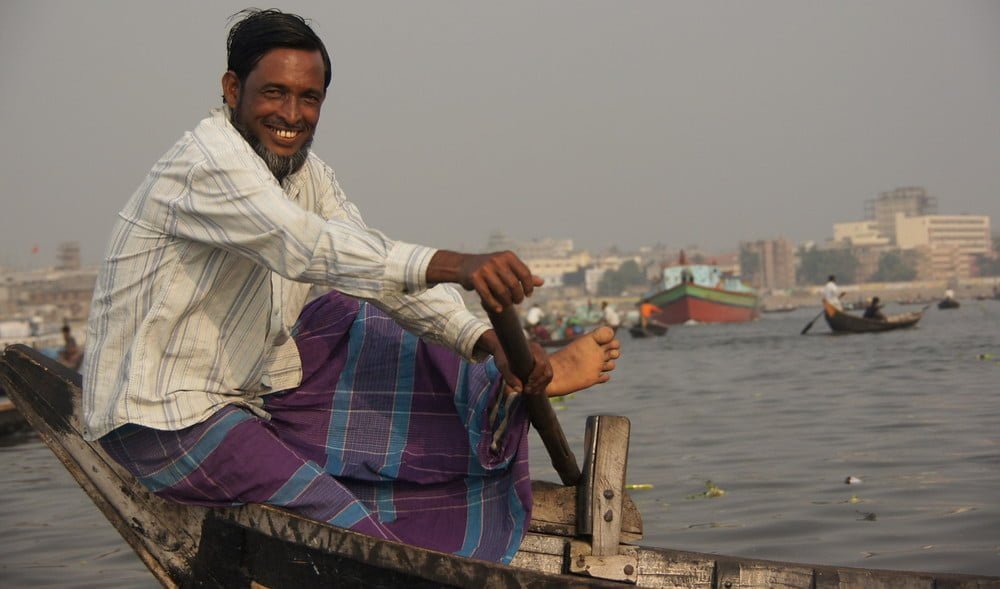
My first view from the boat: tiny wooden craft threading their way between passenger launches on the Buriganga River.
Like lowly pawns on a chessboard, tiny rowboats crisscrossed and zigzagged around the larger vessels with an uncanny ability to weave in and out of danger. At least, it looked like danger to me. To the boatmen, this was Tuesday.
The white-knuckle grip I had on the side of our boat slowly subsided. My reservations about the entire journey melted as we paddled past one smiling face after another.
Men danced on the planks of gigantic vessels. Oarsmen grinned from ear to ear. Children waved enthusiastically as soon as they spotted my camera. Before long, it felt less like I had foolishly climbed into a floating matchstick and more like a welcome party was being thrown in my honour.
In Old Dhaka, the Buriganga is inseparable from the city around it. A seemingly endless current of passengers, boatmen, porters and traders moves through Sadarghat while horns, voices, engines and calls to prayer fight for every available inch of air.
It is loud. It is crowded. It smells like a working river in a megacity because that is precisely what it is. And it remains one of the most visually intense places I have ever photographed.
This travel photo essay follows my ride through that controlled chaos: enormous launches, tiny wooden boats and the people who transformed an intimidating beginning into one of my warmest memories from Old Dhaka.
Crossing the Buriganga in a Tiny Wooden Boat
Seen from shore, the traffic looked like complete disorder. Boats approached from every direction. Oars crossed. Launches manoeuvred through gaps that appeared far too small. People boarded and disembarked while the vessels were still wobbling beneath them.
From inside the boat, another pattern gradually emerged.
The boatmen knew when to row hard, when to drift and when to let a larger vessel lumber past. What looked improvised to me was an ordinary working day for them. There was a rhythm to the madness. I did not understand it, but I became increasingly grateful that my boatman did.
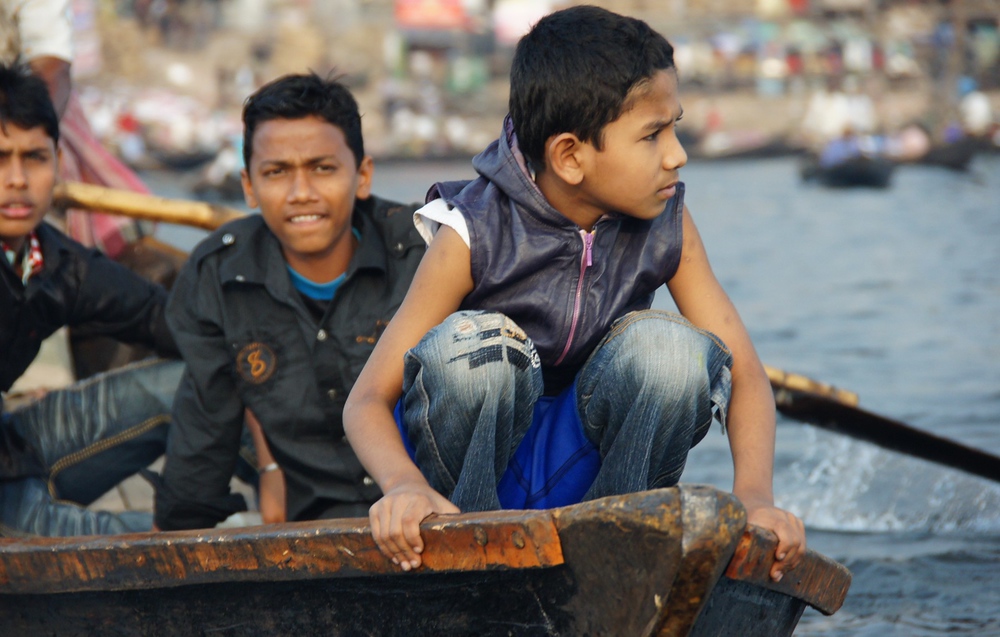
A telephoto view of young passengers crossing the river in another small wooden boat.
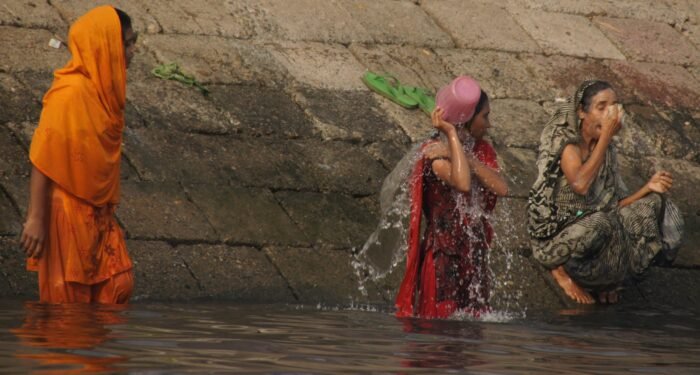
Women washing beside a less crowded ghat away from the thickest river traffic.
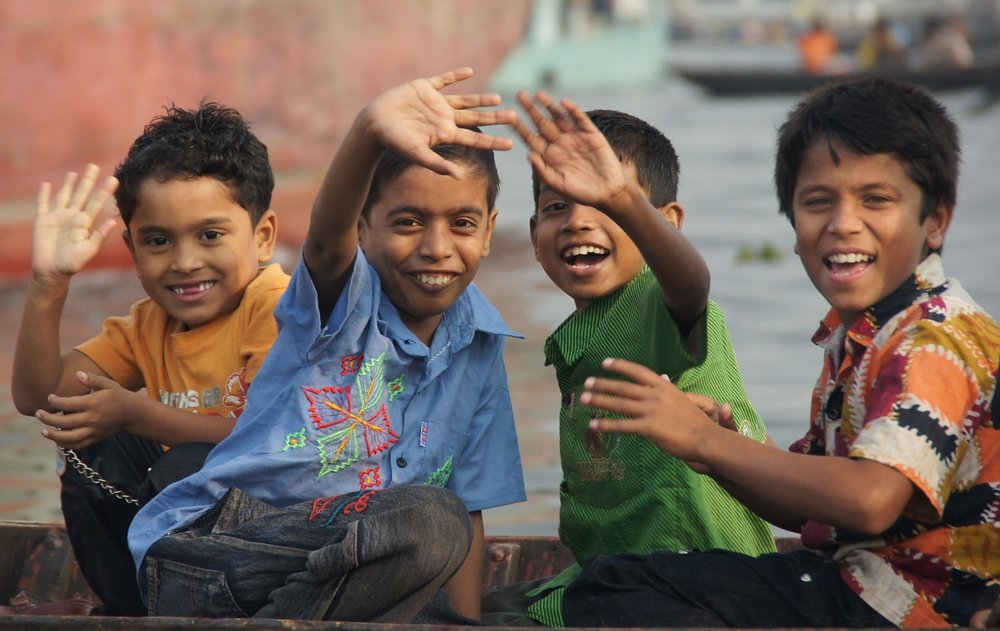
A group of boys waved as our boats passed one another on the Buriganga.

An older oarsman watched us pass while maintaining his course through the traffic.
Small Boats, Enormous Launches and Not Much Breathing Room
The most intimidating part of the ride was not the rowboat itself. It was the scale of everything surrounding it.
Our wooden boat sat only slightly above the waterline. The passenger launches beside us rose several decks into the air. Sitting on that narrow plank, I enjoyed the unpleasantly clear perspective of someone who had brought a toothpick to a shipyard.
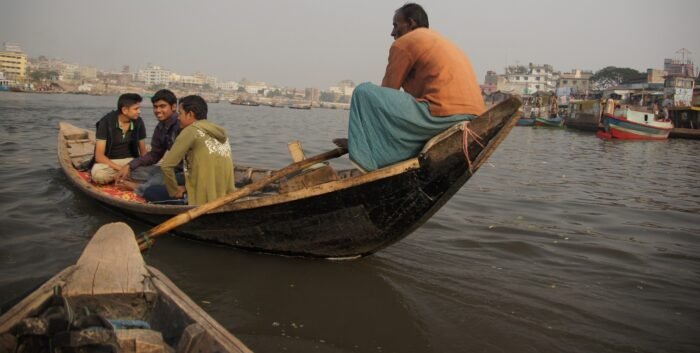
The rowboat in front of us was nearly identical to mine: narrow, low in the water and powered by a single oar.
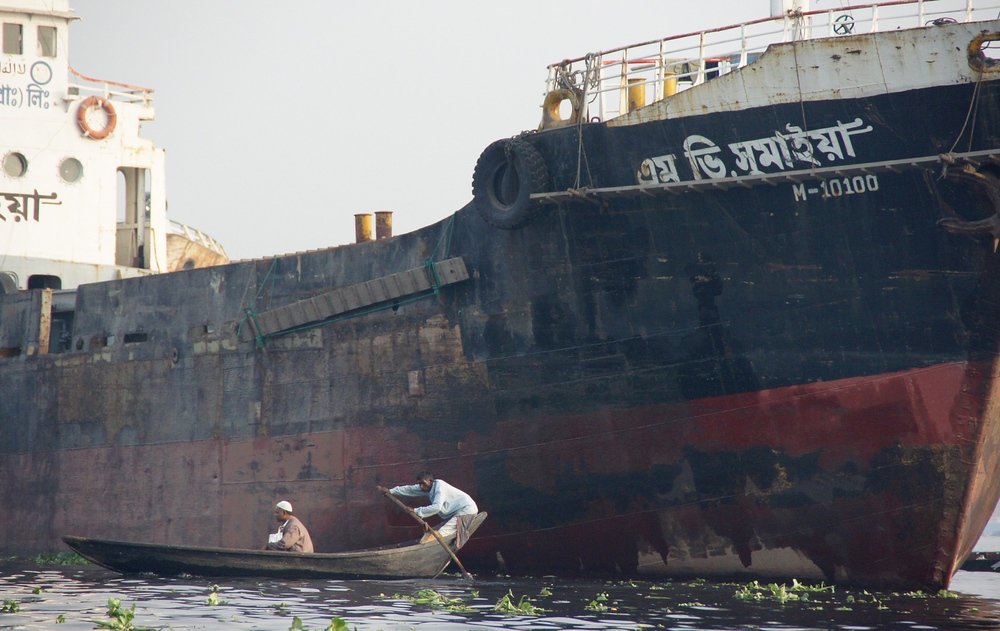
This photograph gives a better sense of the frankly ridiculous size difference between the passenger launches and the rowboats moving around them.
Yet the smaller boats did not behave like frightened minnows. They slipped through gaps, crossed behind larger vessels and changed direction with the confidence of people who understood the river far better than I ever could.
My contribution to this operation was mainly sitting down, holding on and trying not to become an unexpected complication.
The Faces of Sadarghat
Once I stopped staring nervously at the hulls towering above us, the human side of the river took over.
Every few moments brought another wave, grin or performance for the camera. Some people posed deliberately. Others simply glanced up from their work as we drifted past. The distance between boats was often so small that the Buriganga felt less like an open waterway and more like a crowded street where somebody had forgotten to install the pavement.
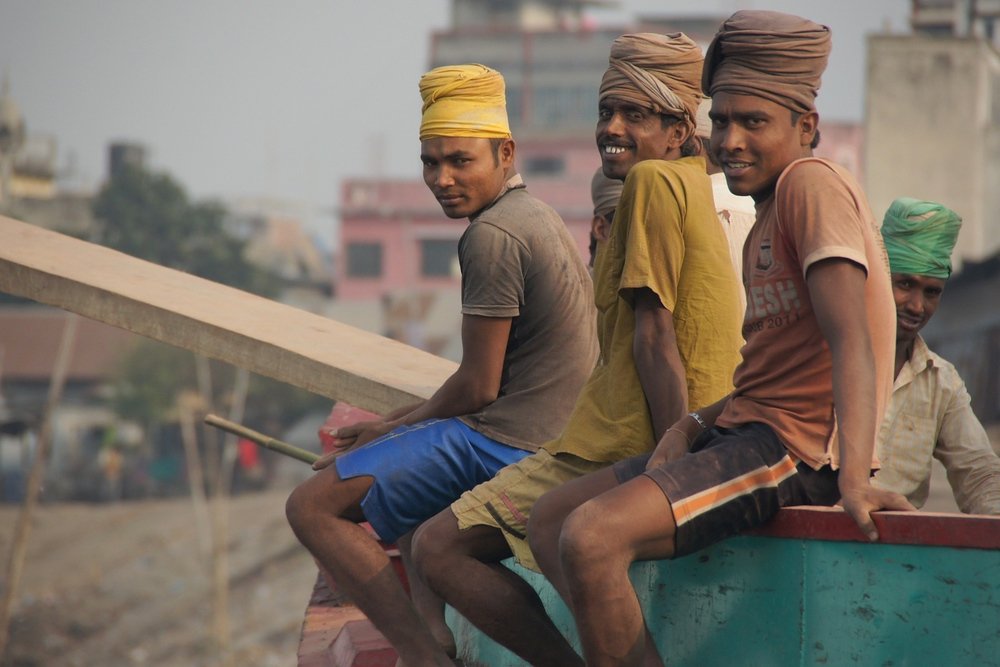
These men greeted me with warm smiles as we passed their vessel.
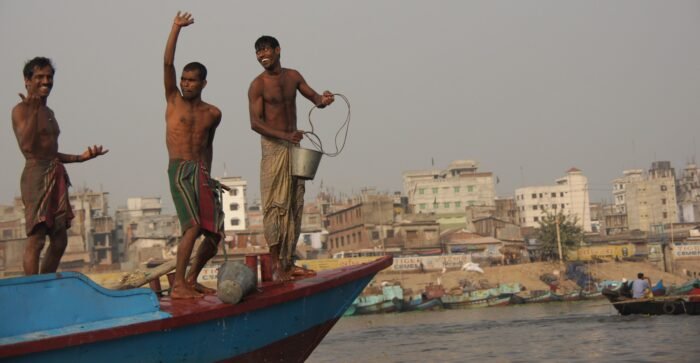
There was dancing, laughter and absolutely no shortage of hamming it up for the camera.

One of the many portraits I made while travelling through the river traffic.
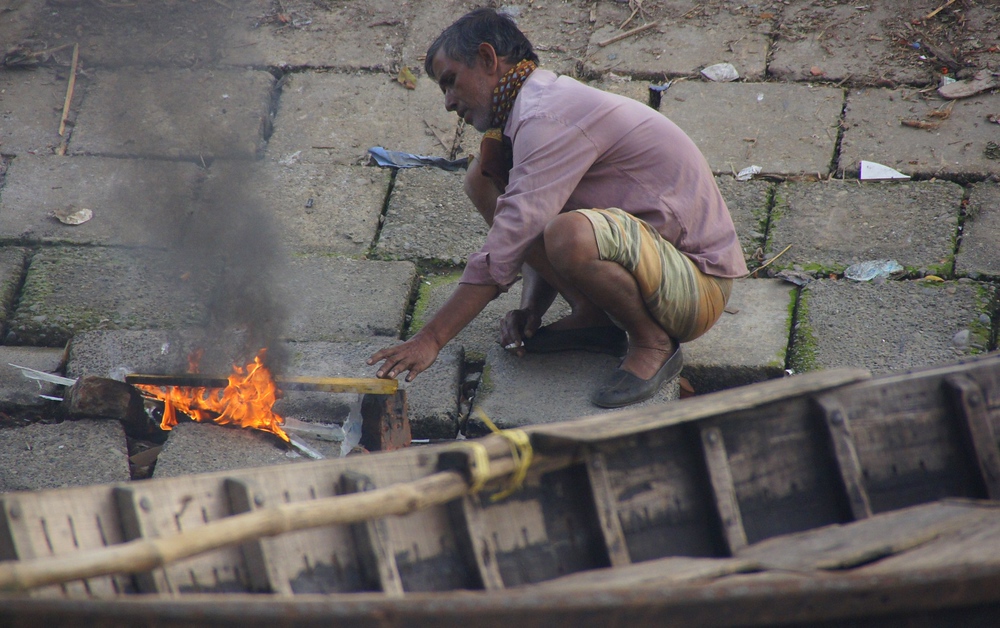
A man tending a small fire beside one of the ghats along the river.
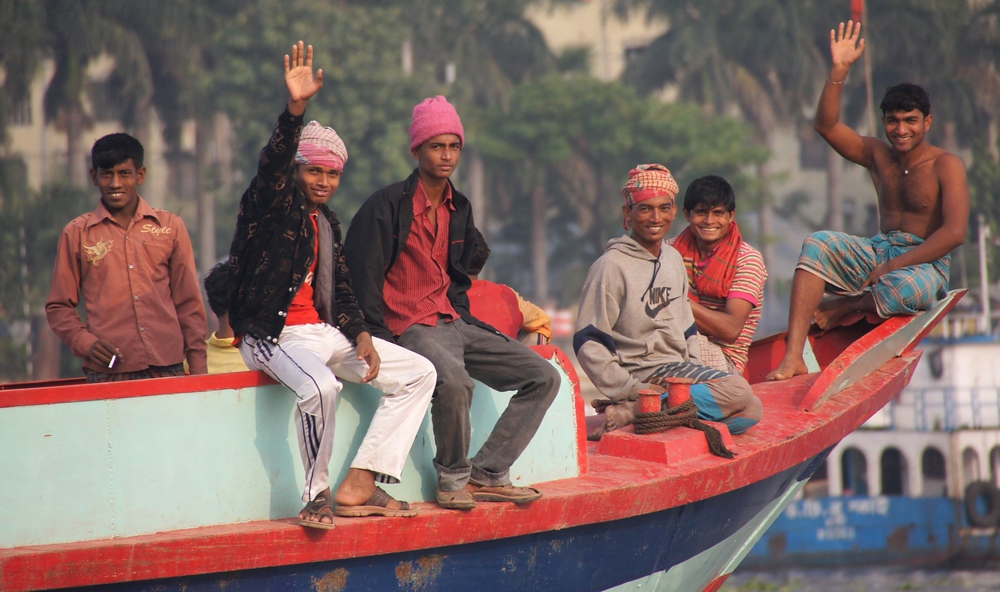
I was not kidding when I said the ride began to feel like a welcome party.
There is a danger in writing about somewhere like Sadarghat and reducing everybody to scenery. The river is photogenic, yes, but these were not performers waiting for a travel blogger to arrive. They were commuting, rowing, carrying cargo and getting on with their day.
The warmth I encountered was real. So was the fact that I was a guest passing briefly through somebody else’s workplace.
Eventually, I Remembered to Relax
The longer we remained on the river, the more normal the boat began to feel.
The plank was still primitive. The launches were still enormous. The water had not magically become inviting. But the initial tension had gone.
I took off my sandals, stretched out my feet and finally allowed the boatman to worry about the traffic. He had, after all, been doing a considerably better job of it than I had.

Sandals off and feet stretched out once the white-knuckle portion of the ride had passed.
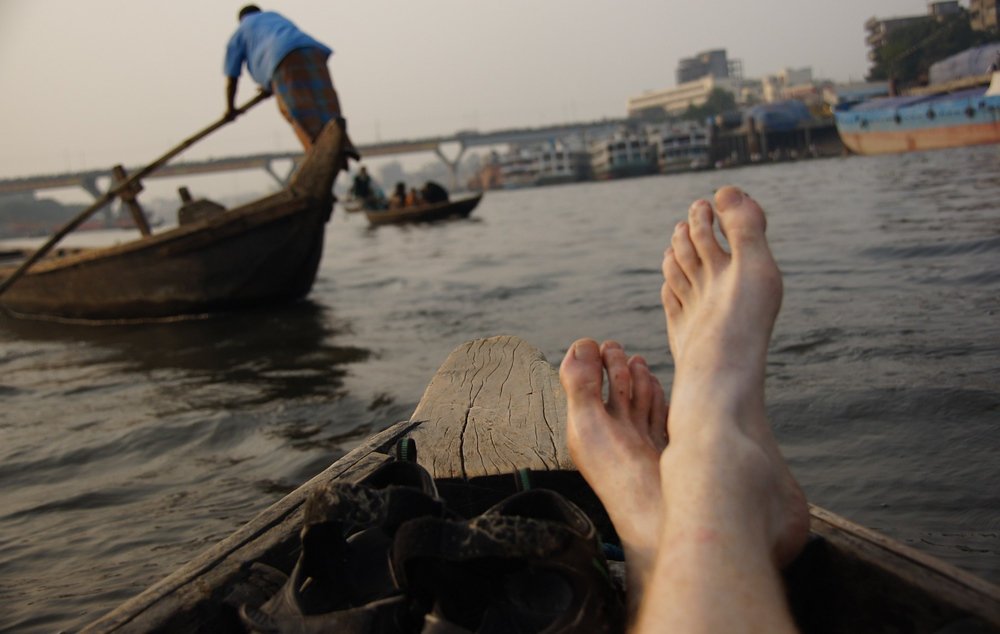
Here I am looking considerably more relaxed as we pass other small boats near Sadarghat.
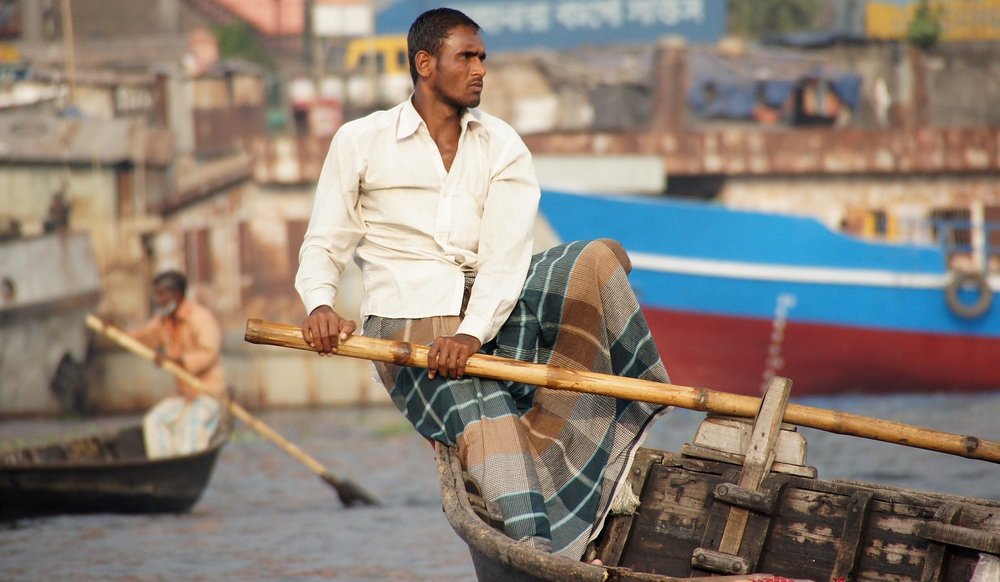
A button-down shirt and traditional lungi were common working clothes among the boatmen I photographed.
Watch my Buriganga boat ride near Sadarghat in Old Dhaka
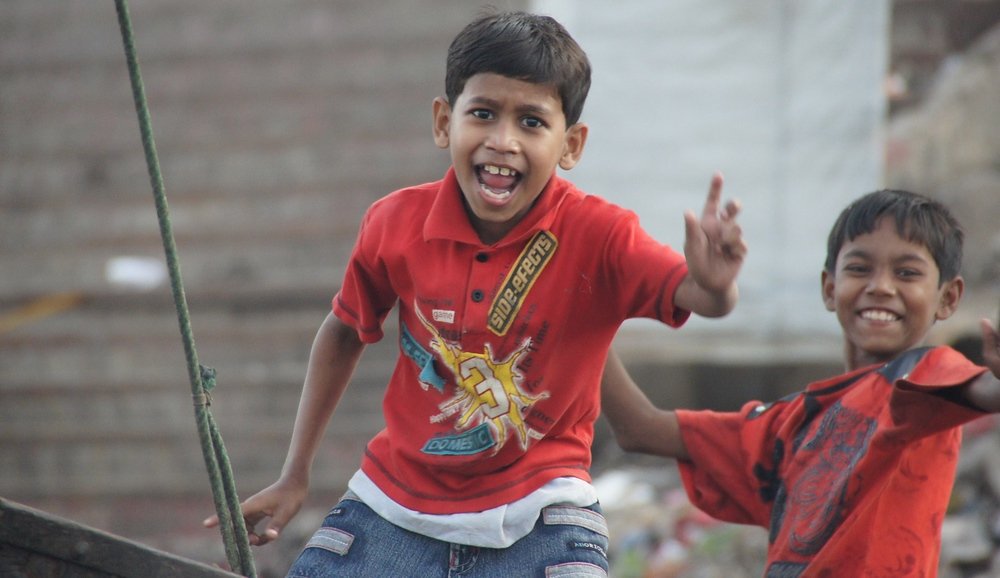
More smiles, more waving and one final dance for the camera.
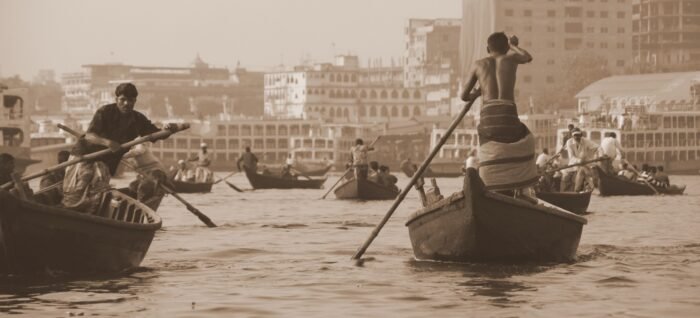
A typical view near Sadarghat: small wooden vessels slipping between one another on the Buriganga.

The Buriganga under softer late-afternoon light, when even the hard edges of the port briefly begin to glow.
Why Sadarghat Matters to Dhaka
Sadarghat is not a purpose-built attraction where boats perform for visitors. There is no themed entrance, polished viewing deck or employee dressed as an eighteenth-century oarsman. Thank goodness.
It is a working river terminal tied to the movement of people and goods through Bangladesh.
Banglapedia describes Sadarghat as a historic wharf on the Buriganga, positioned beside Ahsan Manzil and connected to the old Buckland Bund. It developed as a landing point for boats, launches and ships arriving in Dhaka from elsewhere in the country.
The scene is not frozen in its historical prime. Road connections—especially the Padma Bridge—have changed how many Bangladeshis travel between Dhaka and the south. Recent reporting has documented fewer launch services and operating routes than in Sadarghat’s busier years.
That does not make the riverfront quiet. Small crossing boats, passenger launches, cargo, porters and riverside commerce still overlap in an intensely active space.
It simply means the honest story is more interesting than recycling a grand superlative about it being the world’s busiest something-or-other and hoping nobody asks for evidence.
Planning Your Own Sadarghat Boat Ride
The classic experience pictured in this essay is a ride in one of the small wooden boats operating around the riverfront. These are entirely different beasts from the large multi-deck launches used for longer passenger journeys.
The little boats are basic. Seating may amount to one narrow plank. Space for bags is limited. Boarding can involve uneven steps, wet timber and a vessel that begins moving the moment you place your weight inside it.
This is precisely what makes the experience so intimate. It is also why you should decide whether it suits your balance, mobility and tolerance for risk before you allow enthusiasm to carry you downhill toward the water.
A Crossing Is Not the Same as a Private River Loop
Before discussing a price, make clear what you are asking for. Otherwise, you may imagine a leisurely photography excursion while the boatman believes he is simply delivering you to the opposite bank.
- A direct crossing takes you from one side of the Buriganga to the other and is primarily a local transport service.
- A short loop keeps you around the Sadarghat riverfront and gives you time to observe the surrounding boats.
- A longer photography ride allows more time to wait for scenes, work with changing light and move beyond the most congested patch of water.
Do not assume the presence of a large camera communicates all of this telepathically. Agree on the approximate duration, route, return point and total price before boarding.
How Long Should You Spend on the River?
| Approximate Time | What It Offers | Best Suited To |
|---|---|---|
| 15–20 minutes | A quick introduction to the boats and immediate riverfront | Nervous passengers, tight schedules and anyone testing their comfort level |
| 30–45 minutes | Enough time to settle down, observe the traffic and make photographs without dragging the ride out | Most first-time visitors |
| 60 minutes or longer | More patient observation and changing photographic opportunities | Photographers and travellers already comfortable in small boats |
These are planning ranges, not official ride categories. Your actual route depends on traffic, weather and what the boatman is willing to arrange.
For most people, 30–45 minutes is enough. It gives the initial panic time to evaporate without leaving you sitting on a wooden plank long enough to develop strong opinions about lumbar support.
How Much Does a Sadarghat Boat Ride Cost?
I would not trust any article—including this one—that gives you a supposedly timeless fixed fare for an informal wooden boat.
A local crossing and a private sightseeing loop are different services. Prices can change with duration, demand, weather and the entirely predictable discovery that you are an international visitor carrying camera equipment worth more than the boat.
The sensible approach is refreshingly unglamorous:
- Ask your hotel, guide or a trusted local what a reasonable current fare should be.
- State whether you want a crossing or a private loop.
- Agree on the duration and total price in Bangladeshi taka.
- Confirm whether the amount covers the whole boat or each passenger.
- Carry smaller notes so payment does not become an experimental theatre production at the end.
Keep the conversation friendly. Negotiating does not require transforming yourself into an angry commodities trader. If the arrangement remains vague or the price keeps shifting before you have even boarded, smile, step away and speak with somebody else.
Safety: What the Photographs Do Not Show
The photographs make the ride look spontaneous and joyful. They do not fully convey how low the boats sit, how abruptly they can shift beneath you or how much larger the surrounding launches feel when you are staring up at them from water level.
There may be very little formal visitor infrastructure around an informal rowboat ride. Do not assume a life jacket, safety briefing or dry boarding platform will materialize simply because one would be sensible.
- Watch several boats board and depart first. You will quickly learn what appears normal and what looks overloaded, rushed or needlessly sketchy.
- Choose daylight and calm conditions. Skip the ride during heavy rain, storms, strong wind or poor visibility.
- Board one person at a time. Let the boatman steady the craft and tell you where to sit.
- Sit low and avoid sudden movements. Standing for a photograph is a rotten trade if the reward is an unexpected swim.
- Keep bags low and centred. Do not hang a heavy backpack over one side like a counterweight designed by somebody who failed physics.
- Secure cameras and phones. Use a wrist strap, neck strap or zipped bag whenever you are not shooting.
- Walk away when something feels wrong. Another boat will appear. Your pride does not require you to board the first floating object offered.
Travellers with limited mobility, poor balance, very young children or a strong fear of small boats may enjoy Sadarghat more from shore. Watching the traffic from the riverfront still delivers a tremendous amount of atmosphere without the awkward entry and exit.
There is no shame in deciding the boat is not for you. There is, however, considerable embarrassment in ignoring your instincts and spending the entire ride rigid with terror while pretending to have a transformative cultural experience.
The Buriganga’s Pollution Is Part of the Story
This is not a pristine river cruise.
The Buriganga has endured severe contamination from sewage, industrial activity, urban waste and the pressures of a massive city living along its banks. At times, you may see it. At times, you may smell it. Nobody should be selling this ride as a soothing encounter with untouched nature.
A study reported by Bangladesh Sangbad Sangstha found serious heavy-metal contamination and associated ecological and public-health risks. The river can look compelling in photographs while remaining environmentally distressed. Both things are true at once.
- Avoid touching the water or trailing your hands through it.
- Cover open cuts before visiting.
- Keep drinks, food and camera-cleaning cloths protected from splashes.
- Wash or sanitize your hands before eating.
- Bring a cloth or mask when you are sensitive to smoke, diesel fumes or strong smells.
The pollution should not be hidden beneath romantic language about timeless river life. It is central to understanding the uneasy relationship between Dhaka and the waterway that helped the city grow.
Ignoring that tension would make the article prettier. It would also make it considerably less honest.
Best Time for a Buriganga Boat Ride
There is no universally perfect hour. The best choice depends on whether you care most about softer light, maximum activity or avoiding the sensation that the sun is attempting to grill you from above while the concrete cooks you from below.
| Time | Advantages | Trade-Offs |
|---|---|---|
| Early morning | Cooler conditions, softer light and a gradual build-up of activity | Requires an early departure from your accommodation |
| Late morning | Plenty of working river traffic and strong documentary scenes | Increasing heat and harsher overhead light |
| Late afternoon | Warmer light, longer shadows and more flattering photographs | Heavier road congestion when arriving or leaving |
| After dark | Atmospheric views of illuminated launches from shore | Poor visibility and additional risk in a tiny boat |
For most photographers, early morning or late afternoon offers the best compromise. Late afternoon light can be beautiful, but reaching Sadarghat through Dhaka traffic at precisely the correct moment requires a level of optimism I do not personally possess.
Build in a large time buffer. Then add another one because this is Dhaka.
Whatever the hour, judge the weather and river in front of you rather than blindly following an itinerary written somewhere comfortable and air-conditioned.
Photography from a Moving Rowboat
Sadarghat is visually generous to the point of being overwhelming. Faces, oars, hulls, reflections, cargo, smoke and enormous launches compete inside almost every frame.
The temptation is to photograph everything.
Do not.
That is how you return with 900 photographs of miscellaneous river clutter and no idea what the story was.
- Use a wider lens for scale. It helps show the tiny rowboats beneath the towering launches.
- Use a moderate telephoto for portraits. It allows you to isolate expressions without leaning dangerously across the boat.
- Keep your shutter speed reasonably fast. Your subject, your boat and neighbouring boats may all be moving in different directions.
- Brace before shooting. Stabilize yourself first rather than lunging suddenly for the composition.
- Photograph in layers. A rowboat in the foreground, an oarsman in the middle and a launch behind can explain the river better than another isolated vessel.
- Bring less equipment. A cramped wooden boat is a poor place to discover you packed three lenses you cannot safely reach.
- Protect your gear. Water, diesel residue, dust and gravity remain committed opponents of camera ownership.
Photographing People Without Becoming That Traveller
Many people I encountered waved, smiled or actively performed for the camera. Their enthusiasm was genuine. It should not be treated as universal permission to point a lens at everybody you see.
- Ask before making close portraits whenever practical.
- Accept a refusal immediately and without sulking.
- Be especially considerate when photographing women, children and religious activity.
- Show people the photograph when the situation allows.
- Do not block ramps, stairs, cargo or boarding areas while composing a shot.
- Avoid treating poverty, pollution or manual labour as exotic visual theatre detached from the people living with it.
Sadarghat is a workplace first. Being curious does not grant you the right to become an obstacle with a zoom lens.
Getting to Sadarghat
Sadarghat sits in Old Dhaka beside the Buriganga River, close to Ahsan Manzil. Reaching it can take considerably longer than the distance on a map suggests.
Dhaka traffic is variable enough that rigid transfer times are mostly an elaborate form of self-deception. Leave a generous buffer, particularly when travelling from Gulshan, Banani or another part of northern Dhaka.
Cars and CNG auto-rickshaws can take you toward Old Dhaka, but congestion may make a cycle rickshaw or final approach on foot more practical once the streets narrow. Tell the driver you are going to the Sadarghat river terminal rather than simply saying “Old Dhaka,” which covers a considerably larger area than your patience may allow.
- Save the location offline in both English and Bangla when possible.
- Keep valuables zipped and close to your body in crowded approaches.
- Wear footwear with grip for wet steps, mud and uneven boarding points.
- Bring drinking water, sun protection, tissues and hand sanitizer.
- Avoid scheduling a fixed airport, train or bus connection immediately after the visit.
Nothing improves a river outing quite like spending the final twenty minutes staring at your watch and calculating whether you are about to miss a flight.
What to Combine with Sadarghat in Old Dhaka
The boat ride can stand on its own. It does not require seven additional attractions, three restaurant reservations and a military-grade spreadsheet to become worthwhile.
Still, two nearby areas make logical additions without turning the day into a frantic sightseeing assault.
Ahsan Manzil
The pink riverside palace is the most natural historical pairing with Sadarghat. It sits close to the Buriganga and helps explain the wealth, politics and commerce that developed around this part of Dhaka.
The official Ahsan Manzil Museum website provides ticketing and current visitor information. Thursday is listed as the weekly closure, but check the schedule again before setting out. Opening arrangements have a nasty habit of changing immediately after somebody publishes them.
Shankhari Bazaar and the Old Dhaka Lanes
Shankhari Bazaar offers a different kind of density: narrow lanes, old buildings, workshops, religious sites and shops pressed tightly together.
It combines naturally with the riverfront, but distances in Old Dhaka feel longer than they appear. Progress is slow because the streets are crowded and there is constantly something—or somebody—occupying the exact patch of ground you intended to use next.
One or two focused stops are enough. Sadarghat already provides more sensory input than some entire cities manage in a week.
Independent Visit or Guided Old Dhaka Tour?
Independent travellers can arrange a small boat directly and explore the surrounding streets without joining an organized tour. That approach gives you freedom, but it also leaves you responsible for navigation, negotiation and interpreting what you are seeing.
A knowledgeable local guide becomes worthwhile when you want historical context, help communicating with boatmen or a route through Old Dhaka that does not consist entirely of becoming lost, finding yourself and then immediately becoming lost again.
GetYourGuide currently lists Dhaka city experiences that may include Old Dhaka, Sadarghat and a Buriganga boat ride. Inventory and itineraries change, so read the activity details rather than assuming every “Dhaka highlights” tour includes the river.
Compare Dhaka and Old Dhaka tours on GetYourGuide
Before booking, confirm that the tour genuinely includes:
- Sadarghat rather than merely a distant river view;
- an actual small-boat ride when that is important to you;
- the boat fare or a clear explanation that it is paid separately;
- hotel pickup boundaries and realistic transport arrangements;
- enough time for photography rather than a rushed crossing followed by seventeen additional stops.
The most expensive tour is not automatically the best. Neither is the one promising to show you every important place in Dhaka before lunch.
Where to Stay for a Sadarghat Visit
You do not need to sleep in Old Dhaka to experience Sadarghat. In fact, many first-time visitors may appreciate returning to a quieter room after spending the day marinating in river traffic, horns, heat, diesel fumes and human density.
The trade-off is straightforward:
- Old Dhaka or the central Paltan area: closer to the historical core, but generally busier, noisier and less polished.
- Gulshan or Banani: broader hotel choice, international restaurants and a softer landing, but a potentially painful journey to Sadarghat through traffic.
- Dhanmondi: a middle-ground option with restaurants and residential areas, though it is still not immune to Dhaka’s traffic.
I would choose based on the entire Dhaka trip rather than contorting every accommodation decision around one boat ride. Staying farther away is manageable when you leave early and accept that the journey itself may become an unscheduled city tour.
Compare hotels and accommodation across Dhaka on Booking.com
Travellers wanting the broader hotel selection and easier restaurant access of the northern districts can also search these areas directly:
Check the map carefully before booking. “Central Dhaka” can sound reassuring until you discover that central to the city and convenient for your actual plans are two entirely different concepts.
What to Bring
You do not need expedition equipment. You do need enough practical gear to stop heat, grime and slippery steps from dominating the day.
- Grippy footwear: Wet wood and smooth flip-flops are natural enemies.
- A small daypack: Bring what you can keep between your feet without destabilizing the boat.
- Drinking water: Buy sealed bottled water and avoid drinking from the tap.
- Sun protection: Hat, sunscreen and breathable clothing make the river considerably less punishing.
- Hand sanitizer and tissues: Neither is glamorous. Both become rapidly attractive in Old Dhaka.
- A mask or light scarf: Useful when traffic fumes, dust or smoke become particularly aggressive.
- Small banknotes: Helpful for boats, rickshaws, tea and negotiations that do not need to become emotionally complicated.
- Minimal camera equipment: One body and one or two useful lenses beat dragging an entire cabinet onto the river.
Common Mistakes
- Failing to agree on the ride before boarding. Establish the duration, route, return point and total fare.
- Arriving during the fiercest midday heat. The light is harsh, the concrete radiates heat and enthusiasm can evaporate alarmingly quickly.
- Carrying too much valuable gear. A tiny boat is not the place to conduct an inventory of everything you own.
- Standing up for photographs. Your composition is probably not worth capsizing over.
- Treating the port like an outdoor film set. People are working, travelling and carrying heavy loads. Stay out of the way.
- Planning too many Old Dhaka stops. Crowds, heat and traffic make even short distances tiring.
- Ignoring your own comfort level. Watching from shore is better than forcing yourself into a ride you genuinely do not want.
Final Thoughts on My Buriganga Boat Ride
The journey began with sweaty palms, an unconvincing plank for a seat and the strong suspicion that every vessel on the river was larger than mine because somebody else had made better life choices.
What changed the ride was not the boat becoming safer, the launches becoming smaller or Sadarghat becoming less chaotic.
None of those things happened.
My fear simply stopped being the most interesting thing around me.
The smiles, waves, portraits and spontaneous performances gradually took over. That emotional turn—from white-knuckle anxiety to genuine connection—is the centre of this photo essay and the reason the experience has stayed with me.
A Sadarghat boat ride is not polished. It is not serene. It should not be romanticized without acknowledging the Buriganga’s pollution, the risks of tiny boats or the fact that the port exists for working passengers rather than visiting photographers.
That friction is part of what makes it memorable.
Approach the ride with caution, humility and an appetite for controlled chaos, and the Buriganga offers one of the most immediate perspectives you can get on Old Dhaka: not from behind glass, above the traffic or inside a sanitized visitor attraction, but right in the thick of it.
Preferably sitting down.
Some amazing photographs, beautiful country and kind people, definitely visit whenever I have time…
Hey Samuel,
Your photographs are magical, you know! I was considering a visit to Bangladesh next year, but now it seems I will plan something this year only. Though all are simply ‘wow’ in their own charm, the one with the little boys smiling and waving at you just made my day and I guess, it did yours, too!
You really have a knack of getting great photos. Pretty game taking it out on that little boat though!
I also like how you made sitting back on your bum a post (does that make it working?) hehehe
nice article , i like this information about Buriganga River boat ride, very nice article and content , great post.
thanks for sharing this page us , i like this photography, very nice content and article , thanks for sharing.
wow! Those are great photos! It’s like each one captures a story. =)
This is the typical Bangladeshi photo… photographer is awesome
Fantastic photos, you’ve really captured the essence of the Bangladeshi people.
I’ve not had the pleasure of visiting there myself, but a few years ago I was lucky enough to stay in the same hotel as the Banglesdesh cricket team in St Lucia.
The players had the same twinkle in their eyes and wide smiles that you’ve pictured here.
Thanks for the post,
Ian
That’s a cool story Ian. I hope you’ll get a chance to visit Bangladesh someday.
amazing photos! couldn’t help but smile when I saw the first picture… such an honest smile!
look at those eyes.. priceless moments these are!
one question, on the streets, could you see a lot of men in longyi too?
Haven’t really been interested in Bangladesh yet… this makes me start to get attracted to the country.
More please!!
Thanks Apol,
I did notice longyi on the streets and even more fascinating was the way men dyed their hair red. I asked a family friend who has lived in Bangladesh for several years and he told me that it was purely for fashion. I have many more Bangladesh posts coming soon 🙂
Lazy or busy having fun? There is a difference. “-)
I think it’s a bit of both…haha
Hands down those are the best photos I’ve seen this year!
You’re like a modern Lewis Hine
Thanks Maria! You’re too kind 😉 I think I’ve been getting lazy taking photos lately; these shots were from late 2010.
Beautiful photos. You’ve captured the essence of the place well.
I’m very keen to visit Bangladesh & have been looking into it. Is it safe for a female alone? That was my main concern…
Hi Anisha,
That’s a really good question. While traveling there I didn’t meet any solo backpackers. In fact, it was hard to find any backpackers. Although my hunch would be to say ‘yes’ I think it would be based mostly on my experiences as a man.
The photo of the traditional row boat set against that gargantuan container ship is so emotive. In my mind it highlights just what a huge impact our consumerism and industrial evolution has had on those swept up in its wake. As always superb shots Samuel.
Thanks Charli,
Indeed, I couldn’t believe the contrast in size and just how bold and daring these tiny vessels were next to the gargantuan sized ones.