
As I wound my way around the final flight of steps, I pushed open a humble door that granted me access to the roof.
I was panting frantically. Hauling two suitcases stuffed with everything I had deemed essential before leaving Canada had seemed like a perfectly reasonable idea 24 hours earlier.
It felt considerably less reasonable now.
My Korean director eagerly waved me towards a structure on the far side of the rooftop.
I looked at it and immediately thought, “No way. This can’t be it.”
What stood in front of me was a makeshift shack perched on top of a residential building. Its crumbling white siding led to a sliding door caked with dirt. It looked temporary. Experimental, even. The sort of structure you might use to store broken chairs, drying peppers or one extremely naïve Canadian English teacher.
I dropped my suitcases and tried to catch my breath.
The reality of the situation slowly began to sink in.
I was going to live in this place for an entire year while teaching English in Korea.
What on earth had I gotten myself into?
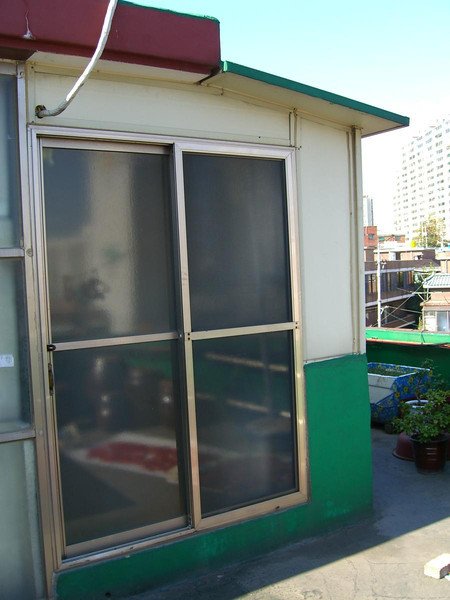
My Korean apartment on top of a roof, circa 2005–2006.
The Korean Rooftop Shack That Nearly Broke Me
Aaaaah, it sure can be fun to look back in hindsight and laugh at yourself.
What I described above was my Korean apartment—or shack on top of the roof—during my first ESL teaching stint in 2005–2006.
On days when my morale was high and I was feeling unusually peppy, I considered it my crumbling artist’s loft. It was unconventional. Bohemian. A bold rejection of tedious bourgeois concepts such as insulation, structural dignity and not being able to see daylight through suspicious gaps around the door.
On days that were not quite as rosy, the description became more accurate.
I was living in a shit tin can on top of a roof.
Korea’s brutally cold winters and impossibly hot, humid summers nearly did me in that year. I resorted to electric blankets and heat fans in winter, followed by three or four cold showers a day and little more than my underwear in summer.
It was cold when I needed warmth, boiling when I needed relief and generally committed to making sure I never became too comfortable with my life choices.
The rooftop location exposed the apartment to every temperature swing. In winter, the cold seemed to creep in from all directions. In summer, the sun roasted the roof and everything sitting on it—including me.
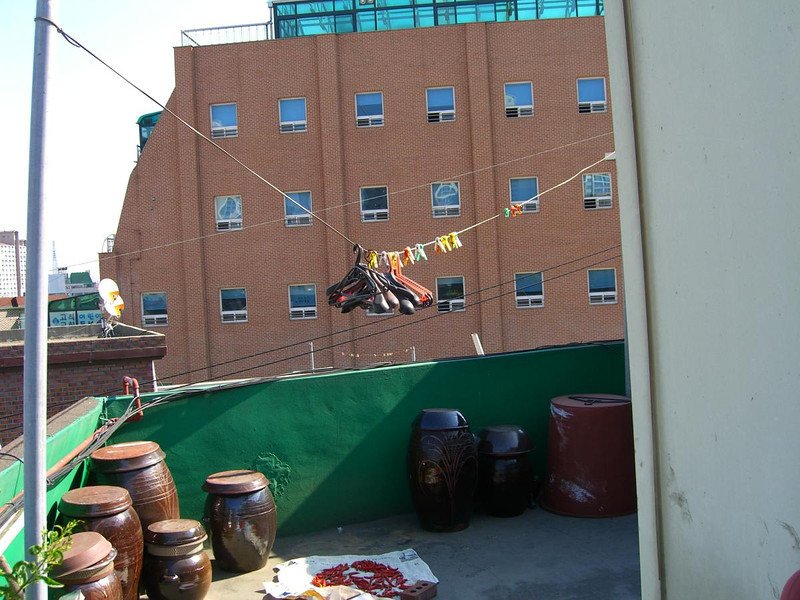
More views from the humble shack, including laundry hangers and Korean red peppers drying on the roof.
It was uncomfortable, occasionally ridiculous and unlike anywhere I had lived before. Yet it was also unmistakably part of the neighbourhood. Laundry fluttered nearby. Red peppers dried on the roof. Daily life unfolded around me in ways it never could have from an anonymous hotel room.
I would not volunteer to live there again.
Let’s not rewrite history into a heartwarming rooftop fantasy where the terrible insulation taught me the true meaning of gratitude and every frozen morning brought me closer to enlightenment.
It was a bad apartment.
But it was also one of the most memorable places I have ever called home.
Four Korean Homes Across Two Very Different Chapters
That rooftop shack was only the beginning of my Korean apartment story.
During my later teaching years, I lived in a far better apartment on the seventeenth floor of a high-rise. Audrey had her own compact teacher apartment elsewhere. Years after that, we returned to Seoul as travellers and rented a studio together for approximately a month.
These were four distinct homes from different parts of our lives:
- The rooftop shack: my employer-provided home during my first teaching contract.
- My later high-rise: another employer-provided apartment after I had considerably more Korean teaching experience.
- Audrey’s studio: her separate apartment while she was teaching in Korea.
- Our later Seoul rental: a short-term apartment we shared when we returned to Korea as travellers.
That distinction matters. My teaching apartments came through employment contracts. Audrey’s apartment was hers, not mine. Our later Seoul rental was a traveller accommodation rather than school housing.
The personal sections below come from our original apartment videos and firsthand memories. The practical housing guidance later in the article uses current official information and is clearly separated from what we personally experienced.
The Housing Lesson I Never Forgot
After that first contract, I requested—no, demanded—to see photographs of the place I was signing my life away to before putting my name on paper.
Not a photograph of another apartment in the same building.
Not a suspiciously wide-angle image taken ten years earlier when the wallpaper was still attached to the wall.
Not an assurance from a recruiter that the apartment was “cozy,” “traditional” or “perfect for a single teacher.” Those phrases can cover an alarming range of architectural sins.
I wanted recent photographs of the exact unit.
Ideally, I also wanted to speak with the teacher already living there. That person had no reason to describe a freezing rooftop box as a “charming private studio with excellent natural light.”
The truth is that I loved all of my later apartments in Korea. Having a place provided through my contract, along with the autonomy and privacy of living alone, was one of the main reasons I enjoyed living in South Korea over the years.
All of the teaching apartments were small compared with what many Canadians would expect back home.
Tiny, however, was never the real problem.
A small apartment can be warm, clean, private and brilliantly located. A larger apartment can be damp, inconvenient and miserable. Square metres are easy to photograph. Heating, ventilation, maintenance and a soul-destroying commute are not.
I would take a well-designed shoebox over a spacious mould museum any day.
My Newer Teacher Apartment: Rice Fields, Empty Shelves And A Spare Room
My later high-rise apartment felt like a staggering upgrade after the rooftop shack.
The standards were admittedly low.
A front door that closed properly would have impressed me at that point.
I lived on the seventeenth floor, with views stretching across nearby rice fields. The apartment was still modest, but it functioned like an actual home rather than a weather experiment.
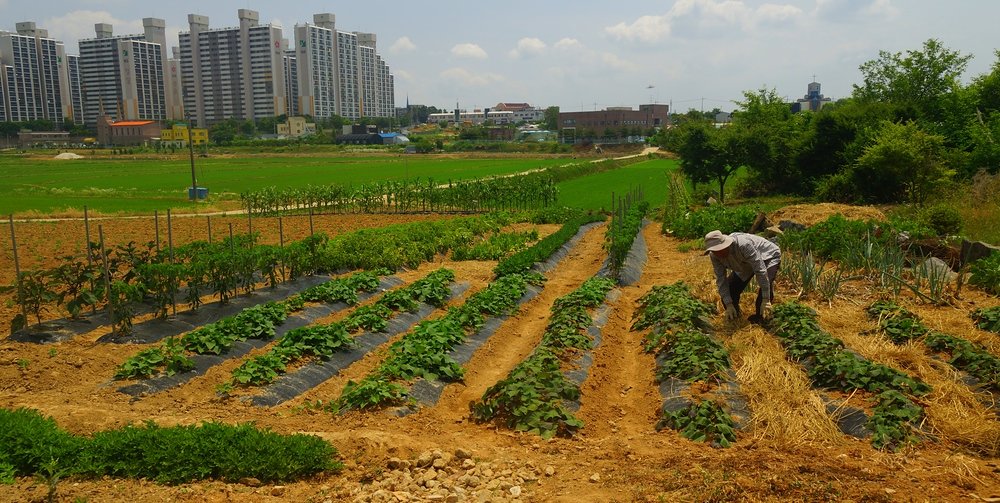
A farmer working near the rice fields visible from my high-rise apartment.
The view alone changed the feeling of the space. My apartment may have been modest by Canadian standards, but looking across the fields made it feel far less boxed in.
A compact apartment with light and an open view can feel peaceful. A compact apartment facing a concrete wall can feel like a storage locker that happens to contain your toothbrush.

A crane in flight near the apartment where I lived while teaching English.
Welcome To My “Bedoire”
My original apartment tour begins outside with “rice fields aplenty,” followed by my urgent warning not to look at the door code.
Security was apparently important, even though I was about to broadcast the remainder of my domestic existence to the internet.
Before showing the apartment, I proudly introduced my striped candy-cane Christmas socks. Then came what I called my “bedoire”: a bed, couch, dresser, makeshift wardrobe, television I never used and a bookshelf containing absolutely no books.
The room had enough open floor space that I attempted a small dance party.
It did not go well.
Still, after the rooftop shack, having a proper room with usable floor space felt decadent.
The Kitchen Of A Supposedly High-Rolling ESL Teacher
The kitchen contained a small sink, drying rack and two cooking elements. There was no oven in that particular unit, although this should not be mistaken for a universal rule covering every kitchen in Korea.
I also had Cass beer glasses and the metal chopsticks found in so many Korean homes and restaurants.
To prove my chopstick ability after four years in Korea, I attempted to pick up a butter knife.
A practical demonstration of a skill nobody had requested.
The frying pan was in suspiciously pristine condition because I rarely cooked. My food supply consisted mostly of condiments, water, juice, more condiments and bread.
Not exactly the bounty of Korean food you might expect from a high-rolling English teacher.
I normally went out for a quick meal at a local kimbap restaurant or occasionally visited a Korean fast-food joint. My cupboard was less a pantry and more an emergency condiment archive.
Wet Bathroom, Spare Room And Balcony
The apartment had a compact wet bathroom. Shower water could reach much of the floor, so bathroom flip-flops were essential unless damp socks happened to be part of your morning wellness routine.
The most shocking detail, at least compared with my first Korean home, was that I had a spare room.
It contained the two suitcases I had brought from Canada, camera bags, a tripod and assorted photography gear. When Audrey asked what I used the room for, I claimed it was for studying before immediately correcting myself.
I used it for nothing.
Luxury.
There was also a balcony with the washing machine and a spectacular view of a parking lot. The rice fields had not followed me around to every side of the building.
The video ends with me attempting to flirt with the camera. Audrey correctly observes that I look less flirtatious than creepy.
Fair.
Some friends and family were genuinely shocked by the apartment’s size. To me, after ten and a half months, it had become home. It was humble and certainly nothing special, but I knew I would be sad to leave when I packed my bags six weeks later and returned to Canada for the holidays.
Audrey’s Korean Studio: Spam, Dulce De Leche And A Heated Toilet Seat
Audrey lived separately in her own compact studio while she was teaching in Korea.
Her apartment was not merely a supporting example in my housing story. It was her home, shaped by her belongings, habits and priorities.
And her priorities included dulce de leche and a heated toilet seat.
The Chuseok Gift Set
Her video begins around Chuseok, when her workplace presented her with a handsome gift set filled with tuna and Spam.
Nothing says festive abundance quite like enough canned meat to survive a modest siege.
Audrey was informed that it was an expensive set and therefore needed to appreciate her Spam properly. She also performed a brief musical number whose artistic significance may have exceeded its technical execution.
Argentina In A Korean Fridge
Inside the refrigerator sat a jar of dulce de leche brought from Argentina.
That small detail tells you more about making a temporary apartment feel personal than any generic decorating checklist could. Her Korean studio contained a taste of Argentina, a Bolivian bedcover and the accumulated objects of someone building a life between several cultures.
Audrey’s kitchen was tiny, although that was not a major hardship because she cooked very little. The transcript includes a comically low gas bill, but the exact amount is unclear enough that I would rather preserve the honest point than pretend an old subtitle transcription is flawless.
She barely used the stove.
The gas company was not becoming wealthy from her.
The Most Intimidating Toilet In The Apartment
Audrey described the Korean toilet as slightly terrifying because of its many buttons and mysterious washing functions.
The heated seat, however, was a clear victory during winter.
Her bathroom was another wet-room setup. Take a shower and nearly everything became wet. This was not a spacious retreat involving candles and a freestanding tub. It was a highly efficient room where the shower, toilet and sink had agreed to stop respecting personal boundaries.
Urban Views And A Compact Personal Space
Where my apartment looked across rice fields, Audrey’s view was urban: apartment buildings, restaurants and bars, with mountains visible in the distance.
Her sleeping area had the Bolivian bedcover, open shelving for clothing, a small television and storage tucked wherever it could fit.
At the entrance was a lowered area where shoes came off. Audrey explained that walking through a Korean home in outdoor shoes was considered poor manners.
That habit eventually became so normal to us that, years later, removing our shoes upon entering another Korean apartment required no explanation at all.
Returning Years Later: Our Compact Seoul Rental
Years after our teaching lives in Korea, Audrey and I returned to Seoul as travellers.
This time, instead of living separately in apartments arranged through our employers, we shared a short-term studio for approximately one month before continuing our travels around the country.
The apartment was compact. Seoul had not suddenly discovered a secret reserve of inexpensive empty floor space.
But it was also intelligently designed. Nearly every cupboard, wall and piece of furniture performed more than one job.
No Wasted Space
The entrance had a recessed shoe-removal area, a cupboard for footwear and a narrow compartment for umbrellas. We were visiting during a rainy period, so that last detail was more useful than it sounds.
The kitchen had two cooking burners, a small toaster oven, microwave, kettle and rice cooker.
We were best at preparing noodle cups.
Some culinary traditions require years of disciplined training. Ours required boiling water and remembering to remove the foil lid.
We also had seaweed snacks, which we demolished with considerably more enthusiasm than anything involving the rice cooker.
A Washing Machine, Sliding Rack And Hidden Refrigerator
The apartment had an in-unit washing machine but no dryer. Instead, a drying rack slid out when needed and disappeared again when the laundry was finished.
The refrigerator was even more cleverly disguised. At first glance, it looked like another section of wall or built-in storage. Open it and there was the fridge, followed by a separate freezer compartment below.
Our food supply was once again less impressive than the appliance: water, cucumbers, vitamins and a growing sense that we ought to buy kimchi.
The freezer stood empty while we debated filling it with ice cream or frozen mandu.
Some themes in my Korean apartment life proved remarkably durable.
Two Shelves For Audrey, One For Me
The closet held our luggage, clothing and several small drawers. Audrey received two shelves.
I received one.
The division of territory had apparently been settled before filming began.
The sofa converted into a second double bed. The rental listing suggested the apartment could sleep up to four people. Technically, that was possible.
Four adults would also have developed an intimate understanding of one another’s breathing patterns and luggage-management habits.
A Firm Bed And A Place To Work
The main bed was firm, which suited me perfectly. I have never understood the appeal of sinking into a mattress like a tranquilized hippopotamus.
I like a solid bed.
Korea and I were in complete agreement.
There was also a proper desk where I edited videos, worked on blog posts and dealt with social media. That mattered because this was not merely a place to sleep between sightseeing days. It was our temporary home and working base.
The wall decorations included a tree, bird and Korean Hanja characters. A fan and air conditioner kept the room tolerable during the August heat.
Air conditioning was not a decorative luxury.
Without it, we would have melted into the firm mattress I had just praised.
The Tiny Wet Bathroom Returns
The bathroom floor sat lower than the main apartment because the entire room was designed to get wet.
The shower hose attached beside the sink. Once the water started, the sink, toiletries, toothpaste and most nearby objects joined the shower whether they had volunteered or not.
We learned to leave towels and clean clothing outside the door. Bringing them inside was an efficient method of turning clean laundry back into wet laundry.
The bathroom was tiny, but functional. By that point in our relationship with Korea, the wet-room arrangement no longer felt shocking. We knew where to leave the towel, when to wear the slippers and why the floor was lowered.
The apartment itself was not the smallest place we had ever rented. Hong Kong still wins that dubious competition by a considerable margin.
But the Seoul studio showed us how much comfort could be squeezed into a small footprint when the space had been designed with care.
These apartment tours are also part of our larger YouTube travel video archive, which preserves our early footage from living and travelling in Korea.
Four Korean Homes, Four Completely Different Experiences
| Home | Life Stage | Defining Details | Biggest Strength | Main Lesson |
|---|---|---|---|---|
| Rooftop shack | My first teaching contract | Improvised rooftop structure, drying peppers, brutal seasonal temperatures | Privacy and an unforgettable neighbourhood setting | Never accept housing without seeing the exact unit |
| My high-rise apartment | Later teaching job | Rice-field views, spare room, balcony, wet bathroom and a mostly empty kitchen | Space, privacy and a far more functional home | Comfort and light matter more than Western ideas about size |
| Audrey’s studio | Audrey teaching separately | Urban views, Spam gift set, dulce de leche, heated toilet seat and Bolivian bedcover | A compact space that still felt distinctly hers | A small apartment becomes personal through the life inside it |
| Shared Seoul rental | Returning together as travellers | Built-in storage, hidden fridge, sofa bed, firm mattress and tiny wet bathroom | Highly efficient design | A thoughtfully designed studio can outperform a much larger but poorly planned home |
The rooftop shack was the worst apartment.
It was not even close.
But the progression between these homes taught me something more useful than “bigger is better.”
Good housing is not just floor area.
It is warmth in winter, relief in summer, working plumbing, privacy, natural light, usable storage, a reasonable commute and somebody willing to fix the boiler when it gives up on life.
What “Free Housing” For English Teachers Actually Means
Housing is one of the most attractive benefits attached to many English-teaching jobs in Korea. Removing rent from your largest monthly expenses can make settling in easier and leave considerably more room for travel or savings.
But “free apartment” is often lazy shorthand.
Your employer may cover the lease while you remain responsible for utilities, building maintenance charges, internet, damage and other household expenses. The exact arrangement depends on the programme, employer, region and contract.
That final word matters.
Contract.
Not what somebody in an online forum received several years ago.
Not what your recruiter vaguely remembers another school offering.
Not what your friend in Busan insists is “standard everywhere.”
Current EPIK benefits information states that participating teachers receive a leased house, apartment or studio-type room through the relevant education authority. Utilities and maintenance fees remain the teacher’s responsibility, while housing size and location vary by region.
Other public-school placements, private schools and hagwons may use different terms. Some contracts offer a housing allowance; some do not. Some give the teacher a choice; others present the apartment keys on arrival and consider the matter settled.
Sometimes those keys unlock a clean modern studio.
Sometimes they unlock a shack on a roof.
Ask questions.
| Housing Arrangement | Main Advantage | Main Risk | Best Suited To |
|---|---|---|---|
| Employer-provided apartment | No immediate housing search or major rental deposit | Limited control over the exact unit and neighbourhood | Most first-time teachers |
| Contractual housing allowance | More choice over location and apartment | The allowance may not cover deposits, rent and fees | Teachers who already understand the local market |
| Independent rental | Maximum control over the home | Deposits, contracts, reporting and fraud risks become your responsibility | Experienced residents with reliable local assistance |
Questions To Ask Before Accepting A Teaching Job
The best time to discover a housing problem is before signing the contract and flying across the world.
This sounds painfully obvious.
I still managed not to do it.
Learn from my rooftop stupidity.
Ask the following questions in writing so you have a record of the answers.
Can I See The Exact Apartment?
- Can you send recent photographs of the exact unit?
- Can you provide a short video showing every room?
- When were the photographs or video recorded?
- Is the apartment currently occupied by another teacher?
- May I contact that teacher and ask about the unit?
A current tenant can tell you what photographs cannot: whether the heating works, the landlord responds, the walls are paper-thin or the hallway smells like something died behind the boiler.
What Kind Of Building Is It?
- Is it a high-rise apartment, villa, officetel, one-room or rooftop unit?
- Which floor is the apartment on?
- Is there an elevator?
- Will I have the entire unit to myself?
- Does anyone else from the school live in the building?
- Is the unit properly registered for residential use?
That final question deserves particular attention when the accommodation is improvised, unusual or sitting alone on a roof looking as though it appeared after a weekend of enthusiastic but poorly supervised construction.
What Is Included?
- Bed or mattress
- Wardrobe or clothing rack
- Desk and chair
- Refrigerator
- Washing machine
- Cooking surface and microwave
- Air conditioner or fan
- Internet connection
- Heating and hot-water system
Do not merely ask whether the apartment is “furnished.” Ask what furniture and appliances are actually there and whether they work.
A stained mattress, one plastic chair and a microwave that sparks when turned on may technically qualify as furnished.
Technically is doing a lot of work in that sentence.
Who Pays For What?
- Electricity
- Gas
- Water
- Internet
- Building maintenance charges
- Repairs
- Damage left by the previous teacher
- Cleaning when moving in or out
Ask how bills arrive, whose name appears on them and how payment is made.
“The school takes care of it” is not a complete answer.
How Far Is It From Work?
- What is the real door-to-door commute?
- Can you walk, or must you take a bus?
- How frequently does that bus run?
- Is there a grocery store nearby?
- How far away is the nearest useful transport hub?
A slightly less glamorous apartment ten minutes from school can improve your year more than a prettier unit requiring two buses and a daily wrestling match with rush hour.
Thirty unpleasant minutes twice a day becomes five hours a week. Over a full contract, that is an impressive amount of your life spent staring through a bus window and silently resenting everyone involved.
Your First-Day Korean Apartment Inspection
You will probably arrive tired, jet-lagged and carrying far too much luggage.
Inspect the apartment anyway.
Problems are easiest to document before you unpack and before anyone can suggest that you caused them.
Photograph Everything Before Moving In
- Record a slow video of the entire apartment.
- Photograph stains, holes, cracks and damaged wallpaper.
- Open cupboards and record their condition.
- Photograph every supplied appliance.
- Send the evidence to your school contact in writing.
This is not dramatic.
It protects you from being blamed later for damage already present when you arrived.
Test Heating And Hot Water
Ask someone to explain the boiler controls rather than leaving you to decipher a wall panel entirely in Korean at midnight.
- Confirm that hot water reaches the shower and kitchen.
- Test the floor heating rather than assuming it works.
- Ask which settings control room heat, water temperature and timers.
- Find out whether the system uses gas, electricity or a central building supply.
My rooftop year taught me that heating deserves considerably more attention than decorative cushions.
A lovely cushion will not save you when your floor feels like a frozen lake and your breath is becoming visible indoors.
Look For Moisture And Mould
- Check corners near the ceiling.
- Look behind furniture and curtains.
- Inspect wallpaper around windows.
- Check underneath the sink.
- Smell closed cupboards and the bathroom.
- Confirm that windows or ventilation fans work.
A small mark that wipes away is different from widespread damp, recurring mould or water entering through the wall.
Document anything substantial immediately.
Do not accept “all Korean apartments are like this” as a magical phrase capable of making a serious problem disappear.
Inspect The Wet Bathroom
A wet bathroom is common in compact Korean homes. The shower may share an open tiled room with the toilet and sink, meaning most of the floor gets wet.
- Run the shower and check the water pressure.
- Watch whether water flows towards the drain.
- Flush the toilet.
- Look for leaks beneath the sink.
- Test the ventilation fan.
- Find a dry place for toilet paper, towels and clean clothing.
Bathroom slippers and a small squeegee solve many daily annoyances.
They do not solve broken drainage or chronic mould.
Check Windows, Doors And Locks
- Do the windows open, close and lock?
- Are there obvious gaps or cold drafts?
- Does the front door lock properly?
- Can the door code be changed after the previous tenant leaves?
- Is the building entrance illuminated and secured?
Test Every Appliance
- Refrigerator
- Washing machine
- Cooking surface
- Microwave
- Air conditioner
- Fans
- Internet router
- Lights and electrical outlets
A dead washing machine discovered on your first day is the school’s inherited problem.
A dead washing machine reported three months later may become an argument.
Push the buttons. Turn the knobs. Make the refrigerator prove itself.
Ask How Rubbish And Food Waste Work
Korean waste disposal can involve designated bags, separate recycling, food-waste containers or building-specific collection points. Procedures vary by municipality and building.
Ask someone to physically show you where everything goes and which bags or containers you need to buy.
This saves you from standing beside a collection area at night holding a leaking bag of food scraps and questioning every decision that brought you there.
Korean Housing Terms New Teachers May Encounter
You do not need to memorize the Korean property market before accepting a teaching job.
You should know enough to recognize whether somebody is offering you a normal studio, a dormitory room or a rooftop structure with the thermal properties of a baking tray.
One-Room (원룸)
A Korean one-room is essentially a studio: one main room performs the functions of bedroom, living room, kitchen and dining area. It is one of the most realistic layouts for a single English teacher.
The term describes the layout, not the quality.
One one-room may be bright, modern and intelligently designed. Another may barely contain the bed without requiring you to climb across it to reach the refrigerator.
Officetel (오피스텔)
An officetel is a mixed-use building containing compact units that may function as offices or homes. They are often found near transport, commercial districts and newer developments.
They can be highly convenient, although building maintenance charges and the exact legal use of the unit are worth confirming.
Apartment (아파트)
In Korea, an apartment commonly means a unit inside a large residential complex. These complexes may contain multiple towers and neighbourhood services.
A teacher placed in a high-rise may still receive a small unit. “Apartment building” should never be confused with “large apartment.”
Villa (빌라)
A Korean villa is generally a lower-rise multi-unit residential building.
It is not a Mediterranean mansion with a pool, terracotta tiles and someone bringing you breakfast on a shaded terrace.
Adjust expectations accordingly.
Rooftop Room (옥탑방)
A rooftop room sits on top of another building.
Mine belonged at the especially rough end of that category.
Not every rooftop room is automatically unlivable. Some have private outdoor space, open views and plenty of sunlight. The recurring concerns are exposure to heat and cold, waterproofing, access, insulation and whether the structure is properly maintained.
Sunlight is lovely.
Being slow-roasted by it for three consecutive months is less lovely.
Goshiwon (고시원)
A goshiwon is an extremely compact rented room historically associated with students and examination preparation. Some have private bathrooms, while others share facilities.
A goshiwon is not the same thing as a normal employer-provided teacher studio. If anyone describes one as your year-long private apartment, ask many more questions.

Dormitory And Student-Style Housing
Universities and private institutions may operate dormitories or other compact residential facilities. These are distinct from a private teacher apartment and may involve shared kitchens, bathrooms, entrances or house rules.
If an employer uses vague words such as “residence,” “dormitory” or “campus accommodation,” establish whether you will have a genuinely private unit.

School Housing Versus Renting Your Own Apartment
My teaching apartments were provided through employment contracts. I did not arrive as a new teacher and independently navigate a major Korean rental deposit, unfamiliar paperwork and a real-estate market operating largely in another language.
Our later Seoul studio was a short-term traveller rental, not a conventional long-term Korean lease.
Those distinctions matter.
Employer housing is usually the lower-friction option for a first year. You surrender some choice but avoid having to secure a property immediately after arriving.
Independent renting offers more control, but introduces a different set of legal and financial responsibilities.
Wolse And Jeonse
Two terms frequently encountered in the Korean rental market are:
- Wolse: a deposit combined with recurring monthly rent.
- Jeonse: a much larger lump-sum deposit placed with the landlord instead of conventional monthly rent.
The deposits involved can be substantial.
This is not the moment to nod politely while understanding 40 percent of the conversation and hoping the remaining 60 percent contains nothing financially catastrophic.
Deposit protection, property ownership, existing debt, registration and contract wording deserve professional attention.
Seoul Metropolitan Government maintains an official English explanation of wolse and jeonse, including information about deposits, monthly rent and foreign-language real-estate assistance.
Lease Reporting And Deposit Protection
Certain Korean residential leases must be reported within 30 days. Whether a lease qualifies depends on its location, date and financial terms, and those rules can change.
Before signing independently, check the current official housing lease reporting guidance rather than relying on an old blog post, a social-media comment or a recruiter who does not represent you.
Independent renters should also ask about:
- The registered owner of the property
- Existing claims or debt attached to it
- Move-in registration and obtaining a fixed date
- Whether deposit-return guarantee coverage is available
- The correct lease-reporting procedure
- Brokerage fees and who pays them
This is no longer merely an apartment-viewing decision.
It is a legal and financial transaction.
Where Foreign Residents Can Get Help
International residents in Seoul can contact the Seoul Foreign Resident Center, which offers housing and real-estate consultation for foreign residents.
Teachers living elsewhere should look for equivalent services through their municipality, education office, local foreign resident centre or a qualified independent professional.
This section is practical orientation, not legal advice. Do not allow the school recruiter, landlord or real-estate agent earning the transaction fee to be the only person explaining your legal position.
Friendly is nice.
Independent advice is nicer.
What To Do If Your Teacher Apartment Is Bad
There is a difference between disappointing housing and genuinely serious housing problems.
A tiny kitchen may be frustrating.
Exposed wiring beside a leaking shower is something else entirely.
Annoying But Usually Manageable
- The apartment is smaller than expected.
- The furniture is ugly or mismatched.
- The kitchen has almost no counter space.
- The bathroom is a wet room.
- The building is older than the photographs suggested.
- The neighbourhood is quiet or unfashionable.
An ugly wardrobe will not ruin your year.
It may offend you every morning, but the relationship can remain civil.
Serious And Worth Escalating Immediately
- No functioning heat or hot water
- Major mould or water intrusion
- Unsafe wiring or exposed electrical hazards
- A door or window that cannot be secured
- Severe plumbing or sewage problems
- A unit materially different from what the contract promised
- Being required to share housing when private housing was promised
For serious problems:
- Photograph and record the problem.
- Report it in writing to the designated school contact.
- State the specific repair or remedy required.
- Ask for a realistic response date.
- Keep copies of every message and photograph.
- Escalate through the school administration, education office, programme coordinator or qualified adviser when necessary.
Do not begin with threats unless the situation is immediately dangerous.
Give the responsible party a clear opportunity to solve the problem—but do not allow endless verbal promises to replace action.
“We’ll look into it” is not a repair.
“Maybe next week” is not a date.
And another portable fan is not a meaningful answer to an apartment turning into a rooftop kiln.
What Matters More Than Apartment Size
Friends and family were often shocked by how small our Korean apartments looked.
Fair enough.
Some were roughly the size of rooms Canadians use to store winter coats and exercise equipment they no longer intend to touch.
But after four very different Korean homes, I would rank the following factors above raw floor area.
Temperature Control
A warm small apartment beats a large freezing one.
The same principle applies when August arrives and the room begins auditioning as a commercial sauna.
Ventilation And Natural Light
A functional window, useful airflow and a little daylight can make a compact space feel dramatically more comfortable.
My rice-field view and Audrey’s distant mountains both expanded the feeling of otherwise modest apartments.
Intelligent Storage
Our later Seoul rental proved how much difference built-in storage could make. A hidden refrigerator, sliding drying rack, shoe cupboard and sofa bed allowed the apartment to remain functional without feeling buried beneath our belongings.
A Reasonable Commute
Your apartment is not isolated from the rest of your teaching life.
A punishing commute steals time every working day, usually when you are already tired and have no desire to become intimately familiar with another bus timetable.
Responsive Maintenance
Even a good apartment develops problems.
The difference is whether someone answers the phone and fixes them—or begins a long campaign of pretending not to understand your messages.
Privacy
Having my own space mattered enormously.
After a full teaching day, shutting the door and being alone was worth far more to me than an extra room I did not need.
Teachers spend a lot of time performing energy.
A private apartment is where you stop.
The Life Inside It
Audrey’s Spam gift set, Argentine dulce de leche and Bolivian bedcover did not make her studio larger.
They made it hers.
My empty bookshelf, camera bags and sad condiment collection did the same for me, although perhaps with less decorative success.
Your apartment should be good enough to keep you healthy, rested and sane.
Perfect is a bonus.
Functional is non-negotiable.
Korean Teacher Apartment FAQ
Are English Teacher Apartments In Korea Really Free?
Many employers cover the apartment lease, but that does not necessarily mean every housing cost is covered. Teachers may remain responsible for electricity, gas, water, internet, building maintenance charges and damage. Read the exact housing clause in your contract rather than allowing the word “free” to hypnotize you.
What Size Apartment Should A Teacher Expect?
A compact studio, Korean one-room or small apartment is a realistic expectation for a single teacher. Size and quality vary substantially by city, region, employer and building. A small apartment should not automatically be considered bad housing, provided it is safe, clean, private and functional.
Can I Ask For Photographs Before Accepting The Job?
Yes—and I strongly recommend doing so. Ask for recent photographs or a video of the exact unit and request contact with the current teacher. An employer may not always have the final apartment secured far in advance, but they should explain that clearly rather than supplying unrelated sample images.
I was too passive about housing once.
The roof remembers.
Is A Rooftop Room Automatically A Bad Apartment?
No, but it deserves additional scrutiny. Check insulation, heating, air conditioning, roof access, leaks, window security and summer heat exposure. My rooftop shack performed badly in both winter and summer, which is why I would never accept another one without a detailed inspection.
Are Korean Wet Bathrooms Livable?
Yes. Samuel’s later apartment, Audrey’s studio and our shared Seoul rental all had compact wet bathrooms. Bathroom slippers, sensible storage and keeping towels outside the splash zone make them manageable. Poor drainage, broken ventilation and recurring mould are separate problems that should not be dismissed as normal wet-room quirks.
Should A First-Time Teacher Choose School Housing Or An Allowance?
Employer-provided housing is usually simpler for a first year because it avoids an immediate rental search and major deposit. An allowance offers more choice only when the contract permits it, the amount is adequate and the teacher understands the local rental system. Never assume an allowance is automatically available.
What Should I Check Immediately After Moving In?
Document the apartment’s condition, test heat and hot water, inspect for mould, run every appliance, check the bathroom drainage, confirm the door locks and ask how utilities and rubbish disposal work. Report existing damage in writing before unpacking.
Can I Refuse An Apartment After Arriving?
Your options depend on the contract and severity of the problem. A disappointing layout is different from unsafe wiring, severe mould or no functioning heat. Document serious issues and use the employer’s formal reporting and escalation process. Do not assume you can abandon the unit or convert the benefit into cash without contractual approval.
Be reasonable.
But do not be a doormat with luggage.
Would I Live In The Rooftop Shack Again?
No.
That answer did not require a committee meeting.
I can appreciate the story now without pretending the housing was good.
What I appreciate even more, looking back across all four homes, is how clearly they reflect different stages of our lives.
The shack belonged to the inexperienced version of me who flew across the world without demanding proper housing evidence.
The high-rise belonged to a later teaching chapter, when I had a better job, a spare room I did not need and enough Korean experience to pick up a butter knife with chopsticks for no sensible reason.
Audrey’s studio was unmistakably hers: Spam, dulce de leche, a Bolivian bedcover, city views and the heated toilet seat she had no intention of surrendering.
Our later Seoul rental belonged to us together. Two shelves for Audrey, one for me. Noodle cups in the kitchen. Work at the desk. Laundry on the sliding rack. Air conditioning fighting a losing battle against August.
None of these homes needed to be large.
They did need to work.
The rooftop shack taught me what I would never accept blindly again. The homes that followed taught me that a compact apartment could still be comfortable, personal and genuinely ours.
So ask for photographs.
Read the housing clause.
Check the boiler.
Look behind the wardrobe.
Speak with the current teacher.
You are not being difficult.
You are making sure the place where you will spend an entire Korean year is an actual home—and not merely an optimistic shed with an extension cord.
Oh well, I can still live in that apartment even how brutal it is, its exciting and unique. Hope to discover more valuable things in Korea.
Korea seems to be the hotspot for people looking to teach English these days.
Definitely lots of jobs to be had. More demand these days though than when I was teaching there.
Your apartment in Korea is small, but seems to have created worth reminiscing memories. I had a small one like that when I was in Korea last year.
Certainly brings me back!! Are those containers of kimchi I see sitting on the balcony? I think the coolest thing about living in korea is that densified living is the norm because most people live in apartments, even in the country. Not much urban sprawl outside of the big cities.
Wow! Your apartment is beautiful.
In 2010 I had traveled to New Mumbai city(adjacent to Greater Mumbai) in India, the scenery was much resembling to those of Korea.. i.e. The Urbanization as well as the agriculture in symbiosis.
Your refridgerator reminds me of college. Oh, the days of having some condiments and water. I’d love to hear an update of how everything is going thus far.
Sure it’s small, but I imagine you spend more time out and about than cooped up inside anyway (especially if you’re mostly eating out). We’re definitely fortunate/spoiled in North America and forget that most of the world lives in little shoe box apartments!
That’s definitely true Reena. One of the main advantages of having a smaller place is that it encourages you to go out more and it is also easier to clean 😛
Try teaching in Abu Dhabi. The accommodations and pay are probably among the best in the world, not to mention the incredible sights that the UAE offers. But I like this place you got here and “the humble shack” looks pretty awesome as well.
Jimmy, I think you’re absolutely correct about teaching jobs in the UAE. I’d be interested in potentially pursuing that in the future 🙂
You guys are adorable. Well, believe it or not, both apartments look a great deal bigger than the place I lived in in Costa Rica! A couch? What luxury!! Although, at least I got to open my front door and be outside… Even if I had to shower out there, too, since there was no room inside!
Thanks Abby,
The couch is certainly a luxurious addition that I wasn’t expecting to have 🙂
That’s definitely the best attitude to have Paul!
What a surprise! Sometimes they are good and sometimes not so much. Too bad you can’t really do much about it. I guess you make the best of it!
So you’ve lived in Korea, i’ve lived in Korea. Strange things happen there.
Check out my blog on life in Japan. Let me know what you think about its infant stages 🙂
http://www.travellingtalesofciara.com
Cool, I’ve always thought of teaching and travelling more in Japan.
Wow, you weren’t kidding, that apartment is TINYYYYY! I bet compared to the shack on the roof it feels like a palace though, no?
It sure does feel like a palace in comparison! I suppose the best apartment I’ve ever had was back in University and at the time I thought it was small…lol
for this, I can trade my house and the view, this is just awesome. I am a short man so I can fit into this perfectly fine and find solace. Now, my question is how secure it is from fire and how do you get out of your shack from the 17th floor? That one had me thinking though I was imagining a good cable ride across the building will do just the trick but that one has to be considered too.
Its great you had this one featured. My sister and her Canadian hubby used to teach ESL in Korea too and its great their apartments are just fine and cozy, Korea i supposed prefers smaller spaces 🙂
Hahaha, I wish I had a cable car escape route. In my current apartment they have several staircases I could go down and a three elevators but I’ve always felt a bit nervous being high above ground level.
That’s one of the most pimp apartments I’ve seen in Korea! You’ve got great space. I think you should have Twister parties in your spare roomm. Most of my friends in Korea had apartment resembling your first rooftop spot, complete with mold. Mine had a bedroom exactly the size of our bed. I miss the heated floors though!!
LOL, it is quite big for a place in Korea. Ahhhh, the mold. Oh dear, sometimes ‘free’ isn’t always a good thing 😛
I’ve moved into a not-so-great place now at home. In a way its good cuz It allows me to focus on things like reading and being out and about. The only real downside is its hard to invite friends over.
I agree with what you’re saying. I think ‘small apartment’ sizes in Korea encourage people to go out more to socialize and since I’ve been here it’s been rare to be invited into a home.
I’ve lived in some European apartments which were smaller. In fact, I liked the appartment 🙂
That’s great! I prefer small places because they are easier to clean 🙂
Aren’t learning experiences great? LOL! Hopefully, plenty of future ESL teachers are reading this and taking notes. And, I could deal with a smaller place. I think the politically correct term is “cozy”. 🙂
LOL, definitely builds character 😛 Now that I’m far removed from that place I can think of it as being ‘cozy’ I suppose 🙂
It looks wonderful!! The video is great!!
Thanks Arti!
Ha! Great apartment Samuel you look like you love it there. How do you like teaching in Korea. I am getting my TESOL right now.
That’s great Stephen! I’ve enjoyed the experience, although after doing it for several years, I’m looking forward to a change soon.
Ah man that is brutal! My buddy is over there right now and he actually lucked out in accommodation despite him thinking it was terrible (he has ridiculous expectations sometimes haha). It’s good that you’ve learned from that experience though!
Thanks Margyle, I’ve met a few people who complained about their apartments as well even though the place was 99% better than what most ESL teachers receive.
I think it’s all about what you make of it. There’s always that “adjustment” phase but after it passes, the home slowly takes on your character and feels more personal
That’s a great point Marco. It does take some time but one can adjust.
That shack on the roof sure looks character building 😉 And your apartment seems about the same size as where I lived in London. Turns out we don’t really need that much space after all 😉
We certainly don’t. I like that – character building. On good days I used to consider it ‘my artists’ loft…lol
How come no food? Is it as cheap to eat out all the time…?
It is quite cheap to eat out Paul. I honestly can’t be bothered to cook my own meal when I can get one for $3-4 USD which includes a main, sides and a soup.
I suppose it’s hard to argue with that. You’d probably easily spend that (and potentially more?) in ingredients and electricity. Plus then you’d have more washing up, too… not good!
Great window views! How do you like teaching in Korea? I’ve read there’s some significant differences with their culture and western education, and that suicide (even in children) was a problem if they don’t do well in school?
Hi James,
It certainly can be challenging at times but I’ve found it rewarding. The Korean education system is far more strict and stringent than back home. The pressure is turned up at a young age to get into a good middle school which leads to a top high school which leads to a top university. Suicide rates are definitely high amongst students. I hope this aspect of their culture changes in the future but unfortunately things just to seem getting more competitive in recent years.
I could live in your current apartment for a while. I like the cozy kitchen. Enjoy your time there! Oh, enjoyed the dance party, too. 🙂
Thanks Cathy 🙂 I think it’s nice and cozy and perfect considering I don’t have a lot of things here with me now.
That place is great! I mean, what do you really need?
Those places feel more like your own then some Ikea furnished box….
Agree with you Shaun. It has everything I need and more.
I think it’s perfect! I remember finding space limited pretty much everywhere when I was in Korea… but we Canadians are spoiled! And anyway, you get used to a place, no matter its size. It’s all part of living abroad. 🙂
Also, you have fabulous hair.
I couldn’t agree with you more Colleen. I think if I moved back home I’d be ‘annoyed’ by having to clean a bigger place 😛 Thanks for the compliment regarding my hair. I think I ought to get a cut soon though as it’s getting Wolverine-esque awfully fast.
Laughter in the face of problems is good medicine. 🙂
(You might want to check ‘chock-full’ versus ‘chalked full’)
Thanks David, appreciate you finding the typo!
Nice apartment! We went through the same thing about 4 months ago looking for an apartment here in China. Saw some really dingy ones, a couple with mould and one where the roof was caving in a bit! Luckily we ended up with a nice one. We got to choose so we were lucky but even other teachers who chose just took the first one they saw and man…. did their places suck! Haha, have fun in Korea and thanks for the tour.
That’s interesting to hear about your experiences in China. It’s so hit or miss when it comes to teaching contracts, working conditions and living conditions with your typical ESL gig in Asia.
Nice… Thanks for the tour!
You’re most welcome 🙂
Funny stuff man. Nice apartment for sure. I’ll be heading down the tefl road myself in Thailand next March.
Thanks! Good luck with that. TEFL is a great stepping stone for ESL gigs across Asia.