
Travelling through parts of northern India was the pinnacle of my entire 2010–11 backpacking trip across Asia.
Before arriving in India, I had started to feel road-weary and thoroughly templed out after revisiting many familiar corners of Southeast Asia. I was still enjoying the trip, but the spark had dimmed. Another temple, another bus, another guesthouse, another backpack shuffle. I had fallen into the rhythm of long-term travel without necessarily feeling much of anything.
India changed that almost immediately.
It provided the stimulation—and, more importantly, the challenge—I had been subconsciously craving. Some of those challenges became extraordinary travel experiences. Others were simply frustrating, exhausting and demoralizing.
Often, they were all three at once.
One particular aspect of travelling in India that I had begun to loathe was taking an auto-rickshaw from point A to point B.
The negatively charged experiences were starting to pile up. Haggling over fares. Being taken somewhere I had never asked to go. Persistent offers of additional services. Sudden price changes. Drivers who appeared to regard my destination as a loose suggestion rather than the entire purpose of the transaction.
By that stage of the trip, I was often climbing into a rickshaw already braced for an argument.
That was not a particularly healthy way to travel, but it had not come out of nowhere.
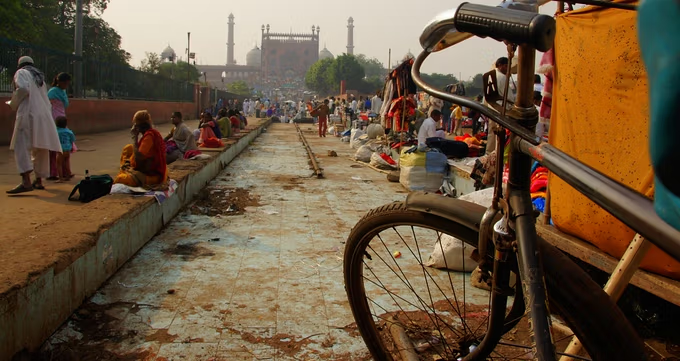
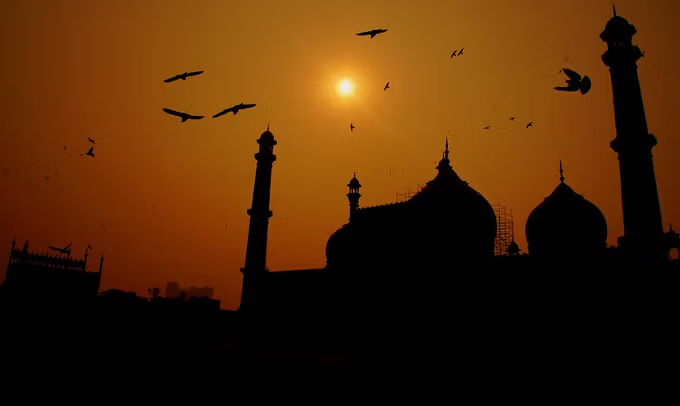
While staying in Old Delhi, I spent time visiting the impressive Jama Masjid and wandering through the surrounding streets.
I had only recently recovered from a horrific case of food poisoning that had left me bedridden for several days. “Recovered” may be too generous a word. I had reached the stage where I could stand upright, keep food inside my body and convince myself that this meant I was ready to explore one of the most intense cities on earth.
My recovery strategy was not sophisticated: feel slightly better, immediately overdo it.
After walking around Old Delhi for longer than my body appreciated, I was completely knackered. My strength disappeared, everything began to throb and the nearest metro station suddenly felt several countries away.
I needed a rickshaw.
I was not thrilled about it.
The Rickshaw Ride in Old Delhi
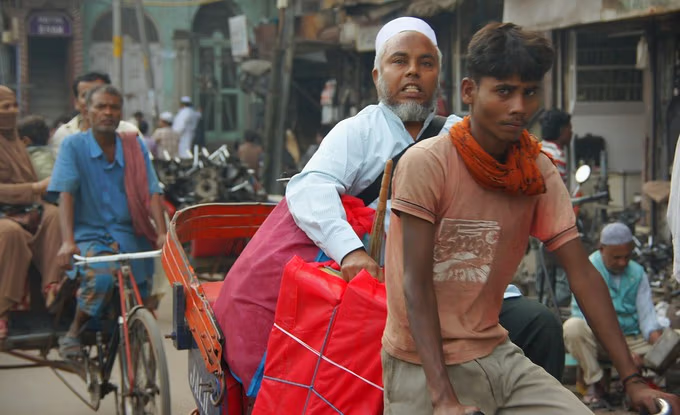
A rickshaw driver offered me a ride back to my guesthouse, several kilometres away, for a price that seemed reasonable.
We agreed on the fare. I climbed inside. Off we went.
The rickshaw threaded its way through an endless maze of crowded markets and streets filled to the brim with activity. Normally, I would have been absorbing it all. On this particular ride, I was mostly trying not to collapse sideways into the vehicle.
Then, just outside my intended destination, the driver suddenly stopped.
As far as he was concerned, the ride was over.
I insisted that he take me the rest of the way to my guesthouse. It was not far, but I was exhausted and that was the destination we had agreed upon.
He refused to move.
It quickly became clear that this was the end point whether I liked it or not. We were far enough from the guesthouse entrance, the tourist police and other foreigners that I suspected the location had not been chosen entirely by accident.
I reached into my wallet and pulled out the fare we had agreed upon.
As I moved to hand it over, I could not believe his reaction.
He refused the money entirely. He crossed his arms and glared at me with contempt.
Dumbfounded, I offered it again.
He still would not take it.
Then came the real price: four times the amount we had agreed upon.
My frustration entered the red zone so quickly that common sense barely had time to pack its bags.
I was weak, recently ill and alone in an unfamiliar part of Delhi. The sensible response would have been to assess the situation calmly and prioritize getting back to my guesthouse.
I did not do that.
Instead, I marched over to the rickshaw, placed the agreed fare on the seat and turned to walk away.
I knew it was far from over.
Moments later, I felt a forceful tug on my shoulder.
I spun around, thrust his hand away and turned to face him directly.
We glared at each other with mutual disdain for what felt like an eternity. In reality, it was probably only several seconds.
Several very long seconds.
The fact that we came so close to exchanging blows still makes me feel queasy. There was a fine line between what happened and something much uglier, and neither of us appeared particularly interested in stepping away from it.
Eventually, he backed off.
I continued walking towards my guesthouse, visibly shaken and more than a little puzzled by my own reaction.
Would it not have made more sense to pay the newly demanded fare—the equivalent of only a few extra dollars—and avoid escalating the conflict?
Was nearly getting into a physical confrontation worth such a small amount of money?
At first, the answer seemed obvious.
No.
But the more I thought about it, the more I understood that the money itself had never been the real issue.
I felt that I was being bullied. I felt disrespected. From my perspective, it had stopped being a disagreement over a rickshaw fare and become a refusal to be treated without a shred of humanity.
Although I was mentally and physically rattled, part of me also felt proud. I had stood up for myself. I had not allowed myself to be intimidated. I had not handed over four times the agreed fare merely because someone demanded it loudly enough.
Another part of me understood that I had nearly been punched—or thrown a punch myself—over a few dollars while barely recovered from food poisoning.
Hardly my finest tactical decision.
Even now, I cannot neatly separate principle from pride. I still believe I had every right to reject the new fare. I also believe I allowed anger and accumulated frustration to push the encounter dangerously close to violence.
Both things can be true.
A Completely Different Experience in Udaipur
Several weeks later, while visiting Udaipur, I once again needed the services of a rickshaw driver.
The encounter in Delhi was still lodged firmly in my mind. So were the other arguments, detours and demands that had accumulated before it.
I approached the driver already dreading the entire routine: the bargaining, the hassle, the suspiciously helpful questions and the inevitable offer to take me somewhere I had never expressed the slightest interest in visiting.
Before the man had done anything wrong, I was treating him like a future problem.

To my surprise, he quoted a price that seemed reasonable enough that I did not even bother bargaining.
That alone caught me off guard.
As I went to place my backpack on the passenger seat, I felt another pair of hands assisting me. He took the bag from me and lifted it securely into the rickshaw.
We set off towards the station, and I slowly began to relax.
He started a conversation and appeared genuinely interested in what I had to say.
At first, I remained suspicious. I had heard friendly conversation before. Sometimes it was genuine. Sometimes it was the opening act before a sales pitch, a shop detour or an offer involving someone’s brother, cousin or exceptionally trustworthy friend.
I kept waiting for the angle.
It never arrived.
Once I realized he was not buttering me up for additional services, I became more open and engaged with my answers. The tension I had carried into the rickshaw began to loosen.
When we arrived at the station, he helped lift my backpack out of the vehicle. I could not help noticing the radiant smile on his face.
Before I could even reach for my wallet, he wished me well on my journey.
He did not demand a tip.
He did not invent an additional charge.
He did not stop short of the destination or steer me towards a shop.
He had taken me where I asked to go, for the price we had agreed upon, and helped me with my backpack at both ends.
The bar, apparently, had fallen into a deep hole.
Yet his kindness did feel meaningful. He treated me like a valued passenger rather than a walking ATM machine.
More importantly, he treated me like another human being.
Without hesitation, I reached into my wallet and handed him several bills. The tip was generous, but as much as he probably appreciated it, I owed him more gratitude than he could ever have imagined.
He had done nothing extraordinary.
He quoted a fair price, helped with my bag, spoke to me kindly and delivered me to the correct destination.
That was precisely the point.
By then, I had become so accustomed to approaching rickshaw drivers with suspicion that ordinary decency felt remarkable. Without realizing it, I had expected this man in Udaipur to answer for everything that had happened with another man in Delhi.
One driver had grabbed my shoulder.
The other had lifted my backpack.
They had nothing to do with each other, yet I had carried the first man into my encounter with the second.
Sometimes it is the smallest gestures that make the greatest difference.
The lesson I took from that ride was worth far more than the tip. A difficult experience can teach you to be cautious, and sometimes caution is necessary. But it can also harden into something uglier when you begin treating every new person as a replay of the last one.
Ever since, I have tried to detach myself from previous experiences and allow each new person to begin with a blank slate.
I do not always succeed. Few of us do. Suspicion is sticky, especially after someone has given us a legitimate reason to feel it.
But that short ride through Udaipur reminded me that the next person I meet is not responsible for the last person who treated me badly.
I have learned many lessons on the road. This was one of the simplest—and one of the most valuable.
We did it, by driving for 13 days from Chennai- Mumbai in the 2009 Mumbai Express Rickshaw Challenge. Indian rckshaw drivers is one of the things about a trip to India that gives most Westerners headaches. Travelling by auto is great fun but, thanks to the open windows.
Great story! One of our mates is actually doing the rickshaw run in India now. Have you heard of it? Basically, they are driving rickshaws all over India on a race for charity!
An inspirational blog post! Thank you for the share! I have wrote my own one as well – and created a video of one of my terrible experiences in Bangalore, India. Please share as much as you can, I can’t believe how much of an issue it is across India today! Let’s stop SCAMMERS!
I also had a similar experience but I usually treat them like dogs or children – which is terrible to say but very necessary. If I am not ripped off.. I tip them, if they do rip me off, well then.. screw it.. I’m still paying normal price. One month in India and I’m glad to same I’m back at ease in Germany.
Oh, yeah! Rickshaws are tough to deal with in India. We just drove an auto rickshaw 2,500 miles across India and I loved seeing it from the other perspective. We saw a few tourists getting haggled and pulled up and told them we’d drive them for free. You would have thought someone had been shot as dozens of (seemingly-asleep) drivers jumped to their feet and started screaming at us. It is addictive to scam the scammers, I promise.
Fair play for standing up for yourself. I had a similar experience in Indonesia with a taxi driver. As you say they just see you as a walking ATM. Like you I got very angry at the blatant lying that he did saying it was a different price.
Ross,
I wish it wasn’t this way but sometimes you’re forced into a position where you really have to stick up for yourself in an assertive manner.
I certainly think you did the right thing not handing out the extra money and when in India I have found rickshaw drivers to always be friendly I think you found the one bad Apple, which if anywhere you will in Delhi.
Also India is not like Thailand where if you get into trouble the police will always favour the local, in fact the rickshaw driver would have been in big trouble so he was just trying it on. If you had been in Thailand I would have paid asap.
Hey Nik,
You bring up a really good point regarding being a foreigner in another country. Often, as you’ve stated, the police will side with locals.
I must say after reading through all the comments I am not feeling so good about everyone’s perceptive of Indian rickshaw drivers. I dont think they are as bad as what it seems like with many people’s experience here however may be I may be not thinking correctly because I am a native indian. Just a few tips to avoid any chance of rickshaw wala trying to fool you:
– Ask your hotel manager to help arrange a rickshaw or taxi for a full day excursion. This should be possible in any indian city be it tier one or two or three city. This way you dont have to hire / catch rickshaw or taxis multiple times in a day even if you are visiting multiple places.
– For some reason even if you end up with a rickshaw driver not accepting the money what you had agreed upon earlier, best trick would be to immediately walk to a nearest shop or local store keeper who would easily help you out in dealing with the rickshaw / taxi driver. Since these shop owners are local they would know what the real fair should be and if rick guy is asking more he would be told to either take it or get lost 🙂
– Another way to handle it is, to tell the rickshaw or taxi guy to come with you to a nearest local police station where cops can decide what the fair fare should be 🙂 Trust me just say it no need to even go to the police station he would nicely accept the agreed money and walk away. It would be the last thing in a rickshaw/taxi driver’s life to go to a police station fighting for fare.
Hope some of these tips would help you next time you are touring India and wont have to get frustrated dealing with rickshaw / taxi drivers 🙂 In any case you can contact myself or any Indian friend to help you plan your next vacation well & enjoyable!!!
Those are some fantastic tips! I think they key is to be calm and try to get help if necessary 🙂
Beautiful story and I totally agree with you. A price agreed is a price agreed and it makes me really mad if they don’t keep it. On the other hand if they are respectful and treat you normally, I do not mind tipping either even if that means I actually gave more than one of these touts would have asked me when not living up to the agreed price. I guess it comes indeed all down to respect and principal.
Freya, that’s exactly how I feel. I like to reward great service.
It becomes so hard not to be that jaded long term traveler that assumes everyone is trying to scam you, particularly taxi drivers, because, as you said, there is good in a lot of people. I too try to reward it when possible.
Amber,
I’ve struggled at times not to feel jaded in advance when negotiating transportation; however, when I have kept an open mind I’ve often been rewarded.
We have managed to avoid a lot of negative feelings by stopping to use rickshaws and taxis. The past 6 years we have not taken a single paid ride. It saves a lot of money, it’s better for the environment and healthier to walk instead. For the longer distances, over 10 miles, we use public buses and trains, or if we are moving without our big backpacks, we hitchhike.
Don’t you think that giving tips in cultures where they are not customary is cultural pollution? Once they get a tip, they will start insisting it from the others, too. In the worst case that will cause them to lose business, or other travellers waste their travel money for unnecessary tips. Avoiding tips is another good reason for ditching all servers that require tipping.
I agree with you regarding walking. If it’s not too far of a distance, I’d prefer to head there on foot as well.
That’s an interesting take on tipping. I think a big part of the problem is that servers know they can get away with it from tourists without any repercussions.. They’d never try those same tricks on locals.
Yes, thinking that they get away is the root cause. They can treat you anyway they want and prefer take the money and run -style approaches. For us every country where we happen to be is our home country as long as we are there. That is why we treat it as such, and want to leave it a bit better behind when we leave. If we would go for these short-sighted business schemes, we would leave it behind worse.
Would you give tips in your country of original if it was not customary there? That is our way of thinking.
this could really be frustrating..sometimes I don’t know if I’d want to just give in or argue. 🙁
In our recent trip to Bangkok, we had to go to KhaoSan from Lumphini so we hailed a tuktuk. With tuktuk’s notoriety, I haggled so hard, not willing to be cheated on. He agreed with a fare 30 Baht less than the original price he gave us. Turned out he was so friendly and seemed so amused with us I ended up giving him the fare he initially wanted.
Apol,
That’s a great story. Honestly, the best business model is to value the customer and treat them like a valued human being as opposed to a walking ATM machine.
Money is one of those funny things, you definitely notice it when you’re in different places with varying exchange rates.
You hit the nail on the head, it really does come down to respect. Its a real challenge to our ego, the amount we get ripped off amounts to very little compared to at home and yet we claw to protect every last cent. But as you described if the money is to go somewhere and be stretched out, you rather it went to someone deserving an goodhearted as opposed to the opportunist who gouges travelers.
There’s definitely a lot of mental gymnastics involved. Its all a bit absurd, reminds you that money at the end of the day is a construct.
Definitely, when you consider that it only amounts to a small amount compared to back home it does put it in perspective. I think mostly for me it’s a respect issue. I’m at times willing to stand up to those who are clearly just trying to take advantage of me.
Whenever I travel in India, I become a harder/more tough person. The indians are fierce traders and I find it being a little harder gets you more respect somehow. Stern might be the right word.
Despite of this, I still love India to death, and have been fortunate enough to go there 7 times so far in my life, and definitely will continue returning!
I feel the same as you Michael. I felt like my 2 months in India were the equivalent of an entire year spent traveling somewhere else. I just experienced so much in such a short period of time.
I hear you, Sam. Growing up in Delhi both Savi and I saw a lot of this but we never used to give in. You did the right thing 🙂
I hope you had a great time in India otherwise and took some interesting (I am sure both good and bad) experiences with you. At least, a story to tell 🙂
The next time you are in India, just tell them you will tip them 20% of the fare if they agree to take you “by the meter”. That used to work for us. We haven’t been back in 4 years but I am sure it’s the same still.
I don’t usually like long blogs but this one was good. I find your blog through your youtube appearance with JC in thailand.
Thanks Scott,
That’s cool you found my site through YouTube 🙂
I hear you, Sam. Savi and I grew up in Delhi, and we have seen this umpteen times. Although one can’t generalise and say all Auto-rickshaw drivers are out to loot us, but it does happen a lot in Delhi. I used to make it a point to tip generously to those who would go “by the meter”. Next time you visit India (I hope there will be a next time and you won’t be deterred by this experience), just tell the driver you will tip him 20% if he let’s the meter run and charges the official price – it should work most of the times 🙂
Well, at least you didn’t buckle under pressure. Other than this, I hope you did enjoy India and took something back from there. A story to tell, at least 🙂
Cheers from London
Thanks!
I certainly did enjoy my time in India. Sometimes the challenges make for good stories later on 🙂
We’ve yet to visit Asia and I must admit this daily battle with bartering and the locals believing you should pay an exorbitant price because of the color of your skin is something that I’ve no doubt will wear me down. I’ve found that grudges are often more costly for you to bare a grunge than forgive, forget and move on. I thoroughly enjoyed your account of both journeys. Thanks for sharing 🙂
Thanks Charli,
Sometimes it’s challenging not allowing negative experiences mount. I’m certainly more street smart than I was just several years ago. I can now often sense when a situation is turning for worse and when I need to be firm.
Very well written story, I love it when you learn a good lesson on the road.
Thanks Lucy! I certainly did learn something from this 🙂
Very well written piece, I love it when you learn a good lesson on the road.
I personally hate it when people try to change an agreement and it drives me nuts. My wife’s a lot nicer than I am on giving in, but I would have done what you did and walked away. I’ve found most people will push you a good distance, but if you stand your ground they back down. Being calm and collected also helps keep the situation in your control a little better.
Blank slates are a tough thing to end up with. I find that if I want to go back to a city that I had a bad experience in, I have to try and do everything completely different than I did the last time I was there.
I personally hate it when people try to change an agreement and it drives me nuts. My wife’s a lot nicer than I am on giving in, but I would have done what you did and walked away. I’ve found most people will push you a good distance, but if you stand your ground they back down. Being calm and collected helps a lot too.
Blank slates are a tough thing to end up with. I find that if I want to go back to a city that I had a bad experience in, I have to try and do everything completely different than I did the last time I was there.
Clayton,
That makes a lot of sense. We keep certain emotions about certain places. If you experience enough negativity somewhere it’s hard to justify coming back.
What a great story, I’m so glad your encounter didn’t result in blows! You did what you thought you needed to do to earn the respect you deserve; I have to admire you for that. We all learn from our experiences and I thank you for sharing yours, I think we all learned from it!
Thanks Barbara,
I took a chance by sticking up for myself and I ended up not regretting it.
Good thing it was just you and him! I’ve heard stories of people who’ve gotten ripped-off by taxi drivers, and had no choice but to pay – at risk of getting the shit beat out of them.
Thanks for providing an inspring example. It’s important to keep a certain sense of clarity when dealing with adverse situations abroad.
Hey Paul,
That was always in the back of my mind. If things got nasty it’s not risky your health (or life) over a few dollars.
Great story and even better lesson learned. Something for everyone to strive to do.
Thanks Elaine!
You wrote about this experience in a beautiful way.
I read a ton of travel blogs and, whenever the blogger has been to India, there is ALWAYS a mention to the common hassle that is negotiating with auto drivers. What to do if one is a gora and can’t hide that?! You did well in not giving extra money.. it’s not about the money, it’s about the principle. As you say – it’s about respect. And North India lacks a lot of that.. things are crazy there. But same as in your case, you’ll always find individuals that restore your faith in humanity.. and isn’t that why we all travel for? To learn a lot of life lessons with these experiences and odd moments.
Thanks Zara,
I really like what you said here: “You’ll always find individuals that restore your faith in humanity.” That’s so very true.
What a story! I ‘ll keep that story in mind when I’ll need a rickshaw driver!
Thanks Panos!
Great post Sam.
I definitely know what you were feeling when you just about fought the tuk tuk driver. Nick had a very similar experience! Just like you, we reflected on it and were able to move on.
As you learned, not everyone is out to rip off tourists and there are some unbelievably kind, friendly and genuine people in the world.
Cheers.
That’s the most important thing – being able to reflect and move on.
Great Story!
We experienced something similar in Thailand with Tuk Tuks. It started as a novelty and turned into something we dreaded!
Just have to remember that all drivers are not the same.. this is a good example!
Sam, isn’t that the truth. Sometimes its hard not to get jaded.
I had an interesting happening in Granada, Spain recently. I was enjoying coffee in one of their darling plazas. I had been marveling at the beautiful sycamore trees and the enormous number of birds that had come to roost for the evening as the sun started to slip lower in the sky. Suddenly, a the jolt of dynamite broke the quiet interlude resulting in startling thousands of birds out of the trees, instantaneously. It startled the shit out them, literally. Bird doo doo rained down on our heads and everyone ran for cover. It was unbelievable! Swift and impressive!
LOL, funny story. Shit happens 😉
As an Indian, I can safely say that rickshaw drivers are a problem for locals and not just tourists.
That’s interesting to hear. I wish there was some better standards that ensured the drivers were paid well and the passengers felt comfortable.
Great story-I couldn’t agree more, it’ really the little things that can make a huge difference in the end. We’ve definitely had our fair share of good and bad in terms of rickshaw drivers. Notably one guy tried to charge us $200 to go about ten minutes. Seriously. But it’s always inspiring when things like that happen and remind us not to put up barriers with certain people due to previous situations!
LOL, $200 for ten minutes. It’s amazing what some people will try 😉
What a lovely story! I guess it just teaches you to not expect that every person is looking at you like you’re a Walking ATM Machine (just most of them LOL!) India both excites and frightens me. I’m working up to taking a trip there one day. Need to get my feet a little more wet in other places first!
Thanks Andrea, India certainly can be a challenging country to travel in but it can be equally parts rewarding as well.
Great piece of storytelling, Sam; felt like we were right there with you.
Thanks Henry! Writing this brought out some of the same emotions I felt at the time.
Very well written. Being an Indian I know all the hassles foreign tourists have to go through. These things are disgusting and take a sheen out of good things. I hope things will change soon.
Thanks Ashwin,
Even though I faced some challenges traveling in India, I feel as though it has made me stronger. I’m excited to come back again!
I think you did the right thing – in both cases. Well done. And the lesson … a very very good one. Thank you for sharing it with all of us.
Thanks Sonja, I definitely learned some lessons in India.
Good point, money talks, true just about everywhere, but even more so in some places.
It’s also about sticking up for yourself.
Nice gesture! simple yet engrossing story. I wholly support your first reaction with the driver. There is no need to show humanity everywhere, at least I don’t believe in this way. This world is too rough (you know better!) and it’s not necessary to show arrogance but a sheer indifference what is needed most of the time. It’s very general reaction of Chandi Chowk rickshaw walah, though I am not intending to put here any pessimistic for any particular place.
Tomas posted a valuable comment here. I like it.
It can be a rough world out there! It’s important to stick up for yourself 🙂
Great post Sam; at times it does feel silly to haggle over such a small amount of money but you are completely right – it is definitely a respect thing; hopefully this will inspire more backpackers to stand their ground.
Thanks Emma, I hope so as well. It’s not easy to stand your ground at times but it’s often worth it.
Treating each experience like a blank slate is great advice. It’s hard not to get jaded by a bad experience, ut I’m glad you were able to move past it and that the second rickshaw ride made up for the first. But I’m like you — I don’t like being taken advantage of and being disrespected. Even as a woman, I would have stood my ground — unless it really was going to get physical. I try to be respectful of different cultures and put things like money into perspective, but if someone tries to cheat me, I’m not going to stand for it.
Great pictures, btw. 🙂
Juliann, I like your attitude. I try to be as respectful as possible without being a doormat. Sometimes that is easy said than done.
It is not just a question of deciding to treat every rickshaw driver with an open mind and give him a chance. First of all you need to keep in mind you travel in Asia and most south, southeast and far east Asian cultures are non-confrontational. An uneducated rickshaw wallah would not dare to yank another Indian by the shoulder; his wife may be, and he would smack her if necessary and would not think about it twice. He definitely picked up his rude style from a Western tourist, as that is not the Asian way. The fact you leaped to face him you became confrontational. You became confrontational when you objected to where he stopped, demanding he takes you to your ultimate destination. You made him lose his face. Try a face to face standoff with a Thai driver, a bartender etc., and though you may walk away unharmed you just might get your ass kicked an hour later when you least expect it. You do not want to make a Thai, any Asian, lose his face, period! You do not want to lose your cool, your temper above all, in Asia at any cost. When the rickshaw stopped, you should have politely given him the money, quietly thank him, nod your head and retreat, facing him, showing respect. If he would not accept the money then put it down on his seat and retreat facing him, thanking him.
And, frankly, there is no such thing as getting ripped-off. Only ignorant Western travelers get rip-off. Find out what to pay, pay and leave it at that. If you stupid enough to allow yourself to get ripped-off then you deserve it. If you get ripped-off, blame yourself for not knowing, not understanding, not the local. You are the stupid one, he is the clever one. Leave it at that. Learn, observe and this topic of getting ripped-off becomes a non issue.
I don’t agree with what you’re saying. Having traveled around the world I’ve seen how locals prey on foreigners in certain situations. To put the blame on the visitor is a shallow attempt to somehow justify the shady behavior of the individuals engaging in dodgy practices.
Love this post. All of us who’ve been to India has had the Rickshaw Rip Off experience..doesn’t feel good. I also experienced many wonderful people as you describe here…Love your post!
Thanks Corinne!
In the end, it’s about the ups and downs. I think that’s why I like India so much.
I struggle with this a lot as an expat in Norway. Having had a couple of instances of serious rudeness and outright xenophobia from locals who don’t like foreigners, I really have to stop and take a deep breath before letting past hurts affect a new interaction. I think it’s a really important lesson for a traveller to let go.
Andrea, I can relate to what you’re saying. Being open minded in new situations is not as easy as it sounds – especially if you have a fresh negative experience in your mind.
I once agreed on a fare of 15 rupees. Upon arrival, he demanded 50. The two numbers sound similar but we made sure, using hand gestures and reconfirming three times.
I tried to put it his shirt pocket but he dodged it with Mohammed Ali agility. It was an ugly scene, but at a bus station with lots of witnesses. Finally he took it.
Hahaha! Those dodgy characters sure are rather agile. I’m glad it ended well for you. Again, it’s not about the money; it’s about being treated with respect.
Wonderful story that tells us to always treat a person as an individual.
Thanks Nat 🙂 When I find myself feeling tense about a situation I try to remind myself of that.
Great story. I also found it really easy to be morally beaten down by the constant threat of scams in SE Asia. Good on ya for being able to get past it
Thanks Jade,
It’s certainly challenging mentally at times. I suppose I’m more used to all of the tricks now and I’m less likely to fall for them 😉
Wonderful story Sam. Sometimes it’s really hard to deal with people who try to ripped you off mostly when you encounter them frequently. Glad that your rickshaw experience in Udaipur covered the not so good one. 🙂 It was in deed a great lesson on the road.
Thanks Bino,
I’m glad to have experiences like the one I had in Udaipur to prevent myself from becoming super jaded 🙂
Good story, Sam. I’ve met some rude tuk-tuks and rickshaws in India too. One even ran over my foot 🙂 But, rude people are everywhere… I always treat rude people with the the same attitude, even if the deal is about a few cents. It is not about money! I always give good tip for good services.
Yikes! I hope your foot was okay 😉 Honestly, reciprocating your attitude is great idea.
I really liked reading this post. Just goes to show that no matter what comes our way in terms of bad experiences, we can’t let it colour the way that we treat new individuals. Need to be respectful to everyone at first and take each situation as it comes.
Thanks Paul!
It’s about treating each situation with an open mind.
Good for you for standing up for yourself and standing your ground.
Thanks Colleen!
It wasn’t easy but I’m glad I did it 😉
All these conflicts roll down to respect. There was absolutely no other reason for the tension between you and him.
It’s so unpleasant to take rickshaws, I completely agree with you.
Natalia,
Indeed, it sure is! I’m sure you’d have quite a few stories to tell as well.
I do the same: whenever I’ve lucked out with an honest driver over the past ten years, I’ve given a generous tip. They both appreciated it.
I also always refuse to pay when they hit me with a sudden price increase. It’s definitely not about the money, but like you said, about respect, principle, etc. It’s also about setting an example. When you give in and just pay, it encourages the driver to continue trying to rip people off and it encourages honest drivers to give dishonesty a try. Pretty soon you’ve got a fleet of drivers like the ones in Delhi or Bangkok.
It’s definitely about setting an example. If you cave they’re most likely to try it with the next person. I agree with you completely.
Great story Sam! After meeting so many horrible people on the, it’s such a relief to find such genuine nice people!
It sure is Flip!
Great article – I too came across your first scenario so many times in India that by the end of my two month trip I really hated anyone coming to talk to me because mostly all interactions I had with the local people were negative. I say ‘mostly’ all because I did meet a couple of good people out there that just genuinely wanted to talk, but most people I met that could speak English wanted to part me from my hard earned cash. Your completely right about rickshaw drivers, it is about treating each other with mutual respect – we agree to pay them a fair price and we might then give them a tip for good service, but they have no right to intimidate us into giving them more money than was agreed upon. At first I thought they may treat us this way because relatively we are so rich compared to them, however I have visited other poor countries around the world and there is no where else that I have been treated so much like a walking bank than in India. Check out my article about my gripes here: http://www.travelbllgr.com/travel-blog/india-the-constant-battle-not-to-get-ripped-off/
You bring up a really good point Jennifer. I too have also traveled to other developing nations and not experienced the constant hassling and tactics to rip you off.
So with you! We experienced our fair share of crooked taxi and rickshaw drivers while in India. We had just about had it by the time that we arrived in Jaipur. Two guys tracked us down outside the train station and offered us a ride. We told them that we’d rather walk, but they insisted that we could pay them whatever we thought was fair.
LONG story short, we spent an entire week with them. They ended up taking us on a Rajasthan road trip that they organized for us. We camped in the desert, explored Chand Baori, and ended at the Taj Mahal. Even in the end when we said goodbye they never asked for a tip. We were so grateful for them and their integrity that we were extremely generous.
Loved this lesson from India. I’m sure it’s just one of many that you’ve learned on your travels.
That’s an amazing story Tawny. I swear traveling in India for a short period of time is the equivalent of being somewhere else for significantly longer in terms of what you experience and the lessons you learn. I can’t wait to go back someday!
I can totally relate to this post. Sometimes it’s difficult to get past those past experiences. I have been ripped off so many times when it comes to Taxi’s that it’s easier for me to just plan on getting ripped off but I love your approach of tipping. I will try it myself and see what happens.
Hey Michael,
I know what you mean! I sometimes mentally prepare that I’m going to get ripped off; it’s so pleasant when you don’t.
Wonderful story and so well written. Felt like I was right beside you, cringing at the prospect of being punched.
Thanks Barbara,
I’ve become a lot better at balancing the ups and downs on the road 🙂