
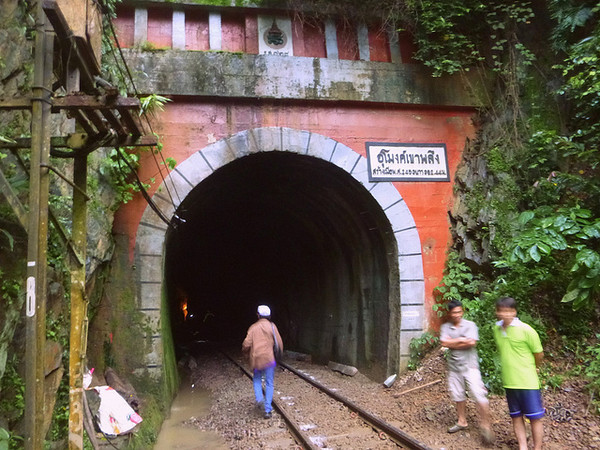
Lugging my backpack in near pitch black conditions, I moved one foot after another traipsing along decaying tracks that reeked of feces and urine as I emerged from a desolate tunnel. This probably sounds awful. 99.9% of the time I don’t think I’d enjoy this situation; however, I felt relieved to have finally escaped from our train that had several hours ago derailed en route from Bangkok to Chiang Mai.
On our way from Suvarnabhumi airport to Don Muang Airport via shuttle bus, I debated with Audrey whether or not we should take a train, bus or plane. “The plane will certainly cost more,” she said. Well, if we take the bus it’s certainly the cheapest option,” I murmured: “Hmmmm, how about taking the train?
Crazy Travel Story: My Train Derailed in Thailand!
Taking the train had been by far our preferred method of transportation anywhere we’ve traveled together. While in Vietnam, the incessant honking, sudden swerving and wanton sounding of the horn ensured we rarely (if ever) got a decent night’s sleep when we took overnight long haul sleeper buses from Nha Trang to Hoi An and from Hoi An to Hanoi. When we traveled in the posh ET Pumpkin carriage from Hanoi to Sapa, the soothing swaying reliable motion of the train ‘baaaa-thump….baaaa-thump’ rocked us to sleep. We both marveled how refreshed we felt after sleeping the entire night on the train as opposed to the bus.
We arrived at Don Muang station looking like a couple of greasy thugs profusely sweating and knackered from the combination of two consecutive flights from Europe combined with our bodies in shock at going from the moderate summer temperatures of Helsinki to the sweltering heat and humidity of typical day in Bangkok.
Desperately wanting to return to our home in Chiang Mai, we quickly snapped up the last tickets available on the train – a pair of first class sleeper booths. I looked over at Audrey and rolled my eyes: “We never pay for first class; second class sleeper is a splurge for us.”
As we boarded the train we quickly settled into the lower and upper bunks of our private air conditioned room. Soon after relaxing for a few minutes we ordered a Thai curry that we shared together. The rich spicy red curry duck and assorted vegetables with rice reminded us how much we loved being back in Thailand. Feeling the effects of jet-lag, we soon retired to our respective bunks. The familiar gentle back and forth motion of the train quavered us to sleep; suddenly, the gentle motion of the train turned to a screeching halt as it careened off the tracks.
Thump. Bang. Crash. Thump. Bang. Crash.
Frantic, I reached for the sidebars of my upper booth and grabbed a hold of them – with a white knuckle death grip – fearing I’d suddenly be propelled off of my bed like a slingshot.
Thump. Bang. Crash. Thump. Bang. Crash.
The train finally came to a grinding halt.
Certain we had jumped off the tracks! I looked down at Audrey who appeared much calmer: “No, we just stopped abruptly by a station”
I jumped out of the upper booth and started exploring around the rest of the cabin. Other passengers looked shell shocked and confused. None of us had any idea what had just happened. As I peered out the window it was pitch black outside.
Suddenly a Thai lady attendant chased down another farang who had just sauntered out of his room: “You pay for beer. Pay for beer now.” This was all a bit too surreal for me to handle.
As more passengers came out of their private booths information and rumours started to spread like wildfire.
Are we trapped? Is this a tunnel? Did we actually derail? A rescue train is coming to pick us up? What? Buses?
Finally, another Thai attendant came to calm us down coercing us to go back into our private rooms and sleep for a while; apparently, a train would be arriving in roughly 3 hours.
Not really knowing how grave the situation was at the time, we both drifted back to sleep for several hours only awakening to a loud thumping noise: “Get off of the train.”
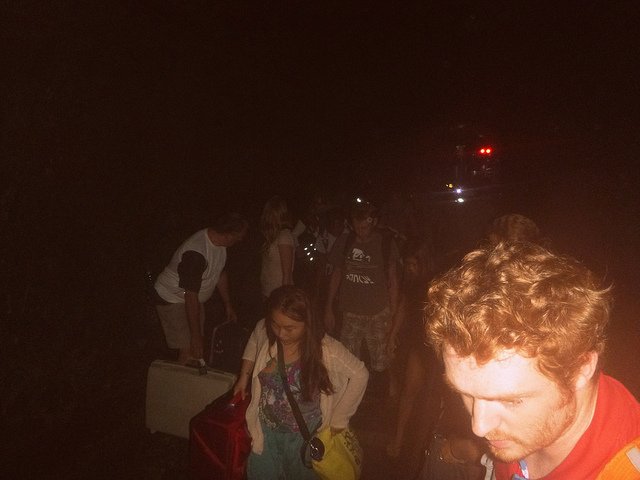
As we climbed out of the train a series of flashlights guided us down the tunnel to a trolley that was evacuating both passengers and luggage.
Audrey grabbed her point and shoot camera and fired off a few exposures.
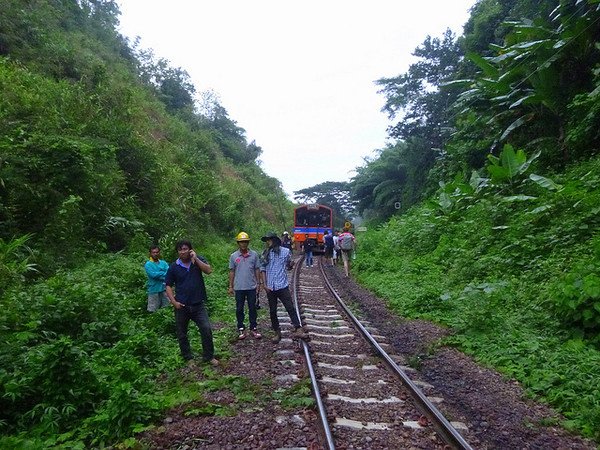
After a short distance was covered I looked back at the train; it was clear to me at this point, it had in fact derailed.
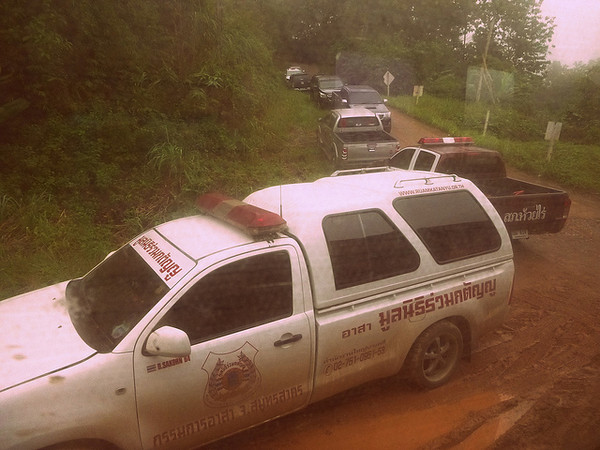
The aftermath of all of this was that we eventually were all evacuated from the tunnel and transported to Sila-at railway station where a fleet of double-decker buses awaited us – eventually transporting all 415 passengers to Chiang Mai not a single one of us was injured.
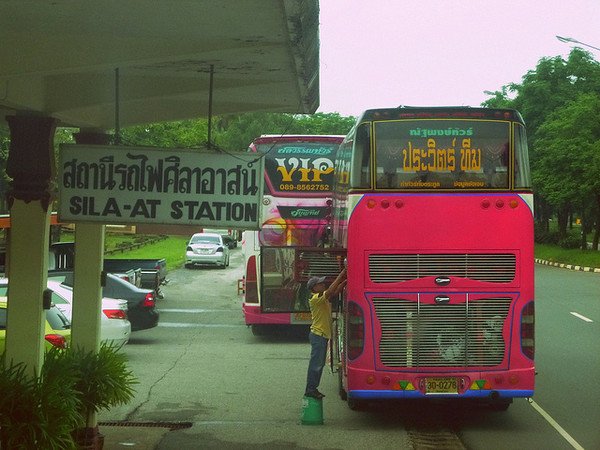
On the bus, a Thai man responsible for coordinating the rescue efforts started to crack jokes: “You so lucky. You pay for train and you get a bus too. We’ll arrive 5 hours later – no extra charge.”
Skittishly, I, along with most of the other passengers, laugh at his attempt to inject a little humour into what was several hours ago a life and death threatening scenario.
(Previous Chiang Mai to Bangkok train journey)
Thai Train Derailments
Apparently our situation was not a select or freak accident. Thai trains, especially on this particular Chiang Mai – Bangkok route, have been derailing frequently. Antiquated carriages and archaic tracks are the chief culprit as opposed to driver error or recklessness. After doing a bit of research, I couldn’t believe what I was reading. An accident mere weeks before our crash – another one shortly after. I’m the type of person who is safety cautious; how could I have not realized this?
What To Do If Your Train Derails In Thailand?
Knowing what to do if your train derails can help you stay calm and handle the situation effectively.
Stay Calm and Assess the Situation
The first and most crucial step is to remain calm. Panic can exacerbate the situation and make it more challenging to think clearly. Take a deep breath and quickly assess your surroundings. Check yourself and others around you for any injuries. If you or anyone else is injured, try to administer basic first aid if possible.
Listen for Announcements and Follow Crew Instructions
In the event of a derailment, the train crew is trained to handle emergencies. Listen carefully to any announcements made over the train’s PA system, and follow the instructions provided by the train staff. They will guide you on what to do next, whether it’s to stay in your seat, evacuate the train, or move to a safer location.
Evacuate Safely If Instructed
If the crew instructs you to evacuate the train, do so in an orderly manner. Take only essential belongings with you—such as your passport, wallet, and phone—and leave heavier items behind. Use the designated exits, and help others if they need assistance. If the train is tilted or off-balance, move cautiously to avoid slipping or falling.
Move to a Safe Location
Once you’ve evacuated the train, move away from the tracks and any potential hazards, such as steep slopes or unstable ground. Find a safe spot where you can wait for further instructions from the authorities or rescue teams. Avoid wandering off too far from the train, as emergency responders will need to account for everyone on board.
Contact Authorities and Loved Ones
If you have access to your phone, contact local authorities or the train company to inform them of your location and condition. It’s also important to reach out to your loved ones to let them know you’re safe. If you’re unable to make calls, try to connect with other passengers to pool resources and information.
Document the Incident
If it’s safe to do so, take photos or videos of the derailment and your surroundings. This documentation can be helpful for reporting the incident to authorities, insurance companies, or your embassy if needed. However, prioritize your safety and the safety of others over capturing footage.
Cooperate With Emergency Responders
When emergency responders arrive, cooperate fully with their instructions. They are trained to handle such situations and will guide you to safety or provide medical assistance if necessary. Be patient, as it may take time for rescue operations to be fully coordinated, especially in remote areas.
Seek Medical Attention
Even if you feel uninjured, it’s wise to seek medical attention after a derailment. Some injuries may not be immediately apparent, and getting checked by a healthcare professional can ensure your well-being. If you’re in a remote area, emergency services will likely transport you to the nearest medical facility.
File a Report
After the incident, it’s important to file a report with the train company or local authorities. This can help with any insurance claims and ensures that the incident is officially recorded. If you’re a tourist, contact your embassy for additional support and guidance on what steps to take next.
Trail Derailment In Thailand: The Aftermath
Prior to our derailment, train travel was by far my preferred method of transportation. When I fly, the slightest amount of turbulence can send my mind down a slimy rabbit hole where I start thinking the most morbid of thoughts. I’ve experienced far too many bus rides with a kamikaze driver – seemingly hell bent on risky the lives of all of the passengers on board – playing chicken with oncoming traffic to shave a few minutes off our journey. Until our crash, I had never once felt nervous on a train; that’s now changed.
(Previous Bangkok to Chiang Mai train adventure)
Turning a Near-Miss Into a Practical Guide
When a train you’re sleeping on suddenly decides to leave the tracks, it changes how you look at transport. Before this, the Bangkok–Chiang Mai train was my happy place: curry in the dining car, the lullaby of steel on steel, a full night’s sleep and a fresh arrival in the north.
After the derailment, I still liked trains. I just stopped treating them as invincible.
If you’re planning this journey yourself, I don’t want my story to scare you off. I want it to help you prepare. The Bangkok–Chiang Mai route is still one of the classic overland trips in Southeast Asia. You just need to know what you’re signing up for, what your options are, and how to build a bit of resilience into your plans in case things go sideways.
Let’s turn a crazy night in a tunnel into something useful for your trip.
Choosing Your Route Between Bangkok and Chiang Mai
You’ve basically got three main ways to get from Bangkok to Chiang Mai:
- Train
- Bus
- Flight
Each one has its own personality. One isn’t “right” for everyone. It’s about what you care about most on this particular trip: time, budget, comfort, or the experience.
Train vs Bus vs Flight: Quick Comparison
Use this as a rough, big-picture snapshot:
| Mode | Journey Time (approx.) | Typical Cost Range (one way) | Comfort Level | Best For | Main Downsides |
|---|---|---|---|---|---|
| Train | 11–14 hours | Budget to mid-range | Comfortable if in sleeper | Slow travel, scenery, “night train” experience | Delays possible, basic bathrooms, noise |
| Bus | 9–11 hours | Usually cheapest | Varies by company | Tight budgets, last-minute decisions | Driver style, cramped, overnight fatigue |
| Flight | 1–1.5 hours (air) | Mid-range to higher | Most comfortable per hour | Time-poor travellers, tight itineraries | Airport transfers, luggage limits, less “journey” feel |
If you’ve dreamed of night trains and want the journey itself to be part of the story, take the train. Just travel with eyes open rather than rose-coloured glasses.
When the Train Still Makes Sense
Even after our derailment, there are some good reasons I still choose the train on this route:
- You leave in the evening and arrive in the morning, saving a night of accommodation.
- You avoid the long shuffle to Bangkok’s airports and the taxi ride on the Chiang Mai end.
- You get a more gradual transition from capital chaos to northern calm.
- You have time to read, write, chat, stare out the window and remember you’re actually travelling, not just teleporting.
If you’re extremely anxious around trains, or you’ve got a tight schedule where a long delay would wreck everything, flying might be the better call. There’s no shame in choosing the option that lets you sleep at night.
Understanding Train Classes on the Bangkok–Chiang Mai Route
If you’ve never taken a Thai train before, the system can feel confusing. Sleeper? Seat? Fan? Air-con? First class? Second?
Here’s what you’re actually choosing between on this route.
Sleeper and Seat Options at a Glance
| Option | Bed / Seat Type | Pros | Cons | Best For |
|---|---|---|---|---|
| 1st Class AC Sleeper | Private 2-berth cabin | Privacy, quiet, lockable door, AC | More expensive, limited tickets | Couples, light sleepers, post-flight zombies |
| 2nd Class AC Sleeper | Open-plan bunks | Good value, AC, social vibe | Less privacy, lights/noise from corridor | Most backpackers and long-term travellers |
| 2nd Class Fan Sleeper | Open-plan bunks, fan only | Cheaper, airy when windows open | Hotter, dust/noise, weather-dependent | Budget travellers who sleep easily |
| 2nd Class Seat | Reclining seat | Cheaper than sleeper, ok for daytime | Rough for overnights, limited legroom | Day trains, short hops |
| 3rd Class Seat | Hard bench or basic seat | Very cheap, local experience | Crowded, noisy, minimal comfort | Hardcore budget or short segments only |
A few practical notes from many sweaty journeys:
- Lower bunks in 2nd class are wider and more comfortable but often cost a little more.
- Upper bunks are narrower, but you’re higher off the floor and sometimes feel a bit more cocooned.
- In 1st class, you’re in a small private cabin with two bunks. Great if you want to decompress after a long flight or trip.
- In both 1st and 2nd, bring your own earplugs and eye mask. The train itself doesn’t come with silence or darkness.
Night Train Packing List for the Bangkok–Chiang Mai Route
Here’s what I’d tell a friend to throw into their daypack for a more comfortable and resilient night:
- Lightweight sleeping clothes you’re okay being seen in if you have to get up quickly.
- A thin layer or hoodie—AC cars can get surprisingly chilly at 3 a.m.
- Earplugs and an eye mask to deal with lights, chatter, snoring, and rattling doors.
- A light scarf or buff that can double as a pillow cover or eye shade.
- Flip-flops or slides for runs to the bathroom, plus socks if you’re prone to cold feet.
- A refillable water bottle and a few snacks you actually like: nuts, crackers, fruit, instant noodles if hot water is available.
- A power bank and charging cable; some trains have outlets, but they’re not guaranteed or always functional.
- A small pack of tissues and hand sanitizer—bathrooms aren’t known for their luxury.
- A book, podcast, or offline playlist for the inevitable slow stretches.
Bangkok to Chiang Mai Night Train Questions: Honest Answers, Safety Insights & Practical Tips
Is the Bangkok to Chiang Mai night train still safe to take after hearing about your derailment?
Mostly, yes. Any form of transport carries some risk, but for most travellers the Bangkok–Chiang Mai night train is a reasonable choice as long as you accept that Thailand’s rail system is older and not as polished as in Japan or Europe. After a cluster of derailments on this line in the early 2010s, the State Railway of Thailand invested in newer sleeper carriages and track improvements on key routes, including this one, so incidents are now rarer, though never impossible. I always tell people to treat it like an overnight adventure: book a good class, travel with decent insurance, and understand that safe on Thai rails still means a slightly rough, rattly ride.
How common are train derailments in Thailand nowadays?
Rare. Train derailments still happen in Thailand, but they are not an everyday thing, and serious injuries on the main Bangkok–Chiang Mai corridor have become much less frequent than they were during the bad run of accidents back in 2013. What you do see more often are minor incidents elsewhere in the network or collisions at road crossings, which make headlines but do not reflect the experience of most travellers who ride this line without incident.
For this route, is the train actually safer than taking an overnight bus?
Usually, yes. If you compare risk in Thailand, long-distance buses and minivans have a reputation for far more serious crashes than trains, mostly because of speeding, driver fatigue, and the sheer number of vehicles on the road. Thailand’s road death rate is among the highest in the region, which is why many cautious travellers prefer rail or short domestic flights for overnight journeys. That doesn’t mean trains are risk free, but if you’re choosing between a night bus tearing along a highway and a sleeper train doing a steady trundle through the hills, I’m still more relaxed on the rails.
Which class or sleeper type should I book if I’m a bit nervous about safety and comfort?
It depends. If you’re anxious, I’d aim for first-class AC sleeper or the newer second-class AC sleepers rather than seats or the older fan cars. A private first-class cabin lets you shut the door, control your light, and lie flat, which makes it easier to stay calm if the train jolts, while second-class AC bunks give you a good mix of comfort and value in a supervised, well-lit carriage. I’d avoid third-class benches or overnight seats if you already feel on edge, because being cramped, exhausted, and surrounded by noise will amplify every strange sound and bump.
How far in advance should I buy tickets for the Bangkok–Chiang Mai night train?
Early. This is one of the most popular train routes in the country, and sleeper berths in the nicer carriages often sell out days or even weeks ahead during Thai holidays and peak season. If your dates are fixed, I’d book as soon as you’re sure of your plans; if you’re flexible and travelling in a quieter month, buying a few days in advance is usually enough, but I still wouldn’t count on just rocking up an hour before departure and getting the perfect bunk.
Is the Bangkok–Chiang Mai night train okay for solo travellers, families, and solo female travellers?
Absolutely. The Bangkok–Chiang Mai night trains are full of solo backpackers, Thai families, and older travellers, and there is usually a staff member assigned to each carriage who keeps an eye on things overnight. For solo female travellers, the combination of curtains, shared but open-plan bunks, and plenty of other people around tends to feel safer than a nearly empty bus in the middle of nowhere, though you still want the usual common sense: keep valuables on your body, avoid getting drunk with strangers, and choose a lower bunk or private cabin if you sleep lighter. For kids and grandparents, the key is comfort more than safety – a proper berth where everyone can lie flat, use the bathroom easily, and not get flung around by sudden braking.
How long does the Bangkok to Chiang Mai train take and what does the journey feel like at night?
Long. You’re looking at roughly half a day of travel when you factor in boarding and arrival, with most night trains scheduled for around 11–14 hours depending on the service, and delays of an hour or two aren’t unusual. At night you’ll feel a steady rocking and occasional hard braking as you pass junctions or slow for curves, plus the usual soundtrack of clanks, whistles, and people moving in the corridor; in air-con carriages it can get surprisingly cold, so you’ll be much happier with a hoodie, earplugs, and the mental expectation that this will be more rolling campsite than luxury hotel.
What should I pack specifically for the Bangkok–Chiang Mai night train in case something goes wrong?
Two things: comfort and contingency. Pack as if the journey might run long or be interrupted – that means your passport, money, medication, phone, and a power bank in a small daypack that never leaves your side, plus a bottle of water, snacks you actually like, tissues, hand gel, and a light layer in case the AC goes wild or you end up outside in the cool night air. After my derailment, I also pay more attention to footwear: flip-flops are fine on board, but having shoes you can quickly slip on makes walking along tracks, gravel, or uneven ground much easier if you ever need to evacuate in the dark.
If my train derails or breaks down in the middle of the night, what actually happens next?
In theory, there’s a clear protocol: the crew secure the train, check for injuries, call for backup, and coordinate with rescue teams and the rail authorities, and then you’re either moved to another train or bused onward once everyone is accounted for. In practice it can feel confusing and slow, especially in the middle of the night, but you’ll usually see a mix of railway staff, police, and local emergency responders arriving with vehicles to move people and luggage. Your job in that chaos is simple: stay with your carriage mates, follow instructions, keep your essential documents on you, and help anyone nearby who looks disoriented or scared.
Can I get a refund or compensation if there’s a serious delay or incident on my train?
Sometimes. For straightforward delays the railway might offer a partial refund, a rebooking, or nothing at all, depending on how late you are and what caused it, and the amounts are usually small by international standards. In the case of a serious incident with injuries or damage, there may be official compensation processes, but they’re slow and paperwork heavy, which is why I always treat local refunds as a bonus and rely on my own travel insurance for any real medical or onward-travel costs. If your train is badly delayed or cancelled, get a written confirmation or photo of the notice if you can – it gives you something concrete to show your insurer later.
When is the best time of year to ride the Bangkok–Chiang Mai train for weather and crowds?
Cool and dry. The most pleasant months to ride this route are generally November to February, when Bangkok is marginally less scorching and the nights in the north can even feel a bit crisp, which makes sleeping under a blanket on a rattling train surprisingly cosy. March to May tends to be brutally hot, and April can combine holiday crowds with heat, while the June–October rainy season brings more chance of storms and occasional disruption, though the hills around Chiang Mai do look lush. If you’re nervous, I’d avoid the very busiest Thai holiday periods, when everything sells out and the stations are packed, and aim for a shoulder-season weekday instead.
After living through a derailment yourself, do you still personally recommend doing this journey by train?
Yes. I’m not going to pretend the derailment didn’t shake me – it did – but it also didn’t turn me off trains forever, and I’ve taken Thai sleepers again since with a bit more respect for gravity and a lot more gratitude when we roll into the station upright. For me the Bangkok–Chiang Mai night train is still one of those classic overland journeys that turns a simple transfer into a story, and if you go in with realistic expectations, a decent berth, and the understanding that things might get delayed or weird, it’s a story that usually ends with a safe arrival and a good plate of northern Thai food the next day.
Would I ever want to take a train again?
Yes, it’s still my preferred method of getting from point A to B. Having taken the train several times since our accident, I don’t feel quite as relaxed as I once did. When the train suddenly changes tracks or there is an unexpected thump, I now react with the same tension and anxiety I experience while on a turbulent flight or a swerving bus; however, it’s not a dis-empowering fear that leaves me incapable of hopping on board. I just no longer feel invincible on a train.
Accidents and illness are often a reminder that we’re mere mortals. I found myself feeling an extreme sense of gratitude that our train derailed where it did (inside of a tunnel) as opposed to several kilometres behind us where unforgiving terrain would have sent us plummeting vertically downward. It’s these kind of events that make you realize life is a game of inches.
Have you ever been on a train that derailed? A car crash? A scary plane ride? Please share your stories below.
It’s October 2023, and I’m planning my first trip to Thailand, which includes going to Chiang Mai from Bangkok and thence to Chiang Rai and returning to Bangkok. I had learned that the train trip from Bangkok to Chiang Mai would take nearly a full day or overnight, so I’d planned on flying. Now I’m glad to have read your story about the derailment back a decade ago. As for the trip from CM to CR, I am really concerned about the safety of buses, minivans, renting a car and driver or renting a car (we’re Americans, so not accustomed to driving on the left: that’s another risk). You’ve convinced me: we’re flying!
PS We were on a train from Vienna to Freistadt, Austria, in September 2001. We were chugging nicely along a hillside above the Danube when we screeched to a halt and derailed. A landslide blocked the tracks. We waited in the railcar for about 45 minutes until another train arrived from the Freistadt direction. The staff walked us around the landslide and carried our luggage for us. We were quickly on our way. But it could have been so much worse! The Danube loomed below. We could easily have rolled down the hillside into the river.
Wow!
Goodness me.
I remember reading this when you originally wrote it back in 2013, but I didn’t comment at the time as I was a newbie in the blogging world, and very shy!
Nevertheless, I kept it in mind ‘cos even though I had already been to Thailand a few times, I hadn’t yet been to Chiang Mai. In fact, whenever I go to Thailand, I never seem to go to the beach!
Anyhoo, I took my family to Thailand and when we went from Bangkok to Chiang Mai, we did so by plane.
Because of this article.
Your article.
It cost the same amount as the train – $34.00 each and took just 1 hour and 10 minutes.
Most importantly, we got there safely.
Thank you!
Oh! It sounds too scary. Thank God you guys were okay! But apart from all, it was a nice experience and adventures too 😛
When I went on that exact same route, a weird thing happened, I was in the sleeper car, which was located in the middle of the train (I was not in the last carriage at least), but later on, after exiting a tunnel (possibly the same one you derailed in), there were no carriages behind us, and we were in the last carriage. Soon the train stopped (most people thought it had broken down) and we were told to get off, and there were dodgy looking vans looking to take us away to (hopefully) Chang Mai. I was wandering if this was actually the same accident as you experienced. Do you know if the whole train derailed, or if it was just the last few carriages you were in and the rest of the train was not there?
You look very professional writer. Hats off to you 🙂
Wow, that’s really scary! I’m on my way to Thailand in February next year and i’ll be heading into Chiang Mai from Bangkok. I hope nothing like this will happen to me! I’m glad to see that you made it out alright though and I still plan to use the train systems there, as they seem like the best way to get around that region.
Have you ever been to Phuket? If never, I would recommend Phuket island. Last month my husband and I visited Phuket island of Thailand. One of the places we really enjoyed was a Thai Cultural Theme Park – Phuket FantaSea. Every service area there was beautiful and neat. We enjoyed watching their beautiful, costumed parade culminating at an outdoor stage with a Bangok theme show. The place is really somewhat like Disneyland of Thailand! The highlight their main show held at a beautiful Palace of the Elephants Theater. I must say it was pretty amazing, I left overwhelmed by their beautiful culture. International buffet dinner was good, particularly the noodle soup. We remember it as one of our nicest outings in Phuket and do recommend it for a quality evening-into-the-night entertainment. Don’t miss it!
Traveling around the world needs lots of courage, adventure and money also. Keep it up buddy!Go ahead….
I once rode a tram, which detailed in a curve. But on a train it could be terribly dangerous.
Well, at least you went through an adventure safely.
This post does make flying to CM sound like a much better option. Yikes! Glad you weren’t hurt
Oh my gosh, this would’ve scared the crap out of me! I am so glad I decided to fly in CM, opposed to taking the train or bus.
Sounds like an adventure in itself. I am glad you weren’t hurt and came out ok. I would have been scared to death. At least you made it in the end to your destination.
Thanks Todd, we were admittedly very lucky.
Geez, derailing the train is a heckuv a way to get people to pay their beer tab, Samuel! All kidding aside that would have scared the bejeezus out of me. I’m so glad you two were safe and please always be so in your travels. A huge fan here that looks forward to hearing from you. I mean that 🙂
Thanks Mike!
Hopefully we won’t be crawling out of tunnels again soon 😉
We flew from BKK to Chiang Mai in January — $72 USD on Thai Airways International (checked luggage and taxes included). Flight under an hour and they even fed us. I’m not sure what it was, but we appreciated the gesture. The pilot spoke better English than I do.
That’s fantastic value! On discount flights (and special deals) it can sometimes be cheaper to take a flight than to take the train!
That sounds like some wake up call. I never got a train in Thailand (luckily for me) and had no idea that they derailed so often. If I ever go back I definitely wont be taking one.
I should find it disconcerting that when I was searching for train information from Chiang Mai to Bangkok this was what came up!
I’m currently debating the best method of getting back to Bangkok from Chiang Mai and heard great things about the train. The tracks were closed for a month for repairs and maintenance recently so I’m hoping that I don’t end up with a story like yours.
That must have been both frightening, surreal and kind of exciting all at once. Have you still got the fear or has safe travel on trains since set your mind at ease? Thanks for sharing your story!
You always take your chances on any kind of transportation, but it is really the fear of each individual that makes the decision on which you will pick. Of course on the ground you have more choices, but in foreign countries they drive way crazier than in the U.S. and you hear of buses going over the sides of cliffs a lot. I love to ride trains, but unfortunately in poor countries the tracks are a real concern. Unlike the U.S. where the real concern lies with the conductor texting or not while driving:)
quick question for you, i’m actually considering taking that train and doing my research. I’m 6 months pregnant and traveling by myself. is it something you’d avoid?
I went to Budapest beginning of October and when i was coming back to London i had the worse by far experience in a plane, it was really windy in London and we where fliying in one of those small Boeing 737-800 to make it even worse.
At the moment of landing the plane was swinging really badly and the view from the window was, few seconds of dark grey sky, and few seconds of really close landing strip…
Resume: terrifying, but still alive and with no evidence of fear to fly again.
What an experience! Thankfully you are OK.. that’s always the most important part! I just had a car accident in Guatemala recently.. makes you remember the real danger of traveling.. transportation!
Oh Thailand… glad it was nothing too serious.
Sam, I am so thankful that this train accident wasn’t worst than what it could’ve been.
I HATE flying, but you could never tell while I am booking the flight and boarding the plane. The main time you can sense I hate flying is when the plane ascends into the clouds which increases turbulence. I know many people say that automobile accidents occur more than plane accidents, the simple fact that I am IN CONTROL while driving puts me more at ease. Thirty thousand feet in the air and the only way to go is down freaks me out.
I totally agree with you! Today we took a flight that landed really roughly after some turbulence. I was completely terrified.
I admire your honesty about being terrified! Whenever I am on the plane with other passengers, they are either so knocked out from sleep despite the turbulence or they seem like it doesn’t bother them! I am always looking around like, ‘ don’t you all FEE that. OH EM GEE! Is this it for me?’ LOL!
This must have been so scary! Don’t think I’d be quick to get on a train again. Glad you guys were okay!
Thanks Heather 🙂
We felt really lucky to walk away without injuries.
Wow, Sounds like the route if fraught with derailments. No matter how attractive a train ride is, Ive learnt to do serious research on its safety before i buy that ticket. Thats not to say that all of their trains get off the tracks…but wouldn’t want to be in your position either.
Robert recently posted: Amboseli National Park Day Tour
Robert,
That’s a very wise thing to do. I’ve really learned my lesson in terms of doing that as well.
No, I’ve never experienced a train derailment and hopefully never will. I must give Audrey some credit for being calm and not immediately expecting something terrible (as I might!). Wonderful that there was nobody injured. It certainly gave you a good story to tell.
Thanks Cathy,
Audrey did handle it more calmly 😉
We just felt lucky to have escaped without injury.
Great coverage of an unfortunate situation. I live in Bangkok and I feel like I’m ALWAYS reading about a train derailment or a fatal bus or minivan crash. It happens WAY too often. Luckily for me, the worst transportation problems I’ve encountered are just traffic jams!
Thanks Karisa,
I think flying may be the safest option. Nok Air will be getting more of my business in the future 🙂
Believe it or not, I had a similar issue going from BKK to Chaing Mai. I ended up taking the daytime train because the rest were sold out, and sat in that seat for the next 18 hours while the train kept breaking down and tilting. It was NOT a good experience!
Yikes! It’s shocking how many people we now know of who have had similar issues on this route. 99.9% of the time I’d take the train over a bus or flying but not in this case!
That’s a very good point K.T.!
These crashes and accidents never do make it on the news. It’s really only when you search that you begin to unravel just how bad it is at times.
I too am a safety conscious traveler!
Didn’t used to be- but after our bus crashed in Vietnam, our INSANE turbulence on an Air Asia flight and our car crash in Egypt- I decided it was time to research safe methods of transport in each country we went to. The results were un-nerving. Plane crashes here, bus crashes there. Pretty scary.
Yet, somehow these incidents never make it on the news back in the West.
Since then my preferred method of travel — trains whenever possible! Looks like that is out the window now too! Looks like I’ll be walking!
Glad you guys are okay- I would have pooped myself!
it’s fabulous that you survived (for you and us, your readers/followers) but WHOA! That would have scared me into a new pair of undies.
Thanks Maria!
It was definitely one of the scariest travel moments I’ve ever experienced.
That’s such a crazy story. It’s disconcerting that they haven’t fixed the train car that caused the problem. Hopefully things turn around soon. I’m glad you two made it out ok with only a cool story.
Thanks Tim,
I’m equally as baffled why they haven’t taken the time to properly repair and maintain the route.
I’m afraid it might take a serious accident – with significant injuries and/or casualties – for something to finally be done.
Shhhhhiiiiiitttttt!!!!! Glad you guys are safe and sound. What a nightmare!
Thanks Stuart!
We were lucky to escape that incident unscathed 😉
Good to “hear” that you survived, and that nobody was hurt. I didn’t realize that route had so many derailments. I’ve taken it several times, in both directions, and thankfully made it without any drama. These days, I usually fly. I like to get into CM quickly. 🙂
Thanks Nancie,
We’ve also taken that route many times before! Aside from it being slow (and frequently delayed) it was our favorite way of getting from Chiang Mai to Bangkok or vice versa. I have a feeling we’ll be flying a lot more now as well!
Old blog post but FYI – if anyone is still thinking of getting the train from CM to Bangkok, don’t. Got the train yesterday and while ours was okay in that it stayed on the tracks (just about), the one in front of us wasn’t so lucky. Overall we were delayed by about 3 hours, but bloody hell – the train shook back and forth violently like a palm tree in a hurricane. Having traveled extensively by train over the years I didn’t think much of it at first, but when we found out that the train in front had derailed it put a different spin on things.
And while the train overall was an experience and I am glad I did it, it was overall pretty unpleasant. Why oh why is it the case in certain places that they insist on such blisteringly cold temperatures for the air con? Can someone explain the logic behind this? Why? Why the need to inflict air so bloody cold my fingers go numb?
Oh, and the mosquitos were a blast too. Not to mention the food, or lack thereof. So if you are going to brave the train make sure to bring your own grub and not spare the Deet. Overall, a distinctly unpleasant and nerve wracking 14 hour experience but one strangely I’m glad I had. I guess it will make for somewhat interesting reading when I sit down one day to write my memoirs.