
My first night in Malaysia was spent sleeping at the airport.
This was my brilliant money-saving idea.
Audrey had imagined something slightly more romantic for the beginning of our trip. I pointed out that we had secured our bags, avoided paying for a room and were therefore living in the lap of luxury.
She was not entirely convinced.
It was an appropriately scruffy beginning to what became 29 days travelling around Malaysia. We ate dim sum at absurd hours, rode the train from Kuala Lumpur to Butterworth, wandered through Melaka and George Town, sweated through Kuala Lumpur, failed spectacularly in the Cameron Highlands and never reached the beaches we had originally planned to visit.
That was not our only Malaysian trip either. We returned to Kuala Lumpur repeatedly over the years, usually pulled back by food and the dangerous belief that we had room for one more meal.
By that stage, I had spent more than seven consecutive years abroad as a backpacker and expat, yet there were still entire regions of the world I had barely touched. At the time I first wrote this article, I had never travelled through Europe, Africa, Central America or the Middle East.
So what was my excuse?
Southeast Asia.
It kept pulling me back. Thailand had beaches, curries and a backpacking circuit so established that you could practically navigate it by following abandoned elephant-print trousers. Cambodia and Laos rewarded slower travel. Vietnam possessed enough energy to make crossing a street feel like a small military campaign.
I could never settle on one favourite country for long. My answer changed depending on where I had just eaten, how badly I had been rained on and whether the last overnight bus had deposited me at an actual terminal or beside a confused goat.
But I could answer a slightly different question.
Which country in Southeast Asia was the most underrated?
Malaysia.
Easily.
What I Mean When I Call Malaysia Underrated
Before somebody reasonably points out that Malaysia receives millions upon millions of visitors, let me qualify the argument.
Malaysia is not undiscovered.
According to Tourism Malaysia’s 2024 statistics, the country welcomed almost 38 million foreign visitors that year. Plenty arrived overland from neighbouring Singapore, Indonesia, Thailand and Brunei, but the larger point stands.
Nobody has been keeping Malaysia hidden beneath a giant banana leaf.
By underrated, I mean under-celebrated relative to what the country actually delivers.
Malaysia rarely dominates the Southeast Asian backpacking conversation. Travellers dream about island-hopping in Thailand, motorbiking through Vietnam, wandering around Angkor in Cambodia or disappearing into Bali for three weeks and returning as a cacao facilitator with unusually strong opinions about vibrations.
Malaysia often gets reduced to a short Kuala Lumpur stopover on the way somewhere else.
That is the mistake.
Malaysia gives you historic trading cities, some of the best food in Asia, tropical islands, cool highlands, ancient rainforest, major modern cities and access to the radically different landscapes of Malaysian Borneo.
It is relatively easy to navigate. English is widely used. It works for backpackers, couples, families and travellers who have advanced beyond the stage of wanting every evening to end with a plastic bucket and an unexplained bruise.
Yet it does all of this without feeling like a sanitised introduction to Asia.
Why So Many Travellers Overlook Malaysia
I do not think Malaysia gets overlooked because it lacks attractions. It gets overlooked partly because its strengths are harder to reduce to a single postcard.
Thailand owns the classic backpacker fantasy. Singapore is the polished city-state. Bali has become an international lifestyle product. Cambodia has Angkor. Vietnam has a strong north-to-south route that practically writes the itinerary for you.
Malaysia is messier to explain.
Kuala Lumpur, Melaka and George Town tell one story. The Cameron Highlands and Taman Negara tell another. Langkawi, the Perhentian Islands, Redang and Tioman offer very different versions of island travel. Sabah and Sarawak sit across the South China Sea on Borneo and deserve far more than a rushed little appendix tagged onto the end.
The country also rewards ordinary moments more than frantic sightseeing.
A morning in a kopitiam. An evening beside the river in Melaka. A plate of dim sum in George Town. A mosque, Hindu temple and Chinese clan house occupying the same urban landscape. A cold drink consumed while your shirt slowly loses its battle against tropical humidity.
Malaysia does not always smack you over the head on arrival.
It grows on you.
That may be its greatest strength and its biggest marketing problem.
1. George Town and Melaka Are Two of Southeast Asia’s Best Cultural Cities
Malaysia has two of my favourite cultural hubs in Southeast Asia: George Town in Penang and Melaka.
Many travellers know George Town as a food destination, an old-school Thai visa-run stop or somewhere to break the journey between Thailand and Kuala Lumpur.
Those who slow down find considerably more than that.
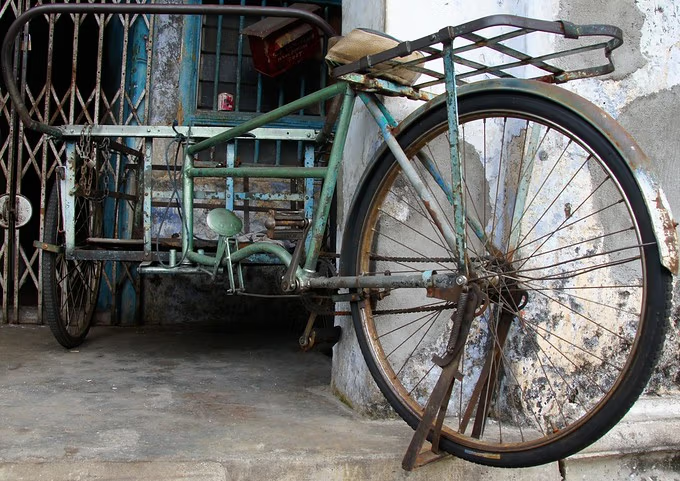
George Town is not a historical shell polished for tour groups. It is a living city of shophouses, clan associations, religious buildings, markets, workshops, restaurants, cafés and neighbourhoods where Malay, Chinese, Indian, Peranakan and European influences remain visible.
The street art gets plenty of attention. Sometimes too much.
Visitors queue for photographs beside murals while walking straight past the more interesting city happening around them. The real pleasure is wandering without converting every block into an Instagram scavenger hunt.
Stop for dim sum. Poke your head into a temple when appropriate. Follow the smell of something frying. Become distracted. Abandon whatever heroic sightseeing schedule you created the night before.
That is usually when George Town starts working.
Melaka is even more underrated in my opinion.
Too many travellers see Kuala Lumpur and continue directly to Singapore. Melaka is frequently squeezed into a frantic day trip, which is still better than skipping it but not the best way to experience the city.
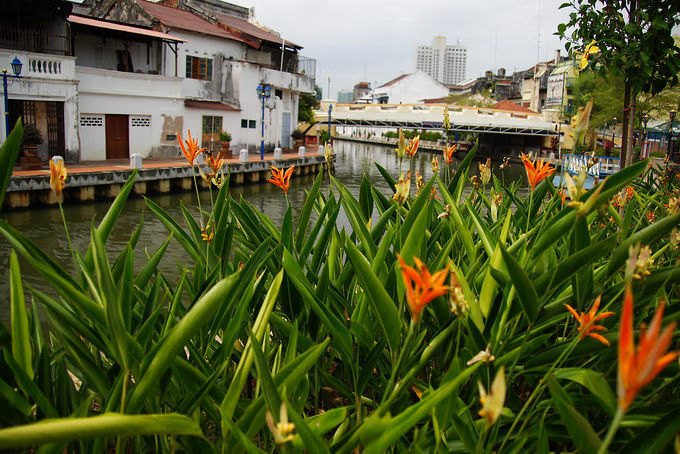
Melaka offers riverside walks, distinctive neighbourhoods, old religious buildings, Portuguese and Dutch remnants, Peranakan heritage and streets that become considerably more pleasant after some of the daytime tour groups leave.
The city is compact enough to explore without conducting a full expedition, but layered enough to reward staying overnight.
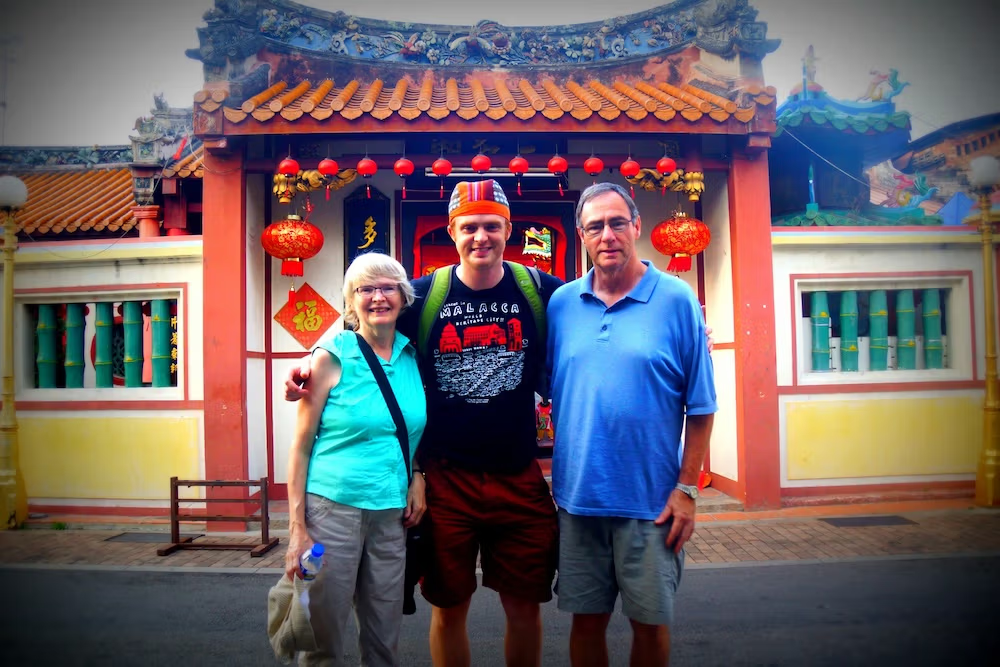
At the end of our 29-day trip, I asked Audrey to name her favourite destination in Malaysia. She chose Melaka without hesitation.
She liked how easy the city was to navigate, the red lanterns, the food and the fact that it offered a relatively gentle introduction to Southeast Asia. That was Audrey’s judgment rather than mine, but it supported something I had already felt strongly: Melaka deserved more attention than it received from travellers rushing between Kuala Lumpur and Singapore.
George Town and Melaka were jointly inscribed by UNESCO as the Historic Cities of the Straits of Malacca. Their importance goes beyond attractive old buildings. Both cities reflect more than 500 years of trade and cultural exchange connecting the Malay Archipelago with China, India, the Middle East and Europe.
They are complementary rather than interchangeable.
| Choose | Go for | Stay at least | My take |
|---|---|---|---|
| George Town | Food, shophouses, religious diversity, street life and a larger urban base | 3 nights | Best for travellers who can happily spend several days eating and wandering |
| Melaka | Riverside atmosphere, layered colonial history and a more compact old centre | 2 nights | Best once the day-trippers leave and the city exhales |
| Both | A better understanding of the old Straits of Malacca trading world | 5–6 nights combined | The strongest choice when culture and food matter more than beach time |
Neither city is magically protected from traffic, commercialisation or crowds.
Jonker Street in Melaka can become intensely busy. Parts of George Town are hot, congested and less pedestrian-friendly than the dreamy photographs suggest. Your romantic heritage walk may occasionally involve dodging a motorcycle while sweating into your own eyes.
Go anyway.
Just stay long enough to escape the most obvious streets.
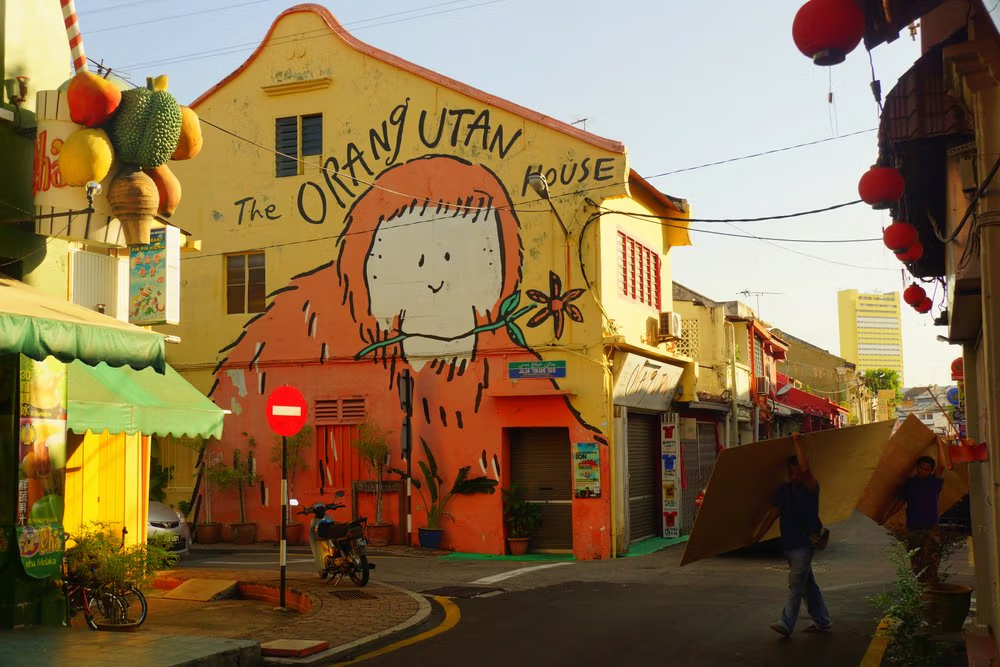
Where to Stay in Kuala Lumpur, Melaka and George Town
Location matters more than chasing the cheapest room on the opposite side of a six-lane road.
During our early budget-travel years, Chinatown was our preferred Kuala Lumpur base. It put us close to inexpensive rooms, food, temples, Central Market, Petaling Street and useful public transport.
The prices we paid then belong firmly to travel-blog archaeology and should not be used as a current budget. The location logic still holds.
In Melaka, I would prioritise being within comfortable walking distance of the historic centre rather than treating the city like a commuter suburb. In George Town, staying near the UNESCO core makes spontaneous early-morning and evening wandering much easier.
- Compare hotels and apartments in Kuala Lumpur on Booking.com
- Browse accommodation in Melaka near the historic centre
- Find hotels and heritage stays in George Town
I have deliberately linked to broad accommodation searches rather than pretending one hotel is universally perfect. A backpacker arriving alone at midnight, a couple on a food trip and a family travelling with children are solving three different problems.
2. Malaysia May Have the Best Breakfast Culture in the World
I once had a conversation with a friend about our favourite breakfasts.
That was when I realised Malaysia had the category cornered.
I am a huge fan of dim sum, which is readily available in Kuala Lumpur, Melaka and Penang. During our month-long trip, I ate it almost everywhere we went.
This frequently required waking Audrey at ridiculous hours.
Six in the morning?
Perfectly reasonable when dumplings are involved.
Audrey’s memories of our dim sum mornings involve being dragged out of bed while only partially conscious. Mine involve exemplary commitment to breakfast.
Our George Town Dim Sum Ritual
George Town had no shortage of dim sum restaurants, but I had a favourite.
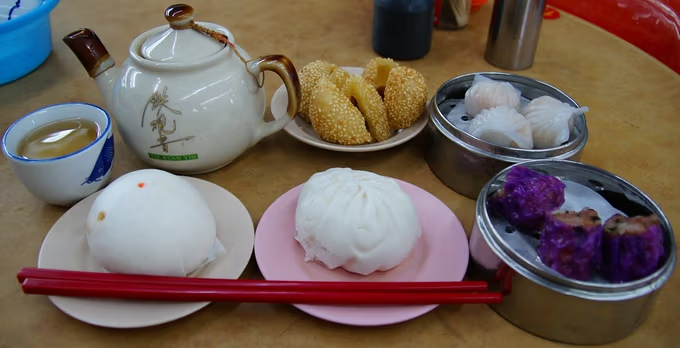
The meal began with tea because, as far as I am concerned, no dim sum breakfast is complete without it. Then the carts began moving through the room.
Staff pushed around different trays loaded with dumplings and buns. We chose whatever looked tempting, each item was placed on our table, and the corresponding box was marked on a paper bill.
This is a dangerous ordering system for someone like me. There is no final decision. Food simply keeps arriving until reason, stomach capacity or Audrey intervenes.
We ate shrimp dumplings, vegetable fillings, pork and buns stuffed with barbecue pork. I especially loved the sweeter dim sum filled with red bean paste.
What I remember most was not one perfect dumpling. It was the social rhythm of the meal: tea, conversation, carts circulating, another dish appearing and the collective pretence that nobody was already full.

When I wanted something different, few breakfasts were more satisfying than roti canai: flaky Indian-influenced flatbread torn apart by hand and dipped into curry.
We also tried versions stuffed with cheese and even Milo. Some rotis arrived with a miserable token slice of cheese. Others were so thoroughly loaded that structural integrity ceased to be a realistic goal.
Roti is cheap, greasy in all the correct ways and almost impossible to eat while maintaining any illusion of dignity.
Then there is nasi lemak with coconut rice, sambal, peanuts, anchovies, cucumber and egg. Kaya toast with soft-boiled eggs. Noodles. Curries. Teh tarik. Strong local coffee served in a kopitiam that looks as though it has been doing the same brisk trade since long before anyone felt the need to call a restaurant “a concept.”
This is not merely my stomach becoming emotional.
In 2024, Malaysia’s multi-ethnic breakfast culture was inscribed by UNESCO on its Representative List of the Intangible Cultural Heritage of Humanity.
That recognition makes perfect sense because Malaysian breakfast is not one cuisine. It is an everyday meeting point for Malay, Chinese, Indian and other traditions.
You can eat something entirely different every morning without leaving the same neighbourhood.
A Simple Malaysian Food Strategy
Trying to create a complete Malaysian food checklist is a reliable way to become overwhelmed before lunch.
I would use a simpler approach.
- Eat breakfast outside your hotel. Unless your hotel serves something genuinely local, leave the buffet croissants for somebody with less ambition.
- Visit a kopitiam. Order coffee or tea, toast, eggs and whatever the surrounding tables appear to be demolishing.
- Use hawker centres for range. They allow couples, friends and families to order from several stalls and share.
- Repeat dishes. One laksa, roti canai or nasi lemak does not represent every regional version.
- Follow busy local stalls. A short queue of regular customers is generally more reassuring than a menu translated into eleven languages beside a plastic palm tree.
| Place | Food angle | Start with |
|---|---|---|
| Kuala Lumpur | Maximum multicultural range in one city | Nasi lemak, banana-leaf rice, roti canai and late-night street food |
| George Town | Hawker culture and Penang specialities | Char kway teow, assam laksa, nasi kandar, dim sum and cendol |
| Melaka | Peranakan and local heritage dishes | Nyonya cooking, chicken rice balls, cendol and kopitiam breakfasts |
| Ipoh | Chinese Malaysian coffee-shop culture | White coffee, noodles and bean-sprout chicken |
During our early Malaysia trip, Audrey singled out cendol as one of her favourite discoveries: shaved ice, coconut milk, palm sugar and assorted toppings assembled into a dessert designed specifically for tropical survival.
You could construct an entire Malaysia itinerary around eating.
I would consider that completely rational behaviour.
Jalan Alor: Durian, Satay and Excessive Dessert
One evening in Kuala Lumpur, Audrey and I went to Jalan Alor hungry and left carrying the spiritual burden of several additional meals.
The street was packed with plastic tables, traffic, smoke, noise and competing food smells. It was not subtle. It was not calm. It smelled fantastic.
I began with durian because apparently I prefer to start a meal by testing the stability of my marriage.
I love durian.
I like its thick, creamy, almost pudding-like texture. The smell does not bother me much. Audrey’s assessment was different. She detected rancid fruit, garlic and a pressing need to locate a drink.
She managed a cautious encounter with it, declared herself firmly outside the fan club and handed the rest to me.
This arrangement suited everybody.
We continued with dim sum, an extraordinarily thick Malaysian milk tea, satay skewers, coconut ice cream buried beneath an irresponsible number of toppings and mochi ice cream that briefly froze my tongue to the point where speaking became a technical challenge.
The coconut ice cream came with coconut flesh, coconut cream, shredded coconut and four scoops. Unlimited toppings were offered. I interpreted “unlimited” less as a feature and more as a direct personal challenge.
By the end of the night, I had eaten substantially more food than planned and was completely unable to blame anybody else.
That is the trouble with Malaysian street food. Discipline appears sensible before you arrive and unnecessarily puritanical once you can smell everything.
A Kuala Lumpur Food Tour Can Be Worth It
We explored Kuala Lumpur’s food independently through repeated visits, wandering, bad restraint and occasionally ordering things before fully understanding them.
A well-run food tour can still help a first-time visitor understand how Malay, Chinese and Indian Malaysian traditions overlap. It is especially useful when your trip is short and you would rather not spend two days eating mediocre food beside the wrong shopping mall.
Check availability for the Sambal Streets Kuala Lumpur food tour with multiple tastings
Book it because you want context and range, not because Malaysian food requires a chaperone.
3. Malaysia’s Cultural Mix Is Visible in Everyday Life
Nowhere else in Southeast Asia have I encountered quite the same combination of cultures and cuisines in such an accessible form.
Malaysia’s population includes Malay, Chinese, Indian, Indigenous and other communities, and that diversity is not confined to museum panels or official speeches.
It shapes what people eat, the languages spoken around you, the calendar of festivals and the architecture of entire neighbourhoods.
A short walk may take you past a mosque, Hindu temple, Chinese temple, church and a row of restaurants serving entirely different culinary traditions.
In Kuala Lumpur’s Chinatown, we visited Sri Mahamariamman Temple and kept our voices low as we explored. We removed our shoes before entering. A short walk away, we visited Guan Di Temple.
That proximity was not an itinerary trick. It was the city revealing how many histories and religious traditions occupy the same neighbourhood.
That does not mean Malaysia is a frictionless multicultural utopia. No country is, and travel writing becomes ridiculous when it treats complex societies as harmonious food courts with national flags.
It means the traveller encounters a complicated and unusually visible cultural mixture in ordinary daily life.
This is one reason the old “Malaysia, Truly Asia” tourism slogan worked as well as it did.
It was marketing. Obviously.
But it was not pulled entirely from thin air.
Travellers should approach that diversity with basic respect rather than turning courtesy into a heroic personal achievement.
- Dress appropriately when visiting places of worship.
- Remove your shoes when instructed.
- Ask before photographing people engaged in prayer or ceremony.
- Remember that religious holidays can change opening hours and transport demand.
- Do not climb over something sacred because the lighting is good.
4. Malaysia Is Far More Geographically Diverse Than It Gets Credit For
I did not appreciate how geographically varied Malaysia was until I travelled there.
There are beaches and islands such as the Perhentians, Redang, Tioman and Langkawi. The Cameron Highlands offer cooler temperatures, tea country and a welcome break from the sensation of permanently inhabiting a damp towel.
At least, that was the theory.
Our Cameron Highlands Trip Fell Apart
We travelled from Penang to the Cameron Highlands expecting a pleasant hillside retreat.
Instead, we were booted out of our hotel.
The remaining accommodation we found was far more expensive than we were prepared to pay, so we had to abandon the highlands and scramble back to Kuala Lumpur.
We had spent roughly a day and a half there but had taken our first day slowly, assuming we would see the main attractions the following day.
We did not.
That experience did not prove the Cameron Highlands were bad. It proved that accommodation failures can destroy even a simple itinerary when availability is limited and the next affordable room does not exist.
It remains the low point of that Malaysian trip, although it has aged into a much better story than it was an afternoon.
Taman Negara introduces travellers to tropical rainforest in Peninsular Malaysia.
Then there is Malaysian Borneo.
The firsthand heart of this article comes primarily from Peninsular Malaysia, so I am not going to pretend Sabah and Sarawak formed part of the same original experience.
They nevertheless belong in any honest explanation of what Malaysia offers.
Sabah brings Mount Kinabalu, marine parks and major wildlife routes. Sarawak offers Kuching, Bako National Park, Indigenous cultural experiences and the immense cave systems and rainforest of Gunung Mulu National Park.
Borneo is not a casual overnight detour from Kuala Lumpur.
It requires a flight and deserves its own time. Treating it as a three-day garnish is how people end up spending more time in airports than forests.
| Your priority | Consider | Main planning catch |
|---|---|---|
| Food and heritage | Kuala Lumpur, Melaka, Ipoh and George Town | Heat, city traffic and the temptation to schedule six meals per day |
| Cooler highlands | Cameron Highlands or quieter Fraser’s Hill | Weekend traffic, winding roads and accommodation pressure |
| Easy beach break | Langkawi | More development and less of a castaway atmosphere |
| Clear water and island time | Perhentian, Redang or Tioman | Seasonal seas, reduced monsoon services and boat logistics |
| Peninsular rainforest | Taman Negara | Humidity, wildlife uncertainty and longer transfers |
| Mountains and wildlife | Sabah | Flights, permits and the need to reserve key experiences |
| Caves, culture and national parks | Sarawak | Distances and the danger of trying to cover everything |
Malaysia can give you a major city, historic port, highland retreat, rainforest and island in one trip.
Whether putting all five into the same itinerary is sensible is another question.
The Malaysian Beach Trip We Never Took
Our 29-day route was supposed to include beach time.
It did not happen.
The Perhentian Islands were not realistically accessible during the season we were travelling. Langkawi appeared too expensive for our budget at the time, and the internet situation mattered because we were working online.
So we skipped both.
This is an important experience boundary. I can explain how Langkawi or the east-coast islands fit into an itinerary, but I am not going to rewrite a failed plan into a fictional beach holiday.
Langkawi: Easier Island Logistics
Langkawi is a practical choice for travellers who want a developed island, broad accommodation range and straightforward tourism infrastructure.
That makes it useful for families, couples and first-time island visitors, although it offers less of a castaway atmosphere than smaller east-coast islands.
We did not personally stay there on the trip described above, so treat this as current planning guidance rather than a disguised hotel review.
- Browse Langkawi accommodation around Kuah and nearby areas
- Check Langkawi island-hopping boat tour availability
- Compare additional Langkawi mangrove, island and nature tours
Choose your accommodation carefully. Kuah is practical for town services and ferry access, while Pantai Cenang suits travellers who want a more obvious beach base. “Langkawi hotel” is not a precise location. The island is large enough to punish lazy map reading.
5. Malaysia Is Easy to Travel Without Feeling Sanitised
Another reason I have always enjoyed Malaysia is the relative ease of communicating in English.
Outside Singapore, I have rarely found day-to-day communication in Southeast Asia quite so straightforward.
English is widely used in cities and tourism businesses. Transport signage is generally manageable. Ordering food or buying a ticket rarely becomes an elaborate mime performance involving your backpack, three strangers and a calculator from 1997.
I sometimes enjoy the challenge of not knowing the local language. It forces greater attention and occasionally produces memorable interactions.
It can also become tiring when you are hot, carrying a backpack and trying to determine whether you just purchased a bus ticket or accidentally joined a regional badminton league.
Malaysia lowers that friction.
It also makes Malaysia particularly approachable for first-time visitors to Southeast Asia and for multigenerational trips.
I travelled there with my parents, and the combination of familiar infrastructure, varied food, manageable transport and genuinely different cultural environments worked extremely well.
Easy does not mean bland.
Kuala Lumpur can still feel chaotic. Hawker centres are not curated theme parks. Tropical rain remains tropical rain. The humidity has no interest whatsoever in your carefully selected clothing.
The country simply removes some unnecessary obstacles while leaving the experience intact.
6. Malaysia Offers Better Value Than Its Reputation Suggests
Malaysia is not necessarily the cheapest country in Southeast Asia.
I would not sell it using prehistoric backpacker budgets from an era when everyone carried traveller’s cheques, slept beneath ceiling fans and considered hot water a decadent Western weakness.
Its strength is value rather than rock-bottom pricing.
During our 29-day trip, we set ourselves a daily budget and repeatedly came in below it. We stayed in private rooms that were basic rather than luxurious, usually with a fan or air conditioning, shared bathrooms and Wi-Fi of wildly inconsistent quality.
We ate primarily in local restaurants and from street stalls. We also gravitated toward free or inexpensive attractions instead of turning every day into a paid sightseeing marathon.
The exact figures from that trip are now historical curiosities rather than useful current budgets. What remains relevant is the pattern: eating locally, choosing sensible accommodation and using public transport allowed us to travel comfortably without spending everything we had allocated.
You can still eat exceptionally well without relying on expensive restaurants. Intercity buses and trains cover useful routes. Private rooms, family accommodation and comfortable city hotels are often attainable without Singapore-level financial trauma.
Domestic flights make Borneo and distant regions accessible when time matters more than proving your ideological commitment to overland travel.
Malaysia is especially good for travellers who have moved slightly beyond pure shoestring survival but still care about costs.
Spending a little more often produces a meaningful improvement in comfort.
That matters in a hot, humid country.
Air conditioning is not a moral failure.
Who Malaysia Suits Best
I would recommend Malaysia most strongly to the following travellers:
- First-time visitors to Southeast Asia who want cultural depth without maximum logistical friction.
- Food travellers who consider breakfast, lunch, dinner and the snacks between them legitimate itinerary anchors.
- Couples and families who want comfortable accommodation, manageable transport and varied activities.
- Slower travellers who enjoy neighbourhoods, cafés, markets and returning to the same food stall.
- Travellers tired of the party circuit but not ready for an entirely quiet holiday.
- People who want variety and cannot decide between cities, heritage, highlands, rainforest and beaches.
Malaysia may be less obvious for travellers whose only priority is an all-night beach-party circuit, those who want every major attraction within walking distance or anybody determined to visit twelve destinations in eight days.
The country can support fast travel.
It just becomes considerably less interesting when treated that way.
How to Plan a First Trip to Malaysia
The most important planning decision is not which list of 47 attractions to follow.
It is choosing which version of Malaysia you actually want.
| Trip style | Core route | Best length | What you gain |
|---|---|---|---|
| Classic first trip | Kuala Lumpur → Melaka → George Town | 7–10 days | Food, cities, heritage and straightforward logistics |
| Food and highlands | Kuala Lumpur → Cameron Highlands or Ipoh → George Town | 9–12 days | Urban eating, cooler weather and Penang |
| Culture and west-coast beach | Kuala Lumpur → Melaka → George Town → Langkawi | 12–14 days | A balanced trip with relatively simple connections |
| Culture and east-coast island | Kuala Lumpur → Taman Negara or Cameron Highlands → Perhentian, Redang or Tioman | 12–16 days | More nature and a clearer seasonal beach focus |
| Peninsular Malaysia plus Borneo | Kuala Lumpur and one peninsula stop → Sabah or Sarawak | 3 weeks or more | Two dramatically different sides of the country |
Seven Days: Keep It Focused
With one week, I would choose Kuala Lumpur, Melaka and George Town.
- Kuala Lumpur: 2 nights
- Melaka: 2 nights
- George Town: 3 nights
This is not a beach trip. It is a concentrated introduction to Malaysia’s urban, culinary and historical strengths.
In Kuala Lumpur, build your time around neighbourhoods and food rather than shopping malls alone. Visit the Petronas Towers and Kuala Lumpur skyline, but do not mistake the towers for the entire city.
On one of our trips, we skipped going up the towers. Instead, we walked through KLCC Park and stayed for the Lake Symphony.
We also entered Suria KLCC claiming not to be serious shoppers and emerged with four pairs of footwear.
Malaysia has a way of exposing weakly defended principles.
If the observation deck matters to you, reserve ahead instead of arriving with the touching belief that several million other visitors somehow forgot.
Check Petronas Towers observation-deck ticket availability
Ten to Fourteen Days: Add One Contrasting Region
This is the sweet spot for a first visit.
Start with Kuala Lumpur, Melaka and George Town, then choose one addition:
- Langkawi for an easier west-coast beach finish.
- The Cameron Highlands for cooler temperatures and tea-country scenery—provided your accommodation does not eject you.
- Ipoh for food, old-town atmosphere and fewer resort logistics.
- An east-coast island when the season and sea conditions are favourable.
Do not add all four.
A holiday should contain at least a few hours when you are not repacking underwear.
Three Weeks or More: Consider Borneo Properly
With three weeks, you can combine a focused Peninsular Malaysia route with either Sabah or Sarawak.
I would still resist trying to cover Kuala Lumpur, Melaka, Penang, Langkawi, Sabah and Sarawak in one magnificent blur.
Choose one Borneo region and give it a meaningful block of time.
Wildlife trips, national parks, caves and mountain climbs require more planning than wandering into a city food court. Mount Kinabalu climbs, for example, involve controlled reservations and should be checked through the official Sabah Parks climbing information.
Kota Kinabalu is a practical base for parts of Sabah, but do not confuse staying in the city with being close to every major wildlife area.
Compare accommodation in Kota Kinabalu before building a Sabah itinerary
Kuala Lumpur Rewards Repeat Visits
We visited Kuala Lumpur many times, and our travel decisions there were frequently dictated by food.
Central Market became a repeat stop less because we needed souvenirs and more because some of our favourite restaurants were located in or around it.
At Precious Old China, on the upper floor of the market, we became obsessed with an enormous bowl of rich, coconut-heavy Nyonya laksa. Around Chinatown, we repeatedly returned to familiar restaurants for roti, noodles, tea and Indian Malaysian food.
Petaling Street became livelier after dark, with clay-pot rice, noodles and other inexpensive dishes appearing among the market stalls.
KL was never simply a Petronas Towers photograph for us. It became a network of meals, temples, markets, train rides, cooling stops and mistakes we were smart enough not to repeat every time.
The Bird Park Walking Mistake
On one visit, we walked from Chinatown to KL Bird Park.
We arrived sweaty and fatigued before the actual attraction had properly begun.
On our next visit, we took a taxi.
This was not defeat. It was growth.
Afterward, we crossed into the Botanical Gardens and Audrey immediately began hiding in the shade because the midday sun was attempting to cook us. The gardens were lush and marginally cooler beneath the trees, although exposed patches of sunlight still felt aggressive enough to concern a vampire.
Kuala Lumpur Tours That Solve Real Planning Problems
Kuala Lumpur is easy enough to explore independently, so I would not book a tour merely because somebody placed a clipboard in front of me.
A tour makes sense when it handles transport, timed entry or a destination outside the easiest central routes.
Batu Caves
We visited Batu Caves independently by train.
Arriving early was one of our better decisions. The climb was already a sweat fest in the morning, and the tour buses had not yet arrived in force.
Go later and you combine steep stairs, stronger heat and more people—three ingredients rarely improved by being stirred together.
A half-day tour is useful when you want hotel pickup, cultural context and fewer transport decisions.
Check the Batu Caves half-day tour with pickup options
Remember that Batu Caves is an active Hindu religious site, not merely a staircase decorated for social media.
Melaka as a Day Trip
I still prefer staying overnight in Melaka.
However, travellers with a rigid Kuala Lumpur itinerary may find a guided day trip more realistic than skipping the city completely.
Compare the historical Melaka day tour from Kuala Lumpur
Just understand the compromise. You gain easy transport and lose the quieter evening atmosphere that makes Melaka more appealing.
When to Visit Malaysia
There is no single perfect month for all of Malaysia.
The country is tropical, so expect heat, humidity and the possibility of rain throughout the year.
The meaningful distinction is where you are going.
The Malaysian Meteorological Department identifies two main monsoon regimes. The northeast monsoon generally runs from November to March and brings particularly heavy rain to the east coast of Peninsular Malaysia, western Sarawak and eastern Sabah. The southwest monsoon runs approximately from late May to September and is relatively drier across much of the country.
| Region | Broad planning window | Main issue |
|---|---|---|
| Kuala Lumpur, Melaka and west-coast cities | Possible year-round | Heat and rain are always possible; build flexible days |
| Penang and Langkawi | Year-round travel is possible, with seasonal variation | Rainfall and holiday crowds matter more than finding a mythical perfect month |
| Perhentian and Redang islands | Usually planned outside the northeast monsoon | Rough seas and reduced or closed services during monsoon months |
| Tioman | Generally better outside the northeast monsoon | Boat conditions and seasonal accommodation schedules |
| Sabah and Sarawak | Depends heavily on exact coast and activity | Borneo cannot be reduced to one tidy weather rule |
Do not treat these as weather guarantees.
Tropical climates enjoy humiliating confident itinerary planners.
For an east-coast island trip, verify ferry and accommodation operations shortly before booking. We failed to reach the Perhentians during our month-long journey because our timing did not cooperate.
For a city-and-food itinerary, almost any month can work if you accept rain, carry an umbrella and stop treating perspiration as a personal character flaw.
Getting Around Malaysia
Malaysia’s transport is one of the reasons the country works so well for independent travellers.
| Transport | Best used for | Important detail |
|---|---|---|
| Intercity bus | Kuala Lumpur, Melaka, Cameron Highlands and many regional routes | Usually the most flexible option; book early around holidays |
| ETS train | Kuala Lumpur, Ipoh, Butterworth and the north–south west-coast spine | Butterworth serves Penang; the train does not magically terminate beside your George Town hotel |
| Domestic flight | Borneo, Langkawi and longer cross-country journeys | Useful when time is limited, but baggage fees and airport transfers affect value |
| Grab or local ride-hailing | Urban transfers and places poorly served by rail | Coverage and wait times vary outside major centres |
| Ferry or speedboat | Langkawi and east-coast islands | Schedules depend on route, season and sea conditions |
| Rental car | Families, rural stops and flexible regional exploration | Less useful in dense historic centres where parking becomes a personal feud |
The Kuala Lumpur to Butterworth Train
My favourite transport experience from our month in Malaysia was the train from Kuala Lumpur to Butterworth.
It was the only long-distance train journey we took on that trip, but it was enough to win me over.
The seats were comfortable, the carriage was not crowded and the scenery changed as we travelled north. Children moved through the train and came over to interact with us, giving the journey an almost familial atmosphere.
It felt like travel rather than merely transportation.
The service and rolling stock have evolved since that old journey, so current travellers should use the KTM ETS network information rather than expecting our exact historical experience.
The route remains particularly useful between Kuala Lumpur, Ipoh and Butterworth.
From Butterworth, continue across to Penang Island rather than assuming the train deposits you beside your George Town guesthouse.
Buses fill many of the gaps.
Within Kuala Lumpur, we used the LRT and a stored-value card rather than buying individual tickets for every ride. The exact card rules and transport network can change, but the broader lesson remains: rail is usually preferable to trying to walk across the entire city through tropical heat.
On popular weekends and major Malaysian holidays, comfortable spontaneity can rapidly become standing beside a sold-out ticket counter reconsidering your personality.
Practical Things to Check Before You Go
- Entry rules: Visa requirements depend on nationality and can change. Check the Malaysian Immigration Department rather than trusting a forum reply written during the previous geological era.
- Arrival card: Many foreign visitors must complete the Malaysia Digital Arrival Card requirements. Confirm current exemptions and timing before departure.
- Island operations: Verify ferries and accommodation when travelling near the east-coast monsoon season.
- Public holidays: Hari Raya, Chinese New Year, Deepavali, school holidays and long weekends can increase domestic travel demand.
- Modest clothing: Carry something that covers shoulders and knees for religious sites. This does not require writing an entire wardrobe manifesto.
- Cash: Cards and mobile payments are common in many businesses, but smaller food stalls may still require cash.
- Heat: Schedule demanding outdoor sightseeing early or later in the day. Mid-afternoon is an excellent time to eat again.
- Accommodation backup: Check cancellation policies and availability before arriving in smaller destinations. Our Cameron Highlands disaster taught us that one failed hotel can rearrange an entire route.
The Honest Drawbacks of Travelling in Malaysia
No country becomes more convincing when its weaknesses are buried beneath tourism-board adjectives.
The Heat and Humidity Are Relentless
Malaysia can feel brutally humid.
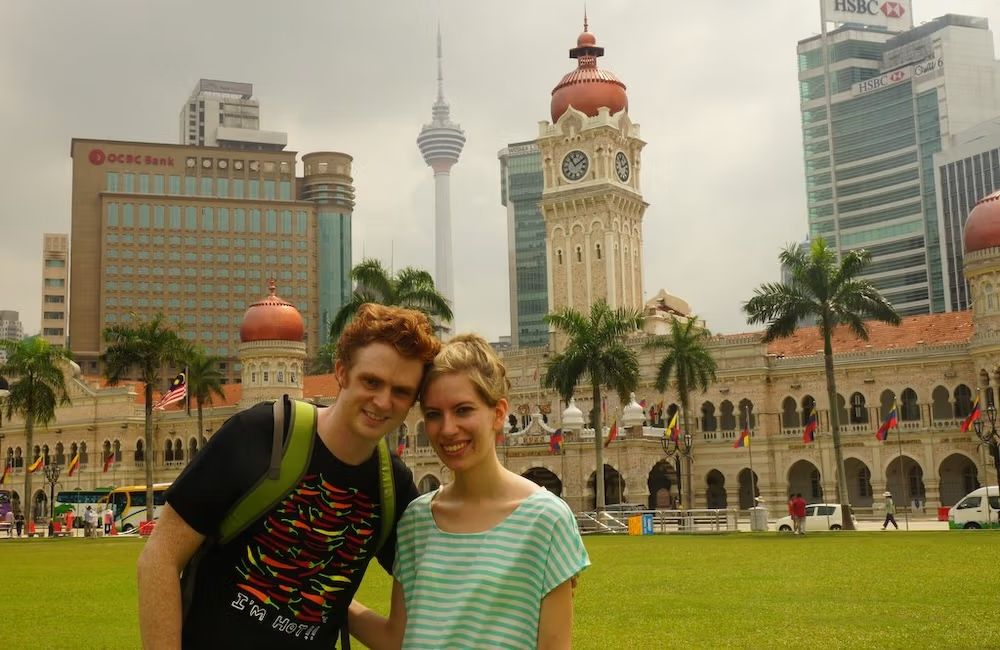
On our first proper day exploring Kuala Lumpur, Audrey and I went to Merdeka Square at exactly the wrong time.
Within roughly half an hour, we were exhausted, dehydrated and dripping with sweat.
Melting, as Audrey put it.
We later became better at visiting outdoor sights early and using nearby museums as strategic air-conditioned refuges. Around Merdeka Square, we moved through museums and galleries partly because they were interesting and partly because the climate outside had become vindictive.
Build slower days. Drink water. Use shade and air conditioning strategically.
There is no prize for heatstroke.
Some Cities Are Not Pleasant to Walk Everywhere
Historic areas may be compact, but larger Malaysian cities can involve wide roads, traffic, disconnected pavements and distances that look much more reasonable on a map than they feel in tropical heat.
I love walking.
I did not love arriving at KL Bird Park already exhausted because we had walked there from Chinatown.
Nor do I love discovering halfway through a supposedly short walk that the pavement has vanished into a drainage ditch.
The Country Is Geographically Fragmented
Peninsular Malaysia and Malaysian Borneo are separated by the South China Sea.
Even within the peninsula, combining west-coast cities, east-coast islands, rainforest and highlands creates more transit than travellers initially expect.
Accommodation Problems Can Derail Smaller Stops
Kuala Lumpur gives you choices. Smaller destinations may not.
When we lost our Cameron Highlands accommodation, the alternatives available to us were far outside what we wanted to pay. We had no elegant backup plan. We simply left.
This is not a reason to avoid the highlands. It is a reason to avoid assuming that every destination has endless last-minute inventory.
The Islands Are Not Immune to Development
Do not assume every Malaysian beach is untouched.
Langkawi is developed, while smaller islands face their own pressures involving waste, reefs, construction and seasonal tourism.
Malaysia may avoid some of the extreme overdevelopment I disliked in places such as Sihanoukville in Cambodia, but no destination remains pristine merely because a brochure uses the word paradise.
Wildlife Is Never Guaranteed
Rehabilitation centres, river trips and rainforest tours can improve your chances of seeing animals, but a wild orangutan, pygmy elephant or clouded leopard does not appear because your spreadsheet says “wildlife morning.”
Treat sightings as privileges rather than deliverables.
Common Malaysia Travel Mistakes
- Only visiting Kuala Lumpur. The capital is worthwhile, but it cannot explain the entire country.
- Treating Melaka as a two-hour photograph stop. Stay overnight and experience the city after many day visitors leave.
- Rushing George Town. Three nights is a far better starting point than one.
- Ignoring the monsoon. “Tropical” does not mean every island works equally well all year. Our own beach plan failed because the season did not cooperate.
- Adding Borneo casually. Sabah or Sarawak can anchor an entire trip and deserve more than leftover days.
- Eating hotel breakfast every morning. This may be the gravest mistake on the list.
- Planning too many regions. Malaysia is easy to travel, but every transfer still consumes time and energy.
- Walking every urban distance out of principle. Sometimes the taxi, train or ride-hailing option is not laziness. It is the only reason you will enjoy the next attraction.
- Assuming underrated means empty. Domestic travellers know their own country. Weekends and holidays can be busy.
- Forgetting religious context. Malaysia is multicultural and majority Muslim. Respect local expectations without turning basic courtesy into theatre.
Frequently Asked Questions
Why do you call Malaysia the most underrated country in Southeast Asia?
Malaysia is not undiscovered, but it receives less enthusiasm than its food, heritage cities, islands, rainforests and cultural variety deserve. Many travellers still treat Kuala Lumpur as a stopover instead of exploring the country properly.
How many days should I spend in Malaysia on a first trip?
Seven days works for a focused Kuala Lumpur, Melaka and George Town route. Ten to fourteen days allows one contrasting addition such as Langkawi, Ipoh or the Cameron Highlands, while three weeks makes a Peninsular Malaysia and Borneo combination more realistic.
What is the best route for a first Malaysia itinerary?
A strong first route is Kuala Lumpur, Melaka and George Town. It combines modern city life, historic trading centres and exceptional food without creating an exhausting chain of flights and long transfers.
Should I visit George Town or Melaka?
Visit both when time allows. George Town is stronger for food, shophouses and several days of urban wandering, while Melaka offers a more compact historic centre and better atmosphere after many day-trippers leave.
When should I visit Malaysia’s east-coast islands?
Plan Perhentian, Redang or Tioman outside the northeast monsoon and verify current ferry and accommodation operations before booking. Rough seas and reduced services can affect east-coast island travel during monsoon months.
Do I need to rent a car in Malaysia?
Not for a classic first route. Intercity buses, ETS trains, domestic flights and ride-hailing cover many common destinations, although a car can be useful for families, rural stops and more flexible regional travel.
Should I include Malaysian Borneo on my first trip?
Include Sabah or Sarawak when you have several dedicated days and a strong interest in wildlife, rainforest, caves or mountains. With only one week, a focused Peninsular Malaysia itinerary is the more sensible choice.
Why I Still Defend Malaysia as Southeast Asia’s Most Underrated Country
Malaysia is not a hidden country waiting for a travel blogger to discover it.
Malaysians already know what they have. Regional travellers arrive in enormous numbers. Kuala Lumpur, Penang and Langkawi are hardly anonymous dots on the map.
But among travellers who habitually place Thailand, Vietnam, Indonesia or Cambodia at the centre of every Southeast Asian plan, Malaysia still receives less enthusiasm than it deserves.
It has two of the region’s most compelling heritage cities. Its multicultural food is exceptional. Its breakfast culture alone could justify a return trip.
It offers islands, highlands, rainforest, wildlife and modern urban life. English and strong transport connections reduce friction without making the country feel generic.
Our own trips were not flawless.
We slept at the airport. We walked too far through Kuala Lumpur. We melted at Merdeka Square. We were thrown out of a hotel in the Cameron Highlands. We failed to reach the beaches. I repeatedly woke Audrey at dawn because I believed dim sum was more important than sleep.
And yet we kept returning.
That is a stronger endorsement than pretending every day unfolded perfectly.
Malaysia improves when you stop treating it as somewhere between Thailand and Singapore.
Give George Town time.
Stay overnight in Melaka.
Eat breakfast outside your hotel.
Take the train when the journey itself appeals to you.
Choose an island according to the monsoon rather than whichever photograph currently has the most turquoise saturation.
Malaysia may not overwhelm you on the first afternoon.
It does something more dangerous.
It quietly becomes one of those countries you keep comparing everywhere else to.
What do you think is the most underrated country to travel in Southeast Asia?
I have been to over 30 countries around the world including almost all of Southeast Asia – and Malaysia is my favourite. Affordable luxury, delicious food, and diverse landscapes. Can’t wait to be back!
Funny how u compared Malaysia being an underrated hot-spot for backpackers to, well, Malaysia, I wonder if u noticed that.
I’m not sure how people get such impression that Malaysia is anything at all underrated which is, statistically, untrue.
All these decades passed, Malaysia has remained as the single most popular powerhouse in terms of tourist arrivals, the numbers don’t lie. Thailand has always been trailing behind only recent year has it come closer to narrowing the gap to be our only biggest competition. Check out the data for verification.
If Malaysia is that underrated, we won’t be getting 38.1 million visitors last year, more than Thailand 35.2 million, or that range.
Singapore may seem to be in everyone’s mind but the fact is, its tourist arrivals are not even half of what Malaysia received, and more than half of the numbers are actually daily excursionists where hundreds & thousands of Malaysians crossing border for work every single day.
It’s also not hard to understand why the route between KL & Singapore has always been one of the busiest in the world in aviation, if not the busiest of all like 2023. KLIA is the 2nd most connected airport in the world especially with it being the single most dominant LCCT that has been not just the major powerhouse but winning best LCCT & best low cost airline, homegrown Air Asia, every year without fail for nearly 2 decades.
Talk about biodiversity, fact is, Malaysia is one of the pioneer 16 mega-diverse countries in the world, a group of nations with the most astounding biodiversity in each of their own setting. And ecotourism has long been one of our most prized & mastered selling points as we probably were one of the very first in the region to venture into promoting & exploring it, showing the world our oldest tropical rainforest with some of the most endemic species such as the Orang Utan with the world. It’s perhaps the only animal that shares the same status & popularity as the Panda Bear due to its uniqueness.
All these strongly justify the very fact is, Malaysia, is after all, not underrated as people might perceive.
Visit us, as 2026 is Visit Malaysia Year!
Well I just arrived here as i am planning to visit malaysia I am a Saudi, I seen the title in which you states malay as under-ratted but I don’t think so my friends already visit it last year and now I am also going to visit.
Well I am reading that you didn’t come to middle east yet, so if you make your mind than must visit my country and must do safari on sand dunes.
I’m a Malaysian. Compared to surrounding SE Asian countries like Thailand, Vietnam, Cambodia, Malaysia is a little bit more expensive but not that much. Was in Vietnam not too long back & prices there has risen too.
You have to know where to eat to get better prices. Obviously tourist traps around KL, Jalan Alor, Chinatown tend to be 10 to 20% more expensive.
There are lots of nice places to visit in Malaysia beyond the West coast of West Malaysia (KL, Penang, Melacca, Langkawi). If your visit is longer, there is the East coast & East Malaysia (Borneo) to check out too.
Don’t compare to the under developed nations, it doesn’t paint the full picture.
U think Thailand is cheap ? Seriously, u need to renew ur understanding. Vietnam is a rip off, don’t be ridiculous. Cambodia literally uses USD, so how cheap could it be when u lose out the currency exchange rate every time???? If u think cheaper is due to the fact that u have hardly anything to do or to buy or to spend on, which translates into u not having to spend as much money during the trip to get the impression of it being affordable & cheap, well, then u got it wrong! Plus, these places target on very cheap tourists, so let’s go figure!lol
My wife and I took a 2 week road trip to Central and Eastern Europe back in March (we love going to place other people don’t go). We went to Hungary, Slovakia, Poland, Czech, Germany, Austria, Italy, Slovenia, Croatia, Bosnia, Serbia, Bulgaria, and Romania. All in all we put over 3000 miles on a rental car and had a blast. I have begun to think about our next adventure and at first I was thinking about Taiwan, but now after seeing many things about Malaysia I am leaning toward that. I am thinking about doing the whole road trip thing again in Malaysia. How would you compare Taiwan to Malaysia?
Malaysia definitely is the most under-rated SE Asia Country but this is where the magic works ! let it be this way. 🙂 you can actually hide yourself here with all the comfort of life ie foods, accomodations, entertainment etc. It is a destination that you are welcome to miss ! lolz..I <3 Malaysia ! Truly Asia.
Please do visit Malaysia Borneo (Sabah & Sarawak). Kuching & Kota Kinabalu is both fascinating Borneo’s cities. Sarawak & Sabah welcome all of you. I guarantee 100% satisfaction to all visitors. Don’t just visit Malacca & Penang. Please visit Malaysia Borneo! You will find another unique experience what is Malaysia all about. Malaysia truly Asia!!!
hi im suraya from malaysia…
not try to be proud bout malaysian ,i knw some of visitors have bad exp here n me also if i found local dun try to help or give wrong direction i will volunteer to help..coz some of them indonesian working here or local who do not speak english well and lazy. im sorry for that.. but for me, i love to approach them if they look lost for humanity reason imagining if i be at the same shoes… so far, i hve few frens from european that i helped before..sometimes bring them to look for food and see klcc at nite… i can say actually malysian people is friendly 🙂 just try to smile to them. here the culture is to smile..if you didnt smile back to the person, it look arrogant 🙂 ya i can say it cheap FOR food and accomodation and transportation.. even it not good enuf like singapore but yeah it will not be same for evry place u been. tht the most valuable thing tht you cant buy from other or other can have yours. 🙂
i love malacca, penang n terengganu n not to forget SABAH and sarawak! 😉
i just wanna know how you guys find the best budget room? im thinking to make small budget house for backpackers. dorm n room. a lot of thing need to think 🙂
HI Suraya,
I grew up in Ipoh and a lot of my Arab friends kept asking me to take them around. The problem is I am not really sure about the good halal food in some state except Penang which I studied there for a year.
Hopefully you can send me some good recommendation of halal food or local kampung food. it would be much appreciated.
Regards
Reuben
Oh I just commented on your You Tube that KL was underrated ! I liked it for so many reasons one of which is I didn’t see any drunken boorish Aussies their , I do believe on my limited time their it attracts a different type of traveller , much of the tourists are from it’s near by neighbours !
Yes, Malaysia is under-rated, especially when it comes to the choices of food and the affordability.
It’s where you could get Singaporean kind of luxury at Indonesian kind of price, and you could meet the whole Asian races in under one country.
“Although Malaysia has so much to offer it’s not nearly as popular for backpackers or travelers as countries such as Thailand, Malaysia or the region of Indochina.”
Huh? So Malaysia isn’t nearly as popular as… itself? OK whatever. Malaysia is a cool country, I lived there for a couple of years and enjoyed it. The racist and corrupt government can get annoying, but as a tourist you wouldn’t really be exposed to all that.
I’m curious, seeing how you’ve admittedly never traveled in Africa, Europe, or Central America, how you would know you’d choose SE Asia to travel in the rest of your life? I know you want to portray yourself as this seasoned, intrepid traveler, but really if you’ve never set foot in sub-Saharan Africa, you aren’t. 😉 SE Asia, (Vietnam and Thailand in particular) are popular with drunks, pedophiles, and package tourists, but tourism has been pretty well-established at this point and it’s getting increasingly difficult to get away from the hordes of mainland Chinese being shuttled about.
Have you been to Myanmar? That’s been on my list for a while.
No doubt South East Asia has a lot to offer when it comes to tourism. The food, the lifestyle and attractions are unique. I have traveled to a few South East Asian countries like Malaysia and Singapore and have learnt a lot in the process of traveling.
Samuel, since you love Malaysia (my home country), couldn’t help suggest you find a local girl who loves travelling as much as you do to marry and you can be sure for a good reason to visit regularly lol! One of non-Muslim descent to avoid having to speak Malay…you have to approach them first as Malaysian gals are generally shy but they actually love knowing expats.
thank you for your blog. Malaysia is really a cheap country for visitors to visit as though it is a cheap country but there are many happening and good tourist place to visit in malaysia like Kuala Lumpur,Kelantan, Malacca and many others to spend good time there.
My friend lives in Malaysia and loves it! I can’t wait to visit!
Why Malaysia? It has more foreign visitors than Indonesia has, and Indonesia has so much more. It’s just shy of broadcasting itself to the world, and the Western press gives too much bad rep to Indonesia.
Sawahlunto turned from a ghost town into a mining tourism city in 4-5 years.
Padang has its equivalent of Big Ben (Jam Gadang Bukittinggi).
Surabaya has the DBL Arena for basketball lovers and various other historical sights.
Makassar has Losari Beach and, to me, Sultan Hassanudin Airport is comparable to Hong Kong International Airport.
Also check out Bandung, Manado, Jayapura, Jakarta (goes without saying), Medan, Palembang (cross the Ampera Bridge over Musi River), and Aceh (I think the 8-9 years of rebuilding has transformed it into a good location to visit).
Hi gregory from Israel… i feel bad to know that you have an interest to visit my country. But yes, we do not have any diplomatic ties with Israel. It is hard for Malaysian to travel to your country as well.
Thanks to the nomadicsamuel for posting this journal. Guess what? I will be leaving to Malacca too this weekend with my bunch of friends.. and it is only 2 hours away from Kuala Lumpur 😉
I hope those who come over to Malaysia, will experience the most what we have to offer.. forget not the east Malaysia ( Borneo ) where Sarawak and Sabah. There have more ethnic and and very interesting culture. Sabah will be the top spot for divers. 🙂
Good luck to travellers and enjoy your stay
I think Myanmar/Burma is probably the most underrated as a tourist destination. It seems more exotic and interesting than Thailand. I’ve seen a map of it, and it looks like it has literally hundreds of islands off the Southwest coast.
Hello,Im sitting in bed on a saturday morning in Cape Town, surrounded by my 2 kids and husband as we make plans for our december trip overseas.I had goosebumps as I read your article to the family.We too love southeast asia and have been to kuching ,penang ,langkawi and kl in malaysia. Our most recent trip took us too khao lak in thailand .We too cant think of any other place in the world we would rather travel too !!! We would love to visit Cambodia but I would not like to give my kids malaria tabs right now.
actually malaysia is second to china in the entire asia that has the most tourist arrivals.it may not be a backpacker’s favorite but there are many other types of tourists that visit malaysia.by the way is there something that can be done with your videos coz i cant access them using an android phone.
I am unfortunately guilty of skipping Malaysia on my Southeast Asia trip. I’m dying to get back to the region though and will definitely include it next time! Sounds great!
That’s great Britany, there are still countries I’ve yet to visit in SE Asia as well. So much to see and do in the region 🙂
Quality of hotel rooms in Malayasia is very low for the money, relative to Thailand, Cambodia, and Vietnam. KL and George Town can be quite grubby.
Tourist spots can be very expensive – 80 Ringgit ($27) to take a tour of the Petronas Towers.
Food, though inexpensive and tasty, is not prepared at the same standards of cleanliness as most other Asian countres. Be prepared to suffer the runs if you eat street food. It is also not uncommon to buy water or get water in hotels that has been put into bottles that have already been used – i.e., the seal is broken.
I’ve traveled all over the world to all continents and to all countries in SE Asia and Malaysia is one of the few countries I would never go back to.
Being a Singaporean, I live super close to Malaysia and have travelled there a few times. You’re right, it’s definitely underrated. My work takes me to Kuala Lumpur pretty often where I stay at one of the serviced apartments there, Fraser Place KL. Whenever I have the time, I’ll go wandering and exploring the city. The food is awesome and cheap as well!
I’m indonesian & i love my country.. 🙂
Too bad i’m not yet explore whole my country.. since i stay in Europe now.. too many places & islands to explore,, I miss the foods, beaches, mountain and suuunnn…. :p
YES to Malaysia being under-rated! I’ve got a lot of friends heading off to southeast Asia and, without exception, not a SINGLE one of them has Malaysia on their itinerary. I have no IDEA why, especially as it’s the AirAsia hub and SO easy to get to – and cheap, too! Maybe not as cheap as Thailand or Cambodia, but a lot cheaper than Singapore. I love the food there, the people are incredibly friendly, and it’s so beautiful. People need to stop skipping out on it!
You know what, Samuel? I am similar to you in that I have traveled (and plan to extensively travel) to Central/South America. I would love to be a super world traveler, but my heart’s desire is to really explore the countries within these two regions.
I say, live it up in South East Asia, man! You’ve found your joy- stick with it.
I agree! I had been to Kuala Lumpur in 2008 and itches to go back and explore more. this is what I also see of Malaysia and felt it when I was there. 🙂
I agree with all of it (except the breakfast thing maybe.. I have different tastes concerning breakfast 😉 ). I also loved Melaka and the Highlands. I stayed for four days each.. which still is not much.. but it’s more than most of the other travelers did which I found curious. Of course the highlights are not many, but the places itself are true highlights!
I also enjoyed being able to communicate in English. I can do that in Thailand too but then only with people who work in tourism and even with them it’s harder.
I definitely will recommend Malaysia to anyone who asks me where they should go in Asia.
Sad I missed Malaysia, it will give me a reason to go back to SE Asia. Laos is such an underrated country, I think that’s my favorite.
Greetings from Borneo NomadicSamuel.
Have you explored Borneo? Two Malaysian states- Sarawak and Sabah on the island of Borneo are the most underrated places.
To witness real diversity, Sarawak and Sabah are the best provider. There are more than 20 indigenous groups. Not just Indian, Chinese and Malay.
I am a Malaysian but I describe myself as a Kadazan, a Sabahan and a Bornean.
Borneo is where the real adventure is at (:
I’m so with you on this, but I think I’d just change no.4 from breakfast to every meal!
Hi Samuel, I am strongly agreed with you regarding the Thailand , it is simply one of the easiest place to live and another place where I find the similar comfort is India and China. Though earlier years , the usage of English language was not frequent in China but now the situation is quite changed.
I love Malaysia! And I agree that it is very underrated; Malaysian food is wicked, the people are nice and there is so much to see and do. My favourite place in SE Asia, though, still has to be Cambodia.
Would love to go there. I heard many good things about the country, but also some bad comments – but fewer than the good ones. I will go there one day, I’m sure of it!
Hope you’ll get a chance to visit soon Jo!
Yes yes yes! I couldn’t agree more with this post! I absolutely loved Malaysia during my time there, even though we only got to stay in Penang and KL and pass through the Cameron Highlands. In hindsight I’m really disappointed with friends/acquaintances of mine who’ve done the standard S.E. Asia trip, yet just seemed to pass Malaysia by.
I’m definitely heading back at some point, so much more to see! Mind you I’d go back just for Penang, as Georgetown is one of the most photogenic places you could hope to come across!
Ahhh I miss it!
I totally agree with you Carl. I wish I could wake-up in George Town tomorrow. There are few cities I enjoy wandering around in more than there.
Hey, if you love something why change things? I wish I could get out there and see more things too, like this Malaysia you speak of lol. Glad it’s all good!
Hope you’ll get a chance soon Margyle!
While I absolutely loved Laos and Cambodia, I can’t say the same about Malaysia, but then again I only saw Kuala Lumpur and Langkawi. And compared to KL, I think I’d take any other capital in SE Asia… but there is more to see in Malyasia, so maybe I’ll give it another change next time.
Hey Jarmo,
I can understand where you’re coming from in relation to KL. I like Bangkok and Phnom Penh more. I think it’s the smaller cultural hubs that are really worth exploring in the country.
Really? You’d take Jakarta or Manila over KL? It makes me wonder how you spent your time in KL if you feel that way. I will say that public transportation is lacking in KL compared to, say, HK or Singapore. But it is well ahead of Jakarta and Manila in that respect and I personally enjoy it more than Bangkok. Someone once described Malaysia as a more “mature vintage” and I’m inclined to agree. The blend of Malay, Chinese, and Tamil culture with Islamic influences, all under the legacy of British Colonialism is pretty unique. While KL may not have the exotic sense of “other” like you find in Cambodia or Vietnam, it is a far better place to live, and offers a wealth of activities, and Bangkok, Hanoi, et al are close at hand in any case. Moreover KL has got to be one of the greatest food cities in the world. Better to have a local to show you around though!
Not goina lie… I usually forget about Malaysia! Stupid Hogga…
LOL, no worries, I’m sure it’ll forgive you 🙂
I have been to Malaysia once, but it was a business trip so I did not get enough time to move around. It seems I’ll be heading back for a tour there.
Glad you’ll get another chance to experience it!
Argh now you’re making me regret having never been to SE Asia. I think you can find underrated areas in every country. When I spent a summer in Japan I made a habit of taking the train to a random destination and walking as far as I could go (as in miles away), away from the tourists. It turned out great and I got to experience a little piece of life not many tourists get to see.
That’s a great idea Craig! Sometimes I think it is best to just throw the map or guidebook away (or leave it behind for a day :P) and just explore randomly. Some of my best travel experiences have been doing it that style.
This is a fantastic post. I have never been to southeast Asia before but this post has so much energy around the region that it makes me want to take a trip here! I’ve only ever been to Europe and although I’ve always had a good time, there’s something about Asia that intrigues me and screams unique.
If you get a chance to visit SE Asia I would suggest you pounce on it! 🙂
I really want to visit Malaysia. Thanks for making that desire even more acute.
I think you’d love it Ted considering how much you enjoyed Thailand. Lot’s of adventures (or should I say misadventures) for a guy like you to enjoy 😛
Perfect! I’ve been thinking about where to spend go for a visa run during my upcoming five weeks in and out of Bangkok. I’ve seen some great stories about George Town (http://www.soultravelers3.com/2012/08/where-to-buy-organic-food-in-penang.html) and it’s been high on my list.
But, wow, when I looked at the visa requirements, guess what? Israeli citizens are not allowed in! So much for the celebrated multi-culturalism of Malaysia. 🙁
That’s too bad Gregory. I certainly don’t agree with that policy 🙁
I’ve only traveled a little bit in Malaysia, but I’ve loved what I’ve seen and can’t wait to travel more. Personally, I think the most underrated country is Indonesia. Everyone seems to do Thailand and Vietnam, but people skip Indonesia (or just visit Bali and consider themselves done with the place).
I grew up in Indo and I LOVE it there! I could honestly spend the rest of my life just exploring the wondrous Indonesian islands. Lucky for me, if I ever get bored there, Malaysia is just around the corner 😉
I agree with you that Indonesia is definitely under-rated. I’m really looking forward to exploring more next year. I’d love to go to Sumatra!
Never heard of Melaka — thanks for the tip, will keep it in mind when I finally make it to SE Asia 😀
– Maria Alexandra
It’s one of my favorite spots Maria! Definitely worth checking out 🙂
I cannot agree more. I’m in Malaysia now for about 11 days and was only suppose to stay for about three to do a visa run and go back to Thailand. Our visa run was to Langkawi, which during low season felt like the perfect backpacker destination. It’s not so busy that it feels over run, but is busy enough to be fun. We stayed there for ten days haha. After that we should have just started heading back to Thailand, but we fell so in love with Malaysia food, culture and people, that we just had to see more. In KL now and I can’t get over the mix of modern and old, concrete and jungle. Truly amazing place to visit. I feel bad about overlooking it on previous trips.
That’s a cool story Bobbi. I love when a country pleasantly surprises and you end up staying longer than you would have ever anticipated.
“Although Malaysia has so much to offer it’s not nearly as popular for backpackers or travelers as countries such as Thailand, Malaysia or Indochina.” think you got messed up on that part 😉
He prob meant to say Cambodia/Vietnam region. Maybe taking “as countries” out would have helped. Typo? ;P
LOL, I did mess up. Thanks for the heads up.
I have never been to Malaysia. It certainly sounds very tempting!!
I think you’d enjoy it Arti 🙂
My vote goes to Poland. Cheap and awesome.
I’d love to visit Poland soon. Eastern Europe is more appealing to me than Western Europe.
I completely agree! It was one of the standout countries on my 8-month backpacking trip, and frankly was a breath of fresh air after Thailand. There’s so much to love about the country, from the food, the people and the culture. It’s modern, easy to get around, clean, and yet still maintains some of the cheap prices Southeast Asia is known for. I’d go back in a heartbeat!
I agree with you Arienne. It’s a little more expensive than some other nearby countries but overall it still offers tremendous value.
I’ve heard nothing but amazing [and expensive] things about Malaysia and I’d totally visit in a heart beat. I think the Philippines is one of the most underrated countries in SE Asia. People always talk and blog about Thailand, Cambodia, or Laos, and even Vietnam but only a handful of those about the Philippines.
I’m really looking forward to visiting the Philippines next year! Another under-rated SE Asian country I’ve yet to visit 🙂
So the cuisine is a mixture of dim sum and Indian food? Say no more!!
🙂 I feel the same way!
I think NZ often gets overlooked because it sits next to a Australia. Lots of people when they make their journey down under only spend a couple of days in NZ mainly in Auckland and then spend more time time in Oz, which I think is a big mistake. There is so much to see and do in NZ. Plus, the scenery is just so breathtaking.
If I had to choose between visiting Australia or New Zealand for the first time I would go with NZ 🙂
Samuel, what a great post! We’ve been to every country in SE Asia (apart from East Timor) and would agree that Malaysia is truly over-rated. KL is one of our favourite cities in the world, the beaches are stunning (did you check out Kapas Island?) the people are so welcoming and the value for money is great here. Oh, and the food is amazing.
I completely agree with the above comments: Indonesia and Sri Lanka are highly under-rated – awesome locals, great food, beautiful jungles & beaches, cheap travel and you can easily get off the beaten path…basically, they’re perfect budget backpacker destinations!
Cheers for the article. Safe Travels.
Thanks Dariece,
Indonesia & Sri Lanka are places I want to spend a lot of time in next year 🙂
I think Sri Lanka (in South Asia) is one of the under-rated countries to visit. It’s so close to India yet many who travel to India don’t make it to this island. Anyway, I will be going to Malaysia next month so looking forward to experience at least some of these (specially the breakfast, which looks really good) first hand.
I’m planning on going to Sri Lanka next year! From what I’ve heard from family and friends I think I’m going to love it 🙂
I couldn’t agree more with your 5 point list. I could easily add another 20 points to it when I think about it. I would definitely add diving (Malaysia has many awesome diving spots), jungle trekking (besides Taman Negara there are so many other national parks), the cheap domestic transport, ranging from flights, trains to buses and rental cars….and not to forget the great shopping possibilities in KL and numerous other bigger cities.
I also think you are right with Malaysia being underrated, even though it has quite the amount of inbound travelers compared to many other SE Asian countries (though this is mainly because of all those millions of Singaporeans that visit the country each year). I have to admit that many backpackers often think Malaysia is mainly an expensive country, probably because of its wealth compared to many neighboring countries. Others describe Malaysia as the perfect 1st time Asian country, mainly for the fact that everybody speaks English, and because it’s quite developed compared to many neighbors.
Anyway, I love the country and with both my popular sites Wonderful Malaysia and Veelzijdig Maleisie (Dutch) I am already promoting it for well over 10 years.
Cheers,
Ilya
That’s awesome Ilya! I certainly did cut it short. To be honest there are plenty of things for me to still do in Malaysia and I can’t wait until I get back next spring to try them out.
P.S. I would probably agree with you on Europe, but what about the Baltic Countries? Don’t pass up South America or for that matter Mexico, it’s intriguing.
I’d love to visit the Baltic countries! I’m thinking a trip through the Americas (South, Central & North) is planned for 2014.
Cambodia stole my heart. The people – the food – history – scenery. Knowing their rich history, surviving Pol Pot. I was told their was not a person I met that had not been touched by a death of a loved one or relative. Their life is still so hard, but their zest for life, hard working, such lovely people. I truly will say no question Cambodia. Interesting your take on Malaka it was O.K. in my book, I felt uncomfortable the entire time I was in Kuala Lumpur, never made it to Penang but so wanted to. Deseree Beach I enjoyed but would never go back. I enjoyed Lankowi (sp) but over all Malaysia unnerved me. Last time I was there 2009. My second favorite country was Indonesia. Loved the people and the jest for life they had. Must say I had a ball in Singapore, spent months there. Still love reading your travel stories – and I so agree with you, I fell in love with S.E. Asia, so much to see and experience. Safe travels.
Thanks Martie,
I found myself falling for Cambodia on my last journey as well. It’s incredible how kind and gentle the people are considering their tragic recent past.
I’m curious to understand more about why Malaysia unnerved you? The muslim cultural influences? I found the cultural diversity and absence of a dominant bar/alcohol culture refreshing.
I am curious too. I am Malaysian and a Muslim. Here in Malaysia we do not have terrorist that use our Muslim identity to attack you. No worries guys, our country are peaceful and harmonious .Thank you Samuel for promoting Malaysia, if you come back be sure to send me email and I will suggest another interesting location and food for you. I agree with Gabriel, Malaysia is refreshing.
Assalama alikum,I am from Canada.I wana visit your country.If you dont mind,let me know ,how the expenses for two month stay in your country.if you dont,let me know.thanks,take care talk to you soon.
I didn’t make it to Malaysia when I was in SE Asia – I’ll make sure to put it on my list next time! I absolutely loved SE Asia (and that comes from someone who has stepped foot in Europe, Africa, Australia, etc., etc…). Leaving SE was so tough, and I miss it so much! That food looks delish!
All of SE Asia is fantastic. There are places I’ve yet to visit, such as the Philippines & Burma that are high on my list for next time.
I think you should try to visit Malaysia Borneo (the states of Sabah & Sarawak). Maybe foreign tourists doesn’t know about Malaysia’s Borneo. It’s divided by South China Sea, Malaysia Borneo is Christians (indigenous/aborigin) by majority. Foreigners only visit the Peninsular Malaysia in Mainland Asia. Believe me, Malaysia Borneo offers something that really unique, adventurous, really nature & paradise jungle. There are Niah Cave, Mulu Cave, Logan Bunut National Park, Lambir National Park, Bario Highlands, Kundasang Highlands, Mount Kinabalu (highest mountain in SEA). Malaysians Borneo are diversed in languages, cultures, religions & ethnics. Must visit!!!
Nomadic Samuel, I love your photos and enthusiasm. I am also a SE Asia junkie. I think Indonesia is my pick for under-rated country. Several or even many of my fellow Americans think all of Indonesia is Bali. While I love Bali, I also cannot wait to go back to Komodo and Kalimantan and top of my list for new places is Sulawesi.
Thanks for the great read.
Lisa
Indonesia is definitely under-rated. I’m really keen on exploring Sumatra 🙂