
Bangkok is infamously regarded as a whirlpool of a city that chaotically sucks up anything in its path. I absolutely love the gritty aspect this city has to offer.
Anybody who has spent significant time roaming about the streets and back alleys likely would have noticed a few furry little feline friends wandering around Bangkok, which is simply littered with cats.
Some are cared for, adored and exalted at a level often only seen in certain cultures; yet many are feral and left to scrounge for leftover scraps, dodging human activity and a plethora of vehicles whizzing on by. It’s survival of the fittest for the ones left to fend for themselves.
I’m personally a sucker for cats and I hold a soft spot for them. They’re also one of my favourite subjects for photography—whether they’re leaping and bounding for scraps of food or comfortably stretched out in the sun, dozing off in a state of bliss.
The following is a photo essay of the cats of Bangkok:
Photos of the Cats of Bangkok, Thailand
The cats kept drawing my attention toward the parts of Bangkok I already loved photographing: cluttered markets, plastic tables, back alleys, food stalls and small moments unfolding without preparation. At street level, the city could be frantic, noisy and unforgiving. The cats somehow existed within all of that commotion while also appearing completely detached from it.
Some watched me suspiciously. Others barely bothered opening their eyes. A few looked healthy enough to have a regular caretaker nearby, while others clearly depended on whatever scraps they could find. Together, they offered a revealing little portrait of Bangkok—funny in one frame, uncomfortable in the next, and never quite as simple as “here’s a cute cat.”
The Moment a Cat Notices the Camera

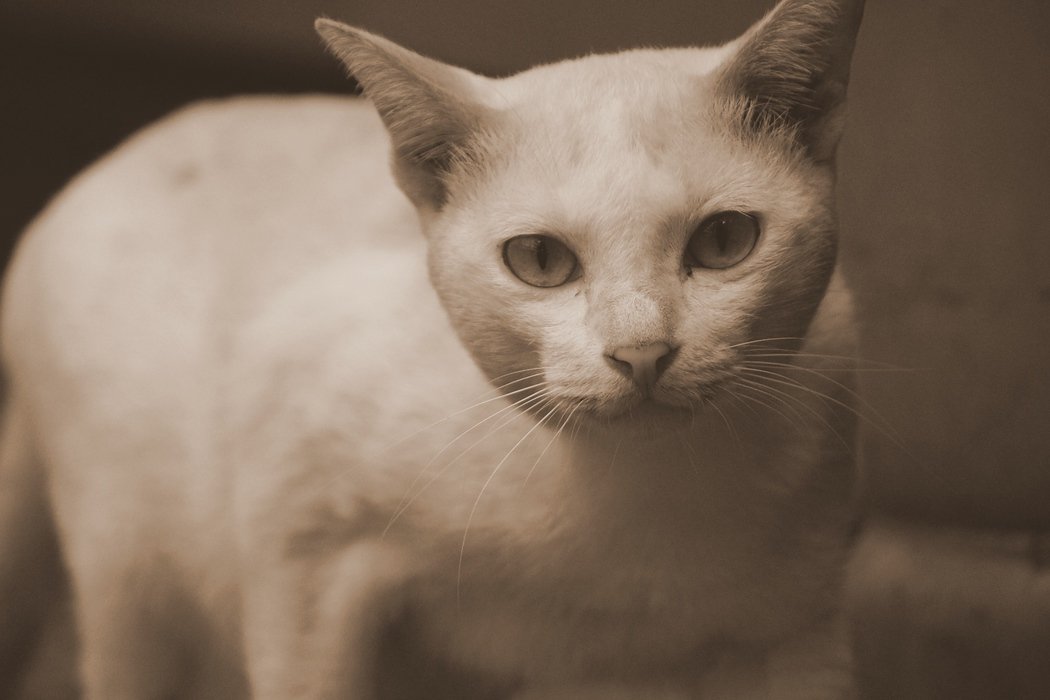
I love candid shots of people and that extends to animals as well. Here I’ve captured this skittish cat just as it notices me.
A closer-up shot of the same cat looking a lot more relaxed in its demeanour.
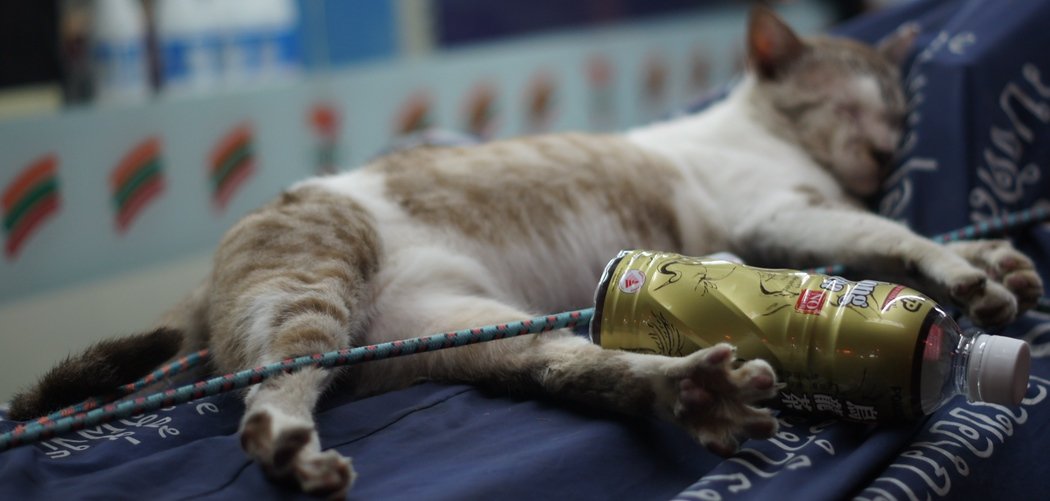
I often envy how comfortable cats look when they’re resting or sleeping. This cat is completely stretched out on top of a table.
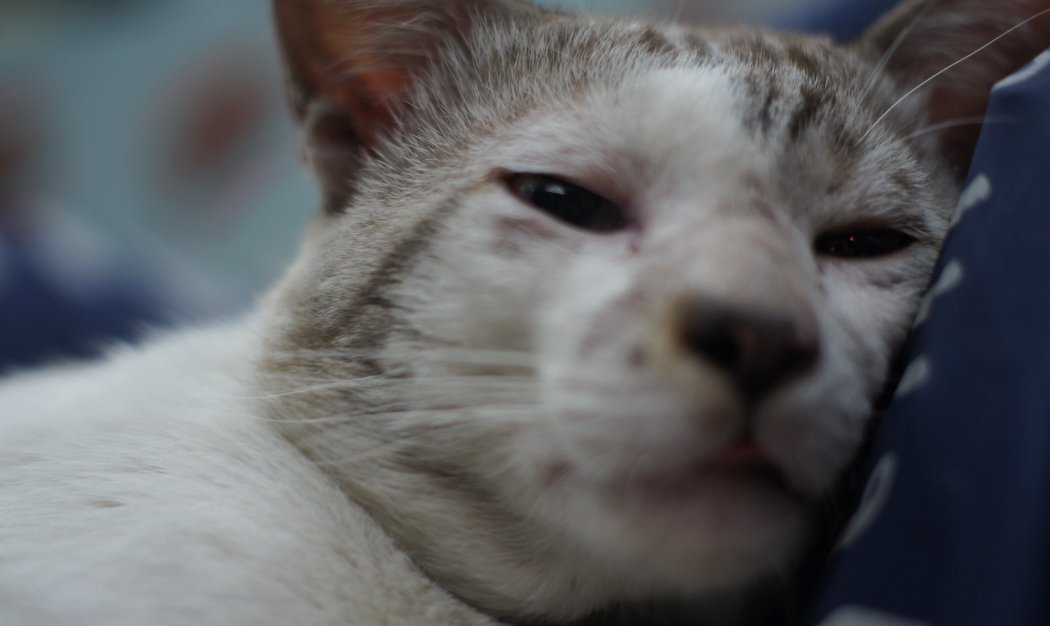
This is a close-up shot of the cat from the previous photo. Did I wake you? Sorry, you can go back to sleep now 🙂
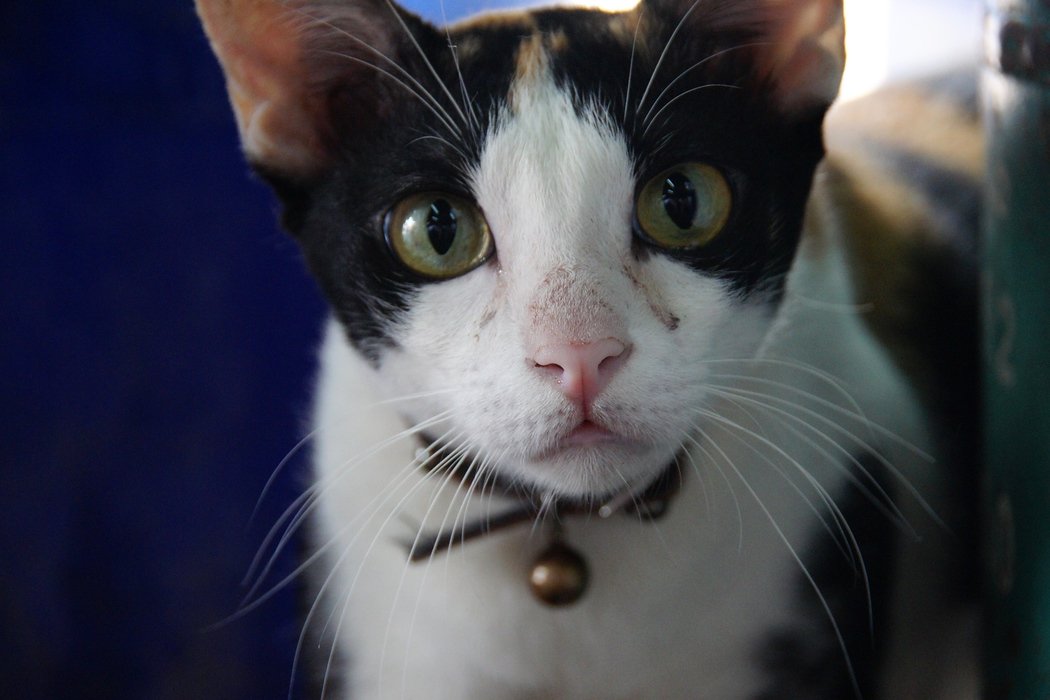
A close-up shot of a well-cared-for domestic cat with big eyes and an inquisitive-looking face—Bangkok, Thailand.
The first two photographs form a small sequence I particularly like. The cat initially looks startled and ready to disappear, but appears noticeably more relaxed in the second frame. I sometimes think photographers overcomplicate these moments. You do not always need better equipment, a clever technique or a pocket full of treats. Occasionally, you just need to stop advancing like an enthusiastic lunatic and give the animal a minute.
Cats Working the Market
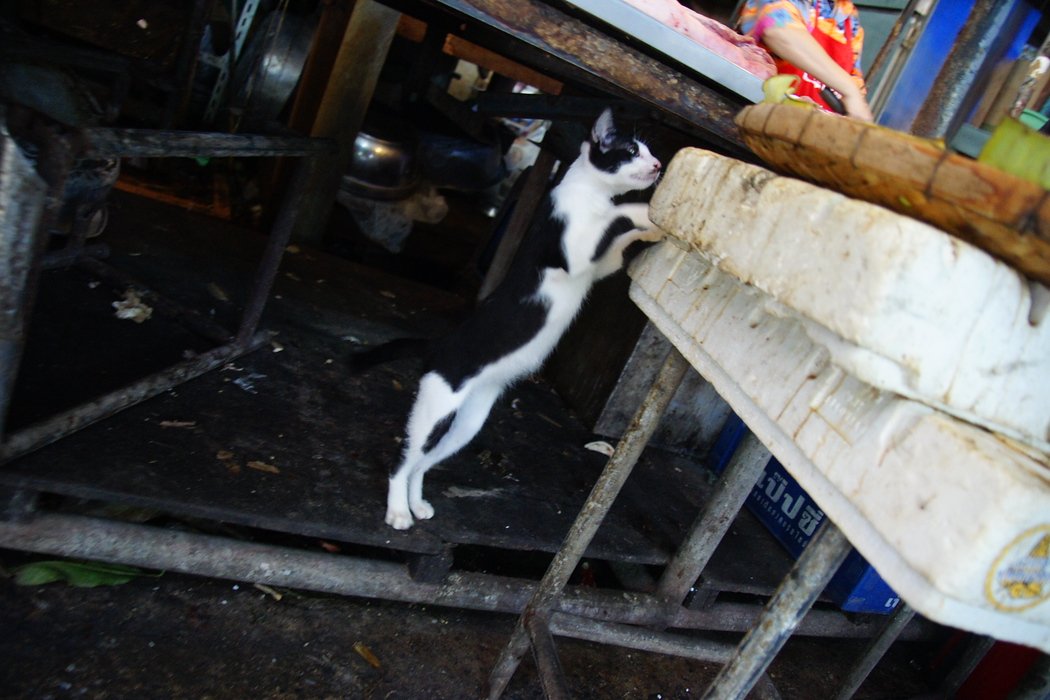
I think I smell fish! 😛
This kitty is enjoying an opportunistic moment to grab some fish while they’re being left unattended by a shop owner at a local market—Bangkok, Thailand.
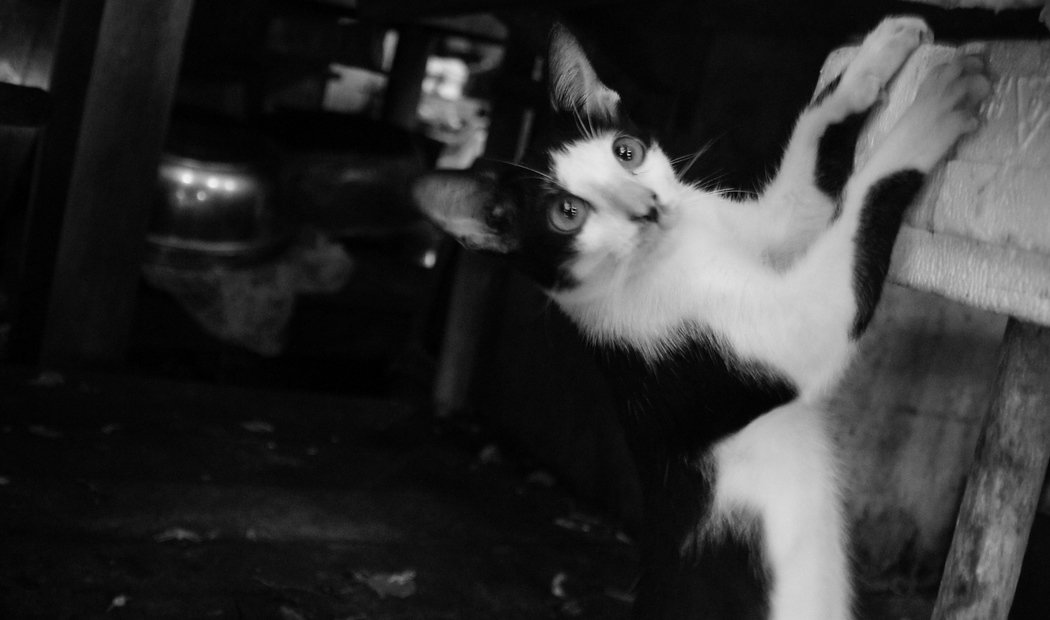
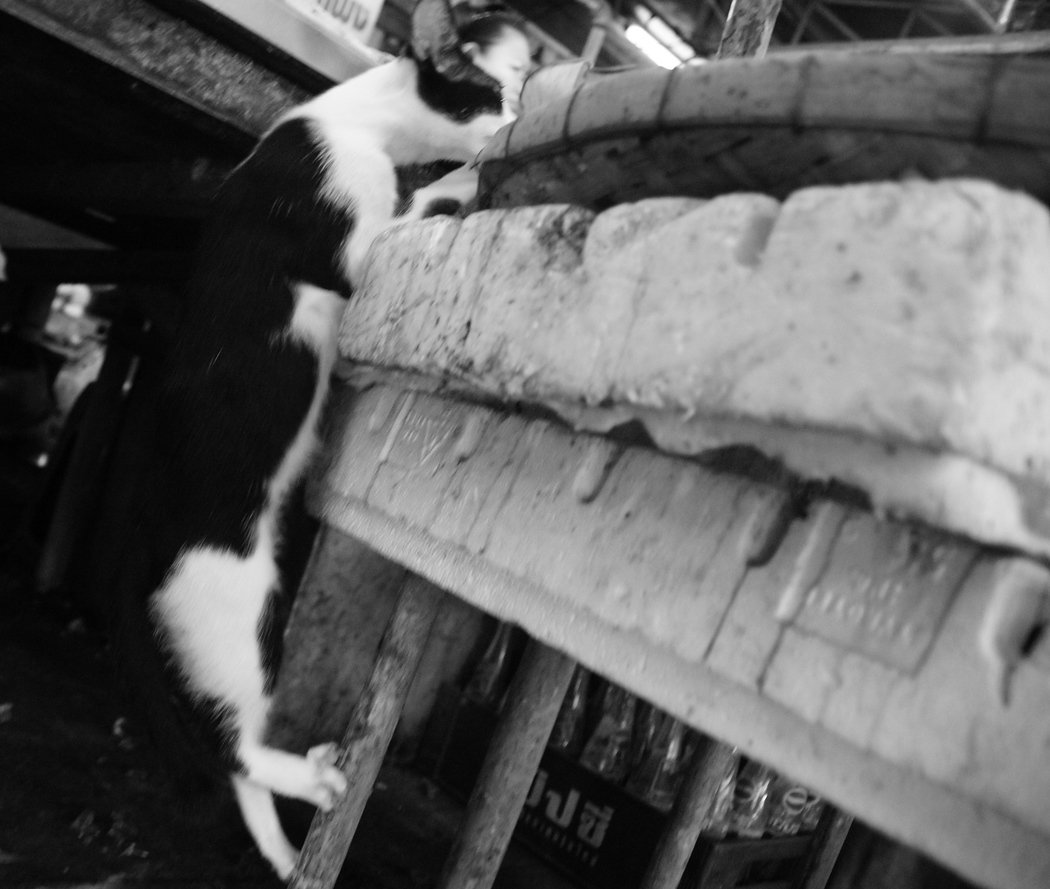
A black-and-white shot of the same kitty losing its grip as it slides back down.
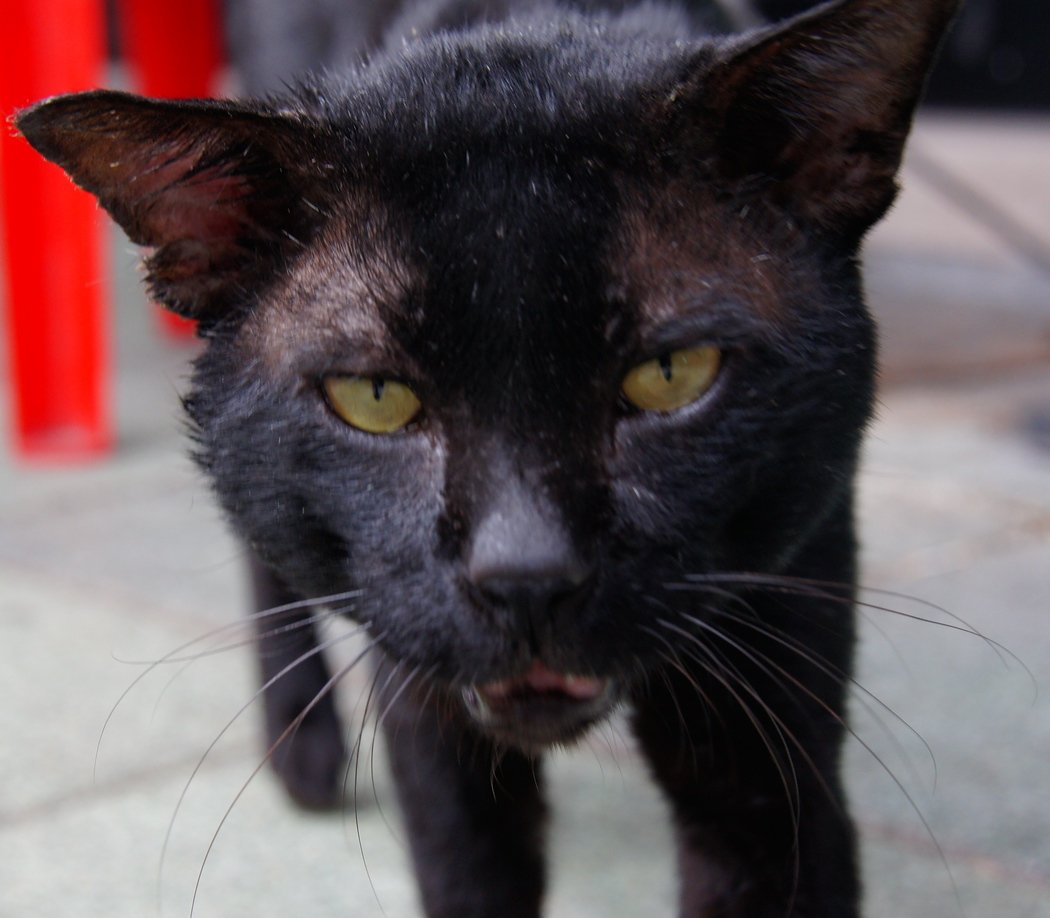
This street cat wonders if I have a nice can of tuna in my hand. I’m sorry. I’ve got nothing but my camera.
The market photographs contain the most obvious little story in this collection. A cat notices the fish, attempts an opportunistic raid, loses its grip and slides back down. There is ambition, execution and immediate failure. I can relate.
No elaborate setup was required. Bangkok’s markets already supplied the smells, movement, clutter and unpredictability. Wet markets and food stalls are natural places for cats to investigate because food is handled constantly and small scraps inevitably appear. They are also among Bangkok’s most interesting environments for observing everyday life.
Food has always been one of the best ways into the city, whether I was photographing market cats plotting petty theft or learning more about the country’s dishes through my guide to Thai cuisine with Mark Wiens.
Bangkok’s Professional Nappers
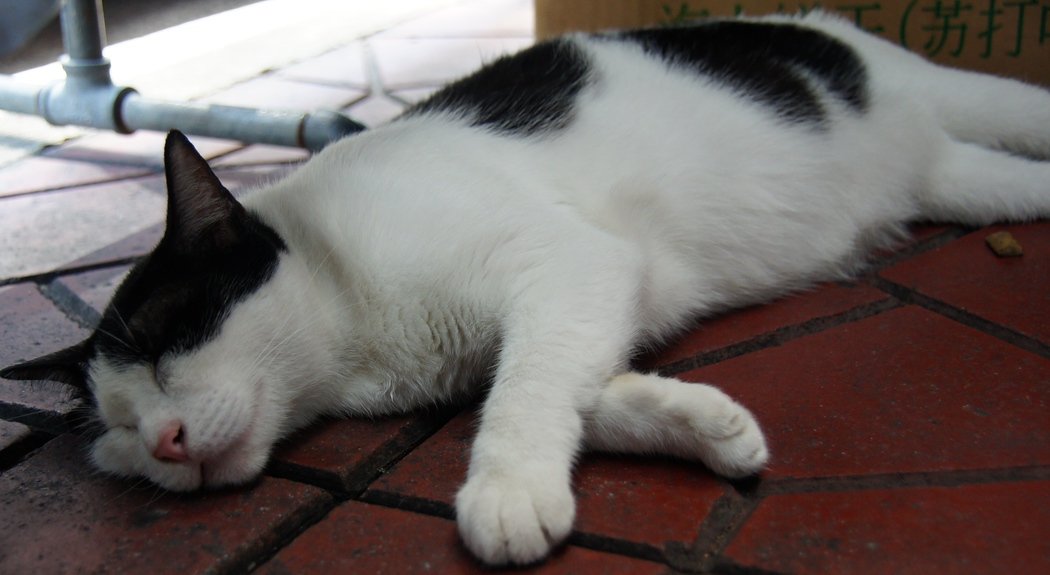
This cat is blissfully asleep on the ground under a table.
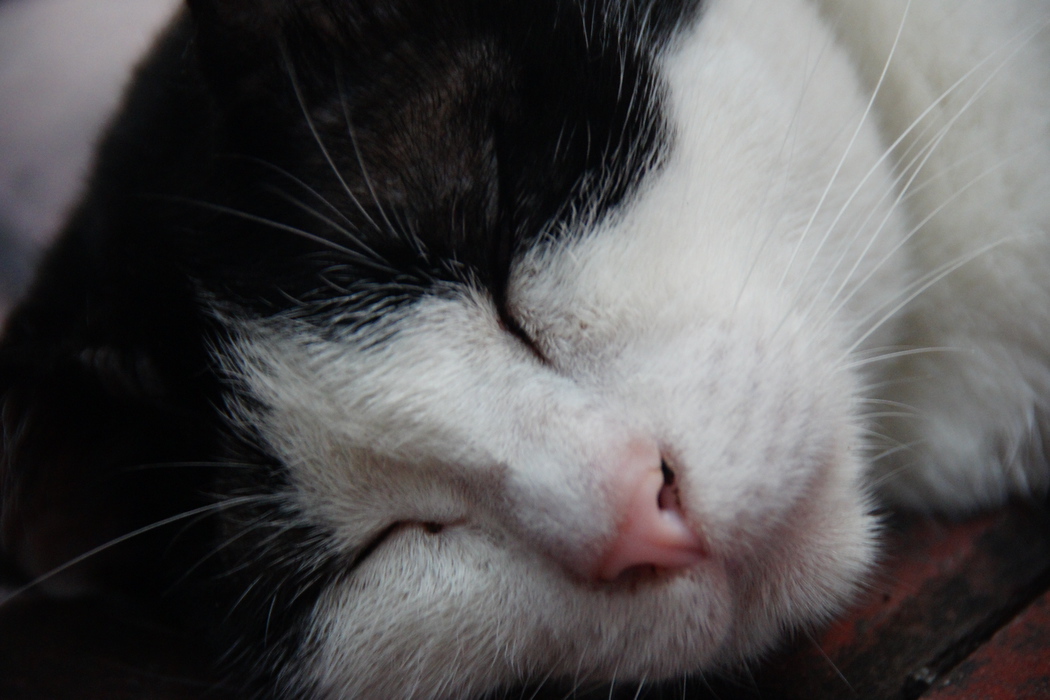
A close-up shot of its face.
Bangkok has never struck me as an easy city in which to relax. The heat, traffic, people and constant sensory overload can wear you down quickly. Cats appear to have solved this problem more effectively than humans.
They locate a table, chair, ledge or shaded patch of concrete and sleep as though the surrounding city has been muted. Meanwhile, the overheated traveller is several iced coffees deep and still wondering why the shirt clinging to his back somehow weighs five kilograms.
The Harder Side of Street Life
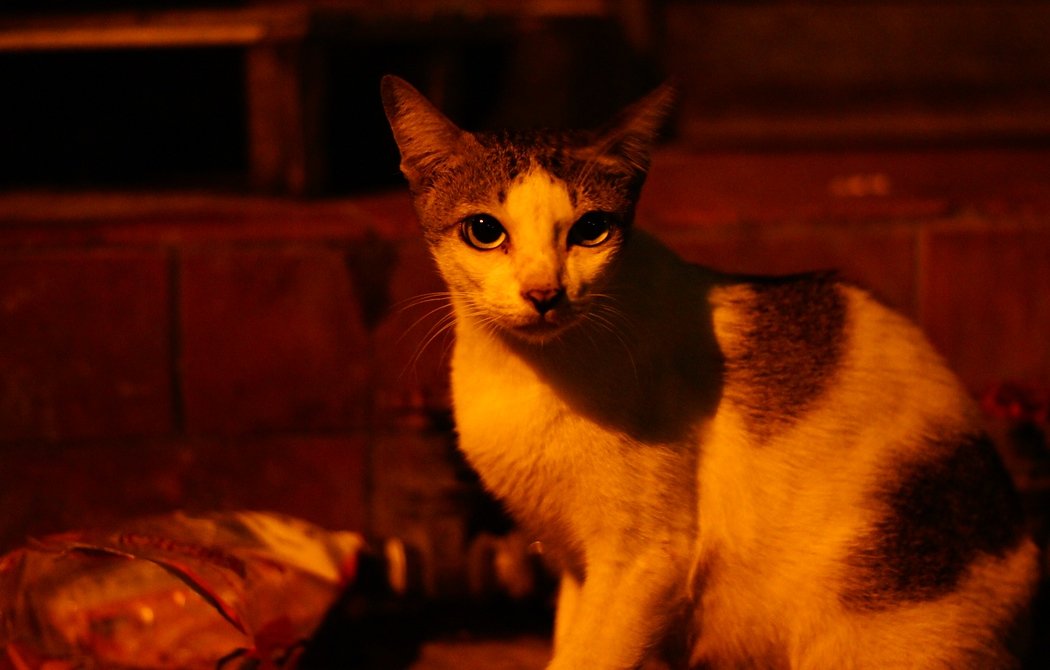
Late at night, this cat with lovely eyes takes a moment to pose for me before scrounging in the plastic bag for leftover scraps of food—Bangkok, Thailand.
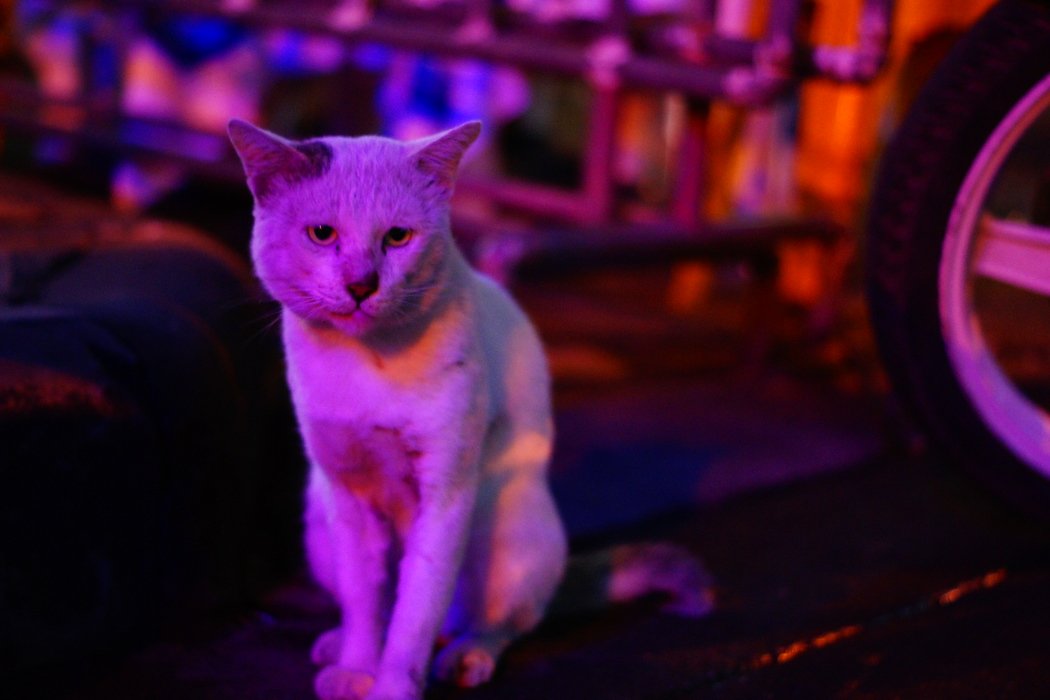
This is an example of a mangy-looking feral cat on the streets of Khao San Road. You can tell from its coat of fur and lanky frame that it just barely gets by day to day.
This is where the idea of Bangkok’s cats as charming urban characters starts to become uncomfortable. I am probably more susceptible than most people to romanticizing a cat stretched across a restaurant table. The camera loves the scene. That does not mean street life is kind.
A cat sleeping on a table may be fed and watched over by people nearby. A thin animal searching through plastic bags late at night may have no reliable source of food, shelter or medical care at all. Both can appear under the broad label of “street cat,” but their circumstances may be completely different.
A photograph cannot reveal a cat’s complete history. I could not know whether every animal had an owner, whether a shopkeeper regularly fed it or whether it had recently been abandoned. What the photographs can show is the visible contrast. Some of these cats appeared comfortable in their surroundings. Others looked as though street life was taking a serious toll.
Cats Claiming Bangkok’s Shared Spaces
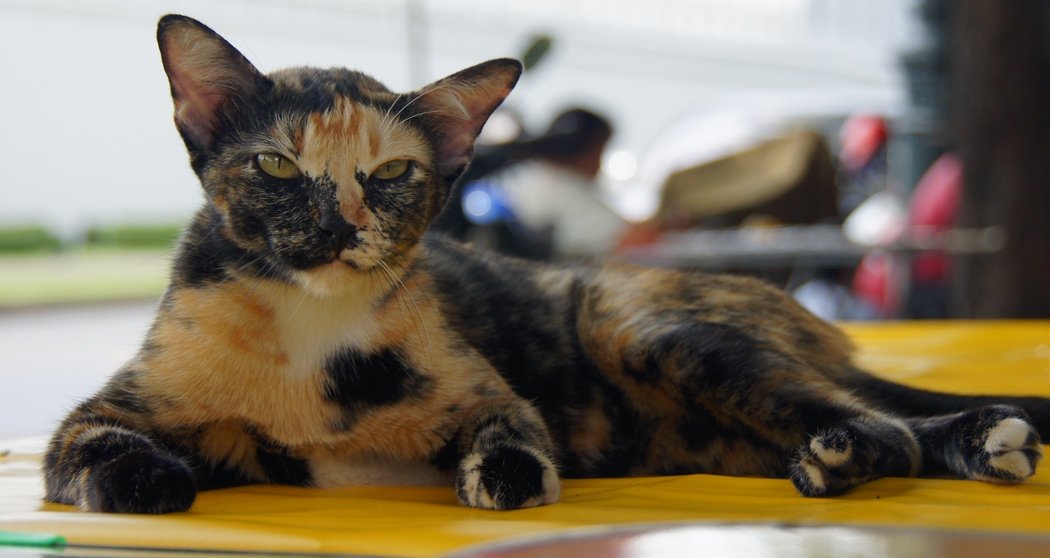
This multicoloured cat is lying on top of a restaurant table. I love how the Thai people are so relaxed about things and permit something like this to happen quite often.
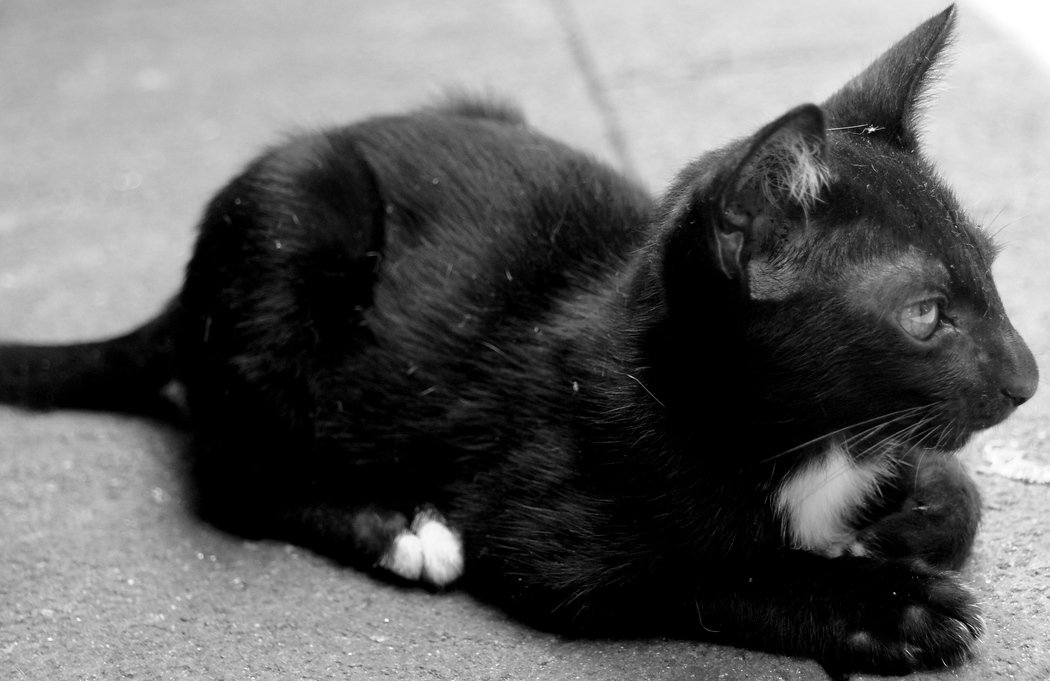
This kitten is just relaxing as it looks around.
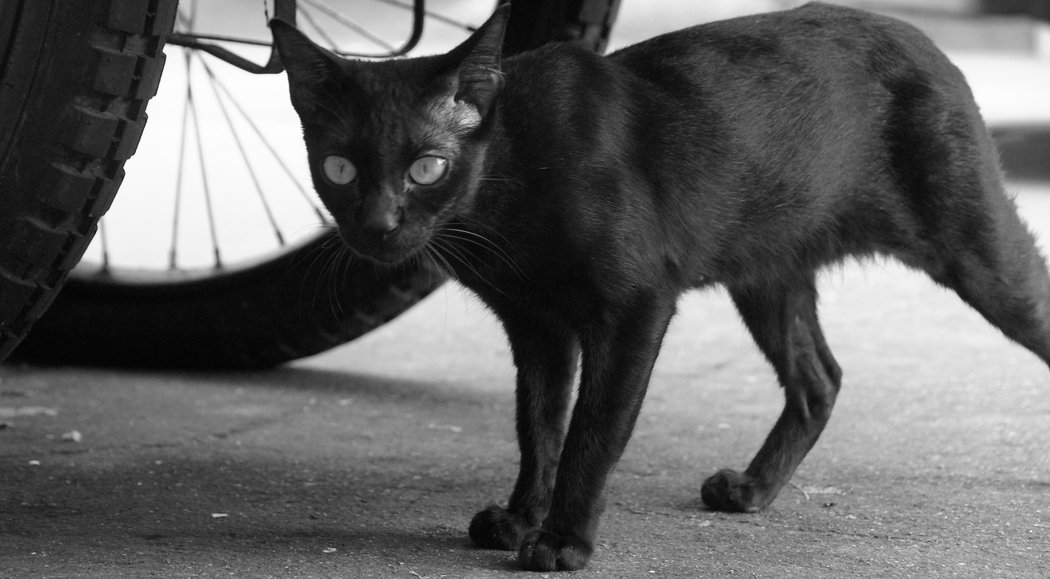
This scrawny-looking cat pauses briefly before suddenly dashing off under the bicycle.
Restaurants, markets and shopfronts blur the boundary between private and public space in Bangkok. Cats make themselves at home within that ambiguity. One might be sprawled across a table, another watching from beneath a bicycle and another moving between food stalls as if conducting an inspection nobody asked for.
That is part of what makes them so interesting to photograph. The cats are not separate from the city. They are wedged directly into it—between stools, scooters, bowls, baskets, wheels, feet and whatever food happens to be unattended for thirty seconds.
What Is a Soi Cat?
The Thai word soi refers to a side street or lane. “Soi cat” is therefore a convenient description for the cats encountered along Thailand’s streets, alleys, markets and neighbourhoods.
It is also a rather imprecise label. Seeing a cat outdoors does not tell you whether it is feral, abandoned, loosely owned or fed every evening by three different shopkeepers who each assume the other two are in charge.
A cat seen outdoors in Bangkok might be:
- An owned cat that is allowed to roam.
- A shop, restaurant or temple cat with a recognizable caretaker.
- A sociable community cat fed by several households or vendors.
- An abandoned former pet accustomed to human contact.
- A genuinely unsocialized feral cat that avoids close human interaction.
Bangkok Cat Society generally uses the term “community cats” for non-owned cats living within Bangkok’s neighbourhoods. I find that more useful than assuming every outdoor cat is completely on its own.
Many exist in a grey area. They may not belong to one household, yet they are recognized, fed and watched over by people living or working nearby. That informal support can be the difference between surviving and not surviving.
Still, a bowl outside a shop is not the same thing as veterinary care. Affection and leftovers can keep a cat going; they cannot sterilize it, vaccinate it or treat an infection.
Why Bangkok’s Cats Gather Around Markets, Temples and Shopfronts
The locations appearing in this photo essay make obvious sense from a cat’s perspective. Markets provide food smells, scraps and shelter beneath tables. Restaurants and shops offer shaded corners, familiar people and sometimes a dependable meal. Parked bicycles, boxes, chairs and awnings become places to hide or sleep.
A cat does not need a destination-management strategy. It needs food, water, shade and somewhere that does not currently contain a moving wheel.
Temples also support significant populations of free-roaming cats and dogs in parts of Thailand. Some animals are fed by monks, temple staff and nearby residents. Others have been left there by owners who assumed a religious community would absorb the responsibility.
That makes the reality more complicated than saying Buddhist compassion neatly explains Bangkok’s tolerance of street animals. Compassion is certainly part of the story. So are abandonment, limited resources and the uncomfortable human habit of transferring a problem to somebody who appears too kind to refuse it.
Temples can become places of refuge and community care, but they are not limitless animal shelters. Feeding dozens of animals is one challenge; providing sterilization, vaccines and veterinary treatment is another.
Animal-welfare groups have increasingly worked with temple communities to close that gap. In one Bangkok campaign at Wat Klong Toei Nok, FOUR PAWS, Bangkok Cat Society and Lanta Animal Welfare sterilized and vaccinated nearly 200 cats. Resident monks helped identify animals needing medical attention and encouraged people in the surrounding community to participate.
That is a far more honest picture of Bangkok’s relationship with its cats than a romantic claim that everybody simply lives in perfect harmony. Compassion exists. So does the hard, repetitive and expensive work required when compassion alone is not enough.
Thailand’s Older Cultural Relationship With Cats
Bangkok’s street cats should not be confused with Thailand’s recognized traditional breeds, but the country’s relationship with domestic cats stretches far beyond the modern city.
Historic Thai manuscripts commonly known as the Tamra Maew, or Cat Poems, described cats according to their physical characteristics and associated different types with fortune, status or misfortune. Apparently, long before the internet learned to assign personalities to cats based on one photograph, Thai manuscripts were already several centuries ahead of the game.
Among the best known is the Wichien Maat, the Thai cat from which the Western Siamese breed developed. The Royal Thai Embassy’s history of the Wichien Maat describes the breed’s place in Thai court life, ceremonies and diplomatic gifting.
The historic Thai type also differs from the increasingly slender modern Siamese developed through selective breeding outside Thailand. As often happens, something travels abroad, becomes more exaggerated and then returns looking vaguely surprised by what everybody has done to it.
None of that makes the cats in my Bangkok photographs rare royal descendants. Most appear to be ordinary mixed cats occupying ordinary urban spaces. Still, the older manuscripts offer useful context: cats have been noticed, categorized, valued and incorporated into Thai beliefs for centuries. The fascination did not begin with cat cafés, Instagram or people dressing reluctant pets in tiny hats.
The Charm and Hardship of Bangkok’s Street Cats
It is tempting to romanticize soi cats. They are remarkably photogenic. They sleep in unlikely places, patrol fish stalls with exaggerated seriousness and appear capable of ignoring Bangkok’s chaos better than any traveller I have met.
I am not immune to any of this. Give me a cat, a market and an expression of mild feline contempt and I will probably take far too many photographs.
But resilience is not the same as comfort.
Life outdoors exposes cats to traffic, parasites, infectious disease, territorial fights, pregnancy, extreme heat and inconsistent access to food or medical treatment. The healthier animals in this essay may have had people looking after them. The thin and rough-looking cats may have been surviving with very little support.
There is no honest reason to flatten those different situations into one cheerful story about Bangkok’s feline charm. The cats can be funny, beautiful and deeply woven into neighbourhood life while also facing conditions we should not romanticize.
A community cat can be a loved local character and still lack the security of a permanent home. A cat can look perfectly relaxed on a table while remaining unvaccinated or unsterilized. Feeding can ease hunger without addressing the next litter of kittens or an untreated infection.
That is why established welfare groups concentrate so heavily on population management and veterinary care rather than trying to place every visible street cat into a shelter. The less emotionally satisfying answer is often the more useful one.
What Bangkok Cat-Welfare Programs Actually Do
One of the main approaches is usually called TNR or TNVR: trap or catch, neuter, vaccinate and return. Suitable community cats are humanely caught, sterilized, vaccinated where the program includes it, allowed to recover and returned to the territory they already know.
This does not produce a dramatic overnight disappearance of street cats. There is no satisfying montage in which every problem is solved before the music finishes.
It is slow work designed to prevent new litters, improve the health of established colonies and reduce suffering over time. It also requires cooperation from the people who feed and recognize the cats locally. Without that neighbourhood knowledge, even finding the right animals can become difficult.
Bangkok Cat Society combines sterilization with medical treatment, rescue and community education. Soi Dog Foundation’s large-scale CNVR work addresses homeless dogs and cats through sterilization and vaccination, alongside rescue, treatment and adoption for animals that cannot safely return to the street.
The distinction matters. Rescue is essential for an injured cat, an abandoned kitten or an animal unable to survive outside. But shelters and adopters cannot absorb every community cat in a city the size of Bangkok. Humane population management deals with the larger cycle rather than waiting until every new litter becomes a fresh emergency.
It is not as immediately heart-warming as taking one photogenic kitten home. It is also far more likely to improve conditions for thousands of cats that will never become somebody’s pet.
Bangkok Cat-Welfare Resources
- Bangkok Cat Society: A Bangkok-focused organization supporting community-cat sterilization, medical care, rescue and education.
- Soi Dog Foundation: A Thailand-based organization working on large-scale sterilization and vaccination, medical treatment, rescue, rehabilitation and adoption for homeless dogs and cats.
- FOUR PAWS in Thailand: Works with local partners on sterilization, vaccination and community outreach, including projects involving temple cats.
Photographing Soi Cats Without Turning Them Into Props
Cats are compelling photography subjects because they can switch from complete stillness to sudden movement without warning. That unpredictability is also why patience matters more than an elaborate bag of camera equipment.
My favourite photographs in this collection are not necessarily the closest portraits. They are the frames where the cat remains part of Bangkok: reaching toward fish at a market, sleeping beneath a table, watching me beside a bicycle or emerging from the clutter of a nighttime street.
A perfectly sharp cat against a meaningless background is still just a perfectly sharp cat. Include the scooters, stools, signs, food stalls and strange little corners and the photograph starts to say something about Bangkok.
A few principles make photographing street cats both more respectful and more visually interesting:
- Slow down before approaching. Walking directly at an unfamiliar cat can cause it to flee before you have even raised the camera.
- Let the cat notice you. If it relaxes, resumes grooming or returns to sleep, you can usually photograph without pushing closer.
- Watch the whole body. Flattened or rotated ears, a tightly crouched posture, a tucked tail, hissing or an attempt to retreat all mean it is time to back away.
- Photograph from the cat’s level. A lower angle makes the image more intimate and reveals the surrounding street from the animal’s perspective.
- Keep enough of Bangkok in the frame. Market tables, scooters, signs, chairs, food stalls and shopfronts turn a generic cat portrait into a photograph about place.
- Never chase or corner an animal for a photograph. A missed frame is less important than adding stress to a cat already living in a difficult environment.
- Ask when a cat clearly belongs to a business or household. A quick gesture toward the camera is preferable when an owner, vendor or customer will also appear in the image.
International Cat Care emphasizes interpreting ears, eyes, whiskers, tail and posture together rather than treating one movement as a complete emotional diagnosis.
The practical lesson for a photographer is simpler: pay attention, avoid forcing proximity and stop before the cat has to defend its space. There will always be another cat. This is Bangkok, after all.
Is It Safe to Touch Bangkok’s Stray Cats?
The safest choice is to admire unfamiliar street animals without touching or picking them up. I know this is not what a committed cat person necessarily wants to hear. The existence of a visible cat can make otherwise sensible adults behave as though they have been personally invited to initiate contact.
A sociable cat may approach you, but friendliness does not reveal its vaccination history or guarantee that it will remain comfortable with contact. Street cats are still animals with unknown health histories, and even a playful scratch can become medically important.
Rabies vaccination campaigns have greatly reduced the disease in Thailand, but the risk has not disappeared completely. Travellers who expect frequent contact with animals, work with them or may have difficulty reaching appropriate treatment should discuss pre-exposure rabies vaccination with a qualified travel-health professional before departure.
What to Do After a Bite or Scratch
If an unfamiliar cat bites or scratches you, immediately wash and flush the wound thoroughly with soap and running water for at least 15 minutes. Then seek urgent medical assessment for rabies post-exposure treatment. Do not wait for symptoms and do not assume a small scratch is automatically harmless.
Previous rabies vaccination simplifies parts of post-exposure treatment but does not eliminate the need to obtain medical care after a possible exposure. Current guidance should always come from a medical professional and authoritative public-health sources such as the CDC’s Thailand travel-health page and the World Health Organization’s rabies guidance.
How Visitors Can Help Bangkok’s Cats Responsibly
It is natural to want to help a hungry or injured cat, especially when you are already an animal lover. The challenge is making sure a well-intentioned action does not interfere with people who know the local colony or create a problem that ends as soon as you leave Bangkok.
I understand the emotional pull of buying food for the cat directly in front of you. It feels immediate, tangible and considerably more satisfying than donating toward sterilization work you will never personally witness. Unfortunately, the less cinematic option is often the one that does more good.
- Support established organizations. Donations toward sterilization, vaccination and medical care usually have a longer-lasting effect than purchasing one improvised meal.
- Look for an existing caretaker. Bowls, bedding or cats gathering at a particular shop may indicate that somebody already manages the group.
- Ask before feeding a known colony. Regular caretakers may be following a feeding schedule or trying to trap a particular cat for treatment.
- Do not feed spicy leftovers or cooked bones. Plain commercial cat food and clean water are more appropriate when feeding has been cleared with the people caring for the animals.
- Do not relocate a healthy-looking cat impulsively. A cat that appears ownerless may know the territory, belong to a nearby household or rely on several established caretakers.
- Contact a local rescue about an injured animal. Attempting to catch a frightened or badly hurt cat without suitable equipment can endanger both you and the animal.
- Treat adoption as a long-term commitment. International adoption requires time, veterinary work, airline arrangements and compliance with the destination country’s import rules. It is not something to improvise on the way to the airport.
A short-term visitor cannot solve Bangkok’s community-cat population. Supporting the people doing the unglamorous work year after year—sterilizing, vaccinating, treating and educating—is a realistic way to contribute.
You may not leave with a dramatic rescue story. You may simply have helped fund one surgery, one vaccination or one animal’s medical treatment. That is not insignificant.
Final Thoughts on the Cats of Bangkok
Bangkok is an intense city. Traffic surges past, vendors prepare food, people squeeze through narrow lanes and seemingly every available surface has already been claimed by something. The cats create little pockets of stillness within all of that motion.
They stretch across tables, sleep beneath chairs and watch the surrounding chaos with expressions ranging from suspicious to profoundly unimpressed. Then a fish appears and all that carefully cultivated dignity disappears.
That humour is part of why I kept pointing my camera at them. Cats are naturally good at turning a completely ordinary scene into something worth stopping for. They are also very good at making the photographer feel faintly ridiculous for caring so much.
But the thinner cats in this collection are just as important as the comfortable ones. Together, the photographs show a spectrum ranging from apparently cared-for domestic cats to animals whose daily survival looked considerably less certain.
I still have a soft spot for cats, and I still envy their ability to make almost any table, pavement or patch of shade look comfortable. Photographing Bangkok’s soi cats gave me another way of observing a city I already found endlessly compelling—not from its rooftops or grandest monuments, but from much closer to the ground.
More Street Photography and Photo Essays
If you enjoyed looking at Bangkok through its smaller street-level moments, you may also enjoy these Nomadic Samuel travel and photography stories:
- Insadong Cultural Street in Seoul, South Korea
- Ten Things to Do in Lombardy, Italy
- The Top 100 Travel Blogs of the 2010s Archive, documenting the wider independent travel-blogging era in which many of these early photo essays were created.
It takes a special man to love cats. Great photos!
It does! One sure has to work to earn affection from kitties.
A photo essay with cats! You just put a smile on my face. It will stay there for the rest of the evening. Thank you.
Thanks Laura, glad to see so many cat lovers out there 🙂
There are so many beautiful cats in Thailand…nice captures.
I’ve just arrived back in Korea via Thailand and Spain. The first thing I did was pick up Indy (my cat)!
Oh I love cats!!! Even the stray ones. Love this post!
Glad to hear that as a fellow cat lover 🙂
That multicoloured cat is RAD looking!
It is pretty rad!
Do You realy think these are a beautiful cats?! Jast look at the real beautiful cat: http://victortravelblog.com/2011/11/27/the-same-face/
I did come over and take a look – one beautiful kitty, no doubt 🙂
There are a lot of stray cats in the city I live in. The photos of the cats are similar to what the cats I usually see. Often when I eat in the streets these cats are waiting eagerly to share what I have. I already have four cats and I can’t afford to adopt anymore.
Hey Maria, that’s totally understandable. With 4 at home you’re certainly a cat lover!
It is hard to see these cute creatures to have no home or owner. As pets, they are used to just lying around, staying clean and waiting to be fed. It is amazing how they are fit for survival even without anyone to care for them.
Sharon, I agree with! I think of the spoiled cat back home with parents. It actually rejects certain cat food to hold out for something better 😛 Some of these cats would eat just about anything.
Way to go right for the soft spot. Absolutely adorable. Love the different colored lighting in a number of the shots.
Thanks Alex 🙂 It’s quite a random gallery!
I heart cats … seeing these photos makes me want to rush to Thailand and bring them home with me. So cute!
You’d have a lot to bring back 🙂
Aww I love cats. When I was in Asia I would oftan have a kitty just jump up and enjoy a nap on my lap. Makes me so happy 😀
I’ve also had similar experiences. I find being around animals makes me feel more calm and at ease.
I just love the kittehs on my travels … some saunter over for a good rubdown when called, others skitter away, running for their lives (usually the feral ones imo)!
That’s very true James!
I have a bad habit of trying to pet stray cats (and dogs, to be honest) in other countries. I almost got my hand bitten by a cat in the Colosseum once, but that hasn’t stopped me! Rabies, shmabies. 😛
LOL, I’m the same way Christy. I ought to be more careful but never am 😛
Cats are awesome. This is the second cat themed post I’ve seen this week (was there a memo I missed?) and I’m loving them 😀
LOL, are you going to make a third one?
The only pictures I have are of various cats I’ve owned, and I always seem to get the flash wrong so they have giant glowing eyes. So unless the post is titled “Vampire Cats from the Netherworlds”.. it seems unlikely 😉
LOL, that might actually make for a clever post…don’t discount it 😛
OMG! They are so cute! I’m a sucker for cats, therefore I really appreciate this post.
Glad you liked it Laura 🙂
While I don’t share your fondness for Bangkok, I do love cats. These are excellent pictures! We saw quite a few cats while wandering around Thailand ourselves!
Shanna, you bring up a great point that the cats aren’t just exclusive to Bangkok. I could do a whole other gallery on the cats of Chiang Mai 😛
Thanks to you I just want to book it to Thailand now to cuddle cats. Lots of cats. Is that weird? Think my favourite shot was the “late at night” cat.
LOL, that’s not too weird although maybe a bit hard to justify the cost of the plane ticket 😛
I LOVE this!!! I have to little kits and this post just made me so happy. These cats are gorgeous!
Thanks D! I bet your kits are adorable 🙂
Awwww :)… that’s all I’m saying
LOL, you’re a cat lover as well? 🙂
The black and white asleep under the table reminds me almost exactly of the cat we had when I was a kid.
Oh, that’s cool! Must bring back good memories for you.
Fascinating some of the cats look like the egyptian hairless with fur?
They do! I agree with you.
I’d be tempted to bring one home. Seriously. I adopted a street dog in Kenya.
I felt like doing that myself 🙂
Do you ever try to pet them? We’ve found the cats in some countries to be really friendly (like in Jordan) and others will claw you to death if you touch them (like in Turkey).
I was able to pet some of them. I find with cats you can kind of sense from their body language and disposition whether or not to try it 🙂
Love cats! And so photogenic, aren’t they?
Thanks Sophie, I agree with you- adorable and photogenic. When, or if I become semi-nomadic I’ll have a cat again as a pet.